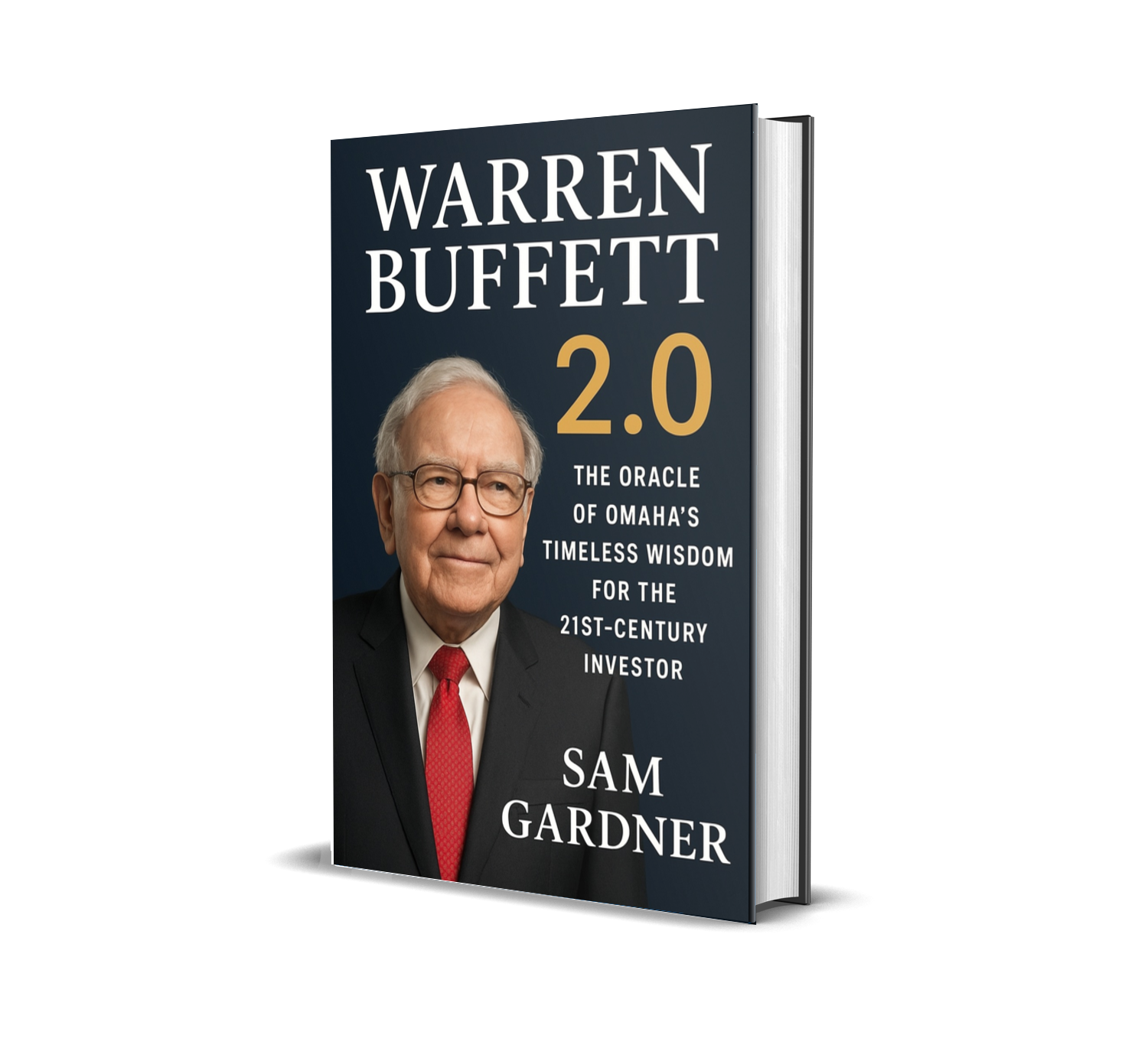
About the Book ‘Warren Buffett 2.0‘
| PDf Name | Warren Buffett 2.0 |
| Author | Sam Gardner |
| Genre | Biograpgy |
| Language | English |
| Pages | 281 Pages |
| File Size | 2.22MB |
| Format | Free PDF Download |
Warren Buffett 2.0 Free PDF Dwonload
Loading Viewer...
Why Read This Book, ‘Warren Buffett 2.0’
The world of investing has changed. The principles of intelligent investing have not.
Artificial intelligence, cryptocurrencies, algorithmic trading, digital platforms, social-media-driven speculation, and intangible assets have transformed the investment landscape. Investors today have access to more information than ever before—and yet, that abundance of information can make rational decision-making more difficult.
So, where does Warren Buffett’s philosophy fit into this new world?
Warren Buffett 2.0 explores that question and offers a compelling answer: Buffett’s greatest contribution was never a list of stocks to buy. It was a way of thinking.
This book takes the timeless principles associated with Warren Buffett and Charlie Munger—value, economic moats, margin of safety, compounding, circle of competence, rationality, patience, discipline, and long-term ownership—and examines how those principles can be interpreted and applied in the 21st-century economy.
Because Modern Investing Is Full of Noise
Investors today are surrounded by breaking news, financial influencers, market alerts, social-media commentary, algorithmic trading, and endless opinions. The challenge is no longer simply finding information. It is determining what information actually matters.
This book explores how to develop an information filter, reduce emotional distractions, and concentrate on the underlying economics of a business rather than becoming obsessed with short-term price movements.
Because Buffett’s Ideas Need a 21st-Century Translation
The companies defining today’s economy may look very different from the businesses Buffett traditionally studied. Software, platforms, data, artificial intelligence, biotechnology, cloud computing, and network effects can be difficult to evaluate using traditional intuition.
Warren Buffett 2.0 examines how concepts such as economic moats, margin of safety, and circle of competence can be extended to businesses whose most valuable assets may be intangible rather than physical.
The objective is not to abandon Buffett’s framework because the world has changed—but to understand its underlying logic well enough to apply it to new circumstances.
Because You Need to Understand Economic Moats
A company’s competitive advantage may no longer come only from factories, distribution networks, or recognizable consumer brands.
Modern competitive advantages can emerge from:
- Network effects
- Data
- Ecosystems
- Technology
- Brand loyalty
- Switching costs
- Scale
- Platform economics
The book develops a Tech Moat Analysis designed to help readers distinguish businesses with potentially durable competitive advantages from companies benefiting primarily from temporary enthusiasm or hype.
Because Information Is Not the Same as Understanding
Having thousands of financial websites, dashboards, videos, analysts, and social-media feeds does not automatically make an investor better informed.
The deeper advantage comes from learning how to process information intelligently.
This book emphasizes the development of judgment, intellectual discipline, and the ability to separate signal from noise. Its central message is that in an information-saturated world, clarity itself can become a competitive advantage.
Because Patience Is Becoming More Difficult—and More Valuable
Modern markets encourage constant activity. Prices move every second. Notifications arrive continuously. Investors are constantly exposed to the fear of missing the next opportunity.
That environment can make patience feel like inactivity.
This book challenges that assumption and explores the strategic value of doing nothing when there is nothing intelligent to do. It examines how an investor can develop an internal scorecard and maintain rationality when everyone else is reacting emotionally.
Because AI and Crypto Demand Rational Questions
Artificial intelligence and digital assets represent some of the most important—and controversial—developments in modern finance.
Rather than simply dismissing them as speculation or embracing them because they are fashionable, the book proposes a more disciplined approach.
Ask:
- What problem does the technology solve?
- Can its economics be understood?
- Does it possess a durable competitive advantage?
- Is its valuation connected to economic reality?
- Is the opportunity transformative—or merely speculative?
The book applies a Buffett-inspired analytical lens to modern technologies rather than relying on either blind enthusiasm or reflexive rejection.
Because Knowing When to Sell Matters
Investing is not only about knowing what to buy. It is also about recognizing when the original investment thesis has changed.
Warren Buffett 2.0 introduces an updated framework that considers potential warning signs such as an eroding competitive moat, deteriorating corporate culture, and valuations that become disconnected from future cash flows.
The goal is to make selling a matter of disciplined reasoning rather than panic, boredom, fear, or excitement.
Because Compounding Requires More Than Money
One of the book’s deeper ideas is that Buffett’s philosophy can extend beyond the stock market.
Your skills, knowledge, health, relationships, time, and energy are also forms of capital.
The book develops the idea of becoming the CEO of your own human capital—building your own “conglomerate of one” by allocating your limited resources intelligently and thinking about the long-term consequences of today’s decisions.
In that sense, the book is not only about building a better portfolio. It is about developing a better decision-making system for life.
Because You Don’t Need to Become Warren Buffett
You cannot replicate Warren Buffett’s exact circumstances, career, resources, or results.
And you don’t need to.
The purpose of this book is to understand the quality of thinking behind his success and adapt those mental models to your own circumstances.
Whether you are building your first investment portfolio, running a business, studying technology, managing your career, or simply trying to make better long-term decisions, the underlying principles can provide a useful framework.
Who Should Read This Book?
Warren Buffett 2.0 is particularly suited to:
- New investors who want to build a rational long-term mindset.
- Experienced investors wondering how traditional value principles apply to modern businesses.
- Professionals building their first portfolio.
- Technology-focused readers who want to understand AI, blockchain, and digital businesses through an investment framework.
- Entrepreneurs and business owners interested in competitive advantage and capital allocation.
- Readers who want to understand Buffett and Munger beyond famous quotations.
- Anyone seeking greater rationality, patience, discipline, and intellectual honesty in financial decision-making.
This Is Not a Get-Rich-Quick Book
You will not find promises of instant wealth, secret stock tips, market-timing formulas, or shortcuts to guaranteed returns.
Instead, this book advocates something slower and more demanding:
Understand the business.
Understand the economics.
Understand the risks.
Know your circle of competence.
Demand a margin of safety.
Control your emotions.
Think independently.
Let time and compounding do their work.
That approach may be less exciting than chasing the latest market sensation—but the book argues that its very lack