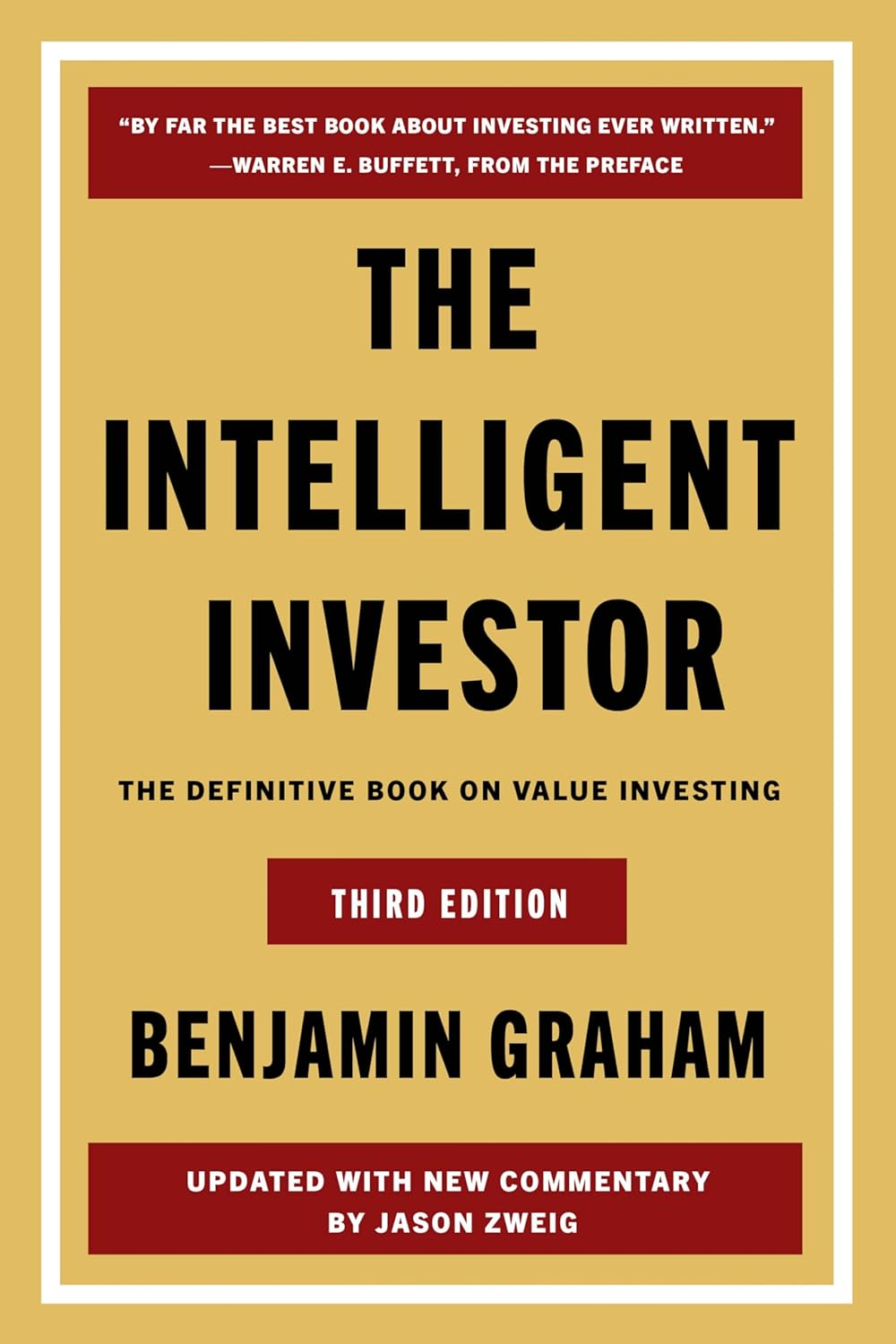
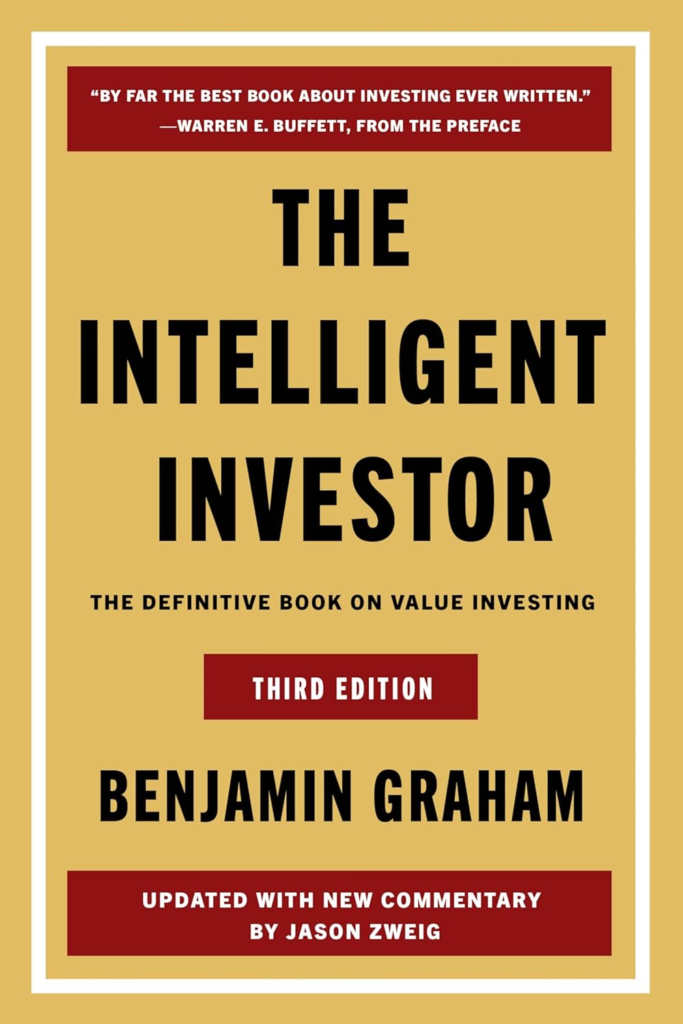
The Intelligent Investor: A Book of Practical Counsel is an investment book by Benjamin Graham, first published in 1949. It is one of the foundational works of value investing and focuses on the principles of disciplined security analysis, long-term investing, diversification, risk management, and emotional control.
Rather than presenting investing as a contest to predict the next market movement, Graham approaches it as a problem of decision-making under uncertainty. His central distinction is between the underlying value of a business and the price at which that business happens to be offered in the market.
The book has undergone several revisions. Graham’s fourth and final edition was published in 1973, shortly before his death. Later editions incorporated commentary and explanatory notes by financial journalist Jason Zweig, while the fourth edition included a preface and appendix by investor Warren Buffett. The modern revised edition therefore combines Graham’s original framework with commentary intended to place his ideas in a more contemporary context.
Infobox
| The Intelligent Investor | |
|---|---|
| Author | Benjamin Graham |
| Original title | The Intelligent Investor: A Book of Practical Counsel |
| Language | English |
| Subject | Investing, securities analysis, value investing |
| First published | 1949 |
| Original publisher | Harper & Brothers |
| Country | United States |
| Original edition | 1949 |
| Final Graham revision | 1973 |
| Modern revised editions | With commentary by Jason Zweig |
| Notable contributor | Warren E. Buffett |
| Principal concepts | Value investing, margin of safety, Mr. Market, defensive investing, enterprising investing |
| Related work | Security Analysis |
| Field | Finance and investment |
Overview
The Intelligent Investor is not primarily a book about choosing individual stocks. Its broader subject is how an investor should think.
Graham wrote at a time when financial markets had already experienced extraordinary booms and crashes, including the Wall Street crash of 1929 and the Great Depression. His investment philosophy consequently places unusual emphasis on protecting capital, controlling emotion, analyzing financial statements, and refusing to confuse market quotations with permanent economic value.
The book distinguishes between an investor and a speculator.
For Graham, an investor does not simply buy an asset because its price is rising. An investment decision requires an examination of the underlying security, an assessment of the return that can reasonably be expected, and an effort to limit the possibility of permanent loss.
This makes the book fundamentally different from books that concentrate on market forecasting.
Its message can be reduced to a simple intellectual framework:
Study the security → estimate value and risk → demand a margin of safety → diversify → remain disciplined.
Benjamin Graham
Early life
Benjamin Graham was born Benjamin Grossbaum on May 9, 1894, in London, England. His family later moved to the United States.
Graham graduated from Columbia College in 1914, where he was the salutatorian of his class. Although he received opportunities to teach several subjects, financial circumstances led him to begin his professional career on Wall Street.
He eventually became one of the most influential figures in twentieth-century investment analysis.
Columbia University identifies Graham as a member of its faculty beginning in 1928 and credits him with helping establish systematic approaches to security analysis. He later taught generations of students, including Warren Buffett.
Graham and security analysis
Graham’s intellectual importance extends beyond The Intelligent Investor.
In 1934, he and David Dodd published Security Analysis. The book attempted to establish a systematic framework for evaluating securities rather than relying primarily on speculation, market sentiment, or financial fashion.
This approach helped establish what later became known as value investing.
Graham’s work emphasized the idea that an investor should ask:
- What does the business actually own?
- How much does it earn?
- How much debt does it carry?
- What has its earnings history looked like?
- What price am I paying?
- What could go wrong?
- Is there enough of a discount to protect me if my assumptions are wrong?
This distinction between price and value became one of the defining ideas of his career.
Graham at Columbia
Graham joined Columbia’s faculty in 1928 and taught investment analysis for many years.
One of his most famous students was Warren Buffett, who studied under Graham at Columbia Business School.
Buffett later became one of Graham’s most prominent intellectual descendants, although Buffett’s investment philosophy eventually developed beyond Graham’s original emphasis on statistically cheap securities toward the purchase of high-quality businesses at reasonable prices.
Graham also influenced investors such as Walter Schloss and Irving Kahn.
Columbia describes Graham as a major figure in the development of modern security analysis and records the lasting influence of his teaching on investors who followed him.
Publication history
The Intelligent Investor was first published in 1949.
Graham subsequently revised the work several times. The fourth revised edition, published in 1973, became the final edition prepared during his lifetime.
The 1973 edition included a preface and appendix by Warren Buffett.
After Graham’s death in 1976, later editions retained the basic Graham text while adding contemporary commentary.
The widely circulated revised edition associated with Jason Zweig added commentary intended to connect Graham’s original examples and principles with later market developments.
A further revised edition was published by Harper Business in 2024. Bibliographic records identify it as a 640-page edition carrying the Graham/Zweig authorship and updated publication information.
Why the book was written
Graham’s central concern was that ordinary investors frequently make decisions for the wrong reasons.
A stock rises, and they buy because it is rising.
A stock falls, and they sell because they fear it will fall further.
A famous company becomes fashionable, and they assume that a famous company must automatically be a good investment at any price.
Graham challenged this psychology.
His approach starts from a different question:
What is the security worth, and how does that compare with its current market price?
The investor’s job is therefore not to predict every movement of the market.
It is to make decisions in which the relationship between price, value, risk and expected return is favorable enough to justify committing capital.
The central philosophy of the book
The philosophy of The Intelligent Investor can be represented by five interconnected ideas.
1. Investment is different from speculation
An investment requires analysis and a rational basis for expecting an adequate return.
Speculation depends much more heavily on expectations about future price movements.
2. Price is not the same as value
A quoted market price is simply the price at which securities can currently be bought or sold.
It is not necessarily an accurate measure of the underlying economic value of the business.
3. The margin of safety matters
Because investors cannot know the future with certainty, they should avoid paying prices that require everything to go according to plan.
A discount between estimated value and purchase price provides a buffer against error.
4. The investor must control behavior
Fear, greed, excitement, impatience and overconfidence can undermine otherwise sound analysis.
5. The appropriate strategy depends on the investor
Graham distinguishes between the defensive investor, who wants simplicity and protection, and the enterprising investor, who is prepared to devote greater effort to security selection and analysis.
Investor versus speculator
One of Graham’s most important contributions is his attempt to separate investing from speculation.
Investment
Graham’s conception of investment involves:
- analysis;
- protection of principal;
- an adequate expected return;
- and a disciplined basis for decision-making.
Speculation
Speculation focuses more heavily on what an asset’s market price might do in the future.
Speculation is not necessarily presented as something that can simply be eliminated from financial markets. Instead, Graham argues that investors should recognize when they are speculating rather than pretending that speculation is investment.
The distinction
| Investment | Speculation |
|---|---|
| Based on analysis | Often based on expectations |
| Focuses on value and return | Focuses heavily on price movement |
| Considers downside risk | May emphasize upside |
| Uses a margin of safety | Often depends on forecasts |
| Requires discipline | Can become emotionally driven |
| Usually longer-term in orientation | May be short- or medium-term |
The distinction is particularly important because the same security can be an investment at one price and a speculative purchase at another.
The concept of intrinsic value
One of Graham’s most influential ideas is intrinsic value.
Intrinsic value refers broadly to an estimate of what a security is fundamentally worth based on factors such as:
- assets;
- earnings;
- dividends;
- financial strength;
- earning power;
- business prospects;
- and other economic characteristics.
Graham did not treat intrinsic value as an exact number.
It is better understood as an estimate.
This is important because investment analysis is inherently uncertain.
Suppose an investor estimates that a company is worth approximately $100 per share.
Buying at $99 provides little protection if the estimate is wrong.
Buying at $65 creates a larger gap between estimated value and market price.
That gap is the foundation of Graham’s margin of safety.
Margin of safety
The margin of safety is arguably the most important practical principle in The Intelligent Investor.
It can be illustrated as:
Estimated Intrinsic Value
          $100
           │
           │  ← Margin of Safety
           │
           ▼
Purchase Price
           $65
The investor does not assume that the valuation estimate is perfectly accurate.
Instead, the investor attempts to buy sufficiently below estimated value that mistakes, unexpected events, or unfavorable developments do not automatically turn the investment into a permanent loss.
Simplified formula
Margin of Safety ≈ Intrinsic Value − Purchase Price
A more useful conceptual expression is:
Margin of Safety % ≈ (Intrinsic Value − Market Price) ÷ Intrinsic Value × 100
For example:
- Estimated value = $100
- Market price = $70
- Difference = $30
- Margin of safety = approximately 30%
This is only an illustration. Real-world valuation is considerably more complicated.
Mr. Market
One of Graham’s most famous teaching devices is Mr. Market.
Imagine that you own part of a private business with a partner named Mr. Market.
Every day, Mr. Market offers to buy your share or sell you his share.
The problem is that Mr. Market is extremely emotional.
On some days he is optimistic and offers an extremely high price.
On other days he becomes pessimistic and offers an extremely low price.
You do not have to agree with him.
You can simply ignore his quotation when it is unattractive.
This metaphor captures one of Graham’s deepest lessons:
The market provides prices; it does not dictate decisions.
The investor should use the market rather than become psychologically controlled by it.
Mr. Market infographic
                    MR. MARKET
                         │
          ┌──────────────┴──────────────┐
          │                             │
      OPTIMISM                       PESSIMISM
          │                             │
      "Buy! Buy!"                  "Everything is doomed!"
          │                             │
      High prices                   Low prices
          │                             │
          └──────────────┬──────────────┘
                         │
                         ▼
                INTELLIGENT INVESTOR
                         │
                         ▼
             "What is the business worth?"
The market’s mood changes.
The investor’s analytical framework should not change merely because the market is emotional.
Defensive investor
Graham divides investors broadly into two categories.
The first is the defensive investor.
The defensive investor wants to achieve a reasonable result without spending enormous amounts of time analyzing individual securities.
For such an investor, Graham emphasizes:
- diversification;
- quality;
- financial strength;
- avoidance of excessive valuation;
- appropriate allocation between stocks and bonds;
- and simplicity.
The defensive investor is not necessarily less intelligent.
The strategy simply recognizes that most people do not want investing to become a full-time occupation.
Enterprising investor
The second category is the enterprising investor.
This investor is willing to spend considerably more time and effort searching for opportunities.
The enterprising investor may examine:
- undervalued securities;
- unusual corporate situations;
- companies temporarily out of favor;
- special situations;
- financial statements;
- balance sheets;
- earnings records;
- and securities that require more detailed analysis.
The key distinction is effort.
An investor who chooses the enterprising approach must actually be willing to do the work.
Simply buying volatile stocks does not make someone an enterprising investor.
The two-investor framework
                 INVESTOR
                    │
          ┌─────────┴─────────┐
          │                   │
      DEFENSIVE           ENTERPRISING
          │                   │
      Simplicity           More analysis
      Diversification      More research
      Lower effort         Higher effort
      Broad exposure       Select opportunities
      Risk control         Mispricing analysis
This framework remains one of the book’s most practical contributions because it acknowledges that investment strategy must fit the investor’s time, knowledge, temperament and resources.
Stocks and bonds
Graham does not treat common stocks as universally superior to bonds.
Instead, he considers portfolio construction as a matter of balancing:
- income;
- capital preservation;
- growth;
- inflation;
- valuation;
- and risk.
The book historically discusses combinations of stocks and bonds rather than assuming that one asset class should always dominate.
The exact allocation appropriate for an investor depends on circumstances, and Graham’s historical examples should not be mechanically transplanted into modern markets.
Diversification
Diversification is another important pillar of Graham’s philosophy.
The fundamental reason for diversification is simple:
No investment thesis is guaranteed to be correct.
Even careful analysis can fail.
A diversified portfolio reduces the damage caused when a particular security performs badly.
This leads to an important distinction:
Diversification is not a substitute for analysis, but analysis is not a substitute for diversification.
An investor can be completely correct about nine companies and completely wrong about the tenth.
Concentration can magnify both success and failure.
Inflation
Graham devotes attention to inflation because the purchasing power of money can decline over time.
For investors, the relevant question is not simply:
“How much money did I make?”
It is:
“How much purchasing power did my investment actually preserve or create?”
For example, a nominal return of 5% is not equivalent to a real return of 5% if inflation is also significant.
The book therefore encourages investors to think in terms of real economic returns, not merely changes in nominal prices.
Market history
Graham includes historical market analysis to demonstrate how dramatically valuations and investor sentiment can change.
The historical sections are important because they show that markets can experience:
- prolonged optimism;
- extreme pessimism;
- speculative bubbles;
- crashes;
- recoveries;
- and periods of unusually high or low valuations.
The lesson is not that history will repeat itself exactly.
Rather, history demonstrates that investors repeatedly make similar psychological mistakes in different forms.
Earnings and financial statements
Graham’s investment method places considerable importance on financial information.
An investor examining a company should consider factors such as:
Income statement
- Revenue
- Operating profit
- Net income
- Earnings history
Balance sheet
- Cash
- Assets
- Liabilities
- Debt
- Working capital
- Net tangible assets
Cash generation
- Operating cash flow
- Capital expenditure
- Free cash flow
- Dividend capacity
Valuation
- Price-to-earnings ratio
- Price-to-book ratio
- Enterprise value
- Earnings yield
- Dividend yield
These metrics should not be treated as isolated numbers.
Their usefulness depends on the business, industry, accounting quality and economic environment.
The importance of price
A central lesson of Graham’s work is:
A good company is not automatically a good investment at every price.
Consider two hypothetical investors.
Investor A
Buys an excellent company at an extremely high valuation.
Investor B
Buys an ordinary but financially sound company at a substantial discount to its estimated value.
Graham’s framework asks us to evaluate not merely the quality of the company, but the relationship between quality, price and expected return.
This is one reason the book remains fundamentally different from a simple “buy great companies” philosophy.
The intelligent investor’s mental model
The book can be visualized as a decision system:
                 MARKET PRICE
                       │
                       ▼
               BUSINESS ANALYSIS
                       │
                       ▼
               ESTIMATED VALUE
                       │
                       ▼
              COMPARE VALUE & PRICE
                       │
             ┌─────────┴─────────┐
             │                   │
        Price attractive     Price excessive
             │                   │
             ▼                   ▼
      MARGIN OF SAFETY          WAIT
             │
             ▼
       DIVERSIFICATION
             │
             ▼
        HOLD DISCIPLINED
             │
             ▼
        REVIEW THESIS
The most important step is perhaps the final one.
An intelligent investor must distinguish between:
“The market price has fallen.”
and
“My original investment thesis has been proven wrong.”
They are not the same thing.
Emotional discipline
Graham’s investment philosophy is partly a philosophy of human behavior.
Investors commonly experience:
- fear;
- greed;
- FOMO;
- impatience;
- regret;
- overconfidence;
- confirmation bias;
- loss aversion;
- herd behavior.
A market decline can make a fundamentally sound investment appear disastrous.
A rapidly rising stock can make an expensive investment appear safe.
Graham’s solution is not to eliminate emotions completely.
Instead, he attempts to create an investment process that prevents emotions from automatically controlling decisions.
The psychology of loss
One of the most important distinctions in investing is between:
Temporary price decline
and
Permanent loss of capital
A stock falling from $100 to $70 does not automatically mean that $30 of economic value has permanently disappeared.
Likewise, a stock rising from $100 to $150 does not prove that the underlying business has become 50% more valuable.
The investor therefore has to examine the business rather than merely reacting to the quotation.
A simple Graham-style checklist
A simplified modern checklist inspired by Graham’s philosophy might look like this:
Business
- Do I understand what the company does?
- Does it have a durable economic position?
- Is its business model understandable?
Financial strength
- Does it have manageable debt?
- Does it generate cash?
- Does it have adequate liquidity?
Earnings
- Are earnings reasonably consistent?
- Are profits supported by the underlying business?
Valuation
- What am I paying?
- What assumptions are embedded in the price?
- Is there a sufficient margin of safety?
Portfolio
- Is the position appropriately sized?
- Is the portfolio diversified?
- Could one mistake seriously damage my finances?
Behavior
- Am I buying because I understand the business?
- Or because everyone else is buying it?
The “intelligent” part of investing
The title can easily be misunderstood.
Graham’s intelligent investor is not necessarily:
- the person with the highest IQ;
- the person who predicts recessions;
- the person who knows tomorrow’s stock price;
- the person who trades the most;
- or the person who follows the financial news every hour.
Instead, intelligence in Graham’s framework is largely behavioral and procedural.
An intelligent investor:
- distinguishes investment from speculation;
- understands risk;
- accepts uncertainty;
- controls emotion;
- demands a margin of safety;
- diversifies;
- thinks independently;
- avoids unnecessary activity;
- studies valuation;
- maintains discipline.
The role of temperament
One of the book’s enduring lessons is that successful investing depends heavily on temperament.
Two people can receive exactly the same financial information and reach completely different decisions.
The difference may not be intelligence.
It may be emotional discipline.
An investor who cannot tolerate market volatility may sell at precisely the wrong moment.
An investor who becomes euphoric during a bull market may pay an excessive price.
Graham’s framework attempts to make the investment process less dependent on mood.
Graham’s influence on Warren Buffett
Warren Buffett encountered The Intelligent Investor as a young man and subsequently studied under Graham at Columbia.
Buffett’s later investment philosophy evolved significantly.
Graham was particularly interested in quantitative undervaluation, asset values and statistical bargains.
Buffett eventually placed greater emphasis on:
- business quality;
- competitive advantages;
- management;
- durable economics;
- and long-term ownership.
Nevertheless, Buffett has repeatedly credited Graham with providing the intellectual foundation for his approach to investing.
The revised edition of The Intelligent Investor contains Buffett’s preface and appendix, making his connection with Graham part of the book’s publishing history.
From Graham to modern value investing
Graham’s original methods developed in a very different market environment.
During Graham’s career, investors had access to far less information than they do today.
Modern investors can obtain:
- real-time prices;
- quarterly filings;
- earnings calls;
- institutional research;
- alternative data;
- algorithmic analysis;
- automated financial screening;
- global financial information.
Consequently, some of Graham’s numerical rules are less directly applicable today.
However, several of his conceptual principles remain influential:
Price matters.
Risk matters.
Valuation matters.
Diversification matters.
Behavior matters.
A margin of safety matters.
What the book does not promise
The Intelligent Investor is not a promise of:
- guaranteed profits;
- immunity from market crashes;
- perfect stock selection;
- short-term market timing;
- constant outperformance;
- or risk-free investing.
Its philosophy is fundamentally about improving the quality of investment decisions, not eliminating uncertainty.
This distinction is important.
Financial markets contain uncertainty that no analytical system can completely remove.
Common misunderstandings
“Intelligent investors never lose money.”
Incorrect.
Graham’s approach recognizes that individual investments can decline substantially.
The objective is to reduce the probability and consequences of permanent capital loss, not to prevent every temporary decline.
“Value investing means buying cheap stocks.”
Only partly.
A low share price does not automatically mean that a stock is undervalued.
The relevant question is:
Cheap relative to what?
A company can be cheap because its business is deteriorating.
Conversely, a high-quality business may appear expensive while still offering reasonable long-term economics depending on its valuation.
“Graham says investors should never buy growth companies.”
This is an oversimplification.
Graham’s framework emphasizes valuation and financial strength. Growth can certainly have value, but the investor must avoid paying a price that assumes unrealistic future growth.
Criticism and limitations
The book’s historical significance does not mean every rule should be applied literally in modern markets.
Several limitations deserve attention.
Changing accounting standards
Financial statements have become more complex, particularly for technology and intangible-asset-heavy businesses.
Intangible assets
Modern businesses may derive enormous value from:
- software;
- intellectual property;
- networks;
- brands;
- data;
- human capital.
Traditional asset-based valuation can struggle with such companies.
Global markets
Investors today operate in a global financial system that is substantially different from the U.S. market Graham studied.
Index investing
Low-cost index funds have transformed the practical options available to ordinary investors.
Market efficiency
Academic finance has developed extensive theories concerning the efficiency of securities markets and the difficulty of consistently outperforming broad benchmarks.
Technology
Information is now disseminated dramatically faster than in Graham’s era.
Consequently, some traditional quantitative bargains may be less common or may require more sophisticated analysis.
These developments do not necessarily invalidate Graham’s principles. They demonstrate why the principles should be distinguished from the historical examples used to explain them.
Graham’s ideas versus modern investing
| Graham principle | Modern interpretation |
|---|---|
| Margin of safety | Allow for valuation uncertainty |
| Mr. Market | Separate market price from business value |
| Diversification | Control portfolio-specific risk |
| Financial strength | Examine balance-sheet resilience |
| Investment vs speculation | Understand the source of expected return |
| Defensive investor | Prefer simplicity and broad diversification |
| Enterprising investor | Conduct deeper research when justified |
| Independent thinking | Avoid herd-driven decisions |
| Long-term discipline | Reduce unnecessary trading |
| Valuation | Relate price to fundamentals |
The book’s conceptual map
                         THE INTELLIGENT INVESTOR
                                  │
              ┌───────────────────┼───────────────────┐
              │                   │                   │
          MINDSET              ANALYSIS            PORTFOLIO
              │                   │                   │
       Emotional control     Financial data      Diversification
       Independent thought   Valuation            Stocks
       Patience              Earnings             Bonds
       Discipline            Assets               Risk
              │                   │                   │
              └───────────────────┼───────────────────┘
                                  │
                                  ▼
                         MARGIN OF SAFETY
                                  │
                                  ▼
                         DISCIPLINED ACTION
                                  │
                                  ▼
                        LONG-TERM INVESTING
Ten major lessons from the book
1. Investing is not forecasting
The investor does not need to know exactly what the market will do next.
2. Price and value are different
A quotation is not the same thing as an appraisal of economic worth.
3. Risk is more than volatility
A falling price is uncomfortable, but permanent loss of capital is a deeper concern.
4. A margin of safety is essential
Because estimates can be wrong, the purchase price should leave room for error.
5. Diversification matters
Even good analysis can be wrong.
6. Temperament matters
Emotional discipline can be as important as analytical ability.
7. Simplicity has value
Investors do not need to make every possible investment decision.
8. Activity is not intelligence
Buying and selling frequently does not automatically improve returns.
9. The market can be irrational
Market prices can deviate significantly from underlying economic value.
10. The investor controls the process, not the market
The market cannot be commanded.
The investor can control:
- what to buy;
- what price to pay;
- how much to own;
- how diversified the portfolio is;
- and how to respond to changing information.
A visual model of the Graham philosophy
                    DON'T ASK:
              "Where will the market go?"

                           │
                           ▼

                    ASK INSTEAD:
             "What am I buying?"
                           │
                           ▼
                   "What is it worth?"
                           │
                           ▼
                  "What am I paying?"
                           │
                           ▼
                "What could go wrong?"
                           │
                           ▼
                "Where is my safety margin?"
                           │
                           ▼
                "Is my portfolio resilient?"
                           │
                           ▼
                  "Can I stay disciplined?"
Structure of the book
The revised edition is organized around a progression from the fundamental distinction between investment and speculation toward portfolio construction and security analysis.
Major subjects include:
- Investment versus speculation
- Inflation
- Market history and valuation
- General portfolio policy
- The defensive investor
- The enterprising investor
- Portfolio policy
- The investor and market fluctuations
- Investment funds
- The investor and advisers
- Security analysis
- Earnings per share
- Comparison of companies
- Stock selection for the defensive investor
- Stock selection for the enterprising investor
- Convertible issues and warrants
- Four case histories
- Companies compared
- Shareholders and management
- The margin of safety
The modern revised editions interleave Graham’s chapters with commentary by Jason Zweig.
Why Chapter 8 matters
One of the most frequently discussed portions of the book is Graham’s treatment of market fluctuations.
The fundamental idea is that investors should not allow daily price movements to dictate their emotional state.
A falling market can create opportunities if prices become disconnected from underlying values.
A rising market can create danger if enthusiasm pushes prices beyond reasonable valuations.
Thus:
MARKET FALL
     │
     ├── Fear
     │
     └── Potential opportunity
              │
              ▼
        Examine fundamentals

MARKET RISE
     │
     ├── Optimism
     │
     └── Potential overvaluation
              │
              ▼
        Examine fundamentals
The same analytical framework should be used in both directions.
Why Chapter 20 matters
The final major principle is the margin of safety.
This concept brings together many of the book’s themes:
- uncertainty;
- valuation;
- risk;
- discipline;
- patience;
- and protection against error.
The margin of safety is not a mathematical guarantee.
It is a method for acknowledging that the investor’s analysis may be imperfect.
That humility is one of the deepest philosophical ideas in the book.
Human behavior at the center of investing
Perhaps the most enduring aspect of The Intelligent Investor is that it is not really a book about numbers alone.
It is also a book about people.
Markets are populated by human beings who:
- become optimistic;
- become frightened;
- chase trends;
- regret missed opportunities;
- overestimate their abilities;
- imitate others;
- and occasionally become convinced that “this time is different.”
Graham’s response is to construct an investment philosophy that does not require the investor to be emotionally perfect.
Instead, the investor builds rules and processes that make emotional mistakes less damaging.
The enduring idea
More than seven decades after its first publication, the most durable message of The Intelligent Investor is not a particular stock-selection formula.
It is a way of thinking.
An investor should know the difference between:
price and value,
investment and speculation,
temporary decline and permanent loss,
analysis and prediction,
confidence and certainty,
and
activity and progress.
That intellectual framework explains why the book has remained part of the canon of investment literature.
Legacy
Benjamin Graham’s influence extends far beyond The Intelligent Investor.
His work helped shape the discipline of security analysis and influenced generations of professional and individual investors.
His students and intellectual followers developed a variety of approaches derived from, or reacting to, his ideas.
Some focused on deeply discounted securities.
Others developed more qualitative approaches emphasizing business quality and competitive advantages.
The broad tradition is commonly associated with value investing.
Graham’s legacy also influenced the wider discussion about whether investors should attempt to outperform markets at all, and whether a disciplined, diversified approach may be preferable for investors who lack the time or expertise required for intensive security analysis.
Reception
The book has received extensive praise from investors and financial writers.
Warren Buffett has described it as a foundational investment book and wrote the preface to the fourth edition. Publisher materials continue to describe Graham’s work as a landmark text in value investing.
Its influence is also reflected in its continued publication, numerous editions, translations and modern annotations.
However, its reputation should not be confused with universal agreement on every historical rule or valuation technique.
The book is best understood as a framework for rational investing, rather than a mechanical stock-picking system.
Editions
1949 — First edition
The original edition introduced Graham’s framework to a broad investing audience.
1954, 1959 and 1965 editions
Graham subsequently revised the book as financial markets and investment practices evolved.
1973 — Fourth revised edition
This became the final edition revised by Graham himself and included material by Warren Buffett.
2003 — Revised edition with Jason Zweig
Jason Zweig added extensive commentary and modern context while retaining Graham’s underlying text.
2006 and later printings
The revised edition became widely distributed internationally in paperback, electronic and other formats.
2024 — New revised edition
A further Harper Business edition was published with updated bibliographic and editorial information.
The book in one sentence
The Intelligent Investor teaches that successful investing is less about predicting the future than about buying securities rationally, managing risk, maintaining a margin of safety and controlling one’s own behavior.
The book in one diagram
                         BENJAMIN GRAHAM
                                │
                                ▼
                     THE INTELLIGENT INVESTOR
                                │
        ┌───────────────────────┼────────────────────────┐
        │                       │                        │
        ▼                       ▼                        ▼
   INVESTMENT               VALUATION                 BEHAVIOR
        │                       │                        │
        ▼                       ▼                        ▼
   Not speculation        Price ≠ Value           Control emotion
        │                       │                        │
        └──────────────┬────────┴───────────────┬────────┘
                       │                        │
                       ▼                        ▼
                MARGIN OF SAFETY          DIVERSIFICATION
                       │                        │
                       └────────────┬───────────┘
                                    ▼
                         DISCIPLINED INVESTOR
                                    │
                                    ▼
                         LONG-TERM DECISION MAKING
Frequently asked questions
What is The Intelligent Investor about?
It is a book about investment principles, particularly value investing, risk management, valuation, diversification and investor psychology.
Who wrote The Intelligent Investor?
The book was written by Benjamin Graham.
When was The Intelligent Investor first published?
It was first published in 1949.
What is Benjamin Graham famous for?
Graham is widely associated with the development of modern security analysis and value investing. He also co-authored Security Analysis with David Dodd.
What is the margin of safety?
It is the gap between an investor’s conservative estimate of value and the price paid for a security. The purpose is to provide protection against analytical error and uncertainty.
What is Mr. Market?
Mr. Market is Graham’s metaphor for the stock market as an emotional business partner whose quotations fluctuate between optimism and pessimism.
Is The Intelligent Investor a book about stock picking?
Partly, but its broader purpose is to teach a framework for thinking about investments, risk, valuation and investor behavior.
Is the book still relevant?
Many of its principles remain influential, although some numerical rules and historical examples need to be interpreted in the context of contemporary markets.
Is value investing the same as buying cheap stocks?
No. A low price alone does not establish that a security is undervalued. Value investing requires a relationship between price and an assessment of underlying worth.
Who was Warren Buffett’s teacher?
Benjamin Graham was one of Warren Buffett’s most important investment teachers. Buffett studied under Graham at Columbia.
See also
- Benjamin Graham
- Value investing
- Security analysis
- Warren Buffett
- David Dodd
- Margin of safety
- Mr. Market
- Fundamental analysis
- Portfolio diversification
- Behavioral finance
- Efficient-market hypothesis
- Investment management
- Financial markets
- Stock valuation
- Long-term investing
About the author: Benjamin Graham
Benjamin Graham (1894–1976) was an English-born American financial analyst, investor, economist, professor and author.
He is principally remembered for establishing a systematic approach to security analysis and for developing ideas that became central to value investing.
His two best-known books are:
Security Analysis
Published with David Dodd in 1934, this work provided a systematic framework for analyzing securities.
The Intelligent Investor
Published in 1949, this work presented many of Graham’s investment principles in a form intended for a broader investing audience.
Graham taught at Columbia University for many years and later taught at UCLA’s Anderson School of Management.
His students and followers included some of the most influential investors of the twentieth century.
Columbia’s historical profile records Graham’s academic career, his 1914 graduation, his 1928 appointment to Columbia’s faculty and his continuing influence on generations of investors.
Historical timeline
1894 ── Benjamin Graham born
  │
1914 ── Graduates from Columbia
  │
1920s ─ Develops investment-analysis methods
  │
1928 ── Begins teaching at Columbia
  │
1934 ── Security Analysis published
  │
1949 ── The Intelligent Investor published
  │
1950 ── Warren Buffett studies under Graham
  │
1973 ── Fourth revised edition published
  │
1976 ── Graham dies
  │
2003 ── Zweig commentary edition
  │
2024 ── Further revised edition
Further reading
By Benjamin Graham
- The Intelligent Investor
- Security Analysis — with David Dodd
- The Interpretation of Financial Statements
- The Memoirs of the Dean of Wall Street
Related subjects
- Value investing
- Fundamental analysis
- Behavioral finance
- Portfolio theory
- Financial statement analysis
- Market efficiency
- Investment psychology
- Risk management
References
- Graham, Benjamin. The Intelligent Investor: A Book of Practical Counsel. Harper & Brothers, 1949.
- Graham, Benjamin. The Intelligent Investor, fourth revised edition. Harper & Row, 1973.
- Graham, Benjamin and David Dodd. Security Analysis. McGraw-Hill, 1934.
- Graham, Benjamin and Jason Zweig. The Intelligent Investor, revised editions. HarperBusiness.
- Columbia University. Benjamin Graham biographical profile and historical materials.
- HarperCollins. The Intelligent Investor, Revised Edition.
- O’Reilly. Bibliographic and contents information for The Intelligent Investor, Revised Edition.
- Open Library. Bibliographic records for editions of The Intelligent Investor.
External links
- Benjamin Graham — Columbia University historical profile
- HarperCollins — The Intelligent Investor
- Jason Zweig — The Intelligent Investor
- Open Library — bibliographic records for The Intelligent Investor
Final perspective
The Intelligent Investor is often introduced as a classic book about stocks.
That description is accurate, but incomplete.
At a deeper level, Graham’s book is about how to make decisions when the future is unknowable.
The market will always produce new technologies, new industries, new bubbles and new crises. Financial terminology will change. Investment platforms will change. Information will become faster and more abundant.
Human behavior, however, changes much more slowly.
Investors will still experience fear after large declines.
They will still become enthusiastic during periods of rapid appreciation.
They will still confuse popularity with value.
They will still be tempted to believe that a rising price proves that an investment is good.
Graham’s answer is deliberately unglamorous:
Analyze. Compare price with value. Protect yourself against error. Diversify. Be patient. And do not allow the market’s mood to become your own.
That is the enduring idea behind The Intelligent Investor.