
Introduction
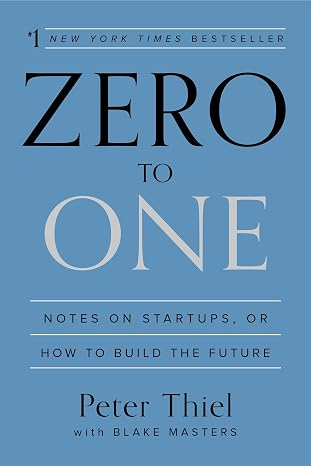
Zero to One: Notes on Startups, or How to Build the Future is a 2014 business and entrepreneurship book by American entrepreneur and investor Peter Thiel, written with Blake Masters. The book examines entrepreneurship, technological innovation, competition, monopoly, venture capital, company building, distribution, and long-term technological progress.
First published in the United States by Crown Business on September 16, 2014, Zero to One contains 224 pages in its first published edition. The book developed from notes that Masters made while attending Thiel’s Stanford University course CS183: Startup in 2012. Those notes became popular online before being substantially developed into the published book.
The central distinction of Zero to One is between “going from 0 to 1”, which Thiel uses to describe creating something genuinely new, and “going from 1 to n”, which describes copying, scaling, or reproducing something that already exists.
Thiel argues that technological innovation is a form of vertical progress: it creates something that did not previously exist. By contrast, globalization and imitation can represent horizontal progress, in which existing ideas, technologies, or business models are reproduced at larger scale.
The book combines startup advice with broader arguments about economics, technology, culture, and the future. Rather than presenting entrepreneurship as a standardized formula, Thiel repeatedly argues that the most valuable opportunities are unusual precisely because they are not obvious to everyone else.
Book information
| Field | Details |
|---|---|
| Title | Zero to One: Notes on Startups, or How to Build the Future |
| Authors | Peter Thiel with Blake Masters |
| Genre | Business, entrepreneurship, technology, economics |
| Original language | English |
| Country | United States |
| Publisher | Crown Business |
| Publication date | September 16, 2014 |
| First-edition length | 224 pages |
| Hardcover ISBN | 978-0-8041-3929-8 |
| E-book ISBN | 978-0-8041-3930-4 |
| Subject areas | Entrepreneurship, innovation, startups, technology |
| Origin | Stanford CS183: Startup course |
| Co-author | Blake Masters |
Overview
At its heart, Zero to One asks a deceptively simple question:
What does it mean to create something new?
Thiel’s answer is that the most important entrepreneurial achievements are not necessarily improvements to existing products. They are inventions, technologies, businesses, and systems that introduce something fundamentally new.
A company that copies an existing product and sells it to more customers may move from 1 to n.
A company that creates an entirely new category may move from 0 to 1.
This distinction gives the book its title.
The argument is deliberately provocative. Thiel is not merely telling entrepreneurs to work harder, move faster, or optimize an existing business. He asks them to reconsider the assumptions behind the business itself.
The book consequently reads less like a conventional startup manual and more like an extended argument about how people should think about innovation and the future.
The meaning of “Zero to One”
Thiel divides progress into two broad categories.
Horizontal progress: 1 → n
Horizontal progress means taking something that already works and reproducing it.
Examples might include:
- opening another restaurant based on an existing concept;
- manufacturing more units of an established product;
- expanding a proven business into another country;
- copying a successful software model;
- increasing production of an existing technology.
The essential activity is replication.
Vertical progress: 0 → 1
Vertical progress means creating something genuinely new.
Examples include:
- inventing a new technology;
- creating an entirely new product category;
- developing a previously unavailable method of solving a problem;
- creating a new business model that changes an industry.
The essential activity is innovation.
Conceptual infographic
                 PROGRESS

                    │
          ┌─────────┴─────────┐
          │                   │
     1 → n                   0 → 1
          │                   │
     Copy / Scale          Create
     Replicate             Invent
     Expand                Discover
     Globalize             Innovate
          │                   │
  More of what exists    Something new
Thiel’s broader argument is that societies need both forms of progress, but that technological innovation is particularly important when the objective is to create a genuinely different future.
Origins of the book
Zero to One originated in Thiel’s Stanford course CS183: Startup, taught in 2012.
Blake Masters was a student at Stanford Law School who attended the course and published detailed notes from Thiel’s lectures online. The notes attracted substantial attention within the technology and startup community.
The eventual book was not simply a transcript of those lectures. The material was edited, reorganized, expanded, and turned into a concise book-length argument.
The connection to the Stanford course is important because it explains the book’s unusual character. It combines:
- classroom-style observations;
- economic arguments;
- startup case studies;
- philosophical questions;
- practical advice;
- historical examples;
- Thiel’s personal experiences as an entrepreneur and investor.
The challenge of the future
The opening chapter establishes the book’s central concern: the future should not merely be a larger version of the present.
For Thiel, genuine progress means creating things that do not currently exist.
The future becomes meaningful when humanity can produce technologies, institutions, or ideas that change what is possible.
This leads to one of the book’s most famous thought exercises:
What important truth do very few people agree with you on?
The question is not simply designed to encourage disagreement.
Its deeper purpose is to force the entrepreneur to search for an underappreciated truth that could become the foundation of a new company or technology.
In Thiel’s framework, a valuable startup idea may initially appear strange precisely because it has not yet become conventional wisdom.
Technology versus globalization
Another important distinction in the book is between technology and globalization.
Thiel uses technology to mean methods of doing things that are substantially better or fundamentally different.
Globalization, in his framework, involves taking existing methods and applying them elsewhere or at larger scale.
The two can happen simultaneously, but they are conceptually different.
For example:
Globalization
Build another factory using an existing manufacturing process.
Technology
Invent a substantially better manufacturing process.
Thiel argues that the two forms of progress have different implications for the future.
The dot-com crash and its lessons
The second chapter examines the technology boom of the late 1990s and the dot-com crash around 2000.
Thiel argues that the crash produced a set of lessons that became deeply embedded in startup culture.
Among the post-crash assumptions he challenges are ideas such as:
- avoid long-term planning;
- distrust ambitious visions;
- make small improvements;
- launch quickly;
- imitate successful companies;
- avoid committing too strongly to one future;
- remain flexible rather than making a definite plan.
Thiel believes some of these lessons were understandable reactions to the excesses of the dot-com era, but argues that they can become harmful when treated as universal principles.
His alternative is greater willingness to make specific, long-term bets.
All Happy Companies Are Different
The third chapter introduces one of the book’s most important economic arguments.
Thiel contrasts competitive markets with businesses that possess a strong form of differentiation.
His argument is that companies operating in highly competitive markets can find it difficult to earn exceptional profits because competitors continually imitate one another.
A company with a unique product or technology, by contrast, may be able to capture substantial economic value.
This leads to the provocative statement that successful companies should seek a form of monopoly.
In the context of the book, “monopoly” refers primarily to a company possessing a sufficiently differentiated position that competitors cannot easily offer a close substitute.
Thiel’s examples include technology companies that created distinctive products and became dominant within particular markets.
Monopoly versus competition
The book’s treatment of monopoly is one of its most controversial and frequently discussed ideas.
Thiel argues that entrepreneurs should not automatically enter markets simply because those markets are large.
Instead, a startup should attempt to become extremely strong in a small, carefully chosen market, and then expand.
The logic can be represented as:
             START SMALL
                  │
                  ↓
       Dominate a narrow market
                  │
                  ↓
       Establish strong advantage
                  │
                  ↓
          Expand outward
                  │
                  ↓
        Enter adjacent markets
This is different from entering a huge market immediately and fighting numerous established competitors.
Thiel argues that the second approach can produce a situation in which a company spends most of its energy competing rather than creating.
Monopoly as a business strategy
The word “monopoly” requires careful interpretation when discussing Zero to One.
Thiel’s argument is primarily about competitive defensibility and differentiation, rather than a general claim that every legal monopoly or concentration of market power is socially desirable.
His ideal startup has characteristics such as:
- proprietary technology;
- strong brand;
- network effects;
- economies of scale;
- a highly focused initial market;
- a durable competitive advantage.
The underlying question is:
What can this company do that another company cannot easily reproduce?
That question is arguably more important than the terminology.
The four characteristics of a monopoly
Thiel identifies several characteristics that can help create a defensible business.
Proprietary technology
A company should ideally possess technology that is substantially better than existing alternatives.
Thiel places particular emphasis on technology that represents a major improvement rather than a marginal one.
Network effects
A product can become more valuable as more people use it.
Examples include:
- social networks;
- communication platforms;
- marketplaces;
- payment networks.
Network effects can create barriers for competitors because a new entrant must persuade users to leave an established network or somehow create value without the same network.
Economies of scale
Some businesses become more efficient as they grow.
Technology companies can sometimes have particularly strong economies of scale because the cost of serving additional users may be relatively low compared with the cost of developing the initial product.
Branding
A strong brand can create differentiation that is difficult to reproduce quickly.
Brand alone, however, is not necessarily enough to create a durable monopoly.
Start small and dominate
One of the book’s practical recommendations is to begin with a small market that a startup can realistically dominate.
Thiel argues against beginning with a market so broad that the startup immediately faces numerous powerful competitors.
The strategy can be represented as:
        SMALL MARKET
             ↓
       Strong position
             ↓
       Market leadership
             ↓
      Adjacent market
             ↓
      Larger opportunity
             ↓
       Broader expansion
The idea is not simply “think small.”
It is:
Start with a narrow problem that you can solve exceptionally well, then expand.
Last mover advantage
Thiel distinguishes between being the first company to enter a market and becoming the company that ultimately captures durable value.
He therefore emphasizes last-mover advantage.
The first company may discover an opportunity, but a later company can sometimes build a better, more durable business.
The relevant question is not:
Who arrived first?
It is:
Who can build a position that remains valuable for many years?
This shifts attention from short-term novelty toward long-term durability.
You Are Not a Lottery Ticket
Chapter 6 challenges the idea that startup success is primarily a matter of luck.
Thiel distinguishes between two broad attitudes toward the future.
Definite optimism
A person believes the future can be made better and has a reasonably clear plan for achieving that improvement.
Indefinite optimism
A person expects the future to become better but does not have a specific plan for making it happen.
The distinction is important because Thiel argues that optimism without a concrete plan can become passive.
His preferred model is:
Optimism + definite plan + action
rather than:
Optimism + hope + waiting
Definite versus indefinite optimism
                     FUTURE
                        │
             ┌──────────┴──────────┐
             │                     │
          Optimism              Pessimism
             │                     │
       ┌─────┴─────┐         ┌─────┴─────┐
       │           │         │           │
   Definite    Indefinite  Definite   Indefinite
   optimism    optimism    pessimism  pessimism
       │           │
    "We know    "Things
    what to     will work
    build."     out somehow."
Thiel considers definite optimism particularly compatible with entrepreneurship because startups require people to make concrete decisions about an uncertain future.
Planning and control
The book repeatedly returns to the relationship between planning and uncertainty.
Thiel argues that entrepreneurs should not treat the future as something entirely outside their control.
Instead, they should identify areas where deliberate action can produce specific outcomes.
This leads to a central entrepreneurial question:
What future can you actively build rather than merely predict?
The distinction is subtle but important.
Prediction asks:
What will happen?
Entrepreneurial planning asks:
What can we make happen?
Follow the money
Chapter 7 examines venture capital and the power law.
Thiel argues that venture capital returns are not normally distributed evenly across investments.
Instead, a small number of companies can generate a very large proportion of the total returns.
This has implications for both investors and entrepreneurs.
For a venture capitalist, investing in a company that produces modest success may not compensate for missing the rare company that becomes extraordinarily valuable.
The implication is:
A few exceptional outcomes can dominate the economics of an entire portfolio.
The power law
The concept can be represented conceptually as follows:
Value generated
│
│ █
│ █
│ █
│ █
│
│
│
│
│
│                         █
│                         █
│                         █
└──────────────────────────────────
   Many companies       Few extreme winners
The diagram is intentionally conceptual rather than a statistical measurement of any particular venture portfolio.
The point is that startup outcomes can be highly uneven.
Thiel argues that investors and founders should therefore think differently from people operating in businesses where outcomes are more evenly distributed.
Secrets
Chapter 8 introduces another central concept: secrets.
For Thiel, a secret is not a conspiracy or hidden piece of gossip.
It is an important truth that:
- is real;
- matters;
- is not widely understood;
- can potentially be acted upon.
A startup opportunity may exist because the world contains an important problem or possibility that most people have overlooked.
The entrepreneur’s task is to search for these hidden opportunities.
The importance of asking unusual questions
Thiel’s concept of the secret connects closely with his contrarian question.
A conventional entrepreneur may ask:
What business should I start?
Thiel encourages a more fundamental question:
What important truth is being overlooked?
This changes the direction of the search.
Instead of beginning with a business model and looking for a market, the entrepreneur begins with a non-obvious insight and asks whether a business can be built around it.
Foundations
Chapter 9 turns from ideas to company formation.
Thiel argues that early decisions have long-term consequences.
Particular attention is given to:
- choosing co-founders;
- dividing responsibilities;
- allocating equity;
- establishing governance;
- defining relationships between founders and investors.
His underlying point is straightforward:
A company with a weak foundation can become difficult to repair later.
Choosing co-founders
Thiel treats the choice of co-founder as similar in importance to choosing a long-term partner.
The reason is practical.
Founders may spend years making decisions together under extreme uncertainty.
Differences in:
- ambition;
- risk tolerance;
- working style;
- values;
- commitment;
- financial expectations
can eventually become major sources of conflict.
For that reason, founder selection is presented as a strategic decision rather than merely a social one.
The Mechanics of Mafia
Chapter 10 discusses company culture and the importance of creating a tightly connected founding team.
The chapter draws heavily on Thiel’s experience with the group of former PayPal employees and associates who later founded or joined other technology companies.
The term “PayPal Mafia” subsequently became widely used to describe this network of former PayPal employees and founders.
Thiel’s broader lesson is that organizations are shaped by the people who join them early.
A startup should therefore think carefully about:
- who belongs on the team;
- what the company stands for;
- how employees understand their roles;
- what makes the organization distinctive.
Company culture
Thiel’s approach to culture is not primarily about office decoration, perks, or recreational activities.
Instead, he treats culture as a mechanism for alignment.
A strong early-stage company benefits when employees understand:
- what the company is trying to accomplish;
- why their work matters;
- why they were specifically chosen;
- what makes the organization different.
This is particularly important in small companies because every employee can have a disproportionately large influence.
If You Build It, Will They Come?
Chapter 11 challenges a common entrepreneurial assumption:
A great product does not automatically guarantee a successful company.
Thiel emphasizes distribution.
Distribution includes the systems through which a product reaches customers and generates revenue.
These systems can include:
- direct sales;
- sales teams;
- marketing;
- partnerships;
- network effects;
- product-led growth;
- viral distribution;
- retail channels.
The precise mechanism depends on the type of product.
Sales and distribution
Thiel argues that founders often underestimate sales because technological culture tends to place greater prestige on engineering.
A technically impressive product that nobody buys is not automatically a successful business.
This creates a simple relationship:
        GREAT PRODUCT
              │
              ↓
        ┌───────────┐
        │Distribution│
        └─────┬─────┘
              ↓
          Customers
              ↓
           Revenue
              ↓
      Sustainable company
The point is not that sales are more important than technology in every situation.
Rather, technology and distribution solve different problems.
Technology creates value.
Distribution transfers that value to customers and converts it into economic results.
Man and Machine
Chapter 12 examines the relationship between humans and computers.
Thiel rejects the idea that technological progress necessarily means humans will simply be replaced by machines.
Instead, he argues that computers can complement human strengths.
Humans are often better at:
- judgment;
- context;
- creativity;
- complex social understanding;
- ambiguous decision-making.
Computers are often better at:
- processing enormous datasets;
- repetitive calculations;
- pattern detection;
- rapid computation;
- handling large quantities of information.
The combination can therefore be more powerful than either alone.
Human-computer complementarity
The book’s argument can be summarized as:
             HUMAN
               │
     Judgment • Context
     Creativity • Values
               │
               +
               │
            COMPUTER
               │
   Computation • Scale
   Data • Pattern recognition
               │
               ↓
      HUMAN + MACHINE
               │
               ↓
      Expanded capability
This perspective is especially relevant to the book’s broader argument that technology should increase humanity’s productive capabilities rather than simply be viewed as a replacement mechanism.
Seeing Green
Chapter 13 examines the cleantech boom of the late 2000s.
Thiel uses the experience of cleantech startups to illustrate what he considers a recurring entrepreneurial mistake: assuming that entering an important or fashionable industry is enough.
He argues that a company still needs a strong answer to fundamental business questions.
This chapter introduces the book’s seven questions every business must answer.
The seven questions every business must answer
According to Thiel, entrepreneurs should examine seven areas.
1. Engineering
Can you create breakthrough technology rather than incremental improvements?
The question concerns the technological advantage of the product.
2. Timing
Is now the right time to start the company?
A good idea can fail if the surrounding market and technology are not ready.
3. Monopoly
Are you starting with a big share of a small market?
The objective is to establish a defensible position rather than enter a huge market with no meaningful advantage.
4. People
Do you have the right team?
The founders and employees need the capabilities and commitment required to execute the plan.
5. Distribution
Do you have a way to sell and deliver the product?
Creating value is not sufficient if the company cannot reach customers.
6. Durability
Will your position remain defensible for many years?
A successful business should not depend entirely on a temporary advantage.
7. Secret
Have you identified an opportunity that others have missed?
The company should be based on a meaningful insight rather than merely following conventional wisdom.
The seven-question framework
                  GREAT BUSINESS
                        │
      ┌─────────────────┼─────────────────┐
      ↓                 ↓                 ↓
  Technology         Timing           Monopoly
      │                 │                 │
      ├─────────────────┼─────────────────┤
      ↓                 ↓                 ↓
    People         Distribution       Durability
                        │
                        ↓
                      Secret
                        │
                        ↓
                Durable company
The seven questions are not presented as a mathematical formula.
They function instead as a strategic checklist.
The Founder’s Paradox
The final chapter examines the unusual characteristics often associated with founders.
Thiel observes that successful founders can combine traits that appear contradictory.
A founder might be:
- highly confident but deeply uncertain;
- unconventional but commercially successful;
- intensely focused but socially unusual;
- ambitious but insecure;
- capable of attracting both admiration and criticism.
The chapter explores why founders can become unusually influential within their organizations.
The broader point is that entrepreneurship does not always emerge from conventional personality types.
Stagnation or Singularity?
The conclusion returns to the book’s central concern: the future.
Thiel presents two broad possibilities.
One is stagnation: technological progress slows, and society largely reproduces existing systems.
The other is a future in which technological development accelerates dramatically.
The book does not present technological progress as inevitable.
Instead, it argues that human beings have a role in determining which future becomes possible.
The title therefore represents more than a startup metaphor.
Zero to one is ultimately an argument about civilization and the creation of the future.
Major concepts in Zero to One
| Concept | Meaning |
|---|---|
| 0 → 1 | Creating something genuinely new |
| 1 → n | Replicating or scaling what already exists |
| Vertical progress | Technological or qualitative innovation |
| Horizontal progress | Replication and expansion |
| Monopoly | A strongly differentiated, defensible market position |
| Definite optimism | Belief in a better future combined with a concrete plan |
| Indefinite optimism | Belief that the future will improve without a definite plan |
| Secret | An important but underappreciated truth |
| Power law | A distribution in which a small number of outcomes dominate total results |
| Last mover advantage | Building a durable position rather than merely arriving first |
| Distribution | The process of getting a product to customers |
| Durability | The ability of a business advantage to survive over time |
The philosophy of the book
Although marketed primarily as a startup book, Zero to One is broader than a manual for entrepreneurs.
Its underlying philosophy can be summarized through five questions:
1. What is missing?
Instead of asking what already works, look for what does not yet exist.
2. What do other people overlook?
A valuable opportunity may be hidden behind an assumption everyone accepts.
3. What can be built?
Ideas matter only when they can become real products, companies, technologies, or institutions.
4. What can survive?
A temporary advantage is less valuable than a durable one.
5. What future is worth creating?
The ultimate objective is not merely financial success but meaningful technological progress.
A practical interpretation
One of the most useful ways to read Zero to One is not as a literal instruction to build a monopoly.
Instead, its framework can be translated into a series of practical questions:
Problem
What important problem exists?
↓
Insight
What do I understand about that problem that others may have missed?
↓
Innovation
Can I solve it in a substantially different way?
↓
Niche
Who needs the solution most urgently?
↓
Dominance
Can I become exceptionally strong in that narrow segment?
↓
Distribution
How will the product reach customers?
↓
Defensibility
What prevents easy imitation?
↓
Expansion
Where can the company go next?
This interpretation preserves the strategic heart of the book while making the framework applicable beyond venture-backed technology startups.
Examples discussed in the book
Zero to One frequently uses technology companies and entrepreneurial experiences to illustrate its arguments.
Among the prominent examples are:
- PayPal;
- Google;
- Microsoft;
- Apple;
- Facebook;
- Amazon;
- Tesla;
- cleantech startups.
These examples are used not simply as company histories but as illustrations of ideas such as:
- technological differentiation;
- monopoly;
- distribution;
- founder influence;
- market selection;
- long-term planning;
- competitive advantage.
Because many of the examples are successful companies, readers should remember that the book is presenting an argument rather than conducting a statistical study of all startups.
The PayPal example
PayPal is particularly important because Thiel was one of its founders and served as its CEO.
The company’s early history provides the book with an example of starting with a relatively narrow market and developing a product around a specific problem.
The PayPal story also illustrates several recurring themes:
- finding an initial niche;
- rapid growth;
- distribution;
- competition;
- technology;
- strategic positioning;
- the importance of a strong founding team.
For Thiel, the PayPal experience is not simply a personal success story. It is evidence for a broader theory of how startups can develop defensible positions.
The Tesla example
Tesla appears in the cleantech discussion as an example of a company that, in Thiel’s analysis, successfully addressed multiple dimensions of the seven-question framework.
The company began with a relatively narrow market focused on high-end electric vehicles before moving toward broader markets.
The example illustrates Thiel’s preferred sequence:
Start with a narrow market → establish a strong position → expand.
It also demonstrates why the book treats distribution, technology, branding, and timing as interconnected rather than isolated business problems.
Criticism and limitations
Zero to One has received both strong praise and substantial criticism.
The criticism is important because the book’s claims are deliberately broad.
The monopoly argument
One of the most debated aspects of the book is Thiel’s positive treatment of monopoly.
Supporters of the argument interpret monopoly as shorthand for strong differentiation and durable competitive advantage.
Critics argue that concentrated market power can create problems that the book does not explore sufficiently, including:
- higher prices;
- reduced consumer choice;
- barriers to entry;
- political influence;
- reduced competitive pressure;
- potential regulatory concerns.
Thus, the business meaning of “monopoly” and the broader economic meaning of monopoly should not automatically be treated as identical.
Survivorship bias
Another limitation is the book’s reliance on successful companies as examples.
PayPal, Google, Facebook, Tesla, and other successful businesses provide compelling case studies.
But thousands of companies have attempted ambitious technological strategies and failed.
A reader should therefore distinguish:
“This successful company followed this pattern”
from:
“Following this pattern causes success.”
The first is a historical observation.
The second is a causal claim, which requires much stronger evidence.
This distinction is particularly important when reading business books written by successful entrepreneurs and investors.
The limits of the “0 to 1” distinction
The distinction between invention and copying is intellectually useful, but real innovation is rarely completely isolated from previous work.
Most technologies develop through combinations of:
- previous inventions;
- scientific discoveries;
- engineering improvements;
- infrastructure;
- market demand;
- complementary technologies;
- accumulated knowledge.
A smartphone, for example, is not simply a single invention appearing from nowhere. It combines telecommunications, computing, batteries, semiconductor technology, software, displays, sensors, and many other developments.
Therefore, “0 to 1” is best understood as a conceptual distinction, not a literal claim that innovation emerges without predecessors.
The limits of the monopoly model
A startup may achieve a temporary monopoly-like position without maintaining it permanently.
Technology changes.
Customers change.
Competitors learn.
Regulation changes.
New substitutes appear.
A business that appears unassailable today can become vulnerable tomorrow.
For this reason, the book’s emphasis on durability is particularly important: a strong current position is not necessarily a permanent position.
Technology is not the only path to value
Another limitation is the book’s strong emphasis on technological entrepreneurship.
Many valuable businesses are built through:
- operational excellence;
- customer service;
- specialized knowledge;
- craftsmanship;
- local relationships;
- incremental innovation;
- logistics;
- brand;
- reliability.
Not every successful company needs to invent a fundamentally new technology.
Zero to One is therefore most directly applicable to entrepreneurs seeking differentiated, scalable businesses, particularly in technology-oriented sectors.
Reception
The book attracted considerable attention upon publication.
Penguin Random House lists Zero to One as a New York Times bestseller and describes it as a book about creating value through new approaches rather than competing along established paths.
Reviews have differed in emphasis.
Some reviewers have praised the book for its concise prose, unusual perspective, and willingness to challenge conventional startup assumptions.
Others have argued that its advice can be overly abstract, that its contrarian framing sometimes makes familiar business ideas appear more radical than they are, or that its examples do not constitute systematic evidence.
The New Republic’s contemporary review described the book less as a conventional management manual than as an extended argument against stagnation and uninspired thinking, while also noting the limits of Thiel’s ability to provide a universal formula for innovation.
This disagreement is part of the book’s character: it is intentionally provocative.
Why the book remains influential
The continuing appeal of Zero to One comes partly from its unusual combination of subjects.
It is simultaneously about:
- startups;
- technology;
- economics;
- competition;
- venture capital;
- company culture;
- philosophy;
- planning;
- innovation;
- the future.
Many business books ask:
How can I compete better?
Zero to One asks a different question:
Why compete in the same game at all?
That change in framing is arguably the book’s most important contribution.
The book’s enduring questions
Even readers who disagree with some of Thiel’s conclusions can use the book’s questions as strategic exercises.
About the product
What are we doing that is genuinely different?
About the market
Where can we become exceptionally strong?
About technology
Is our advantage significant or merely incremental?
About competition
Why will customers choose us rather than an established alternative?
About distribution
How will customers actually discover and buy the product?
About durability
What will protect this business five, ten, or twenty years from now?
About insight
What do we know that others have not yet recognized?
These questions remain useful even when the reader rejects the book’s stronger claims about monopoly or competition.
Zero to One as a startup framework
The entire book can be compressed into the following conceptual model:
              FIND A SECRET
                    │
                    ↓
          BUILD SOMETHING NEW
                    │
                    ↓
          START WITH A NICHE
                    │
                    ↓
          DOMINATE THAT NICHE
                    │
                    ↓
             BUILD MOAT
                    │
                    ↓
              DISTRIBUTE
                    │
                    ↓
             EXPAND CAREFULLY
                    │
                    ↓
          CREATE LONG-TERM VALUE
The model is not a guarantee of success.
It is a representation of the strategic logic developed throughout the book.
What makes Zero to One different from a conventional startup book?
A conventional startup guide might focus on:
- customer interviews;
- product-market fit;
- rapid experimentation;
- fundraising;
- growth;
- hiring;
- metrics.
Zero to One is interested in those topics, but approaches them from a more philosophical angle.
Its primary concern is:
What kind of company is worth building in the first place?
That is why the book spends considerable time discussing technology, monopolies, secrets, the future, and the nature of progress.
Legacy
Zero to One became an influential work in the literature surrounding technology startups and entrepreneurship.
Its vocabulary—particularly 0 to 1, 1 to n, definite optimism, secrets, monopoly, power law, and seven questions—has become widely used in discussions of startup strategy.
Its influence extends beyond founders.
The book is also read by:
- investors;
- product managers;
- technology executives;
- students;
- consultants;
- business strategists;
- aspiring entrepreneurs.
Its central challenge is simple enough to remember but difficult enough to apply:
Do not merely copy what already works. Look for something that has not yet been built.
About Peter Thiel
Peter Thiel is an American entrepreneur, investor, and author.
He co-founded PayPal and served as its chief executive before the company went public in 2002. He later became an early outside investor in Facebook and co-founded Palantir Technologies.
His investment activities have included technology companies such as LinkedIn and Yelp, among others.
Thiel also founded the Thiel Fellowship and has been associated with Founders Fund, a venture capital firm.
His professional background strongly shapes Zero to One. The book is therefore not written from the perspective of an academic observer of entrepreneurship alone. Many of its arguments emerge from Thiel’s experiences as a founder, investor, and participant in Silicon Valley’s technology ecosystem.
About Blake Masters
Blake Masters is an American writer, entrepreneur, and investor.
While studying at Stanford Law School, Masters attended Peter Thiel’s startup course in 2012 and published detailed notes from the lectures.
Those notes attracted significant attention online and became the foundation for the eventual collaboration between Masters and Thiel.
The published book therefore carries two forms of authorship: Thiel’s entrepreneurial ideas and Masters’ role in organizing and developing the original course material into a readable book.
Publication history
The first edition was published in the United States in September 2014.
The Crown edition lists:
- hardcover ISBN: 978-0-8041-3929-8
- e-book ISBN: 978-0-8041-3930-4
- 224 pages.
The book has subsequently appeared in multiple international editions and translations.
Because pagination and ISBN information can differ between countries and formats, bibliographic databases may show different page counts for particular editions.
Table of contents
The original book contains a preface, 14 numbered chapters, a conclusion, acknowledgments, and an index.
Preface
Zero to One
Chapter 1
The Challenge of the Future
Chapter 2
Party Like It’s 1999
Chapter 3
All Happy Companies Are Different
Chapter 4
The Ideology of Competition
Chapter 5
Last Mover Advantage
Chapter 6
You Are Not a Lottery Ticket
Chapter 7
Follow the Money
Chapter 8
Secrets
Chapter 9
Foundations
Chapter 10
The Mechanics of Mafia
Chapter 11
If You Build It, Will They Come?
Chapter 12
Man and Machine
Chapter 13
Seeing Green
Chapter 14
The Founder’s Paradox
Conclusion
Stagnation or Singularity?
Frequently asked questions
What is Zero to One about?
It is a book about startups, technological innovation, competition, monopoly, company building, and the creation of new businesses and technologies.
What does “zero to one” mean?
It means creating something genuinely new rather than simply copying or scaling something that already exists.
What does “one to n” mean?
It describes replication, expansion, and scaling of an existing idea or technology.
What is the main idea of Zero to One?
The book argues that the greatest entrepreneurial opportunities often come from creating something unique rather than competing directly in an existing market.
What does Peter Thiel mean by monopoly?
In the book, monopoly primarily refers to a company possessing a sufficiently differentiated and defensible market position that competitors cannot easily replicate.
What are the seven questions in Zero to One?
They concern:
- Engineering
- Timing
- Monopoly
- People
- Distribution
- Durability
- Secret
What is definite optimism?
It is the belief that the future can become better combined with a concrete plan for creating that future.
What is the power law?
It describes a situation in which a small number of outcomes account for a disproportionately large share of the total result.
Is Zero to One a step-by-step startup guide?
Not really. It provides principles and strategic questions rather than a universal procedure for creating a successful startup.
Is the book only useful for technology companies?
No. Its ideas about differentiation, niche markets, distribution, durability, and strategic thinking can be applied more broadly, although the book’s examples and strongest arguments are heavily oriented toward technology startups.
Is everything in Zero to One scientifically proven?
No. The book is a work of business strategy and entrepreneurial philosophy, not a scientific textbook or systematic empirical study.
Its examples and arguments should therefore be distinguished from independently established research.
Key lessons at a glance
┌──────────────────────────────────────────────┐
│              ZERO TO ONE                     │
├──────────────────────────────────────────────┤
│  0 → 1    Create something new              │
│  1 → n    Copy / scale what exists          │
│                                              │
│  THINK    Find an overlooked truth          │
│  BUILD    Create differentiated value       │
│  FOCUS    Start with a narrow market        │
│  DEFEND   Build a durable advantage         │
│  SELL     Treat distribution seriously      │
│  PLAN     Prefer definite optimism           │
│  SEARCH   Look for secrets                  │
│  SCALE    Expand after establishing a base  │
└──────────────────────────────────────────────┘
Editorial assessment
The most productive way to approach Zero to One is neither to treat it as a universal recipe nor to dismiss it simply because some of its arguments are provocative.
It is better understood as a strategic lens.
Its strongest contribution is the insistence that entrepreneurs should ask a more fundamental question before optimizing an existing business:
Is there something genuinely new here?
Its most debatable ideas concern monopoly, competition, the degree to which technological innovation should be prioritized over incremental improvement, and the extent to which successful examples can support broad entrepreneurial conclusions.
The book is therefore most valuable when read actively.
Agree with some ideas.
Question others.
Test the framework against businesses that succeeded—and businesses that failed.
That approach is consistent with the spirit of the book itself: think independently rather than simply copying an established formula.
References
- Thiel, Peter A., with Blake Masters. Zero to One: Notes on Startups, or How to Build the Future. Crown Business, 2014.
- Penguin Random House. Zero to One — official publisher bibliographic and book description page.
- Penguin Random House Higher Education. Zero to One — publisher description and excerpt.
- Penguin Random House India. Zero to One — international edition information.
- Masters, Blake. Peter Thiel’s CS183: Startup — Class Notes, Stanford University, 2012.
- Open Library. Zero to One: Notes on Startups, or How to Build the Future — bibliographic and table-of-contents records.
- Google Books. Zero to One: Notes on Startups, or How to Build the Future — bibliographic record and author information.
- Winkler, Elizabeth. “Peter Thiel Is a Closet Humanist.” The New Republic, September 23, 2014.
- The Economist. Contemporary review of Zero to One.
- Fortune. Contemporary review of Zero to One.
Read more
Peter Thiel and the book
- Zero to One — official publisher edition
- Peter Thiel’s writings and interviews
- Blake Masters’ original CS183 course notes
- Stanford materials relating to entrepreneurship and innovation
Related subjects
- Entrepreneurship
- Startup companies
- Technological innovation
- Venture capital
- Competitive advantage
- Monopoly
- Network effects
- Product differentiation
- Distribution strategy
- Corporate strategy
- Technological progress
- Silicon Valley
- Innovation economics
Related books
- The Innovator’s Dilemma — Clayton M. Christensen
- The Lean Startup — Eric Ries
- The Hard Thing About Hard Things — Ben Horowitz
- Good to Great — Jim Collins
- The Innovators — Walter Isaacson
- The Everything Store — Brad Stone
See also
- Peter Thiel
- Blake Masters
- PayPal
- Venture capital
- Startup company
- Entrepreneurship
- Technological innovation
- Monopoly
- Network effect
- Competitive advantage
- Silicon Valley
- Product-market fit
- Business strategy
- The Lean Startup
In one sentence
Zero to One argues that the most valuable entrepreneurial opportunities often arise not from doing more of what already exists, but from discovering an overlooked opportunity and building something genuinely new, differentiated, and durable around it.