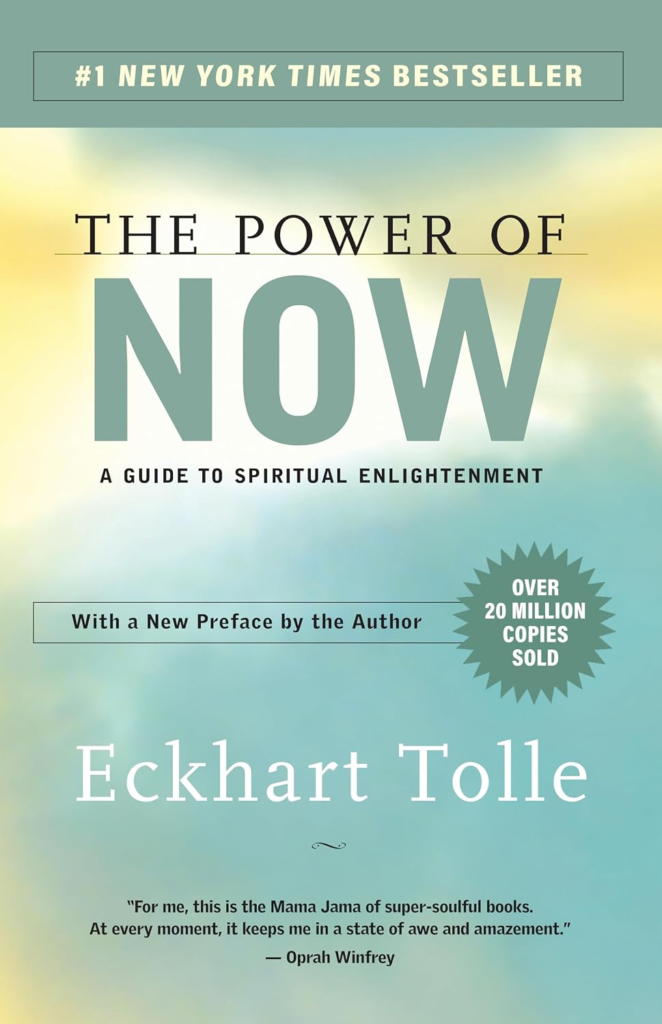
The Power of Now: A Guide to Spiritual Enlightenment is a spiritual self-help book by German-born spiritual teacher and author Eckhart Tolle. First published in 1997, the book explores the relationship between human consciousness, thought, emotional suffering, identity, and the experience of the present moment.
The central proposition of The Power of Now is that people frequently become psychologically absorbed in memories of the past or imagined scenarios about the future, while overlooking the present moment—the only point at which life is actually experienced. Tolle argues that identification with the mind and its continuous stream of thought is a major source of psychological suffering and that greater awareness of the present can lead toward what he calls Presence, Being, and ultimately spiritual enlightenment.
Rather than presenting a conventional religious doctrine, Tolle draws on ideas associated with several spiritual traditions, including Christianity, Buddhism, Hinduism, and other contemplative traditions, while expressing them through his own vocabulary and framework.
The book is organized largely as a series of questions and answers, allowing Tolle to introduce concepts such as the ego, mind identification, the pain-body, Presence, the inner body, surrender, and the Now.
Originally published by Namaste Publishing in 1997, the book was subsequently published by New World Library in 1999. It became an international bestseller and has been translated into dozens of languages. New World Library’s bibliographic description reports more than 20 million copies sold and translation into 69 languages, while current official Eckhart Tolle materials describe it as a major international bestseller.
Book information
| Field | Details |
|---|---|
| Title | The Power of Now: A Guide to Spiritual Enlightenment |
| Author | Eckhart Tolle |
| Original language | English |
| Genre | Spirituality, self-help, personal development |
| Subject | Presence, consciousness, spirituality, psychological suffering |
| First published | 1997 |
| Original publisher | Namaste Publishing |
| Later publisher | New World Library |
| ISBN | 978-1-57731-152-2 |
| Original edition | 1997 |
| Common edition length | Approximately 236 pages |
| Format | Print, ebook, audiobook and other editions |
| Notable related work | A New Earth: Awakening to Your Life’s Purpose |
Bibliographic records identify a 1997 edition, while the New World Library edition appeared in 1999. Pagination varies between editions.
Overview
At its heart, The Power of Now asks a deceptively simple question:
What happens when a human being stops living primarily through thought and becomes fully aware of the present moment?
For Tolle, this question is not merely about improving concentration or becoming more productive.
It is a spiritual question.
The book proposes that most people spend much of their waking lives identified with their thoughts. They replay old conversations, anticipate future problems, compare themselves with others, judge themselves, imagine possible outcomes, and construct stories about who they are.
Tolle calls this identification with thought one of the fundamental obstacles to awakening.
His alternative is Presence—a state of conscious awareness in which attention is no longer completely captured by the stream of thinking.
The book therefore moves through a broad progression:
IDENTIFICATION WITH THOUGHT
            ↓
        EGOIC SELF
            ↓
      PSYCHOLOGICAL PAIN
            ↓
     AWARENESS OF THOUGHT
            ↓
        PRESENCE
            ↓
       INNER STILLNESS
            ↓
      SPIRITUAL AWAKENING
This diagram represents Tolle’s spiritual framework rather than an experimentally established psychological model.
The central concept: the Now
The Now is the central concept of the book.
Tolle does not use “now” simply to mean the current minute on a clock.
Instead, the Now represents direct awareness of present experience.
The past exists in the present as memory.
The future exists in the present as anticipation or imagination.
From this perspective, the only moment in which a person can actually experience life is the present.
Tolle’s basic distinction
                 TIME
                  │
        ┌─────────┼─────────┐
        │         │         │
        ▼         ▼         ▼
      PAST       NOW      FUTURE
        │         │         │
     Memory    EXPERIENCE  Imagination
        │         │         │
        └─────────┼─────────┘
                  │
                  ▼
          CONSCIOUS AWARENESS
Tolle’s argument is not that memory and planning are useless.
Rather, he distinguishes between using the mind when appropriate and being psychologically trapped in thought.
A person may need to remember yesterday’s meeting or plan tomorrow’s appointment. The problem, in his framework, arises when thought becomes compulsive and the individual loses awareness of the present.
You Are Not Your Mind
The first major section of the book introduces one of Tolle’s most recognizable ideas:
The human being is not identical to the thinking mind.
Tolle does not argue that thinking itself is inherently bad.
The problem, in his view, is identification.
A thought arises:
“I am a failure.”
Instead of recognizing this as a thought, a person may experience it as an unquestionable description of reality.
Similarly:
“Everyone dislikes me.”
can become an apparently objective fact rather than a temporary mental interpretation.
Tolle asks readers to create a distinction between:
the thought
and
the awareness of the thought.
That distinction is fundamental to his philosophy.
The observer and the observed
The book repeatedly encourages readers to notice their own thinking.
Consider the difference between:
“I am angry.”
and:
“I notice that anger is present.”
The second statement introduces an element of observation.
In Tolle’s framework, this observation is significant because awareness is no longer completely absorbed in the emotional state.
Conceptual model
              THOUGHT
                 │
                 ▼
          "I AM THIS THOUGHT"
                 │
                 ▼
          IDENTIFICATION
                 │
                 ▼
              REACTION


                    VS.


              THOUGHT
                 │
                 ▼
       "I NOTICE THIS THOUGHT"
                 │
                 ▼
             AWARENESS
                 │
                 ▼
          POSSIBLE RESPONSE
The book presents this movement from identification to observation as an important step toward Presence.
The ego
Another major concept is the egoic self.
In Tolle’s terminology, the ego is not simply arrogance.
It refers more broadly to a constructed sense of identity based on mental narratives.
This identity may include:
- one’s name;
- profession;
- possessions;
- social status;
- achievements;
- failures;
- relationships;
- political or cultural identity;
- personal history;
- opinions;
- fears;
- ambitions;
- memories.
These things can be part of a person’s life without necessarily defining what Tolle calls their deeper Being.
The ego seeks psychological security by continually constructing an answer to the question:
“Who am I?”
Tolle argues that this search can become endless because the ego is maintained through comparison, attachment and identification.
The mind as a problem—and a tool
One of the subtler aspects of The Power of Now is that Tolle does not simply tell readers to stop thinking.
Thinking remains necessary for ordinary life.
People need thought to:
- solve problems;
- communicate;
- calculate;
- organize;
- plan;
- learn;
- remember;
- make decisions.
The distinction is between functional thinking and compulsive identification with thought.
Functional use of the mind
Problem
   ↓
Think
   ↓
Solve
   ↓
Act
   ↓
Return to present awareness
Compulsive thinking
Thought
   ↓
More thought
   ↓
Memory
   ↓
Fear
   ↓
More thought
   ↓
Imagined future
   ↓
More thought
   ↓
Anxiety
   ↓
More thought
The second pattern is what Tolle identifies as a major source of unnecessary suffering.
The way out of pain
A substantial portion of the book deals with psychological suffering.
Tolle argues that emotional pain can be intensified when people resist their present experience.
For example, an unpleasant emotion arises.
Instead of simply recognizing it, the mind may immediately produce a second layer:
“I shouldn’t feel this.”
Then another:
“Why am I always like this?”
And another:
“This is going to ruin everything.”
The original emotion becomes surrounded by layers of mental resistance.
Tolle’s proposed alternative is awareness.
Pain cycle
Unpleasant experience
        ↓
Mental resistance
        ↓
Judgment
        ↓
Identification
        ↓
More emotional pain
        ↓
More resistance
        ↺
Awareness cycle
Unpleasant experience
        ↓
Notice it
        ↓
Allow awareness
        ↓
Observe thoughts and sensations
        ↓
Respond rather than automatically react
This does not mean that every painful situation should simply be accepted passively. The book’s concept of surrender is more specifically about reducing inner resistance to the reality of the present moment.
The “pain-body”
One of the most distinctive concepts introduced by Tolle is the pain-body.
The pain-body is described as a kind of accumulated emotional energy associated with unresolved pain.
According to Tolle’s framework, the pain-body can become activated by particular circumstances.
For example:
Present event
      ↓
Emotional trigger
      ↓
Old pain activated
      ↓
Strong emotional reaction
      ↓
Mind creates justification
      ↓
Conflict / suffering
Tolle argues that the pain-body can become strengthened when people unconsciously identify with it.
Awareness is presented as the means by which the individual can recognize the pain without becoming completely absorbed in it.
The pain-body is a spiritual concept used by Tolle; it should not be confused with a formally recognized medical or psychiatric entity.
Presence
Presence is perhaps the most important term in Tolle’s vocabulary.
Presence means being consciously aware of what is happening now without being completely dominated by thought.
It can involve awareness of:
- breathing;
- bodily sensations;
- sounds;
- surroundings;
- emotions;
- thoughts;
- stillness.
The objective is not necessarily to eliminate thought.
Instead, thought becomes something that appears within awareness rather than something that completely controls awareness.
Presence model
                  AWARENESS
                      │
       ┌──────────────┼──────────────┐
       │              │              │
       ▼              ▼              ▼
    Thoughts       Feelings       Sensations
       │              │              │
       └──────────────┼──────────────┘
                      │
                      ▼
                 PRESENCE
Moving deeply into the Now
Tolle presents several practical ways of returning attention to the present.
These include:
- observing breathing;
- paying attention to bodily sensations;
- listening deeply;
- noticing the environment;
- becoming aware of thought;
- sensing the “inner body”;
- observing emotional reactions without immediate identification.
These practices are not presented primarily as productivity techniques.
They are intended as methods of shifting consciousness.
The inner body
Another major concept is the inner body.
Tolle encourages readers to direct attention inward toward physical sensations.
Rather than thinking about the body as an object, the reader is encouraged to experience bodily aliveness directly.
For example, a person may close their eyes and notice:
- sensations in the hands;
- sensations in the feet;
- warmth;
- tingling;
- pressure;
- movement;
- subtle bodily energy.
The purpose is to move attention away from excessive conceptual thinking and toward direct experience.
Attention shift
OUTER WORLD
    ↓
Thought about experience
    ↓
Conceptual interpretation
    ↓
INNER AWARENESS
    ↓
Direct bodily sensation
    ↓
PRESENCE
Portals into the Unmanifested
The later sections of the book move further into Tolle’s metaphysical vocabulary.
The Unmanifested refers to a dimension of reality that Tolle associates with stillness, Being, consciousness and the spiritual source underlying ordinary forms.
He describes silence, inner stillness, the inner body and the present moment as possible “portals” into this dimension.
These ideas place the book firmly within the spiritual and metaphysical genre rather than conventional psychology.
Readers approaching the book from a secular perspective may interpret these practices as forms of mindfulness or attention training, while readers with a spiritual orientation may understand them in the metaphysical terms used by Tolle.
Enlightened relationships
Tolle applies the idea of Presence to intimate relationships.
Relationships can become sources of conflict when people unconsciously use one another to obtain:
- approval;
- security;
- identity;
- emotional stimulation;
- validation;
- control.
According to Tolle, relationships can become particularly intense because they activate deeply established patterns.
He argues that greater awareness can change the dynamics of a relationship.
Conventional relationship pattern
Need
 ↓
Expectation
 ↓
Disappointment
 ↓
Blame
 ↓
Conflict
 ↓
Emotional reaction
Tolle’s alternative
Awareness
 ↓
Recognition of reaction
 ↓
Presence
 ↓
Clear communication
 ↓
Less identification
 ↓
Greater acceptance
The book does not suggest that awareness eliminates disagreement. Rather, it proposes that conflict can be approached without automatically turning it into an attack on one’s identity.
Happiness and unhappiness
One of the book’s recurring themes is the distinction between happiness and inner peace.
Tolle argues that happiness is generally dependent on circumstances.
For example:
Good circumstances
        ↓
Pleasant emotion
        ↓
Happiness
But circumstances inevitably change.
Therefore:
Changing circumstances
        ↓
Changing emotional states
        ↓
Changing happiness
Tolle’s proposed alternative is a deeper state of peace that is less dependent upon external conditions.
This does not mean that he rejects ordinary happiness. Instead, he distinguishes temporary emotional pleasure from what he regards as a deeper state of inner stillness.
Surrender
The final major concept is surrender.
In ordinary language, surrender can imply defeat.
Tolle uses the term differently.
For him, surrender means accepting the reality of the present moment rather than mentally fighting against what has already happened.
This does not necessarily mean refusing to act.
Instead:
WHAT IS HAPPENING
       ↓
Recognize reality
       ↓
Stop unnecessary inner resistance
       ↓
See clearly
       ↓
Take appropriate action
For example, if a flight is canceled, resistance might take the form of:
“This shouldn’t be happening!”
Surrender would mean recognizing:
“The flight has been canceled.”
From that starting point, practical action becomes possible.
This distinction between acceptance of reality and passivity is important when interpreting the book.
The structure of the book
The book is organized into an introduction followed by ten principal chapters or sections.
The table of contents of the 2004 New World Library edition identifies the following structure:
| Section | Title | Central theme |
|---|---|---|
| Introduction | — | Tolle’s personal awakening and the origins of his teaching |
| Chapter 1 | You Are Not Your Mind | Identification with thought |
| Chapter 2 | Consciousness: The Way Out of Pain | Awareness and emotional suffering |
| Chapter 3 | Moving Deeply into the Now | Present-moment awareness |
| Chapter 4 | Mind Strategies for Avoiding the Now | Mental patterns and resistance |
| Chapter 5 | The State of Presence | Conscious awareness |
| Chapter 6 | The Inner Body | Bodily awareness |
| Chapter 7 | Portals into the Unmanifested | Stillness and metaphysical awareness |
| Chapter 8 | Enlightened Relationships | Presence in relationships |
| Chapter 9 | Beyond Happiness and Unhappiness There Is Peace | Inner peace |
| Chapter 10 | The Meaning of Surrender | Acceptance and action |
Different editions vary in pagination and some bibliographic presentations format the chapter headings differently.
The intellectual and spiritual framework
The book can be visualized as a movement through four broad stages:
┌─────────────────────────────────────┐
│  1. IDENTIFICATION                  │
│  "I am my thoughts and emotions."  │
└──────────────────┬──────────────────┘
                   ↓
┌─────────────────────────────────────┐
│  2. AWARENESS                       │
│  "I can observe my thoughts."       │
└──────────────────┬──────────────────┘
                   ↓
┌─────────────────────────────────────┐
│  3. PRESENCE                        │
│  "I am fully aware of this moment." │
└──────────────────┬──────────────────┘
                   ↓
┌─────────────────────────────────────┐
│  4. SPIRITUAL AWAKENING             │
│  Awareness of Being / consciousness │
└─────────────────────────────────────┘
This is a conceptual summary of Tolle’s argument rather than a scientific model.
Major themes
Presence
The book’s central theme is the importance of being consciously present.
Consciousness
Tolle distinguishes consciousness from the contents of consciousness—thoughts, emotions and perceptions.
Ego
The ego is presented as a constructed identity maintained through thought and psychological identification.
Suffering
Mental resistance, identification and compulsive thought are presented as major contributors to psychological suffering.
Acceptance
Acceptance of the present moment is treated as a foundation for inner freedom.
Relationships
Relationships are presented as environments in which unconscious patterns become especially visible.
Spiritual awakening
The ultimate objective is not simply relaxation or stress reduction but a transformation of consciousness.
Past and future
Tolle makes a particularly strong distinction between chronological time and psychological time.
Chronological time is necessary.
A person needs to know:
- when an appointment begins;
- how long a journey takes;
- when a bill is due;
- when a project must be completed.
Psychological time is different.
It refers to becoming mentally absorbed in:
- regret;
- resentment;
- nostalgia;
- anxiety;
- anticipation;
- imagined future scenarios.
The book argues that psychological time can become a source of suffering when the mind continually leaves the present.
Time in Tolle’s framework
                    TIME
                      │
          ┌───────────┴───────────┐
          │                       │
          ▼                       ▼
 CHRONOLOGICAL TIME        PSYCHOLOGICAL TIME
          │                       │
      Planning                 Regret
      Scheduling               Anxiety
      Learning                 Fear
      Remembering              Resentment
          │                       │
          ▼                       ▼
     USEFUL TOOL              POSSIBLE SUFFERING
This distinction is one of the most practically accessible ideas in the book.
The book’s approach to thought
A common misunderstanding of The Power of Now is that it teaches people to stop thinking.
That is not quite what Tolle’s framework proposes.
The emphasis is on disidentification from compulsive thought.
A person can think about a problem while simultaneously remaining aware that thinking is taking place.
This creates a useful distinction:
Thinking:
“I need to solve this problem.”
versus
Identification:
“This problem determines who I am.”
The first can be functional.
The second can become psychologically consuming.
The Power of Now as a practical philosophy
Although the book is spiritual in orientation, many of its practices can be expressed in simple everyday terms.
Before reacting
Pause.
During emotional distress
Notice what is happening internally.
During an argument
Observe the urge to defend the ego.
During anxiety about the future
Separate what is actually happening now from what is being imagined.
During regret
Recognize that the past cannot be physically revisited; only its memory exists in the present.
During ordinary activities
Pay attention to the activity itself rather than continuously narrating it mentally.
This is where the book’s title becomes practical.
The “Power of Now” is not primarily a claim about clock time. It is a claim about where attention is placed.
Infographic: The Power of Now
                 THE POWER OF NOW
                        │
                        ▼
              ┌─────────────────┐
              │  NOTICE THOUGHT │
              └────────┬────────┘
                       ↓
              ┌─────────────────┐
              │ DON'T IDENTIFY  │
              └────────┬────────┘
                       ↓
              ┌─────────────────┐
              │ FEEL THE BODY   │
              └────────┬────────┘
                       ↓
              ┌─────────────────┐
              │ ACCEPT THE NOW  │
              └────────┬────────┘
                       ↓
              ┌─────────────────┐
              │ BECOME PRESENT  │
              └────────┬────────┘
                       ↓
              ┌─────────────────┐
              │ INNER STILLNESS │
              └────────┬────────┘
                       ↓
              ┌─────────────────┐
              │   PRESENCE      │
              └────────┬────────┘
                       ↓
              SPIRITUAL AWARENESS
A practical “Now” exercise
A simple exercise consistent with the book’s approach can be summarized as follows:
Step 1 — Stop
Pause whatever you are doing for a few seconds.
Step 2 — Notice
Observe what you are thinking.
Step 3 — Don’t fight
You do not need to eliminate the thought.
Step 4 — Feel
Notice your breathing and bodily sensations.
Step 5 — Listen
Become aware of sounds around you.
Step 6 — Return
Bring attention back to the immediate experience.
Step 7 — Act
Continue whatever you need to do, but with greater awareness.
STOP
 ↓
NOTICE
 ↓
FEEL
 ↓
LISTEN
 ↓
RETURN
 ↓
ACT
This captures the practical direction of Tolle’s teachings without requiring the reader to adopt every metaphysical proposition in the book.
Eckhart Tolle
Eckhart Tolle is the pen name of Ulrich Leonard Tölle, a German-born spiritual teacher and author.
He was born on 16 February 1948 in Lünen, Germany. He studied at the University of London and subsequently attended the University of Cambridge, where he left doctoral studies after what he describes as a profound spiritual awakening.
His published biography describes an intense period of anxiety and depression followed by a transformative experience in his late twenties. Tolle subsequently devoted himself to exploring and communicating what he regarded as the nature of consciousness and spiritual awakening.
He later became an internationally known spiritual teacher and author.
His major books include:
- The Power of Now (1997)
- Stillness Speaks (2003)
- A New Earth (2005)
- Oneness with All Life (2008)
- Guardians of Being (2009)
Penguin Random House describes Tolle’s teachings as focusing on Presence, awakened consciousness, and freedom from egoic and discursive thinking.
Eckhart Tolle’s spiritual awakening
Tolle’s personal account is important to understanding The Power of Now.
In the introduction to the book, he describes a period in which he experienced severe anxiety and suicidal depression. According to his account, a profound inner transformation occurred around the age of 29.
He describes waking one night in an intense state of distress and subsequently experiencing what he regarded as a radical shift in consciousness.
This event became the foundation of the spiritual teaching that later developed into The Power of Now.
It is important to distinguish here between Tolle’s autobiographical account and an independently verified scientific explanation of his experience. The spiritual interpretation belongs to Tolle’s own worldview.
From obscurity to international recognition
The Power of Now was initially a relatively modest publication.
Its international profile grew substantially over the following years.
One important factor in its wider public recognition was Oprah Winfrey, who publicly recommended Tolle’s work and later selected A New Earth for her book club.
The book subsequently became a major international bestseller.
Publisher and bibliographic sources now describe The Power of Now as a major international bestseller, with more than 20 million copies sold and translations into 69 languages.
Reception and influence
The book has had a significant influence on contemporary popular spirituality and personal-development literature.
Its influence can be seen in several areas:
- mindfulness-oriented self-help;
- contemporary spirituality;
- meditation culture;
- personal-development writing;
- discussions about consciousness;
- popular approaches to stress and emotional awareness.
Tolle’s language has also entered wider popular culture through interviews, talks, online teachings and adaptations of his ideas.
Penguin Random House notes that The Power of Now and A New Earth have introduced millions of readers to Tolle’s teachings on living in the present moment.
Relationship to religion
The Power of Now is spiritual but is not presented as belonging exclusively to one organized religion.
Tolle refers to ideas associated with several traditions, including:
- Christianity;
- Buddhism;
- Hinduism;
- Zen;
- Sufism;
- other contemplative traditions.
However, he interprets these traditions through his own framework.
The book’s central vocabulary—Presence, Being, Now, ego, pain-body, surrender and consciousness—forms a distinct system of presentation.
For this reason, The Power of Now is generally categorized as a work of contemporary spirituality rather than as a formal scripture or doctrinal text of a traditional religion.
Relationship to psychology and mindfulness
There are clear areas of overlap between some of Tolle’s practices and modern mindfulness approaches.
Both may involve:
- observing thoughts;
- paying attention to the present;
- noticing bodily sensations;
- reducing automatic reactions;
- developing awareness.
However, The Power of Now goes beyond a secular psychological description.
Tolle makes explicit metaphysical and spiritual claims concerning:
- Being;
- consciousness;
- enlightenment;
- the Unmanifested;
- ego;
- spiritual awakening.
Therefore, the book should not be treated as a standard clinical psychology manual.
Its practices may be interpreted psychologically by some readers, but its overall framework remains spiritual.
Criticism and limitations
Like other popular spiritual works, The Power of Now has attracted both enthusiastic readership and criticism.
One potential difficulty is Tolle’s use of specialized spiritual terminology. Concepts such as “Being,” “the Unmanifested,” and “pain-body” are meaningful within his framework but do not have universally accepted definitions in academic psychology.
Another issue concerns the book’s treatment of psychological suffering.
Present-moment awareness can be useful as a reflective practice, but serious mental-health conditions cannot simply be reduced to excessive thinking or insufficient presence. Professional psychological or medical care may be appropriate for people experiencing significant mental-health difficulties.
The book can therefore be most accurately understood as a spiritual philosophy and contemplative self-help work, rather than as a scientifically validated treatment system.
Why the book became so influential
The book’s success is partly explained by the unusual simplicity of its central message.
It takes an enormous subject—human consciousness—and repeatedly brings the reader back to one practical question:
Where is your attention right now?
The question is easy to understand even when the philosophical implications become considerably more complex.
The book also offers readers something that many philosophical works do not: a set of practices that can be attempted immediately.
Its message can be reduced to a simple cycle:
THOUGHT
   ↓
NOTICE
   ↓
OBSERVE
   ↓
RETURN TO THE PRESENT
   ↓
BECOME AWARE
   ↓
RESPOND CONSCIOUSLY
This simplicity has helped make the book accessible to readers who may never have studied philosophy or comparative religion.
The enduring appeal of the book
There is an interesting paradox at the center of The Power of Now.
The book is nearly 30 years old, yet its subject has arguably become even more recognizable in the digital age.
Modern life constantly encourages attention to move elsewhere:
- notifications;
- social media;
- news feeds;
- email;
- financial concerns;
- career competition;
- online comparison;
- endless future planning.
Tolle’s response is remarkably simple:
Return attention to the experience of this moment.
That does not solve every problem.
It does, however, describe the particular problem that the book is trying to address: the tendency to live mentally somewhere other than where one’s actual life is taking place.
The Power of Now: conceptual map
                           THE POWER OF NOW
                                  │
             ┌────────────────────┼────────────────────┐
             │                    │                    │
             ▼                    ▼                    ▼
           MIND                  EGO               EMOTION
             │                    │                    │
       identification        constructed self       pain-body
             │                    │                    │
             └────────────────────┼────────────────────┘
                                  ↓
                            UNCONSCIOUSNESS
                                  │
                                  ↓
                              AWARENESS
                                  │
                                  ↓
                              PRESENCE
                                  │
                                  ↓
                            INNER STILLNESS
                                  │
                                  ↓
                         SPIRITUAL AWAKENING
Key concepts at a glance
| Concept | Meaning in Tolle’s framework |
|---|---|
| Now | Immediate present experience |
| Presence | Conscious awareness of the present |
| Being | Deeper spiritual identity beyond conceptual self |
| Ego | Constructed identity maintained through thought |
| Pain-body | Accumulated emotional pain described as an energetic pattern |
| Mind identification | Treating thoughts as one’s essential identity |
| Inner body | Direct awareness of bodily aliveness |
| Surrender | Acceptance of present reality without unnecessary inner resistance |
| Enlightenment | Awakening beyond identification with ego and compulsive thought |
| Unmanifested | Tolle’s term for the formless spiritual dimension underlying manifested existence |
The book in one sentence
If The Power of Now had to be reduced to one sentence, its central teaching could be expressed as:
Become aware of the present moment instead of allowing compulsive identification with thought, past and future to dominate your experience of life.
This is a summary of the book’s central argument, not a quotation from it.
Frequently asked questions
What is The Power of Now about?
It is a spiritual self-help book about present-moment awareness, consciousness, ego, emotional suffering and spiritual awakening.
Who wrote The Power of Now?
The book was written by Eckhart Tolle, a German-born spiritual teacher and author.
When was The Power of Now published?
The book was first published in 1997 by Namaste Publishing. New World Library subsequently published it in 1999.
What is the main message of The Power of Now?
Its central message is that excessive identification with thought—especially thoughts about the past and future—can contribute to suffering, while conscious awareness of the present can open the way to greater inner peace and spiritual awareness.
Is The Power of Now a religious book?
It is best described as a spiritual rather than strictly religious book. Tolle draws on concepts associated with several religious and contemplative traditions while presenting his own framework.
What does Tolle mean by “the Now”?
The Now means the immediate present moment as directly experienced, rather than a mere point on the clock.
What is the “pain-body”?
It is Tolle’s term for accumulated emotional pain that can become activated by present circumstances. It is a spiritual concept, not a recognized medical diagnosis.
Is The Power of Now a psychology book?
Not in the conventional academic sense. It discusses psychological experiences but is fundamentally a spiritual and philosophical work.
What should a reader take from the book?
The most accessible practical principle is to notice when attention has become absorbed in compulsive thinking and deliberately return awareness to present experience.
Legacy
The Power of Now occupies an unusual place in modern popular spirituality.
It is neither a conventional religious text nor a conventional psychology textbook. Instead, it sits at the intersection of spirituality, philosophy, meditation, self-help and popular discussions of consciousness.
Its most enduring contribution is the vocabulary through which many readers now discuss present-moment awareness: Presence, the Now, ego, pain-body, Being and surrender.
The book’s continuing publication and international reach indicate the durability of its appeal. New World Library reports more than 20 million copies sold and translations into 69 languages, while Penguin Random House continues to describe Tolle as an internationally influential spiritual author.
Whether a reader accepts Tolle’s metaphysical interpretation or approaches the book simply as a guide to attention and self-observation, its central question remains remarkably accessible:
How much of our lives are we actually experiencing—and how much are we merely thinking about?
See also
- [[Eckhart Tolle]]
- [[A New Earth]]
- [[Stillness Speaks]]
- [[Mindfulness]]
- [[Meditation]]
- [[Spirituality]]
- [[Consciousness]]
- [[Self-help]]
- [[Personal development]]
- [[Enlightenment]]
- [[Ego]]
- [[Present moment]]
- [[New Age]]
- [[Contemplation]]
- [[Eastern philosophy]]
References
- Tolle, Eckhart. The Power of Now: A Guide to Spiritual Enlightenment. Namaste Publishing, 1997. Bibliographic records identify the work as a 1997 publication.
- Tolle, Eckhart. The Power of Now: A Guide to Spiritual Enlightenment. New World Library, 1999 and subsequent editions.
- New World Library / Google Books. The Power of Now: A Guide to Spiritual Enlightenment. Bibliographic information, table of contents and publisher description.
- Eckhart Tolle official website. The Power of Now excerpt and autobiographical account of Tolle’s early life and spiritual awakening.
- Penguin Random House. Eckhart Tolle — Author page, including biographical and publishing information.
- Google Books. The Power of Now, various editions and bibliographic records.
- Open Library. The Power of Now: A Guide to Spiritual Enlightenment, 1997 edition record.
Further reading
Books by Eckhart Tolle
- A New Earth: Awakening to Your Life’s Purpose
- Stillness Speaks
- Oneness with All Life
- Guardians of Being
Related subjects
- Mindfulness
- Meditation
- Consciousness
- Contemplative spirituality
- Comparative religion
- Philosophy of mind
- Personal development
- Spiritual awakening
External links
- Eckhart Tolle official website
- The Power of Now — Eckhart Tolle official teachings
- Penguin Random House — Eckhart Tolle
- Google Books — The Power of Now
Article summary
The Power of Now: A Guide to Spiritual Enlightenment is Eckhart Tolle’s best-known work and one of the most widely circulated books of contemporary spirituality. First published in 1997, it argues that habitual identification with thought, psychological time and ego can obscure direct experience of the present.
Tolle’s proposed alternative is Presence: an attentive awareness of the current moment, including thoughts, emotions, bodily sensations and the surrounding world.
The book ultimately moves beyond ordinary self-help. Its goal is not simply to make the reader calmer or more productive, but to propose a fundamental transformation in the way human consciousness relates to thought and identity.
That is the central idea behind its title.
The Power of Now, in Tolle’s sense, is not that the present moment magically solves life’s problems. It is that the present is the only place in which life is actually experienced—and becoming conscious of that fact may change the way one relates to everything else.