
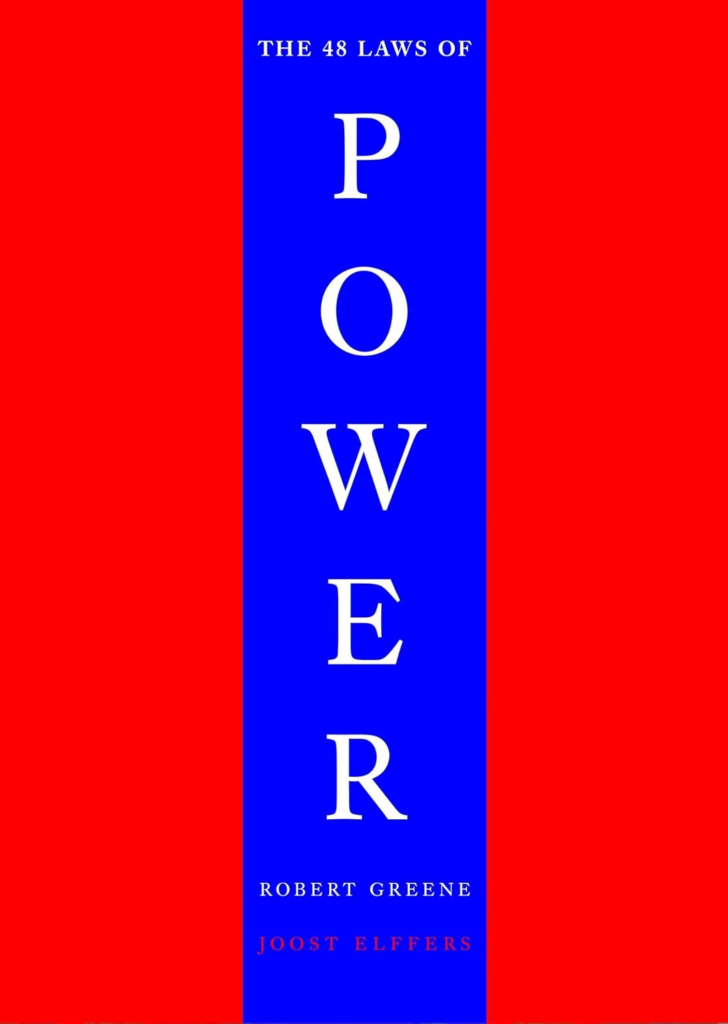
The 48 Laws of Power is a nonfiction book by American author Robert Greene, first published in 1998 by Viking. The book examines the acquisition, maintenance, observation, and defense of power through a collection of 48 propositions, or “laws,” illustrated by historical anecdotes and examples drawn from politics, warfare, business, court life, diplomacy, entertainment, and other competitive environments.
Greene’s first book, The 48 Laws of Power, draws on approximately three thousand years of historical writing and examples. Among the thinkers and historical figures referenced in the work are Niccolò Machiavelli, Sun Tzu, Carl von Clausewitz, Queen Elizabeth I, Henry Kissinger, Louis XIV, P. T. Barnum, and numerous other political leaders, military commanders, artists, courtiers, entrepreneurs, and strategists.
The book is organized into 48 chapters, with each chapter devoted to one law. The chapters generally contain historical examples illustrating the law, examples of people who violated or followed it, and commentary concerning its practical application. Some chapters also include a “reversal,” describing circumstances in which the stated principle may not apply.
Although the title presents the propositions as “laws,” the book does not establish them through scientific experimentation or systematic empirical research. Critics have therefore treated them as strategic maxims, historical observations, or rhetorical propositions rather than universal laws of human behavior. Stanford professor Jeffrey Pfeffer, for example, has criticized Greene’s reliance on isolated historical examples rather than systematic research.
The book has nevertheless become a highly influential work of popular literature on power and strategy. It has been widely read in business, entertainment, popular culture, and other environments where readers are interested in competition, hierarchy, influence, negotiation, and interpersonal strategy.
Book information
| Field | Details |
|---|---|
| Title | The 48 Laws of Power |
| Author | Robert Greene |
| Designer / collaborator | Joost Elffers |
| Country | United States |
| Language | English |
| Genre | Nonfiction, self-help, strategy |
| Subject | Power, influence, strategy, human behavior |
| Publisher | Viking |
| First published | 1998 |
| Original publication place | New York |
| Original ISBN | 0-670-88146-5 |
| Common paperback ISBN | 0-14-028019-7 |
| First-edition pages | Approximately 430–452, depending on catalog/edition |
| Followed by | The Art of Seduction |
| Format | Hardcover, paperback, ebook, audiobook |
WorldCat records the first English edition as a 1998 Viking publication by Robert Greene and Joost Elffers. Open Library’s bibliographic record identifies the first edition as a 1998 Viking publication.
Overview
The 48 Laws of Power is essentially a study of how power operates between people.
Greene approaches power not primarily as a moral concept but as a social and strategic phenomenon.
His underlying question is:
How do people gain influence, protect their position, and respond when other people attempt to control them?
The book answers this question through 48 principles.
Some of the laws concern:
- reputation;
- timing;
- discretion;
- appearance;
- information;
- alliances;
- competition;
- persuasion;
- attention;
- uncertainty;
- adaptability;
- emotional control.
Others are considerably more aggressive, advocating strategies involving deception, concealment, retaliation, manipulation, or the destruction of an opponent’s ability to recover.
The result is a deliberately provocative book.
It can be read in at least three different ways:
- as a manual for gaining power;
- as a guide for recognizing power tactics used by others;
- as a historical collection of recurring strategies in competitive human environments.
Greene himself has emphasized that the book can be used defensively—to recognize and protect oneself from power games—as well as offensively.
The central idea of power
Greene’s concept of power is broader than political authority.
Power can arise whenever one person or group has greater ability than another to influence:
- decisions;
- resources;
- information;
- opportunities;
- reputation;
- relationships;
- access;
- attention;
- organizational outcomes.
A simplified representation of the book’s worldview is:
                 POWER
                   │
       ┌───────────┼───────────┐
       │           │           │
       ▼           ▼           ▼
  INFORMATION   REPUTATION   RELATIONSHIPS
       │           │           │
       └───────────┼───────────┘
                   ↓
              PERCEPTION
                   ↓
              INFLUENCE
                   ↓
               POSITION
                   ↓
                POWER
This is a conceptual representation of Greene’s approach, not a scientific formula.
The 48 Laws of Power
Law 1 — Never Outshine the Master
Greene argues that people in positions of authority can feel threatened when a subordinate appears excessively talented, successful, intelligent, or ambitious.
The strategic principle is to allow superiors to retain a sense of status and importance.
The law is illustrated through historical examples involving courts and political hierarchies.
Law 2 — Never Put Too Much Trust in Friends; Learn How to Use Enemies
Greene questions the assumption that friendship automatically makes someone a reliable ally.
Friends can become jealous, complacent, or emotionally complicated, while former opponents may sometimes have stronger incentives to prove their loyalty.
The broader lesson concerns incentives rather than labels.
Law 3 — Conceal Your Intentions
According to Greene, openly revealing one’s complete plan can allow competitors to interfere with it.
Strategic ambiguity can therefore preserve freedom of action.
The law emphasizes the value of controlling information.
Law 4 — Always Say Less Than Necessary
Greene argues that excessive speech can reveal information, uncertainty, emotion, or intention.
Speaking less can make a person appear more controlled and can reduce opportunities for others to exploit their words.
Law 5 — So Much Depends on Reputation—Guard It With Your Life
Reputation is treated as a form of social capital.
A strong reputation can create trust and authority before a person has even spoken, while a damaged reputation can make otherwise effective actions more difficult.
Law 6 — Court Attention at All Cost
Greene argues that invisibility can limit influence.
Attention can create recognition, and recognition can create opportunities for influence.
The law therefore treats visibility as an important strategic resource.
Law 7 — Get Others to Do the Work for You, but Always Take the Credit
This is one of the book’s most controversial laws.
Greene describes situations in which powerful individuals used the labor or expertise of others while associating the resulting achievement with themselves.
The law illustrates the book’s deliberately amoral treatment of power rather than presenting a conventional ethical recommendation.
Law 8 — Make Other People Come to You—Use Bait If Necessary
Greene argues that controlling the circumstances of interaction can create strategic advantage.
Instead of continually pursuing others, a person may structure situations so that others approach them.
Law 9 — Win Through Your Actions, Never Through Argument
The law argues that demonstrations can be more persuasive than verbal disputes.
Rather than trying to defeat someone through endless argument, Greene emphasizes producing a visible result.
Law 10 — Infection: Avoid the Unhappy and Unlucky
Greene argues that emotional states and behavioral patterns can spread between people.
The law recommends caution in relationships characterized by chronic instability, destructive behavior, or repeated crisis.
The wording is controversial because it can encourage readers to treat vulnerable people as sources of contamination rather than complexity.
Law 11 — Learn to Keep People Dependent on You
The law concerns indispensability.
Greene argues that a person’s position can become stronger when others depend on their expertise, access, skills, or resources.
Law 12 — Use Selective Honesty and Generosity to Disarm Your Victim
Greene describes honesty and generosity as potential strategic tools.
A carefully chosen act of openness can lower another person’s defenses.
The word “victim” reflects the book’s deliberately adversarial vocabulary.
Law 13 — When Asking for Help, Appeal to People’s Self-Interest, Never to Their Mercy or Gratitude
The law emphasizes incentives.
Instead of asking someone to help because it would be morally admirable, Greene argues that people are often more responsive when they can see a benefit to themselves.
Law 14 — Pose as a Friend, Work as a Spy
Information is one of the recurring sources of power in Greene’s framework.
The law describes methods for learning about other people’s intentions, motivations, strengths, weaknesses, and relationships.
Law 15 — Crush Your Enemy Totally
Greene argues that leaving an opponent with the ability and motivation to retaliate can create future danger.
The law advocates decisive resolution of serious conflicts.
It is among the most controversial propositions in the book because of its explicitly ruthless language.
Law 16 — Use Absence to Increase Respect and Honor
Scarcity can increase perceived value.
Greene applies this principle to social relationships, status, and visibility.
Excessive availability, he argues, can sometimes reduce perceived importance.
Law 17 — Keep Others in Suspended Terror: Cultivate an Air of Unpredictability
Predictability can make behavior easier to anticipate.
Greene argues that controlled unpredictability can make others more cautious when dealing with a person.
Law 18 — Do Not Build Fortresses to Protect Yourself—Isolation Is Dangerous
Although many of the book’s laws emphasize defensive behavior, this one warns against excessive isolation.
Information, alliances, and social connections can be essential sources of protection.
Law 19 — Know Who You’re Dealing With—Do Not Offend the Wrong Person
Not every opponent reacts in the same way.
Greene argues that strategy must account for individual personality, position, resources, and potential consequences.
Law 20 — Do Not Commit to Anyone
The law recommends preserving strategic independence.
Greene argues that becoming permanently aligned with one faction can reduce flexibility and bargaining power.
Law 21 — Play a Sucker to Catch a Sucker—Seem Dumber Than Your Mark
The law describes the strategic use of underestimation.
A person who appears less capable than they actually are may encourage others to lower their defenses.
Law 22 — Use the Surrender Tactic: Transform Weakness Into Power
Greene argues that fighting when one’s position is weak can make matters worse.
Temporary surrender or retreat can sometimes create time and space for a later strategic response.
Law 23 — Concentrate Your Forces
Rather than spreading resources across too many objectives, Greene recommends concentrating effort where it can produce the greatest effect.
The principle applies to:
- money;
- attention;
- relationships;
- projects;
- skills;
- strategic objectives.
Law 24 — Play the Perfect Courtier
The “courtier” is Greene’s model of a person who understands hierarchy and social dynamics.
The perfect courtier:
- avoids unnecessary offense;
- understands status;
- communicates tactfully;
- observes social rules;
- manages appearances;
- knows when to speak and when to remain silent.
Law 25 — Re-Create Yourself
Greene argues that identity is not necessarily fixed.
A person can consciously shape:
- appearance;
- reputation;
- behavior;
- public image;
- professional identity.
This law is concerned with self-reinvention.
Law 26 — Keep Your Hands Clean
Powerful people often attempt to distance themselves from unpopular or controversial actions.
Greene describes the strategic value of maintaining an appearance of innocence or responsibility while difficult actions are carried out indirectly.
Law 27 — Play on People’s Need to Believe to Create a Cultlike Following
People often seek meaning, certainty, community, and belonging.
Greene argues that leaders can gain influence by providing a compelling narrative around which followers organize themselves.
The law is particularly relevant to charismatic leadership and mass persuasion.
Law 28 — Enter Action With Boldness
Hesitation can create uncertainty.
Greene argues that decisive action can communicate confidence and reduce opportunities for opponents to exploit indecision.
Law 29 — Plan All the Way to the End
Strategic action should consider consequences beyond the immediate objective.
Greene encourages readers to ask:
- What happens next?
- What happens after that?
- Who benefits?
- What new problems will this create?
- What happens if the plan succeeds?
Law 30 — Make Your Accomplishments Seem Effortless
Visible effort can sometimes reduce perceptions of natural mastery.
Greene therefore recommends presenting successful outcomes with an appearance of ease.
Law 31 — Control the Options: Get Others to Play With the Cards You Deal
Influence can operate through the structure of choices themselves.
Instead of controlling another person’s final decision directly, a strategist may influence the available options.
Law 32 — Play to People’s Fantasies
People do not always respond to objective facts alone.
Greene argues that hopes, aspirations, dreams, and fantasies can be powerful sources of influence.
Law 33 — Discover Each Man’s Thumbscrew
A “thumbscrew” represents an individual’s particular vulnerability.
It may involve:
- insecurity;
- ambition;
- vanity;
- fear;
- desire for recognition;
- financial dependence;
- emotional attachment.
The law emphasizes understanding what motivates an individual.
Law 34 — Be Royal in Your Own Fashion: Act Like a King to Be Treated Like One
Greene argues that people’s behavior toward an individual can be influenced by the individual’s own presentation of self-worth and status.
Confidence and dignity can affect how others respond.
Law 35 — Master the Art of Timing
Timing is treated as a strategic resource.
The same action can produce very different results depending on when it is taken.
Law 36 — Disdain Things You Cannot Have: Ignoring Them Is the Best Revenge
Greene argues that visible frustration can increase the perceived importance of something.
Sometimes refusing to give an unavailable object attention reduces its psychological power.
Law 37 — Create Compelling Spectacles
Visual presentation can communicate ideas more powerfully than abstract explanation.
Greene emphasizes ceremony, symbolism, drama, and memorable presentation as tools of influence.
Law 38 — Think as You Like but Behave Like Others
Greene distinguishes private thought from public behavior.
In environments governed by strong social conventions, openly violating those conventions can produce unnecessary resistance.
Law 39 — Stir Up Waters to Catch Fish
Emotional agitation can make people less rational and more predictable.
The law describes the strategic exploitation of emotional instability.
Law 40 — Despise the Free Lunch
Greene argues that apparently free benefits can carry hidden costs.
The law emphasizes independence and awareness of what is exchanged in social and professional relationships.
Law 41 — Avoid Stepping Into a Great Man’s Shoes
Following a famous predecessor creates a difficult comparison.
Greene recommends establishing a distinct identity rather than living entirely under another person’s reputation.
Law 42 — Strike the Shepherd and the Sheep Will Scatter
Groups may sometimes depend heavily on a central leader.
The law describes the strategic importance of identifying the individual who organizes or influences a group.
Law 43 — Work on the Hearts and Minds of Others
Coercion can produce compliance without genuine loyalty.
Greene argues that understanding people’s emotions, desires, and values can create deeper influence.
Law 44 — Disarm and Infuriate With the Mirror Effect
The “mirror effect” involves reflecting another person’s behavior, style, or tactics back to them.
Greene presents mirroring as a way of creating psychological uncertainty or revealing another person’s behavior.
Law 45 — Preach the Need for Change, but Never Reform Too Much at Once
People may support change in theory but resist abrupt disruption.
Greene therefore recommends gradual transformation when dealing with established systems.
Law 46 — Never Appear Too Perfect
Excessive perfection can create envy or resentment.
Greene argues that occasionally revealing ordinary human imperfections can make success less threatening to others.
Law 47 — Do Not Go Past the Mark You Aimed For; In Victory, Learn When to Stop
Success can create overconfidence.
The law warns that continuing to pursue advantage after achieving an objective can turn victory into failure.
Law 48 — Assume Formlessness
The final law recommends adaptability.
Instead of becoming rigidly attached to one strategy, identity, structure, or position, Greene argues that flexibility makes a person harder to predict and defeat.
The book therefore ends with a principle that contrasts with the apparent rigidity of the title:
The ultimate strategy is adaptability.
The 48 laws at a glance
| No. | Law | Central idea |
|---|---|---|
| 1 | Never Outshine the Master | Manage hierarchy |
| 2 | Never Put Too Much Trust in Friends | Understand incentives |
| 3 | Conceal Your Intentions | Control information |
| 4 | Always Say Less Than Necessary | Use restraint |
| 5 | Guard Your Reputation | Protect social capital |
| 6 | Court Attention | Maintain visibility |
| 7 | Get Others to Do the Work | Leverage resources |
| 8 | Make Others Come to You | Control interaction |
| 9 | Win Through Actions | Demonstrate rather than argue |
| 10 | Avoid the Unhappy and Unlucky | Manage destructive associations |
| 11 | Keep People Dependent | Become valuable |
| 12 | Use Selective Honesty | Lower defenses |
| 13 | Appeal to Self-Interest | Understand incentives |
| 14 | Pose as a Friend, Work as a Spy | Gather information |
| 15 | Crush Your Enemy Totally | Prevent retaliation |
| 16 | Use Absence | Create scarcity |
| 17 | Cultivate Unpredictability | Remain difficult to anticipate |
| 18 | Avoid Isolation | Maintain networks |
| 19 | Know Who You’re Dealing With | Adapt to individuals |
| 20 | Do Not Commit | Preserve flexibility |
| 21 | Seem Dumber Than Your Mark | Encourage underestimation |
| 22 | Use Surrender | Turn weakness into time |
| 23 | Concentrate Your Forces | Focus resources |
| 24 | Play the Perfect Courtier | Navigate hierarchy |
| 25 | Re-Create Yourself | Shape identity |
| 26 | Keep Your Hands Clean | Manage responsibility and appearance |
| 27 | Play on People’s Need to Believe | Build loyalty |
| 28 | Enter Action With Boldness | Act decisively |
| 29 | Plan to the End | Think beyond the immediate goal |
| 30 | Make Accomplishments Seem Effortless | Manage perception |
| 31 | Control the Options | Shape choices |
| 32 | Play to People’s Fantasies | Understand aspirations |
| 33 | Discover Each Person’s Thumbscrew | Understand vulnerabilities |
| 34 | Act Like a King | Project self-respect |
| 35 | Master Timing | Choose the right moment |
| 36 | Disdain What You Cannot Have | Reduce psychological attachment |
| 37 | Create Compelling Spectacles | Use symbolism |
| 38 | Think Freely, Behave Strategically | Understand social conventions |
| 39 | Stir Up Waters | Exploit emotional instability |
| 40 | Despise the Free Lunch | Recognize hidden costs |
| 41 | Avoid Great Men’s Shoes | Build an independent identity |
| 42 | Strike the Shepherd | Understand group leadership |
| 43 | Work on Hearts and Minds | Build emotional influence |
| 44 | Use the Mirror Effect | Reflect behavior |
| 45 | Change Gradually | Manage resistance |
| 46 | Never Appear Too Perfect | Reduce envy |
| 47 | Know When to Stop | Control ambition |
| 48 | Assume Formlessness | Remain adaptable |
Infographic: The architecture of the 48 laws
The laws can be grouped conceptually into several recurring themes.
                    THE 48 LAWS OF POWER
                             │
       ┌─────────────────────┼─────────────────────┐
       │                     │                     │
       ▼                     ▼                     ▼
   PERCEPTION             PEOPLE              STRATEGY
       │                     │                     │
 Reputation              Incentives             Timing
 Attention               Emotions               Planning
 Appearance              Relationships          Flexibility
 Mystery                 Vulnerabilities        Concentration
       │                     │                     │
       └─────────────────────┼─────────────────────┘
                             ▼
                         INFLUENCE
                             │
                             ▼
                           POWER
These categories are an interpretive grouping rather than categories supplied by Greene himself.
The book’s historical sources
Greene draws from a wide range of historical and literary material.
Among the intellectual influences and figures associated with the book are:
Niccolò Machiavelli
The Renaissance political thinker and author of The Prince provides one of the most obvious intellectual precedents for Greene’s examination of political power and strategy.
Sun Tzu
The ancient Chinese military strategist is used to illustrate the importance of indirect strategy, information, positioning, and deception.
Carl von Clausewitz
The Prussian military theorist contributes a military-strategic perspective on conflict and objectives.
Queen Elizabeth I
Greene uses historical rulers to illustrate court politics, reputation, alliances, and political survival.
Louis XIV
The court of Versailles provides examples concerning status, attention, hierarchy, and control.
P. T. Barnum
Barnum’s career provides examples involving publicity, spectacle, attention, and public perception.
Other historical figures
The book also draws upon statesmen, generals, artists, entrepreneurs, courtiers, con artists, and political operators.
WorldCat describes the book as a synthesis of approximately 3,000 years of historical material and specifically identifies Machiavelli, Sun Tzu, Clausewitz, Queen Elizabeth I, Henry Kissinger, and P. T. Barnum among its examples.
Historical anecdote as method
Greene’s principal method is historical storytelling.
Rather than presenting statistical studies, the book repeatedly follows a pattern:
Historical situation
        ↓
Person faces a power problem
        ↓
Strategic decision
        ↓
Outcome
        ↓
Lesson
        ↓
Generalized "law"
This makes the book highly readable.
It also creates one of its major intellectual limitations.
A successful historical strategy does not necessarily establish a universal rule.
For example:
Successful historical example
          ≠
Universal law of human behavior
This distinction is central to understanding the book critically.
The role of storytelling
The historical stories serve several functions.
They:
- make abstract ideas memorable;
- provide concrete examples;
- dramatize conflict;
- create contrasts between successful and unsuccessful behavior;
- allow readers to visualize power dynamics.
This storytelling approach contributes substantially to the book’s popularity.
It also gives the book a literary quality that distinguishes it from conventional management manuals.
Power as an amoral concept
One of Greene’s most important claims is that power itself is amoral.
In this framework, power is treated as a capacity rather than as a moral virtue.
A person can use power for:
- constructive purposes;
- destructive purposes;
- personal survival;
- organizational leadership;
- political control;
- self-protection.
Greene has explained that the book is intended not only for people seeking power but also for people who want to recognize power strategies being used against them.
This distinction is important because the book’s title and language can make it appear to be a straightforward manual for manipulation, whereas its stated scope is broader.
The book’s deliberately provocative style
The writing style of The 48 Laws of Power is unusually direct.
The laws are phrased as commands:
- Never outshine the master.
- Conceal your intentions.
- Always say less than necessary.
- Master the art of timing.
- Assume formlessness.
This gives the book the tone of a strategic handbook.
The style also creates an important rhetorical effect.
Readers are encouraged to think in terms of:
position → opponent → objective → strategy → outcome.
That perspective is very different from books that begin with cooperation, morality, or emotional well-being.
The visual design
Joost Elffers was responsible for the book’s design and packaging.
The first edition combined historical text with visually distinctive typography, marginal quotations, illustrations, and graphic elements.
WorldCat describes the original book as being laid out in black and red and containing “word sculptures” alongside historical material.
The visual design became part of the book’s identity rather than merely an accessory to the text.
The psychology of power
Although The 48 Laws of Power is not an academic psychology textbook, many of its laws revolve around recognizable psychological phenomena.
Status
People often respond to perceived differences in status.
Reciprocity
Giving something can create expectations of return.
Scarcity
Limited availability can increase perceived value.
Reputation
Past behavior affects expectations about future behavior.
Social proof
People frequently look to others when deciding what is acceptable or valuable.
Fear
Fear can alter decision-making and behavior.
Vanity
Desire for recognition can influence choices.
Identity
People may defend identities even when doing so conflicts with their immediate interests.
Greene packages these phenomena as strategic observations rather than as formal psychological theories.
Reputation as a form of power
One of the strongest recurring themes in the book is reputation.
Greene treats reputation as something that operates before direct interaction.
Consider the difference between:
UNKNOWN PERSON
      ↓
Must prove credibility
      ↓
Trust develops slowly
and:
ESTABLISHED REPUTATION
      ↓
Others already have expectations
      ↓
Interaction begins with an advantage
This is why the fifth law places such strong emphasis on protecting reputation.
A reputation can influence:
- trust;
- opportunities;
- alliances;
- negotiations;
- authority;
- access.
Information as power
Several laws revolve around controlling information.
Information can include:
- intentions;
- weaknesses;
- ambitions;
- relationships;
- plans;
- preferences;
- fears;
- opportunities.
Greene’s model can be summarized as:
Information
     ↓
Understanding
     ↓
Prediction
     ↓
Strategic advantage
     ↓
Influence
This explains the prominence of secrecy, observation, and information gathering throughout the book.
The importance of perception
A recurring theme is that what people perceive can matter almost as much as what objectively exists.
A person may have substantial ability but little influence if nobody recognizes it.
Conversely, a person may possess less actual power than others believe.
This produces one of the book’s recurring equations:
Actual ability
      +
Perceived ability
      +
Reputation
      =
Social influence
This is a conceptual representation, not a quantitative formula.
Timing
Greene repeatedly returns to the importance of timing.
An action can be:
- too early;
- too late;
- appropriately timed.
The same proposal may be rejected one month and accepted the next.
The same confrontation may be disastrous at one moment and necessary at another.
The same opportunity may be valuable today and worthless tomorrow.
Thus:
ACTION + WRONG TIMING = POSSIBLE FAILURE

ACTION + RIGHT TIMING = POSSIBLE ADVANTAGE
Timing is therefore treated as a strategic variable rather than a background circumstance.
Adaptability and Law 48
The final law, “Assume Formlessness,” is arguably the book’s most flexible principle.
Instead of recommending one permanent personality or strategy, Greene argues that rigid patterns make people predictable.
The principle can be visualized as:
Rigid strategy
     ↓
Predictability
     ↓
Others adapt to you
     ↓
Vulnerability


Flexible strategy
     ↓
Uncertainty
     ↓
Continuous adaptation
     ↓
Greater strategic options
This final law provides a conceptual conclusion to the book.
Power, in Greene’s framework, does not belong permanently to a single tactic.
It belongs to the ability to change tactics.
A conceptual map of the book
                        POWER
                          │
        ┌─────────────────┼─────────────────┐
        │                 │                 │
        ▼                 ▼                 ▼
    PERCEPTION        INFORMATION        PEOPLE
        │                 │                 │
        ▼                 ▼                 ▼
    Reputation        Secrecy           Emotion
    Attention         Knowledge         Desire
    Appearance        Observation       Incentives
        │                 │                 │
        └─────────────────┼─────────────────┘
                          ▼
                       STRATEGY
                          │
             ┌────────────┼────────────┐
             │            │            │
             ▼            ▼            ▼
           Timing       Position    Adaptability
             │            │            │
             └────────────┼────────────┘
                          ▼
                       OUTCOME
The book’s relationship to Machiavelli
The title and subject matter naturally invite comparison with Niccolò Machiavelli’s The Prince.
Both works discuss:
- political power;
- manipulation;
- reputation;
- fear;
- alliances;
- appearances;
- strategic behavior.
However, the two books differ substantially in structure and historical context.
The Prince is a Renaissance political treatise concerned primarily with rulers and political government.
The 48 Laws of Power is a modern popular work that expands the discussion of power into:
- workplaces;
- relationships;
- business;
- social life;
- entertainment;
- organizational hierarchies.
Greene therefore transforms a classical political question into a much broader modern strategy manual.
Criticism
The 48 Laws of Power has generated substantial criticism, particularly concerning its morality, evidence base, and treatment of human relationships.
Moral criticism
Some readers regard the book as encouraging manipulation, deception, exploitation, and ruthless behavior.
This criticism is particularly directed at laws such as:
- Law 3 — Conceal Your Intentions;
- Law 7 — Get Others to Do the Work for You;
- Law 12 — Use Selective Honesty;
- Law 15 — Crush Your Enemy Totally;
- Law 33 — Discover Each Man’s Thumbscrew;
- Law 39 — Stir Up Waters.
Kirkus Reviews characterized the book as excessively ruthless and deceptive and questioned whether Greene was presenting his worldview seriously or satirically.
Criticism of the “laws”
A second criticism concerns the word law itself.
Scientific laws normally emerge from systematic observation and testing.
Greene’s propositions are instead derived primarily from historical anecdotes and interpretations.
Critics therefore argue that the 48 principles should be regarded as heuristics or maxims, not universal laws.
Stanford professor Jeffrey Pfeffer has specifically criticized the book’s reliance on isolated examples rather than solid empirical research.
Internal contradictions
Some laws appear to conflict with one another.
For example:
Law 6: Court attention.
Law 38: Think as you like but behave like others.
One encourages visibility, while the other warns against unnecessarily violating social conventions.
Similarly:
Law 20: Do not commit to anyone.
can conflict with situations in which long-term alliances and loyalty produce substantial benefits.
Greene’s approach is to treat the laws as context-dependent strategies rather than rigid rules.
Critics have nevertheless argued that these contradictions weaken the claim implied by the word “laws.” Kirkus Reviews highlighted such contradictions in its contemporary review.
The book as satire
One unusual aspect of the book’s reception is that some critics have wondered whether it should partly be read as satire.
Kirkus Reviews famously framed its review around this possibility, suggesting that if Greene were serious the book could be viewed as distasteful, while if he were not serious it could be interpreted as a sophisticated satire of power-seeking behavior.
Greene, however, has consistently discussed the book as a serious study of power.
Defensive reading
Not all readers use the book as an instruction manual.
Another approach is to read it defensively.
For example:
Law 3 — Conceal Your Intentions
can be read as:
Recognize that other people may not reveal their full intentions.
Law 5 — Guard Your Reputation
can become:
Understand how reputation affects professional and social relationships.
Law 33 — Discover Each Man’s Thumbscrew
can become:
Recognize that people have vulnerabilities that others may exploit.
Law 35 — Master the Art of Timing
can become:
Pay attention to context before acting.
This reading treats the book partly as a field guide to recognizing strategic behavior, rather than a command to manipulate everyone encountered.
Reception
The book became a commercial bestseller and developed a substantial cultural following.
The book has reportedly sold more than 1.2 million copies in the United States and has been translated into numerous languages. It has also been described as a “cult classic” by Fast Company.
Its audience has extended well beyond traditional business readers.
The book has been discussed or referenced by figures in:
- music;
- entertainment;
- business;
- sports;
- popular culture.
Rapper 50 Cent became particularly associated with Greene’s work and later collaborated with him on The 50th Law. The book has also been referenced in popular music and discussed by numerous entertainers.
Cultural influence
The book’s influence is partly visible in its unusually broad readership.
It has been associated with:
- entrepreneurs;
- executives;
- entertainers;
- musicians;
- athletes;
- students;
- political commentators;
- prisoners and prison-library readers.
Its language has also become part of popular internet discussions about:
- manipulation;
- leadership;
- social hierarchy;
- dating;
- business;
- negotiation;
- workplace politics.
The popularity of the book does not establish the universal validity of its propositions, but it demonstrates the continuing public interest in questions of power and influence.
Robert Greene
Robert Greene is an American author known for books examining power, strategy, mastery, human behavior, and historical patterns.
He was born in Los Angeles, California, in 1959.
Before becoming a full-time author, Greene worked in a variety of fields, including writing, editing, and the entertainment industry.
His experience working in Hollywood contributed to his interest in informal hierarchies, ambition, competition, and the behavior of people attempting to gain influence.
Greene’s first major book was The 48 Laws of Power, published in 1998.
It was followed by:
- The Art of Seduction (2001)
- The 33 Strategies of War (2006)
- The 50th Law (2009), with 50 Cent
- Mastery (2012)
- The Laws of Human Nature (2018)
- The Daily Laws (2021)
Robert Greene’s background
Greene has described himself as having worked numerous jobs before becoming an author.
His professional background included work in Hollywood, where he observed the ways individuals attempted to navigate competition, status, and informal power structures.
This experience contributed to his decision to write about power as something that exists not only in governments but also in everyday organizations and relationships.
The historical orientation of The 48 Laws of Power reflects this perspective: Greene looks for recurring patterns across different periods and cultures.
Greene’s major works
| Year | Book | Central subject |
|---|---|---|
| 1998 | The 48 Laws of Power | Power and influence |
| 2001 | The Art of Seduction | Seduction and interpersonal influence |
| 2006 | The 33 Strategies of War | Strategy and conflict |
| 2009 | The 50th Law | Fearlessness and self-reliance |
| 2012 | Mastery | Expertise and achievement |
| 2018 | The Laws of Human Nature | Human behavior |
| 2021 | The Daily Laws | Daily principles derived from Greene’s work |
The 48 Laws of Power was Greene’s first book and established the themes that would continue throughout his later writing.
Joost Elffers
Joost Elffers is a Dutch-born publisher and book designer known for creating visually distinctive illustrated and conceptual books.
For The 48 Laws of Power, Elffers was responsible for the design and visual presentation.
His contribution is particularly important because the book is not simply a conventional text.
Its visual presentation—typography, quotations, illustrations, margins, and layout—forms part of the reading experience.
WorldCat identifies the work as written by Robert Greene and designed by Joost Elffers.
Publication history
The first edition appeared in 1998 through Viking.
Later editions were published by Penguin and other imprints in different markets and formats.
The work has appeared in:
- hardcover;
- paperback;
- ebook;
- audiobook;
- special editions.
Open Library records the first edition as a 1998 Viking publication, while later Penguin editions have different pagination and ISBNs.
The book’s evolution in popular culture
The cultural meaning of The 48 Laws of Power has changed somewhat over time.
When originally published, it could be read primarily as a provocative business and strategy book.
As Greene’s reputation grew, the book became associated with a wider internet culture interested in:
- social strategy;
- dominance;
- negotiation;
- status;
- psychological influence;
- personal branding.
Short-form social media has also encouraged readers to extract individual laws from the larger historical context.
This creates a potential problem: a law that appears straightforward when presented as a one-line quotation can have a considerably more nuanced meaning when read alongside Greene’s historical examples.
The 48 laws as a decision framework
One way of interpreting the book is to convert its principles into five questions.
              BEFORE ACTING
                    │
          ┌─────────┼─────────┐
          ▼         ▼         ▼
       PEOPLE     TIMING    PERCEPTION
          │         │         │
          ▼         ▼         ▼
     Who matters? When?    How will this
     What do they          be perceived?
     want?
          │         │         │
          └─────────┼─────────┘
                    ▼
                OPTIONS
                    │
                    ▼
                CONSEQUENCES
                    │
                    ▼
                  ACTION
This interpretation emphasizes strategic awareness rather than manipulation.
Power, ethics, and responsibility
One of the most important questions raised by the book is whether strategic effectiveness and ethical behavior are the same thing.
They are not necessarily the same.
A tactic may be effective in achieving an immediate objective while damaging:
- trust;
- relationships;
- reputation;
- organizational culture;
- long-term cooperation.
This creates an important distinction:
TACTICALLY EFFECTIVE
        ≠
ETHICALLY JUSTIFIED
        ≠
LONG-TERM EFFECTIVE
Readers therefore need to distinguish between:
- what Greene says powerful people do;
- what Greene recommends strategically;
- what a reader considers ethically acceptable;
- what actually works in a particular environment.
These are four different questions.
Why the book remains controversial
The controversy surrounding The 48 Laws of Power is not accidental.
It is built into the book’s premise.
Greene deliberately asks readers to look at human relationships through the lens of power.
That perspective can be illuminating in environments where competition and hierarchy genuinely matter.
But if applied indiscriminately, it can also encourage a reader to interpret ordinary relationships as constant strategic contests.
This is one reason the book can produce radically different reactions.
One reader may see:
a useful guide to recognizing manipulation.
Another may see:
a handbook for manipulation.
Another may see:
a historical study of recurring power strategies.
All three readings have emerged in the book’s reception.
A balanced way to read the book
A careful reading can separate the book into three layers.
Layer 1 — Historical examples
Ask:
What actually happened in the historical case?
Layer 2 — Greene’s interpretation
Ask:
What lesson does Greene extract from the event?
Layer 3 — Generalization
Ask:
Does this lesson really apply universally?
This produces a more critical reading:
HISTORICAL EVENT
       ↓
GREENE'S INTERPRETATION
       ↓
"LAW"
       ↓
CRITICAL QUESTION
       ↓
CONTEXTUAL APPLICATION
This approach preserves the book’s practical value while avoiding the assumption that every law is universally valid.
The 48 Laws as a “mirror”
The title can also be interpreted metaphorically.
The book does not merely tell readers how to pursue power.
It forces readers to ask:
- Do I behave this way?
- Have others behaved this way toward me?
- When have I been manipulated?
- What motivates people around me?
- How much of social life involves status?
- Where does ambition become destructive?
- When does strategy become manipulation?
- When does self-protection become paranoia?
In this reading, the book becomes less a simple instruction manual and more a mirror for examining human behavior.
The central paradox of the book
The deepest paradox in The 48 Laws of Power is that the book teaches readers to understand power while simultaneously warning them—implicitly through its examples—that power can be unstable.
A person can rise through:
- strategy;
- reputation;
- alliances;
- attention;
- timing.
But the same person can fall through:
- overconfidence;
- envy;
- excessive ambition;
- poor timing;
- damaged reputation;
- failure to adapt.
This is particularly visible in Law 47, which warns against going beyond the point of victory, and Law 48, which emphasizes adaptability.
Thus the book’s final lessons are not simply about domination.
They are also about restraint and flexibility.
The 48 Laws in four broad stages
For readers approaching the book for the first time, its laws can be understood as a strategic cycle:
          1. OBSERVE
              │
              ▼
        Understand people
        Understand hierarchy
        Understand incentives
              │
              ▼
          2. POSITION
              │
              ▼
        Protect reputation
        Control information
        Choose alliances
              │
              ▼
          3. ACT
              │
              ▼
        Choose timing
        Influence perception
        Concentrate resources
              │
              ▼
          4. ADAPT
              │
              ▼
        Learn from outcomes
        Avoid overreach
        Change strategy
This four-stage framework is an interpretive synthesis rather than Greene’s own chapter structure.
Frequently asked questions
What is The 48 Laws of Power about?
It is a nonfiction book by Robert Greene examining strategies, patterns, and historical examples involving power, influence, hierarchy, reputation, competition, and human behavior.
Who wrote The 48 Laws of Power?
It was written by Robert Greene and designed by Joost Elffers.
When was it published?
The first edition was published by Viking in 1998.
Are the 48 laws scientifically proven?
No. The book’s “laws” are primarily historical and strategic propositions. Critics have specifically questioned the lack of systematic empirical evidence behind Greene’s generalizations.
Is The 48 Laws of Power a psychology book?
It is better classified as popular nonfiction/self-help and strategy rather than academic psychology.
Is the book about manipulation?
Manipulation is an important theme in several laws, but the book is broader than manipulation. It also discusses reputation, timing, observation, social positioning, adaptability, and self-protection.
Is the book morally neutral?
Greene presents power as an essentially amoral phenomenon, but some individual laws advocate behavior that many readers regard as unethical. This tension is a major part of the book’s reception.
Why is the book controversial?
Critics have objected to its ruthless language, its treatment of relationships as power contests, its historical generalizations, and the apparent contradictions among some laws.
What is the most important idea in the book?
There is no single officially designated “most important” law. Taken as a whole, the book emphasizes awareness of power dynamics, control of perception and information, strategic timing, and adaptability.
What is Law 48?
Law 48 is “Assume Formlessness.” It argues for adaptability rather than rigid attachment to a single strategy or identity.
Legacy
The 48 Laws of Power has become one of the most recognizable modern books about power and strategy.
Its continuing popularity is unusual because the book sits between several genres. It is simultaneously:
- a historical anthology;
- a strategy manual;
- a work of popular psychology;
- a self-help book;
- a study of influence;
- and, for some readers, a provocative commentary on human nature.
Its language has entered popular culture, particularly through business, entertainment, music, social media, and discussions of interpersonal strategy.
At the same time, the book remains controversial because its historical examples are used to support broad claims about human behavior, and because some of its recommendations openly conflict with conventional ideas about trust, cooperation, and ethics. Critics have pointed both to these moral concerns and to the lack of systematic evidence behind the book’s supposed “laws.”
Perhaps the most useful way to understand The 48 Laws of Power is therefore not as a scientific textbook containing 48 universal laws.
It is better understood as Robert Greene’s deliberately provocative interpretation of recurring strategies of power, illustrated through centuries of history.
Its lasting question is not simply:
“How can I become powerful?”
It is also:
“How does power actually operate around me—and what should I do when I encounter it?”
See also
- [[Robert Greene]]
- [[The Art of Seduction]]
- [[The 33 Strategies of War]]
- [[The 50th Law]]
- [[Mastery]]
- [[The Laws of Human Nature]]
- [[The Daily Laws]]
- [[Niccolò Machiavelli]]
- [[The Prince]]
- [[Sun Tzu]]
- [[Carl von Clausewitz]]
- [[Power (social and political)]]
- [[Social influence]]
- [[Persuasion]]
- [[Leadership]]
- [[Negotiation]]
- [[Strategy]]
- [[Human behavior]]
- [[Game theory]]
Further reading
Works by Robert Greene
- The Art of Seduction
- The 33 Strategies of War
- The 50th Law, with 50 Cent
- Mastery
- The Laws of Human Nature
- The Daily Laws
Historical and intellectual works
- Niccolò Machiavelli — The Prince
- Sun Tzu — The Art of War
- Carl von Clausewitz — On War
- Works on political power and social influence
- Studies of organizational behavior and leadership
References
- Greene, Robert. The 48 Laws of Power. New York: Viking, 1998. Bibliographic records identify the first edition as a 1998 Viking publication.
- WorldCat. The 48 Laws of Power. Record identifying Robert Greene as author and Joost Elffers as designer, and describing the book’s historical sources and original 1998 Viking edition.
- Google Books. The 48 Laws of Power. Penguin Publishing Group edition and bibliographic information.
- Open Library. The 48 Laws of Power, first-edition bibliographic record.
- Kirkus Reviews. The 48 Laws of Power. Contemporary review discussing the book’s historical approach, contradictions, ethical questions, and concept of power.
- The 48 Laws of Power. Bibliographic and reception information, including sales, translations, cultural influence, and commentary from critics and scholars.
External links
- Robert Greene’s official website
- Penguin Books — Robert Greene
- WorldCat — The 48 Laws of Power
- Open Library — The 48 Laws of Power
Article summary
The 48 Laws of Power is Robert Greene’s 1998 study of power, influence, strategy, and human behavior. Drawing on roughly three thousand years of historical examples, Greene presents 48 propositions concerning reputation, information, hierarchy, persuasion, timing, competition, and adaptability.
The book’s distinctive feature is its willingness to examine power without beginning from the assumption that human behavior is always cooperative or morally motivated.
That is also the source of its controversy.
Some readers approach the book as a strategic manual. Others use it defensively—to recognize manipulation and understand the behavior of people attempting to gain influence. Critics, meanwhile, have questioned its ethical assumptions, internal contradictions, and reliance on historical anecdotes rather than systematic empirical evidence.
Nearly three decades after its original publication, the book remains culturally significant because it addresses a subject that exists in almost every organized human environment: who influences whom, how that influence is created, and what happens when people compete for control, status, attention, and resources.
That is ultimately what makes The 48 Laws of Power more than a list of 48 provocative rules. It is an extended argument that understanding power requires understanding people—and understanding people requires looking beyond what they say to what they want, fear, protect, and pursue.