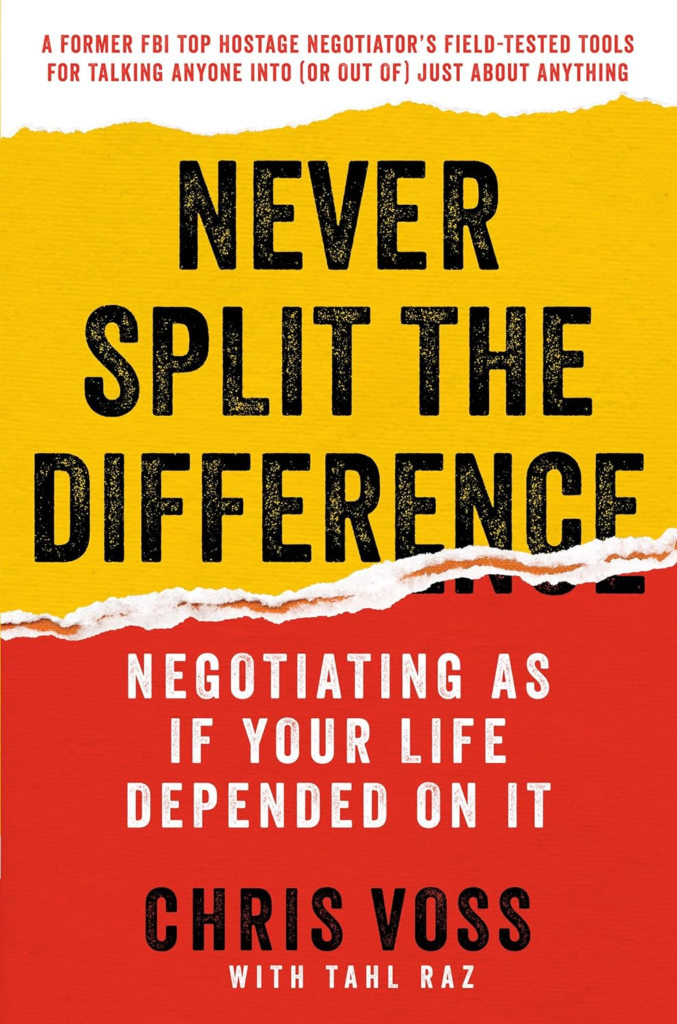
Never Split the Difference: Negotiating as If Your Life Depended On It is a 2016 book on negotiation written by former FBI hostage negotiator Chris Voss with journalist Tahl Raz. Published by HarperBusiness, the book presents a negotiation framework derived largely from Voss’s experiences in hostage and kidnapping negotiations and adapted for business and everyday situations. The book is 288 pages in the 2016 HarperBusiness edition.
Rather than treating negotiation primarily as a contest of logic, price, or compromise, Voss emphasizes emotional intelligence, active listening, tactical empathy, calibrated questions, strategic use of “no,” and the discovery of hidden information. His central argument is that a negotiator can often improve an outcome not by meeting halfway, but by understanding what is actually driving the other party.
The title expresses one of the book’s most distinctive propositions: compromise is not automatically a good outcome. Splitting the difference can produce an agreement that satisfies neither side, particularly when the midpoint is arbitrary or when the parties have not yet discovered the underlying interests and constraints.
The book became one of the best-known popular works on practical negotiation and has been applied to subjects ranging from salary discussions and business deals to purchasing a car, negotiating rent, resolving workplace disagreements, and managing difficult personal conversations.
Book information
| Field | Details |
|---|---|
| Title | Never Split the Difference: Negotiating as If Your Life Depended On It |
| Authors | Chris Voss and Tahl Raz |
| Subject | Negotiation, communication, persuasion |
| Genre | Business / negotiation / popular psychology |
| Language | English |
| Publisher | HarperBusiness |
| Publication date | May 17, 2016 |
| Length | 288 pages in the original HarperBusiness edition |
| Country | United States |
| ISBN | 978-0062407801 |
| Principal framework | The Black Swan Method / tactical negotiation |
| Notable concepts | Tactical empathy, mirroring, labeling, calibrated questions, “no,” “that’s right,” accusation audit, Ackerman model, Black Swans |
Bibliographic records identify Voss and Raz as the authors and the 2016 HarperBusiness edition as a 288-page publication.
Overview
At its heart, Never Split the Difference is a book about a deceptively simple idea:
A negotiation is not merely an exchange of demands. It is an attempt to understand what is happening inside another person’s world.
Voss argues that people rarely make important decisions through pure rational calculation. Fear, anger, pride, status, perceived fairness, loss aversion, deadlines, identity, and the desire to retain control can all affect what a person says and does during a negotiation.
Consequently, the negotiator’s first task is not necessarily to make an offer.
It is to listen.
Voss’s method is built around deliberately slowing down the conversation, encouraging the other party to speak, identifying emotions and interests, and asking questions that reveal constraints that may not have been visible at the beginning.
The resulting approach is simultaneously conversational and strategic. Instead of saying:
“Here is what I want. What will you give me?”
the negotiator attempts to create a conversation in which the other person explains why they want what they want, what they fear, what constraints they face, and what would make an agreement workable.
Chris Voss
Christopher Voss is an American author, business consultant, negotiation instructor, and former FBI hostage negotiator. He was born on November 28, 1957, in Mount Pleasant, Iowa. He studied at Iowa State University and later earned a master’s degree in public administration from Harvard University.
Voss spent approximately 24 years with the FBI and became the agency’s lead international kidnapping negotiator. He also served as the FBI’s hostage-negotiation representative to the National Security Council’s Hostage Working Group. According to his professional biography, his career included international kidnapping and hostage cases and negotiations involving locations including Iraq and Gaza.
After leaving the FBI, Voss founded The Black Swan Group, a negotiation-training and consulting company. The company describes its approach as emphasizing deep listening, reciprocity, tactical negotiation, and the Black Swan Method.
Voss’s unusual professional background is fundamental to the book. Rather than presenting negotiation entirely as an academic discipline, he approaches it as a practical skill developed under circumstances where communication failures could have severe consequences.
Tahl Raz
Tahl Raz is a journalist, writer, and collaborator who co-authored Never Split the Difference with Voss.
Raz’s role helped transform Voss’s professional experiences into a readable narrative for a general audience. The book combines Voss’s negotiation stories and techniques with explanatory passages, examples, and practical applications.
The resulting structure is closer to a narrative field guide than a conventional academic textbook.
The central idea: do not negotiate against yourself
The title Never Split the Difference challenges one of the most familiar assumptions about negotiation: that a fair agreement is necessarily found somewhere in the middle.
Imagine that one person wants to sell a car for $20,000 while the buyer wants to pay $16,000.
A conventional approach might be:
$20,000 → $18,000 → $18,000
The two sides meet halfway.
Voss asks a more fundamental question:
Why is the seller asking $20,000?
Perhaps the seller needs to pay off a loan.
Perhaps the car has unusually valuable equipment.
Perhaps the seller has another buyer.
Perhaps the seller simply chose the number arbitrarily.
Likewise, why is the buyer offering $16,000?
Perhaps $16,000 is the maximum amount available.
Perhaps the buyer has found another vehicle.
Perhaps the buyer is deliberately anchoring low.
The midpoint itself contains very little information.
The underlying reasons contain much more.
The book’s negotiation logic
                 DEMAND
                    │
                    ▼
             "What do you want?"
                    │
                    ▼
          ┌───────────────────┐
          │   LISTEN DEEPLY   │
          └───────────────────┘
                    │
          ┌─────────┴─────────┐
          ▼                   ▼
       EMOTION            INFORMATION
          │                   │
          ▼                   ▼
      LABEL IT          EXPLORE IT
          │                   │
          └─────────┬─────────┘
                    ▼
           FIND THE REAL ISSUE
                    │
                    ▼
          ASK CALIBRATED QUESTIONS
                    │
                    ▼
            DISCOVER OPTIONS
                    │
                    ▼
             NEGOTIATE TERMS
This is one of the book’s most important distinctions:
Position ≠ interest ≠ constraint.
A person’s stated position is often only the visible surface of the negotiation.
Negotiation as an emotional process
One of Voss’s fundamental arguments is that emotion cannot simply be removed from negotiation.
People are not machines calculating maximum economic utility.
A person may reject a financially attractive proposal because:
- they feel disrespected;
- they believe the other party is exploiting them;
- they fear losing status;
- they distrust the other side;
- they want control;
- they feel rushed;
- they perceive the proposal as unfair;
- they believe accepting it would damage their identity or reputation.
Voss therefore places considerable emphasis on understanding emotions without necessarily agreeing with them.
This distinction becomes the foundation for one of his signature concepts.
Tactical empathy
Tactical empathy is the term Voss uses for deliberately recognizing another person’s feelings, perspective, and position and communicating that understanding during a negotiation.
It is important to distinguish tactical empathy from ordinary sympathy.
Sympathy
“I feel sorry for you.”
Agreement
“I agree with your position.”
Tactical empathy
“I understand how you are seeing this situation.”
The negotiator does not have to surrender their position merely because they understand the other party.
Tactical empathy model
        OBSERVE
           │
           ▼
      IDENTIFY EMOTION
           │
           ▼
         LABEL
           │
           ▼
    LET THEM RESPOND
           │
           ▼
      GATHER INFORMATION
           │
           ▼
     IMPROVE NEGOTIATION
Voss’s method treats empathy as a strategic listening skill, rather than merely as a moral virtue.
Mirroring
One of the simplest techniques presented in the book is mirroring.
Mirroring involves repeating the last few important words spoken by the other person, usually with a questioning tone.
Example
Seller:
“We can’t reduce the price because the installation alone costs us thousands.”
Buyer:
“Costs you thousands?”
The buyer has not argued.
The buyer has not rejected the statement.
Instead, the buyer has created space for the seller to continue.
The seller might respond:
“Yes. The equipment is expensive, and our technicians have to travel two hours…”
Suddenly, the buyer has obtained information that might otherwise have remained hidden.
Mirroring sequence
OTHER PERSON SPEAKS
        ↓
IDENTIFY IMPORTANT WORDS
        ↓
REPEAT THE WORDS
        ↓
PAUSE
        ↓
LET THEM ELABORATE
        ↓
COLLECT INFORMATION
Voss recommends using a small number of words rather than repeating an entire sentence. The technique works partly because it encourages the speaker to elaborate rather than forcing the listener to dominate the conversation.
Labeling
Labeling involves identifying the emotion, concern, or dynamic that appears to be present.
Typical constructions include:
- “It seems like…”
- “It sounds like…”
- “It looks like…”
For example:
“It sounds like the deadline is the biggest concern.”
Or:
“It seems like you are worried that changing the agreement will create problems for your team.”
The objective is not to diagnose the other person psychologically.
The objective is to put an observable emotional or situational dynamic into words.
Why labeling matters
A difficult negotiation often contains an unspoken statement:
“You don’t understand what this means to me.”
A well-executed label attempts to answer:
“I see what this situation looks like from your side.”
That can make further discussion easier.
The accusation audit
One of the book’s more unusual techniques is the accusation audit.
Before the other party raises objections, the negotiator identifies the negative things the other side might already be thinking.
For example:
“You may think we’re asking for too much.”
“You may feel that we’ve created unnecessary work for your team.”
“You may think we’re trying to push the risk onto you.”
Instead of allowing the other party to introduce these criticisms unexpectedly, the negotiator brings them into the open.
Accusation Audit
WHAT THEY MAY BE THINKING
          │
          ▼
     SAY IT FIRST
          │
          ▼
      REDUCE TENSION
          │
          ▼
      OPEN DISCUSSION
          │
          ▼
    MOVE TO REAL ISSUES
The technique can feel counterintuitive because conventional persuasion often emphasizes presenting one’s strengths first.
Voss’s approach sometimes does the opposite.
Address the negative first.
The power of “No”
A major theme of Never Split the Difference is that “no” is not necessarily the end of a negotiation.
Voss argues that people often feel safer when they are allowed to say no.
Compare:
“Do you agree?”
with:
“Would it be ridiculous to discuss another option?”
The second question makes refusal psychologically available.
According to Voss’s framework, a person who feels free to say no may become more willing to participate honestly.
This leads to one of the book’s important distinctions:
YES
│
├── Genuine agreement
├── Temporary agreement
├── Polite agreement
└── "Yes" to end the conversation

NO
│
├── Rejection
├── Protection
├── Clarification
├── Boundary setting
└── Opening for further discussion
The book therefore treats no as information, not merely as failure.
“That’s right” versus “You’re right”
Voss gives special importance to the difference between two seemingly similar expressions:
“You’re right.”
and
“That’s right.”
In ordinary conversation, “you’re right” can be used to end an argument without genuine agreement.
For example:
“You’re right, you’re right. Let’s just move on.”
Voss considers this different from the moment when the other person responds:
“That’s right.”
after hearing an accurate summary of their own position.
The summary technique
The negotiator attempts to summarize:
- the other person’s facts;
- their concerns;
- their constraints;
- their emotions;
- their priorities.
Then the other person confirms the summary.
Information loop
THEY SPEAK
   ↓
YOU LISTEN
   ↓
YOU IDENTIFY FACTS + EMOTIONS
   ↓
YOU SUMMARIZE
   ↓
THEY CONFIRM
   ↓
"THAT'S RIGHT"
For Voss, this is a sign that the negotiator has moved beyond merely hearing words to understanding the other person’s perspective.
Calibrated questions
Another central component of the book is the use of calibrated questions.
These are generally open-ended questions beginning with “How” or “What.”
Examples include:
- “How am I supposed to do that?”
- “How would you like me to proceed?”
- “What is the biggest challenge here?”
- “What would make this work?”
- “How can we solve this?”
- “What happens if we cannot meet that deadline?”
Instead of directly rejecting a demand, the negotiator turns the problem into a question.
Direct confrontation
“We cannot do that.”
Calibrated question
“How are we supposed to make that work within our budget?”
The second formulation places the practical problem on the table without immediately turning the conversation into a confrontation.
Why “How?” and “What?” matter
A calibrated question can subtly transfer part of the problem-solving burden to the other side.
Consider:
“You need this delivered tomorrow.”
The response:
“No.”
creates a confrontation.
But:
“How are we supposed to deliver it tomorrow?”
requires the other party to think about logistics.
They might respond:
“Could you deliver part of it tomorrow and the rest Monday?”
Now a new option exists.
Calibrated-question framework
DEMAND
  │
  ▼
"NO" ─────────► CONFRONTATION
  │
  │
  ▼
"HOW?" ───────► PROBLEM SOLVING
  │
  ▼
OTHER PARTY EXPLAINS CONSTRAINTS
  │
  ▼
NEW INFORMATION
  │
  ▼
NEW OPTIONS
The “late-night FM DJ voice”
Voss also discusses the importance of voice and delivery.
He describes a calm, controlled vocal style comparable to the relaxed delivery of a late-night radio announcer.
The objective is not theatrical manipulation.
The point is to communicate:
- calmness;
- confidence;
- patience;
- lack of panic;
- emotional control.
In a tense conversation, speaking faster and louder can unintentionally communicate anxiety or aggression.
A slower and calmer voice can change the emotional temperature of the conversation.
The three voices
Voss describes different vocal styles that can be useful in negotiation.
1. The late-night FM DJ voice
Calm, slow, controlled, and reassuring.
2. The playful voice
Light and relaxed, used when appropriate to establish warmth.
3. The assertive voice
Direct and firm.
Voss generally places greater emphasis on calmness and rapport than on aggressive confrontation.
“Bend their reality”
One section of the book concerns the psychological framing of value.
People do not evaluate numbers in isolation.
They interpret numbers relative to:
- expectations;
- alternatives;
- perceived scarcity;
- deadlines;
- comparisons;
- previous prices;
- emotional context.
This means that the way an offer is presented can influence how it is perceived.
For example, “$10,000” has little psychological meaning without context.
But:
“The comparable proposals are between $12,000 and $15,000, and we’re asking for $10,000.”
creates a different frame.
The underlying number is unchanged.
The surrounding reference point is different.
Loss aversion
The book draws on the broader idea that people can be particularly sensitive to losses.
A person may respond more strongly to the possibility of losing something than to receiving an equivalent gain.
For example:
“You could save $5,000.”
and
“You could lose $5,000 by waiting.”
may evoke different reactions.
Voss uses this kind of framing as part of negotiation strategy.
However, these psychological principles should not be interpreted as guaranteed formulas. Individual responses vary, and negotiation outcomes depend on the relationship, context, incentives, and alternatives available to the parties.
Deadlines and time pressure
Deadlines are among the most powerful forces in negotiation.
A negotiator who becomes convinced that a deadline is absolute may make unnecessary concessions.
Voss therefore encourages negotiators to investigate deadlines rather than automatically accepting them as fixed facts.
A useful question is:
“What happens if we don’t meet that deadline?”
The answer may reveal whether the deadline is:
- legally fixed;
- operationally necessary;
- politically convenient;
- internally imposed;
- merely preferred.
The difference can be enormous.
The Ackerman bargaining model
The book presents the Ackerman bargaining model, associated with Mike Ackerman, as a structured approach to price negotiation.
The basic sequence described in discussions of Voss’s method is approximately:
65%
 ↓
85%
 ↓
95%
 ↓
100%
The percentages refer to progressively increasing offers relative to a target price.
The model also emphasizes preparing carefully, using precise rather than round numbers, and attaching a small non-monetary item near the end.
The purpose is to create a disciplined bargaining process rather than improvising concessions emotionally.
Simplified Ackerman sequence
SET TARGET
    ↓
FIRST OFFER — approximately 65%
    ↓
SECOND OFFER — approximately 85%
    ↓
THIRD OFFER — approximately 95%
    ↓
FINAL OFFER — approximately 100%
    ↓
SMALL NON-MONETARY CONCESSION
The important lesson is not the percentages alone.
It is the principle of planned concessions.
A negotiator who has no concession strategy can easily give away more than intended.
Black Swans
The book’s final major concept is the Black Swan.
In Voss’s terminology, a Black Swan is an important piece of information that is unknown to the negotiator but can substantially change the negotiation once discovered.
The metaphor comes from the historical assumption that all swans were white until black swans were observed.
In negotiation, the equivalent discovery might be:
- an undisclosed deadline;
- another decision-maker;
- a hidden financial constraint;
- a personal motivation;
- a competing offer;
- an internal political problem;
- a fear the other party has not mentioned;
- an opportunity that the negotiator did not know existed.
Black Swan discovery
VISIBLE POSITION
      │
      ▼
    QUESTIONS
      │
      ▼
    LISTENING
      │
      ▼
  CONTRADICTIONS
      │
      ▼
HIDDEN INFORMATION
      │
      ▼
   BLACK SWAN
      │
      ▼
NEGOTIATION CHANGES
This is one of the book’s strongest recurring ideas:
The most valuable information may be the information you do not yet know exists.
The nine major principles
Publisher descriptions characterize the book as presenting nine key principles.
A practical synthesis of those principles is:
| Principle | Central idea |
|---|---|
| 1. Be a mirror | Encourage the other person to talk by reflecting important words |
| 2. Use tactical empathy | Understand and acknowledge emotions without necessarily agreeing |
| 3. Label emotions | Give emotions and concerns a name |
| 4. Use “no” strategically | Allow the other person to feel safe and retain agency |
| 5. Seek “that’s right” | Demonstrate genuine understanding through accurate summaries |
| 6. Use calibrated questions | Ask “how” and “what” questions to uncover constraints |
| 7. Shape perception | Understand framing, expectations, and reference points |
| 8. Negotiate systematically | Use structured bargaining rather than emotional concessions |
| 9. Find Black Swans | Search for hidden information that can change the negotiation |
The ten-chapter structure
The book is organized into ten chapters that progressively develop the negotiation framework.
Chapter 1 — The New Rules
Voss introduces his argument that conventional approaches to negotiation can underestimate emotion and human psychology.
The reader is introduced to the difference between traditional bargaining and the high-stakes communication environment of hostage negotiation.
Chapter 2 — Be a Mirror
The chapter introduces mirroring and emphasizes the importance of getting the other person to continue talking.
The technique is deliberately simple.
Instead of preparing the next argument, the negotiator pays attention to the words already being spoken.
Chapter 3 — Don’t Feel Their Pain, Label It
This chapter develops tactical empathy and labeling.
The negotiator attempts to identify the emotions and concerns operating beneath the surface.
The distinction between understanding and agreement becomes especially important.
Chapter 4 — Beware “Yes”—Master “No”
This chapter challenges the conventional assumption that the objective of negotiation should always be to obtain “yes.”
Voss argues that “no” can provide psychological safety and reveal boundaries.
Chapter 5 — Trigger the Two Words That Immediately Transform Any Negotiation
The two words are:
“That’s right.”
The chapter emphasizes summaries and the importance of demonstrating genuine understanding.
Chapter 6 — Bend Their Reality
This chapter examines perception, framing, loss, deadlines, and the psychological context surrounding offers.
A number is not evaluated independently of the story surrounding it.
Chapter 7 — Create the Illusion of Control
The chapter develops calibrated questions.
Instead of commanding the other party, the negotiator asks questions that encourage them to think through the problem.
Chapter 8 — Guarantee Execution
The book moves from reaching an agreement to ensuring that the agreement can actually be implemented.
A negotiated agreement has little value if the parties cannot or will not carry it out.
Chapter 9 — Bargain Hard
This chapter introduces the Ackerman bargaining model and focuses on the mechanics of price negotiation.
The central lesson is to prepare concessions rather than surrendering them spontaneously.
Chapter 10 — Find the Black Swan
The final chapter brings the book’s information-gathering philosophy to its conclusion.
The negotiator searches for unknown information that can fundamentally change the negotiation.
The Voss negotiation model
The ideas in the book can be represented as a practical sequence:
          START
            │
            ▼
      CREATE RAPPORT
            │
            ▼
        LISTEN
            │
            ▼
        MIRROR
            │
            ▼
         LABEL
            │
            ▼
    TACTICAL EMPATHY
            │
            ▼
     ACCUSATION AUDIT
            │
            ▼
       ALLOW "NO"
            │
            ▼
     SEEK "THAT'S RIGHT"
            │
            ▼
   CALIBRATED QUESTIONS
            │
            ▼
     DISCOVER CONSTRAINTS
            │
            ▼
      FIND BLACK SWANS
            │
            ▼
      NEGOTIATE TERMS
            │
            ▼
      ENSURE EXECUTION
This is not a rigid algorithm.
One of the recurring messages of Voss’s approach is that negotiations are dynamic and require adaptation.
Listening as a negotiation advantage
Perhaps the most practical lesson in Never Split the Difference is also the easiest to underestimate:
The person who talks less may learn more.
A negotiator who continuously presents arguments reveals their own position.
A negotiator who listens can discover:
- priorities;
- fears;
- deadlines;
- decision-making structures;
- financial limitations;
- competing alternatives;
- hidden motivations;
- internal disagreements.
This produces an unusual form of leverage.
Speaking versus listening
ARGUMENT-FIRST NEGOTIATION

YOU →→→→→→→→→ THEM
       INFORMATION


LISTENING-FIRST NEGOTIATION

THEM →→→→→→→→→ YOU
          ↓
      INFORMATION
          ↓
      LEVERAGE
In this sense, listening is not passive.
It is an information-gathering activity.
The role of silence
Silence is another recurring element in Voss’s approach.
After asking a question or using a mirror, the negotiator may deliberately stop speaking.
This can feel uncomfortable.
People often rush to fill silence.
That tendency can produce additional information.
A person who hears:
“How am I supposed to do that?”
may initially remain silent.
The other party may then begin explaining:
“Well, maybe we could…”
The silence has created room for the other person to solve the problem aloud.
Negotiation and everyday life
Although the book draws heavily on hostage negotiations, its intended application extends far beyond crisis situations.
Examples include:
Salary negotiation
Instead of:
“I want a 20% raise.”
A negotiator might ask:
“What would it take for us to get this compensation to a level that reflects the additional responsibilities?”
Buying a vehicle
Instead of immediately bargaining over the sticker price:
“It seems like keeping the price close to the advertised figure is important to you. What flexibility do you have on the final out-the-door price?”
Workplace disagreement
Instead of:
“You are being unreasonable.”
Try:
“It sounds like you are concerned that this change will create additional work for your team.”
Freelance pricing
Instead of:
“That’s too low.”
Ask:
“How am I supposed to deliver that scope within that budget?”
The goal is not to imitate hostage negotiation literally.
It is to transfer the communication principles into lower-stakes situations.
Negotiation in personal relationships
The book also suggests that negotiation is not confined to commercial transactions.
People negotiate constantly:
- household responsibilities;
- travel plans;
- schedules;
- parenting arrangements;
- purchases;
- boundaries;
- expectations;
- social commitments.
However, personal relationships introduce an important complication.
A business negotiation may end with a contract.
A family relationship may continue for decades.
Therefore, techniques designed for tactical influence should be balanced with trust, reciprocity, transparency, and long-term relationship considerations.
Negotiation versus compromise
One of the most important philosophical distinctions in the book is:
Agreement is not necessarily compromise.
A compromise can be excellent.
But compromise can also be a lazy substitute for discovering better options.
Consider:
OPTION A: $100
OPTION B: $60

MIDPOINT = $80
The midpoint appears fair.
But suppose further discussion reveals:
- the seller can accept $70 if paid immediately;
- the buyer can pay $75 if delivery is included;
- the seller desperately needs inventory cleared;
- the buyer urgently needs the product.
The midpoint was not necessarily the best solution.
It was simply the first solution.
This is why Voss emphasizes information before concession.
The psychology of control
A recurring theme throughout the book is the human desire for agency.
People generally dislike feeling that decisions are being forced upon them.
Calibrated questions therefore serve two purposes:
- they gather information;
- they allow the other party to participate in constructing the solution.
The technique can transform:
“Take it or leave it.”
into:
“How would you like us to make this work?”
The second statement does not automatically produce agreement.
But it changes the structure of the conversation.
The importance of preparation
Despite its emphasis on spontaneous conversation, the book is not an argument for entering negotiations unprepared.
Preparation can include:
Before the negotiation
- Define the desired outcome.
- Define the minimum acceptable outcome.
- Identify likely objections.
- Conduct an accusation audit.
- Identify your constraints.
- Research the other party.
- Prepare calibrated questions.
- Identify possible Black Swans.
- Decide which concessions are available.
- Decide which concessions are unacceptable.
During the negotiation
- Listen.
- Mirror.
- Label.
- Summarize.
- Ask calibrated questions.
- Watch for contradictions.
- Avoid unnecessary concessions.
- Search for hidden information.
After agreement
- Confirm the terms.
- Clarify responsibilities.
- Establish deadlines.
- Confirm who does what.
- Check that both sides understand the agreement.
Negotiation preparation chart
                    NEGOTIATION
                         │
        ┌────────────────┼────────────────┐
        ▼                ▼                ▼
     YOUR SIDE       THEIR SIDE       ENVIRONMENT
        │                │                │
   Objectives        Interests         Deadline
   Limits            Fears            Competition
   Alternatives      Constraints      Market
   Concessions       Authority        Relationships
        │                │                │
        └────────────────┼────────────────┘
                         ▼
                  NEGOTIATION PLAN
Why the book is distinctive
Never Split the Difference occupies an unusual position among popular negotiation books.
Traditional negotiation literature often emphasizes:
- interests;
- objective criteria;
- alternatives;
- bargaining structures;
- value creation;
- principled negotiation.
Voss’s presentation emphasizes the moment-to-moment conversation.
His questions are practical:
What should I say next?
What should I listen for?
How do I respond when the other person becomes angry?
What do I do when they reject my proposal?
How do I find out what they really want?
This gives the book a highly operational character.
Relationship to “Getting to Yes”
One useful comparison is with Getting to Yes, the influential negotiation book by Roger Fisher, William Ury, and Bruce Patton.
The two approaches are not identical.
| Never Split the Difference | Getting to Yes |
|---|---|
| Tactical and conversational | Principled and analytical |
| Strong emphasis on emotion | Strong emphasis on interests |
| Mirroring and labeling | Separating people from problems |
| Calibrated questions | Objective criteria |
| “That’s right” | Mutual gains |
| “No” as useful information | BATNA and principled alternatives |
| High emphasis on listening | High emphasis on structured problem-solving |
Voss’s book is therefore better understood as part of the broader negotiation literature rather than as a replacement for every other negotiation framework.
Strengths of the book
Several features have contributed to the book’s popularity.
1. Practical language
The book gives readers actual conversational structures rather than only abstract principles.
2. Memorable terminology
Terms such as:
- tactical empathy;
- mirroring;
- calibrated questions;
- accusation audit;
- Black Swans;
make the framework relatively easy to remember.
3. Real-world storytelling
Voss’s FBI experiences give the concepts dramatic context.
4. Transferability
The techniques can be adapted to business, sales, management, purchasing, salary discussions, and everyday conversations.
5. Emphasis on listening
The book challenges the common assumption that negotiation is primarily about producing better arguments.
Criticism and limitations
Despite its popularity, Never Split the Difference should not be interpreted as a scientifically established universal formula for negotiation.
There are several reasons for caution.
1. Hostage negotiation is not ordinary negotiation
A hostage crisis differs fundamentally from:
- marriage;
- employment;
- long-term supplier relationships;
- corporate partnerships;
- diplomatic negotiations.
The stakes, time horizons, power structures, and consequences are different.
Techniques that work under extreme crisis conditions may not transfer perfectly to cooperative relationships.
2. Anecdotal evidence
Much of the book’s persuasive force comes from Voss’s professional experiences and stories.
Those stories are valuable, but they are not equivalent to controlled experimental evidence.
3. Risk of mechanical application
A person who constantly mirrors, labels, and asks calibrated questions may sound artificial.
The technique works best when it reflects genuine attention rather than becoming a visible script.
4. Ethical concerns
Negotiation techniques can be used constructively or manipulatively.
Understanding someone’s emotional state can help resolve conflict.
It can also be abused to exploit vulnerabilities.
The ethical quality of the negotiation therefore depends partly on the negotiator’s intentions and the consequences of the agreement.
5. Long-term relationships
A tactic that produces a favorable immediate agreement may damage trust if the other party later feels manipulated.
This matters particularly in:
- families;
- partnerships;
- workplaces;
- recurring supplier relationships;
- professional networks.
Academic and professional perspective
The book belongs primarily to the popular business and negotiation literature, rather than to peer-reviewed academic negotiation research.
A 2026 review published in the Journal of Pediatric Rehabilitation Medicine described the book as a practical negotiation work and discussed its potential application to clinical settings. The review also illustrates the broader interest in adapting Voss’s conversational techniques beyond hostage negotiation.
This distinction matters.
The book can be read as:
a practical framework developed from professional experience
rather than:
a universally validated scientific theory of human behavior.
Readers should therefore separate useful communication techniques from claims that would require independent empirical validation.
A practical example
Imagine an employee asks for a substantial salary increase.
Traditional response
Manager:
“We can’t afford that.”
Employee:
“But I’ve taken on much more responsibility.”
Manager:
“We can meet halfway.”
The conversation becomes a numbers contest.
Voss-style approach
Employee:
“It seems like the company is under budget pressure.”
Manager:
“Yes, we are.”
Employee:
“What is the biggest constraint preventing an adjustment?”
Manager:
“We don’t have room in this year’s salary budget.”
Employee:
“How am I supposed to take on these additional responsibilities without a corresponding adjustment?”
The manager now has to explain the underlying problem.
Perhaps the solution becomes:
- a staged raise;
- a performance-linked increase;
- additional benefits;
- a revised title;
- a bonus;
- additional leave;
- a future salary review.
The original negotiation was framed as:
“How much money?”
The deeper negotiation becomes:
“How can we align responsibility, recognition, and compensation?”
That is the kind of transformation Voss wants the reader to learn.
The complete framework at a glance
┌──────────────────────────────────────────────┐
│          NEVER SPLIT THE DIFFERENCE          │
├──────────────────────────────────────────────┤
│  1. LISTEN                                    │
│  2. MIRROR                                    │
│  3. LABEL                                     │
│  4. SHOW TACTICAL EMPATHY                     │
│  5. CONDUCT AN ACCUSATION AUDIT               │
│  6. LET THEM SAY "NO"                         │
│  7. SEEK "THAT'S RIGHT"                       │
│  8. ASK CALIBRATED QUESTIONS                  │
│  9. CONTROL CONCESSIONS                       │
│ 10. SEARCH FOR BLACK SWANS                    │
└──────────────────────────────────────────────┘
Most important concepts in the book
| Concept | Meaning |
|---|---|
| Tactical empathy | Understanding and acknowledging another person’s perspective |
| Mirroring | Repeating key words to encourage elaboration |
| Labeling | Naming an emotion or concern |
| Accusation audit | Identifying likely negative perceptions before they are raised |
| No-oriented questions | Questions that allow the other person to safely say no |
| “That’s right” | A sign that the other person’s position has been accurately understood |
| Calibrated questions | Open “how” and “what” questions |
| Late-night FM DJ voice | Calm, controlled vocal delivery |
| Ackerman model | Structured concession strategy |
| Black Swan | Hidden information capable of changing the negotiation |
What “Never Split the Difference” does not mean
The title can easily be misunderstood.
It does not mean:
- never compromise under any circumstances;
- always dominate the other person;
- always demand more;
- never make concessions;
- treat every conversation as a battle;
- manipulate people;
- refuse reasonable agreements.
The deeper message is more specific:
Do not compromise merely because compromise feels like the natural endpoint of negotiation.
First understand the problem.
Then determine whether the midpoint is actually useful.
Ethical use of the Voss method
A responsible application of the book’s ideas should preserve the other person’s autonomy.
Constructive use
- listening carefully;
- reducing unnecessary conflict;
- clarifying misunderstandings;
- discovering genuine constraints;
- creating mutually workable solutions;
- preventing impulsive concessions.
Manipulative use
- exploiting emotional vulnerabilities;
- deliberately creating fear;
- hiding material information;
- using empathy merely as deception;
- pressuring someone who cannot reasonably refuse.
The techniques themselves do not determine the ethics of their application.
The context and purpose matter.
Legacy and influence
Never Split the Difference helped popularize a negotiation vocabulary that is now widely recognizable outside traditional negotiation training.
Its concepts have been discussed in contexts including:
- entrepreneurship;
- sales;
- management;
- leadership;
- procurement;
- real estate;
- salary negotiation;
- customer service;
- family communication;
- conflict resolution.
The Black Swan Group continues to present Voss’s negotiation methodology as a training system for business and other professional settings.
The book’s lasting appeal comes partly from the contrast between its subject matter and its method.
Negotiation is often imagined as aggressive.
Voss’s framework repeatedly returns to something much quieter:
Listen.
About Chris Voss after the FBI
After leaving the FBI, Voss founded The Black Swan Group, where he developed negotiation training based on his professional experience. The organization describes itself as teaching negotiation through deep listening, tactical empathy, and reciprocal communication.
Voss has also taught negotiation-related subjects in academic and professional settings and has become a prominent speaker on negotiation and communication.
His career therefore moved through three distinct stages:
FBI
│
│  Hostage & kidnapping negotiation
▼
PROFESSIONAL NEGOTIATOR
│
│  Field experience
▼
BLACK SWAN GROUP
│
│  Training & consulting
▼
AUTHOR / EDUCATOR
Other works by Chris Voss
Voss is particularly identified with Never Split the Difference, which remains his best-known book.
His broader work has focused on negotiation training, communication, persuasion, and the application of high-stakes negotiation principles to business and everyday life.
Frequently asked questions
What is Never Split the Difference about?
It is a book about negotiation written by former FBI hostage negotiator Chris Voss with Tahl Raz. It presents practical techniques including tactical empathy, mirroring, labeling, calibrated questions, strategic use of “no,” and the search for hidden information.
Why is the book called Never Split the Difference?
The title refers to Voss’s argument that automatically meeting in the middle is not necessarily the best way to reach an agreement. Negotiators should first investigate the underlying interests, constraints, and possibilities.
What is tactical empathy?
Tactical empathy is Voss’s term for understanding and acknowledging another person’s emotional and situational perspective without necessarily agreeing with it.
What is mirroring?
Mirroring involves repeating a few important words spoken by the other person, usually as a question, to encourage them to elaborate.
What are calibrated questions?
They are generally open-ended “how” and “what” questions designed to encourage the other party to explain constraints and participate in solving the problem.
Why does Voss emphasize “no”?
He argues that people can feel safer when they have the ability to say no. In his framework, “no” can therefore provide information and create a sense of control rather than simply ending the negotiation.
What does “that’s right” mean?
It refers to the moment when the other person confirms that a summary accurately represents their perspective. Voss distinguishes this from the more superficial “you’re right.”
What is a Black Swan in negotiation?
A Black Swan is a piece of information that was previously unknown to the negotiator but that can significantly change the negotiation once discovered.
Is the book only useful for hostage negotiators?
No. The book explicitly presents its negotiation principles as applicable to professional and personal situations, including salary negotiations, purchases, business discussions, and everyday disagreements.
Is Never Split the Difference an academic book?
No. It is primarily a practical business and negotiation book based heavily on Voss’s professional experience and examples rather than a conventional academic textbook.
See also
- Negotiation
- Conflict resolution
- Crisis negotiation
- Hostage negotiation
- Active listening
- Emotional intelligence
- Persuasion
- Behavioral economics
- Communication
- Getting to Yes
- Influence
- Thinking, Fast and Slow
- The 48 Laws of Power
Further reading
Chris Voss and Tahl Raz
Never Split the Difference: Negotiating as If Your Life Depended On It — the primary source for the framework described in this article. The 2016 HarperBusiness edition is 288 pages.
Roger Fisher, William Ury and Bruce Patton
Getting to Yes: Negotiating Agreement Without Giving In — an influential work on principled negotiation and interest-based bargaining.
Daniel Kahneman
Thinking, Fast and Slow — a major work on judgment, decision-making, cognitive biases, and behavioral economics.
Robert Cialdini
Influence — a widely known examination of persuasion and the psychological principles affecting compliance and decision-making.
References
- Voss, Chris; Raz, Tahl. Never Split the Difference: Negotiating as If Your Life Depended On It. HarperBusiness, 2016. Google Books records the publication date as May 17, 2016 and the edition at 288 pages.
- Google Books. Never Split the Difference: Negotiating as if Your Life Depended on It. Christopher Voss and Tahl Raz. Random House edition.
- The Black Swan Group. Chris Voss — CEO, Founder, Instructor, and Keynote Speaker. The organization’s biography describes Voss’s former role as the FBI’s lead international kidnapping negotiator and his subsequent development of negotiation training.
- The Black Swan Group. Who We Are. Description of the organization’s approach to negotiation, including deep listening, tactical negotiation, and the Black Swan Method.
- Christopher Voss. Biographical information concerning Voss’s FBI career, education, authorship, and professional work.
- Godbold, Lisa. “Negotiation techniques in the clinical setting: Book review of Never Split the Difference by Chris Voss.” Journal of Pediatric Rehabilitation Medicine, 2026.
- Voss, Chris. Professional material and negotiation methodology published through The Black Swan Group.
External resources
The Black Swan Group — official website:
The Black Swan Group
Chris Voss — author and negotiator profile:
Chris Voss at The Black Swan Group
Google Books — Never Split the Difference:
Google Books edition
Article summary
Never Split the Difference presents negotiation as a process of listening, emotional recognition, information discovery, and controlled problem-solving, rather than simply a contest over price or a search for a midpoint.
Its most recognizable concepts—tactical empathy, mirroring, labeling, the accusation audit, calibrated questions, “no,” “that’s right,” the Ackerman model, and Black Swans—form an interconnected system.
The book’s most useful lesson may be the simplest:
DON'T RUSH TO ANSWER
          ↓
LISTEN
          ↓
UNDERSTAND
          ↓
ASK
          ↓
DISCOVER
          ↓
THEN NEGOTIATE
The title’s “difference” is therefore not merely a number between two offers. It can represent the gap between what people say they want and what they actually need.
Finding that gap—and understanding what lies behind it—is the central intellectual and practical theme of Never Split the Difference.