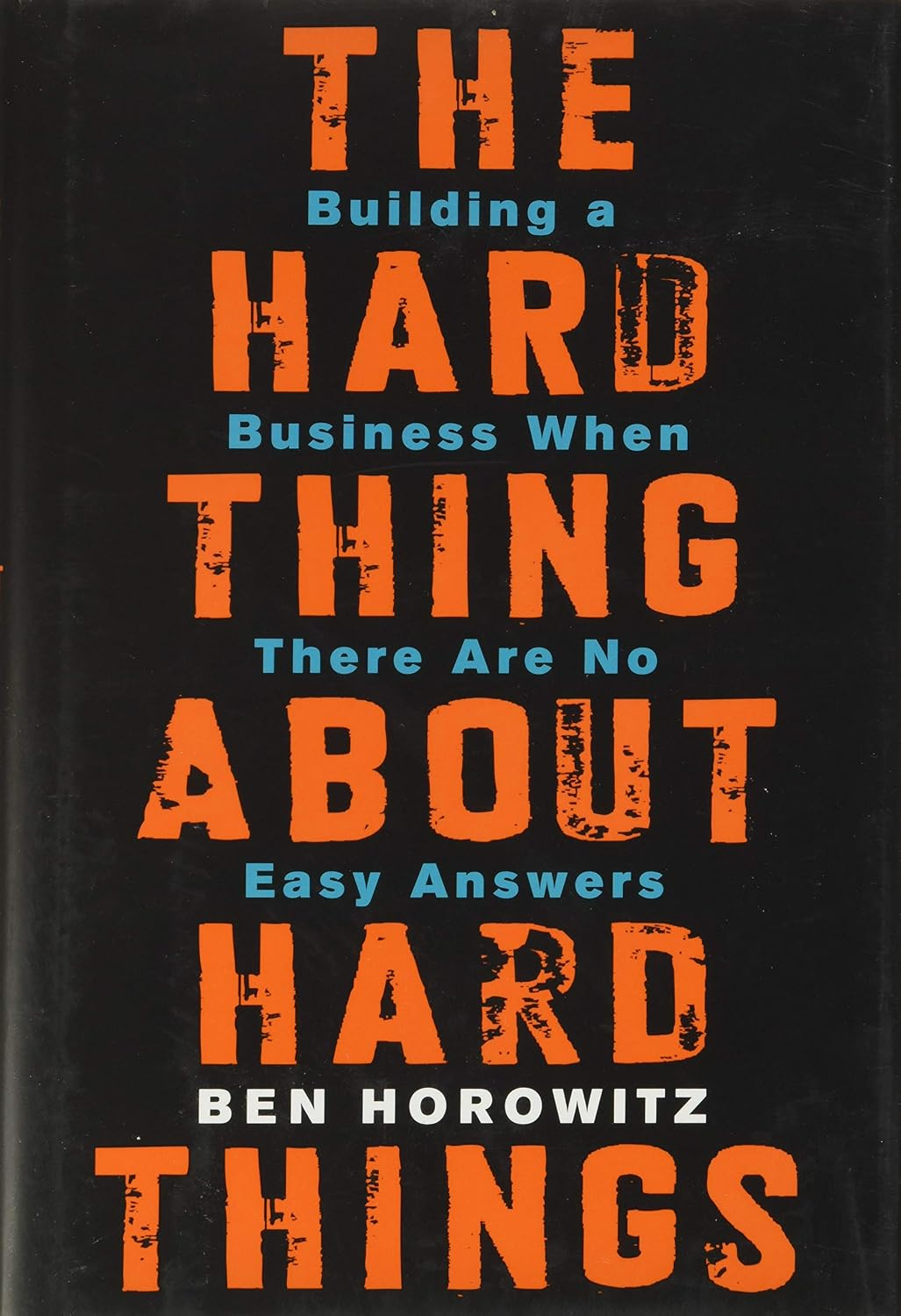
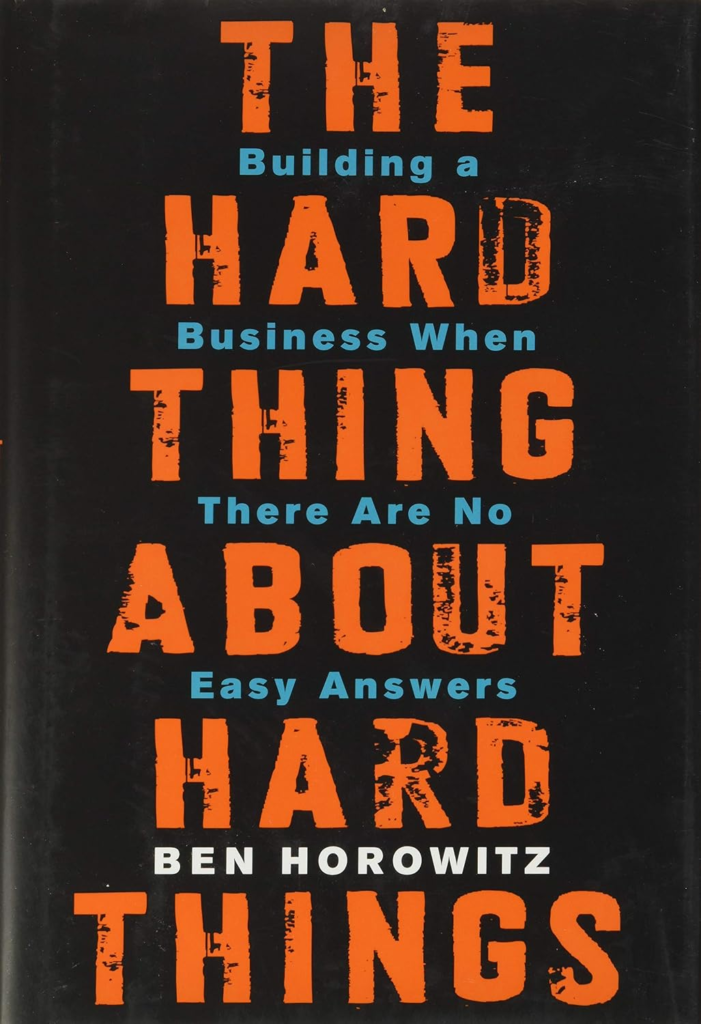
The Hard Thing About Hard Things: Building a Business When There Are No Easy Answers is a business and management book by American technology entrepreneur and venture capitalist Ben Horowitz. First published by Harper Business in 2014, the book examines the difficult, often uncomfortable decisions involved in founding, operating, managing, and eventually transforming a technology company. The first edition is approximately 289 pages in print, while the Google Books/HarperCollins edition is listed at 304 pages.
Unlike many entrepreneurship books that emphasize opportunity recognition, growth strategies, or inspirational success stories, The Hard Thing About Hard Things focuses on situations in which there is no obviously correct answer. Horowitz writes about layoffs, executive failures, declining companies, difficult employees, organizational change, CEO decision-making, competition, fundraising, selling a company, and the psychological burden of leadership.
The book draws heavily on Horowitz’s experience as co-founder and chief executive of Loudcloud, later renamed Opsware, and subsequently as co-founder and general partner of the venture capital firm Andreessen Horowitz. Opsware was acquired by Hewlett-Packard for $1.6 billion in 2007.
The book’s central message can be summarized as:
Building a company is not primarily about knowing the answers; it is about learning how to lead when the answers are unclear and the consequences of being wrong are significant.
Book information
| Field | Details |
|---|---|
| Title | The Hard Thing About Hard Things |
| Full title | The Hard Thing About Hard Things: Building a Business When There Are No Easy Answers |
| Author | Ben Horowitz |
| Genre | Business, management, entrepreneurship |
| Subject | Leadership, startups, management, entrepreneurship |
| Original publisher | Harper Business |
| Publication date | March 4, 2014 |
| Language | English |
| First edition | 2014 |
| Length | Approximately 289 pages in the first print edition; 304 pages in the Google Books edition |
| ISBN-13 | 9780062273208 |
| Major themes | Leadership, crisis management, hiring, firing, company culture, CEO decision-making, organizational design |
| Author’s principal case study | Loudcloud/Opsware |
| Later work by author | What You Do Is Who You Are |
Bibliographic records from Google Books, WorldCat, Open Library, and academic library catalogs identify HarperCollins/Harper Business as the publisher of the 2014 first edition.
Overview
The Hard Thing About Hard Things is essentially a field manual for difficult leadership decisions.
Horowitz deliberately moves away from the polished version of entrepreneurship.
There is no neat formula such as:
Idea → Product → Customers → Growth → Success
Instead, the entrepreneurial journey in Horowitz’s account looks more like:
                VISION
                   │
                   ▼
                BUILD
                   │
                   ▼
                GROW
                   │
                   ▼
          ┌────────┴────────┐
          │                 │
       PROBLEM           PROBLEM
          │                 │
          └────────┬────────┘
                   ▼
             HARD DECISION
                   │
                   ▼
              CONSEQUENCE
                   │
                   ▼
               LEARNING
                   │
                   ▼
             NEXT DECISION
The book’s distinctive quality comes from its refusal to pretend that difficult business problems always have elegant solutions.
Sometimes a CEO must fire a talented executive.
Sometimes a friend is no longer suitable for a job.
Sometimes the product is failing.
Sometimes the company is running out of money.
Sometimes an employee is causing cultural damage despite excellent performance.
Sometimes the CEO has to choose between two bad alternatives.
Horowitz’s subject is what happens after the motivational speech is over.
Ben Horowitz
Ben Horowitz
Benjamin Abraham Horowitz is an American technology entrepreneur, venture capitalist, author, and management writer.
He is best known as the co-founder and general partner of Andreessen Horowitz, the Silicon Valley venture capital firm he established with Marc Andreessen.
Before founding Andreessen Horowitz, Horowitz co-founded Loudcloud, a technology company that later became Opsware, and served as its chief executive officer. Hewlett-Packard acquired Opsware for approximately $1.6 billion in 2007.
Horowitz subsequently became an investor and adviser to technology companies through Andreessen Horowitz. His official firm biography describes earlier roles at Netscape, America Online, and Lotus Development Corporation, illustrating a career that moved from engineering and product management into entrepreneurship and venture capital.
He holds a bachelor’s degree from Columbia University and a master’s degree in computer science from UCLA.
His other major book is What You Do Is Who You Are: How to Create Your Business Culture.
Horowitz’s entrepreneurial background
The book cannot be separated completely from Horowitz’s own career.
His most important case study is the transformation of Loudcloud into Opsware.
Loudcloud initially operated as an internet infrastructure company during the dot-com era. When the technology bubble collapsed, the company’s circumstances changed dramatically.
Horowitz and his team were forced to make difficult decisions about:
- survival,
- business-model transformation,
- employees,
- customers,
- financing,
- technology,
- organizational structure,
- and ultimately the company’s future.
The experience became a laboratory for the leadership ideas that later appeared in the book.
This is one reason the book feels different from a conventional management textbook.
Horowitz is not primarily describing what he thinks a CEO should do.
He is describing decisions he says he actually had to make.
The central idea: There are no easy answers
The title is deliberately important.
Horowitz’s argument is not that entrepreneurs lack information.
The deeper problem is that many leadership situations are inherently ambiguous.
For example:
OPTION A
Save cash
    ↓
Lay off employees
    ↓
Company survives
    ↓
Morale suffers


OPTION B
Protect employees
    ↓
Preserve morale
    ↓
Cash declines
    ↓
Company may become financially unstable
Neither option is obviously perfect.
The CEO must decide.
This is the “hard thing” in the title.
Why traditional management advice can fail
Horowitz is skeptical of overly formulaic management advice.
A conventional management book might say:
- hire great people,
- communicate clearly,
- build a strong culture,
- focus on customers,
- set ambitious goals.
These principles may be useful.
But they become much less helpful when the CEO asks:
What do I do when my best executive is failing?
or:
What do I do when I have enough cash for only six months?
or:
What do I tell employees when the company is in serious trouble?
or:
Should I fire someone who helped build the company?
Horowitz’s book is largely an attempt to answer these kinds of questions.
The book’s central leadership model
A simplified representation of Horowitz’s approach is:
             REALITY
                │
                ▼
       ┌────────────────┐
       │  DIFFICULT      │
       │  SITUATION      │
       └───────┬────────┘
               │
               ▼
          ASSESS FACTS
               │
               ▼
        IDENTIFY OPTIONS
               │
               ▼
       CHOOSE A DIRECTION
               │
               ▼
        COMMUNICATE IT
               │
               ▼
           EXECUTE
               │
               ▼
           REASSESS
The process does not guarantee a good outcome.
It creates a mechanism for acting despite uncertainty.
Chapter structure
The first edition contains nine major chapters, followed by an appendix concerning enterprise sales leadership. Library catalogs identify the following chapter structure:
- From Communist to Venture Capitalist
- “I Will Survive”
- This Time with Feeling
- When Things Fall Apart
- Take Care of the People, the Products, and the Profits—in That Order
- Concerning the Going Concern
- How to Lead Even When You Don’t Know Where You Are Going
- First Rule of Entrepreneurship: There Are No Rules
- The End of the Beginning
The appendix is titled:
Questions for Head of Enterprise Sales Force
Chapter 1: From Communist to Venture Capitalist
The opening chapter establishes Horowitz’s personal background and introduces some of the experiences that shaped his thinking.
The title itself reflects an unusual personal journey: Horowitz grew up in Berkeley and came from a family with a strong political and intellectual background before eventually becoming a technology entrepreneur and venture capitalist.
But the chapter is not simply autobiography.
Its purpose is to establish an important theme:
Leadership lessons often emerge from unexpected experiences.
Horowitz also introduces the idea that entrepreneurship cannot be understood purely through business-school theory.
Experience matters.
Chapter 2: “I Will Survive”
The second chapter turns toward company survival.
Survival is one of the least glamorous subjects in entrepreneurship, but it is one of the most important.
A startup can have:
- a great technology,
- talented employees,
- enthusiastic investors,
- a large market opportunity,
and still fail because it runs out of money.
Horowitz therefore treats cash and survival as fundamental managerial realities.
The survival equation
A simplified model looks like:
Cash available
     │
     ├───────────────┐
     │               │
     ▼               ▼
Revenue          Expenses
     │               │
     └───────┬───────┘
             ▼
        Cash runway
             │
             ▼
          Survival
This is not a financial formula from the book but a conceptual representation of the problem Horowitz describes.
The key point is simple:
A company cannot pursue a long-term vision if it does not survive long enough to pursue it.
Chapter 3: This Time with Feeling
This section explores the emotional dimensions of leadership.
A CEO is not an emotionless decision-making machine.
Leadership involves:
- fear,
- uncertainty,
- pressure,
- disappointment,
- confidence,
- loneliness,
- responsibility,
- and sometimes exhaustion.
One of Horowitz’s recurring themes is that CEOs must learn to function despite these pressures.
The existence of fear does not automatically mean a decision is wrong.
The CEO’s emotional paradox
CEO feels uncertainty
        ↓
Employees look to CEO
        ↓
CEO must communicate confidence
        ↓
But cannot pretend uncertainty doesn't exist
        ↓
Balance:
Honesty + Direction + Responsibility
The challenge is not to eliminate fear.
It is to continue making decisions while experiencing it.
Chapter 4: When Things Fall Apart
This is one of the book’s central sections.
Horowitz addresses what happens when a company enters a crisis.
A crisis can take many forms:
- product failure,
- financial distress,
- executive failure,
- employee departures,
- customer loss,
- competitive threats,
- market collapse,
- acquisition problems,
- or strategic mistakes.
The important distinction is between normal difficulty and existential difficulty.
Crisis management
A useful conceptual model is:
             CRISIS
                │
                ▼
        Stop emotional reaction
                │
                ▼
          Understand reality
                │
                ▼
       Identify critical problem
                │
                ▼
         Generate options
                │
                ▼
         Choose a strategy
                │
                ▼
        Communicate clearly
                │
                ▼
             Execute
                │
                ▼
          Monitor results
A crisis often creates an illusion that everything must be solved immediately.
In practice, leadership requires identifying the problem that matters most right now.
Wartime CEO and peacetime CEO
One of the best-known ideas associated with Horowitz is the distinction between wartime and peacetime leadership.
Peacetime CEO
A peacetime organization may focus on:
- growth,
- optimization,
- culture,
- process,
- efficiency,
- long-term development.
Wartime CEO
A wartime organization may face:
- existential threats,
- severe competition,
- financial distress,
- major strategic disruption,
- or rapidly changing circumstances.
The leadership style may consequently become more direct and urgent.
PEACETIME
Stability
   ↓
Optimization
   ↓
Process
   ↓
Scale


WARTIME
Threat
   ↓
Urgency
   ↓
Focus
   ↓
Survival
Horowitz has continued discussing the wartime/peacetime distinction in later interviews and talks about leadership. Andreessen Horowitz published a 2026 discussion specifically revisiting the distinction and its relationship to the book.
Importantly, this distinction is a leadership framework, not a claim that every difficult company should literally operate as if it were at war.
Chapter 5: Take Care of the People, the Products, and the Profits—in That Order
This chapter contains one of the book’s most memorable formulations.
Horowitz argues for prioritizing:
People → Product → Profits
The underlying idea is that organizational health and product quality depend heavily on the people doing the work.
A simplified causal chain is:
GOOD PEOPLE
     ↓
BETTER EXECUTION
     ↓
BETTER PRODUCT
     ↓
CUSTOMER VALUE
     ↓
REVENUE
     ↓
PROFIT
The model is not intended as an accounting formula.
It is a leadership philosophy.
Hiring
Hiring becomes especially important because an early-stage company has relatively few people.
If one person represents 10% of the workforce, a bad hire has a much larger organizational effect than at a company with 10,000 employees.
Horowitz emphasizes hiring people who can actually perform the required role rather than hiring primarily because they are impressive or well connected.
The danger of hiring for reputation
A famous executive may have succeeded brilliantly in another organization.
That does not automatically mean the person is right for your organization.
The relevant question is:
Can this person succeed in this particular environment, at this particular stage, with these particular responsibilities?
Context matters.
Firing
One of the hardest subjects in the book is firing employees.
Horowitz argues that delaying a necessary firing can damage:
- the employee,
- the manager,
- the team,
- the product,
- and the company.
The emotional difficulty is obvious.
The organizational responsibility is less obvious.
A CEO may genuinely like an employee and still conclude that the person is wrong for the role.
Firing friends
This becomes even harder when the employee is a friend.
The problem can be represented as:
PERSONAL RELATIONSHIP
        +
BUSINESS RESPONSIBILITY
        ↓
CONFLICT
        ↓
DIFFICULT DECISION
Horowitz’s broader lesson is that leadership sometimes requires separating personal affection from organizational responsibility.
Demoting an executive
Promotion is usually celebrated.
Demotion is uncomfortable.
But executives can become unsuitable for their roles as companies grow.
The skills required to lead:
10 people
may differ from those required to lead:
1,000 people.
Therefore, an executive who was excellent at one stage may not automatically be the right executive for the next stage.
Chapter 6: Concerning the Going Concern
The “going concern” refers broadly to the company’s ability to continue operating.
This chapter returns to practical business survival.
It addresses issues surrounding:
- management,
- organizational problems,
- executive performance,
- compensation,
- communication,
- and maintaining the company as a functioning enterprise.
The theme is that management is not merely about setting strategy.
It is also about keeping the machine operating while changing the machine.
Organizational design
As companies grow, informal communication becomes insufficient.
A founder may once know:
- every employee,
- every customer,
- every major technical problem.
That becomes impossible at scale.
The company therefore requires:
- organizational structure,
- management systems,
- communication mechanisms,
- clear responsibilities,
- and decision-making processes.
The management transition
STARTUP

Founder
  ↓
Direct communication
  ↓
Small team
  ↓
Fast decisions


GROWTH

Founder
  ↓
Executives
  ↓
Managers
  ↓
Teams
  ↓
Processes
  ↓
Organizational complexity
Growth therefore changes the nature of leadership.
Chapter 7: How to Lead Even When You Don’t Know Where You Are Going
This chapter addresses perhaps the deepest leadership problem in the book.
A CEO is expected to provide direction.
But sometimes the CEO genuinely does not know the answer.
Pretending otherwise can be dangerous.
The challenge is to distinguish:
uncertainty
from
indecision.
A leader can honestly say:
“We do not know exactly how this will work.”
while still saying:
“Here is what we are going to do next.”
The CEO’s job
Horowitz’s framework suggests that the CEO must repeatedly:
- understand reality,
- make decisions,
- communicate decisions,
- build the organization,
- recruit leaders,
- resolve conflicts,
- manage crises,
- maintain morale,
- and continually reassess strategy.
The CEO’s job therefore cannot be reduced to “having the vision.”
One-on-one meetings
Horowitz places importance on managerial communication and one-on-one meetings.
A good one-on-one is not simply a status report.
It can provide:
- employee feedback,
- early warning signals,
- relationship building,
- problem identification,
- and organizational intelligence.
The manager’s task is not merely to talk.
It is to listen for information that might otherwise remain hidden.
Chapter 8: First Rule of Entrepreneurship: There Are No Rules
The chapter title captures one of the book’s most important philosophical points.
There are management principles.
There are patterns.
There are useful frameworks.
But entrepreneurship involves circumstances that cannot always be handled through universal rules.
A technique that works brilliantly in one company may fail in another.
Why there are no universal rules
Consider two companies:
Company A
- 10 employees
- pre-revenue
- uncertain product
- limited cash
Company B
- 10,000 employees
- global customers
- regulatory obligations
- public-market pressures
The same management decision can have radically different consequences.
Therefore:
Context matters.
Chapter 9: The End of the Beginning
The final chapter considers what happens when a company reaches a new stage.
The early struggle is not necessarily the end of the struggle.
A company may move from:
Idea
 ↓
Startup
 ↓
Product
 ↓
Market
 ↓
Growth
 ↓
Scale
 ↓
New challenges
Success changes the nature of the problems.
The organization may now face:
- bureaucracy,
- complexity,
- management layers,
- culture preservation,
- competition,
- new markets,
- acquisitions,
- succession,
- and institutional decision-making.
Thus, the end of one crisis can simply mark the beginning of another phase.
Appendix: Questions for Head of Enterprise Sales Force
The book concludes with an appendix dealing with questions relevant to evaluating a head of enterprise sales.
This reflects another important idea in the book:
Senior hiring requires more than generic interview questions.
The interviewer needs to understand whether the candidate can perform the specific job required by the organization.
The CEO’s psychological burden
One of the book’s most human themes is the loneliness of leadership.
A CEO may have:
- a board,
- investors,
- executives,
- employees,
- friends,
- and family.
Yet there are decisions that ultimately belong to the CEO.
The organization may look to the CEO for certainty at precisely the moment when the CEO has the least certainty.
This creates a paradox:
More responsibility
        ↓
More decisions
        ↓
More uncertainty
        ↓
More pressure
        ↓
Greater need for judgment
“The struggle”
Horowitz repeatedly emphasizes what he calls the struggle.
The struggle is the period when:
- the company is not working,
- the strategy is unclear,
- money is tight,
- employees are worried,
- customers are unhappy,
- and the CEO does not know how the story will end.
The important lesson is not that struggle guarantees success.
It is that struggle is normal in entrepreneurship.
This challenges the popular image in which successful founders appear to move smoothly from one achievement to another.
The difference between success stories and operating reality
A conventional success story often looks like:
IDEA
 ↓
VISION
 ↓
EXECUTION
 ↓
SUCCESS
Horowitz’s story is closer to:
IDEA
 ↓
EXECUTION
 ↓
PROBLEM
 ↓
CRISIS
 ↓
DECISION
 ↓
ANOTHER PROBLEM
 ↓
ANOTHER DECISION
 ↓
SURVIVAL
 ↓
GROWTH
 ↓
NEW PROBLEM
That is one reason the book has resonated with founders who are already operating businesses rather than merely thinking about starting one.
Management techniques discussed in the book
The book covers a wide range of practical management questions, including:
- hiring executives,
- firing executives,
- demoting employees,
- managing friends,
- conducting one-on-ones,
- compensation,
- organizational design,
- communication,
- company culture,
- executive performance,
- sales leadership,
- managing through crisis,
- handling layoffs,
- managing CEOs and boards,
- and deciding when to sell a company.
Google Books’ contents and keyword index reflect the book’s emphasis on executive management, organizational design, hiring, firing, sales, culture, and CEO decision-making.
The “right product, right time” idea
Horowitz’s later discussions continue to emphasize a basic entrepreneurial responsibility:
getting the right product to the market at the right time.
In a 2026 Andreessen Horowitz discussion, he described the founder’s primary job in those terms while connecting the idea to strategy, hiring, fundraising, and decision-making.
This connects naturally with the book’s broader argument.
Leadership is ultimately not about activity.
It is about making the decisions that determine whether the organization creates something people actually value.
Company culture
Culture is another recurring concern.
Horowitz’s later book, What You Do Is Who You Are, explores organizational culture in greater depth.
The connection between the two books is significant.
In The Hard Thing About Hard Things, culture appears primarily as a practical management issue:
- What behavior should the company reward?
- What behavior should it punish?
- What kind of people should it hire?
- What happens when a high performer violates cultural expectations?
Culture therefore becomes something demonstrated through decisions and behavior, rather than merely through slogans.
Culture versus performance
One of the most difficult management questions is what to do when an employee is:
highly productive but culturally destructive.
The decision can be represented as:
                 EMPLOYEE
                    │
          ┌─────────┴─────────┐
          ▼                   ▼
     High performance     Low performance
          │                   │
          ▼                   ▼
   Does behavior fit?     Performance issue
          │
     ┌────┴────┐
     ▼         ▼
    YES        NO
     │         │
 Continue   Difficult
            decision
The book encourages leaders to recognize that one employee’s behavior can influence many others.
Communication during crisis
A company in trouble creates an information vacuum.
When employees do not know what is happening, they often fill the vacuum with speculation.
This can produce:
- rumors,
- fear,
- declining morale,
- employee departures,
- and mistrust.
Therefore, leadership communication becomes especially important during difficult periods.
Crisis communication model
WHAT HAPPENED?
      ↓
WHAT DO WE KNOW?
      ↓
WHAT DON'T WE KNOW?
      ↓
WHAT ARE WE DOING?
      ↓
WHAT HAPPENS NEXT?
The leader does not need to possess perfect information.
The leader needs to communicate honestly about what is known, unknown, and being done.
The importance of context
One of the strongest themes running through the book is that management decisions depend on circumstances.
A decision may be appropriate when:
- the company has six months of cash,
but inappropriate when:
- the company has six years of cash.
A management style appropriate during a crisis may become destructive during stability.
A process appropriate for 20 employees may become burdensome at 2,000.
Therefore:
Good management is contextual management.
Wartime and peacetime leadership: visual comparison
| Dimension | Peacetime leadership | Wartime leadership |
|---|---|---|
| Primary concern | Growth and optimization | Survival and decisive action |
| Decision speed | Deliberate | Often rapid |
| Organizational style | Process-oriented | Highly focused |
| Risk | Managed incrementally | Often unavoidable |
| Communication | Coordinated | Direct and urgent |
| Main threat | Inefficiency | Existential disruption |
| Leadership emphasis | Scale | Focus |
This is a conceptual interpretation of Horowitz’s framework, not a claim that all organizations fit neatly into one category.
Hard decisions matrix
Horowitz’s philosophy can be visualized through four common leadership situations:
                  CERTAINTY
              LOW            HIGH
          ┌────────────┬────────────┐
          │            │            │
LOW       │ Ambiguous  │ Difficult  │
URGENCY   │ decision   │ execution  │
          │            │            │
          ├────────────┼────────────┤
          │            │            │
HIGH      │ Crisis     │ Immediate  │
URGENCY   │ judgment   │ action     │
          │            │            │
          └────────────┴────────────┘
The hardest quadrant is often:
High urgency + low certainty.
That is where leadership judgment matters most.
The role of fear
Entrepreneurship frequently involves fear.
Fear of:
- failure,
- losing money,
- disappointing employees,
- losing customers,
- making the wrong decision,
- running out of cash,
- being exposed as inexperienced,
- or losing the company.
Horowitz’s approach does not require eliminating fear.
Instead, the leader learns to act despite it.
Decision-making under uncertainty
A practical interpretation of Horowitz’s framework is:
FACTS
  +
EXPERIENCE
  +
CONTEXT
  +
JUDGMENT
  +
COURAGE TO ACT
       ↓
DECISION
No framework can remove uncertainty entirely.
The purpose of leadership is to make the best available decision and accept responsibility for its consequences.
The book’s use of music and popular culture
One of the book’s stylistic characteristics is Horowitz’s frequent use of rap lyrics and popular culture to illuminate management ideas.
Google Books specifically describes the book as using lessons from Horowitz’s favorite rap songs alongside his business experiences.
This makes the book unusual among conventional business books.
Instead of relying exclusively on:
- management jargon,
- academic models,
- corporate case studies,
Horowitz mixes business experience with music, history, personal stories, and humor.
The result is intentionally conversational.
Why the writing style matters
The writing style reflects the book’s argument.
The prose is direct.
The stories are often uncomfortable.
The language is sometimes blunt.
And the author does not attempt to make entrepreneurship appear glamorous at every moment.
That stylistic choice supports the central premise:
Running a company is messy.
The Hard Thing About Hard Things versus motivational entrepreneurship
| Motivational entrepreneurship | Horowitz’s approach |
|---|---|
| Follow your vision | Confront reality |
| Believe in yourself | Make difficult decisions |
| Work hard | Decide what work matters |
| Never give up | Know when strategy must change |
| Build a great team | Fire or change people when necessary |
| Grow quickly | Survive long enough to grow |
| Celebrate success | Prepare for the next problem |
| Have confidence | Act despite uncertainty |
The book does not reject ambition.
It places ambition inside the reality of management.
What the book teaches about failure
Failure in the book is not presented as a simple moral lesson.
Sometimes failure results from:
- poor execution,
- bad timing,
- incorrect strategy,
- market conditions,
- competition,
- organizational mistakes,
- or circumstances outside the founder’s control.
The important managerial question is:
What should we do now?
That orientation toward the present is one of the book’s defining characteristics.
What the book teaches about success
Success is also treated differently from conventional entrepreneurship literature.
A successful company does not stop having problems.
Instead, the problems change.
STARTUP PROBLEMS
      ↓
Product
Customers
Cash
Hiring
      ↓
GROWTH PROBLEMS
      ↓
Management
Organization
Culture
Competition
      ↓
SCALE PROBLEMS
      ↓
Complexity
Leadership
Capital
Strategy
Success therefore creates a new category of difficulty.
The entrepreneur’s paradox
The entrepreneur must simultaneously possess:
Conviction
Enough belief to continue.
Flexibility
Enough humility to change.
Confidence
Enough authority to lead.
Humility
Enough openness to admit mistakes.
Urgency
Enough speed to act.
Patience
Enough endurance to survive.
These qualities can appear contradictory.
The book’s argument is that entrepreneurship requires managing these contradictions rather than eliminating them.
Practical framework derived from the book
A founder facing a difficult situation can use the following sequence:
1. Name the problem
Avoid vague descriptions.
Instead of:
“Everything is going badly.”
identify:
“Our enterprise sales pipeline has fallen by 40%.”
2. Separate facts from emotions
Ask:
- What do we know?
- What do we believe?
- What are we assuming?
3. Identify the critical decision
Not every problem deserves equal attention.
Ask:
What decision matters most right now?
4. Identify the consequences
Every option has costs.
Write them down.
5. Choose
At some point, analysis must stop.
Leadership requires action.
6. Communicate
Explain the decision to the people who need to act on it.
7. Execute
A decision without execution is merely an opinion.
8. Reassess
Once reality provides new information, update the strategy.
A “hard decisions” infographic
              DIFFICULT PROBLEM
                     │
                     ▼
              DEFINE REALITY
                     │
                     ▼
             WHAT IS AT STAKE?
                     │
                     ▼
             WHAT OPTIONS EXIST?
                     │
                     ▼
             WHAT DOES EACH COST?
                     │
                     ▼
                  DECIDE
                     │
                     ▼
              COMMUNICATE
                     │
                     ▼
                 EXECUTE
                     │
                     ▼
                 LEARN
                     │
                     └────────→ NEXT DECISION
Major themes
Leadership under uncertainty
Leaders frequently have to act without complete information.
Survival
Financial and organizational survival are prerequisites for long-term ambition.
People
Hiring, firing, promotion, and organizational design are central leadership responsibilities.
Product
A company ultimately needs to create something customers value.
Culture
Organizational behavior is shaped by what leaders reward, tolerate, and punish.
Crisis
Leadership becomes most visible when circumstances deteriorate.
Context
There are few universally correct management decisions.
Emotional resilience
Fear and uncertainty are normal components of entrepreneurship.
Decision-making
The CEO’s responsibility is ultimately to make difficult decisions and accept their consequences.
Key concepts at a glance
| Concept | Meaning |
|---|---|
| The struggle | The difficult period in which the company faces serious uncertainty and pressure |
| Wartime CEO | A leadership mode emphasizing urgency and survival under major threat |
| Peacetime CEO | A leadership mode emphasizing growth, optimization, and organizational development |
| CEO mentality | The ability to make consequential decisions and take responsibility |
| People, product, profits | A prioritization framework emphasizing people and product before financial outcomes |
| Context | The circumstances that determine whether a management practice is appropriate |
| Organizational design | Structuring roles and teams as the company grows |
| One-on-one | A recurring manager-employee communication mechanism |
| Executive management | Selecting, developing, evaluating, and sometimes replacing senior leaders |
| Going concern | Maintaining the company’s ability to continue operating |
| Hard decision | A decision in which every available option has meaningful costs |
The Hard Thing About Hard Things and startup stages
The book’s lessons can be mapped broadly onto the startup lifecycle.
         IDEA
          │
          ▼
       FOUNDING
          │
          ▼
      PRODUCT
          │
          ▼
       MARKET
          │
          ▼
       GROWTH
          │
          ▼
        SCALE
          │
          ▼
    INSTITUTION
At each stage, the “hard thing” changes.
Founding
“What should we build?”
Early operation
“Can we survive?”
Product-market fit
“Do customers really value this?”
Growth
“Can we scale?”
Management
“Can we build an organization?”
Scale
“Can the organization remain effective?”
Institution
“Can the company continue without depending entirely on its founders?”
The Hard Thing About Hard Things and The Lean Startup
The book is often discussed alongside other influential startup-management frameworks.
A useful conceptual distinction is:
| The Lean Startup | The Hard Thing About Hard Things |
|---|---|
| Eric Ries | Ben Horowitz |
| Experimentation | Leadership |
| Validated learning | Decision-making |
| MVP | Organization |
| Build–Measure–Learn | Crisis management |
| Pivot | Executive judgment |
| Customer feedback | People management |
| Innovation accounting | CEO mentality |
| Product discovery | Operating reality |
The two approaches can complement one another.
A startup may use Lean Startup principles to discover what customers want and Horowitz’s principles to manage the organization when difficult operational decisions arise.
The Hard Thing About Hard Things and The $100 Startup
Another useful comparison is with Chris Guillebeau’s The $100 Startup.
The $100 Startup focuses more heavily on:
- small businesses,
- entrepreneurship,
- independent work,
- low-cost ventures,
- and turning skills into income.
The Hard Thing About Hard Things focuses more heavily on:
- technology companies,
- venture-backed businesses,
- CEOs,
- management,
- organizational complexity,
- and high-stakes leadership.
The books therefore address different points on the entrepreneurial spectrum.
Criticism and limitations
No management book provides a universal operating manual, and Horowitz’s approach has limitations.
Heavy technology-company orientation
Many of the examples arise from technology companies, particularly venture-backed companies.
The problems of a software company can differ substantially from those of:
- a restaurant,
- a medical practice,
- a family business,
- a manufacturing company,
- or a nonprofit.
Some principles transfer well; others require adaptation.
Founder-centric perspective
The book is largely written from the perspective of a founder and CEO.
This makes it particularly useful for understanding executive responsibility, but it can underrepresent the perspective of:
- employees,
- middle managers,
- customers,
- or communities affected by company decisions.
Context-dependent advice
Horowitz repeatedly emphasizes context, but readers can still be tempted to turn his stories into universal rules.
For example:
“This worked at Opsware.”
does not necessarily mean:
“This will work at every startup.”
The value often lies in understanding the reasoning behind the decision, not copying the decision itself.
Wartime language
The “wartime CEO” concept is memorable because it captures the urgency of existential threats.
However, using military metaphors too broadly can encourage unnecessarily adversarial organizational behavior.
The useful lesson is the recognition that leadership style may need to change with circumstances—not that every organization should operate permanently in crisis mode.
Anecdotal evidence
The book relies heavily on Horowitz’s personal experiences.
Personal experience can provide valuable practical knowledge, but it is not the same as controlled empirical research.
A story demonstrates what happened in one context.
It does not automatically establish a universal causal rule.
Why the book remains relevant
The problems described by Horowitz are not limited to the technology environment of the 1990s and 2000s.
Companies still face:
- difficult hiring decisions,
- changing markets,
- product failures,
- executive conflicts,
- layoffs,
- competitive threats,
- uncertain strategy,
- organizational growth,
- and leadership pressure.
The technology itself changes.
The human problems of leadership change much more slowly.
Relevance in the age of artificial intelligence
The rise of artificial intelligence has changed how technology companies build products, but it has not eliminated many of the managerial problems described in the book.
AI can accelerate:
- software development,
- prototyping,
- research,
- automation,
- customer support,
- and product iteration.
But companies still have to answer:
- What should we build?
- Who should own it?
- Which customers matter?
- How should teams be organized?
- What happens when an executive fails?
- When should we change strategy?
- How much should we spend?
- What risks are acceptable?
In this sense, technological acceleration may actually make judgment more important rather than less important.
A modern interpretation
A useful modern reading of the book is:
Technology can make building easier. It does not make leadership easier.
A founder can now create a prototype in hours that previously required months.
But the founder still has to decide:
Should the company build it?
That remains a human decision.
The book’s human dimension
The strongest part of The Hard Thing About Hard Things is arguably not any individual management technique.
It is the recognition that entrepreneurship can be emotionally brutal.
A founder can simultaneously experience:
- excitement,
- responsibility,
- fear,
- pride,
- doubt,
- exhaustion,
- and hope.
The outside world often sees:
funding → growth → valuation → acquisition.
The person running the company sees:
problems → decisions → consequences → more problems.
Horowitz’s contribution is to make that second picture visible.
Master infographic: The entrepreneurial reality
                         VISION
                           │
                           ▼
                        STARTUP
                           │
                           ▼
                     FIRST PROBLEMS
                           │
                           ▼
                    HARD DECISIONS
                           │
                           ▼
                       EXECUTION
                           │
              ┌────────────┴────────────┐
              ▼                         ▼
          PROGRESS                    CRISIS
              │                         │
              ▼                         ▼
            GROWTH                   RESPONSE
              │                         │
              └────────────┬────────────┘
                           ▼
                      NEW PROBLEMS
                           │
                           ▼
                     NEW DECISIONS
                           │
                           ▼
                         SCALE
                           │
                           ▼
                   DIFFERENT PROBLEMS
This is perhaps the most faithful visual representation of the book’s philosophy:
Success does not eliminate hard problems. It changes them.
Ten major lessons
1. Running a company is different from starting one
An idea may be exciting.
Operating an organization is a different skill.
2. Survival comes first
A company must survive long enough to realize its ambitions.
3. CEOs make difficult decisions
The CEO cannot delegate every consequential decision.
4. People decisions matter enormously
Hiring and firing can determine organizational performance.
5. Context matters
There are few universal management rules.
6. Crisis changes leadership
A company facing existential danger may require a different operating mode.
7. Communication is a management tool
Employees need to understand what is happening and what happens next.
8. Fear is normal
Leadership does not require the absence of fear.
It requires action despite uncertainty.
9. Success creates new problems
Growth is not the end of management difficulty.
10. The struggle is part of the job
Entrepreneurship is not difficult because something has necessarily gone wrong.
It is difficult because building something new inherently involves uncertainty.
Frequently asked questions
What is The Hard Thing About Hard Things about?
It is a practical book about managing companies through difficult situations, particularly the problems faced by CEOs and startup leaders when there are no obvious solutions.
Who wrote the book?
It was written by Ben Horowitz, co-founder and general partner of Andreessen Horowitz and former co-founder and CEO of Opsware.
When was it published?
The first edition was published by Harper Business on March 4, 2014.
How long is the book?
The first print edition is cataloged at approximately 289 pages, while the Google Books edition is listed at 304 pages.
What does “the hard thing” mean?
It refers to the difficult decisions involved in building and managing a company when there is no simple or obviously correct solution.
What is the “struggle”?
The struggle is Horowitz’s term for the period when a company and its leader are under intense pressure and uncertainty.
What is a wartime CEO?
It is Horowitz’s metaphor for a leader operating under circumstances in which the organization faces an existential or highly urgent threat.
What is a peacetime CEO?
A peacetime CEO operates primarily in an environment where the company can focus on growth, optimization, organizational development, and long-term improvement.
What is the main lesson of the book?
A central lesson is that entrepreneurship requires leaders to make difficult decisions under uncertainty rather than waiting for perfect information or easy answers.
Is the book only for startup founders?
No. Many of its discussions concern CEOs, managers, executives, and organizational leadership more generally, although its examples are strongly rooted in technology entrepreneurship.
Is it a step-by-step startup guide?
Not in the conventional sense. It is better understood as a collection of practical leadership experiences, frameworks, and decisions than as a sequential startup formula.
Legacy and influence
The Hard Thing About Hard Things became a prominent work in the modern literature of entrepreneurship and startup management.
Its popularity partly stems from its contrast with conventional startup narratives.
Rather than presenting entrepreneurship as a smooth progression from idea to success, Horowitz describes the operational reality between those milestones.
The book has also become closely associated with discussions of:
- CEO leadership,
- wartime and peacetime management,
- startup culture,
- executive hiring,
- organizational design,
- crisis management,
- and founder psychology.
Andreessen Horowitz continues to describe the book as a practical guide to building companies and dealing with difficult executive decisions.
Related works by Ben Horowitz
What You Do Is Who You Are
Published in 2019, What You Do Is Who You Are examines organizational culture and argues that culture is demonstrated through behavior rather than merely declared through corporate statements.
The two books can be viewed as complementary:
THE HARD THING ABOUT HARD THINGS
             │
             ▼
      How to lead through
       difficult problems


WHAT YOU DO IS WHO YOU ARE
             │
             ▼
       How behavior and
       decisions create culture
Horowitz’s current author biography at Andreessen Horowitz identifies both books as New York Times bestsellers.
See also
- Entrepreneurship
- Startup company
- Business management
- Leadership
- Chief executive officer
- Organizational culture
- Organizational design
- Crisis management
- Venture capital
- Technology company
- Product management
- Executive management
- Business strategy
- The Lean Startup
- The Startup Way
- The $100 Startup
- Zero to One
- What You Do Is Who You Are
References
- Horowitz, Ben. The Hard Thing About Hard Things: Building a Business When There Are No Easy Answers. Harper Business, 2014. Google Books bibliographic record and contents.
- Andreessen Horowitz. “The Hard Thing About Hard Things.” Official book page and description.
- Andreessen Horowitz. “Ben Horowitz.” Official author and investor biography, including his career at Opsware, Netscape, AOL, Lotus, and Andreessen Horowitz.
- Open Library. The Hard Thing About Hard Things, bibliographic information and table of contents.
- Indiana University Library Catalog. The Hard Thing About Hard Things, first-edition bibliographic record and contents.
- WorldCat. The Hard Thing About Hard Things, first-edition bibliographic record.
- Delhi University Library System. Bibliographic record for the 2014 Harper Business edition.
- Andreessen Horowitz. “Wartime vs Peacetime: Ben Horowitz on Leadership,” 2026 discussion revisiting leadership concepts associated with the book.
Further reading
By Ben Horowitz
- The Hard Thing About Hard Things: Building a Business When There Are No Easy Answers
- What You Do Is Who You Are: How to Create Your Business Culture
- Ben Horowitz’s essays and management writing at Andreessen Horowitz
Related books
- The Lean Startup — Eric Ries
- The Startup Way — Eric Ries
- Zero to One — Peter Thiel with Blake Masters
- The Innovator’s Dilemma — Clayton M. Christensen
- High Output Management — Andrew S. Grove
- Only the Paranoid Survive — Andrew S. Grove
- Good to Great — Jim Collins
- The $100 Startup — Chris Guillebeau
- Measure What Matters — John Doerr
External links
- Andreessen Horowitz — The Hard Thing About Hard Things
- Ben Horowitz — Andreessen Horowitz author page
- Google Books — The Hard Thing About Hard Things
- Open Library — The Hard Thing About Hard Things
Conclusion
The Hard Thing About Hard Things is ultimately a book about leadership after the easy decisions have disappeared.
Starting a company can be romantic.
Running one is often not.
There are moments when the product does not work, the money is disappearing, an executive is failing, employees are frightened, customers are leaving, competitors are advancing, and the founder has no perfect answer.
That is where Horowitz places his attention.
His most useful contribution is not a formula for avoiding difficult situations. It is the recognition that difficult situations are part of the job.
A CEO cannot always know what will happen.
A founder cannot always preserve every relationship.
A manager cannot always keep every employee.
A company cannot always avoid painful trade-offs.
And a strategy cannot always survive contact with reality.
The leader’s responsibility is therefore not to create a world in which hard decisions disappear.
It is to develop the judgment and organizational discipline necessary to make those decisions when they arrive.
The book’s philosophy can ultimately be reduced to this cycle:
                BUILD
                  │
                  ▼
               REALITY
                  │
                  ▼
             PROBLEM
                  │
                  ▼
              JUDGMENT
                  │
                  ▼
              DECISION
                  │
                  ▼
              EXECUTION
                  │
                  ▼
              RESULT
                  │
                  ▼
              LEARNING
                  │
                  ▼
            NEXT DECISION
That is why the title is so appropriate.
The hard thing about building a business is rarely the part that appears in the business plan.
The hard thing is what happens when the plan meets reality.
And when reality does not cooperate, there is no formula that can make the decision painless.
There is only leadership.