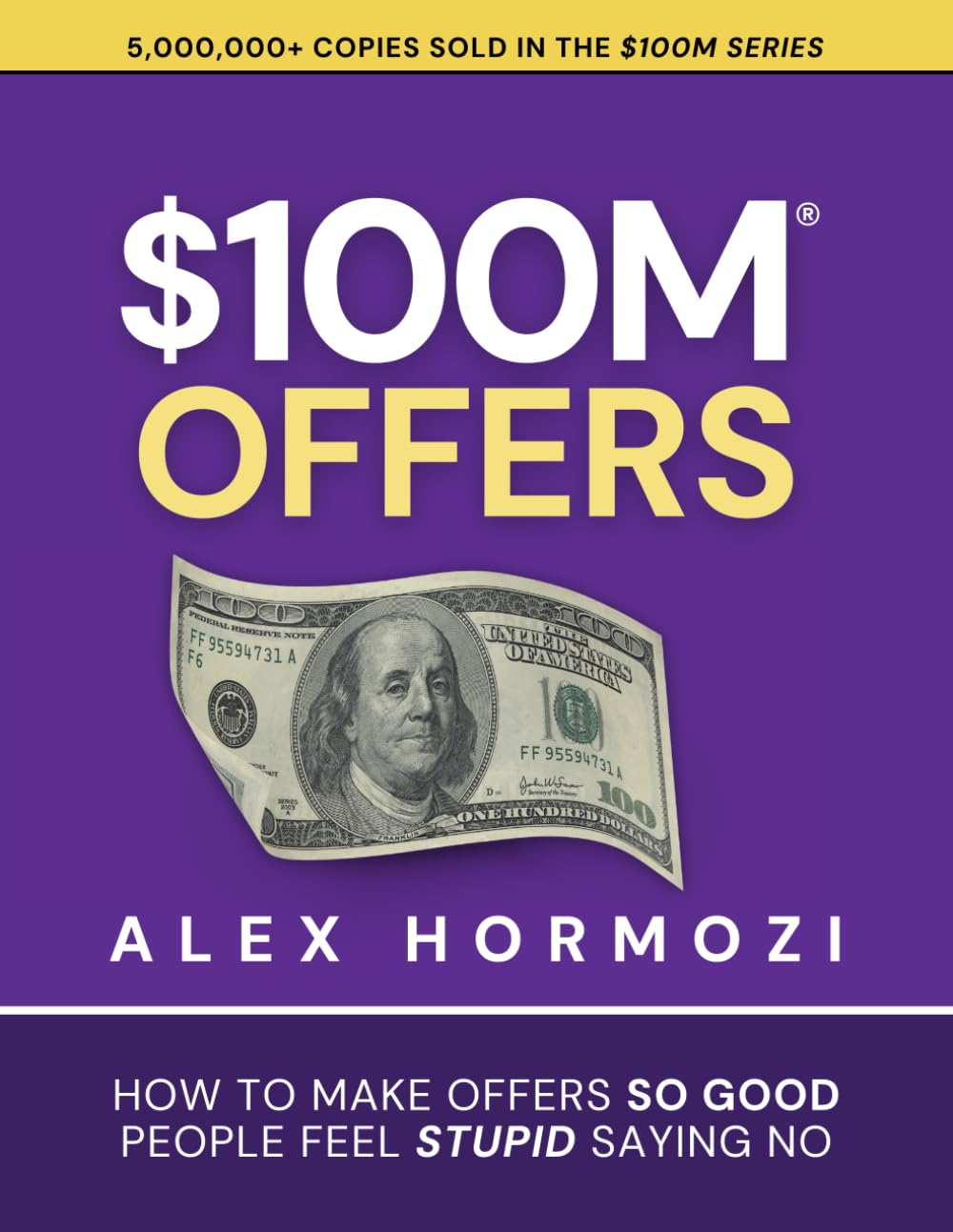
$100M Offers: How to Make Offers So Good People Feel Stupid Saying No is a business and entrepreneurship book by American entrepreneur, investor, and educator Alex Hormozi. It was first published in 2021 by Acquisition.com.
The book focuses on offer creation, pricing, perceived value, market selection, product positioning, and customer acquisition economics. Its central argument is that many businesses attempt to solve sales problems primarily through advertising or lead generation when the more fundamental problem may be the attractiveness of what they are actually selling.
Hormozi introduces a collection of frameworks for designing what he calls a “Grand Slam Offer”—an offer structured to provide substantially greater perceived value to a specific customer than the price being requested.
Among the book’s best-known concepts are the Value Equation, the Grand Slam Offer, the Delivery Cube, Value Stacking, Scarcity, Urgency, Bonuses, Guarantees, and the use of naming and positioning to differentiate an offer from commoditized alternatives.
The book subsequently became the first volume in Hormozi’s broader “$100M” business-book series, followed by $100M Leads and $100M Money Models. Acquisition.com describes $100M Leads as building on the foundation established by $100M Offers.
Infobox
| $100M Offers | |
|---|---|
| Author | Alex Hormozi |
| Full title | $100M Offers: How to Make Offers So Good People Feel Stupid Saying No |
| Language | English |
| Genre | Business, entrepreneurship, marketing |
| Subject | Offer creation, pricing, sales, value creation |
| Publisher | Acquisition.com |
| First published | July 13, 2021 |
| Length of original edition | 164 pages |
| Series | $100M series |
| Major framework | Value Equation |
| Central concept | Grand Slam Offer |
| Related books | $100M Leads, $100M Money Models |
| Author’s company | Acquisition.com |
Google Books records the original publication as July 13, 2021, with 164 pages.
Overview
At first glance, $100M Offers appears to be a book about selling products and services at higher prices.
Its underlying subject is broader.
Hormozi’s argument is that the offer itself is a major component of the economics of a business. If an entrepreneur can construct an offer that solves an important problem for a well-defined market and communicates a compelling exchange of value, the business may be able to charge more, acquire customers more efficiently and create greater room for profit.
The book therefore begins before advertising.
Instead of asking:
“How can I convince more people to buy?”
Hormozi’s framework encourages the entrepreneur to ask:
“What could I offer that would make the buying decision extraordinarily attractive?”
That shift—from persuasion toward offer design—is the intellectual center of the book.
Author
Alex Hormozi
Alex Hormozi is an entrepreneur, investor, author and founder of Acquisition.com.
According to his official biography, Hormozi began his first brick-and-mortar business in 2013 and expanded it to six locations within three years. He subsequently worked with more than 32 brick-and-mortar businesses and developed a licensing model based on his experience. Acquisition.com states that he later founded and scaled several companies across software, services, e-commerce and brick-and-mortar businesses.
His most notable reported transaction involved the sale of a majority interest in his licensing business. Acquisition.com states that a private-equity sponsor acquired 66% of Gym Launch and Prestige Labs in 2021 at a valuation of $46.2 million.
Hormozi later established Acquisition.com with his wife, Leila Hormozi, as an investment and business-education company.
According to Acquisition.com, its portfolio grew to more than $250 million in annual revenue within four years.
Education
Hormozi graduated from Vanderbilt University magna cum laude in three years with a Bachelor of Science in Human and Organizational Development, with a focus on corporate strategy.
Before entering entrepreneurship, he worked as a management consultant for a boutique strategy firm.
Acquisition.com
Acquisition.com is the business platform founded by Alex and Leila Hormozi.
The company describes itself as an investment and educational organization focused on helping entrepreneurs scale businesses.
The firm’s stated investment interests include asset-light, high-cash-flow businesses, particularly in service and digital-product categories.
The company subsequently organized Hormozi’s business education around three major systems:
                 THE $100M BUSINESS SYSTEM
                           │
          ┌────────────────┼────────────────┐
          │                │                │
          ▼                ▼                ▼
      $100M OFFERS     $100M LEADS    $100M MONEY MODELS
          │                │                │
          ▼                ▼                ▼
       WHAT TO          HOW TO GET      HOW TO
        SELL             CUSTOMERS       MONETIZE
Acquisition.com describes $100M Offers as the first system, $100M Leads as the lead-generation system, and $100M Money Models as the monetization system.
Background and purpose
Hormozi developed $100M Offers from his experience operating and advising businesses.
The book is particularly oriented toward businesses selling:
- services;
- consulting;
- coaching;
- education;
- fitness programs;
- agencies;
- professional services;
- digital products;
- and other relatively high-margin offerings.
The underlying principles, however, are broader than any single industry.
At its core, the book addresses a fundamental business problem:
How can a company create enough customer value that price becomes a smaller barrier to purchase?
The central concept: the offer
An offer is more than a product.
A product may be:
“A six-week fitness program.”
An offer might instead specify:
- who the program is for;
- what outcome it targets;
- how the program is delivered;
- what is included;
- how quickly the customer can begin;
- what additional resources are provided;
- what risks the customer faces;
- what guarantees apply;
- and what the total price is.
Thus, Hormozi’s approach treats an offer as a constructed package of value, rather than merely a description of a product.
The Grand Slam Offer
The book’s signature concept is the Grand Slam Offer.
A Grand Slam Offer is designed to be sufficiently differentiated and valuable that the customer has difficulty comparing it directly with ordinary competing products.
The basic objective is:
             ORDINARY OFFER
                    │
                    ▼
             Customer compares
             price vs. price
                    │
                    ▼
             COMMODITY MARKET


             GRAND SLAM OFFER
                    │
                    ▼
             Customer compares
             total perceived value
                    │
                    ▼
          DIFFERENTIATED OFFER
The important distinction is value differentiation, rather than simply being different for the sake of being different.
The Commodity Problem
Hormozi argues that businesses frequently become trapped in commodity markets.
For example, if ten businesses offer essentially the same service, customers may compare them primarily on:
- price;
- convenience;
- location;
- reviews;
- reputation;
- or minor differences in features.
This creates downward pressure on price.
Hormozi’s proposed solution is to redesign the offer so that the customer perceives it as meaningfully different.
Commodity model
Product → Price comparison → Competition
Differentiated model
Problem → Outcome → Mechanism → Offer → Value comparison
The Value Equation
The Value Equation is the book’s best-known analytical framework.
Hormozi presents perceived value as being influenced by four broad variables:
                  DREAM OUTCOME
                       ×
              PERCEIVED LIKELIHOOD
                 OF ACHIEVEMENT
                       │
                       ├───────────────
                       │
                       ▼
                  PERCEIVED VALUE
                       │
                       ÷
                       │
             TIME DELAY × EFFORT
                AND SACRIFICE
Conceptually, the equation can be represented as:
Value = (Dream Outcome × Perceived Likelihood of Achievement) ÷ (Time Delay × Effort and Sacrifice)
The formula is a conceptual model rather than a scientifically validated equation.
Its purpose is to provide entrepreneurs with a way of thinking about perceived value.
The four components of the Value Equation
1. Dream Outcome
The Dream Outcome is the result the customer ultimately wants.
Customers often do not buy the product itself.
They buy what they believe the product will help them achieve.
A person may not actually want:
- a course;
- a gym membership;
- consulting hours;
- software;
- a dental procedure;
- or a financial product.
They may want the outcome associated with those things.
Example
A customer does not necessarily want:
“a six-month language course.”
They may want:
“the ability to confidently communicate in English at work.”
The offer therefore becomes more powerful when it is connected to the customer’s desired end state.
2. Perceived likelihood of achievement
A desirable outcome is not enough.
The customer must also believe:
“This could actually work for me.”
Hormozi therefore emphasizes increasing the perceived probability that the promised outcome can be achieved.
Possible mechanisms include:
- demonstrations;
- testimonials;
- case studies;
- guarantees;
- proof;
- credentials;
- transparent processes;
- demonstrations of expertise;
- and clearly explained delivery systems.
This creates an important distinction:
             BIG PROMISE
                 │
                 ▼
       "Sounds attractive"
                 │
                 ▼
          But will it work?
                 │
                 ▼
       PROOF + MECHANISM
                 │
                 ▼
       Higher perceived
        likelihood
3. Time delay
The third factor is the amount of time between purchase and desired result.
All else being equal, customers generally prefer an outcome sooner rather than later.
Therefore, an offer can potentially become more attractive by reducing unnecessary delays.
For example:
Slow process
Purchase
   ↓
Wait
   ↓
Setup
   ↓
Training
   ↓
Implementation
   ↓
Result
versus:
Accelerated process
Purchase
   ↓
Immediate onboarding
   ↓
Immediate implementation
   ↓
Early progress
   ↓
Result
The key phrase is unnecessary delay.
Some outcomes inherently require time.
Reducing time delay does not mean making unrealistic promises.
4. Effort and sacrifice
Customers also evaluate how difficult the process will be.
An offer that produces the desired result while requiring enormous effort may be less attractive than an offer producing the same result through a simpler process.
Hormozi therefore encourages entrepreneurs to examine:
- complexity;
- inconvenience;
- number of steps;
- time commitment;
- learning requirements;
- administrative work;
- physical effort;
- and emotional friction.
The objective is not necessarily to eliminate all customer effort.
It is to eliminate unnecessary effort.
The Value Equation as a design tool
The four components can be transformed into practical questions:
| Component | Question for the entrepreneur |
|---|---|
| Dream Outcome | What does the customer ultimately want? |
| Likelihood | Why should the customer believe it will work? |
| Time Delay | How quickly can meaningful progress occur? |
| Effort & Sacrifice | How much work or inconvenience does the customer experience? |
This makes the Value Equation useful as a product-design checklist, not merely a sales formula.
Creating a Grand Slam Offer
Hormozi’s offer-building process can broadly be represented as:
       FIND THE MARKET
              │
              ▼
       IDENTIFY THE PROBLEM
              │
              ▼
       DEFINE THE DREAM OUTCOME
              │
              ▼
       CREATE THE SOLUTION
              │
              ▼
       PACKAGE THE SOLUTION
              │
              ▼
       ADD VALUE
              │
              ▼
       REDUCE RISK
              │
              ▼
       REDUCE TIME & EFFORT
              │
              ▼
       NAME THE OFFER
              │
              ▼
       PRESENT THE OFFER
Market selection
Hormozi places significant importance on choosing the right market.
His framework suggests that a business can struggle even when the product itself is competent if the target market lacks:
- purchasing power;
- a sufficiently important problem;
- a strong desire for the solution;
- or the ability to access the solution.
This leads to a fundamental business principle:
The same solution can have very different economic value in different markets.
The “starving crowd”
A recurring idea in direct-response marketing is that it is easier to sell a solution to people who already recognize and urgently want the outcome.
Hormozi applies this logic to market selection.
A market becomes more attractive when customers:
- have a significant problem;
- know they have the problem;
- want it solved;
- have the ability to pay;
- and are actively seeking solutions.
This can be visualized as:
               PROBLEM
                  │
                  ▼
             AWARENESS
                  │
                  ▼
               DESIRE
                  │
                  ▼
          ABILITY TO PAY
                  │
                  ▼
            ACTIVE DEMAND
                  │
                  ▼
           ATTRACTIVE MARKET
Niche selection
The book argues for identifying specific groups rather than attempting to sell a generic product to everybody.
For example:
Broad market
Fitness
More specific
Weight loss
More specific
Weight loss for busy professionals
More specific
Weight loss for busy executives who travel frequently
The point is not that narrower is always better.
The objective is to identify a group whose problem, desired outcome and purchasing capacity align with the proposed offer.
Pricing
Pricing occupies a major part of $100M Offers.
Hormozi challenges the common assumption that lower prices automatically create more sales.
His framework instead asks entrepreneurs to consider the relationship between:
price ↔ perceived value ↔ customer economics
A higher price can sometimes coexist with greater demand if the offer creates substantially greater perceived value and the target customer can afford it.
Price-to-value relationship
The basic principle can be visualized as:
              PERCEIVED VALUE
                    │
                    │
             ┌──────┴──────┐
             │             │
          HIGH VALUE     LOW VALUE
             │             │
             ▼             ▼
       Price feels      Price feels
        reasonable       expensive
Therefore, the question is not simply:
“How low can I make my price?”
It is:
“How much valuable transformation am I creating relative to the price?”
Value stacking
One of the practical techniques discussed in the book is value stacking.
Instead of presenting one product as a single undifferentiated item, the entrepreneur can present the components of the solution separately.
For example:
CORE SOLUTION
     +
IMPLEMENTATION GUIDE
     +
CHECKLIST
     +
TEMPLATE
     +
SUPPORT
     +
BONUS RESOURCE
     +
RISK-REDUCTION MECHANISM
     │
     ▼
COMPLETE OFFER
The objective is to make the customer understand the full scope of what is being provided.
Bonuses
Bonuses are additional components included with the primary offer.
A useful bonus should ideally address:
- a secondary problem;
- an implementation obstacle;
- a common objection;
- or a related customer need.
The book therefore treats bonuses as more than random gifts.
A strong bonus can function as an obstacle-removal mechanism.
Example
Suppose the primary product is:
“Build Your First Website.”
A useful bonus might be:
“50 Website Conversion Mistakes Checklist.”
The bonus directly addresses another problem encountered during implementation.
Scarcity
Scarcity refers to limiting availability.
Hormozi discusses scarcity as one of the mechanisms that can increase urgency, but the underlying principle raises an important ethical consideration:
Scarcity should correspond to something real.
Examples of legitimate scarcity may include:
- limited capacity;
- limited appointment slots;
- limited cohort size;
- genuinely limited inventory;
- or a real deadline associated with an offer.
Artificial scarcity can undermine trust.
Urgency
Urgency concerns the reason a customer should act now rather than indefinitely postponing a decision.
The book distinguishes urgency from scarcity.
Scarcity
“There are only five places.”
Urgency
“Enrollment closes Friday.”
The two mechanisms can overlap, but they solve different psychological problems.
Guarantees
Guarantees can reduce perceived risk.
From the customer’s perspective, purchasing a service involves uncertainty:
             CUSTOMER
                 │
                 ▼
        "Will this actually work?"
                 │
          ┌──────┴──────┐
          │             │
         YES            NO
          │             │
       Purchase       Avoid
A guarantee can reduce the perceived downside of the purchase.
However, guarantees must be designed carefully.
An irresponsible guarantee can expose a business to:
- excessive refunds;
- abuse;
- operational losses;
- legal problems;
- or unrealistic customer expectations.
The Delivery Cube
The Delivery Cube is another framework presented in $100M Offers.
Its purpose is to help entrepreneurs think about how a product or service is delivered and how delivery affects:
- customer experience;
- scalability;
- time;
- labor;
- consistency;
- and profitability.
A useful conceptual model is:
                 DELIVERY
                    │
       ┌────────────┼────────────┐
       │            │            │
       ▼            ▼            ▼
     TIME         EFFORT       COST
       │            │            │
       └────────────┼────────────┘
                    ▼
             CUSTOMER RESULT
The entrepreneur’s task is to increase the quality of the customer outcome while controlling unnecessary delivery complexity.
Trim and Stack
Hormozi’s Trim and Stack concept addresses the composition of the offer.
The basic idea is to:
Trim
Remove elements that create substantial cost or complexity without producing proportionate customer value.
Stack
Add elements that create meaningful perceived or actual value at relatively low marginal cost.
This produces a strategic asymmetry:
          HIGH CUSTOMER VALUE
                  ▲
                  │
                  │       STACK
                  │      ↗
                  │
                  │
                  └──────────────────►
                       BUSINESS COST

         Remove low-value / high-cost components
                         ↓
                        TRIM
The goal is to improve the economics of the offer rather than simply making it larger.
Offer economics
A strong offer must work for both sides of the transaction.
Customer perspective
Value received > Price paid
Business perspective
Revenue > Cost of acquisition + Cost of delivery + Overhead
A business cannot sustainably offer enormous value if every additional sale destroys cash.
Thus, the book’s offer philosophy is ultimately connected to unit economics.
The economics of increasing price
Consider a simplified example.
A service costs a business $200 to deliver.
Scenario A
Price = $300
Gross contribution before other costs = $100
Scenario B
Price = $600
Gross contribution = $400
If the business can genuinely increase customer value enough to support the higher price, the economics of customer acquisition can change dramatically.
This is one reason Hormozi emphasizes pricing.
A higher-value, higher-priced offer may give a business more resources to:
- acquire customers;
- hire talent;
- improve delivery;
- provide support;
- and reinvest in growth.
The numerical example is illustrative rather than a prediction of actual business performance.
The Price-Value Flywheel
The relationship can be represented as a reinforcing cycle:
      GREATER VALUE
           │
           ▼
      HIGHER PRICE
           │
           ▼
    MORE GROSS PROFIT
           │
           ▼
 MORE RESOURCES TO INVEST
           │
     ┌─────┼─────┐
     ▼     ▼     ▼
   SALES  STAFF  DELIVERY
     │     │     │
     └─────┼─────┘
           ▼
      GREATER VALUE
This is one of the strategic implications of the book’s pricing philosophy.
However, the flywheel works only when the underlying value proposition is genuine and the economics actually support reinvestment.
Free goodwill
The book also discusses the strategic use of free value.
Giving away useful information can create:
- trust;
- goodwill;
- awareness;
- expertise positioning;
- reciprocity;
- and future demand.
The distinction is important:
Free value is not necessarily a free business model.
A business can give away educational content while monetizing:
- implementation;
- products;
- services;
- consulting;
- software;
- communities;
- or other paid solutions.
The transformation concept
One of the most useful ways to understand Hormozi’s philosophy is through the concept of transformation.
A customer begins at:
Current State
and wants to reach:
Desired State
The offer is the bridge.
CURRENT STATE
     │
     │
     │     OFFER
     │   ┌─────────┐
     └──►│ PROCESS │
         │ SUPPORT │
         │ TOOLS   │
         └─────────┘
              │
              ▼
        DESIRED STATE
The stronger the offer’s ability to credibly bridge this gap, the greater its potential value.
The problem-solution framework
Hormozi’s approach can also be summarized as:
            CUSTOMER
               │
               ▼
             PROBLEM
               │
               ▼
          DESIRED RESULT
               │
               ▼
            OBSTACLES
               │
               ▼
             SOLUTION
               │
               ▼
              OFFER
               │
               ▼
             PRICE
A strong offer therefore begins with the customer rather than the entrepreneur’s preferred product.
Customer objections
An offer should anticipate the reasons someone might hesitate.
Common objections include:
- “It’s too expensive.”
- “I don’t have time.”
- “I don’t know whether it will work.”
- “I’ve tried something similar before.”
- “I need to think about it.”
- “I don’t trust the provider.”
- “I can do this myself.”
- “I need to ask someone else.”
The Value Equation provides a framework for examining many of these objections.
Too expensive
Increase or clarify value.
Too difficult
Reduce effort.
Too slow
Reduce unnecessary time delay.
“Will it work?”
Increase proof and perceived likelihood.
Offer creation framework
A simplified version of the book’s methodology is:
STEP 1
Choose a valuable market
        ↓
STEP 2
Identify a painful problem
        ↓
STEP 3
Define the desired outcome
        ↓
STEP 4
Create the solution
        ↓
STEP 5
Increase perceived likelihood
        ↓
STEP 6
Reduce time delay
        ↓
STEP 7
Reduce effort and sacrifice
        ↓
STEP 8
Add relevant bonuses
        ↓
STEP 9
Reduce perceived risk
        ↓
STEP 10
Name and position the offer
        ↓
STEP 11
Price according to value
        ↓
STEP 12
Test in the real market
The importance of testing
A theoretical offer is not necessarily a successful offer.
Ultimately, the marketplace provides feedback.
Entrepreneurs must observe:
- conversion rates;
- sales calls;
- customer objections;
- refund rates;
- retention;
- delivery costs;
- customer satisfaction;
- referrals;
- and profitability.
This turns offer design into an iterative process.
CREATE
  ↓
SELL
  ↓
MEASURE
  ↓
LEARN
  ↓
IMPROVE
  ↓
SELL AGAIN
The book’s chapter structure
Google Books lists the major sections and concepts of the work, including Grand Slam Offers, Pricing, the Value Equation, Free Goodwill, Creating Your Grand Slam Offer, Trim & Stack, Scarcity, Urgency, Bonuses, Guarantees and Naming.
The book can broadly be understood through three stages.
Part I — Foundations
The opening material establishes why offers matter and examines business growth through customers, purchase value and purchase frequency.
Part II — Pricing
This section examines commoditization, market selection and pricing strategy.
Part III — Offer creation
The book then moves into the practical construction of a Grand Slam Offer, including the Value Equation and methods for improving delivery.
Final offer-enhancement section
The later material discusses:
- scarcity;
- urgency;
- bonuses;
- guarantees;
- naming;
- and implementation.
Acquisition.com’s own description similarly organizes the book around charging more, creating offers and implementing them in the real world.
The book’s complete conceptual architecture
                         $100M OFFERS
                              │
              ┌───────────────┼────────────────┐
              │               │                │
              ▼               ▼                ▼
           MARKET          VALUE            PRICE
              │               │                │
              │        ┌──────┼──────┐         │
              │        │      │      │         │
              │        ▼      ▼      ▼         │
              │      DREAM  LIKELIHOOD         │
              │      OUTCOME  OF RESULT        │
              │                  │              │
              │             TIME DELAY          │
              │                  │              │
              │          EFFORT/SACRIFICE      │
              │                                 │
              └───────────────┬─────────────────┘
                              ▼
                       GRAND SLAM OFFER
                              │
             ┌────────────────┼────────────────┐
             │                │                │
             ▼                ▼                ▼
          BONUSES          GUARANTEE        SCARCITY
             │                │                │
             └────────────────┼────────────────┘
                              ▼
                           URGENCY
                              │
                              ▼
                           NAMING
                              │
                              ▼
                       CUSTOMER DECISION
                              │
                              ▼
                          BUSINESS
Ten major lessons
1. Start with the customer
An offer should solve an important customer problem rather than merely showcase what the business wants to sell.
2. Sell the outcome
Customers generally care more about the result than the technical specifications of the product.
3. Increase perceived certainty
Proof, demonstrations and clear mechanisms can make an offer more credible.
4. Reduce unnecessary delay
Customers generally prefer meaningful progress sooner.
5. Reduce unnecessary effort
A simpler customer journey can increase the attractiveness of an offer.
6. Price according to value
Price should be considered in relation to the value and economics of the outcome rather than simply copied from competitors.
7. Differentiate
If an offer is indistinguishable from alternatives, price comparison becomes easier.
8. Use bonuses strategically
A bonus should ideally solve a related problem rather than merely increase the apparent size of the package.
9. Reduce legitimate risk
Guarantees and clear expectations can reduce uncertainty when designed responsibly.
10. Test the marketplace
No framework eliminates the need for actual customer feedback.
$100M Offers and traditional marketing
Traditional marketing often begins with:
Product → Advertisement → Customer
Hormozi’s approach reverses the emphasis:
Customer problem → Desired outcome → Offer → Marketing
This is a meaningful distinction.
Advertising can amplify an offer.
It cannot necessarily rescue an offer that customers do not want.
The book therefore places offer-market fit before aggressive customer acquisition.
Offer-market fit
The concept can be represented as:
             CUSTOMER
                │
                ▼
        IMPORTANT PROBLEM
                │
                ▼
          DESIRED OUTCOME
                │
                ▼
          STRONG SOLUTION
                │
                ▼
           ATTRACTIVE OFFER
                │
                ▼
          WILLINGNESS TO PAY
When this chain breaks, marketing becomes substantially harder.
Comparison with $100M Leads
The two books are closely related but focus on different stages of the business system.
| $100M Offers | $100M Leads |
|---|---|
| What to sell | How to attract customers |
| Offer design | Lead generation |
| Value | Attention and demand |
| Pricing | Acquisition |
| Grand Slam Offer | Lead-generation systems |
| Value Equation | Advertising and outreach |
| First book | Second book |
Acquisition.com explicitly describes $100M Leads as building on the foundation of $100M Offers and assuming that the reader already has a Grand Slam Offer.
Comparison with $100M Money Models
The third book moves further into monetization.
The three-book framework can therefore be summarized:
                 BUSINESS
                    │
          ┌─────────┼─────────┐
          ▼         ▼         ▼
        OFFER      LEADS     MONEY
          │         │         │
          ▼         ▼         ▼
       WHAT TO    HOW TO    HOW TO
        SELL      ATTRACT   MONETIZE
Acquisition.com describes these as three complementary systems for building a scalable business.
Applications outside entrepreneurship
Although written primarily for entrepreneurs, the book’s concepts can be applied to many areas.
Professional services
A professional can package expertise around a specific outcome rather than selling hours alone.
Education
A course can be positioned around a measurable transformation rather than simply a collection of lessons.
Healthcare
A clinic can organize a patient journey around convenience, education, follow-up and outcomes, subject to professional and regulatory requirements.
Software
A software company can focus its offer on the business result enabled by the software rather than only its feature list.
Consulting
Consultants can package diagnosis, implementation, support and measurement into a defined outcome-oriented engagement.
The underlying principle is the same:
Identify the customer’s desired outcome and construct the offer around the transformation.
Limitations and criticisms
The $100M Offers framework is influential in contemporary online entrepreneurship, but it should not be treated as a universal law of economics.
Several limitations are worth noting.
Perceived value is subjective
Different customers may assign radically different values to the same offer.
Higher prices do not automatically create higher demand
A price increase may improve unit economics in some situations but reduce demand in others.
Not every problem can be accelerated
Some transformations require time because of biological, educational, technological or operational constraints.
Guarantees can create financial risk
A poorly designed guarantee can shift excessive risk onto the business.
Scarcity can become manipulative
False scarcity or fabricated deadlines can damage trust.
Market selection is not sufficient
A desirable market does not guarantee a profitable business. Competition, regulation, operating costs, customer acquisition and retention still matter.
Frameworks are not substitutes for evidence
A compelling offer must eventually survive contact with real customers.
Ethical considerations
The book’s title deliberately uses provocative language: “so good people feel stupid saying no.”
The phrase is intended as marketing rhetoric, but it raises a useful ethical question.
A compelling offer should not depend on deceiving or coercing customers.
Responsible application requires:
- accurate claims;
- transparent pricing;
- realistic expectations;
- genuine scarcity;
- honest testimonials;
- appropriate guarantees;
- compliance with applicable laws;
- and respect for the customer’s ability to decline.
The strongest interpretation of Hormozi’s framework is therefore not:
“How do I manipulate someone into buying?”
but:
“How do I create so much legitimate value that the purchase makes economic sense to the right customer?”
That distinction is important when applying direct-response marketing techniques in the real world.
A modern interpretation of the Value Equation
The framework can be translated into four practical product-design questions:
Increase the dream outcome
Make the destination more valuable.
Increase perceived likelihood
Make success more believable.
Decrease time delay
Help customers progress sooner.
Decrease effort and sacrifice
Make the journey easier.
This creates the following design matrix:
| Goal | Possible business action |
|---|---|
| Increase desired outcome | Improve transformation |
| Increase certainty | Proof, demonstration, process |
| Reduce delay | Faster onboarding or implementation |
| Reduce effort | Templates, automation, support |
| Reduce risk | Appropriate guarantee |
| Increase differentiation | Unique mechanism or positioning |
A practical example
Consider a hypothetical language-learning business.
Ordinary offer
English Speaking Course — $100
Includes:
- 20 video lessons
- PDF workbook
The customer has to compare it with hundreds of similar courses.
Redesigned offer
90-Day Workplace English Transformation
Includes:
- diagnostic assessment;
- personalized learning path;
- daily speaking exercises;
- weekly live practice;
- workplace conversation templates;
- interview practice;
- progress tracking;
- feedback;
- implementation support.
The second offer is not necessarily better simply because it contains more items.
Its potential advantage is that the components are organized around a specific customer outcome.
That is the essence of the Grand Slam Offer concept.
The Offer Scorecard
A practical evaluation tool derived from the book’s concepts can be represented as follows:
                     OFFER SCORECARD

Market
[ ] Important problem
[ ] Strong desire
[ ] Ability to pay

Outcome
[ ] Clear dream outcome
[ ] Specific transformation

Certainty
[ ] Proof
[ ] Credible mechanism
[ ] Clear process

Speed
[ ] Shortest reasonable time
[ ] Fast onboarding

Effort
[ ] Low unnecessary friction
[ ] Simple implementation

Risk
[ ] Clear expectations
[ ] Appropriate guarantee

Economics
[ ] Healthy gross margin
[ ] Sustainable delivery
[ ] Customer acquisition economics work

Differentiation
[ ] Distinct positioning
[ ] Not easily reduced to price comparison
Why the book became influential
Several characteristics helped $100M Offers gain attention in the entrepreneurial community.
Practical language
The book presents business concepts through memorable labels and formulas.
Framework-driven structure
Readers can convert concepts into checklists and exercises.
Strong emphasis on implementation
The material is designed to encourage readers to modify actual offers.
Connection to Hormozi’s business story
The author’s own entrepreneurial history provides a practical context for the frameworks.
Compatibility with online entrepreneurship
The concepts apply naturally to coaching, consulting, agencies, information products and other internet-based businesses.
Acquisition.com states that $100M Offers and $100M Leads have each sold more than one million copies. This is a company-reported figure rather than an independently audited bibliographic statistic.
Reception and influence
The book became part of the expanding literature surrounding contemporary entrepreneurship, direct-response marketing and high-ticket service businesses.
Its terminology—including Grand Slam Offer and Value Equation—has become closely associated with Hormozi’s educational content.
Acquisition.com’s current catalog presents $100M Offers as the first book in a larger system covering offers, leads and money models.
Relationship to earlier marketing literature
Hormozi’s ideas exist within a much older tradition of direct-response marketing.
The broader intellectual background includes concepts associated with:
- market segmentation;
- positioning;
- perceived value;
- direct response;
- risk reversal;
- guarantees;
- sales psychology;
- copywriting;
- product differentiation;
- and customer lifetime value.
The distinctive feature of $100M Offers is its synthesis of these concepts into a highly packaged entrepreneurial framework.
The central philosophy in one sentence
Do not merely sell a product; design an exchange in which the customer’s perceived value of the desired transformation substantially exceeds the price and friction required to obtain it.
One-page infographic
╔══════════════════════════════════════════════════════════╗
║                    $100M OFFERS                         ║
║                ALEX HORMOZI'S FRAMEWORK                 ║
╠══════════════════════════════════════════════════════════╣
║                                                          ║
║  1. FIND THE RIGHT MARKET                                ║
║        ↓                                                 ║
║  2. FIND A VALUABLE PROBLEM                              ║
║        ↓                                                 ║
║  3. DEFINE THE DREAM OUTCOME                             ║
║        ↓                                                 ║
║  4. BUILD THE SOLUTION                                   ║
║        ↓                                                 ║
║  5. INCREASE CERTAINTY                                   ║
║        ↓                                                 ║
║  6. REDUCE TIME                                          ║
║        ↓                                                 ║
║  7. REDUCE EFFORT                                        ║
║        ↓                                                 ║
║  8. STACK RELEVANT VALUE                                 ║
║        ↓                                                 ║
║  9. REDUCE PERCEIVED RISK                                ║
║        ↓                                                 ║
║ 10. DIFFERENTIATE + NAME THE OFFER                       ║
║        ↓                                                 ║
║ 11. PRICE ACCORDING TO VALUE & ECONOMICS                 ║
║        ↓                                                 ║
║ 12. TEST → MEASURE → IMPROVE                             ║
║                                                          ║
╚══════════════════════════════════════════════════════════╝
Frequently asked questions
What is $100M Offers about?
It is a business book about designing products and services as compelling offers, with particular emphasis on customer value, pricing, market selection and perceived risk.
Who wrote $100M Offers?
It was written by entrepreneur Alex Hormozi.
When was it published?
The original edition was published on July 13, 2021.
What is a Grand Slam Offer?
It is Hormozi’s term for a highly differentiated offer designed around a specific customer problem and desired outcome.
What is the Value Equation?
It is Hormozi’s conceptual framework for thinking about perceived value through four variables: desired outcome, perceived likelihood of achievement, time delay, and effort or sacrifice.
Does the book teach sales techniques?
Yes, but its primary emphasis is on offer construction rather than conventional sales scripts.
Does the book teach how to get customers?
Only indirectly. Its main focus is the offer itself. $100M Leads subsequently addresses lead generation. Acquisition.com explicitly describes $100M Leads as building on the offer framework.
Is the $100M figure a literal promise?
No. The “$100M” title is the name of Hormozi’s business framework and brand. It should not be interpreted as a guarantee that readers will generate $100 million.
Is the book suitable for beginners?
Its framework-oriented approach can make it accessible to beginners, although implementing the concepts effectively requires understanding one’s market, economics and customer behavior.
Is the book only for online businesses?
No. Its concepts can be applied to many service and product businesses, although many examples and the author’s business background are particularly relevant to entrepreneurship and service businesses.
See also
- Alex Hormozi
- Acquisition.com
- $100M Leads
- $100M Money Models
- Entrepreneurship
- Marketing
- Direct-response marketing
- Value proposition
- Pricing strategy
- Market segmentation
- Product positioning
- Customer acquisition
- Customer lifetime value
- Sales
- Business model
- Unit economics
- Value-based pricing
Further reading
Books by Alex Hormozi
- $100M Offers: How to Make Offers So Good People Feel Stupid Saying No
- $100M Leads: How to Get Strangers to Want to Buy Your Stuff
- $100M Money Models: How to Make Money
Acquisition.com currently presents these three books as a connected “$100M” system covering offers, lead generation and monetization.
Related subjects
- Value proposition design
- Pricing psychology
- Direct-response marketing
- Customer acquisition
- Product-market fit
- Sales psychology
- Entrepreneurship
- Business strategy
- Customer lifetime value
- Unit economics
References
- Hormozi, Alex. $100M Offers: How to Make Offers So Good People Feel Stupid Saying No. Acquisition.com, 2021.
- Google Books. Bibliographic record for $100M Offers, including publication date, pagination and contents.
- Acquisition.com. “$100M Offers” official book description and framework overview.
- Acquisition.com. Alex Hormozi biography and professional history.
- Acquisition.com. Company and founders information.
- Acquisition.com. $100M book-series information.
External links
- Acquisition.com — official website
- $100M Offers — official Acquisition.com book page
- Alex Hormozi — official biography
- Google Books — $100M Offers
Author’s note
There is something interesting about $100M Offers that is easy to miss when the book is reduced to its formulas.
Its most important idea is not really about charging more.
It is about making the exchange itself better.
A customer has a problem. The business has a potential solution. Between the two sits an enormous amount of friction: uncertainty, price, effort, waiting, distrust, complexity and the fear of making the wrong decision.
Hormozi’s framework asks the entrepreneur to systematically remove those obstacles.
That is why the Value Equation is more useful when treated as a product-design philosophy than as a sales trick.
The best offer is not necessarily the one with the longest list of bonuses or the most aggressive guarantee.
It is the one that makes a simple proposition believable:
“You have a problem. You want a particular outcome. We understand the problem, we have a credible way to solve it, and we have designed the journey so that getting from where you are to where you want to be is easier, faster and less risky.”
That is the underlying idea that connects the book’s many frameworks.
And that is perhaps the most enduring lesson of $100M Offers: before trying to become better at selling, become better at creating something worth buying.