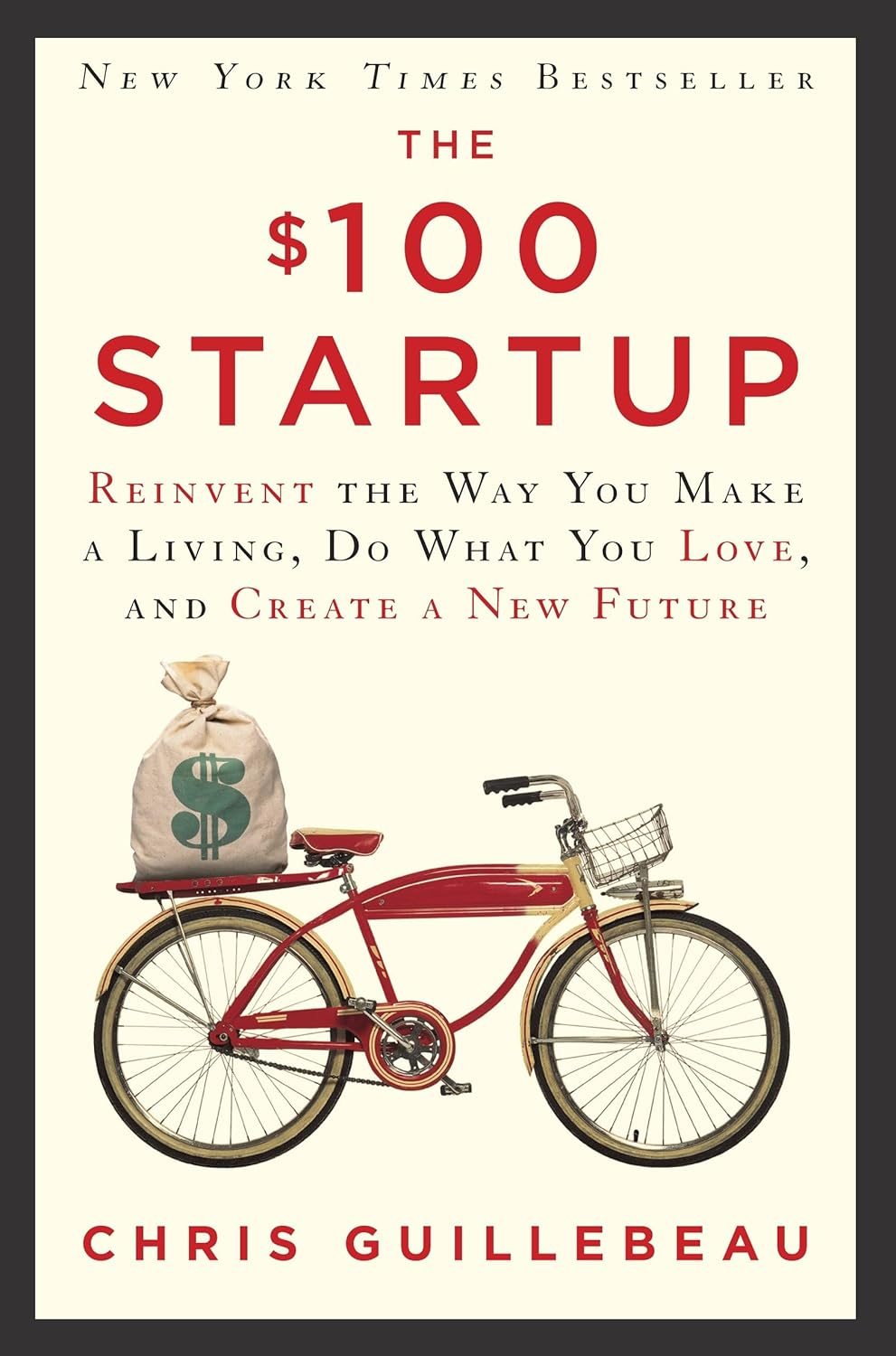
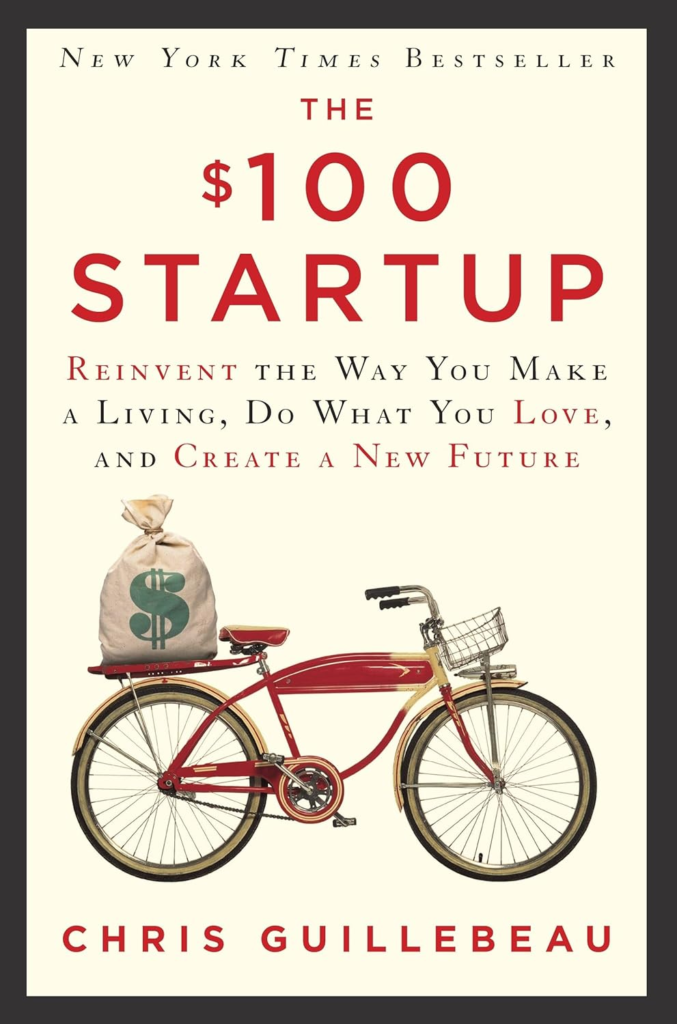
The $100 Startup: Reinvent the Way You Make a Living, Do What You Love, and Create a New Future is a 2012 nonfiction book on entrepreneurship, microbusinesses, self-employment, and lifestyle design by American author and entrepreneur Chris Guillebeau. Published by Crown Business on May 8, 2012, the book argues that many people can create small, sustainable sources of income without large amounts of startup capital, elaborate business plans, outside investors, or traditional entrepreneurial credentials.
Rather than presenting entrepreneurship primarily as a path toward building a large corporation, Guillebeau focuses on the microbusiness: a small enterprise designed to generate useful income while giving its owner greater control over time, work, location, and lifestyle.
The central idea is deceptively simple: find something you can do, identify people who need it, create a useful offer, and find a way to get paid for providing it.
The “$100” in the title is therefore less a universal budget requirement than a symbol of the book’s larger argument—that the initial barrier to entrepreneurship can sometimes be dramatically lower than conventional business culture suggests.
The book was based on Guillebeau’s research into hundreds of small businesses. He identified approximately 1,500 people whose businesses generated at least $50,000 in annual revenue from relatively modest initial investments and selected 50 case studies for particular attention.
Book information
| Field | Details |
|---|---|
| Title | The $100 Startup |
| Full title | The $100 Startup: Reinvent the Way You Make a Living, Do What You Love, and Create a New Future |
| Author | Chris Guillebeau |
| Genre | Business, Entrepreneurship, Personal Development |
| Subject | Microbusiness, self-employment, entrepreneurship, lifestyle design |
| Original publisher | Crown Business / Crown |
| Publication date | May 8, 2012 |
| Original language | English |
| Length | 304 pages in the U.S. Crown edition |
| ISBN | 9780307951526 |
| Illustrations | Mike Rohde |
| Major focus | Turning skills and interests into useful, income-generating businesses |
Bibliographic information is documented by Penguin Random House and Google Books.
Overview
The $100 Startup emerged during a period when technology was making it increasingly inexpensive for individuals to create websites, sell products online, communicate with customers, publish information, and operate businesses independently.
Guillebeau’s argument is not that traditional companies, large investments, business schools, or corporate careers are inherently wrong. Instead, he challenges the assumption that they are the only serious routes to economic independence.
The book examines people who discovered that an existing skill, hobby, professional experience, personal interest, or unusual ability could be transformed into something other people would pay for.
This produces one of the book’s most important distinctions:
A skill by itself is not necessarily a business. A skill becomes commercially useful when it solves a problem or creates a benefit that someone values enough to pay for.
Guillebeau repeatedly brings the reader back to the relationship between value and income.
A person might love photography, cooking, writing, teaching, organizing, designing, repairing, consulting, traveling, fitness, crafts, or collecting information. But passion alone does not guarantee a viable business.
The entrepreneurial question is different:
What can I do that other people actually want?
That shift—from What do I love? to What can I do that is valuable to others?—is at the heart of the book.
The central philosophy of the book
The philosophy of The $100 Startup can be represented as a chain:
SKILL / INTEREST
       ↓
   USEFUL IDEA
       ↓
CUSTOMER PROBLEM
       ↓
VALUABLE OFFER
       ↓
     PAYMENT
       ↓
   PROFITABILITY
       ↓
GREATER FREEDOM
The important point is that the process does not begin with a large office, employees, investors, or complicated infrastructure.
It begins with value.
Guillebeau describes value as something useful that is created and shared with other people. His research suggests that the freedom people seek through self-employment often emerges as a consequence of creating that value successfully.
What is a “$100 Startup”?
A “$100 Startup” is essentially a small, low-cost business built around an individual’s existing skills or interests and designed to produce income without requiring substantial upfront capital.
The model can involve:
- consulting
- freelance services
- online education
- information products
- crafts
- food businesses
- tourism
- professional services
- creative work
- specialized hobbies
- digital products
- niche retail
- coaching
- events
- membership businesses
- small physical products
The concept is especially relevant to what is now commonly called the creator economy, side-hustle economy, or solopreneurship, although those terms became more widespread after the book’s publication.
Guillebeau himself later described the philosophy as resting on three basic questions:
- What can you do?
- Who needs it?
- How can you get paid?
Why $100?
The “$100” figure is one of the book’s most memorable features, but it should not be interpreted as a guarantee that every business can literally be launched for exactly $100.
The case studies demonstrate that some businesses were started with $100 or less, while others required more. The broader argument is about lowering unnecessary barriers to action.
In conventional entrepreneurship, people often begin with questions such as:
- How much capital can I raise?
- Do I need investors?
- Do I need an office?
- Do I need employees?
- Do I need an MBA?
- How large should my business plan be?
Guillebeau reverses the sequence.
He essentially asks:
What is the smallest useful version of this business that I can create and sell?
That change in perspective is fundamental to the book.
The “microbusiness” model
A major subject of the book is the rise of the microbusiness.
A microbusiness is a very small enterprise, often operated by one person or a small team, with relatively limited overhead.
Unlike the traditional startup model, the objective is not necessarily:
Raise capital → hire employees → scale rapidly → sell the company.
Instead, the model can look like:
Skill → Offer → Customer → Revenue → Improvement → Freedom.
This distinction is crucial.
Guillebeau’s entrepreneurs are not necessarily trying to become the next Amazon, Google, or Apple. Many simply want a business that provides enough income to support the life they want.
Freedom and value
The book repeatedly connects two concepts:
Value
Create something useful for another person.
Freedom
Gain greater control over how, when, and where you work.
The relationship can be represented as:
       VALUE
         │
         ▼
      CUSTOMERS
         │
         ▼
       REVENUE
         │
         ▼
       PROFIT
         │
         ▼
      FREEDOM
The book’s philosophy therefore does not define entrepreneurship simply as “making money.”
Money is important because it provides resources and options.
But the deeper objective is autonomy.
Guillebeau’s own website continues to describe the $100 Startup philosophy in terms of useful skills, clear customers, and the willingness to begin.
Author
Chris Guillebeau
Chris Guillebeau is an American author, entrepreneur, speaker, and traveler known for writing about unconventional careers, entrepreneurship, personal freedom, travel, and self-directed living.
His work developed around a recurring question:
How can an individual construct a life according to personally meaningful goals rather than simply following conventional expectations?
Before The $100 Startup, Guillebeau became known through his website and writing project The Art of Non-Conformity, which explored unconventional approaches to work and life.
He subsequently published several books, including:
- The Art of Non-Conformity
- The $100 Startup
- The Happiness of Pursuit
- Born for This
- Side Hustle
- The Money Tree
- Time Anxiety
His official biography states that he has visited every country in the world and that he hosts the Side Hustle School podcast, which began in 2017.
His early life and career also included self-employment and volunteer work in West Africa. By the time The $100 Startup was published, he had completed his personal goal of visiting all 193 countries.
Background to the book
Guillebeau’s interest in unconventional work grew from his own experience of earning income independently rather than following a conventional career path.
The book therefore combines two things:
- Personal philosophy
- Research into real microbusinesses
This combination gives the book a different character from a conventional entrepreneurship textbook.
It is not primarily a theoretical economics book.
It is not a traditional MBA-style business manual.
And it is not simply a motivational book.
Instead, it uses case studies as evidence for a practical entrepreneurial philosophy.
Research behind the book
One of the distinguishing features of The $100 Startup is its extensive use of real-world examples.
Guillebeau reports studying approximately 1,500 individuals who had built businesses generating $50,000 or more in annual revenue from relatively modest investments. From this larger group, he selected about 50 case studies for detailed treatment.
These examples were deliberately varied.
The entrepreneurs did not all possess:
- prestigious qualifications,
- wealthy families,
- venture capital,
- large teams,
- sophisticated technology,
- or extensive corporate experience.
The variety was part of the argument.
The book attempts to demonstrate that entrepreneurial opportunity can appear in unexpected places.
Structure of the book
The book is divided into three major parts, preceded by a prologue and followed by supplementary material and case studies.
Prologue — Manifesto
The opening establishes the book’s central proposition: a different relationship between work, money, freedom, and personal ambition is possible.
Rather than waiting for the perfect opportunity, the reader is encouraged to think about what can be created now.
Part I — Unexpected Entrepreneurs
Chapter 1 — Renaissance
The first chapter introduces the idea that people often possess more commercially useful skills than they realize.
A person may overlook abilities because they have become ordinary through repetition.
Someone who has spent years doing something may think:
“Everybody knows how to do this.”
But that assumption can be wrong.
The chapter introduces the concept of skill transformation: examining existing abilities from a different perspective and discovering other applications for them.
Key idea
WHAT YOU KNOW
      +
WHAT YOU ENJOY
      +
WHAT OTHERS NEED
      ↓
POSSIBLE BUSINESS
Chapter 2 — Give Them the Fish
This chapter focuses on one of the book’s most important entrepreneurial ideas:
Customers generally want outcomes, not lessons about how to obtain those outcomes.
The metaphor of “giving them the fish” emphasizes delivering the desired result rather than merely explaining the process.
For example:
- A customer may not want a photography course.
- They may want beautiful photographs.
A business should therefore pay attention to the result customers actually value.
This is closely connected to the distinction between features and benefits.
Feature
What the product contains.
Benefit
What the customer gets from it.
The book argues that benefits are often more powerful commercially because customers purchase outcomes rather than technical descriptions.
Chapter 3 — Follow Your Passion … Maybe
The chapter challenges the popular advice to simply “follow your passion.”
Guillebeau does not reject passion.
Instead, he qualifies it.
Passion becomes commercially useful when it intersects with something that other people value.
PASSION
   │
   ├── No customer need → HOBBY
   │
   └── Customer need → BUSINESS POSSIBILITY
This is one of the book’s most enduring ideas.
A person does not necessarily need to abandon a passion.
But the passion must be translated into value.
Chapter 4 — The Rise of the Roaming Entrepreneur
This chapter explores location independence.
Technology allows some businesses to be operated without being tied permanently to a particular physical location.
The “roaming entrepreneur” represents a person whose business is sufficiently portable to allow greater geographical freedom.
This idea became increasingly influential in later discussions about:
- remote work
- digital nomadism
- location-independent businesses
- online services
- distributed teams
The book does not suggest that location independence is appropriate for every business. Rather, it presents it as one possible consequence of designing a business around portability.
Chapter 5 — The New Demographics
Traditional marketing often categorizes customers according to:
- age
- gender
- occupation
- income
- geography
Guillebeau argues that entrepreneurs can sometimes identify customers more effectively through shared interests, beliefs, values, and problems.
This is closely related to what modern marketing commonly calls psychographics.
For a microbusiness, finding a relatively small but highly relevant audience may be more useful than trying to appeal to everyone.
Part II — Taking It to the Streets
The second part moves from identifying opportunities to actually building and selling something.
Chapter 6 — The One-Page Business Plan
Guillebeau deliberately minimizes elaborate business planning.
The emphasis is on answering practical questions:
- What will you sell?
- Who will buy it?
- Why will they buy it?
- How much will they pay?
- How will they find you?
- What will it cost to deliver?
- How will you make a profit?
The underlying principle is:
A business plan should clarify action rather than become a substitute for action.
A useful microbusiness plan can therefore be reduced to a small number of essential decisions.
Chapter 7 — An Offer You Can’t Refuse
This chapter examines the construction of a compelling offer.
A good offer is not merely a description of a product.
It should communicate:
- what the customer receives,
- what problem it solves,
- what benefit it provides,
- how much it costs,
- and why the purchase is worthwhile.
A simplified model is:
CUSTOMER PROBLEM
        ↓
DESIRED RESULT
        ↓
SPECIFIC OFFER
        ↓
CLEAR PRICE
        ↓
EASY PURCHASE
The central principle is customer value.
A business should not become obsessed with what something costs to produce while ignoring the value of the result to the buyer.
Chapter 8 — Launch!
Guillebeau argues that launching does not necessarily require a huge marketing campaign.
A small business can launch with:
- an existing network,
- a simple website,
- direct communication,
- partnerships,
- social media,
- a small audience,
- or a modest promotional experiment.
The objective is to get the offer into the real world.
This is important because market feedback is often more informative than private speculation.
Chapter 9 — Hustling: The Gentle Art of Self-Promotion
Promotion is unavoidable.
Even an excellent product cannot generate revenue if nobody knows it exists.
But Guillebeau’s approach is not simply “advertise more.”
Instead, entrepreneurs are encouraged to communicate their value through:
- relationships,
- useful information,
- partnerships,
- publicity,
- direct outreach,
- word of mouth,
- community,
- and creative promotion.
The entrepreneur becomes responsible for making the connection between offer and audience.
Chapter 10 — Show Me the Money
This chapter examines financing and the common assumption that entrepreneurs must raise large amounts of startup capital.
Guillebeau presents alternatives to traditional financing and emphasizes the importance of generating revenue.
The broader principle can be summarized as:
TRADITIONAL MODEL

CAPITAL → BUSINESS → CUSTOMERS → REVENUE


MICROBUSINESS MODEL

CUSTOMER → OFFER → PAYMENT → DELIVERY → GROWTH
The second model can reduce the amount of external capital required.
The book’s examples include unconventional ways of funding or financing small ventures, but it does not establish borrowing as universally appropriate.
Part III — Leverage and Next Steps
The final major section focuses on improving an existing business rather than simply starting one.
Chapter 11 — Moving On Up
Once a business works, the next question is:
How can it become more profitable?
Guillebeau identifies several practical approaches, including improving pricing, increasing customer value, refining the offer, and finding ways to earn more without proportionally increasing workload.
One particularly important pricing principle is:
Price according to the value or benefit provided, rather than simply calculating production cost.
The book also discusses offering a limited range of price points and creating opportunities for repeat purchases.
Chapter 12 — How to Franchise Yourself
“Franchise yourself” is used metaphorically.
The idea is to turn personal knowledge and repeatable processes into systems.
For example:
PERSONAL SKILL
      ↓
REPEATABLE PROCESS
      ↓
DOCUMENTATION
      ↓
SYSTEM
      ↓
SCALABILITY
This can allow an entrepreneur to serve more customers without personally performing every task from scratch.
It can also involve:
- templates
- standard operating procedures
- outsourcing
- digital products
- automation
- training
- licensing
Chapter 13 — Going Long
Not every successful microbusiness needs to become a giant company.
This is one of the book’s more subtle arguments.
Growth should be intentional.
Some entrepreneurs want:
- a large company,
- employees,
- offices,
- investors,
- international operations.
Others want:
- a comfortable income,
- flexible hours,
- fewer customers,
- more travel,
- more family time,
- or greater creative freedom.
The book therefore treats “bigger” and “better” as different concepts.
Chapter 14 — But What If I Fail?
The final chapter addresses risk and failure.
Guillebeau does not pretend that entrepreneurship is guaranteed to work.
Instead, he emphasizes resilience and the ability to recover.
The low-cost model can reduce certain forms of financial exposure, but it cannot eliminate:
- uncertainty,
- competition,
- poor product-market fit,
- customer acquisition problems,
- unexpected expenses,
- personal stress,
- or market changes.
The underlying message is not that failure is impossible.
It is that small experiments can make failure less catastrophic and learning more affordable.
The Value Doctrine
One of the most important concepts running throughout the book is what can be called the Value Doctrine.
Its logic is:
CREATE SOMETHING USEFUL
          ↓
     SHARE IT
          ↓
      HELP PEOPLE
          ↓
 PEOPLE PAY FOR VALUE
          ↓
     BUSINESS INCOME
          ↓
       FREEDOM
This framework distinguishes the book from approaches that focus primarily on money.
Money is the consequence of successfully creating and delivering value.
Passion versus value
Perhaps the most misunderstood aspect of the book is its treatment of passion.
The simplistic interpretation would be:
“Do what you love and the money will follow.”
That is not the full argument.
A better interpretation is:
Find the intersection between something you can do well, something you care about, and something other people are willing to pay for.
This produces a three-circle model:
             WHAT YOU LOVE
                  ○
                /   \
               /     \
              /       \
             /   $$$   \
            /           \
           ○─────────────○
       WHAT YOU DO      WHAT PEOPLE
          WELL            WANT
The most commercially interesting area is the intersection.
Skill transformation
A major entrepreneurial technique presented in the book is skill transformation.
Instead of asking:
“What is my profession?”
the entrepreneur asks:
“What am I good at, and where else could those abilities be useful?”
For example:
| Existing ability | Possible transformation |
|---|---|
| Writing | Copywriting, newsletters, content products |
| Teaching | Courses, tutoring, workshops |
| Photography | Events, stock images, specialized services |
| Cooking | Classes, catering, digital recipes |
| Organizing | Virtual assistance, consulting |
| Fitness knowledge | Coaching, programs, information products |
| Technical knowledge | Consulting, implementation, training |
| Travel knowledge | Guides, planning services, specialized content |
The skill itself does not determine the business.
The application of the skill does.
Give customers what they want
Another recurring principle is that entrepreneurs should pay attention to actual customer behavior rather than assumptions about what customers supposedly want.
This means observing:
- what people buy,
- what they complain about,
- what they repeatedly ask for,
- what they already spend money on,
- what saves them time,
- what reduces uncertainty,
- and what produces a desirable emotional outcome.
This creates a simple research loop:
ASK
 ↓
LISTEN
 ↓
OBSERVE
 ↓
CREATE
 ↓
SELL
 ↓
MEASURE
 ↓
IMPROVE
Features versus benefits
The distinction between features and benefits is central to the book’s approach to selling.
Feature
A factual description of a product.
Benefit
The positive result experienced by the customer.
For example:
Feature:
“Four weekly online lessons.”
Benefit:
“Learn the skill without commuting to a classroom.”
The customer is generally more interested in the second statement because it connects the product to a desired outcome.
Pricing
Pricing is treated as a strategic business decision rather than simply a mathematical calculation.
Guillebeau emphasizes that price should be related to customer benefit and perceived value, not merely the entrepreneur’s cost of producing the product.
The book also discusses offering a limited range of prices and creating ways to receive repeat payments.
A simplified model is:
LOW PRICE
   │
   ├── Entry-level customer
   │
MEDIUM PRICE
   │
   ├── Core customer
   │
HIGHER PRICE
   │
   └── Customer seeking additional value
The precise structure depends on the business.
Revenue versus profit
The book repeatedly distinguishes between making sales and making money.
A business can have substantial revenue and still be financially weak if expenses consume most of that revenue.
A basic equation is:
Profit = Revenue − Expenses
This simple distinction becomes particularly important as a microbusiness grows.
The entrepreneur therefore needs to monitor:
- revenue,
- expenses,
- profit margin,
- customer acquisition,
- repeat purchases,
- pricing,
- and time spent delivering the product or service.
The $100 Startup business model
The philosophy can be converted into a practical business model:
Step 1 — Identify skills
What do you already know?
Step 2 — Identify problems
What problems can you solve?
Step 3 — Identify customers
Who experiences those problems?
Step 4 — Design an offer
What specific result can you provide?
Step 5 — Set a price
What is the benefit worth?
Step 6 — Launch
Put the offer in front of real customers.
Step 7 — Collect feedback
Find out what works and what does not.
Step 8 — Improve
Modify the product, price, message, or delivery.
Step 9 — Increase profitability
Improve margins and customer value.
Step 10 — Decide the desired scale
Remain small, or grow deliberately.
Infographic: The $100 Startup Flywheel
             ┌───────────────┐
             │     SKILL     │
             └───────┬───────┘
                     ↓
             ┌───────────────┐
             │    PROBLEM    │
             └───────┬───────┘
                     ↓
             ┌───────────────┐
             │     OFFER     │
             └───────┬───────┘
                     ↓
             ┌───────────────┐
             │    CUSTOMER   │
             └───────┬───────┘
                     ↓
             ┌───────────────┐
             │    PAYMENT    │
             └───────┬───────┘
                     ↓
             ┌───────────────┐
             │    PROFIT     │
             └───────┬───────┘
                     ↓
             ┌───────────────┐
             │    FREEDOM    │
             └───────┬───────┘
                     │
                     └──────────→ IMPROVE OFFER
Infographic: From hobby to business
HOBBY
  │
  ▼
SKILL
  │
  ▼
USEFUL APPLICATION
  │
  ▼
CUSTOMER PROBLEM
  │
  ▼
PRODUCT / SERVICE
  │
  ▼
OFFER
  │
  ▼
FIRST CUSTOMER
  │
  ▼
REVENUE
  │
  ▼
REPEATABLE BUSINESS
The important transition is between skill and customer problem.
A hobby becomes commercially meaningful only when it can be connected to a need, desire, or problem in the marketplace.
Infographic: The entrepreneurial equation
A simplified interpretation of the book can be expressed as:
Skill + Customer Need + Useful Offer + Payment Mechanism = Microbusiness
And:
Revenue − Expenses = Profit
While:
Profit + Control of Time = Greater Economic Freedom
These are conceptual models rather than mathematical formulas proposed as scientific laws by Guillebeau.
The role of action
One of the strongest themes in The $100 Startup is the contrast between planning and action.
Planning has value.
But planning can become a form of procrastination.
A person can spend months:
- researching logos,
- building elaborate websites,
- writing business plans,
- choosing company names,
- studying competitors,
- designing business cards,
- and calculating hypothetical scenarios.
None of these activities necessarily proves that customers will pay.
A real transaction provides much stronger evidence.
Therefore:
IDEA
 ↓
SMALL TEST
 ↓
CUSTOMER RESPONSE
 ↓
LEARNING
 ↓
ADJUSTMENT
 ↓
BETTER OFFER
This experimental approach is one reason the book remains relevant to modern online entrepreneurship.
The importance of starting small
Starting small provides several advantages.
Lower financial risk
Less money is exposed before the idea has been tested.
Faster feedback
A small operation can change direction quickly.
Simpler management
There are fewer systems and people to coordinate.
Greater flexibility
The entrepreneur can experiment.
Easier failure recovery
A failed experiment may be disappointing without being financially devastating.
This does not mean that small businesses are automatically safe.
It means that the cost of learning can potentially be reduced.
The role of technology
The book appeared at an important point in the development of internet-based entrepreneurship.
Technology had already reduced the cost of:
- publishing,
- communication,
- website creation,
- payment processing,
- marketing,
- digital distribution,
- international communication,
- and customer research.
That made certain forms of microbusiness significantly more accessible.
Guillebeau’s official site continues to argue that the fundamental philosophy remains relevant and notes that the book has been translated into more than 30 languages.
Why the book is different from a traditional startup book
Traditional startup literature often emphasizes:
- venture capital,
- rapid growth,
- large markets,
- employees,
- technology,
- investment,
- competitive advantage,
- and eventual scale.
The $100 Startup focuses on a different question:
How can one person create enough value to support a meaningful life?
The distinction can be summarized as follows:
| Traditional startup orientation | $100 Startup orientation |
|---|---|
| Large initial capital | Minimal initial capital |
| Rapid growth | Sustainable income |
| Investors | Customers |
| Large market | Specific audience |
| Employees | Often solo |
| Scale first | Viability first |
| Exit | Lifestyle and independence |
| Corporate structure | Flexible structure |
These are not mutually exclusive approaches. A microbusiness can eventually become a larger company.
The book simply argues that large scale is not the only definition of entrepreneurial success.
Case studies
Case studies are central to the book.
Rather than presenting entrepreneurship as an abstract discipline, Guillebeau follows individuals who transformed relatively ordinary abilities into businesses.
The examples include people involved in areas such as:
- travel,
- food,
- consulting,
- crafts,
- education,
- online publishing,
- specialized services,
- physical products,
- and information products.
The case-study format reinforces a recurring message:
There is no single personality type called “entrepreneur.”
Entrepreneurship can emerge from unexpected backgrounds.
The importance of emotional benefits
People frequently purchase outcomes for emotional reasons.
A product might provide:
- confidence,
- status,
- convenience,
- security,
- belonging,
- identity,
- relief,
- enjoyment,
- or a sense of achievement.
Therefore, describing a product only in technical terms may fail to communicate its real value.
A more effective entrepreneurial question is:
How will the customer’s life be different after buying this?
Customer research
The book encourages entrepreneurs to become unusually curious about customers.
Useful questions include:
- What is your biggest problem?
- What are you trying to accomplish?
- What have you already tried?
- What frustrates you?
- What would make your life easier?
- What would you happily pay to solve?
- What do you wish existed?
Customer research converts assumptions into evidence.
The “decision-making matrix”
When several ideas compete for attention, the entrepreneur can compare them using criteria such as:
| Criterion | Question |
|---|---|
| Interest | Do I actually want to work on this? |
| Skill | Can I deliver it competently? |
| Demand | Do people want it? |
| Profitability | Can it make enough money? |
| Cost | Can I test it cheaply? |
| Speed | Can I launch quickly? |
| Flexibility | Does it fit the life I want? |
| Growth | Can it expand if desired? |
The purpose is not to produce a scientifically perfect score.
It is to force clearer thinking.
Starting while employed
The $100 Startup philosophy does not require someone to immediately leave employment.
Guillebeau has explicitly written that starting a business while keeping a full-time job can be an advantage because limited time can force an entrepreneur to focus on activities that matter, such as product development, sales, and client work.
A possible progression is:
JOB
 │
 ├── SIDE PROJECT
 │       ↓
 │   FIRST CUSTOMER
 │       ↓
 │   REPEAT SALES
 │       ↓
 │   STABLE INCOME
 │
 └── Continue employment until the
     economics justify a different choice
This is an important distinction between building an income stream and quitting a job.
What the book does not promise
The title can make the book sound more certain than it actually is.
Starting a business for $100 does not mean:
- success is guaranteed,
- everyone can replace a salary,
- every business can be started for $100,
- expertise is unnecessary,
- marketing is unnecessary,
- competition disappears,
- or entrepreneurship is risk-free.
The book’s case studies are examples, not statistical guarantees.
A successful case study demonstrates possibility, not certainty.
Criticism and limitations
The $100 figure can be misleading
Many businesses cannot realistically be launched with only $100.
Businesses involving:
- physical premises,
- manufacturing,
- regulated services,
- inventory,
- equipment,
- professional licensing,
- employees,
- insurance,
- or substantial logistics
may require considerably more capital.
Therefore, “$100” is best understood as a philosophy of low-cost experimentation, rather than a universal startup budget.
Survivorship bias
The book naturally emphasizes entrepreneurs who succeeded.
That creates a methodological limitation.
For every successful microbusiness, there may be many unsuccessful experiments that are less visible.
The case studies therefore should not be interpreted as evidence that most businesses started with small amounts of money will become successful.
Passion does not guarantee demand
A person can be highly passionate about something that very few people want to buy.
The book itself partly addresses this problem by insisting on the intersection between personal interests and customer demand.
Still, the tension remains:
What you love and what the market wants are not automatically the same thing.
Income is not the same as freedom
Self-employment can create freedom, but it can also create new forms of dependency.
An entrepreneur may become dependent on:
- a few major clients,
- social media platforms,
- search engines,
- marketplaces,
- advertising networks,
- suppliers,
- or the entrepreneur’s own labor.
A business that depends entirely on its owner may become a job with a different boss—the customer.
Relevance in the modern economy
The book’s ideas have become particularly relevant to the growth of:
- freelancing,
- creator businesses,
- digital products,
- online education,
- newsletters,
- consulting,
- independent publishing,
- e-commerce,
- remote work,
- online communities,
- and side businesses.
At the same time, the digital environment has changed considerably since 2012.
Entrepreneurs today face new challenges involving:
- platform competition,
- algorithmic discovery,
- digital advertising costs,
- cybersecurity,
- artificial intelligence,
- marketplace saturation,
- changing search behavior,
- and increasingly global competition.
The underlying principle—start with a useful problem and find someone willing to pay for the solution—remains more durable than any particular technology.
The book’s enduring lesson
Perhaps the deepest lesson of The $100 Startup is not about starting a business for $100.
It is about changing the question.
Instead of asking:
“How much money do I need before I can start?”
the entrepreneur asks:
“What can I create with what I already have?”
Instead of:
“What business should I start?”
the question becomes:
“What problem can I solve?”
Instead of:
“How big can I make this?”
the question becomes:
“What size business supports the life I actually want?”
That shift is what gives the book much of its appeal.
A practical framework derived from the book
For someone applying the book’s ideas today, the framework can be condensed into twelve stages:
01. FIND A SKILL
        ↓
02. FIND A PROBLEM
        ↓
03. IDENTIFY A CUSTOMER
        ↓
04. DEFINE THE BENEFIT
        ↓
05. CREATE A SIMPLE OFFER
        ↓
06. SET A PRICE
        ↓
07. FIND YOUR FIRST CUSTOMER
        ↓
08. DELIVER THE RESULT
        ↓
09. COLLECT FEEDBACK
        ↓
10. IMPROVE THE OFFER
        ↓
11. INCREASE PROFITABILITY
        ↓
12. CHOOSE YOUR DESIRED SCALE
This is arguably the most practical way to understand the book as a whole.
$100 Startup versus conventional entrepreneurship
                 CONVENTIONAL
                 ENTREPRENEURSHIP
                       │
              Capital / Investment
                       ↓
                  Infrastructure
                       ↓
                     Team
                       ↓
                    Product
                       ↓
                    Market


                 $100 STARTUP
                       │
                    SKILL
                       ↓
                    PROBLEM
                       ↓
                  SMALL OFFER
                       ↓
                   CUSTOMER
                       ↓
                    PAYMENT
                       ↓
                   IMPROVEMENT
                       ↓
                     SCALE
The second path is not necessarily “better”; it is simply a different starting point.
Major themes
The major themes of The $100 Startup include:
1. Entrepreneurship without permission
People do not necessarily need institutional permission to begin creating value.
2. Existing skills as assets
Ordinary abilities may have unexpected commercial applications.
3. Customer-centered thinking
A business exists because someone values what it provides.
4. Low-cost experimentation
Testing an idea cheaply can reduce unnecessary financial risk.
5. Passion with practicality
Passion becomes commercially useful when connected to demand.
6. Freedom as an objective
Income can be a means toward greater control over one’s life.
7. Small businesses can remain small
Growth is an option, not an obligation.
8. Action over endless preparation
Real customer feedback can teach more than prolonged theoretical planning.
Reception and significance
The $100 Startup became a commercially successful entrepreneurship book and was described by its publisher as a bestseller.
The book has also had an international reach. Guillebeau’s current website describes it as a global bestseller and says it has been translated into more than 30 languages.
Its influence is particularly visible in discussions surrounding:
- lifestyle entrepreneurship,
- solopreneurship,
- side hustles,
- microbusiness,
- creator businesses,
- and location-independent work.
The book’s enduring appeal comes partly from its accessibility. It does not assume that the reader wants to build a billion-dollar company.
Instead, it asks a more personal question:
What if a small business could give an ordinary person more control over an ordinary life?
Who should read The $100 Startup?
The book is particularly relevant to:
- aspiring entrepreneurs,
- freelancers,
- consultants,
- creators,
- professionals considering self-employment,
- people with side-business ideas,
- students interested in entrepreneurship,
- small-business owners,
- people looking for alternative income streams,
- and individuals who want greater control over their working lives.
It may be less directly applicable to someone building a capital-intensive business such as a manufacturing company, biotechnology venture, large restaurant operation, or infrastructure business.
What readers can learn from the book
A reader who studies the book carefully can take away several practical lessons:
Your existing skills may be more valuable than you think.
Customers pay for outcomes, not merely features.
A small audience can be commercially valuable.
You do not always need large startup capital.
Testing an idea is often more useful than endlessly discussing it.
Pricing should reflect value, not merely cost.
Revenue is not the same thing as profit.
Growth should serve a purpose.
A business can be designed around a life rather than a life being designed around a business.
Frequently asked questions
What is The $100 Startup about?
It is a book about creating small businesses with minimal startup capital by combining an existing skill or interest with something customers are willing to pay for.
Why is it called The $100 Startup?
The title reflects the book’s emphasis on businesses that can sometimes be launched with very little money. It is not a guarantee that every business can be started with exactly $100.
Who wrote The $100 Startup?
The book was written by Chris Guillebeau, an American author, entrepreneur, speaker, and traveler.
When was The $100 Startup published?
The U.S. edition was published by Crown Business on May 8, 2012.
How many pages does the book have?
The U.S. Crown edition is listed at 304 pages.
Does the book say people should quit their jobs?
No. Its philosophy can also be applied to building a business while remaining employed. Guillebeau has specifically discussed starting businesses alongside full-time employment.
Is the book about becoming rich?
Not primarily. Its central concern is creating useful value, earning sustainable income, and increasing personal freedom.
Is $100 enough to start a business today?
Sometimes, particularly for certain service or digital businesses, but not universally. The required capital depends on the industry, regulations, equipment, inventory, marketing, and business model.
What is the most important idea in the book?
A useful interpretation is that business begins where personal capability intersects with customer demand.
Selected principles
| Principle | Meaning |
|---|---|
| Create value | Make something useful to another person |
| Find the intersection | Combine your interests with market demand |
| Give customers what they want | Focus on outcomes rather than assumptions |
| Start small | Reduce unnecessary startup costs |
| Launch | Put the offer in front of real customers |
| Price for value | Consider customer benefit, not merely production cost |
| Improve continuously | Use customer feedback |
| Build repeatability | Turn successful processes into systems |
| Choose your scale | Grow only as much as serves your objectives |
| Protect freedom | Do not let the business consume the life it was supposed to improve |
Timeline
1978
│
├── Chris Guillebeau is born
│
▼
2000s
│
├── Develops work around unconventional living,
│   entrepreneurship and travel
│
▼
2010
│
├── Publishes The Art of Non-Conformity
│
▼
2011
│
├── World Domination Summit develops into
│   an annual gathering
│
▼
2012
│
├── The $100 Startup published
│
├── Crown Business edition
│
├── 304-page U.S. edition
│
└── Research-based case-study approach
│
▼
2010s–2020s
│
├── Ideas spread through discussions of
│   microbusiness and side hustles
│
└── Guillebeau continues publishing and
    developing entrepreneurship-related work
The 2012 publication details are documented by Penguin Random House and Google Books.
See also
- Entrepreneurship
- Microbusiness
- Small business
- Self-employment
- Solopreneurship
- Freelancing
- Lifestyle entrepreneurship
- Side hustle
- Digital entrepreneurship
- Remote work
- Personal development
- The Art of Non-Conformity
- Side Hustle
- The Happiness of Pursuit
- Born for This
References
- Guillebeau, Chris. The $100 Startup: Reinvent the Way You Make a Living, Do What You Love, and Create a New Future. Crown Business, 2012. Bibliographic details and publication information are available through Google Books.
- Penguin Random House. The $100 Startup by Chris Guillebeau. Publisher listing, publication date, format and page information.
- Penguin Random House Higher Education. The $100 Startup. Bibliographic and publisher information.
- Chris Guillebeau. “The $100 Startup: How to Build a Real Business with Almost No Money.” Official author website.
- Chris Guillebeau. Official author biography and current projects.
- Google Books. Bibliographic record for The $100 Startup, including author, publisher, page count, subjects and edition information.
- CCLS Library Catalog. Table of contents and bibliographic information for the 2012 edition.
Further reading
Books by Chris Guillebeau
- The Art of Non-Conformity
- The Happiness of Pursuit
- Born for This
- Side Hustle
- The Money Tree
- Time Anxiety
Related subjects
- Entrepreneurship
- Small-business management
- Personal finance
- Freelancing
- Lifestyle design
- Digital business
- Customer development
- Value proposition
- Product-market fit
- Independent work
External links
Author’s official website: Chris Guillebeau
Official book page: Penguin Random House — The $100 Startup
Google Books: Google Books — The $100 Startup
Conclusion
The $100 Startup is ultimately less a book about a specific dollar amount than a book about lowering the psychological and financial barrier to entrepreneurship.
Its most interesting proposition is not that everyone should become an entrepreneur. Rather, it asks readers to reconsider the assumption that meaningful work must come from a conventional career structure.
The book’s formula is straightforward:
Find what you can do.
Find who needs it.
Create something useful.
Make an offer.
Get paid.
Improve it.
Then decide what kind of life you want the business to support.
That last step is particularly important.
For Guillebeau, entrepreneurship is not necessarily the destination. Freedom, usefulness, and a deliberately designed life are closer to the destination.
The $100 is simply where the experiment begins.