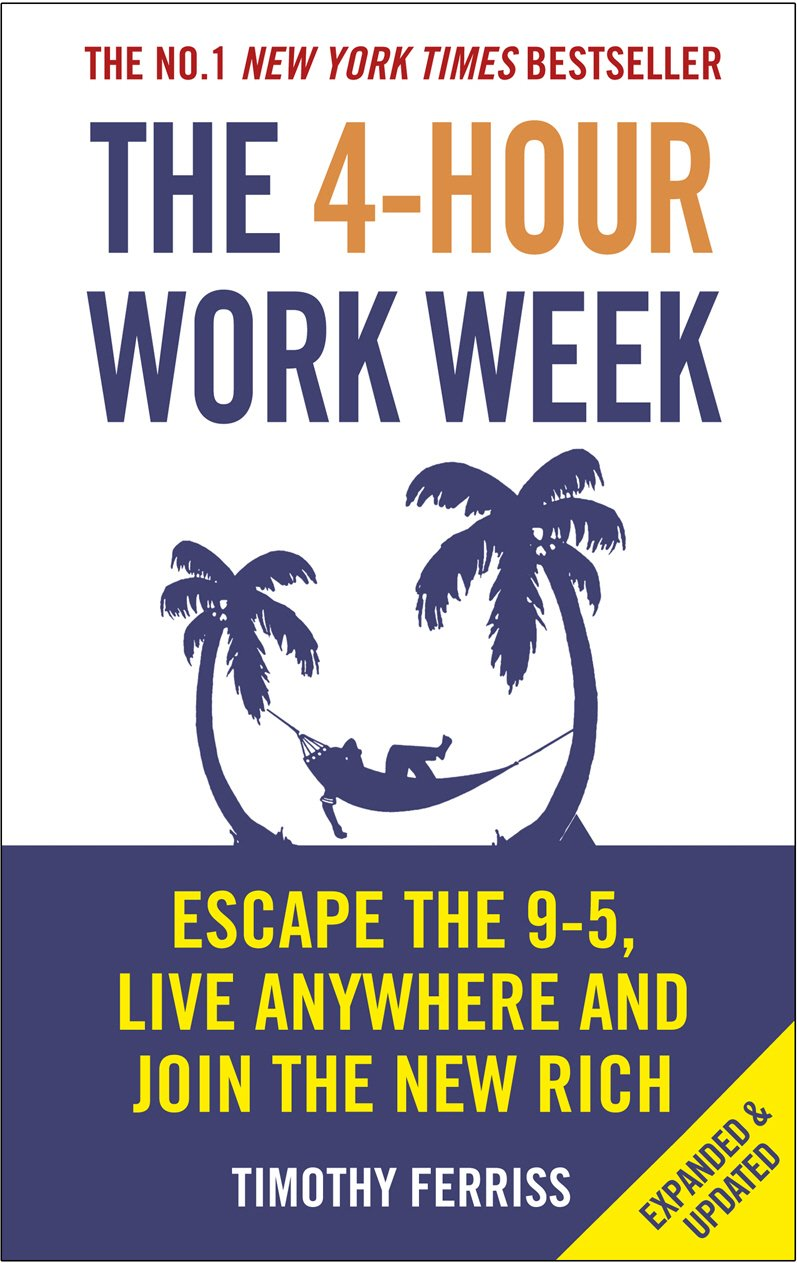
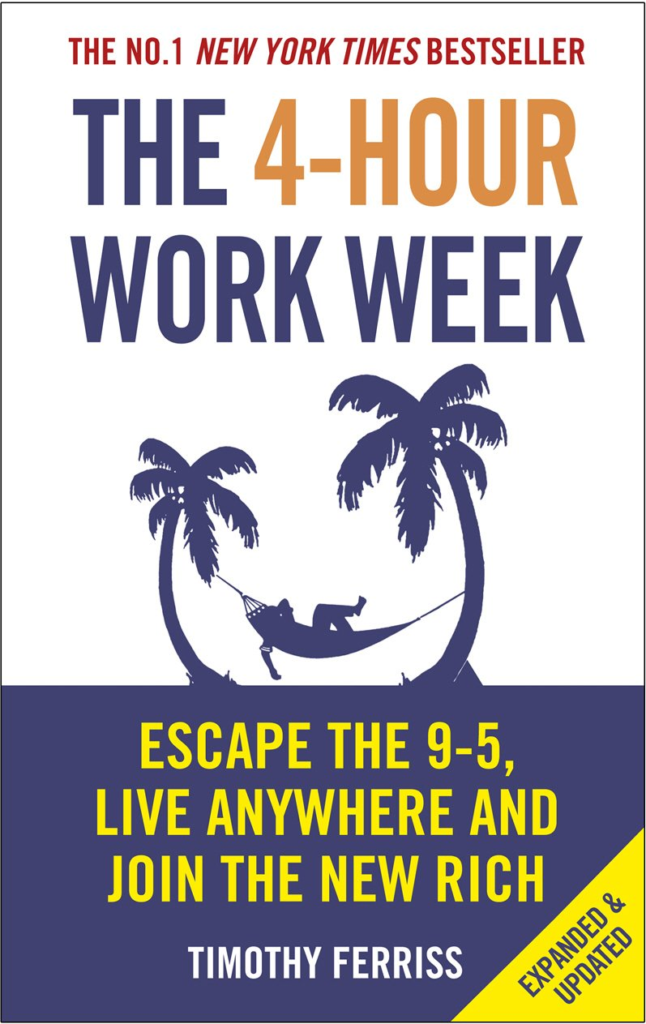
The 4-Hour Workweek: Escape 9–5, Live Anywhere, and Join the New Rich is a business and lifestyle-design book by American entrepreneur and author Timothy Ferriss. It was first published in 2007 by Crown Publishers and subsequently released in an expanded and updated edition in 2009. The book examines conventional assumptions about work, productivity, career progression and retirement, and proposes an alternative approach based on lifestyle design, selective elimination, automation, outsourcing and geographic mobility. (Wikipedia)
Rather than presenting the traditional career path—education, employment, long working hours, saving and retirement—as the only model of a successful life, Ferriss argues for designing work around the life one wants to live. His framework is organized around the acronym DEAL: Definition, Elimination, Automation and Liberation. (Google Books)
The title’s “four-hour workweek” is best understood as a provocative expression of the book’s philosophy rather than a literal universal prescription that every reader should work exactly four hours per week. The underlying objective is to increase output, autonomy and time freedom while reducing unnecessary work.
Infobox
| The 4-Hour Workweek | |
|---|---|
| Author | Timothy Ferriss |
| Full title | The 4-Hour Workweek: Escape 9–5, Live Anywhere, and Join the New Rich |
| Language | English |
| Country | United States |
| Subject | Entrepreneurship, productivity, lifestyle design |
| Genre | Non-fiction, business, self-help |
| Original publisher | Crown Publishers |
| First published | 2007 |
| Expanded and updated edition | 2009 |
| 2009 hardcover | 448 pages |
| Core framework | DEAL |
| D | Definition |
| E | Elimination |
| A | Automation |
| L | Liberation |
| Major concepts | Lifestyle design, mini-retirements, outsourcing, selective ignorance, remote work, automation |
| Followed by | The 4-Hour Body |
| Author’s website/podcast | Tim Ferriss |
Penguin Random House lists the expanded and updated hardcover edition as published on December 15, 2009, with 448 pages. (Penguin Random House)
Overview
The 4-Hour Workweek emerged during a period when the internet was beginning to make location-independent work, online commerce, outsourcing and digital entrepreneurship increasingly accessible.
Ferriss’s central question is deceptively simple:
What if the conventional relationship between work, money and time is backwards?
Traditional career thinking often follows this sequence:
EDUCATION
    ↓
GET A JOB
    ↓
WORK HARD
    ↓
EARN MORE
    ↓
SAVE
    ↓
RETIRE
    ↓
LIVE THE LIFE YOU WANTED
Ferriss proposes a different sequence:
DEFINE THE LIFE YOU WANT
          ↓
ELIMINATE UNNECESSARY WORK
          ↓
AUTOMATE RECURRING WORK
          ↓
CREATE LOCATION & TIME FREEDOM
          ↓
LIVE NOW — NOT ONLY AT RETIREMENT
This reversal is the book’s fundamental intellectual proposition.
Timothy Ferriss
Early life and education
Timothy Ferriss is an American entrepreneur, author, investor and podcaster.
He graduated from Princeton University with a degree in East Asian Studies.
Before becoming widely known as an author, Ferriss worked in technology and entrepreneurship and became associated with the development of BrainQUICKEN, a nutritional-supplement company.
His experiences building and operating the company became a major source of the examples and experiments described in The 4-Hour Workweek.
Entrepreneurial career
Ferriss used his experience with BrainQUICKEN to explore questions concerning:
- productivity;
- outsourcing;
- remote management;
- customer service;
- automation;
- advertising;
- international operations;
- and reducing dependence on the founder.
The book emerged partly from this experimentation.
Rather than simply asking how to make a company bigger, Ferriss repeatedly asks a different question:
How can a business produce its desired result without requiring the owner’s constant presence?
That distinction is central to the book.
Later career
Following the success of The 4-Hour Workweek, Ferriss became an author, investor and podcast host.
His later books include:
- The 4-Hour Body
- The 4-Hour Chef
- Tools of Titans
- Tribe of Mentors
He also hosts The Tim Ferriss Show, a long-form interview podcast.
Penguin Random House describes Ferriss as an early-stage investor and adviser in companies including Uber, Facebook, Twitter, Shopify, Duolingo and Alibaba, among others. It also identifies The 4-Hour Workweek among his bestselling books. (Penguin Random House)
Publication history
2007 — Original edition
The first edition was published in 2007 by Crown Publishers, an imprint of the Crown Publishing Group.
The original book established Ferriss’s central framework for lifestyle design.
2009 — Expanded and updated edition
Ferriss substantially expanded the book in 2009.
The revised edition contains more than 100 additional pages of material, including:
- new case studies;
- updated examples;
- blog material;
- additional practical resources;
- a remote-work proposal;
- and further discussion of lifestyle design. (Penguin Random House)
The expanded edition reorganizes the book around the four stages of DEAL and contains 16 principal chapters followed by additional material. (Google Books)
The central concept: Lifestyle Design
The most important idea in The 4-Hour Workweek is lifestyle design.
Ferriss argues that people often unconsciously accept a predefined relationship between:
time → work → money → retirement.
Lifestyle design attempts to reverse that relationship.
Instead of asking:
“How can I become successful?”
Ferriss encourages readers to ask:
“What does the life I actually want look like, and what economic system would support it?”
This places lifestyle goals before career structure.
The Deferred-Life Plan
Ferriss criticizes what he calls the deferred-life plan.
The conventional model is:
AGE 20s
Education
   ↓
AGE 20–60
Career + Work
   ↓
AGE 60+
Retirement
   ↓
Travel / Hobbies / Freedom
The problem, Ferriss argues, is that the most desirable experiences may be postponed for decades.
His alternative is to distribute periods of freedom throughout one’s life.
Mini-retirements
One of the book’s most recognizable concepts is the mini-retirement.
Instead of assuming that retirement must happen once, at the end of a career, Ferriss proposes taking extended periods away from conventional work throughout one’s lifetime.
For example:
Traditional retirement

WORK ───────────────────────────────► RETIREMENT


Mini-retirement model

WORK → LIFE → WORK → TRAVEL → WORK → LEARNING → WORK → LIFE
The idea is not simply to take vacations.
A mini-retirement is conceived as a deliberate period in which a person can:
- travel;
- learn;
- explore another culture;
- pursue a personal project;
- spend time with family;
- develop a new skill;
- or reconsider career direction.
The expanded edition explicitly includes a chapter titled “Mini-Retirements: Embracing the Mobile Lifestyle.” (Google Books)
The New Rich
Ferriss uses the term “New Rich” to describe people who seek control over when, where and how they work, rather than defining wealth solely by accumulated financial assets.
This is an important distinction.
Traditional wealth might be represented as:
Money + Assets
Ferriss expands the equation:
                  WEALTH
                    │
        ┌───────────┼───────────┐
        ▼           ▼           ▼
       MONEY       TIME        MOBILITY
        │           │           │
        └───────────┼───────────┘
                    ▼
               LIFE DESIGN
Under this philosophy, someone earning substantial income but having no control over their time may be less “rich” in lifestyle terms than someone earning less while possessing considerable autonomy.
The DEAL framework
The entire book can be organized around four stages:
D — Definition
Decide what you actually want.
E — Elimination
Remove unnecessary activities.
A — Automation
Systematize and outsource recurring activities.
L — Liberation
Separate income generation from physical presence and conventional employment.
                  DEAL
                   │
       ┌───────────┼───────────┐
       │           │           │
       ▼           ▼           ▼
   DEFINITION  ELIMINATION  AUTOMATION
       │           │           │
       └───────────┼───────────┘
                   ▼
               LIBERATION
                   │
                   ▼
             LIFESTYLE DESIGN
The sequence is important.
Ferriss does not begin with outsourcing.
He begins with determining what should be done at all.
Step I — Definition
The first stage challenges assumptions about success, work and time.
Ferriss asks readers to define:
- their desired lifestyle;
- their financial requirements;
- what they actually value;
- what they fear;
- and which conventional rules they are willing to question.
The book’s first section contains chapters dealing with redefining success, fear-setting, and challenging conventional assumptions. (Google Books)
Relative income
One of Ferriss’s recurring ideas is that absolute income is not the only useful measure of wealth.
Consider two hypothetical people.
Person A
Earns $200,000 annually but works 80 hours each week.
Person B
Earns $100,000 annually while working 15 hours each week.
The second person earns less money but may have considerably more discretionary time.
This leads to a different measure:
Income per unit of time.
Conceptually:
Relative Income = Income ÷ Time InvestedThis is not a conventional measure of wealth, but it captures an important part of Ferriss’s argument.
Fear-setting
Ferriss introduces a decision-making exercise commonly known as fear-setting.
Instead of asking only:
“What if I fail?”
the reader is encouraged to identify:
- What could go wrong?
- How could the damage be prevented?
- How could the damage be repaired?
- What is the cost of not taking action?
The framework can be visualized as:
              FEAR
               │
               ▼
       IDENTIFY THE RISK
               │
        ┌──────┼──────┐
        ▼      ▼      ▼
     PREVENT  REPAIR  ACCEPT
        │      │      │
        └──────┼──────┘
               ▼
        MAKE A DECISION
This transforms vague anxiety into a more structured decision analysis.
Definition before efficiency
One of the most important lessons in the book is that efficiency applied to the wrong activity is still waste.
Suppose an employee becomes extraordinarily efficient at producing a report that nobody reads.
The person has improved efficiency.
But the organization has not necessarily improved effectiveness.
Ferriss therefore emphasizes:
First decide whether something should be done; then determine how efficiently it can be done.
This distinction connects Definition and Elimination.
Step II — Elimination
The second stage asks:
What can be removed?
Ferriss argues that many people attempt to manage increasingly large workloads instead of questioning whether the workload should exist.
His approach emphasizes:
- selective ignorance;
- interruption reduction;
- refusal;
- batching;
- prioritization;
- and elimination of low-value activities.
The 80/20 principle
Ferriss makes extensive use of the Pareto principle, commonly summarized as the 80/20 rule.
The idea is that a disproportionate amount of output may come from a relatively small portion of inputs.
For example:
INPUTS                         OUTPUT
100 tasks  ─────────────────►  100% output

But perhaps:

20 high-value tasks ─────────►  80% of output
80 low-value tasks ──────────►  20% of output
The exact 80/20 ratio should not be treated as a universal mathematical law.
Its practical use is as a question:
Which small number of activities produce most of the result?
Parkinson’s Law
Ferriss also draws upon Parkinson’s law, the observation commonly expressed as:
Work expands to fill the time available for its completion.
The practical implication is significant.
If someone is given:
30 days to complete a task, the task may occupy 30 days.
If the same task must be completed in:
3 days, the work may be compressed accordingly.
This leads to a productivity strategy:
Reduce the available time for important tasks.
Low-information diet
Another notable concept is Ferriss’s low-information diet.
The idea is that constantly consuming information does not necessarily increase productivity.
Modern workers may spend hours:
- reading email;
- checking news;
- browsing social media;
- monitoring notifications;
- reading newsletters;
- and consuming industry information.
Ferriss asks whether all of this information is actually necessary.
The expanded edition includes a chapter titled “The Low-Information Diet: Cultivating Selective Ignorance.” (Google Books)
Selective ignorance
Selective ignorance means deliberately refusing information that does not contribute meaningfully to one’s goals.
This can be represented as:
              INFORMATION
                   │
        ┌──────────┴──────────┐
        │                     │
    ACTIONABLE            NON-ACTIONABLE
        │                     │
        ▼                     ▼
     PROCESS               IGNORE
        │
        ▼
      RESULT
The idea is not intellectual anti-curiosity.
It is attention management.
The art of refusal
Ferriss emphasizes the importance of saying no.
A calendar filled with other people’s priorities leaves little room for one’s own priorities.
This creates a simple relationship:
MORE "YES"
     ↓
MORE COMMITMENTS
     ↓
MORE INTERRUPTIONS
     ↓
LESS FOCUS
     ↓
LESS FREEDOM
Therefore:
FEWER "YES"
     ↓
FEWER COMMITMENTS
     ↓
MORE FOCUS
     ↓
MORE OUTPUT
     ↓
MORE TIME
Batching
Ferriss recommends grouping similar tasks together rather than constantly switching between them.
For example:
Poor workflow
Email → Project → Email → Phone → Email
→ Meeting → Email → Project → Notification
Batched workflow
Email block
     ↓
Deep-work block
     ↓
Meetings
     ↓
Administrative block
Batching reduces context switching and can make recurring work easier to systematize.
Step III — Automation
Once unnecessary work has been eliminated, Ferriss turns to automation.
The central question becomes:
Which remaining activities can be performed without my continuous involvement?
This is where the book moves from productivity toward entrepreneurship and systems design.
Outsourcing
Ferriss became particularly associated with the use of virtual assistants and offshore outsourcing.
The concept is simple:
FOUNDER
   │
   ├── High-value decisions
   │
   ├── Strategy
   │
   └── Core relationships
             │
             ▼
        DELEGATE
             │
      ┌──────┼──────┐
      ▼      ▼      ▼
   Routine  Admin  Research
   tasks    work   support
The principle is not simply:
“Delegate everything.”
It is:
“Delegate tasks that do not require your unique contribution.”
The outsourcing decision
A useful decision tree inspired by the book is:
            TASK
              │
              ▼
       Is it necessary?
          /       \
        NO         YES
        │           │
      DELETE        ▼
               Is it high-value?
                 /       \
               NO         YES
               │           │
           AUTOMATE     KEEP / FOCUS
               │
               ▼
          or DELEGATE
This is one of the most transferable ideas in the book.
Geoarbitrage
Ferriss discusses geoarbitrage, broadly meaning taking advantage of differences in costs between locations.
For example, a person might:
- earn income in a high-income economy;
- operate digitally;
- and spend substantial periods in locations with lower living costs.
Conceptually:
HIGHER-INCOME LOCATION
        │
        │ Income
        ▼
     DIGITAL WORK
        │
        ▼
LOWER-COST LOCATION
        │
        ▼
GREATER PURCHASING POWER
The strategy depends on many factors, including immigration rules, taxation, healthcare, currency fluctuations, safety, family circumstances and the nature of the work.
It is therefore not universally applicable.
The Muse
Ferriss uses the term “Muse” for a business or income-generating asset designed to provide revenue without requiring the entrepreneur to operate a conventional full-time job.
The concept is particularly important because Ferriss does not suggest merely working fewer hours at an ordinary job.
Instead, he proposes building a revenue-generating system that can function with relatively limited personal involvement.
Characteristics of a Muse
A business suitable for Ferriss’s framework typically aims to be:
- relatively simple;
- scalable;
- productized;
- capable of online or remote operation;
- supported by automation;
- and sufficiently profitable relative to the owner’s time.
The concept can be visualized as:
          CUSTOMER NEED
                │
                ▼
             PRODUCT
                │
                ▼
          ONLINE SALES
                │
                ▼
           AUTOMATION
                │
                ▼
           OUTSOURCING
                │
                ▼
             PROFIT
                │
                ▼
        OWNER'S FREEDOM
Testing the Muse
Ferriss emphasizes testing a business idea before investing heavily in it.
The basic process is:
IDEA
 ↓
TEST DEMAND
 ↓
COLLECT REAL CUSTOMER SIGNALS
 ↓
MEASURE ECONOMICS
 ↓
IMPROVE
 ↓
SCALE
This approach reduces the risk of spending months building something that nobody wants.
Minimum viable product thinking
Although the terminology and modern startup culture have evolved, Ferriss’s method is compatible with the broader principle of testing demand before building extensively.
For example:
Instead of manufacturing 10,000 units:
Test whether people will buy 50.
Instead of building a complete software platform:
Test whether customers will pay for the core solution.
Instead of hiring a large team:
Determine whether the business model works first.
The $1000 test
A recurring theme in the book is the importance of using small experiments to answer large questions.
The principle is:
Do not speculate indefinitely when a relatively inexpensive experiment can provide evidence.
This creates a scientific-style entrepreneurial cycle:
HYPOTHESIS
    ↓
SMALL TEST
    ↓
DATA
    ↓
DECISION
    ↓
NEXT TEST
Management by absence
Ferriss describes MBA—Management by Absence as a method of designing operations so that the founder does not need to be physically present for everything to function.
This requires:
- documented processes;
- clear responsibilities;
- decision rules;
- reporting systems;
- customer-service protocols;
- and appropriate escalation procedures.
The objective is not simply to disappear.
The objective is to make the organization less dependent on one person.
Step IV — Liberation
The final stage of DEAL is Liberation.
Liberation concerns freedom from the traditional requirement to be physically present at a workplace for income to continue.
For employees, Ferriss discusses negotiating remote work and demonstrating productivity outside the office.
For entrepreneurs, the challenge is to reduce the business’s dependence on the founder.
Remote work
Remote work is one of the areas where the book has become especially prescient.
The original book predates the enormous global expansion of remote and hybrid work that occurred in the 2020s.
Its underlying proposition is:
Physical presence should not automatically be treated as proof of productivity.
The expanded edition includes a section titled “How to Escape the Office” and a proposal for working remotely on a contract basis. (Google Books)
Liberation for employees
Ferriss proposes a gradual process rather than necessarily demanding immediate resignation.
The basic logic is:
INCREASE YOUR VALUE
       ↓
DEMONSTRATE RESULTS
       ↓
REDUCE NEED FOR PHYSICAL PRESENCE
       ↓
NEGOTIATE REMOTE / FLEXIBLE WORK
       ↓
INCREASE MOBILITY
The emphasis is on results rather than hours.
Liberation for entrepreneurs
For entrepreneurs:
FOUNDER-CENTRIC BUSINESS
          ↓
DOCUMENT PROCESSES
          ↓
DELEGATE
          ↓
AUTOMATE
          ↓
MANAGE BY EXCEPTION
          ↓
OWNER INDEPENDENCE
This idea later became central to many discussions about building businesses that can operate without constant founder involvement.
Mobility
Ferriss connects physical mobility with freedom.
A location-independent worker may theoretically be able to:
- live in different countries;
- travel while working;
- spend time with family;
- pursue education;
- undertake long-term projects;
- or divide the year among several locations.
The book therefore treats location as a variable that can be redesigned.
The lifestyle-design equation
Ferriss’s philosophy can be represented through a broader equation:
              INCOME
                 ×
              CONTROL
                 ×
              MOBILITY
                 ×
              TIME
                 ↓
          LIFESTYLE VALUE
This is conceptual rather than a literal financial formula.
Its purpose is to show that income is only one component of the lifestyle Ferriss is describing.
Work versus productivity
One of the book’s most important distinctions is:
Work ≠ Productivity
Someone can spend:
60 hours working
and produce less valuable output than someone working:
20 highly focused hours.
The relevant question therefore becomes:
What result was produced?
rather than:
How many hours were spent?
Output per hour
A simplified productivity measure is:
Productivity = Valuable Output ÷ Time Invested
This leads to four possible situations:
| Output | Time | Result |
|---|---|---|
| Low | High | Inefficient |
| High | High | Productive but time-heavy |
| Low | Low | Efficient but ineffective |
| High | Low | High leverage |
Ferriss is particularly interested in the fourth category.
The 4-Hour Workweek philosophy
The title can therefore be interpreted as the endpoint of a progression:
             CONVENTIONAL MODEL

             40–60+ HOURS
                  │
                  ▼
             MORE WORK
                  │
                  ▼
             MORE INCOME
                  │
                  ▼
            EVENTUAL RETIREMENT


             FERRISS MODEL

             DEFINE LIFE
                  │
                  ▼
              ELIMINATE
                  │
                  ▼
              AUTOMATE
                  │
                  ▼
             DELEGATE
                  │
                  ▼
            INCREASE FREEDOM
                  │
                  ▼
              LIVE NOW
The four-hour number functions primarily as a provocative symbol of extreme leverage and freedom.
The importance of “not doing”
One of the book’s most powerful themes is negative productivity:
Sometimes the best productivity improvement is subtraction.
Instead of asking:
“How can I do this faster?”
ask:
“Why am I doing this at all?”
This creates a hierarchy:
1. ELIMINATE
      ↓
2. AUTOMATE
      ↓
3. DELEGATE
      ↓
4. DO
The order is significant.
Automating an unnecessary task simply produces unnecessary work faster.
Information overload
The book’s low-information philosophy has become particularly relevant in the era of smartphones and social media.
The modern information environment can look like:
EMAIL
NEWS
WHATSAPP
SOCIAL MEDIA
NOTIFICATIONS
NEWSLETTERS
MESSAGES
MEETINGS
STREAMING
AI OUTPUT
        ↓
ATTENTION FRAGMENTATION
Ferriss’s response is to deliberately restrict inputs.
The principle can be summarized as:
Information should serve objectives; objectives should not be created merely to consume information.
The danger of constant availability
Modern communication technologies have blurred the boundary between work and personal life.
An employee may technically be free but remain psychologically connected to work through:
- email;
- messaging;
- notifications;
- workplace platforms;
- phone calls.
Ferriss’s framework therefore distinguishes physical freedom from attention freedom.
You can leave the office and still carry the office around in your pocket.
The role of technology
Technology is not the ultimate objective of the book.
It is an enabling mechanism.
Ferriss’s model uses technology to:
- automate transactions;
- communicate remotely;
- manage distributed teams;
- outsource work;
- monitor operations;
- process payments;
- and maintain customer relationships.
The important principle is:
Technology should reduce dependence on the owner’s time.
The 2007 context
Understanding when the book was written is important.
The original edition appeared in 2007, before:
- smartphones became ubiquitous;
- cloud collaboration became standard;
- Zoom became a household business tool;
- social-media platforms became central marketing channels;
- creator businesses became mainstream;
- generative AI became widely available;
- and remote work became commonplace across many industries.
Consequently, some of Ferriss’s examples are technologically dated.
The underlying principles, however, can be separated from their original tools.
The 2020s interpretation
A contemporary entrepreneur might replace Ferriss-era tools with:
| Earlier approach | Modern equivalent |
|---|---|
| Virtual assistants | Distributed remote teams |
| Email workflows | Automation platforms |
| Simple web stores | E-commerce platforms |
| Manual customer support | Helpdesk + AI-assisted support |
| Basic advertising | Multi-channel digital advertising |
| Remote communication | Video collaboration |
| Manual research | Search + databases + AI tools |
| Outsourced administration | SaaS + workflow automation |
The tools changed.
The underlying principle—reduce unnecessary dependence on human time—remains recognizable.
The book’s chapter structure
The expanded and updated edition is explicitly organized into four major sections.
Step I — D is for Definition
- Cautions and Comparisons: How to Burn $1,000,000 a Night
- Rules That Change the Rules: Everything Popular Is Wrong
- Dodging Bullets: Fear-Setting and Escaping Paralysis
- System Reset: Being Unreasonable and Unambiguous
Step II — E is for Elimination
- The End of Time Management: Illusions and Italians
- The Low-Information Diet: Cultivating Selective Ignorance
- Interrupting Interruption and the Art of Refusal
Step III — A is for Automation
- Outsourcing Life: Off-loading the Rest and a Taste of Geoarbitrage
- Income Autopilot I: Finding the Muse
- Income Autopilot II: Testing the Muse
- Income Autopilot III: MBA—Management by Absence
Step IV — L is for Liberation
- Disappearing Act: How to Escape the Office
- Beyond Repair: Killing Your Job
- Mini-Retirements: Embracing the Mobile Lifestyle
- Filling the Void: Adding Life After Subtracting Work
- The Top 13 New Rich Mistakes*
The expanded edition then includes “The Last Chapter”, followed by additional material from Ferriss’s blog and practical resources. (Google Books)
“Filling the Void”
An easily overlooked part of the book is the question:
What happens after you eliminate work?
Ferriss recognizes that reducing work does not automatically produce a meaningful life.
A person who spends years structuring life around work may suddenly discover that removing work creates a vacuum.
Therefore, freedom requires something to replace the old structure.
Possible areas include:
- relationships;
- travel;
- learning;
- creative projects;
- health;
- contribution;
- entrepreneurship;
- hobbies;
- community;
- and exploration.
This is an important philosophical progression:
LESS WORK
   ↓
MORE TIME
   ↓
????
   ↓
MEANINGFUL LIFE
The question mark matters.
Freedom is not automatically fulfillment.
The danger of empty freedom
The book’s philosophy can be misunderstood as:
“Work less and travel more.”
Its deeper argument is closer to:
“Create enough autonomy that your time can be deliberately allocated toward what matters to you.”
That distinction makes the concept of lifestyle design broader than simple leisure.
New Rich mistakes
The expanded edition contains a section titled “The Top 13 New Rich Mistakes.” (Google Books)
The inclusion is significant because Ferriss presents lifestyle design as an experimental process rather than a perfectly predictable formula.
Common failure patterns include:
- pursuing money without defining enough;
- outsourcing before understanding a process;
- confusing activity with productivity;
- attempting too much simultaneously;
- failing to test business ideas;
- and creating freedom without a meaningful purpose.
The book’s major principles
1. Define your desired life
Do not automatically inherit somebody else’s definition of success.
2. Question conventional assumptions
A common practice is not necessarily the optimal practice.
3. Focus on effectiveness before efficiency
First determine whether the task matters.
4. Eliminate low-value work
Subtraction can create more leverage than optimization.
5. Protect attention
Not all information deserves equal access to your mind.
6. Use the 80/20 principle
Identify the activities and customers producing disproportionate results.
7. Use deadlines strategically
Shorter deadlines can reduce unnecessary work.
8. Delegate appropriately
Your time should be reserved for activities that genuinely require your involvement.
9. Automate repetitive processes
Systems should perform predictable tasks wherever practical.
10. Build income systems
The goal is to reduce the direct connection between every dollar earned and every hour personally worked.
11. Increase mobility
Location should be a variable rather than an unavoidable constraint where the nature of the work permits.
12. Take mini-retirements
Do not necessarily postpone every major life experience until traditional retirement.
A complete visual map of the book
                     THE 4-HOUR WORKWEEK
                            │
                            ▼
                    QUESTION THE DEFAULT
                            │
                            ▼
                        DEFINE
                            │
            ┌───────────────┼───────────────┐
            ▼               ▼               ▼
         DREAMS           MONEY            TIME
            │               │               │
            └───────────────┼───────────────┘
                            ▼
                       ELIMINATE
                            │
                   ┌────────┼────────┐
                   ▼        ▼        ▼
                 80/20   BATCHING   SAY NO
                            │
                            ▼
                        AUTOMATE
                            │
             ┌──────────────┼──────────────┐
             ▼              ▼              ▼
         OUTSOURCE        MUSE        SYSTEMIZE
             │              │              │
             └──────────────┼──────────────┘
                            ▼
                       LIBERATION
                            │
                ┌───────────┼───────────┐
                ▼           ▼           ▼
             REMOTE       MOBILE     MINI-RETIRE
                │           │           │
                └───────────┼───────────┘
                            ▼
                     LIFESTYLE DESIGN
The Ferriss productivity hierarchy
The book’s ideas can be condensed into a practical hierarchy:
                 ┌───────────────┐
                 │   ELIMINATE   │
                 └───────┬───────┘
                         ↓
                 ┌───────────────┐
                 │   AUTOMATE    │
                 └───────┬───────┘
                         ↓
                 ┌───────────────┐
                 │   DELEGATE    │
                 └───────┬───────┘
                         ↓
                 ┌───────────────┐
                 │     DO        │
                 └───────────────┘
This hierarchy is one of the easiest ways to translate the book’s philosophy into practical action.
The book’s view of entrepreneurship
Ferriss does not primarily present entrepreneurship as:
Build a huge company → hire hundreds of employees → become CEO.
Instead, he emphasizes entrepreneurship as a mechanism for creating control over time and location.
That produces a different entrepreneurial objective:
TRADITIONAL ENTREPRENEURSHIP

Revenue → Growth → Employees → Larger Company


LIFESTYLE ENTREPRENEURSHIP

Revenue → Automation → Freedom → Desired Life
The two models are not mutually exclusive.
An entrepreneur may pursue both scale and autonomy.
Lifestyle business versus high-growth startup
| Lifestyle-oriented business | High-growth startup |
|---|---|
| Autonomy emphasized | Scale emphasized |
| Owner independence | Rapid expansion |
| Cash flow can be central | Growth can be central |
| Smaller team may be desirable | Large team may be necessary |
| Lifestyle flexibility | Market domination / scale |
| Often bootstrapped | May seek external capital |
Ferriss’s book is particularly associated with the first model.
Criticism
Despite its influence, The 4-Hour Workweek has attracted criticism.
The title can be misleading
Working only four hours per week is unrealistic or undesirable for many people and occupations.
Not every job can be automated
Healthcare, education, skilled trades, scientific research and many relationship-intensive professions require substantial human involvement.
Outsourcing has limitations
Delegation can introduce:
- quality-control problems;
- communication costs;
- security risks;
- cultural misunderstandings;
- management overhead;
- and ethical concerns.
Automation does not eliminate responsibility
A system that runs automatically still requires monitoring, maintenance and decision-making.
Financial independence requires economics
Lifestyle freedom cannot be created solely through productivity techniques.
Income, savings, debt, taxation, insurance and living costs remain important.
Mini-retirements are not equally accessible
People with dependents, medical needs, unstable employment or limited financial reserves may have considerably less flexibility.
Criticism of the “New Rich” concept
The idea of the New Rich has also been criticized for potentially placing too much emphasis on individual optimization.
Not everyone can simply redesign work around personal preferences.
Economic circumstances can be shaped by:
- family responsibilities;
- labor-market conditions;
- immigration law;
- disability;
- education;
- geography;
- housing costs;
- healthcare;
- and employer policies.
Consequently, Ferriss’s framework is best understood as a set of strategies for increasing autonomy where circumstances permit, rather than as a universally available formula.
The ethical question of outsourcing
Outsourcing raises another important issue.
A task delegated to a lower-cost worker may create efficiency for the business while shifting economic pressure elsewhere.
Responsible outsourcing therefore requires attention to:
- fair compensation;
- working conditions;
- data security;
- intellectual property;
- labor laws;
- cultural differences;
- and quality standards.
The efficiency gained by outsourcing should not be treated as automatically beneficial regardless of how it is achieved.
The relevance of the book in the remote-work era
The book’s arguments about remote work became particularly notable because the workplace changed dramatically after its original publication.
The COVID-19 pandemic accelerated remote and hybrid work across many sectors.
Technologies that were once relatively specialized became routine:
- video conferencing;
- cloud collaboration;
- digital project management;
- online payments;
- remote customer service;
- distributed teams.
This environment made some of Ferriss’s earlier arguments about location independence considerably more familiar to mainstream workers.
However, modern remote work also demonstrated that working from home does not automatically produce a four-hour workweek.
It can simply produce:
a 40-hour workweek at home.
That distinction is crucial.
Technology versus leverage
Ferriss’s deepest technological insight is not that a particular tool will make people productive.
It is that technology can create leverage.
A useful hierarchy is:
HUMAN TIME
     ↓
PROCESS
     ↓
SYSTEM
     ↓
AUTOMATION
     ↓
MULTIPLICATIVE OUTPUT
The objective is to build systems in which one hour of human effort can produce more than one hour’s worth of output.
Leverage
The book can therefore be understood as a study of leverage.
There are several forms:
Technology leverage
Software performs repetitive work.
Capital leverage
Money generates additional economic output.
Labor leverage
Other people perform tasks.
Media leverage
One piece of content can reach thousands or millions.
Product leverage
A digital product can be sold repeatedly.
Systems leverage
A documented process can be repeated without reinventing it.
The modern internet dramatically increases the availability of several of these forms of leverage.
The ultimate question
The book repeatedly returns to a question that is much more important than its provocative title:
What would you do with your time if you did not have to spend most of it working for money?
This question changes the discussion from productivity to purpose.
Frequently asked questions
What is The 4-Hour Workweek about?
It is a book about redesigning work and lifestyle through the principles of definition, elimination, automation and liberation.
Who wrote The 4-Hour Workweek?
Timothy Ferriss wrote the book.
When was it published?
The original edition was published in 2007. An expanded and updated edition was published in 2009. (Penguin Random House)
What does DEAL stand for?
D — Definition
E — Elimination
A — Automation
L — Liberation
What are mini-retirements?
They are extended periods of time away from conventional work distributed throughout one’s life rather than postponing all leisure and exploration until traditional retirement.
Does the book literally tell everyone to work four hours per week?
No. The four-hour figure is best understood as a provocative representation of extreme productivity, automation and lifestyle freedom.
What is the New Rich?
Ferriss’s term for people who prioritize control over time and location alongside financial resources.
What is a Muse?
A “Muse” is Ferriss’s term for an income-generating business or system designed to operate with relatively limited ongoing involvement from its owner.
What is geoarbitrage?
It broadly refers to taking advantage of differences in living or operating costs between geographic locations.
Is the book about entrepreneurship?
Yes, particularly entrepreneurship oriented toward autonomy, automation and lifestyle design.
Is the book still relevant?
Many of its tools and examples are dated, but its broader principles concerning elimination, leverage, automation, remote work and lifestyle design remain relevant to contemporary discussions about work.
See also
- Tim Ferriss
- Lifestyle design
- Digital nomad
- Remote work
- Entrepreneurship
- Productivity
- Outsourcing
- Automation
- Pareto principle
- Parkinson’s law
- Time management
- Work–life balance
- Financial independence
- Passive income
- Location independence
- Mini-retirement
- Bootstrapping
- Virtual assistant
- Business process automation
Further reading
Books by Timothy Ferriss
- The 4-Hour Workweek
- The 4-Hour Body
- The 4-Hour Chef
- Tools of Titans
- Tribe of Mentors
Related subjects
- Lifestyle design
- Entrepreneurship
- Remote work
- Productivity
- Automation
- Delegation
- Financial independence
- Digital entrepreneurship
- Time management
- Behavioral economics
- Business process design
References
- Ferriss, Timothy. The 4-Hour Workweek: Escape 9–5, Live Anywhere, and Join the New Rich. Crown Publishers, 2007.
- Ferriss, Timothy. The 4-Hour Workweek, Expanded and Updated. Harmony/Crown, 2009.
- Penguin Random House. The 4-Hour Workweek, Expanded and Updated — publisher information, edition details and author biography. (Penguin Random House)
- Google Books. The 4-Hour Workweek, Expanded and Updated — bibliographic and contents information. (Google Books)
- Columbia University / bibliographic records for Timothy Ferriss and related works.
- Ferriss, Timothy. The 4-Hour Workweek — expanded and updated edition.
External links
- Penguin Random House — The 4-Hour Workweek
- Tim Ferriss — official website
- Google Books — The 4-Hour Workweek
Historical timeline
1977
│
├── Timothy Ferriss born
│
▼
Princeton University
│
▼
Technology / entrepreneurship
│
▼
BrainQUICKEN
│
▼
2007
│
├── The 4-Hour Workweek published
│
▼
2009
│
├── Expanded and Updated edition
│
▼
2010s
│
├── The 4-Hour Body
├── The 4-Hour Chef
├── The Tim Ferriss Show
│
▼
2020s
│
├── Remote work becomes mainstream
├── Automation accelerates
├── AI changes knowledge work
│
▼
The book's central question remains:
│
└── "How should work serve the life you want?"
One-page encyclopedia infographic
╔══════════════════════════════════════════════════════════════╗
║                  THE 4-HOUR WORKWEEK                        ║
║                     TIM FERRISS                             ║
╠══════════════════════════════════════════════════════════════╣
║                                                              ║
║                 QUESTION THE DEFAULT                         ║
║                         ↓                                    ║
║                    D — DEFINITION                            ║
║                 What do I actually want?                     ║
║                         ↓                                    ║
║                   E — ELIMINATION                            ║
║              What should I stop doing?                       ║
║                         ↓                                    ║
║                    A — AUTOMATION                            ║
║            What can systems / others do?                     ║
║                         ↓                                    ║
║                    L — LIBERATION                            ║
║            How can I gain time & mobility?                   ║
║                         ↓                                    ║
║                ┌───────────────────┐                         ║
║                │   LIFESTYLE       │                         ║
║                │     DESIGN        │                         ║
║                └───────────────────┘                         ║
║                         ↓                                    ║
║            WORK BECOMES A TOOL — NOT THE LIFE                ║
║                                                              ║
╚══════════════════════════════════════════════════════════════╝
Final perspective
There is a reason The 4-Hour Workweek continues to generate discussion long after the technologies described in its original examples have changed.
The book is not ultimately about four hours.
It is about questioning the default.
The default says that a successful person should work hard for decades, accumulate enough money, and postpone the life they actually want until later.
Ferriss asks the reader to reverse the question.
Instead of:
“How can I fit my life around my work?”
he asks:
“How can I design my work around the life I want?”
From that question flows the entire DEAL framework.
Definition asks what the destination actually is.
Elimination removes the activities that do not contribute meaningfully to that destination.
Automation turns repetitive economic activity into systems.
Liberation separates income and productivity from unnecessary restrictions of time and location.
And then comes the part that is easy to overlook: what will you actually do with the freedom?
That final question is what prevents the book from being merely a productivity manual.
The ultimate subject of The 4-Hour Workweek is not working four hours.
It is using economic and technological leverage to gain greater control over one’s finite time—and then deliberately deciding what that time is worth.