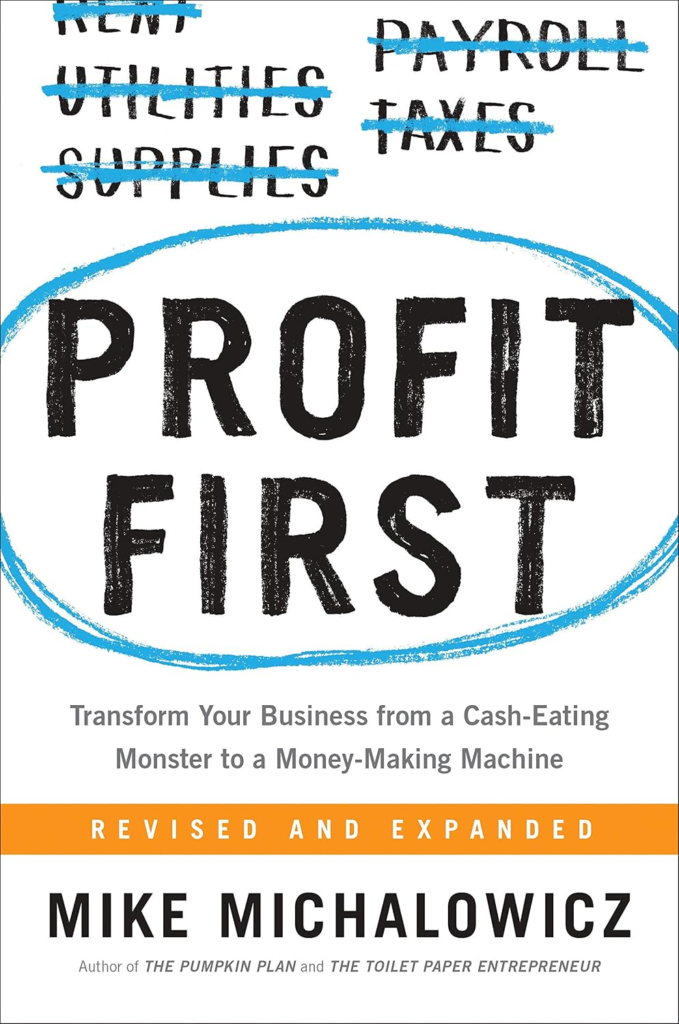
Profit First: Transform Your Business from a Cash-Eating Monster to a Money-Making Machine is a business and financial-management book by American entrepreneur and author Mike Michalowicz. First published in 2017 by Portfolio, an imprint of Penguin, the book presents a cash-management system designed primarily for small businesses and entrepreneurs.
The central idea of Profit First is expressed through a deliberate reversal of the conventional accounting equation:
Sales − Expenses = Profit
is replaced, for management purposes, with:
Sales − Profit = Expenses
Michalowicz argues that entrepreneurs frequently spend whatever cash is available and then regard whatever remains at the end of an accounting period as profit. His system attempts to reverse that behavior by allocating a predetermined portion of incoming cash to profit before the remaining money is made available for operating expenses. The publisher describes the approach as a behavioral alternative to conventional cash-management habits.
The book combines this principle with multiple bank accounts, predetermined allocation percentages, regular cash-allocation routines, smaller operating-expense constraints, and periodic review of a business’s financial health.
Unlike a conventional accounting textbook, Profit First is written for entrepreneurs who may not have formal financial training. Its central promise is behavioral: make profitability visible, tangible, and difficult to spend accidentally.
Book information
| Field | Details |
|---|---|
| Title | Profit First: Transform Your Business from a Cash-Eating Monster to a Money-Making Machine |
| Author | Mike Michalowicz |
| Subject | Entrepreneurship, cash management, small-business finance |
| Genre | Business / personal finance / entrepreneurship |
| Language | English |
| Publisher | Portfolio, Penguin |
| Original publication | 2017 |
| Hardcover publication | February 21, 2017 |
| E-book publication | January 18, 2017 |
| Length | 224 pages |
| ISBN | 9780735214149 |
| Primary audience | Small-business owners and entrepreneurs |
| Central formula | Sales − Profit = Expenses |
| Core method | Allocate cash into dedicated accounts before spending operating expenses |
Penguin Random House lists the hardcover edition at 224 pages, published February 21, 2017, while the e-book edition was published January 18, 2017.
Overview
Profit First begins with a problem familiar to many small-business owners:
A business can generate substantial revenue and still leave its owner with surprisingly little money.
Revenue can rise.
The team can grow.
The customer list can become longer.
The office can become larger.
The owner can become busier.
And yet the bank balance can remain frustratingly small.
Michalowicz’s answer is not primarily to sell more.
His first question is:
What happens to the money the business already receives?
The Profit First system attempts to answer that question by changing the sequence in which money is allocated.
Instead of allowing operating expenses to consume whatever cash happens to be available, the entrepreneur first separates money intended for profit, taxes, and other purposes. Operating expenses are then funded from what remains.
The approach is therefore both a cash-management system and a behavioral system.
The central equation
Traditional accounting commonly represents profit as:
SALES
  −
EXPENSES
  =
PROFIT
Michalowicz proposes reversing the order for cash-management behavior:
SALES
  −
PROFIT
  =
AVAILABLE EXPENSES
This does not replace the accounting definition of profit.
It changes the behavioral sequence for allocating cash.
That distinction is important.
Financial statements still need to follow applicable accounting standards, tax rules, and professional requirements. Profit First is primarily a cash-allocation and management framework rather than a replacement for formal bookkeeping or financial reporting.
The behavioral premise
The system rests on a simple observation:
If money remains available, people and organizations tend to find ways to spend it.
A business owner may think:
“We have $30,000 in the bank, so we can afford this.”
After several such decisions, the business may discover that much of the apparent surplus was not actually surplus.
It may have represented:
- future taxes;
- owner compensation;
- profit;
- payroll requirements;
- supplier obligations;
- seasonal reserves;
- emergency cash.
Profit First attempts to make those distinctions visible by physically separating money.
The psychology behind Profit First
One of the most interesting aspects of the book is that Michalowicz does not treat cash management purely as mathematics.
He treats it as a behavioral problem.
The underlying idea resembles a familiar principle from behavioral economics and personal finance:
People behave differently depending on how money is organized and presented.
Consider two situations.
Situation A
ONE BANK ACCOUNT

$100,000
│
├── Payroll
├── Rent
├── Taxes
├── Marketing
├── Equipment
├── Owner pay
└── Profit
Everything appears to be available.
Situation B
SEPARATED MONEY

Profit       → $10,000
Taxes        → $15,000
Owner Pay    → $20,000
OpEx         → $55,000
The second structure creates psychological boundaries.
The business owner cannot look at the entire $100,000 as though it were available for operating expenditure.
That is the behavioral heart of the system.
The four core principles
Michalowicz’s system is built around four fundamental behavioral principles.
1. Use small plates
The book compares the system to portion control.
A person eating from a large plate may consume more food than necessary.
Similarly, a business with one large operating account may consume more cash than necessary.
The solution is to create smaller financial “plates.”
LARGE PLATE
$100,000 AVAILABLE
        ↓
More spending appears possible


SMALL PLATES
$55,000 OpEx
$20,000 Owner Pay
$15,000 Tax
$10,000 Profit
        ↓
Spending becomes constrained
The point is not that smaller bank accounts magically create money.
They change the behavior around available money.
2. Serve sequentially
The system allocates money in a predetermined sequence rather than allowing every expense to compete for the entire cash balance.
This makes the allocation process systematic.
3. Remove temptation
Profit First recommends separating important funds so that money intended for profit or taxes is not constantly sitting beside operating cash.
The less psychologically available the money is, the less likely it is to be casually spent.
4. Enforce a rhythm
The system depends on repeated allocations rather than a single setup exercise.
Profitability is treated as a habit.
Michalowicz explicitly describes profit as a habit rather than a one-time event.
The five foundational accounts
A typical Profit First structure includes several accounts with distinct purposes.
The exact configuration can vary depending on the business, but the framework commonly distinguishes between:
- Income
- Profit
- Owner’s Compensation
- Tax
- Operating Expenses
The important concept is not simply having five bank accounts.
It is assigning each account a specific job.
The Income account
The Income account acts as the collection point.
Customer payments and other operating receipts flow into this account.
The money is then periodically distributed according to predetermined percentages.
Conceptually:
CUSTOMER PAYMENTS
       │
       ▼
   INCOME ACCOUNT
       │
       ├────────► PROFIT
       │
       ├────────► OWNER'S COMPENSATION
       │
       ├────────► TAX
       │
       └────────► OPERATING EXPENSES
This arrangement creates a deliberate separation between money entering the business and money available for spending.
The Profit account
The Profit account is intended to hold the business’s allocated profit.
The important psychological rule is that this money is not treated as operating cash.
Instead, it is separated from the everyday financial activity of the business.
Michalowicz recommends beginning even with a small allocation rather than waiting until the business feels sufficiently profitable. His own implementation guidance suggests that a business owner can start by creating a dedicated Profit account and initially allocating even 1 percent.
The logic is:
START SMALL
    ↓
BUILD THE HABIT
    ↓
ACCUMULATE PROFIT
    ↓
INCREASE ALLOCATION OVER TIME
The Owner’s Compensation account
The Owner’s Compensation account is intended to distinguish the owner’s compensation from business profit.
This distinction is important because an entrepreneur can technically own a profitable company while receiving inadequate personal compensation.
Profit and owner compensation are therefore treated as separate categories within the framework.
The Tax account
The Tax account is designed to prevent tax obligations from being mistaken for available operating cash.
A common small-business problem is:
“The money is in the bank, so we can use it.”
Later, the tax bill arrives.
Profit First attempts to prevent this by setting tax money aside before it becomes psychologically available for ordinary spending.
The exact tax allocation should depend on the business’s jurisdiction, legal structure, taxable income, and advice from qualified tax professionals.
The Operating Expenses account
The Operating Expenses, or OpEx, account receives whatever remains after the other allocations.
This produces the book’s crucial behavioral constraint:
REVENUE
   ↓
ALLOCATE FIRST
   ↓
WHAT REMAINS
   ↓
OPERATING EXPENSES
Instead of asking:
“How much can we spend?”
the entrepreneur asks:
“How much operating expense can we afford with the cash that remains?”
The Profit First cash-flow architecture
A simplified version can be visualized as follows:
                     SALES
                       │
                       ▼
                ┌─────────────┐
                │   INCOME    │
                └──────┬──────┘
                       │
        ┌──────────────┼──────────────┐
        │              │              │
        ▼              ▼              ▼
     PROFIT         TAXES       OWNER PAY
        │              │              │
        └──────────────┼──────────────┘
                       │
                       ▼
                OPERATING EXPENSES
The essential principle is:
The business does not get to spend every dollar it earns.
Allocation percentages
One of the practical features of Profit First is the use of allocation percentages.
For example, a hypothetical business might initially decide:
| Allocation | Example percentage |
|---|---|
| Profit | 5% |
| Owner’s Compensation | 25% |
| Tax | 15% |
| Operating Expenses | 55% |
| Total | 100% |
If the business receives $100,000:
$100,000 Revenue
       │
       ├── $5,000   Profit
       ├── $25,000  Owner Compensation
       ├── $15,000  Tax
       └── $55,000  Operating Expenses
These numbers are illustrative only, not universal Profit First recommendations.
Actual target percentages depend on the business, industry, stage, margins, taxes, payroll structure, owner compensation, and other factors.
The difference between Current Allocation and Target Allocation
An important feature of the method is distinguishing between where a business currently is and where it wants to be.
A business might discover that its present allocation looks like:
Profit               1%
Owner Compensation  20%
Tax                  10%
Operating Expenses   69%
Its long-term target might be:
Profit               5%
Owner Compensation  25%
Tax                  15%
Operating Expenses   55%
The system does not require the business to jump immediately from one structure to the other.
Instead, the entrepreneur can gradually improve the percentages.
The Current Allocation Percentage (CAP)
The Current Allocation Percentage, often abbreviated CAP, represents how the business is currently allocating its revenue.
The concept provides a realistic starting point.
A business that has historically consumed almost all of its revenue on expenses may not be able to suddenly cut operating expenses dramatically.
The first objective is therefore to measure reality honestly.
The Target Allocation Percentage (TAP)
The Target Allocation Percentage, or TAP, represents the desired long-term structure.
The gap between CAP and TAP identifies the financial work that needs to be done.
CURRENT
CAP
 │
 │        GAP
 │   ───────────────►
 ▼
TARGET
TAP
The gap may need to be closed gradually through:
- increasing prices;
- reducing unnecessary expenses;
- improving productivity;
- increasing gross margin;
- changing the customer mix;
- improving recurring revenue;
- reducing waste;
- redesigning services.
The 10/25 rhythm
Michalowicz’s implementation guidance describes a 10/25 rhythm, in which allocations and bill payments are generally handled around the 10th and 25th of the month. His published FAQ explains this rhythm in connection with choosing checking and savings accounts.
The purpose is behavioral.
Instead of constantly checking and moving money, the business establishes a predictable routine.
Simplified rhythm
10th
 │
 ├── Review cash
 ├── Allocate funds
 └── Pay scheduled obligations

25th
 │
 ├── Review cash
 ├── Allocate funds
 └── Pay scheduled obligations
The exact schedule can be adapted to the business’s cash-flow pattern.
The Hidden Account
Another concept associated with the Profit First system is the Hidden Account.
The principle is simple:
Money intended to be saved or protected should not remain psychologically prominent.
The entrepreneur separates it from everyday operating activity.
The idea is similar to making savings automatic in personal finance.
If money is immediately visible and accessible, it is easier to spend.
If it is separated, spending requires an additional decision.
The role of scarcity
Profit First deliberately introduces a controlled form of scarcity.
Traditional business thinking can encourage:
“If expenses rise, we need more revenue.”
Michalowicz adds another possibility:
“What if the business had to operate with less?”
That constraint can force the entrepreneur to examine expenses more carefully.
UNLIMITED OPERATIONAL CASH
          ↓
EXPENSES EXPAND
          ↓
MORE REVENUE REQUIRED
          ↓
MORE EXPENSES
          ↓
CASH PRESSURE
Profit First attempts to interrupt the cycle:
LIMITED OPERATIONAL CASH
          ↓
EXPENSE DISCIPLINE
          ↓
PRIORITIZATION
          ↓
EFFICIENCY
          ↓
PROFITABILITY
This is a behavioral hypothesis of the framework, not a guarantee that reducing available cash will improve every business.
Parkinson’s law and business expenses
The philosophy of Profit First has an intuitive relationship with a broader observation commonly associated with Parkinson’s law: work and resource consumption can expand to fill the resources available.
Applied to a business:
MORE CASH AVAILABLE
        ↓
MORE SPENDING POSSIBILITIES
        ↓
MORE COMMITMENTS
        ↓
MORE FIXED COSTS
The Profit First response is to make operating cash intentionally constrained.
Profit First versus conventional budgeting
Traditional budgeting often begins with projected expenses.
Profit First begins with cash allocation.
| Conventional approach | Profit First approach |
|---|---|
| Forecast expenses | Allocate cash first |
| Revenue funds expenses | Revenue is divided into purposes |
| Profit is often residual | Profit is allocated first |
| Large operating pool | Separate accounts |
| Spending based on availability | Spending based on remaining OpEx |
| Often annual or monthly planning | Repeated allocation rhythm |
Neither approach eliminates the need for accounting, forecasting, financial statements, or budgeting.
Profit First is better understood as an additional cash-management discipline.
Profit First versus traditional accounting
This distinction is essential.
The book’s formula:
Sales − Profit = Expenses
is not intended to replace generally accepted accounting concepts.
A company’s financial statements still record revenue, expenses, assets, liabilities, equity, and profit according to applicable accounting rules.
Profit First instead changes the order in which cash is psychologically and operationally allocated.
Accounting view
REVENUE
   −
EXPENSES
   =
PROFIT
Profit First management view
REVENUE
   −
PRE-ALLOCATED PURPOSES
   =
OPERATING CASH AVAILABLE
This distinction prevents a common misunderstanding about the book.
The business owner’s behavioral trap
Michalowicz describes a common entrepreneurial pattern:
START BUSINESS
     ↓
GET CUSTOMERS
     ↓
REVENUE INCREASES
     ↓
EXPENSES INCREASE
     ↓
HIRING / TOOLS / OFFICE / MARKETING
     ↓
REVENUE INCREASES AGAIN
     ↓
EXPENSES INCREASE AGAIN
     ↓
OWNER STILL HAS LITTLE MONEY
The business appears to be growing.
But the owner’s financial situation does not necessarily improve.
This is the cash-eating monster in the book’s metaphor.
The cash-eating monster
The metaphor is central to the book’s title and philosophy.
A cash-eating business may:
- generate revenue;
- hire employees;
- acquire customers;
- purchase equipment;
- expand operations;
- increase marketing expenditure;
while still consuming virtually every dollar it produces.
Growth therefore does not automatically equal profitability.
Growth versus profitability
                 BUSINESS
                    │
        ┌───────────┴───────────┐
        ▼                       ▼
     REVENUE                 PROFIT
        │                       │
        ▼                       ▼
    TOP-LINE                 BOTTOM-LINE
      GROWTH                 HEALTH
A business can have strong top-line growth while remaining financially fragile.
Small profitable business versus large unprofitable business
One of the book’s recurring arguments is that size alone is not the objective.
Consider two hypothetical companies:
| Company A | Company B | |
|---|---|---|
| Annual revenue | $1,000,000 | $300,000 |
| Annual expenses | $980,000 | $210,000 |
| Profit | $20,000 | $90,000 |
| Profit margin | 2% | 30% |
Company A is larger in revenue.
Company B produces substantially more profit.
The example illustrates the distinction Michalowicz wants entrepreneurs to recognize:
Revenue is not the same thing as financial success.
The Four D’s
Profit First also emphasizes the behavioral effect of deliberately removing profit from immediate operating access.
The larger philosophy can be summarized through a sequence:
DETERMINE
     ↓
ALLOCATE
     ↓
REMOVE
     ↓
OPERATE WITH THE REST
The system therefore attempts to make profit a structural outcome rather than something the entrepreneur hopes to discover at year-end.
Instant assessment of business health
One attraction of the Profit First approach is its simplicity.
Instead of requiring an entrepreneur to understand every line of an income statement before making a basic cash decision, the entrepreneur can ask:
- How much cash is available?
- How much is allocated to profit?
- How much is reserved for taxes?
- How much is available for owner compensation?
- How much remains for operating expenses?
This creates a quick operational picture.
It does not, however, replace full financial analysis.
The relationship between revenue and capacity
A major implication of the framework is that a business should not automatically solve every problem by pursuing more revenue.
Suppose a company has:
Revenue = $500,000
Expenses = $495,000
Profit = $5,000
Increasing revenue by 20 percent does not necessarily solve the problem.
If expenses also increase by 20 percent:
Revenue = $600,000
Expenses = $594,000
Profit = $6,000
The company is bigger.
But it has not become dramatically more profitable.
The Profit First philosophy therefore asks entrepreneurs to examine profitability before assuming that scale will fix everything.
The importance of pricing
Profit First can indirectly expose pricing problems.
If a business consistently cannot produce acceptable profit without exhausting its operating cash, several possibilities may exist:
- prices are too low;
- gross margins are inadequate;
- costs are excessive;
- customers are unprofitable;
- the business model requires redesign;
- the service consumes too much labor;
- the company is carrying unnecessary overhead.
This leads to a useful diagnostic principle:
If the target allocation does not fit reality, the answer may not be “try harder.” The business model itself may need to change.
Profit First as a diagnostic system
The framework can therefore be viewed as a diagnostic tool.
TARGET PROFIT
      │
      ▼
CAN BUSINESS SUPPORT IT?
      │
 ┌────┴─────┐
 │          │
YES         NO
 │          │
 ▼          ▼
Maintain   Diagnose
           │
     ┌─────┼──────┐
     ▼     ▼      ▼
   Price  Costs  Model
The inability to fund a desired profit level can reveal structural weaknesses.
The role of discipline
The system is deliberately repetitive.
That is part of its design.
A sophisticated financial plan that an entrepreneur never follows is less useful than a simple system that is executed consistently.
Profit First therefore emphasizes:
- routine;
- separation;
- automation where appropriate;
- predetermined percentages;
- periodic review;
- gradual improvement.
The implementation process
A simplified implementation can be represented as follows.
Step 1 — Establish the accounts
Create the necessary bank accounts according to the business’s circumstances.
Step 2 — Establish the Income account
Direct business receipts into the Income account.
Step 3 — Determine current percentages
Calculate how revenue is currently distributed.
Step 4 — Set target percentages
Determine where the business wants to go.
Step 5 — Begin with a manageable profit percentage
Michalowicz recommends starting small rather than waiting for the perfect financial moment. His own guidance specifically suggests starting with a dedicated Profit account and a small initial allocation.
Step 6 — Allocate regularly
Move money according to the predetermined allocation schedule.
Step 7 — Operate within the OpEx allocation
The remaining operating cash becomes the practical spending constraint.
Step 8 — Review and adjust
Gradually improve the allocation percentages as the business becomes healthier.
Implementation infographic
┌───────────────────────────────────────────────┐
│               PROFIT FIRST                    │
├───────────────────────────────────────────────┤
│                                               │
│  1. CREATE ACCOUNTS                           │
│             ↓                                 │
│  2. COLLECT REVENUE                           │
│             ↓                                 │
│  3. ALLOCATE PROFIT                           │
│             ↓                                 │
│  4. ALLOCATE TAX                              │
│             ↓                                 │
│  5. ALLOCATE OWNER COMPENSATION               │
│             ↓                                 │
│  6. OPERATE WITH WHAT REMAINS                 │
│             ↓                                 │
│  7. REVIEW CURRENT VS TARGET                  │
│             ↓                                 │
│  8. IMPROVE GRADUALLY                         │
│                                               │
└───────────────────────────────────────────────┘
The book’s chapter structure
The 2017 edition contains an introduction, multiple chapters covering the Profit First principles and implementation process, and appendices. Library catalog records list chapters addressing the cash-eating business problem, core principles, implementation, business health, allocation percentages, and later stages of the system.
A conceptual outline is:
Introduction
Michalowicz introduces the problem of entrepreneurial cash stress and explains why he developed Profit First.
Chapter 1 — Your Business Is an Out-of-Control Cash-Eating Monster
The book presents the central problem: growing businesses can consume increasing amounts of cash without producing proportional profit.
Chapter 2 — The Core Principles of Profit First
The behavioral foundations of the method are introduced.
Chapter 3 — Setting Up Profit First for Your Business
The practical account structure is explained.
Chapter 4 — Assessing the Health of Your Business
The entrepreneur begins measuring the financial condition of the business.
Chapter 5 — Allocation Percentages
Current and target allocations become central to the system.
The later chapters move into more advanced implementation, behavioral changes, debt and expense management, and maintaining the system as the business develops.
The precise chapter numbering and pagination can differ among editions and formats.
The relationship between profit and cash
The book repeatedly emphasizes cash, but cash and accounting profit are not identical concepts.
A business may show accounting profit while experiencing cash-flow difficulties.
For example:
SALE MADE
   ↓
ACCOUNTING REVENUE
   ↓
CUSTOMER HAS NOT PAID
   ↓
PROFIT MAY EXIST ON PAPER
   ↓
CASH IS NOT YET AVAILABLE
Conversely, a business may receive cash from a loan:
BANK LOAN
   ↓
CASH INCREASES
   ↓
NO OPERATING PROFIT CREATED
Therefore, Profit First should not be interpreted as saying that bank balances alone provide a complete picture of financial health.
They provide a cash-management lens.
Profit First and taxes
Tax allocation is one of the most practical aspects of the method.
Entrepreneurs frequently make the mistake of treating the entire bank balance as disposable.
Suppose a company has $100,000 in cash but expects a $20,000 tax liability.
Its economically available cash is not really $100,000.
Profit First attempts to make this visible:
BANK BALANCE
$100,000
   │
   ├── Tax reserve     $20,000
   └── Potential use   $80,000
Actual tax obligations vary significantly by country, state, business entity, income type, and accounting method.
For that reason, the percentages used in a Profit First implementation should be reviewed with a qualified accountant or tax adviser.
Profit First and debt
Debt can create another illusion of financial strength.
Borrowed money enters the bank account and can temporarily make a business appear cash-rich.
But borrowed cash is not the same as profit.
A disciplined cash-management system should therefore distinguish:
CUSTOMER CASH
      ≠
BORROWED CASH
      ≠
PROFIT
The business must still account for repayment obligations, interest, taxes, and other liabilities.
Profit First and growth
The book does not reject growth.
Instead, it challenges growth for its own sake.
Healthy growth should ideally produce:
- stronger cash flow;
- stronger margins;
- sustainable owner compensation;
- adequate reserves;
- manageable operating costs.
Growth that merely creates larger expenses can increase risk rather than reduce it.
Profitability as a habit
Perhaps the book’s most memorable philosophical proposition is:
Profit should become a habit.
That means profitability is not treated as:
“If anything is left over at the end of the year, we’ll take it.”
Instead:
“We deliberately create the conditions under which profit is protected from the beginning.”
This is the behavioral shift around which the entire method is built.
A hypothetical example
Consider a small consulting business receiving $50,000 during a particular allocation period.
Suppose its predetermined allocations are:
- Profit: 5%
- Owner Compensation: 25%
- Tax: 15%
- Operating Expenses: 55%
The allocation becomes:
| Account | Percentage | Amount |
|---|---|---|
| Profit | 5% | $2,500 |
| Owner Compensation | 25% | $12,500 |
| Tax | 15% | $7,500 |
| Operating Expenses | 55% | $27,500 |
| Total | 100% | $50,000 |
The business therefore operates its day-to-day expenses using $27,500 rather than looking at the entire $50,000 as available.
Again, these percentages are purely illustrative.
What happens when expenses exceed the allocation?
This is where the method becomes more than a bookkeeping exercise.
If a company repeatedly needs $35,000 of operating cash but has only allocated $27,500, the entrepreneur must investigate the mismatch.
Possible responses include:
EXPENSE GAP
    │
    ├── Reduce unnecessary costs
    ├── Increase prices
    ├── Improve efficiency
    ├── Change customer mix
    ├── Improve gross margin
    ├── Reduce complexity
    └── Redesign the business model
The system therefore turns financial pressure into a diagnostic signal.
The danger of “revenue solves everything”
A common entrepreneurial assumption is:
“Once we reach $1 million in sales, everything will be fine.”
Profit First challenges this logic.
Imagine:
$500,000 Revenue
$450,000 Expenses
$50,000 Profit
The business doubles:
$1,000,000 Revenue
$900,000 Expenses
$100,000 Profit
Revenue doubled.
Profit doubled.
But if the entrepreneur’s workload, risk, employees, complexity, and capital requirements also doubled, the economic improvement may not be as dramatic as the revenue numbers suggest.
The book therefore encourages entrepreneurs to think about quality of growth, not simply quantity of growth.
Human behavior and “small plates”
The “small plates” metaphor is one of the book’s most accessible ideas.
Imagine a buffet.
A person given a huge plate can load it with food.
Give the same person a smaller plate and the physical limitation changes behavior.
Michalowicz applies the same logic to business cash.
BIG OPERATIONAL ACCOUNT
          ↓
"WE CAN AFFORD IT"
          ↓
SPENDING EXPANDS


SMALL OPERATIONAL ACCOUNT
          ↓
"WE NEED TO PRIORITIZE"
          ↓
SPENDING BECOMES SELECTIVE
The bank accounts become behavioral boundaries.
Criticism and limitations
Profit First has attracted a large audience among entrepreneurs, but its claims should be interpreted within the appropriate context.
1. It is not a replacement for accounting
Profit First does not eliminate:
- bookkeeping;
- financial statements;
- accrual accounting where applicable;
- tax planning;
- cash-flow forecasting;
- budgeting;
- financial controls.
It is a management framework layered onto financial operations.
2. The percentages are not universal
A 5% profit allocation may be realistic for one company and unrealistic for another.
A labor-intensive company, software company, retailer, medical practice, restaurant, manufacturer, and professional-services firm can have dramatically different economics.
3. Cash constraints can become dangerous if misunderstood
Operating with deliberately limited cash can encourage discipline.
But excessive restriction can also create problems if a company fails to maintain sufficient working capital for:
- payroll;
- inventory;
- debt service;
- emergencies;
- seasonal fluctuations;
- capital expenditure.
The framework therefore needs to be adapted to the actual cash cycle of the business.
4. It does not solve a fundamentally broken business model
If prices are too low, margins are structurally inadequate, or demand is insufficient, moving money between accounts cannot fix the underlying problem.
The allocation system can reveal the problem.
It cannot automatically solve it.
5. Bank balances are not the whole story
A business can have healthy-looking cash reserves while carrying significant liabilities.
Conversely, a business can temporarily have low cash because it has made productive investments.
Cash management therefore needs to be combined with broader financial analysis.
Professional accounting perspective
The most useful way to understand Profit First is as a cash-management methodology with behavioral design, rather than as a replacement for formal accounting.
The framework asks:
“How should cash be separated and protected so the business behaves profitably?”
Traditional accounting asks broader questions:
“What happened financially?”
“What does the business own?”
“What does it owe?”
“What revenue and expenses were recognized?”
“What is the company’s financial position?”
A competent business owner benefits from understanding both.
The book’s broader philosophy
Beneath the bank-account mechanics lies a broader entrepreneurial philosophy:
Revenue is vanity if it does not create economic value.
Growth is not automatically success.
Profit should not be an accident.
Cash should have a purpose.
Constraints can improve decision-making.
A business should serve its owner, not consume the owner’s life indefinitely.
These ideas help explain why the book has resonated particularly strongly with small-business owners.
Mike Michalowicz
Michael “Mike” Michalowicz is an American entrepreneur, author, speaker, and business educator known for developing practical systems for small-business management.
According to his official biography, Michalowicz had founded and sold two multimillion-dollar companies by the age of 35. He subsequently lost much of his fortune after becoming an angel investor, an experience he describes as a major turning point in his career. He later rebuilt his businesses and developed systems focused on financial discipline, sustainable growth, and entrepreneurial resilience.
His official biography describes him as the creator of the Profit First methodology and notes that he operates businesses that he uses as real-world environments for testing his ideas.
Penguin Random House’s author biography similarly notes that Michalowicz founded and sold two multimillion-dollar companies and later built additional multimillion-dollar ventures.
Michalowicz’s entrepreneurial philosophy
Michalowicz’s books generally share several themes:
- simplify complex business problems;
- create behavioral systems;
- focus on practical implementation;
- design businesses around human behavior;
- make important actions repeatable;
- reduce entrepreneurial overwhelm.
His writing style is deliberately conversational.
He frequently uses humor, metaphors, stories, and memorable labels instead of presenting entrepreneurship as a purely technical discipline.
This style is particularly visible in Profit First, where financial management is explained through ideas such as:
- small plates;
- cash-eating monsters;
- taking profit first;
- hidden accounts;
- behavioral constraints.
Other books by Mike Michalowicz
Michalowicz has written a number of books focused on entrepreneurship and business management.
Selected works include:
- The Toilet Paper Entrepreneur (2008)
- The Pumpkin Plan (2012)
- Profit First (2017)
- Clockwork (2018; revised and expanded editions followed)
- Fix This Next (2020)
- Get Different (2021)
- All In (2023)
- Surge
- My Money Bunnies
His official and publisher biographies identify The Pumpkin Plan, Profit First, Clockwork, Fix This Next, Get Different, and other works as part of his broader entrepreneurship-focused bibliography.
Profit First and Profit First Professionals
The Profit First methodology has also developed into a professional training ecosystem.
Michalowicz’s published biography identifies him as a co-founder of Profit First Professionals, a membership organization involving accountants, bookkeepers, and business coaches who teach and implement the Profit First method.
This is significant because it represents a transition from a book-based idea into a broader consulting and implementation framework.
The evolution of Profit First
The method did not appear only as a 2017 publishing phenomenon.
Library records identify an earlier English edition published in 2014 by Obsidian Press under the title Profit First: A Simple System to Transform Your Business from a Cash-Eating Monster to a Money-Making Machine. The 2017 Portfolio/Penguin edition expanded and revised the work.
This publication history illustrates how the system developed before becoming part of the Penguin/Portfolio catalog.
The Profit First philosophy in one diagram
                 OLD HABIT
                     │
                     ▼
                   SALES
                     │
                     ▼
              SPEND ON EXPENSES
                     │
                     ▼
                WHAT IS LEFT?
                     │
                     ▼
                  PROFIT
versus:
                 PROFIT FIRST
                     │
                     ▼
                   SALES
                     │
                     ▼
              ALLOCATE PURPOSES
                     │
        ┌────────────┼────────────┐
        ▼            ▼            ▼
      PROFIT        TAX        OWNER PAY
        │            │            │
        └────────────┼────────────┘
                     ▼
              OPERATING CASH
                     │
                     ▼
                 EXPENSES
The second diagram is the conceptual heart of the book.
A one-page Profit First infographic
╔══════════════════════════════════════════════════╗
║                 PROFIT FIRST                     ║
║                                                  ║
║       "SALES − PROFIT = EXPENSES"                ║
╠══════════════════════════════════════════════════╣
║                                                  ║
║                 CUSTOMER CASH                    ║
║                       │                          ║
║                       ▼                          ║
║                ┌─────────────┐                   ║
║                │   INCOME    │                   ║
║                └──────┬──────┘                   ║
║                       │                          ║
║       ┌───────────────┼────────────────┐         ║
║       ▼               ▼                ▼         ║
║    PROFIT           TAXES          OWNER PAY     ║
║       │               │                │         ║
║       └───────────────┼────────────────┘         ║
║                       ▼                          ║
║                OPERATING EXPENSES                ║
║                       │                          ║
║                       ▼                          ║
║                 RUN THE BUSINESS                 ║
║                                                  ║
╠══════════════════════════════════════════════════╣
║                  KEY IDEA                        ║
║                                                  ║
║     Don't hope that profit remains.              ║
║     Structure the business so profit is          ║
║     deliberately allocated and protected.        ║
╚══════════════════════════════════════════════════╝
Profit First: the complete conceptual map
                       PROFIT FIRST
                            │
        ┌───────────────────┼───────────────────┐
        ▼                   ▼                   ▼
     BEHAVIOR             CASH                PROFIT
        │                   │                   │
        ▼                   ▼                   ▼
   Small Plates         Separate Accounts   Allocate First
        │                   │                   │
        ▼                   ▼                   ▼
    Scarcity             Visibility          Habit
        │                   │                   │
        └───────────────────┼───────────────────┘
                            ▼
                    EXPENSE DISCIPLINE
                            │
                            ▼
                     BUSINESS HEALTH
                            │
                            ▼
                  SUSTAINABLE PROFITABILITY
Practical checklist for readers
A reader interested in applying the philosophy can begin by asking:
Revenue
- What is my average monthly revenue?
- How predictable is it?
- How seasonal is the business?
Profit
- What percentage of revenue is currently retained as profit?
- Is that amount intentional or accidental?
Owner compensation
- Am I paying myself consistently?
- Is my compensation economically sustainable?
Taxes
- Am I setting aside enough money for tax obligations?
- Is tax money clearly separated from operating cash?
Operating expenses
- Which expenses are essential?
- Which exist simply because money was available?
- Which costs scale automatically with revenue?
Business model
- Are my prices high enough?
- Are my margins adequate?
- Which customers or products are most profitable?
- Is growth actually improving the business?
The most important distinction
The deepest distinction in Profit First is not:
“Which bank accounts should I open?”
It is:
“Should the business determine its spending first and accept whatever profit remains, or should it protect an intended profit and force the business to operate within the remaining resources?”
That is the behavioral choice at the center of the book.
Who can benefit from the book?
The framework is particularly relevant to:
- freelancers;
- consultants;
- agencies;
- professional-service firms;
- small retailers;
- independent contractors;
- creative businesses;
- family-owned businesses;
- startups with established revenue;
- owner-operated companies.
It can be less straightforward for businesses with:
- highly irregular cash flows;
- major inventory requirements;
- large capital expenditures;
- complex financing structures;
- extremely thin margins;
- significant working-capital requirements.
Such businesses may require a more sophisticated treasury and cash-flow management approach.
Who should be cautious about applying it blindly?
Readers should be especially careful if they are dealing with:
- payroll obligations;
- regulated industries;
- large tax liabilities;
- debt covenants;
- investor restrictions;
- seasonal businesses;
- inventory-heavy businesses;
- rapidly scaling companies;
- significant capital expenditure;
- international operations.
In such situations, the method should be adapted with the help of appropriate financial professionals rather than copied mechanically.
Final assessment of the book’s central contribution
The enduring contribution of Profit First is not a new accounting equation in the technical sense.
Its more interesting contribution is behavioral design.
Michalowicz takes a familiar financial problem—
“Why does my business make money but leave me with so little?”
—and approaches it from the perspective of human behavior.
His answer is essentially:
Do not give your spending behavior unrestricted access to every dollar the business receives.
Separate the money.
Allocate deliberately.
Create constraints.
Make profit visible.
Then improve the business until it can operate comfortably within those constraints.
That idea is simple enough to fit on a piece of paper, but implementing it can force an entrepreneur to confront uncomfortable realities about pricing, expenses, margins, owner compensation, taxes, and the actual economics of the business.
Frequently asked questions
What is Profit First about?
Profit First is a cash-management system developed by Mike Michalowicz that encourages business owners to allocate a predetermined portion of incoming revenue toward profit before funding operating expenses.
What is the Profit First formula?
The book’s central management formula is:
Sales − Profit = Expenses
It is intended as a behavioral cash-management framework rather than a replacement for formal accounting.
Does Profit First mean taking all profit immediately?
No. The system involves allocating a predetermined portion of cash to a Profit account and managing that money separately. The timing and treatment of profit distributions should depend on the business’s circumstances.
How many bank accounts are required?
The system commonly uses multiple accounts for different purposes, including Income, Profit, Owner’s Compensation, Tax, and Operating Expenses. The precise structure can vary.
What percentage should go into Profit?
There is no single percentage appropriate for every business. Allocation targets depend on the business’s economics, industry, stage, tax situation, and financial obligations.
Is Profit First suitable for startups?
It can be adapted to startups, but businesses with unpredictable revenue, significant investment requirements, or substantial working-capital needs need to use the framework carefully.
Is Profit First an accounting system?
It is better described as a cash-management and behavioral financial-management system. It does not replace bookkeeping, financial reporting, tax accounting, or professional accounting advice.
What does “small plates” mean?
It is Michalowicz’s metaphor for separating money into smaller pools so that the business does not psychologically treat its entire bank balance as available for spending.
What is the main lesson of Profit First?
The central lesson is that profitability should be deliberately structured into the business rather than treated as whatever remains after expenses have been paid.
See also
- Business finance
- Cash flow
- Cash-flow management
- Financial accounting
- Management accounting
- Small business
- Entrepreneurship
- Budgeting
- Working capital
- Profit margin
- Revenue
- Business valuation
- Behavioral economics
- The Pumpkin Plan
- Clockwork
- Fix This Next
- Getting to Yes
Further reading
Mike Michalowicz
Profit First: Transform Your Business from a Cash-Eating Monster to a Money-Making Machine
The primary source for the Profit First methodology. The 2017 Portfolio edition is 224 pages.
Mike Michalowicz
The Pumpkin Plan
A complementary entrepreneurship book focused on building a business around the right customers rather than pursuing growth indiscriminately.
Mike Michalowicz
Clockwork
A business-management framework focused on making companies less dependent on the owner.
Mike Michalowicz
Fix This Next
A framework for identifying the most important business problem that should be addressed next.
General financial-management literature
Readers interested in the underlying disciplines should also explore books and professional literature concerning:
- managerial accounting;
- cash-flow forecasting;
- working-capital management;
- contribution margin;
- financial controls;
- budgeting;
- behavioral economics.
References
- Michalowicz, Mike. Profit First: Transform Your Business from a Cash-Eating Monster to a Money-Making Machine. Portfolio/Penguin, 2017. Penguin Random House lists the hardcover edition as published February 21, 2017, at 224 pages.
- Michalowicz, Mike. Profit First. Penguin, 2017. Google Books bibliographic record identifies the book as a business and economics title focused on accounting, entrepreneurship, and small business.
- Penguin Random House India. Profit First: Transform Your Business from a Cash-Eating Monster to a Money-Making Machine. Publisher description of the Profit First formula and methodology.
- Mike Michalowicz. “Profit First.” Official author website, including an overview of the methodology and implementation resources.
- Mike Michalowicz. “The Best Way to Begin Profit First.” Official guidance on starting the method with a dedicated Profit account and a small initial allocation.
- Mike Michalowicz. “Have Questions About Profit First? Profit First Must See FAQs.” Official FAQ discussing account structures and the 10/25 allocation rhythm.
- Open Library. Bibliographic and contents information for Profit First, including the 2014 Obsidian Press edition and 2017 Portfolio/Penguin edition.
- Mike Michalowicz — Official Biography. Biographical information concerning Michalowicz’s entrepreneurial career, business ventures, and development of the Profit First system.
- Macmillan Authors. Mike Michalowicz author biography and bibliography.
External links
Mike Michalowicz — Official Website
Profit First — Official Book Page
Penguin Random House — Profit First
Article summary
Profit First is Mike Michalowicz’s practical framework for managing business cash by deliberately allocating profit before allowing the remaining funds to be used for operating expenses.
Its central formula—
Sales − Profit = Expenses
—is less important as an accounting equation than as a behavioral rule.
The method attempts to turn this:
MAKE MONEY
     ↓
SPEND MONEY
     ↓
HOPE MONEY REMAINS
into this:
MAKE MONEY
     ↓
ALLOCATE MONEY
     ↓
PROTECT PROFIT
     ↓
FUND TAXES & OWNER PAY
     ↓
OPERATE WITH THE REST
The book’s broader message is that a business should not merely become larger. It should become economically healthier.
Revenue measures activity.
Profit measures what remains.
Cash determines what can actually be done today.
And, in Michalowicz’s philosophy, the entrepreneur’s job is to design a system in which those three realities are not constantly fighting each other.