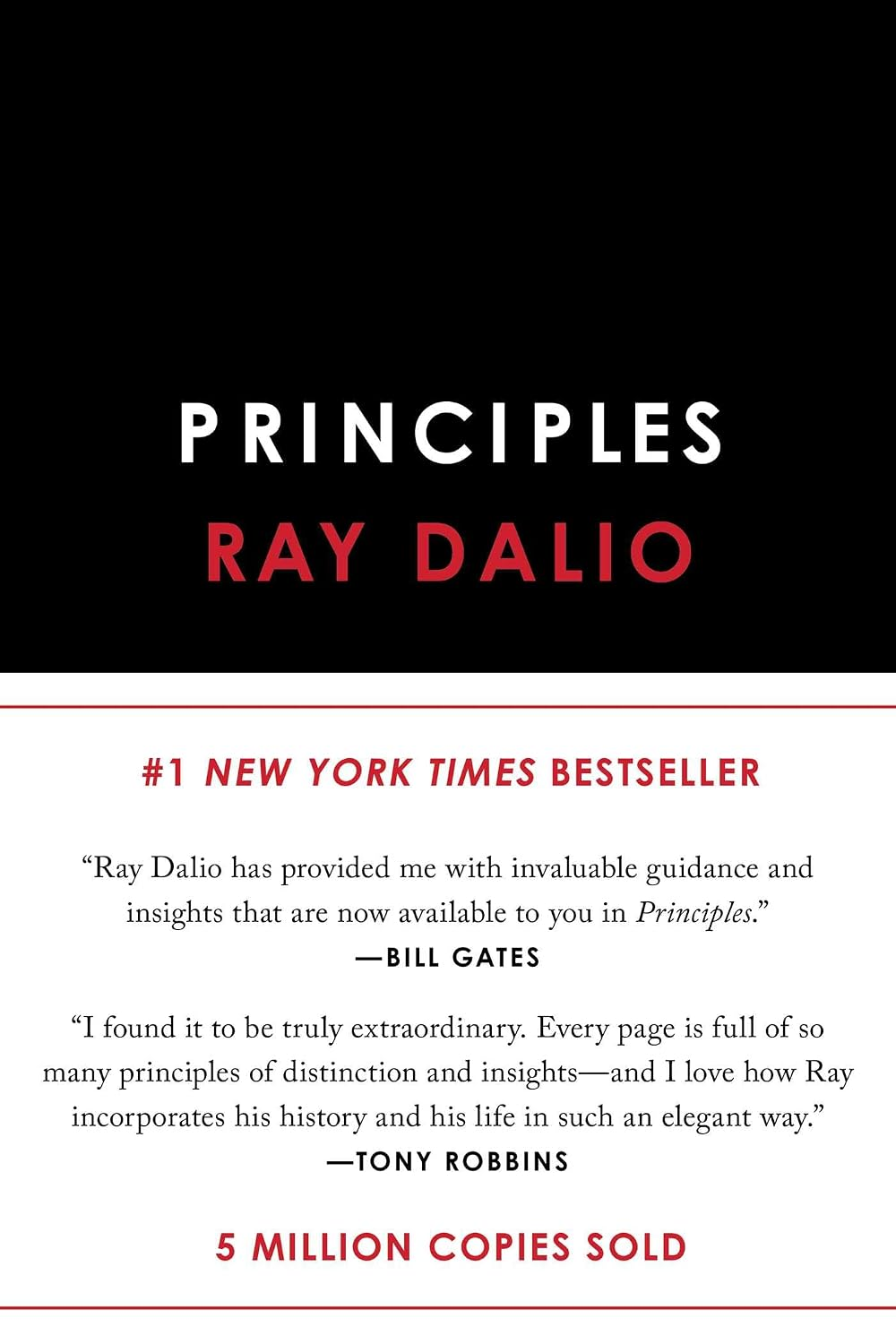
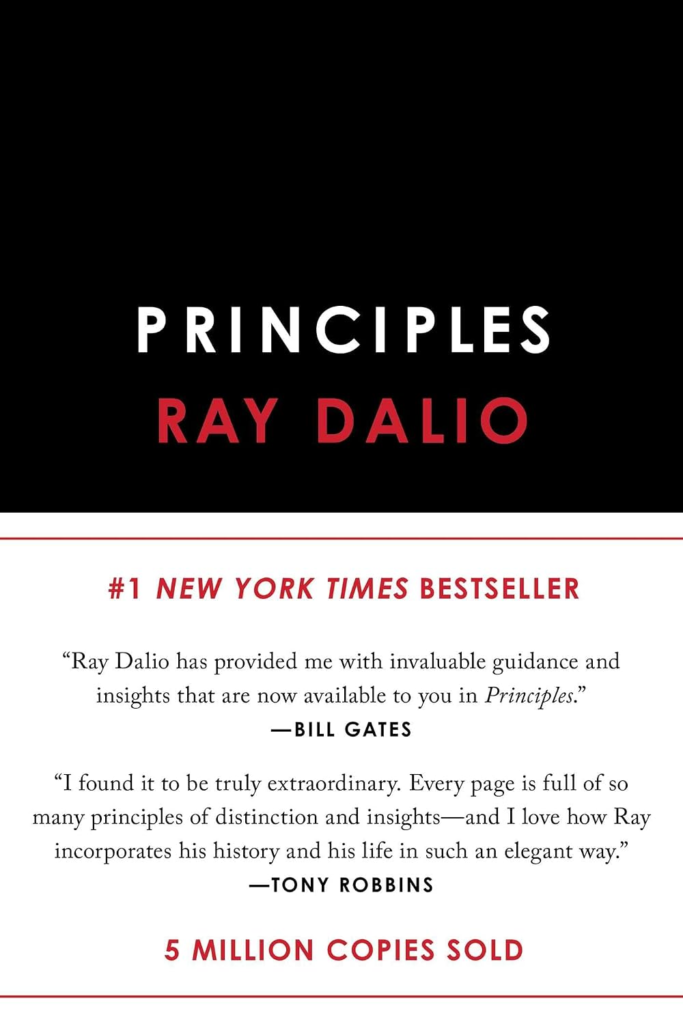
Principles: Life and Work is a 2017 nonfiction book by American investor and entrepreneur Ray Dalio, founder of the investment firm Bridgewater Associates. Published by Simon & Schuster, the book combines autobiography, management philosophy, investment experience, and a detailed collection of personal and organizational principles that Dalio developed during his career. The book is approximately 600 pages in its principal editions. (Google Books)
The central argument of Principles is that many of life’s recurring problems can be approached as cause-and-effect systems and that people can improve their decisions by identifying reality accurately, learning from mistakes, examining their own weaknesses, and converting experience into explicit principles. In the workplace, Dalio extends this philosophy into a management system built around radical truth, radical transparency, idea meritocracy, thoughtful disagreement, and believability-weighted decision-making. (Bridgewater)
The book is partly a memoir of Dalio’s rise from a young investor working from a two-bedroom apartment into the founder of Bridgewater, but its larger purpose is instructional. Dalio presents his career as a series of experiments, failures, observations, and refinements from which principles can be extracted and reused.
Bibliographic information
| Field | Details |
|---|---|
| Title | Principles: Life and Work |
| Author | Ray Dalio |
| Publisher | Simon & Schuster |
| First publication | 2017 |
| Language | English |
| Genre | Memoir; business; management; investing; personal development |
| Original U.S. hardcover | 2017 |
| ISBN | 978-1-5011-2402-0 |
| Pages | Approximately 560–600, depending on edition |
| Primary setting | New York; Bridgewater Associates |
| Major subjects | Decision-making, investing, leadership, organizational culture, personal development |
| Key concepts | Radical truth, radical transparency, idea meritocracy, believability-weighted decision-making |
WorldCat identifies the first Simon & Schuster hardcover edition as a 2017 publication, while Google Books lists editions with 567 and 592 pages and ISBNs varying by edition. (WorldCat)
About the author: Ray Dalio
Ray Dalio is the founder and mentor of Bridgewater Associates, which, over the last forty years, has become the largest and best performing hedge fund in the world. He is the author of #1 New York Times Bestseller and #1 Amazon Business Book of the Year, Principles. Dalio has appeared on the Time 100 list of the most influential people in the world as well as the Bloomberg Markets list of the 50 most influential people. He lives with his family in Connecticut.
Overview
At first glance, Principles: Life and Work appears to be a business memoir.
It is that—but it is also something more unusual.
Dalio attempts to turn the accumulated lessons of his life into a decision-making operating system.
His underlying proposition can be expressed simply:
Experience becomes valuable when you extract a principle from it and use that principle to make better decisions in the future.
The book therefore moves repeatedly through a cycle:
Experience → Mistake → Reflection → Principle → Decision → New Experience
This cycle is central to Dalio’s worldview.
Rather than treating failure as merely something unpleasant to avoid, he argues that painful experiences can provide information about weaknesses in one’s thinking or system.
The structure of the book
Principles: Life and Work is broadly divided into three major sections:
- Where I’m Coming From
- Life Principles
- Work Principles
The first section is autobiographical.
The second develops Dalio’s philosophy of personal development and decision-making.
The third applies the philosophy to organizations, particularly the culture and management system that developed at Bridgewater Associates. (Scalable Human Blog)
This structure is important because Dalio does not present his principles as abstract theories detached from experience. He repeatedly explains where particular ideas came from and connects them to events in his career.
Ray Dalio’s early life and career
Early interest in markets
Ray Dalio developed an interest in financial markets at a relatively young age.
He began investing as a child and eventually developed a particular fascination with the way economic events affected financial markets.
After graduating from C.W. Post College with a degree in finance in 1971, he attended Harvard Business School, receiving an MBA in 1973. (Google Books)
After working in finance, Dalio founded Bridgewater Associates in 1975 from his two-bedroom apartment in New York City. (WorldCat)
What began as a small operation eventually became one of the world’s most prominent hedge-fund organizations.
The 1982 crisis
One of the defining episodes in the book occurs during the early 1980s.
Dalio had developed a strong conviction about the direction of the economy and financial markets. His prediction proved dramatically wrong.
The resulting losses nearly destroyed his business.
More important to Dalio than the financial loss itself was what the failure taught him about ego and certainty.
He realized that being intelligent and having strong opinions did not guarantee being right.
The experience encouraged a different question:
How do I know I’m right?
This became one of the foundations of his later philosophy.
The episode transformed Dalio’s approach from trying to be the person with the best answer toward trying to build a system that could discover the best answer.
The central philosophy: principles
Dalio defines a principle as a fundamental truth that serves as the foundation for behavior or decision-making.
Instead of making every decision from scratch, individuals can create principles based on repeated experience.
For example:
Experience
     ↓
Something goes wrong
     ↓
Study what happened
     ↓
Identify the cause
     ↓
Extract a principle
     ↓
Write it down
     ↓
Apply it next time
     ↓
Better decision
The process resembles the development of an operating system.
Every significant mistake provides an opportunity to update the system.
Pain + Reflection = Progress
One of the most recognizable ideas associated with Principles is:
Pain + Reflection = Progress
Dalio does not suggest that suffering automatically creates wisdom.
The critical element is reflection.
Pain without reflection can simply remain pain.
Reflection turns an unpleasant experience into information.
              PAIN
                │
                ▼
        "What happened?"
                │
                ▼
        "Why did it happen?"
                │
                ▼
       "What was my role?"
                │
                ▼
        "What should change?"
                │
                ▼
            PRINCIPLE
                │
                ▼
             GROWTH
This is one of the book’s most broadly applicable concepts because it extends beyond investing and management.
A failed business project, a damaged relationship, a poor career decision or a financial mistake can all become useful if the person is willing to analyze them honestly.
The five-step process
Dalio presents a five-step process for achieving goals and dealing with problems.
1. Have clear goals
Know what you want.
2. Identify problems
Recognize what is preventing you from achieving it.
3. Diagnose problems
Find the root causes rather than merely treating symptoms.
4. Design solutions
Develop a practical plan for addressing the causes.
5. Push through to completion
Execute the plan.
The framework can be visualized as:
        GOALS
          ↓
       PROBLEMS
          ↓
       DIAGNOSE
          ↓
        DESIGN
          ↓
       EXECUTE
          ↓
        RESULTS
          ↓
       LEARNING
          │
          └───────────────┐
                          ▼
                        GOALS
Dalio emphasizes that these stages should not be confused with one another. First identify the objective, then understand the obstacle, then diagnose its cause, then design the solution, and finally execute it. (Non-Tech CEO)
Embracing reality
A recurring theme throughout Principles is the importance of accepting reality as it is rather than as one wishes it to be.
Dalio’s investment career reinforced the idea that markets do not change simply because an investor has a strong opinion.
Reality wins.
Therefore:
Preference is not evidence.
Confidence is not evidence.
Authority is not evidence.
The question should instead be:
What does reality indicate?
This philosophy forms the foundation for both Dalio’s investing methodology and his approach to management.
Radical truth
Definition
Radical truth is Dalio’s term for openly acknowledging reality, including uncomfortable facts.
In an organizational setting, this means people should be able to identify problems rather than hiding them to protect themselves or their colleagues.
Bridgewater’s published principles describe radical truth as avoiding the filtering of thoughts and questions, particularly critical ones. (Kolegite)
The logic is straightforward:
Hidden problem
      ↓
Problem remains
      ↓
Damage increases
      ↓
Organization suffers

Visible problem
      ↓
Discussion
      ↓
Diagnosis
      ↓
Solution
For Dalio, honesty is therefore not merely a moral virtue.
It is an information-processing mechanism.
Radical transparency
Closely related to radical truth is radical transparency.
Dalio’s concept involves making information widely accessible within an organization so that employees can understand what is happening and evaluate decisions.
At Bridgewater, this included recording many meetings and making recordings available internally, subject to exceptions. (Non-Tech CEO)
The intended effect was to reduce organizational politics.
Instead of relying on:
“The boss said so.”
employees could examine:
“What was said, what evidence was presented, and how was the decision reached?”
Dalio believed this could create a more intellectually honest organization.
Idea meritocracy
One of the book’s most important organizational concepts is idea meritocracy.
An idea meritocracy attempts to create an environment in which the quality of an idea matters more than the rank of the person proposing it.
Dalio describes Bridgewater’s culture as an effort to achieve meaningful work and relationships through radical transparency and an idea-meritocratic system. (Bridgewater)
The concept can be summarized as:
                 IDEA
                   │
        ┌──────────┴──────────┐
        │                     │
      Senior                Junior
     employee              employee
        │                     │
        └──────────┬──────────┘
                   │
                   ▼
             EVALUATE IDEA
                   │
          ┌────────┴────────┐
          │                 │
       Evidence          Expertise
          │                 │
          └────────┬────────┘
                   ▼
             BEST IDEA WINS
In theory, organizational hierarchy should not determine whether an idea is correct.
Believability-weighted decision-making
Dalio recognizes a problem with pure democracy.
If everyone gets exactly one vote regardless of expertise, the group may ignore important differences in knowledge.
He therefore advocates believability-weighted decision-making.
The basic principle is:
Opinions should carry different weights depending on the person’s demonstrated expertise and ability to explain the causal reasoning behind the opinion.
A person’s title alone does not establish credibility.
Nor does confidence.
Dalio emphasizes track record and demonstrated understanding. (Non-Tech CEO)
Conceptual formula
BELIEVABILITY
      =
Relevant experience
          +
Demonstrated track record
          +
Understanding of cause and effect
The result is not intended to eliminate disagreement.
It is intended to make disagreement more productive.
Thoughtful disagreement
Dalio distinguishes between disagreement intended to discover truth and disagreement intended to win an argument.
In the first:
The question is more important than the ego.
A productive disagreement asks:
- What evidence supports your view?
- What evidence supports mine?
- What are we missing?
- Who has greater relevant expertise?
- What would prove either of us wrong?
This approach turns disagreement into a tool for discovering information.
The “machine” metaphor
One of the book’s most distinctive ideas is Dalio’s description of organizations and economies as machines.
He sees many outcomes as the product of interacting causes.
For example:
Economic conditions
        ↓
Human behavior
        ↓
Business activity
        ↓
Financial flows
        ↓
Market prices
        ↓
Economic feedback
        ↺
Similarly, an organization can be viewed as:
People
  +
Processes
  +
Culture
  +
Information
  +
Decision rules
        ↓
    ORGANIZATION
        ↓
     RESULTS
        ↓
    FEEDBACK
        ↺
This systems-thinking perspective is central to Dalio’s worldview.
Turning principles into algorithms
Dalio’s philosophy eventually moved beyond written rules.
He describes an effort to translate decision principles into systematic and computerized decision-making.
The logic is:
Human experience
       ↓
Decision rule
       ↓
Written principle
       ↓
Historical testing
       ↓
Decision system
       ↓
Algorithm
       ↓
Consistent application
This reflects Dalio’s belief that good decision-making should not depend entirely on memory or emotion.
A well-defined principle can become a repeatable process.
“Baseball cards”
Another unusual Bridgewater practice discussed in the book is the creation of employee “baseball cards.”
The idea is to summarize an individual’s strengths, weaknesses, tendencies and characteristics in a compact format.
The metaphor comes from baseball cards, which summarize a player’s relevant attributes and statistics.
The organizational objective is to help people understand:
- what they are good at;
- where they struggle;
- how they tend to behave;
- what types of work suit them;
- how colleagues should interact with them.
WorldCat’s description of the book specifically identifies these “baseball cards” as one of Bridgewater’s tools for implementing its idea-meritocratic culture. (WorldCat)
Knowing one’s weaknesses
Dalio argues that self-awareness is more useful than pretending to have no weaknesses.
A person might be:
- highly analytical but poor at interpersonal communication;
- creative but disorganized;
- decisive but overly impulsive;
- socially skilled but weak at detailed analysis.
The objective is not to become excellent at everything.
It is to:
- identify weaknesses;
- compensate for them;
- work with people who have complementary strengths;
- build systems that reduce the impact of predictable weaknesses.
This produces one of the book’s important management ideas:
Don’t fight reality. Design around it.
Strengths and weaknesses
Dalio’s approach can be represented as a simple organizational model:
             INDIVIDUAL
                 │
        ┌────────┴────────┐
        │                 │
     STRENGTHS          WEAKNESSES
        │                 │
        ▼                 ▼
    MAXIMIZE          RECOGNIZE
        │                 │
        │                 ▼
        │            COMPENSATE
        │                 │
        └────────┬────────┘
                 ▼
          BETTER SYSTEM
The emphasis is on designing systems rather than expecting individuals to overcome every limitation through willpower.
Meaningful work and meaningful relationships
Despite the book’s highly analytical character, Dalio does not define success exclusively in financial terms.
The underlying objective is what he describes as meaningful work and meaningful relationships.
Money is treated as a tool rather than the final purpose.
This is an important point because Principles is often categorized simply as an investing or business book.
Its broader argument concerns how a person should build a life that is both productive and meaningful. (Scott J. Pearson’s Book Review)
Investing principles
Dalio’s investment philosophy is strongly influenced by his belief that economic systems operate according to identifiable relationships.
He is particularly associated with global macro investing, which examines large-scale economic forces such as:
- interest rates;
- inflation;
- debt;
- monetary policy;
- economic growth;
- currency movements;
- capital flows.
The book uses Dalio’s investment career to demonstrate how he developed systematic approaches to understanding these forces.
Diversification
One important investment lesson associated with Dalio’s approach is the importance of diversification.
The underlying idea is not merely to own many assets.
It is to combine assets whose returns respond differently to economic conditions.
Conceptually:
                 PORTFOLIO
                     │
       ┌─────────────┼─────────────┐
       │             │             │
    Asset A       Asset B       Asset C
       │             │             │
  responds       responds      responds
 differently     differently   differently
       │             │             │
       └─────────────┼─────────────┘
                     ▼
              LOWER CONCENTRATION
                     │
                     ▼
               MORE ROBUSTNESS
This is consistent with Dalio’s broader principle of constructing systems that are less vulnerable to any single outcome.
Learning from mistakes
For Dalio, mistakes are not simply failures.
They are data.
A mistake can reveal:
- an incorrect assumption;
- a weakness in judgment;
- a flawed process;
- insufficient information;
- excessive confidence;
- a poor decision rule.
The critical question is:
What can this failure teach me that success could not?
This philosophy gives the book much of its distinctive character.
A decision-making framework
The major ideas in Principles can be condensed into one decision architecture:
                   GOAL
                     │
                     ▼
              FACE REALITY
                     │
                     ▼
             IDENTIFY PROBLEM
                     │
                     ▼
              FIND ROOT CAUSE
                     │
                     ▼
            GATHER PERSPECTIVES
                     │
                     ▼
          WEIGH BELIEVABILITY
                     │
                     ▼
             DESIGN SOLUTION
                     │
                     ▼
                  ACT
                     │
                     ▼
                 RESULTS
                     │
                     ▼
                REFLECT
                     │
                     ▼
                PRINCIPLE
                     │
                     └──────────► NEXT DECISION
This diagram captures perhaps the clearest synthesis of Dalio’s philosophy.
Personal principles versus work principles
| Life Principles | Work Principles |
|---|---|
| Know what you want | Build an idea meritocracy |
| Face reality | Encourage radical truth |
| Learn from mistakes | Practice radical transparency |
| Understand your weaknesses | Evaluate people objectively |
| Build complementary teams | Weight opinions by believability |
| Make decisions systematically | Use systems and algorithms |
| Continue evolving | Build a culture of learning |
The two sections are not independent.
Dalio treats organizational culture as an extension of individual decision-making.
The five-step evolutionary loop
A broader interpretation of Dalio’s philosophy can be expressed as:
            SET GOALS
                │
                ▼
        ENCOUNTER REALITY
                │
                ▼
           EXPERIENCE
                │
                ▼
             FAILURE
                │
                ▼
            REFLECTION
                │
                ▼
             LEARNING
                │
                ▼
            PRINCIPLE
                │
                ▼
          BETTER DECISION
                │
                └─────────────► SET NEW GOALS
This makes the book less about “success secrets” and more about continuous evolution.
Reception
Principles: Life and Work became a major business-book bestseller following its publication.
Google Books identifies the work as a New York Times bestseller, while Bridgewater describes it as a New York Times bestseller published in 2017. (Google Books)
The book has attracted readers in investing, entrepreneurship, management, leadership and personal development because its principles can be interpreted at several levels.
Some readers approach it as:
- an investor’s memoir;
- a management manual;
- a leadership book;
- a decision-making framework;
- a personal-development book;
- or a description of Bridgewater’s unusual corporate culture.
Critical response
The book has also received criticism.
One recurring criticism concerns its length and density. At nearly 600 pages in some editions, Principles devotes extensive space to detailed organizational rules and examples.
Some critics have also questioned whether the Bridgewater model can be transferred successfully to ordinary organizations.
The culture of radical transparency, extensive evaluation and recorded meetings may work very differently depending on an organization’s size, workforce and psychological environment.
A later critique of Dalio’s system has also appeared in reporting surrounding Rob Copeland’s 2023 book The Fund, which examined Bridgewater’s culture and presented accounts from former employees that differed sharply from Dalio’s idealized description. (Non-Tech CEO)
This creates an important distinction:
Principles explains how Dalio says the system should work.
It should not automatically be treated as independent evidence that every element of the system works exactly as described.
That distinction is especially important for readers approaching the book as a management science text rather than as a memoir and philosophical guide.
Strengths of the book
Several characteristics have contributed to the book’s continuing popularity.
1. It converts experience into explicit rules
Instead of merely saying “learn from failure,” Dalio attempts to explain exactly how he learned.
2. It connects personal and organizational development
The same principles are applied to individuals and companies.
3. It encourages intellectual humility
The recurring question is not:
“Am I confident?”
but:
“What makes me believe I am right?”
4. It emphasizes systems
Rather than depending solely on willpower, Dalio advocates designing systems that make good decisions more repeatable.
5. It makes disagreement productive
The goal is not agreement for its own sake but discovering the best available answer.
Limitations
The book also has clear limitations.
The Bridgewater model is unusual
A culture developed over decades inside an investment firm cannot simply be copied into every business.
Radical transparency can have costs
Transparency can expose problems, but poorly implemented transparency can also create fear, defensiveness or excessive self-monitoring.
Expertise is difficult to measure
The idea of weighting opinions according to believability is attractive, but determining exactly who is “believable” can itself become subjective.
Systems cannot eliminate judgment
Even highly structured decision-making ultimately depends on the quality of the information and assumptions entering the system.
These limitations do not invalidate Dalio’s ideas. They demonstrate why principles should be treated as tools rather than universal laws.
Ray Dalio
Author biography
Raymond Thomas Dalio, known as Ray Dalio, is an American investor, entrepreneur, author and philanthropist.
He founded Bridgewater Associates in 1975 and developed it into one of the world’s largest hedge funds. (WorldCat)
Dalio studied finance at C.W. Post College, receiving his bachelor’s degree in 1971, and later earned an MBA from Harvard Business School in 1973. (Google Books)
His career has focused heavily on global macroeconomic investing, and he became particularly known for studying relationships among debt, monetary policy, economic growth and financial markets.
His later writing has expanded beyond personal principles into broader economic and geopolitical subjects.
Other books by Ray Dalio
Dalio subsequently published several other books, including:
Principles for Navigating Big Debt Crises
This work examines the mechanics and historical patterns of major debt crises.
Principles for Dealing with the Changing World Order
Published in 2021, this book examines long-term cycles involving economic power, political structures, debt, internal conflict and international competition.
Together, the books form a broader intellectual project:
                 RAY DALIO'S PRINCIPLES
                         │
        ┌────────────────┼────────────────┐
        │                │                │
        ▼                ▼                ▼
       LIFE             WORK           ECONOMICS
        │                │                │
        ▼                ▼                ▼
    Personal         Organizations      Debt &
    principles        & decisions       economic
                                      cycles
Influence of Principles
The influence of Principles extends beyond traditional investment literature.
Its vocabulary has entered discussions about:
- organizational culture;
- entrepreneurship;
- leadership;
- startup management;
- decision science;
- investment management;
- personal development;
- workplace feedback;
- systems thinking.
Terms such as radical transparency, idea meritocracy and believability-weighted decision-making are particularly associated with Dalio’s approach.
Why the book remains relevant
The fundamental problem addressed by Principles is timeless:
How should human beings make good decisions when they are uncertain, biased and emotionally attached to their own opinions?
Dalio’s answer is not to eliminate human judgment.
Instead, he proposes building a structure around it.
That structure consists of:
Reality → Evidence → Disagreement → Reflection → Principles → Systems → Better decisions
In an age of increasingly complex organizations and enormous amounts of information, the basic challenge remains the same: knowing what to believe, whom to trust and how to recognize when one’s own assumptions are wrong.
The core philosophy in one infographic
╔══════════════════════════════════════════════╗
║              RAY DALIO'S MODEL               ║
╠══════════════════════════════════════════════╣
║                                              ║
║                 FACE REALITY                 ║
║                       ↓                      ║
║                ACCEPT MISTAKES               ║
║                       ↓                      ║
║                  REFLECT                     ║
║                       ↓                      ║
║              FIND ROOT CAUSES                ║
║                       ↓                      ║
║              CREATE PRINCIPLES               ║
║                       ↓                      ║
║             BUILD BETTER SYSTEMS             ║
║                       ↓                      ║
║             MAKE BETTER DECISIONS            ║
║                       ↓                      ║
║                    RESULTS                   ║
║                       ↓                      ║
║                   LEARNING                   ║
║                       │                      ║
║                       └───────────► LOOP     ║
╚══════════════════════════════════════════════╝
Key concepts at a glance
| Concept | Central idea |
|---|---|
| Principles | Fundamental rules derived from experience |
| Pain + Reflection | Mistakes can become sources of growth |
| Radical Truth | Face and discuss reality honestly |
| Radical Transparency | Make relevant information broadly visible |
| Idea Meritocracy | Let the best ideas prevail over hierarchy |
| Believability Weighting | Give greater weight to demonstrated expertise |
| Thoughtful Disagreement | Debate to discover truth rather than win |
| Systemization | Convert repeated decisions into processes |
| Self-awareness | Know strengths and weaknesses |
| Meaningful Work | Pursue work that has genuine significance |
| Meaningful Relationships | Build relationships based on trust and mutual respect |
A “Principles” decision card
For a practical encyclopedia sidebar, Dalio’s approach can be reduced to the following:
┌──────────────────────────────────┐
│       THE PRINCIPLES TEST        │
├──────────────────────────────────┤
│ 1. What do I want?               │
│                                  │
│ 2. What is preventing it?        │
│                                  │
│ 3. What is the root cause?       │
│                                  │
│ 4. What am I missing?            │
│                                  │
│ 5. Who has relevant expertise?   │
│                                  │
│ 6. What evidence exists?         │
│                                  │
│ 7. What principle applies?       │
│                                  │
│ 8. What should I do next?       │
│                                  │
│ 9. What did I learn?             │
└──────────────────────────────────┘
This is a synthesis of the book’s framework, rather than a verbatim checklist from the text.
Legacy
Principles: Life and Work occupies an unusual position among business books.
It is simultaneously:
- a memoir of an investor;
- an account of Bridgewater Associates;
- a management philosophy;
- a guide to decision-making;
- an argument for intellectual humility;
- and an attempt to turn decades of experience into a reusable system.
Its most enduring idea may not be any individual management rule.
It is the broader proposition that a person’s experiences become exponentially more valuable when they are converted into principles and those principles are deliberately applied to future decisions.
Dalio’s philosophy can ultimately be reduced to a cycle:
Experience teaches.
Failure exposes.
Reflection explains.
Principles guide.
Systems reinforce.
Decisions create new experience.
That cycle is the intellectual backbone of Principles: Life and Work.
See also
- Ray Dalio
- Bridgewater Associates
- Hedge fund
- Global macro investing
- Investment management
- Organizational culture
- Systems thinking
- Decision theory
- Behavioral finance
- Leadership
- Management
- Radical transparency
- Idea meritocracy
- Principles for Navigating Big Debt Crises
- Principles for Dealing with the Changing World Order
Read more
- Ray Dalio’s official website
- Bridgewater Associates
- Principles.com
- Principles: Life and Work
- Principles for Navigating Big Debt Crises
- Principles for Dealing with the Changing World Order
- The Fund, by Rob Copeland — an independent account of Bridgewater’s culture and Dalio’s organization.
References
- Dalio, Ray. Principles: Life and Work. Simon & Schuster, 2017. (Google Books)
- Bridgewater Associates. Principles — official excerpt from Principles: Life and Work. (Bridgewater)
- WorldCat. Principles: Life and Work, first Simon & Schuster hardcover edition, 2017. (WorldCat)
- Google Books. Principles: Life and Work — bibliographic and author information. (Google Books)
- Dalio, Ray. Principles: Life and Work — Simon & Schuster editions and bibliographic records. (Google Books)
- Kirkus Reviews. Reviews and critical assessment of Principles: Life and Work. (Non-Tech CEO)
- American Affairs. Matthew Walther, “Principles for Dummies,” review essay on Principles. (American Affairs Journal)
- Copeland, Rob. The Fund. St. Martin’s Press, 2023. Later reporting and commentary concerning Bridgewater’s organizational culture are discussed in connection with the book. (Non-Tech CEO)
External links
Simon & Schuster — Principles: Life and Work
Google Books — Principles: Life and Work