About the Book ‘How to Be More Intelligent?’
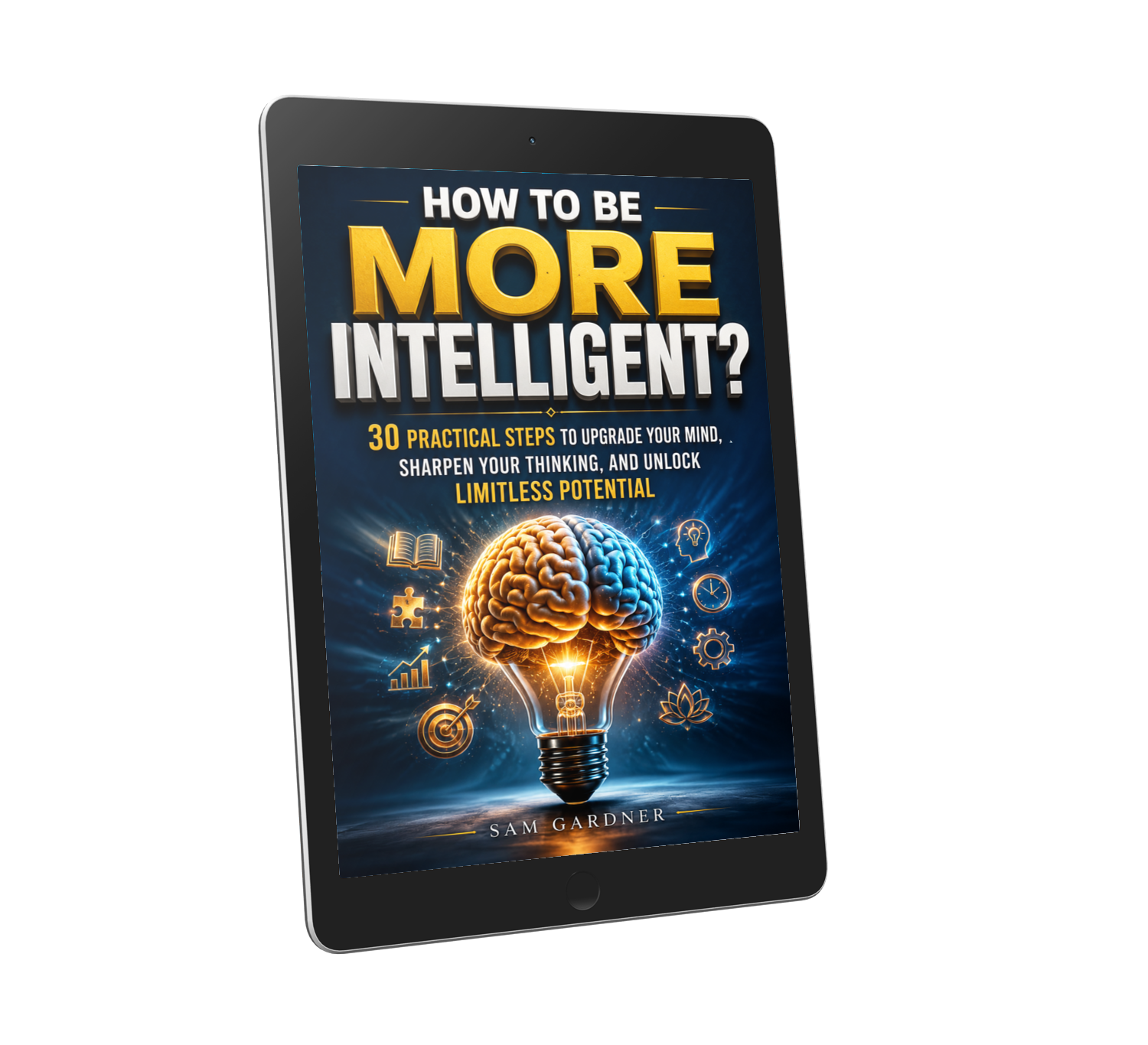
| Book Name | How to Be More Intelligent? |
| Author | Sam Gardner |
| Genre | Self_help |
| Language | English |
| Pages | 305 Pages |
| File Size | 2.87 MB |
| Format | Free PDf Download |
How to Be More Intelligent? Free PDf Download
Loading Viewer...
Why Read This Book ‘How to Be More Intelligent?’
What if becoming more intelligent were not a matter of being born with a brilliant mind—but a matter of learning how to use, train, and continually develop the mind you already have?
That is the central idea behind How to Be More Intelligent?
We live in a world overflowing with information, opinions, notifications, distractions, and constant stimulation. Yet having access to more information does not automatically make us better thinkers. We can consume thousands of articles and videos and still struggle to focus, remember what we learn, evaluate information critically, manage our emotions, or make wise decisions. This book addresses that gap: the difference between knowing more and thinking better.
Because Intelligence Is Not a Fixed Destiny
Perhaps you have sometimes thought, “I’m just not naturally intelligent,” or “I’m not good at learning.”
This book challenges that limiting belief.
Its foundation is the idea that intelligence can be developed. Through neuroplasticity, deliberate practice, effective learning strategies, constructive habits, curiosity, reflection, and a growth mindset, you can continually improve the way you think, learn, solve problems, and respond to the world.
Because You Want to Think More Clearly
Intelligence is not simply about remembering facts or achieving a high score on a test. It is also about asking better questions, examining assumptions, recognizing patterns, understanding complexity, thinking critically, and making thoughtful decisions.
This book takes you beyond passive knowledge and introduces practical ways to develop clearer, more independent thinking.
Because Your Attention Is More Valuable Than Ever
Modern life constantly competes for your attention.
Notifications, social media, endless content, multitasking, and information overload can make deep concentration increasingly difficult. The book therefore treats focus not merely as a productivity skill, but as an essential foundation for learning, memory, analysis, and intelligent action.
Because Learning More Is Not Enough—You Need to Learn Better
Many people spend hours reading, studying, highlighting, watching lectures, or consuming educational content without retaining or applying much of it.
This book explores learning as a skill that can itself be improved. It encourages you to become a more active learner and to transform information into understanding and useful knowledge.
Because Better Thinking Leads to Better Decisions
Every day, you make decisions—small and large.
The quality of those decisions depends on how you process information, recognize biases, understand consequences, evaluate alternatives, and think strategically. The book introduces critical thinking, mental models, systems thinking, and structured decision-making as practical tools for navigating complexity more intelligently.
Because Intelligence Includes Emotional and Social Intelligence
Being intellectually capable is only one part of becoming a wiser and more effective person.
The book also explores emotional regulation, empathy, mindfulness, social intelligence, and the ability to understand yourself and others. These dimensions help transform intelligence from something purely cognitive into something useful in real human situations.
Because This Book Is Designed to Be Used
This is not intended to be a book you simply read, underline, and forget.
It contains 30 practical steps designed to help you strengthen memory and concentration, improve reasoning and decision-making, develop critical thinking and emotional intelligence, challenge yourself mentally, and build habits that support intelligent thinking. Each chapter is structured around practical application rather than abstract theory.
The goal is not to make you feel temporarily inspired.
The goal is to help you think, practice, reflect, and change.
Because Your Future Self Depends on How You Train Your Mind Today
Every intelligent habit begins with a small decision.
Ask a better question.
Read more actively.
Focus more deeply.
Challenge an assumption.
Reflect before reacting.
Learn from a mistake.
Solve a difficult problem.
Listen more carefully.
Stay curious.
Take the next logical step.
Over time, these small actions can become the architecture of a more capable mind.
How to Be More Intelligent? is ultimately an invitation to stop seeing intelligence as something you either possess or lack—and start treating it as something you can continually develop.
You do not need to become someone else.
You need to learn how to make better use of the remarkable mind you already have.
Read this book not merely to know more.
Read it to think better.
Read it to learn better.
Read it to decide better.
Read it to live with greater clarity, curiosity, and intention.
And most importantly, read it ready to act—one practical step, one thought, and one habit at a time.