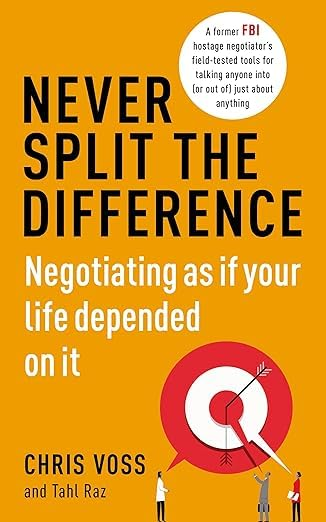
Never Split the Difference: Negotiating as If Your Life Depended on It is a nonfiction book on negotiation written by former FBI hostage and international kidnapping negotiator Chris Voss, with journalist and author Tahl Raz. First published in 2016 by HarperBusiness, the book presents a negotiation methodology derived largely from Voss’s experience in crisis and hostage negotiations and adapts those techniques to business, professional, and personal situations.
The book argues against the conventional idea that successful negotiation is primarily a rational exercise in compromise. Instead, Voss emphasizes emotional intelligence, active listening, tactical empathy, carefully constructed questions, calibrated communication, and the discovery of information that the other party has not initially revealed.
The title refers to the book’s central rejection of automatic compromise. In Voss’s framework, splitting the difference can produce an outcome that is merely halfway between two positions rather than an outcome that addresses the underlying interests, constraints, and sources of leverage in a negotiation.
The book became an international bestseller and has been described by its publisher and booksellers as a New York Times and Wall Street Journal bestseller. Publisher and book records report more than five million copies sold.
Book information
| Title | Never Split the Difference: Negotiating as If Your Life Depended on It |
|---|---|
| Authors | Chris Voss, Tahl Raz |
| Genre | Nonfiction, business, negotiation, communication |
| Subject | Negotiation and conflict resolution |
| Original language | English |
| Publisher | HarperBusiness, an imprint of HarperCollins |
| Publication date | May 17, 2016 |
| Pages | 288 pages in the HarperBusiness edition |
| ISBN | 978-0-06-240780-1 |
| Country | United States |
| Major themes | Negotiation, persuasion, emotional intelligence, communication, conflict resolution |
| Notable status | International bestseller; New York Times and Wall Street Journal bestseller |
Bibliographic records identify the book as a 2016 HarperBusiness publication with ISBN 9780062407801 and 288 pages. Different editions and international releases vary in pagination and ISBN.
Overview
Never Split the Difference occupies an unusual position among popular books on negotiation. Its author does not approach negotiation primarily as a lawyer, economist, academic theorist, or corporate executive. Voss approaches it as a former FBI crisis negotiator whose professional environment frequently involved people under extreme emotional pressure.
His argument is that the principles learned in hostage negotiations are not limited to emergencies. Everyday activities—including negotiating a salary, purchasing a house or car, discussing rent, negotiating a business agreement, managing employees, selling a product, or resolving disagreements within a family—also involve competing interests, emotions, uncertainty, and incomplete information.
The book therefore reframes negotiation as a form of human communication under conditions of disagreement.
Its central proposition can be summarized as:
Effective negotiation begins with understanding the other person’s perception of reality rather than immediately trying to impose your own.
This does not mean that Voss advocates simply being agreeable. On the contrary, the book repeatedly emphasizes maintaining one’s objectives while creating enough psychological safety for the other party to reveal useful information.
Background
Chris Voss

Christopher Voss is an American former FBI negotiator, author, consultant, and negotiation instructor. He spent approximately 24 years with the FBI and ultimately became its lead international kidnapping negotiator. He also served as the FBI’s hostage-negotiation representative to the National Security Council’s Hostage Working Group.
According to the Black Swan Group, Voss worked on international kidnapping and hostage situations and represented the United States as a kidnapping-negotiation expert at international conferences sponsored by the G8.
After leaving the FBI, Voss founded The Black Swan Group, a negotiation consulting and training organization. The company subsequently developed the principles associated with what it calls the Black Swan Method for business and professional negotiations.
Voss has also taught or lectured on negotiation at institutions including Georgetown University’s McDonough School of Business and the University of Southern California’s Marshall School of Business. Publisher biographies additionally associate him with teaching and lectures at institutions including Harvard Law School, MIT Sloan School of Management, and Northwestern University’s Kellogg School of Management.
Voss’s professional background
POLICING
   │
   ▼
FBI CAREER
   │
   ├── Crisis negotiation
   │
   ├── Hostage negotiation
   │
   ├── International kidnapping cases
   │
   └── National Security Council Hostage Working Group
   │
   ▼
LEAD INTERNATIONAL KIDNAPPING NEGOTIATOR
   │
   ▼
BLACK SWAN GROUP
   │
   ▼
BUSINESS & PERSONAL NEGOTIATION METHOD
   │
   ▼
NEVER SPLIT THE DIFFERENCE
The significance of Voss’s background is central to the book’s appeal: readers are being introduced to negotiation through the perspective of someone who learned the discipline in circumstances where poor communication could have severe consequences.
Tahl Raz

Tahl Raz is an award-winning journalist, editor, author, and business storyteller. He has written and edited for publications including Inc., GQ, the Jerusalem Post, and other media organizations. Penguin’s author biography describes him as a storyteller focused on major ideas in business, technology, and the social sciences.
Raz previously co-authored Never Eat Alone with Keith Ferrazzi, which became a widely known business and networking book.
In Never Split the Difference, Raz’s contribution helps transform Voss’s professional experiences into a narrative-driven business book. The result combines hostage-negotiation anecdotes, practical instructions, psychological observations, and conversational examples.
The book therefore has two complementary dimensions:
Voss provides the negotiation experience; Raz helps turn that experience into accessible narrative and instruction.
Origins of the book
Voss’s approach developed from the practical requirements of crisis negotiation. Traditional negotiation models often assume that parties can identify their interests, evaluate alternatives rationally, and reach mutually beneficial compromises.
Hostage negotiations frequently do not operate under those assumptions.
A hostage taker may be frightened, irrational, angry, desperate, intoxicated, ideologically motivated, or concerned about losing control. The negotiator may have incomplete information and little authority over the other party.
Voss argues that these conditions revealed something fundamental about negotiation more generally: people do not make decisions purely through rational calculation.
The book consequently gives unusual importance to:
- emotion;
- perception;
- fear;
- trust;
- loss aversion;
- the desire for control;
- the need to feel heard;
- carefully chosen language;
- silence;
- and previously undisclosed information.
Central thesis
The central thesis of Never Split the Difference is that negotiation should not be treated as a contest between two fixed positions.
Instead, it should be treated as a process of discovering information and influencing perception.
The basic sequence can be represented as:
POSITION
   ↓
LISTEN
   ↓
UNDERSTAND EMOTION
   ↓
LABEL WHAT YOU HEAR
   ↓
CREATE PSYCHOLOGICAL SAFETY
   ↓
ASK CALIBRATED QUESTIONS
   ↓
REVEAL CONSTRAINTS & MOTIVATIONS
   ↓
DISCOVER HIDDEN INFORMATION
   ↓
INFLUENCE THE NEGOTIATION
   ↓
REACH AGREEMENT
The important distinction is that agreement comes relatively late in the process.
Voss’s method does not begin with:
“What percentage should we compromise?”
It begins with:
“What is really happening on the other side?”
The major principles
Tactical empathy
One of the book’s most important concepts is tactical empathy.
Voss distinguishes empathy from sympathy. Tactical empathy does not require agreeing with another person’s position or feeling sorry for them. Instead, it involves demonstrating an understanding of the other person’s emotions, perspective, and concerns.
The purpose is not emotional surrender.
It is information.
A negotiator who understands why the other person is angry, afraid, resistant, or demanding has more information with which to negotiate.
The method can be represented as:
LISTEN
  ↓
OBSERVE
  ↓
IDENTIFY EMOTION
  ↓
NAME THE EMOTION
  ↓
ALLOW RESPONSE
  ↓
CONTINUE DISCOVERY
A useful distinction is:
Empathy ≠ Agreement
Understanding a person’s position does not require accepting it.
Mirroring
Voss recommends mirroring as a simple listening technique.
The negotiator repeats a small number of the other person’s important words, often in the form of a question or with an inquisitive tone.
For example:
Person A:
“We can’t deliver the project until next month.”
Person B:
“Next month?”
The purpose is to encourage the other person to continue talking.
Mirroring can accomplish several things simultaneously:
- demonstrates attention;
- encourages elaboration;
- slows the conversation;
- creates opportunities for additional information;
- and allows the negotiator to avoid prematurely revealing his or her own position.
The technique appears deceptively simple. Its effectiveness depends largely on timing, tone, and genuine curiosity rather than mechanical repetition.
Labeling
Another central technique is labeling.
Labeling involves explicitly identifying an emotion or concern that appears to be present.
Typical formulations include:
- “It seems like…”
- “It sounds like…”
- “It looks like…”
For example:
“It sounds like you’re worried that changing the deadline will create problems for your team.”
The purpose is to bring an unspoken emotion into the conversation.
Rather than arguing against the emotion, the negotiator identifies it.
This can reduce the pressure surrounding the issue and encourage the other party to explain what is actually bothering them.
The accusation audit
Voss introduces the accusation audit, in which a negotiator anticipates the negative things the other party may be thinking.
Before a difficult conversation, the negotiator considers questions such as:
- What will they dislike about my proposal?
- What will they accuse me of?
- What might make them distrust me?
- What weaknesses will they identify?
- What will they believe I am trying to take from them?
The negotiator can then acknowledge these concerns rather than waiting for the other person to raise them aggressively.
The underlying logic is straightforward:
An unspoken objection can exert more psychological pressure than an openly acknowledged one.
The power of “No”
One of the book’s counterintuitive ideas is that “no” can be useful.
Conventional persuasion often treats “yes” as the desired response. Voss argues that an immediate “yes” is not necessarily genuine commitment.
People may say yes simply to:
- end a conversation;
- avoid confrontation;
- appear cooperative;
- escape pressure;
- or postpone a decision.
“No”, by contrast, can give a person a sense of control.
The negotiator therefore does not always need to force agreement.
A carefully constructed question that allows the other party to say “no” may actually make the conversation safer.
“That’s right” versus “You’re right”
The book makes an important distinction between two apparently positive responses:
“You’re right.”
and
“That’s right.”
Voss treats them differently.
“You’re right” can function as a conversational escape hatch. Someone may say it simply to end the discussion.
“That’s right”, in the framework presented by Voss, indicates that the other person recognizes their situation in the negotiator’s summary.
The route to “that’s right” is therefore not persuasion through argument but accurate summarization.
A negotiator summarizes:
- the other person’s position;
- their concerns;
- their emotional perspective;
- their constraints.
The other person then has an opportunity to confirm or correct the description.
Calibrated questions
The book gives considerable importance to calibrated questions, particularly questions beginning with:
- “How…”
- “What…”
Rather than demanding an action, the negotiator asks the other person to explain how that action could be accomplished.
A classic structure is:
“How am I supposed to do that?”
The apparent simplicity of the question is deliberate.
It shifts part of the problem-solving burden to the other side.
Instead of saying:
“Your price is unacceptable.”
the negotiator may ask:
“How am I supposed to make that work?”
Instead of:
“You need to deliver earlier.”
the negotiator may ask:
“What would make it possible to deliver this earlier?”
The other person is then invited to solve a problem rather than simply defend a position.
The illusion of control
Voss argues that people respond strongly to a sense of autonomy.
Calibrated questions can create what he calls an illusion of control.
The negotiator does not issue direct commands. Instead, the other party is encouraged to explain, justify, calculate, or propose.
This produces a subtle shift:
DIRECT DEMAND
      ↓
RESISTANCE
      ↓
ARGUMENT
      ↓
DEADLOCK
versus:
CALIBRATED QUESTION
      ↓
OTHER PARTY THINKS
      ↓
OTHER PARTY EXPLAINS
      ↓
NEW INFORMATION
      ↓
POSSIBLE SOLUTION
The negotiator is still pursuing an objective, but the other party participates in constructing the path toward it.
Loss aversion and framing
The book also draws attention to the psychological importance of loss aversion.
People often experience losses more intensely than equivalent gains. Voss uses this principle when discussing how offers, deadlines, prices, and perceptions of fairness can be framed.
The same economic outcome can feel different depending on how it is presented.
For example:
FRAME A
"You will save $10,000."

          versus

FRAME B
"If we don't act, you risk losing $10,000."
The numerical amount is identical.
The psychological experience is not.
Voss argues that effective negotiators therefore pay attention not only to what is being offered but also to how the other party experiences the choice.
Deadlines
Deadlines can be powerful in negotiation, but the book warns against treating them as simple countdown clocks.
A deadline may create urgency, but artificial or poorly chosen deadlines can also damage credibility.
The important question is:
Who is actually constrained by the deadline?
A negotiator who assumes that the other party must act immediately may be negotiating against an imaginary constraint.
This connects directly with one of the book’s broader principles:
Never assume that you understand the other side’s constraints until you have investigated them.
The Ackerman bargaining model
The book describes an approach commonly known as the Ackerman model, designed for situations involving price negotiation.
The basic sequence is:
TARGET PRICE
     │
     ├── 65% ──► First offer
     │
     ├── 85% ──► Second offer
     │
     ├── 95% ──► Third offer
     │
     └──100% ──► Final target
The method combines incremental concessions with psychological signaling.
The model described in the book also recommends using precise rather than excessively round numbers and making the final concession relatively small.
For example, instead of ending at an arbitrary round number such as $10,000, the final figure might be expressed more precisely.
The broader principle is that concessions should communicate that the negotiator has reached a meaningful boundary.
Negotiating styles
Voss discusses different behavioral approaches to negotiation, including styles characterized by different relationships to time, information, and interpersonal interaction.
The book particularly emphasizes the danger of assuming that every successful negotiator behaves in the same way.
A negotiator must understand both:
- his or her own tendencies; and
- the tendencies of the counterpart.
This is important because a strategy that works with an analytical counterpart may perform differently with someone who prioritizes relationships, speed, status, or control.
The “Black Swan”
The title concept of a Black Swan is one of the book’s most important ideas.
In this context, a Black Swan is information that is:
- unknown to the negotiator;
- difficult to predict in advance;
- and potentially capable of dramatically changing the negotiation.
The term therefore refers to unknown unknowns.
Examples might include:
- an undisclosed budget constraint;
- a hidden deadline;
- an internal disagreement;
- an alternative supplier;
- a personal motivation;
- an organizational rule;
- a third party with decision-making authority;
- or an urgent need that has not been revealed.
The book’s message is that leverage may not come from negotiating harder.
It may come from discovering something you did not know existed.
The Black Swan discovery model
WHAT I KNOW
───────────────
• My objective
• My offer
• My constraints
• My assumptions

        ↓

WHAT THEY HAVE SAID
────────────────────
• Their demands
• Their objections
• Their explanations

        ↓

WHAT I DON'T KNOW
──────────────────
• Their real motivation
• Their hidden constraints
• Their alternatives
• Their internal pressures
• Their decision process

        ↓

BLACK SWAN
──────────────────
Unexpected information
that changes the negotiation
This is perhaps the most intellectually interesting aspect of the book: information can be more valuable than concessions.
Chapter structure
The book is organized around a progression of negotiation principles.
Chapter 1 — The New Rules
Voss introduces the argument that traditional rational negotiation models do not adequately account for human emotion.
The chapter establishes the foundation for the rest of the book: negotiation is fundamentally human before it is mathematical.
Chapter 2 — Be a Mirror
This chapter introduces mirroring and emphasizes listening as a tool for extracting information.
Chapter 3 — Don’t Feel Their Pain, Label It
Voss develops the concepts of tactical empathy, emotional labeling, and the accusation audit.
Chapter 4 — Beware “Yes” — Master “No”
The chapter explores why “no” can create psychological safety and why a quick “yes” may not represent genuine commitment.
Chapter 5 — Trigger “That’s Right”
The focus shifts toward summarization, accurate understanding, and the difference between superficial agreement and genuine recognition.
Chapter 6 — Bend Their Reality
This chapter addresses framing, loss aversion, deadlines, price perception, and the psychology of fairness.
Chapter 7 — Create the Illusion of Control
Calibrated questions become the central technique. The negotiator encourages the counterpart to participate in solving the problem.
Chapter 8 — Guarantee Execution
The book moves beyond reaching an agreement to ensuring that the agreement is actually implemented.
This distinction is important:
A negotiated agreement that is never executed is not a successful negotiation.
Chapter 9 — Bargain Hard
The Ackerman bargaining model and practical price-negotiation strategies are discussed.
Chapter 10 — Find the Black Swan
The final chapter returns to information discovery and emphasizes the importance of identifying hidden facts that can transform the negotiation.
The Voss negotiation framework
The major techniques can be organized into a single framework:
| Stage | Technique | Primary purpose |
|---|---|---|
| 1 | Active listening | Gather information |
| 2 | Mirroring | Encourage elaboration |
| 3 | Labeling | Surface emotions |
| 4 | Tactical empathy | Demonstrate understanding |
| 5 | Accusation audit | Reduce defensive reactions |
| 6 | “No” | Create psychological safety |
| 7 | “That’s right” | Confirm genuine understanding |
| 8 | Calibrated questions | Generate information and options |
| 9 | Framing | Influence perception |
| 10 | Bargaining | Exchange concessions |
| 11 | Black Swan discovery | Find hidden leverage |
| 12 | Execution | Convert agreement into action |
Negotiation as information gathering
One of the book’s strongest recurring themes is that negotiation is not simply an exchange of offers.
It is an information-gathering exercise.
A simplified model is:
LOW INFORMATION
      │
      ▼
ASSUMPTIONS
      │
      ▼
POSITIONAL ARGUMENT
      │
      ▼
CONCESSIONS
      │
      ▼
COMPROMISE

                  versus

LOW INFORMATION
      │
      ▼
LISTENING
      │
      ▼
QUESTIONS
      │
      ▼
DISCOVERY
      │
      ▼
HIDDEN INFORMATION
      │
      ▼
BETTER LEVERAGE
      │
      ▼
BETTER AGREEMENT
This distinction explains why the book places so much emphasis on conversation techniques that, at first glance, appear unrelated to bargaining.
Applications
Although the examples originate partly in hostage and crisis negotiation, the book deliberately extends the framework to ordinary life.
Business
The techniques can be applied to:
- purchasing;
- sales;
- supplier negotiations;
- executive negotiations;
- partnerships;
- hiring;
- compensation;
- contracts;
- customer disputes;
- deadlines;
- and organizational conflict.
Salary negotiations
A person negotiating compensation might avoid immediately demanding a particular figure.
Instead, the person can investigate:
- budget constraints;
- organizational priorities;
- performance expectations;
- timing;
- approval processes;
- and what would make the employer comfortable with a higher offer.
Calibrated questions are particularly relevant in this context.
Personal relationships
Voss also argues that negotiation is present in ordinary relationships.
Examples include:
- deciding where to live;
- dividing household responsibilities;
- resolving disagreements;
- parenting;
- discussing financial decisions;
- making plans;
- and setting boundaries.
The book’s techniques are therefore not limited to transactions.
At their broadest, they are techniques for difficult conversations.
Healthcare and professional communication
The negotiation framework has also been discussed as applicable to healthcare conversations.
A 2026 review in the Journal of Pediatric Rehabilitation Medicine examined the book’s relevance to clinical settings and identified applications including shared medical decision-making, contract discussions, communication with families, coverage issues, and resource negotiations. The review specifically highlighted calibrated questions, tactical empathy, emotional labeling, and mirroring.
This is a useful example of how the book’s techniques have moved beyond their original law-enforcement context.
Why the book became influential
Several characteristics contributed to the book’s popularity.
1. A dramatic professional background
The author’s FBI career provides stories that are considerably more dramatic than conventional corporate negotiation examples.
2. Practical language
Many concepts are presented as short techniques that readers can remember and use immediately.
3. Psychological emphasis
The book treats emotion as central to negotiation rather than as an obstacle that should simply be eliminated.
4. Broad applicability
The authors deliberately connect hostage negotiation with ordinary activities such as buying a car, negotiating salary, purchasing a home, or dealing with family disagreements.
5. Narrative style
Publishers Weekly described the book as conversational, friendly, and rich in practical resources, while noting its combination of FBI stories and negotiation techniques.
Reception
Never Split the Difference received substantial attention in business and popular nonfiction circles and became a bestseller.
HarperBusiness and major booksellers identify it as a New York Times and Wall Street Journal bestseller and report sales exceeding five million copies.
The book has also continued to receive attention years after its original publication. A 2026 peer-reviewed clinical review considered the book’s negotiation techniques relevant to healthcare communication and conflict-resolution situations.
Publishers Weekly’s contemporary review described the approach as intriguing and highlighted its use of Voss’s hostage-negotiation experience to address business and personal negotiations.
Criticism
Despite its popularity, the book is not universally regarded as a comprehensive scientific treatment of negotiation.
Reliance on anecdotal experience
A significant limitation is the book’s reliance on Voss’s professional experience and illustrative stories.
The stories are useful for explaining the techniques, but personal experience does not by itself establish that every technique will work consistently across all populations, cultures, industries, or negotiating environments.
This distinction matters because hostage negotiation and commercial negotiation differ substantially.
A hostage negotiation may involve:
- extreme emotional pressure;
- a very unusual power structure;
- immediate physical danger;
- limited alternatives;
- and an absence of a long-term commercial relationship.
A business negotiation may involve:
- repeated interactions;
- legal contracts;
- multiple decision-makers;
- reputation;
- regulatory constraints;
- competitive alternatives;
- and long-term relationships.
Consequently, techniques developed in one context should not automatically be assumed to have identical effects in another.
Potential for mechanical use
Some techniques can become counterproductive when used mechanically.
For example, excessive mirroring may sound artificial. Repeatedly labeling emotions may make a counterpart feel analyzed rather than understood.
The difference between genuine listening and performing a negotiation technique is therefore important.
Cultural differences
Negotiation norms vary across cultures.
Direct questions, silence, eye contact, explicit disagreement, and expressions of emotion do not have identical meanings everywhere.
A technique that works well in one cultural environment may require adaptation in another.
Ethical concerns
Some readers may interpret the book’s language of influence and control as encouraging manipulation.
Voss’s stated approach emphasizes empathy and understanding, but any persuasive technique can be used ethically or unethically.
The techniques are therefore best understood as communication tools rather than guarantees of a particular outcome.
Strengths and limitations
| Strengths | Limitations |
|---|---|
| Highly practical | Heavy reliance on personal anecdotes |
| Memorable techniques | Not a comprehensive academic theory |
| Strong emphasis on listening | Some techniques may be overused |
| Useful for difficult conversations | Context matters greatly |
| Engaging storytelling | Hostage negotiation differs from ordinary bargaining |
| Easy-to-remember questions | Cultural adaptation may be necessary |
| Strong focus on emotions | Some claims require independent empirical validation |
The book’s most important ideas at a glance
┌─────────────────────────────────────────┐
│     NEVER SPLIT THE DIFFERENCE          │
│         CORE NEGOTIATION MAP            │
├─────────────────────────────────────────┤
│  1. LISTEN                              │
│  2. MIRROR                              │
│  3. LABEL EMOTIONS                      │
│  4. USE TACTICAL EMPATHY                │
│  5. ANTICIPATE ACCUSATIONS              │
│  6. ALLOW "NO"                          │
│  7. AIM FOR "THAT'S RIGHT"              │
│  8. ASK "HOW?" AND "WHAT?"              │
│  9. FRAME THE NEGOTIATION               │
│ 10. BARGAIN SYSTEMATICALLY              │
│ 11. SEARCH FOR BLACK SWANS              │
│ 12. VERIFY EXECUTION                    │
└─────────────────────────────────────────┘
The difference between compromise and negotiation
The title itself expresses a challenge to a common negotiating habit.
Suppose two parties have positions of:
Party A: $60,000
Party B: $100,000
A conventional compromise might produce:
$80,000
But Voss’s framework asks a different set of questions:
- Why does A need $60,000?
- Why does B require $100,000?
- What constraints produced those numbers?
- What information is missing?
- What alternatives exist?
- What does each party value beyond price?
- Is there a hidden deadline?
- Who actually makes the final decision?
- What problem is the other party trying to solve?
The result may be an agreement that does not lie at the mathematical midpoint.
This is the philosophical foundation of the title.
A practical negotiation workflow inspired by the book
BEFORE THE CONVERSATION
        │
        ├── Define your objective
        ├── Define your minimum acceptable outcome
        ├── Identify your assumptions
        └── Prepare an accusation audit
        │
        ▼
OPEN THE CONVERSATION
        │
        ├── Listen
        ├── Mirror
        └── Label
        │
        ▼
BUILD UNDERSTANDING
        │
        ├── Tactical empathy
        ├── Summarize
        └── Seek "That's right"
        │
        ▼
DISCOVER
        │
        ├── Ask calibrated questions
        ├── Explore constraints
        ├── Identify decision-makers
        └── Search for Black Swans
        │
        ▼
NEGOTIATE
        │
        ├── Frame the problem
        ├── Discuss options
        ├── Make calibrated concessions
        └── Bargain systematically
        │
        ▼
EXECUTE
        │
        ├── Confirm responsibilities
        ├── Confirm timing
        ├── Confirm incentives
        └── Confirm the actual next action
Influence versus manipulation
One of the most useful ways to interpret Never Split the Difference is to distinguish influence from manipulation.
The techniques themselves are not inherently ethical or unethical.
For example, labeling can be used to genuinely understand someone’s concern:
“It sounds like the deadline is creating pressure for your team.”
But the same technique could be used cynically to manufacture a false impression of understanding.
The book is therefore most constructive when its techniques are treated as methods of:
better listening → better information → better decisions
rather than:
better tricks → stronger control → guaranteed victory
Legacy
Never Split the Difference helped popularize hostage-negotiation concepts in mainstream business and self-development literature.
Its vocabulary—particularly tactical empathy, mirroring, calibrated questions, “that’s right”, “no”, and Black Swans—has become associated with Voss’s approach to negotiation.
The book also contributed to a broader shift in popular negotiation literature toward emotional intelligence and communication rather than purely positional bargaining.
Its continued relevance is partly explained by the fact that its subject is broader than commercial negotiation.
People negotiate constantly:
WITH EMPLOYERS
WITH CUSTOMERS
WITH SUPPLIERS
WITH PARTNERS
WITH CHILDREN
WITH COLLEAGUES
WITH FAMILY
WITH THEMSELVES
The book’s lasting proposition is therefore not simply that people should negotiate harder.
It is that people should listen more carefully before negotiating at all.
Relationship to other negotiation literature
Never Split the Difference belongs to the broader field of negotiation literature that includes approaches emphasizing interests, communication, persuasion, bargaining, and conflict resolution.
Its philosophy differs in tone from traditional rationalist approaches.
A simplified comparison is:
| Traditional positional approach | Voss approach |
|---|---|
| State your position | Explore the other person’s perspective |
| Exchange offers | Gather information |
| Seek compromise | Search for underlying constraints |
| Avoid emotion | Work with emotion |
| Aim for “yes” | Use “no” constructively |
| Make arguments | Ask calibrated questions |
| Divide the difference | Search for better options |
| Focus on known variables | Search for Black Swans |
This comparison should not be interpreted as meaning that conventional negotiation theory is obsolete. Rather, Voss’s contribution is to emphasize dimensions of negotiation—particularly emotion, language, and behavioral dynamics—that can be underrepresented in purely positional descriptions.
Adaptability across situations
The practical value of the book depends heavily on context.
The same tactic can have different effects depending on:
- the relationship between the parties;
- the stakes;
- the time available;
- cultural expectations;
- power imbalance;
- whether the negotiation is one-time or repeated;
- the availability of alternatives;
- and the importance of maintaining the relationship.
A strong negotiator therefore should not treat the book as a rigid script.
Its techniques are better understood as a toolkit.
Key vocabulary
Tactical empathy
Demonstrating an understanding of another person’s feelings and perspective without necessarily agreeing with them.
Mirroring
Repeating key words or phrases from another person’s statement to encourage further explanation.
Labeling
Naming an emotion or concern that appears to be present.
Accusation audit
Anticipating and acknowledging negative perceptions or objections before the other party raises them.
Calibrated question
An open-ended question, particularly beginning with “how” or “what”, designed to obtain information or encourage the other party to solve a problem.
“That’s right”
A response that Voss treats as evidence that the other person genuinely recognizes and accepts a summary of their position.
“No”
A response that can provide psychological safety and a sense of control rather than necessarily representing failure.
Black Swan
An unknown piece of information that can significantly change the course or outcome of a negotiation.
Ackerman model
A structured bargaining method involving staged concessions toward a target price.
Infographic: The Voss Method
                 ┌─────────────────┐
                 │  NEGOTIATION    │
                 │     BEGINS      │
                 └────────┬────────┘
                          │
                          ▼
                 ┌─────────────────┐
                 │    LISTEN       │
                 └────────┬────────┘
                          │
                          ▼
                 ┌─────────────────┐
                 │    MIRROR       │
                 └────────┬────────┘
                          │
                          ▼
                 ┌─────────────────┐
                 │     LABEL       │
                 └────────┬────────┘
                          │
                          ▼
                 ┌─────────────────┐
                 │ TACTICAL        │
                 │ EMPATHY         │
                 └────────┬────────┘
                          │
                          ▼
                 ┌─────────────────┐
                 │ "THAT'S RIGHT"  │
                 └────────┬────────┘
                          │
                          ▼
                 ┌─────────────────┐
                 │ CALIBRATED      │
                 │ QUESTIONS       │
                 └────────┬────────┘
                          │
                          ▼
                 ┌─────────────────┐
                 │ FIND THE        │
                 │ BLACK SWAN      │
                 └────────┬────────┘
                          │
                          ▼
                 ┌─────────────────┐
                 │ NEGOTIATE       │
                 └────────┬────────┘
                          │
                          ▼
                 ┌─────────────────┐
                 │ EXECUTE         │
                 └─────────────────┘
A one-page summary
The problem:
People enter negotiations with incomplete information, emotional reactions, assumptions, and competing interests.
The conventional response:
Argue, persuade, compromise.
Voss’s response:
Listen, understand, label, question, discover, and then negotiate.
The central tools:
- Mirroring
- Tactical empathy
- Emotional labeling
- Accusation audits
- Allowing “no”
- Seeking “that’s right”
- Calibrated questions
- Loss-aversion framing
- Structured bargaining
- Black Swan discovery
The underlying principle:
The negotiator who understands the situation better generally has more options.
Author’s broader philosophy
The deepest idea in Never Split the Difference is arguably not any individual technique.
It is a change in mindset.
Negotiation is often imagined as:
“I need to convince this person.”
Voss’s method suggests a different starting point:
“I need to understand this person.”
That distinction changes the entire conversation.
Instead of immediately defending one’s own position, the negotiator investigates the other person’s perception.
Instead of assuming resistance means hostility, the negotiator investigates the source of the resistance.
Instead of treating emotion as noise, the negotiator treats emotion as information.
Instead of assuming the visible problem is the real problem, the negotiator searches for what lies underneath it.
And instead of automatically splitting the difference, the negotiator searches for the information that might make the apparent conflict look different.
See also
- Negotiation
- Conflict resolution
- Persuasion
- Emotional intelligence
- Active listening
- Crisis negotiation
- Hostage negotiation
- Decision-making
- Behavioral economics
- Getting to Yes by Roger Fisher, William Ury and Bruce Patton
- Never Eat Alone by Keith Ferrazzi and Tahl Raz
References
- Voss, Chris; Raz, Tahl. Never Split the Difference: Negotiating As If Your Life Depended On It. HarperBusiness, 2016. ISBN 978-0-06-240780-1.
- Google Books. Never Split the Difference: Negotiating As If Your Life Depended On It. HarperCollins, 2016. Bibliographic information and author biographies.
- The Black Swan Group. “Chris Voss.” Official biography and professional history.
- The Black Swan Group. “Who We Are.” Background on the organization’s negotiation philosophy and origins.
- Publishers Weekly. Review of Never Split the Difference. February 8, 2016.
- Penguin Books Australia. “Tahl Raz.” Author biography and professional history.
- Godbold, Lisa. “Negotiation techniques in the clinical setting: Book review of Never Split the Difference by Chris Voss.” Journal of Pediatric Rehabilitation Medicine, vol. 19, no. 3, 2026, pp. 298–299.
- Blackstone Library. Author biographies and audiobook bibliographic information for Never Split the Difference.
Further reading
- Fisher, Roger; Ury, William; Patton, Bruce. Getting to Yes: Negotiating Agreement Without Giving In.
- Fisher, Roger; Shapiro, Daniel. Beyond Reason: Using Emotions as You Negotiate.
- Cialdini, Robert B. Influence: The Psychology of Persuasion.
- Kahneman, Daniel. Thinking, Fast and Slow.
- Voss, Chris; Raz, Tahl. Never Split the Difference: Negotiating As If Your Life Depended On It.
- Ferrazzi, Keith; Raz, Tahl. Never Eat Alone.
External links
- The Black Swan Group — Chris Voss
- HarperCollins / HarperBusiness book listing
- Google Books — Never Split the Difference
- Tahl Raz — Penguin Books author page
Summary
Never Split the Difference is best understood not as a manual for winning arguments, but as a framework for handling difficult conversations under uncertainty. Its most distinctive contribution is the combination of emotional intelligence, active listening, tactical empathy, calibrated questioning, and information discovery.
Its most memorable lesson is also its simplest: the apparent disagreement is often not the real problem.
Before attempting to change someone’s mind, the negotiator should first understand the world from which that person’s position comes.
That is the idea around which Chris Voss and Tahl Raz built Never Split the Difference, and it explains why a book originally rooted in FBI hostage negotiation has found an audience among businesspeople, sales professionals, managers, entrepreneurs, professionals, and ordinary readers dealing with difficult conversations in everyday life.