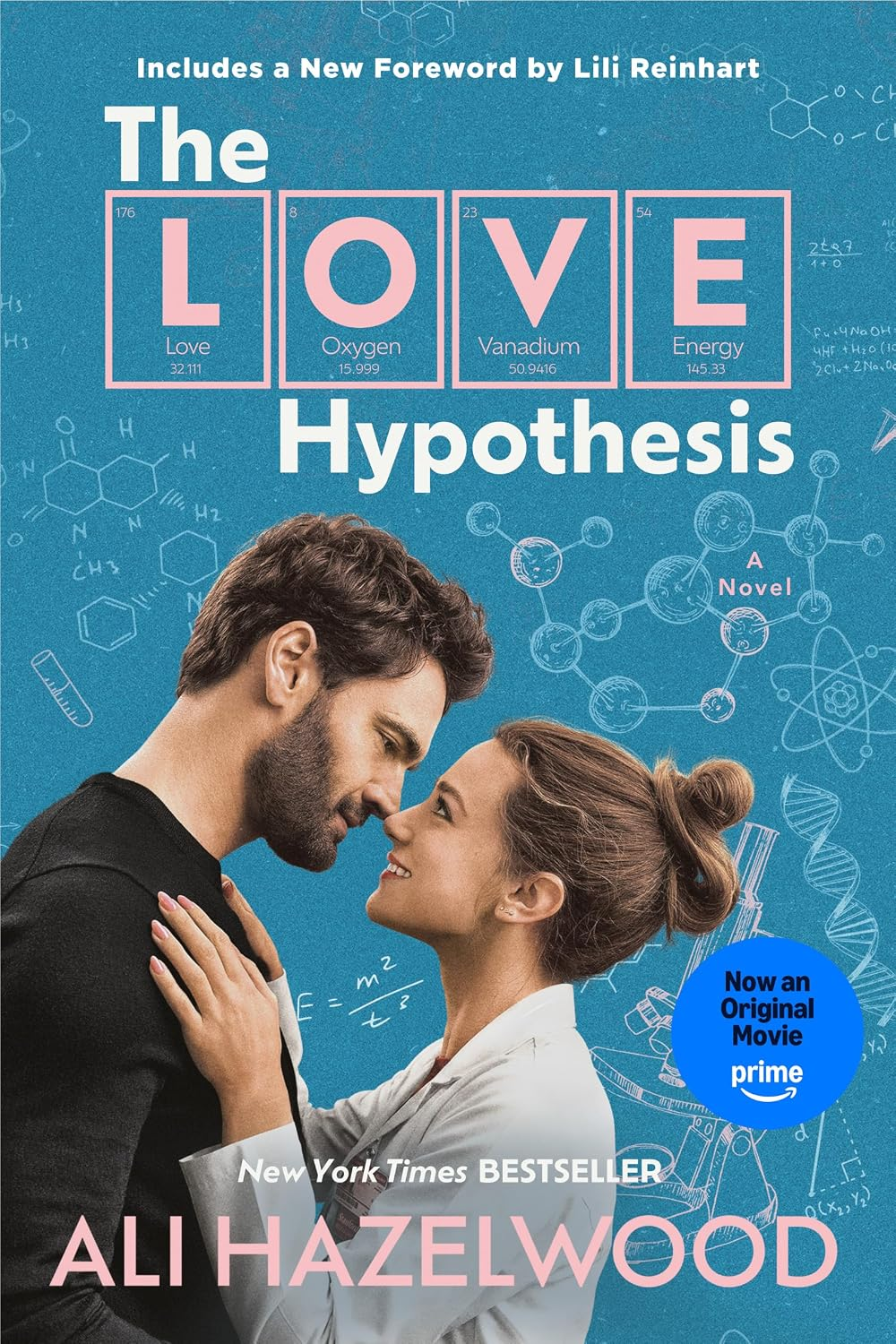
The Love Hypothesis is a contemporary romance novel by American author Ali Hazelwood, published by Berkley on September 14, 2021. It was Hazelwood’s debut full-length novel and became a major commercial success, reaching the New York Times bestseller list and gaining substantial attention through online reading communities, particularly BookTok.
Set primarily within the world of academic science, the novel follows Olive Smith, a third-year Ph.D. candidate in biology at Stanford University, and Dr. Adam Carlsen, a young and intimidating professor. When Olive impulsively kisses Adam to convince her best friend that she has moved on from a romantic situation, the two agree to pretend to be a couple. What begins as a calculated experiment gradually develops into a genuine romantic relationship.
The novel combines the fake-dating romance trope with an academic setting, workplace tensions, questions surrounding women in STEM, friendship, professional ambition, and the emotional uncertainty of early adulthood.
The book has also become notable for its unusual publishing history: the story originated as Star Wars fan fiction before Hazelwood transformed it into an original novel.
Bibliographic information
| Field | Details |
|---|---|
| Title | The Love Hypothesis |
| Author | Ali Hazelwood |
| Country | United States |
| Language | English |
| Genre | Contemporary romance |
| Setting | Stanford University and the academic scientific community |
| Publisher | Berkley |
| Publication date | September 14, 2021 |
| Original medium | Print and digital |
| Original ISBN | 978-0-593-33682-3 |
| Series/related works | STEM-focused romance novels by Ali Hazelwood |
| Main characters | Olive Smith, Adam Carlsen |
| Narrative perspective | Primarily Olive’s perspective |
| Adaptation | 2026 Prime Video film |
| Pre-publication origin | Star Wars fan fiction |
The original novel was published in September 2021. Later editions have included expanded material; the 2025 collector’s edition, for example, contains a bonus chapter from Adam’s perspective.
Author
Ali Hazelwood
Ali Hazelwood is a romance novelist and former academic researcher whose fiction frequently combines romantic relationships with scientific and academic environments.
Hazelwood was born in Italy and later lived in Germany and Japan before moving to the United States to pursue a Ph.D. in neuroscience. She worked as a professor for approximately three years before leaving academia in 2022 to write full time.
Her professional background has become an important part of her literary identity. Rather than treating science merely as decorative scenery, Hazelwood frequently places scientists, researchers, engineers, graduate students, and academics at the center of her stories.
Her official biography describes her as a writer of contemporary romantic comedies involving women in STEM and academia.
Selected works by Ali Hazelwood
- The Love Hypothesis (2021)
- Under One Roof (2022)
- Stuck with You (2022)
- Below Zero (2022)
- Love on the Brain (2022)
- Loathe to Love You (2023)
- Love, Theoretically (2023)
- Check & Mate (2023)
- Bride (2024)
- Not in Love (2024)
- Deep End (2025)
- Problematic Summer Romance (2025)
Her fiction has subsequently established a recognizable niche sometimes described as STEM romance, in which scientific or academic careers form an integral part of the romantic plot rather than serving merely as background.
Background and origins
One of the most interesting aspects of The Love Hypothesis is that it did not begin as a conventional original novel.
Hazelwood originally wrote the story as Star Wars fan fiction, focusing on the relationship popularly known as “Reylo”—the pairing of Rey and Kylo Ren. The fan-fiction version was published online under the title ** Head Over Feet **.
For the published novel, Hazelwood transformed the characters and removed the Star Wars elements. Rey and Kylo Ren became Olive Smith and Adam Carlsen, respectively. The published story consequently became an original contemporary romance rather than a work of fan fiction.
The transformation illustrates an increasingly visible path in modern publishing: stories developed within online fan communities can sometimes evolve into commercially published original fiction.
Hazelwood has subsequently spoken publicly about her fan-fiction background and its influence on her writing.
Plot
Spoiler warning: The following section reveals major plot developments.
Olive Smith
Olive Smith is a third-year Ph.D. candidate in biology at Stanford University.
She is intelligent, hardworking and deeply committed to her scientific career, but she is considerably less confident when it comes to romantic relationships. Her best friend Anh Pham is interested in Olive’s former romantic interest, Jeremy.
Olive wants Anh to believe that she has genuinely moved on and is no longer interested in Jeremy.
The problem is that Olive has no actual boyfriend.
The accidental kiss
In a moment of panic, Olive kisses the first man she encounters.
Unfortunately—or perhaps eventually fortunately—the man is Dr. Adam Carlsen, a highly respected but intimidating professor.
Adam has a reputation for being severe, demanding and difficult to work with. Students fear him, and Olive initially assumes that she has made an enormous mistake.
Instead, Adam unexpectedly agrees to help Olive maintain the illusion that they are dating.
The two establish a fake relationship.
Their arrangement is supposedly practical and temporary.
Neither expects it to become emotionally complicated.
The fake relationship
The fake-dating arrangement gives Olive and Adam opportunities to spend increasing amounts of time together.
At first, their interactions are characterized by awkwardness, sarcasm and uncertainty.
Olive gradually discovers that Adam’s intimidating public reputation does not fully correspond to his private personality.
The apparent “grump” begins to reveal himself as protective, considerate and emotionally vulnerable.
Adam, meanwhile, becomes increasingly interested in Olive.
The relationship therefore follows a familiar romance structure:
pretend relationship → growing familiarity → emotional intimacy → attraction → conflict → revelation → genuine relationship
The scientific setting gives the conventional romance formula a distinctive environment.
Major characters
Olive Smith
Olive is the protagonist and narrator.
She is a biology Ph.D. candidate whose professional ambitions are important to her identity. Her scientific mindset also influences the way she approaches relationships.
Olive frequently attempts to rationalize emotional situations, creating one of the novel’s central comic tensions: she wants evidence for something that cannot easily be proved scientifically—love.
Dr. Adam Carlsen
Adam is a young Stanford professor and a highly accomplished scientist.
He initially appears cold, arrogant and intimidating. His reputation among students and colleagues contributes to Olive’s nervousness around him.
As the story progresses, however, Olive discovers a more compassionate side of his personality.
His character follows the familiar grumpy/sunshine romance dynamic, with Adam representing the outwardly severe character and Olive providing the more openly awkward and emotionally expressive counterpart.
Anh Pham
Anh Pham is Olive’s best friend.
She plays an important role in initiating the central deception because Olive begins fake-dating Adam largely to convince Anh that she has moved on.
Anh also represents the importance of friendship within the novel. The story does not treat romance as Olive’s only meaningful relationship.
Malcolm
Malcolm is Olive’s roommate and friend.
He provides comic relief and contributes to the broader social world surrounding Olive and Adam.
Dr. Holden Rodriguez
Holden Rodriguez is one of Adam’s friends and colleagues.
His relationship with Adam provides another perspective on Adam’s personality, while his interactions with Malcolm contribute a secondary romantic storyline.
Dr. Tom Benton
Tom Benton is a senior academic whose role becomes increasingly important as the story develops.
His behavior toward Olive introduces a darker dimension to the novel, particularly concerning professional power, harassment and the vulnerability of junior researchers within academic institutions.
Relationship structure
At the heart of the novel is the contrast between a relationship that is supposed to be artificial and feelings that become increasingly genuine.
The relationship progression
Olive needs a fake boyfriend
          │
          ▼
       Adam agrees
          │
          ▼
    Fake relationship
          │
          ▼
Increasing time together
          │
          ▼
Emotional familiarity
          │
          ▼
Physical attraction
          │
          ▼
Emotional vulnerability
          │
          ▼
Professional conflict
          │
          ▼
Truth and reconciliation
          │
          ▼
     Genuine love
This structure is one of the reasons the novel fits comfortably within the conventions of contemporary romantic comedy while still providing room for professional and emotional conflict.
Themes
Love versus rationality
The title itself establishes the novel’s central metaphor.
Olive is a scientist. She is trained to form hypotheses, gather evidence and draw conclusions.
Love, however, does not operate according to the same rules.
The novel repeatedly plays with the contrast between:
scientific certainty and emotional uncertainty.
Olive attempts to analyze her feelings almost as if they were an experiment. The story gradually demonstrates the limitations of that approach.
Women in STEM
The scientific workplace is more than a backdrop.
Olive’s experiences highlight several issues that women can encounter in academic and scientific environments, including:
- professional insecurity;
- gender expectations;
- competition for research opportunities;
- unequal power relationships;
- sexual harassment;
- concerns about professional reputation;
- the pressure placed on early-career researchers.
The academic environment therefore allows Hazelwood to combine romance with a recognizable professional setting.
Library Journal specifically praised the novel’s use of its Stanford STEM environment and its depiction of obstacles encountered by Ph.D. students, particularly women in science.
Friendship
Although the central relationship is romantic, friendship drives much of the plot.
Olive’s decision to fake-date Adam originates in her desire to protect Anh’s feelings.
This makes friendship an active narrative force rather than merely a supporting element.
Vulnerability beneath appearances
Adam’s character is built around the difference between reputation and reality.
Other people see him as intimidating and difficult.
Olive gradually discovers that the person behind that reputation is considerably more complicated.
The novel therefore asks readers to consider how incomplete impressions can shape relationships.
Academic pressure
Graduate education is presented as a demanding environment in which personal and professional lives are difficult to separate.
Olive’s career is important to her future, and threats to her research therefore carry consequences beyond ordinary workplace disagreements.
The novel uses romance to make the pressures of academic life accessible to readers who may never have experienced graduate research themselves.
Literary style
Hazelwood’s writing combines several conventions associated with contemporary romantic comedy:
- first-person intimacy;
- fast dialogue;
- awkward humor;
- sexual tension;
- internal monologue;
- workplace conflict;
- emotional misunderstandings;
- familiar romance tropes.
The novel’s tone alternates between comedy and more serious discussions of power, professional misconduct and personal vulnerability.
Publishers Weekly described the book as a charming and offbeat romantic comedy and highlighted its characterization, prose and use of the academic setting.
Romance tropes
One reason for the book’s popularity is its deliberate use of recognizable romance conventions.
| Romance trope | Role in the novel |
|---|---|
| Fake dating | Central premise |
| Grumpy/sunshine | Adam and Olive’s contrasting personalities |
| Opposites attract | Their personalities and emotional approaches differ |
| Slow burn | Attraction develops gradually |
| Workplace romance | Their professional environment creates complications |
| Forced proximity | The fake relationship requires repeated interaction |
| Only one bed | Used as part of the romance-comedy tradition |
| Found family/friendship | Supporting relationships broaden the story |
| STEM romance | Scientific careers are central to the setting |
The novel does not reinvent every romance trope it uses. Instead, its distinctiveness comes largely from combining familiar tropes with an academic-science environment and Hazelwood’s comedic voice.
The “science” of the romance
One of the novel’s cleverest structural ideas is the repeated use of scientific language to describe emotional experiences.
Narrative metaphor
| Scientific concept | Romantic counterpart |
|---|---|
| Hypothesis | Olive’s assumptions about love |
| Evidence | Adam’s actions |
| Experiment | Fake dating |
| Observation | Getting to know each other |
| Unexpected result | Genuine attraction |
| Variable | Emotional circumstances |
| Conclusion | Acceptance of love |
This is more than a decorative gimmick.
Olive’s scientific worldview is part of her character, so the scientific terminology becomes a way of showing how she attempts to understand something fundamentally emotional.
Infographic: The central formula
          THE LOVE HYPOTHESIS

             SCIENCE
                │
                ▼
        "We need evidence."
                │
                ▼
          FAKE DATING
                │
                ▼
        MORE TIME TOGETHER
                │
                ▼
          REAL ATTRACTION
                │
                ▼
          EMOTIONAL RISK
                │
                ▼
             LOVE
Core idea: A relationship that begins as a deliberately constructed experiment becomes something neither character can completely control.
Reception
The Love Hypothesis received substantial attention from readers and professional reviewers.
Library Journal gave the novel a starred review, praising its dialogue, supporting characters and academic STEM setting. Publishers Weekly also gave it a positive review, describing it as a smart contemporary romance.
Kirkus Reviews offered a more mixed assessment, while other publications including Shelf Awareness were positive about the novel’s combination of romance, humor and science.
The novel became a New York Times bestseller and was also nominated for the 2021 Goodreads Choice Award for Readers’ Favorite Romance.
Reader reception
Goodreads provides a useful snapshot of the novel’s continuing reader engagement.
As of October 2026, the Goodreads listing showed approximately 2.17 million ratings and a rating of about 4.09 out of 5, although such figures naturally change over time.
Goodreads rating distribution
Based on the displayed Goodreads percentages:
5 stars  ████████████████████  40%
4 stars  ██████████████████    36%
3 stars  ████████              17%
2 stars  ██                     4%
1 star   █                      1%
The remaining percentage is attributable to rounding.
This distribution indicates that the overwhelming majority of displayed ratings are concentrated in the four- and five-star categories, although Goodreads ratings represent reader responses rather than a formal literary evaluation.
Why the novel became a major romance title
Several factors contributed to the book’s visibility.
1. A highly recognizable trope
Fake dating is one of contemporary romance’s most recognizable premises.
The Love Hypothesis gives that premise a particularly clear motivation: Olive needs to convince her best friend that she has moved on.
2. The STEM setting
The scientific environment distinguishes the novel from many conventional workplace romances.
3. Social-media readership
The book became particularly visible through online reading communities, including BookTok.
4. Fan-fiction origins
Its transformation from Star Wars fan fiction into a traditionally published bestseller added another layer to its cultural story.
5. Accessible academic setting
Readers do not need scientific expertise to understand the emotional conflicts, while the research environment provides a distinctive backdrop.
Criticism and discussion
The novel’s popularity has not prevented debate about some of its elements.
Some readers have questioned the realism of aspects of the academic environment, particularly the relationship between a graduate student and a professor and the professional power imbalance involved.
Others have pointed to the heightened physical descriptions and romantic conventions as intentionally escapist rather than realistic portrayals of academic life.
The novel also relies heavily on established romance tropes. For some readers, this is part of its appeal; for others, the predictability of certain developments can make the story feel formulaic.
These differing responses illustrate an important distinction between romantic realism and romantic fantasy. The Love Hypothesis is fundamentally a romantic comedy and therefore deliberately exaggerates some elements of attraction, coincidence and emotional timing.
Fan-fiction to bestseller: a publishing case study
The history of The Love Hypothesis can be represented as a simple publishing timeline:
2018
│
├── "Head Over Feet"
│   Star Wars fan fiction
│
▼
Manuscript development
│
▼
Characters transformed
Rey → Olive Smith
Kylo Ren → Adam Carlsen
│
▼
2021
│
├── Berkley publication
├── New York Times bestseller
└── Goodreads Choice Award nomination
│
▼
2025–2026
│
├── Collector and movie-related editions
└── Film adaptation
The journey is particularly notable because fan fiction is often regarded as an informal or community-driven literary form, whereas The Love Hypothesis demonstrates how such writing can become the foundation for commercially successful original fiction.
Film adaptation
A film adaptation of The Love Hypothesis was released in 2026.
The adaptation stars Lili Reinhart as Olive Smith and Tom Bateman as Adam Carlsen and was directed by Claire Scanlon. The film premiered on Prime Video in September 2026.
The adaptation brought the novel’s fan-fiction origins back into the public conversation because of the story’s connection to the Star Wars fandom.
The film also differs from the novel in certain plot details and character arrangements. Such changes are typical of literary adaptations, where scenes and supporting characters may be altered to suit a different medium.
2026 collector and movie editions
The novel has continued to receive new editions.
Penguin Random House’s 2025 collector’s edition contains redesigned artwork, decorative elements and a new bonus chapter told from Adam’s perspective.
The 2026 movie-related editions include additional material associated with the film adaptation, including a foreword by Lili Reinhart and bonus chapters from Adam’s perspective.
These editions demonstrate how the book’s publication history has expanded beyond the original 2021 edition.
Sequel
In September 2026, Hazelwood announced a sequel titled The Two-Body Problem, scheduled for publication on February 2, 2027.
The sequel returns to Olive and Adam and explores their relationship as their professional lives develop beyond the events of the original novel.
The title continues Hazelwood’s practice of using scientific terminology as a metaphor for romantic relationships.
Cultural significance
The Love Hypothesis occupies an interesting position in contemporary popular fiction.
It combines several cultural trends:
- the continuing popularity of contemporary romance;
- the growing visibility of women-centered STEM fiction;
- the influence of online reading communities;
- the increasing movement of fan fiction into mainstream publishing;
- the popularity of workplace romance;
- the growth of BookTok as a book-discovery platform;
- the adaptation of romance novels into streaming films.
Its most distinctive contribution is arguably the way it places a recognizable romantic-comedy structure inside a world of laboratories, Ph.D. programs, research grants and academic competition.
The novel’s popularity also helped establish Ali Hazelwood as one of the prominent contemporary writers associated with STEM-centered romance.
What makes the book distinctive?
A useful way to understand The Love Hypothesis is to separate its story mechanics from its setting.
Conventional
- fake dating;
- opposites attract;
- grumpy hero;
- romantic misunderstanding;
- emotional vulnerability;
- happy ending.
Distinctive
- Ph.D. research environment;
- women in STEM;
- academic politics;
- scientist protagonist;
- science-based humor;
- fan-fiction-to-publishing history.
             THE LOVE HYPOTHESIS
                     │
        ┌────────────┴────────────┐
        │                         │
   ROMANCE GENRE              STEM WORLD
        │                         │
  Fake dating                Ph.D. research
  Slow burn                  Laboratory
  Grumpy hero                Academia
  Happy ending               Women in science
        │                         │
        └────────────┬────────────┘
                     │
                     ▼
             CONTEMPORARY
              STEM ROMANCE
Legacy
Since its publication, The Love Hypothesis has become one of the most recognizable contemporary romance novels associated with the modern STEM-romance trend.
Its influence is visible not necessarily through a single literary movement, but through the growing popularity of romances featuring scientists, engineers, academics and other highly specialized professionals.
Its unusual origin story is equally significant. A story that began as online fan fiction was transformed into an original commercial novel and subsequently became a bestseller and a feature-film adaptation.
That trajectory has made The Love Hypothesis an interesting example of the increasingly fluid boundary between online fandom, commercial publishing and mainstream popular culture.
Adaptations and related media
| Year | Format | Development |
|---|---|---|
| 2018 | Fan fiction | Original Head Over Feet story |
| 2021 | Novel | The Love Hypothesis published by Berkley |
| 2021 onward | Audiobook | Commercial audiobook editions released |
| 2025 | Collector’s edition | Expanded edition with bonus material |
| 2026 | Film | Prime Video adaptation |
| 2026 | Movie tie-in editions | New editions connected with the film |
| 2027 | Sequel | The Two-Body Problem scheduled |
Awards and recognition
Goodreads Choice Awards
The Love Hypothesis was nominated for the 2021 Goodreads Choice Award for Readers’ Favorite Romance.
Bestseller status
The book became a New York Times bestseller, helping establish Hazelwood as a major commercial romance author.
Critical recognition
The book received:
- a starred review from Library Journal;
- positive reviews from Publishers Weekly;
- positive attention from Shelf Awareness;
- a more mixed assessment from Kirkus Reviews.
Reception at a glance
| Area | Description |
|---|---|
| Commercial reception | New York Times bestseller |
| Reader reception | Strong Goodreads response |
| Romance appeal | Fake-dating and slow-burn romance |
| Academic setting | Stanford STEM environment |
| Representation | Women in science and graduate academia |
| Online popularity | Strong BookTok/fandom presence |
| Publishing history | Adapted from fan fiction |
| Screen adaptation | 2026 Prime Video film |
Frequently asked questions
What is The Love Hypothesis about?
It follows Olive Smith, a biology Ph.D. candidate who enters a fake relationship with Stanford professor Adam Carlsen. Their pretend romance gradually becomes genuine.
Is The Love Hypothesis a romance novel?
Yes. It is primarily a contemporary romance with strong romantic-comedy elements.
Who wrote The Love Hypothesis?
The novel was written by Ali Hazelwood, a former neuroscience academic and professor who became a full-time writer in 2022.
When was The Love Hypothesis published?
The original edition was published by Berkley on September 14, 2021.
Is the story based on Star Wars?
The published novel is not a Star Wars story. However, its original form was Star Wars fan fiction involving Rey and Kylo Ren. Hazelwood subsequently transformed the story into an original romance.
Is Adam Carlsen based on Kylo Ren?
The original fan-fiction version featured Kylo Ren. The published character Adam Carlsen is an original character after the Star Wars elements were removed.
What does “STEM romance” mean?
STEM romance generally refers to romance fiction in which science, technology, engineering or mathematics forms a significant part of the characters’ professional or educational lives.
Is there a movie?
Yes. A film adaptation starring Lili Reinhart and Tom Bateman was released on Prime Video in September 2026.
Is there a sequel?
Yes. Ali Hazelwood has announced The Two-Body Problem, scheduled for publication on February 2, 2027.
See also
- Ali Hazelwood
- Contemporary romance
- Romantic comedy
- Romance novel
- Fan fiction
- STEM
- Women in STEM
- Academic fiction
- BookTok
- Star Wars fandom
References
- Penguin Random House. The Love Hypothesis by Ali Hazelwood — bibliographic information, description and author biography.
- Penguin Random House Library Marketing. The Love Hypothesis — publisher information and selected critical reception.
- Ali Hazelwood. Official author biography.
- Goodreads. The Love Hypothesis — reader ratings, reviews and 2021 Goodreads Choice Award nomination.
- Library Journal review of The Love Hypothesis.
- Book Marks. Aggregated critical reviews of The Love Hypothesis.
- Entertainment Weekly. Coverage of the novel’s fan-fiction origins and 2026 film adaptation.
- Friends of the Force. Interview with Ali Hazelwood concerning The Love Hypothesis, fan fiction and the novel’s development.
- Associated Press. Apple Books bestseller list, September 29, 2026.
- Penguin Random House. The Love Hypothesis (Prime Tie-In) and related editions.
Further reading
For readers interested in the novel’s development and context, useful areas of further reading include:
- Ali Hazelwood’s official author biography and bibliography.
- Publisher information and editions from Penguin Random House.
- Library Journal’s contemporary review of the novel.
- Goodreads reader reception and award information.
- Interviews with Hazelwood concerning her transition from fan fiction to commercial publishing.
- Articles examining the growth of STEM-centered romance fiction.
Editorial note
The Love Hypothesis is ultimately a deliberately entertaining romance rather than a realistic manual for academic relationships. Its scientific language, graduate-school setting and research culture give a familiar romantic-comedy formula its personality.
The book’s most interesting story may therefore exist on two levels. Inside the novel, Olive attempts to treat love like a scientific hypothesis. Outside the novel, Hazelwood’s own journey—from neuroscience researcher and fan-fiction writer to bestselling novelist and screen-adapted author—became an unlikely experiment in what contemporary romance could look like.
And that is perhaps the most fitting irony of the title: the story begins with Olive believing that love requires evidence, while the novel itself asks the reader to accept that some things become meaningful precisely because they cannot be reduced to an experiment.