
How to Grow Your Business to Million Dollar: 10 Steps Guide
How to Grow Your Business to a Million Dollar. Growing a business into a million-dollar enterprise is not simply about increasing sales, hiring more employees or opening additional locations. It requires building a commercially sustainable system that can consistently attract customers, deliver valuable products or services, generate revenue, maintain healthy margins and operate without depending entirely on the founder. The transition from a small business to a million-dollar business involves fundamental changes in strategy, leadership, financial management, customer acquisition and operational capability.
A million-dollar business can be built through different paths. A professional service company may grow through specialised expertise and recurring contracts. A product business may expand through distribution networks, e-commerce and repeat purchases. A software company may scale through subscriptions, while a local business may expand through additional locations, licensing or franchising. The right growth strategy depends on the industry, market size, available resources and the economics of the business.
This guide presents ten practical steps to help entrepreneurs move from an established small business towards $1 million in annual revenue. It explains how to define a financial target, identify scalable opportunities, strengthen the business model, increase customer acquisition, improve pricing, build systems, hire effectively, manage cash flow and expand without losing control of profitability.
The objective is not to promise that every business can reach this milestone. Instead, the guide provides a structured framework for determining whether the target is achievable and what operational and financial changes may be required to pursue it.
In This Guide: Explore All 10 Steps
- Define your million-dollar target
- Build a scalable business model
- Choose a profitable market and niche
- Develop an irresistible offer
- Build a predictable customer acquisition system
- Increase revenue and customer value
- Create systems and automate operations
- Build a team and develop leadership
- Manage cash flow and reinvest strategically
- Scale, expand and build a sustainable enterprise
- Interactive million-dollar calculators
- Practical growth principles
- Frequently asked questions
Define Your Million-Dollar Business Target
Convert an ambitious financial goal into measurable numbersStart with the destination. A specific revenue target makes it possible to calculate the customers, transactions, pricing, capacity and financial resources required to achieve it.
The first step towards building a million-dollar business is to define precisely what you want the business to become. Many entrepreneurs say they want to grow their company, increase income or become financially successful. These ambitions are understandable, but they are not sufficiently specific to guide operational decisions.
Establish a measurable financial objective. If your goal is $1 million in annual revenue, determine whether you want to reach that figure within three years, five years or another realistic period. Also decide whether you are targeting total revenue, recurring revenue, gross profit or net profit. These are different financial measures and require different strategies.
Break the annual revenue target into smaller numbers. A business generating $1 million annually needs approximately $83,333 in average monthly revenue. That translates into approximately $19,231 per week or $2,740 per day, using a 365-day year.
Next, determine the sales volume required. A business selling a $100 product needs 10,000 annual transactions to generate $1 million in revenue. A consulting company charging $10,000 per contract needs 100 contracts. A software company charging $100 per month needs approximately 834 continuously paying customers to generate an annualised revenue run rate of $1 million, assuming no cancellations or other adjustments.
Sell a relatively affordable product or service to a large number of customers. Requires efficient acquisition and delivery.
Generate substantial revenue from fewer customers through premium products, specialised services or large contracts.
Generate predictable income through subscriptions, retainers, memberships or ongoing service contracts.
Combine product sales, subscriptions, consulting, maintenance or additional services to increase customer value.
Do not focus exclusively on revenue. A business generating $1 million in annual sales with a 3% net profit margin produces only $30,000 in net profit before considering how that profit is distributed. Another company generating $700,000 with a 20% net margin may produce substantially more profit.
Therefore, define at least three targets:
- Revenue target: The annual sales figure you intend to achieve.
- Profitability target: The gross, contribution and net profit margins you want to maintain.
- Operational target: The customer volume, team size, delivery capacity and systems needed to support growth.
Create a revenue roadmap with annual milestones. For example, your first milestone might be $100,000 in annual revenue, followed by $250,000, $500,000 and finally $1 million. These are planning milestones, not guaranteed stages or universal benchmarks.
Finally, assess your current position. Record current revenue, average transaction value, monthly customers, repeat purchase rate, operating costs, available working capital and delivery capacity. The difference between your present position and your target defines the actual growth challenge.
Build a Scalable Business Model
Move beyond a business that grows only when you work moreBuild for repeatability. A scalable business increases revenue without requiring an equal increase in the founder’s personal time, effort or operating costs.
A business can generate good income without being scalable. For example, an independent consultant may earn substantial fees but can serve only a limited number of clients personally. Increasing revenue may require working longer hours, which eventually creates a capacity ceiling.
A scalable business model is designed to increase output while controlling the growth of costs and complexity. It does not necessarily mean that costs remain constant. It means that revenue and productive capacity can grow more efficiently than the resources required to support them.
Examine how your business currently generates revenue. Identify which activities depend directly on the founder, which require repetitive manual work and which can be standardised, delegated, automated or delivered through technology.
- Subscription businesses: Charge customers recurring fees for software, content, products or continuing services.
- Product businesses: Manufacture, source or distribute products that can be sold repeatedly through multiple channels.
- Digital products: Sell courses, templates, downloadable resources, software or online tools.
- Licensing models: Allow other businesses to use intellectual property, technology, systems or branded products under agreed terms.
- Franchise models: Expand through independent operators using a documented business format, brand and operating system.
- Platform businesses: Connect different groups of users and create value through interactions, transactions or network effects.
- Productised services: Convert custom professional work into clearly defined packages with standard pricing and delivery procedures.
For an existing business, you do not necessarily need to change industries. You may be able to redesign the existing model. A one-time service could become a monthly maintenance contract. A physical product could be offered through recurring replenishment. A consultant could develop standardised packages and train a delivery team. A local business could introduce additional distribution channels.
Consider the economics of each model. A subscription business needs strong customer retention. A product company needs effective inventory and distribution management. A marketplace needs enough buyers and sellers. A franchise requires standardised processes, brand consistency and franchisee support. Every model has its own scaling constraints.
- Can the business serve twice as many customers without doubling every operating expense?
- Can delivery be standardised without reducing quality?
- Can revenue be generated repeatedly from existing customers?
- Can other employees deliver the service without the founder performing every task?
- Can the product or service be sold through additional distribution channels?
- Can technology reduce repetitive work and administrative costs?
Choose one scalable improvement rather than attempting to redesign the entire company simultaneously. Test the change with a small customer group, calculate its economics and evaluate whether it improves the business.
Choose a Profitable Market and a Focused Niche
Compete where customer demand and business economics are attractiveFocus creates an advantage. A well-defined niche helps you understand customer needs, build a specialised offer and compete on value rather than relying entirely on price.
Not every market offers the same growth potential. Some markets have large customer populations but intense competition and weak margins. Others have fewer customers but greater purchasing power, repeat demand and a willingness to pay for specialised solutions.
To grow towards $1 million in annual revenue, you need a market large enough to support your target. The opportunity must also be accessible. A market can be enormous in theory but commercially unsuitable if you cannot reach its buyers, meet their requirements or compete effectively.
Start by examining the industry in which you currently operate or intend to enter. Understand its growth drivers, customer spending, purchasing patterns, major competitors, regulatory requirements and distribution structure.
- Customer demand: Is the problem important enough for customers to spend money solving it?
- Market size: Are there enough potential customers to support your revenue objective?
- Purchasing power: Can the target customers afford your product or service?
- Competition: Can you differentiate your offer from existing alternatives?
- Market accessibility: Can you reach customers through affordable and practical channels?
- Repeat demand: Do customers purchase repeatedly or require continuing services?
- Market stability: Is demand reasonably durable, or is it dependent on a short-lived trend?
Next, identify a focused niche. A niche is a specific segment within a broader market. For example, instead of targeting all small businesses, you might serve independent dental clinics. Instead of selling general business software, you might develop inventory management tools for small retailers.
A niche allows you to understand customer workflows more deeply. You can create better features, more relevant marketing messages, specialised customer support and stronger relationships. As your reputation grows, you may expand into adjacent customer segments.
Study your competitors carefully. Look for gaps in product quality, convenience, reliability, pricing, delivery speed, customer experience and after-sales support. A viable competitive advantage must be meaningful to buyers and economically sustainable for your company.
Avoid choosing a niche solely because it appears fashionable or because a competitor is making money in it. You need evidence that customers are purchasing, that you can reach them and that your own cost structure can support attractive margins.
Develop an Irresistible and Profitable Offer
Make the value of your product or service immediately understandableSell outcomes, not just features. Customers should understand what they receive, why it matters and why your offer is worth paying for.
Once you have selected your target market, develop an offer that gives customers a clear reason to choose your business. A product or service alone is not necessarily a compelling offer. Customers evaluate the outcome, price, convenience, reliability, trust, risk and experience associated with purchasing it.
Consider two businesses selling similar products. One simply lists product specifications and prices. The other explains the problem the product solves, provides demonstrations, offers transparent delivery terms and supplies dependable after-sales support. Even when the physical products are comparable, the second business may create a stronger overall value proposition.
Begin by identifying the primary result customers want. Your offer should connect the product or service directly to that result. Explain what is included, who it is designed for, what makes it different and what limitations apply.
- Clear outcome: State the specific problem solved or result delivered.
- Relevant features: Include the product or service elements that genuinely contribute to customer value.
- Credibility: Use demonstrations, evidence, specifications, qualifications and genuine customer feedback.
- Convenience: Make discovery, purchasing, payment and delivery straightforward.
- Appropriate pricing: Align the price with customer value and your delivery economics.
- Risk reduction: Provide clear support, warranty, replacement or refund terms where appropriate and legally permitted.
- Distinct positioning: Explain why customers should choose your offer over available alternatives.
Consider introducing different packages. A basic offer can meet essential needs, a standard offer can provide additional value and a premium offer can serve customers requiring more extensive service or support. Package differentiation should be meaningful rather than merely adding unnecessary features.
Test your offer with actual customers. Measure enquiry rates, conversion rates, average transaction value, customer objections, refund rates and repeat purchases. If customers express interest but do not purchase, examine whether the offer is unclear, the price is unsuitable, the timing is wrong or trust is insufficient.
Do not automatically reduce prices to generate more sales. Discounting may increase transaction volume while reducing contribution margin. Instead, improve the perceived and actual value of the offer, reduce delivery costs or redesign the package.
Build a Predictable Customer Acquisition System
Develop a repeatable process for generating qualified leads and salesBuild a sales engine. A reliable customer acquisition system turns marketing activity into measurable enquiries, paying customers and repeat revenue.
One of the biggest barriers to business growth is inconsistent customer acquisition. Many small businesses depend on personal contacts, occasional referrals, walk-in customers or unpredictable social media activity. These channels can be useful, but they may not provide sufficient control over sales volume.
A million-dollar growth strategy requires a systematic way to attract, qualify, convert and retain customers. Your marketing activities should be measurable, repeatable and financially justified.
Begin by identifying where your customers search for solutions and how they make purchasing decisions. The acquisition strategy for a local restaurant will differ from that of a software company, manufacturing supplier or professional consulting firm.
- Search engine visibility: Publish useful content and optimise your website for the problems customers actively search for.
- Social media: Use relevant platforms to demonstrate expertise, products, customer outcomes and brand credibility.
- Paid advertising: Test targeted campaigns with defined budgets, conversion goals and customer acquisition limits.
- Direct sales: Contact carefully selected prospective customers through relevant business outreach.
- Partnerships: Develop relationships with complementary businesses, distributors, consultants or professional networks.
- Referral systems: Encourage satisfied customers to introduce other potential buyers.
- Email marketing: Build permission-based communication with prospects and existing customers.
- Marketplaces and distributors: Use established sales networks where they provide access to relevant buyers.
Create a sales funnel that tracks the customer’s journey:
Potential customers discover your business through marketing, referrals or direct outreach.
Prospects explore your offer, visit your website or request further information.
Customers compare prices, alternatives, credibility and expected value.
Qualified prospects become paying customers through a clear purchase process.
Measure the performance of each channel. Record how much you spend, how many qualified leads are generated, how many customers purchase and how much revenue those customers produce. Calculate customer acquisition cost rather than judging campaigns only by impressions, clicks or follower counts.
For example, if you spend $2,000 on marketing and acquire 40 new paying customers, your customer acquisition cost is $50. Whether this is attractive depends on contribution margin, customer retention, purchase frequency and the time required to recover the acquisition expenditure.
Improve the sales process continuously. Respond to enquiries promptly, provide clear proposals, follow up professionally and make purchasing easy. Use customer relationship management software when lead volume becomes difficult to manage manually.
Increase Revenue and Customer Lifetime Value
Generate more value from each customer relationshipIncrease customer value. Revenue growth can come from more customers, larger transactions, higher purchase frequency and stronger retention.
Acquiring new customers is only one way to increase revenue. Many businesses overlook substantial growth opportunities within their existing customer base. Customers who already trust your business may purchase additional products, upgrade to premium services, buy more frequently or introduce new buyers.
Instead of focusing only on increasing the number of customers, examine the total value generated by each customer relationship. Customer lifetime value, often abbreviated as CLV or LTV, estimates the economic value a customer generates over the duration of the relationship. It should be calculated using a consistent time period and an appropriate profit or contribution basis.
Expand the number of qualified prospects reached through effective sales and marketing channels.
Offer relevant bundles, complementary products, premium packages or larger order quantities.
Encourage appropriate repeat purchases through replenishment, maintenance or continuing services.
Deliver consistent quality, reliable support and a strong overall customer experience.
A fifth opportunity is to expand your product or service portfolio. Introduce related products that serve existing customers rather than entering unrelated markets simply to increase sales. Product extensions should be based on genuine demand and should not create excessive inventory or operational complexity.
Consider a business that currently generates $100 per transaction. If it serves 1,000 customers annually, revenue is $100,000. Increasing average transaction value to $125, while maintaining the same customer volume, would increase revenue to $125,000. If customers also make repeat purchases, the growth opportunity becomes larger.
However, additional revenue does not automatically mean additional profit. Bundles, discounts, loyalty programmes and free delivery can reduce margins. Evaluate the contribution generated by each initiative before implementation.
Develop a customer retention strategy. Maintain accurate customer records, understand purchasing intervals, communicate relevant updates, resolve complaints and make repeat ordering convenient. Subscription or membership models may be suitable when customers receive continuing value and the business can reliably deliver it.
Track customer retention, repeat purchase rate, average order value, purchase frequency, customer lifetime value and contribution margin. These indicators reveal whether the business is building valuable customer relationships or merely replacing customers who leave.
Create Systems, Processes and Automation
Build an organisation that operates consistently without constant founder interventionSystems create consistency. Documented workflows, automation and performance tracking allow a growing business to handle greater volume without depending on memory and improvisation.
As a business grows, informal management becomes increasingly difficult. Tasks that were manageable when the company had three customers a day may become serious bottlenecks when it handles hundreds of transactions.
Without systems, important activities remain dependent on the founder’s memory, personal involvement and individual employees. This creates operational risk. Customer enquiries may be missed, invoices may be delayed, inventory may become inaccurate and service quality may vary.
To grow sustainably, convert recurring activities into documented processes. A standard operating procedure, or SOP, explains how a task should be performed, who is responsible and what outcome is expected.
- Sales system: Lead capture, qualification, proposals, follow-ups and order confirmation.
- Marketing system: Content planning, campaign execution, lead tracking and performance analysis.
- Customer service system: Enquiry management, complaints, refunds, support and feedback.
- Finance system: Invoicing, expense recording, payment reconciliation, cash-flow forecasting and reporting.
- Operations system: Procurement, inventory, production, scheduling, delivery and quality checks.
- Human resource system: Recruitment, onboarding, performance reviews, training and payroll administration.
Technology can improve the efficiency of these processes. Accounting software can organise financial records. Customer relationship management systems can track sales pipelines. Inventory software can monitor stock levels. Scheduling systems can reduce administrative work. Automation tools can handle routine notifications, data transfers and follow-ups.
Artificial intelligence can also assist with research, customer support drafts, document processing, forecasting and content production. However, automation should be introduced with appropriate human review, privacy safeguards and quality controls.
Do not automate a broken process. First understand the workflow, remove unnecessary steps and establish a reliable procedure. Automating an inefficient process can simply make mistakes happen faster.
Establish a small set of operational performance indicators. These might include order processing time, delivery accuracy, complaint rate, inventory turnover, staff productivity, service completion time and customer satisfaction.
Review the systems regularly. As volume increases, processes may need to be redesigned. The objective is not to create bureaucracy but to make important work predictable, measurable and transferable.
Build a Strong Team and Develop Leadership
Replace founder dependency with organisational capabilityGrowth requires people. A million-dollar business cannot depend indefinitely on one person’s ability to perform every important activity.
In the early stages, founders often manage sales, customer service, purchasing, administration, marketing and operations themselves. This approach may be necessary when resources are limited, but it becomes a constraint when the business expands.
As customer volume increases, the founder’s time becomes increasingly valuable. If every important decision and task requires personal approval, the business cannot grow efficiently. Building a capable team allows the organisation to distribute responsibility and develop specialised expertise.
Do not hire simply because the company appears successful. Hire when there is a clearly identified workload, a defined role and sufficient financial capacity to support the additional employee.
Generate leads, manage prospects, convert enquiries and maintain customer relationships.
Manage procurement, production, inventory, service delivery and quality control.
Maintain records, monitor cash flow, manage invoices and coordinate compliance.
Set priorities, coordinate teams, resolve bottlenecks and monitor organisational performance.
Begin by documenting responsibilities. Every important function should have an accountable owner, even if one person handles several roles. Employees should understand their authority, expected outcomes and performance measures.
Recruit for both competence and reliability. Technical skills matter, but communication, problem-solving, accountability and willingness to learn are also important. A growing business needs people who can adapt as processes and customer requirements change.
Develop an onboarding programme. New employees should understand the business model, customers, products, operating procedures, service standards and reporting structure. Provide training rather than assuming that employees will automatically understand how your business operates.
As the organisation expands, shift from direct supervision to management through objectives and measurable results. Establish regular team meetings, performance reviews and clear reporting arrangements.
Leadership also means making difficult decisions. Address persistent performance problems, resolve conflicts, protect company culture and ensure that employees have the resources needed to perform their responsibilities.
Finally, build a succession and continuity plan for critical roles. No important customer relationship, supplier connection or operational process should depend entirely on one individual.
Manage Cash Flow and Reinvest Strategically
Protect the financial resources required to support growthRevenue alone cannot finance growth. A company needs sufficient cash to pay suppliers, employees, taxes and operating expenses while funding expansion.
Financial management becomes increasingly important as a business approaches substantial revenue. Higher sales often require larger inventory purchases, additional employees, more marketing expenditure, greater delivery capacity and longer customer payment cycles.
A business may report accounting profit while experiencing a cash shortage. For example, a company that delivers products to customers on 60-day credit terms may need to pay suppliers and employees long before customer payments arrive.
Understand the difference between revenue, profit and cash flow. Revenue measures sales earned. Profit measures the financial result after relevant expenses. Cash flow measures the actual movement of money into and out of the business.
- Maintain accurate accounts: Record sales, expenses, invoices, payments, taxes and financial obligations.
- Prepare cash-flow forecasts: Estimate expected receipts and payments over the coming months.
- Control receivables: Monitor overdue customer invoices and establish appropriate payment terms.
- Manage inventory: Avoid tying up excessive capital in slow-moving stock.
- Monitor margins: Track gross margin, contribution margin and operating profit.
- Control fixed costs: Review rent, salaries, subscriptions, financing costs and other recurring expenses.
- Maintain reserves: Hold an appropriate cash buffer based on operating risk and payment cycles.
- Separate personal and business finances: Maintain clear records of owner withdrawals, capital contributions and business transactions.
Reinvestment is an important part of business growth. Profits can be used to strengthen marketing, develop products, improve technology, purchase equipment, hire employees or expand distribution.
However, reinvestment should be based on evidence rather than excitement. If an advertising campaign produces customers at an attractive acquisition cost, increasing the budget may be justified. If a new machine increases production capacity and has a credible payback period, it may be worth purchasing.
Before making a major investment, estimate the expected return, payback period, cash requirements and downside risk. Model what happens if sales are lower than expected, costs increase or customer payments are delayed.
Also establish financial reporting routines. Review cash position weekly, operating performance monthly and strategic investments periodically. Use qualified accounting and tax professionals when the complexity of the business requires them.
Scale, Expand and Build a Sustainable Enterprise
Turn a successful operation into a resilient organisationScale what already works. Expansion should follow proven customer demand, positive unit economics, dependable operations and sufficient management capacity.
Reaching a million-dollar revenue milestone should not be the only measure of business success. The larger objective is to build an organisation that can sustain its performance, adapt to market changes and operate without constant dependence on the founder.
Scaling means increasing the business’s capacity to generate revenue while maintaining financial and operational control. Expansion may involve entering new markets, introducing additional products, increasing production, opening locations, developing partnerships or serving larger customers.
Do not expand simply because sales have increased for a few months. First establish that the business has consistent demand, positive contribution economics, reliable delivery processes and sufficient cash reserves.
- Geographic expansion: Enter additional cities, regions or countries where customer demand and operating economics justify the investment.
- Product expansion: Introduce complementary products or services for existing customers.
- Distribution expansion: Add distributors, retail partners, marketplaces or direct sales channels.
- Digital expansion: Use e-commerce, software, digital delivery and online services to reach new buyers.
- Strategic partnerships: Work with organisations that provide access to customers, technology, distribution or expertise.
- Franchising or licensing: Where appropriate, expand through a documented and legally structured business format.
- International expansion: Enter foreign markets after assessing regulations, localisation, taxation, logistics and competitive conditions.
Before entering a new market, conduct local customer research. Demand in one city does not automatically prove demand elsewhere. Customers may have different preferences, purchasing power, regulations, competitors and distribution requirements.
Establish clear expansion criteria. For example, you might require consistent positive contribution margins, stable customer retention, adequate management capacity and a defined cash reserve before opening another location.
Develop a dashboard that tracks the most important business indicators. These may include revenue growth, gross margin, operating profit, cash balance, customer acquisition cost, customer lifetime value, retention, employee productivity and delivery performance.
As the organisation grows, leadership must evolve. The founder should increasingly focus on strategic direction, capital allocation, leadership development, important partnerships and organisational performance rather than personally supervising every routine activity.
Build resilience by diversifying important customer relationships, suppliers and marketing channels. Protect intellectual property, maintain reliable financial records, manage legal and regulatory obligations and prepare for operational interruptions.
Remember that the ultimate objective is not simply to create a business that reaches $1 million in annual revenue once. It is to create a company that can generate sustainable revenue and profit over multiple years.
Million-Dollar Revenue Calculator
Find out how many customers, transactions or subscriptions your business needs to generate $1 million in annual revenue. Change the figures to explore different business models.
This is a simplified revenue-planning calculator. It assumes the average transaction value and purchase frequency remain constant. Contribution margin is not the same as net profit margin.
How Far Is Your Business from $1 Million?
Enter your current annual revenue and select a target period. The calculator estimates the compound annual growth rate required to reach the milestone.
The CAGR calculation shows the constant annual growth rate mathematically required to move between the two revenue figures. Actual growth is unlikely to occur at an identical rate every year.
Million-Dollar Business Readiness Assessment
Evaluate the current strength of your business across six important areas. Rate each factor honestly from 1 (very weak) to 5 (very strong).
This is a self-assessment worksheet, not a scientifically validated business valuation or investment-readiness test.
The Journey from $100K to $1 Million
There is no universal growth sequence. However, the following milestones illustrate how an entrepreneur can progressively develop a business from an early revenue base into a larger organisation.
Validate demand, establish product-market fit, acquire initial customers and understand unit economics.
Improve sales consistency, strengthen pricing, develop repeat business and document basic operations.
Expand customer acquisition, improve delivery capacity, delegate founder-dependent activities and strengthen financial controls.
Build management capability, optimise unit economics, expand channels and establish reliable organisational systems.
Practical Tips for Growing a Business to Million-Dollar Revenue
Following the ten steps provides a framework, but the quality of execution determines whether the business can grow sustainably. Apply these principles throughout the process.
Do not pursue revenue at any cost. Measure contribution margins and cash generation alongside sales.
Prove demand and operating economics before adding expensive infrastructure or entering new markets.
Where appropriate, develop subscriptions, retainers, maintenance agreements and repeat-purchase opportunities.
Use customer feedback, purchase behaviour and retention data to improve your offer.
Review revenue, margins, operating expenses, receivables and cash flow consistently.
Use appropriate software and automation to improve productivity and reduce repetitive work.
Build a team that can independently manage defined business functions and deliver measurable outcomes.
Maintain consistent quality, transparent communication and dependable after-sales support.
Avoid excessive dependence on one customer, supplier, employee or marketing platform.
Build systems, leadership and organisational knowledge that allow the company to operate without constant personal intervention.
Key Takeaways
- A million-dollar business should be defined through annual revenue, profitability and operational objectives.
- A scalable business model allows revenue to increase without a proportional increase in resources and complexity.
- Market selection and customer focus determine the size and quality of the growth opportunity.
- A compelling offer communicates customer outcomes, credibility, convenience and value.
- Predictable customer acquisition requires measurable marketing and sales processes.
- Customer lifetime value, repeat purchases and average order value can create important revenue opportunities.
- Documented systems and automation reduce operational dependency on the founder.
- A capable team and effective leadership are essential for organisational growth.
- Cash-flow management and disciplined reinvestment protect the company’s ability to expand.
- Sustainable scaling requires consistent demand, healthy unit economics and reliable delivery capacity.
Conclusion: Build a Million-Dollar Business, Not Just a Million-Dollar Sales Figure
Growing a business to $1 million in annual revenue is a substantial commercial objective. It requires more than ambition, a good product or an effective marketing campaign. The business must have a sufficiently large market, a compelling offer, a scalable revenue model, predictable customer acquisition and the operational capacity to deliver consistently.
The transition from a small business to a million-dollar enterprise also requires a change in the founder’s role. Initially, the entrepreneur may perform most of the work personally. As the business expands, success depends increasingly on systems, capable employees, management processes, financial discipline and strategic decision-making.
Follow the ten steps systematically. Define the financial target, redesign the business model where necessary, select the right market, improve the offer, establish customer acquisition channels, increase customer value, build systems, develop the team, protect cash flow and scale only when the business is ready.
Do not measure success by revenue alone. A strong business should generate sustainable profit, maintain sufficient working capital, deliver genuine customer value and remain resilient when market conditions change.
Your next action is straightforward: calculate the revenue gap between your current business and the $1 million target. Then identify the single biggest constraint preventing growth. Work on that constraint using measurable experiments rather than attempting to change everything simultaneously.
Frequently Asked Questions About Growing a Business to $1 Million
1. How do I grow my business to $1 million?
Start by defining the annual revenue target and calculating the required customers, transaction volume and average selling price. Develop a scalable business model, identify a suitable market, strengthen your offer, build predictable customer acquisition channels, improve retention, establish systems and manage cash flow. Expansion should be supported by proven demand and sustainable unit economics.
2. How much revenue does a million-dollar business generate monthly?
A business generating $1 million in annual revenue requires average monthly revenue of approximately $83,333. Actual monthly sales may vary due to seasonality, contracts, customer payment schedules and business cycles.
3. How many customers do I need to generate $1 million annually?
The number depends on average customer spending and purchase frequency. If each customer generates $1,000 annually, approximately 1,000 customers are required. If each customer generates $10,000 annually, approximately 100 customers are required.
4. Can a small business become a million-dollar business?
Yes. A small business can grow through improved customer acquisition, higher average transaction values, recurring revenue, additional distribution channels, product development and operational improvements. The opportunity depends on market demand, competitive conditions, capital requirements and execution.
5. How long does it take to build a million-dollar business?
There is no universal timeline. The duration depends on the industry, starting revenue, market size, business model, available capital, margins, customer acquisition and execution. Some businesses can reach the target relatively quickly, while others may require many years.
6. What type of business can generate $1 million annually?
Potential examples include software companies, specialised consulting firms, manufacturing businesses, e-commerce companies, professional services, distribution businesses, subscription platforms and product companies. No particular business model guarantees this revenue level.
7. Is $1 million in revenue the same as $1 million in profit?
No. Revenue is the income generated from sales. Profit is the amount remaining after relevant expenses are deducted. A company generating $1 million in revenue with a 10% net profit margin would generate approximately $100,000 in net profit, subject to the accounting basis and applicable taxes.
8. Can I grow my business without taking a loan?
Yes. Businesses may finance growth through retained earnings, customer advances, improved cash conversion, supplier arrangements, carefully managed working capital or equity investment. The suitable funding source depends on the business’s cash cycle and investment requirements.
9. What is the most important factor in scaling a business?
There is no single factor that determines success. However, a scalable business model combined with predictable customer acquisition, strong unit economics and reliable operations provides an important foundation for growth.
10. How can I increase business revenue without increasing costs significantly?
Potential approaches include improving customer retention, increasing average order value, selling complementary products, introducing recurring revenue, improving conversion rates, reducing operational waste and using automation. Each initiative should be evaluated against its actual contribution to profit.
11. When should I start hiring employees?
Hire when a recurring workload or business requirement justifies the role and the company can afford the associated employment costs. Define responsibilities, expected outcomes and reporting arrangements before recruiting.
12. Should I focus on marketing or operations first?
Both matter, but the priority depends on the current constraint. If the business lacks qualified leads, customer acquisition may need attention. If demand already exceeds delivery capacity, operational improvements should come first. Increasing marketing while operations are failing can damage customer trust.
13. What is customer lifetime value?
Customer lifetime value estimates the economic value generated by a customer over the duration of their relationship with a business. It helps evaluate retention, repeat purchases and customer acquisition economics. It should be compared with customer acquisition cost using consistent measurement periods and financial assumptions.
14. Can artificial intelligence help grow a business?
AI can support research, marketing, customer service, document processing, forecasting, software development and administrative automation. Its value depends on the quality of implementation, accuracy, human oversight, data protection and measurable productivity improvements.
15. What should I do after reaching $1 million in annual revenue?
Focus on sustainable profitability, cash generation, customer retention, management capability and operational resilience. Evaluate whether further expansion improves the company’s financial performance rather than pursuing higher revenue simply for its own sake.
Editorial note: This guide provides general business education and financial planning concepts. It does not constitute legal, accounting, tax, investment or professional financial advice. Financial examples are illustrative and should be adapted to the relevant business, industry and jurisdiction.
Clickerrr Guides — Practical knowledge. Clear steps. Better decisions.
More Guides from Clickerrr Guides
How to Manage Small Business Cash Flow: 10 Steps Guide
Cash flow is one of the most important aspects of running a successful small business. It represents the money moving into and out of your business during a particular period.
Read the Full Guide →
How to Start a Profitable E-Commerce Business: 10 Steps Guide
Starting an e-commerce business can be an attractive opportunity for entrepreneurs who want to sell products online and build a scalable business. With an online store, you can reach customers beyond your local area, showcase products around the clock, and manage sales through digital platforms.
Read the Full Guide →
How to Start a Service-Based Business
Follow practical steps to select a service, find your first clients, and build a sustainable business.
Read the Full Guide →
How to Write a Business Plan
Understand how to prepare a business plan, define your goals, and create a practical roadmap for your business.
Read the Full Guide →
How to Find a Profitable Business Niche
Getting your first 100 customers is one of the most important milestones when starting a new business. Whether you run an online business, a local shop, a service-based company, a freelance venture, or a startup, your first customers help you turn an idea into a real business.
Read the Full Guide →
How to Use AI to Grow a Small Business
Artificial intelligence (AI) is changing the way small businesses operate, market their products, serve customers, and compete in the digital marketplace.
Read the Full Guide →
How to Start an Online Business with No Experience
Starting an online business can be an exciting way to turn your skills, knowledge, interests, or business ideas into an income-generating opportunity. Unlike many traditional businesses, an online business can often be started from home with a computer, an internet connection, and a small initial investment.
Read the Full Guide →
How to Start a Small Business
Starting a small business can be an excellent way to turn your skills, knowledge, and ideas into a source of income. Whether you want to open a local shop, provide professional services, sell products online, or start a home-based business, the right approach can help you build a strong foundation. However, starting a business requires more than having a good idea.
Read the Full Guide →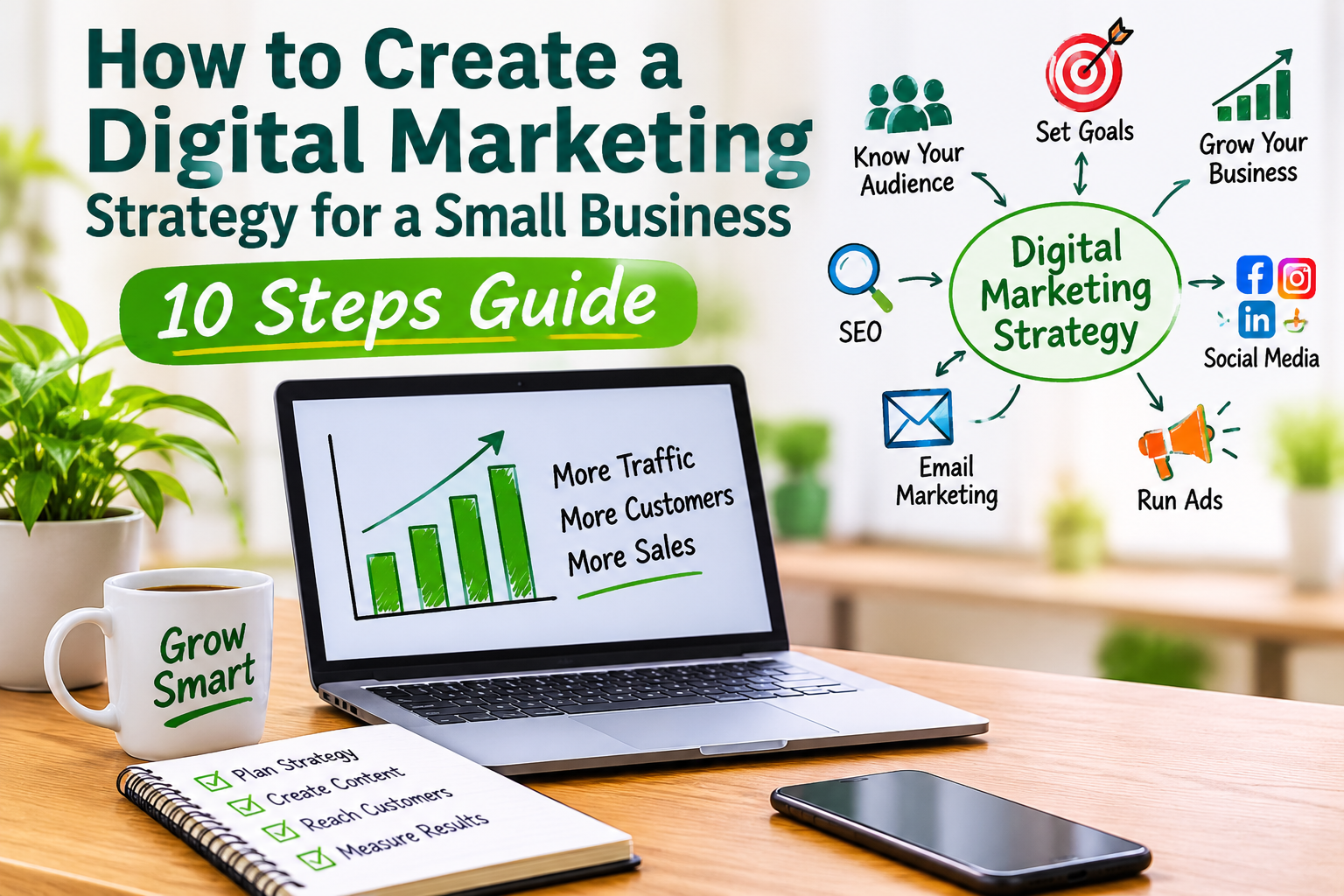
How to Create a Digital Marketing Strategy for a Small Business: 10 Steps Guide
A digital marketing strategy helps a small business attract potential customers, build brand awareness, generate enquiries, and increase sales through online channels.
Read the Full Guide →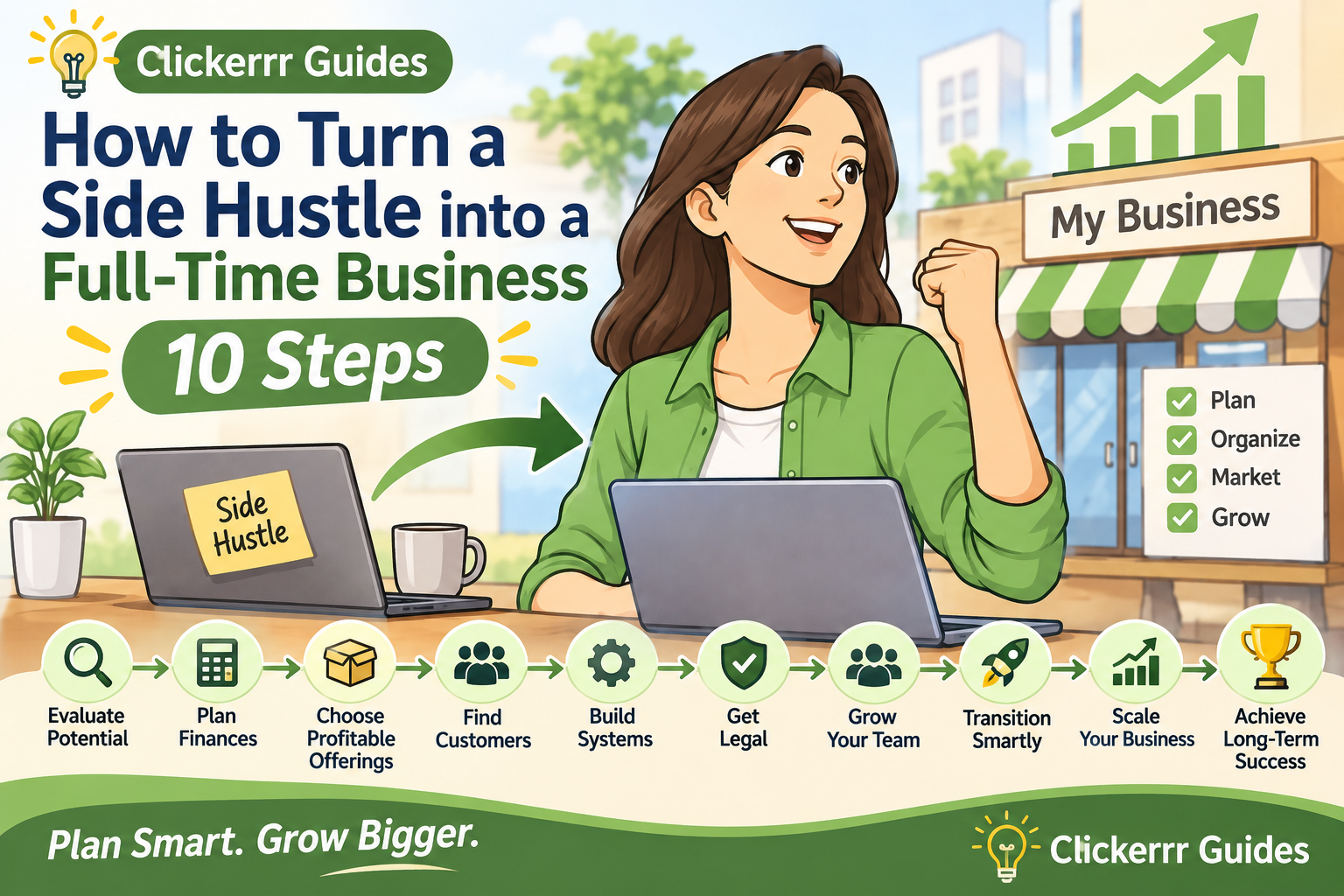
How to Turn a Side Hustle into a Full-Time Business: 10 Steps Guide
Turning a side hustle into a full-time business is an exciting opportunity to gain financial independence, build something of your own, and create a sustainable career. However, moving from a part-time activity to a full-time business requires more than simply increasing your working hours.
Read the Full Guide →
How to Grow a Small Business Faster: 10 Steps Guide
How to Grow a Small Business Faster: 10 Steps Guide? Growing a small business faster requires more than increasing sales or attracting new customers.
Read the Full Guide →
How to Start a Home-Based Business: 10 Steps Guide
Starting a home-based business is an attractive option for people who want to become entrepreneurs without investing heavily in commercial premises or maintaining a traditional office.
Read the Full Guide →