
What Is This Guide About?
Starting a profitable business is not simply about finding a product, opening a shop, creating a website or registering a company. It is about identifying a real customer problem, developing an offer people are willing to pay for, delivering that offer at a sustainable cost and building a repeatable system that generates more revenue than it consumes. A business can attract attention and still lose money. It can generate impressive sales and still struggle with cash flow. Profitability comes from the relationship between customer demand, pricing, operating costs, customer acquisition and consistent execution.
This practical guide explains how to start a profitable business from the ground up. It is designed for first-time founders, aspiring entrepreneurs, professionals exploring self-employment and small-business owners who want to turn an idea into a commercially viable operation. You will learn how to select a business opportunity, validate demand before investing, research competitors, define a customer, calculate startup costs, set prices, build a sales process, manage cash flow and improve profitability over time. The emphasis is on low-risk testing and evidence-based decisions rather than expensive launches or unrealistic income promises.
You do not need to begin with a large office, a big team or a complicated business plan. You do need a clear customer, a useful offer, basic financial discipline and the willingness to test assumptions. Work through the steps in sequence, complete the practical exercises and use the interactive tools to estimate whether your proposed business deserves further investment.
In This Guide: Jump to Any Step
- Choose a problem worth solving
- Research customers and market demand
- Select a business model and niche
- Validate the idea before investing
- Prepare a practical business plan
- Calculate startup costs and funding
- Set profitable prices and margins
- Build your product and operations
- Find customers and generate sales
- Track performance and scale carefully
- Interactive business calculators
- Practical tips and key takeaways
- Frequently asked questions
Choose a Real Customer Problem to Solve
Start with demand, not with a product you happen to likeThink like a problem solver. People pay for outcomes: saving time, reducing effort, avoiding risk, improving comfort, earning more or accessing something they cannot easily obtain elsewhere.
The first step in starting a profitable business is to identify a problem that a specific group of people experiences frequently and wants solved. Many beginners begin by asking, “What business should I start?” A more useful question is, “Which customer group has a problem that I can solve better, faster, more conveniently or at a more suitable price?” This shift matters because a business is sustained by customers purchasing a solution, not by the founder’s enthusiasm for an idea.
Look at your own surroundings. Observe households, local shops, offices, schools, clinics, independent professionals, online sellers and service providers. Notice repeated complaints, delays, unnecessary expenses, poor customer service, complicated processes and products that are difficult to access. A small inconvenience can become a viable opportunity when it affects enough people and customers are prepared to pay for a better solution. However, not every complaint represents a business opportunity. Some problems are irritating but not important enough for people to spend money on.
Make a list of problems rather than immediately writing down business names. For example, small retailers may struggle to maintain stock records; busy families may need reliable meal preparation; local businesses may find it difficult to create consistent product photographs; and independent professionals may need help organising appointments. Each problem suggests different possible offers. You could provide a service, sell a product, create a subscription, supply a business-to-business solution or develop a digital resource.
- Observe repeated difficulties: Look for problems that occur weekly or daily rather than once in a lifetime. Frequent problems can create repeat demand.
- Identify who experiences the problem: Avoid describing customers as “everyone.” Define a group by occupation, location, behaviour, budget, business size or a particular need.
- Understand the current workaround: Find out how people solve the problem today. Existing spending, manual effort or alternative services can indicate demand.
- Measure the consequence: Ask whether the problem causes lost time, lost money, inconvenience, stress, errors or missed opportunities.
- Check willingness to pay: A person saying an idea is interesting is not the same as a person agreeing to pay for it.
- Match the problem to your capabilities: Consider your skills, experience, access to suppliers, available time and ability to deliver reliably.
- Write a one-sentence problem statement: For example: “Independent retailers need a simple way to monitor stock without maintaining complicated spreadsheets.”
Do not confuse a fashionable trend with a durable customer need. A trending product may create short-term sales, but competition can quickly increase and reduce margins. A less glamorous service can be more dependable if customers need it repeatedly and existing providers perform poorly. Similarly, an idea that appears unique is not automatically attractive. If no one is searching for it, asking for it or paying for an alternative, you may need to educate the market at considerable expense.
At this stage, do not rent premises, purchase bulk inventory or spend heavily on branding. Your objective is to produce three to five problem statements that can be investigated. Keep the ideas specific and testable. “Start an online business” is too broad. “Help local home bakers receive and manage online orders” is a clearer starting point because it identifies a customer, a problem and a possible outcome.
Research Customers and Market Demand
Replace assumptions with evidence from real buyersResearch before spending. A market is not just a large population. It is the reachable group of buyers who have a need, can afford the offer and are willing to choose it.
Once you have selected a problem, investigate whether enough customers are willing and able to pay for a solution. Market research helps you understand customer priorities, buying behaviour, price sensitivity, competing offers and the size of the opportunity. It does not require an expensive research agency. A founder can learn a great deal through direct conversations, observation, competitor analysis and small experiments.
Begin with customer interviews. Speak to people who genuinely fit your intended customer profile. Ask about their recent experiences rather than asking them to predict what they might buy in the future. “When did this problem last happen?” is usually more informative than “Would you use my idea?” Ask what they did, how much it cost, what frustrated them and what would make them change providers. Avoid leading questions that encourage people to praise your idea.
Next, study competitors. Competitors include direct businesses offering a similar product and indirect alternatives that solve the same problem differently. If you plan to offer a bookkeeping service, your competition may include accountants, software subscriptions, spreadsheets and a family member who currently handles the records. Compare what each alternative provides, its price, turnaround time, service quality, customer reviews and limitations.
- Define your target market: Specify the customer type, geographic area, approximate budget, buying frequency and key need.
- Interview potential buyers: Aim for 10–20 useful conversations for an early small-business idea. This is a learning exercise, not a statistically representative survey.
- Ask behaviour-based questions: Ask what customers purchased recently, how they selected it and what they disliked about the experience.
- Study at least five competitors: Record their products, pricing, positioning, reviews, delivery methods and apparent strengths.
- Read customer reviews: Look for recurring complaints, missing features, service gaps and reasons customers recommend a provider.
- Estimate reachable demand: Count realistic potential buyers in the area or channel you can serve, not the entire national population.
- Check buying frequency: Determine whether customers purchase once, occasionally, seasonally or repeatedly.
- Identify barriers: Understand trust, delivery, quality, licensing, switching costs and payment concerns.
Separate the total market from your serviceable market. A product may have millions of potential users in theory, but your first business may be able to reach only a few hundred customers in one city or online community. Estimate your initial market from the bottom up: how many suitable prospects can you contact, how many may become paying customers and how often might they purchase? This is more useful than repeating a large industry valuation.
For digital businesses, use search suggestions, keyword research tools, online communities, marketplace listings and competitor websites to understand what people are looking for. Search volume can indicate interest, but it does not prove that visitors will buy. For local businesses, visit the area at different times, observe footfall, speak with nearby operators and assess parking, access, visibility and customer convenience.
Document what you learn. A simple spreadsheet can include customer type, problem, existing solution, current spending, desired outcome, objections and evidence of willingness to pay. If the research repeatedly contradicts your assumptions, change the offer or choose another problem. Do not defend an idea merely because you have already spent time thinking about it.
Select a Business Model and a Focused Niche
Decide how value will be delivered and how revenue will be earnedChoose a workable model. The business model explains who pays, what they pay for, how often they pay and what it costs you to deliver.
A business model describes how your company creates value for customers and captures part of that value as revenue. Two businesses can solve the same problem but operate very differently. One may sell a product directly to consumers; another may provide installation, maintenance or a monthly service. The right model depends on customer preferences, delivery complexity, capital requirements, repeat demand and your ability to earn a healthy contribution margin.
Common models include retail, wholesale, manufacturing, professional services, consulting, subscription services, digital products, online education, licensing, franchising, marketplace operations and business-to-business services. You do not need to select a fashionable model. Select the one that gives customers a convenient way to buy while allowing you to deliver consistently and retain sufficient revenue after direct costs.
For a first-time founder, a service business can be easier to test because it may require less inventory and fewer fixed assets. However, service businesses can depend heavily on the founder’s time and may be difficult to scale without documented processes or trained staff. Product businesses can potentially serve more customers without a proportional increase in labour, but they may require inventory, quality control, packaging, logistics and working capital. Digital products can have low reproduction costs, but customer acquisition, trust and differentiation remain challenging.
Now narrow your target market into a niche. A niche is a clearly defined segment with a specific need. “Marketing services” is broad. “Short-form product videos for independent food brands” is more focused. “Healthy food” is broad. “Convenient high-protein vegetarian lunch boxes for office workers in one locality” is more specific. A niche helps you understand the buyer, design a relevant offer and communicate a clear reason to choose you.
Do not make the niche so narrow that there are too few potential buyers. The objective is to be specific enough to stand out while retaining a commercially viable customer base. You can begin with one customer segment and expand after you understand its needs and economics. Starting with several unrelated audiences often creates confusing messaging, excessive product variety and inefficient marketing.
- Can I deliver the promised outcome with the skills, resources and time currently available?
- Will customers pay directly, through a subscription, through a contract or through another clear revenue mechanism?
- Can I reach buyers without spending more on marketing than the business can afford?
- Does the model create repeat purchases, referrals or long-term customer relationships?
- What happens to quality and costs when the number of customers doubles?
- Can I start with a small offer and expand only after demand is demonstrated?
Write a simple business model statement: “We help [specific customer] achieve [specific outcome] through [product or service], and earn revenue by charging [price or payment structure].” If you cannot complete this sentence clearly, the business model needs more work.
Validate the Business Idea Before Investing
Get evidence of payment, not just complimentsTest on a small scale. A prototype, sample, pilot service or paid pre-order can reveal more than months of planning.
Idea validation is the process of testing whether customers will take meaningful action to buy your proposed solution. It is one of the most important steps in starting a profitable business because it reduces the risk of investing in something people do not want. Research interviews help you understand the problem; validation tests whether your proposed solution is attractive enough to generate a commitment.
Start with the smallest credible version of the offer. A food business might test a limited menu with a small group of paying customers. A consulting service might offer a clearly defined paid diagnostic session. A software founder might create a clickable demonstration or a simple manual service before developing a full application. A physical product seller might test a small batch rather than ordering thousands of units. The test should deliver enough value for customers to judge the offer honestly.
Set a hypothesis before running the test. For example: “At least five of the twenty local businesses I approach will pay for a monthly stock-record service at the proposed price.” This statement identifies the target group, the offer, the price and a measurable result. If the test fails, examine the reasons. The problem may be weak, the price may be unsuitable, the offer may be unclear, the channel may be wrong or the sample may not represent the intended market.
- Landing page test: Explain the offer, benefits, price range and delivery details on a simple page. Measure qualified enquiries or sign-ups rather than page views alone.
- Paid pilot: Deliver the service to a small number of customers at a clearly stated introductory price. Track the time and cost required.
- Sample batch: Produce a limited quantity of a physical product and observe actual purchase behaviour, repeat interest and customer feedback.
- Pre-order: Accept orders only when you can clearly communicate the product, delivery timeline, refund conditions and any applicable legal requirements.
- Demonstration: Show a working prototype or realistic sample and ask prospects to take a concrete next step.
- Concierge test: Provide a proposed digital or automated service manually for a few customers to learn which features matter before building software.
- Local pilot: Run a limited trial in one neighbourhood, institution or customer segment before expanding geographically.
Measure conversion, not vanity metrics. If 100 people visit a page and none asks for details, that is different from 20 qualified prospects requesting a quotation and five purchasing. Track how many prospects you contacted, how many responded, how many received an offer, how many paid and how many completed the purchase. Also record objections and reasons for rejection.
Do not offer a free trial that attracts people who have no intention of paying unless free usage is genuinely part of your business model. A paid pilot, even at a modest introductory price, can provide stronger evidence. Equally, do not interpret one sale from a friend as proof of a scalable market. Seek evidence from customers who are not buying merely to support you.
Set a validation budget and a stopping rule. Decide in advance how much money and time you are willing to spend on the experiment. If you cannot obtain credible demand after several well-designed tests, revise the customer segment, offer or price. If customers buy but delivery is too expensive, improve operations or change the model before expanding.
Prepare a Practical Business Plan
Turn the idea into a sequence of measurable decisionsKeep the plan useful. A short plan that guides weekly action is more valuable than a lengthy document that is never reviewed.
A business plan explains what you intend to sell, who will buy it, how you will reach those buyers, how the business will operate and what financial results are required. It is not a guarantee of success or a document that must predict the future perfectly. It is a working model that makes assumptions visible and helps you decide what to do next.
Begin with an executive summary of the opportunity. Describe the customer problem, your proposed solution, the target market, the business model and the evidence collected during validation. Then explain your competitive position. Avoid vague claims such as “best quality” or “lowest price.” State the specific advantage you can demonstrate: faster delivery, specialist expertise, convenient access, dependable support, customisation or a better total customer experience.
Your marketing and sales plan should explain how a potential customer discovers the business, evaluates the offer, makes a purchase and receives the product or service. For example, a local service provider may use referrals, local search visibility, partnerships and direct business outreach. An online product company may use educational content, marketplaces, email and paid advertising. Select channels based on where your target customers already look for solutions.
- Business concept: Explain the product or service, customer problem and promised outcome in plain language.
- Target customer: Describe the primary buyer, location, needs, budget and buying behaviour.
- Market and competition: Summarise demand evidence, competitor alternatives and the gap you intend to address.
- Revenue model: State prices, payment frequency, sales channels and expected purchase frequency.
- Marketing strategy: Explain how you will attract qualified prospects and convert them into paying customers.
- Operations: List suppliers, equipment, premises, technology, staff, delivery processes and quality checks.
- Legal and compliance requirements: Identify registrations, licences, tax obligations, safety rules and sector-specific approvals that apply to your location and activity.
- Financial forecast: Estimate startup costs, monthly fixed costs, variable costs, sales, gross profit, operating profit and cash requirements.
- Risks and responses: Identify supplier delays, low demand, price pressure, staff dependency and other realistic risks.
- Milestones: Define what should be achieved in the first 30, 60, 90 and 180 days.
Use conservative assumptions. If you expect to sell 100 units every month, explain how many prospects must be reached and what conversion rate is required. If your service can handle 40 customers a month, do not forecast 100 without a staffing or process change. Separate confirmed orders from enquiries and distinguish revenue from cash actually received.
Create three scenarios: conservative, expected and optimistic. The conservative case should test whether the business can survive slower sales, higher costs or delayed payments. The expected case should use the most defensible assumptions. The optimistic case can show upside, but it should not determine your initial spending. Update the plan when actual results become available.
For a small venture, a concise document or spreadsheet may be sufficient. A lender or investor may require more detailed projections, supporting documents and risk analysis. If you are seeking external funding, make sure the assumptions are transparent and the use of funds is linked to measurable business outcomes.
Calculate Startup Costs and Arrange Funding
Protect working capital and avoid unnecessary fixed expensesCash is a survival resource. A business can be profitable on paper and still fail if cash arrives later than bills are due.
Before launching, calculate how much money is required to start and how much cash will be needed to operate until sales become dependable. Startup costs are usually divided into one-time setup costs and recurring operating costs. One-time costs may include equipment, deposits, initial inventory, registrations, website development, furniture and initial marketing. Recurring costs may include rent, salaries, software, utilities, transport, packaging, maintenance, payment fees and ongoing promotion.
Do not estimate costs from memory. Obtain quotations from suppliers, landlords, service providers and contractors. Check whether quoted prices include taxes, delivery, installation, maintenance or replacement parts. For inventory businesses, calculate the amount of stock required to operate safely without tying up too much money in slow-moving products. For service businesses, estimate the cost of staff time, travel, materials and rework.
Working capital is the money available to pay regular expenses while the business waits for customer payments or replenishes inventory. It is particularly important when customers pay after delivery, when suppliers require advance payment or when sales vary by season. A useful starting approach is to model several months of operating expenses, then adjust the reserve based on the business’s payment cycle, risk and access to emergency funds. There is no single reserve percentage that fits every business.
- Setup expenses: List equipment, deposits, renovation, registration, initial software and other one-time purchases.
- Opening inventory: Estimate initial stock, raw materials, packaging and minimum order quantities.
- Monthly fixed costs: Add rent, salaries, subscriptions, insurance, basic utilities and other costs that remain even when sales are low.
- Variable costs: Calculate materials, shipping, transaction charges, commissions and labour that increase with each sale.
- Marketing launch budget: Allocate a controlled amount for testing customer acquisition channels and measuring results.
- Contingency: Include a reasonable allowance for unexpected repairs, delays, price changes and compliance costs.
- Owner’s personal needs: Keep household expenses separate from business funds so that personal withdrawals do not hide the true operating position.
Choose funding according to the risk and cash cycle of the business. Personal savings can provide control but should not expose essential household funds to unnecessary risk. Customer advances and pre-orders can reduce funding pressure when handled transparently. Supplier credit can help inventory businesses but must be managed carefully. Bank loans and other borrowing create repayment obligations even when sales disappoint. Equity investment may be appropriate for businesses with substantial growth potential, but it involves sharing ownership and decision-making.
Do not borrow simply because funds are available. Borrowing is more defensible when the use of funds is specific, the expected return is supported by evidence and the business can service repayments under a conservative scenario. Avoid using short-term expensive debt to finance a business with uncertain demand or a long payback period.
In India, the appropriate registrations and permissions depend on the business activity, legal structure, turnover, location and customer category. Requirements may involve entity registration, local trade permissions, GST registration where applicable, Shops and Establishments requirements, FSSAI licensing for relevant food businesses, professional or sector-specific licences and labour-related compliance. Verify current rules with the relevant government authority or a qualified professional before commencing regulated activity.
Set Prices That Create Healthy Profit Margins
Understand contribution, break-even and the value customers receiveRevenue is not profit. Price must cover direct costs, operating expenses, taxes where applicable and a sustainable return for the business.
Pricing is one of the most consequential decisions in a profitable business. A low price may attract attention but leave too little money to cover delivery, overhead and future investment. A high price may support strong margins but reduce demand if customers do not perceive sufficient value. The objective is not to charge the lowest price or the highest imaginable price. It is to set a price that customers consider reasonable for the outcome and that leaves the business with a viable contribution after direct costs.
Start by calculating the direct cost of delivering one unit or one customer transaction. For a physical product, include purchase or manufacturing cost, packaging, freight, payment fees, expected damage and other costs directly associated with the sale. For a service, include delivery labour, travel, consumables, subcontractors and the time required for support or revisions. Be careful not to ignore your own labour simply because you are not initially paying yourself a salary.
Gross profit is generally revenue minus the cost of goods sold or direct delivery costs, depending on the business. Contribution margin goes further by subtracting variable costs from sales revenue. Contribution is the amount available to cover fixed operating expenses and then produce operating profit. Net profit is what remains after all relevant expenses, interest and taxes are accounted for according to the applicable accounting treatment.
- Gross profit per unit: Selling price minus direct product or service cost.
- Gross margin: Gross profit divided by selling price, multiplied by 100.
- Contribution per sale: Selling price minus variable costs per sale.
- Break-even quantity: Monthly fixed costs divided by contribution per sale.
- Customer acquisition cost: Sales and marketing expenditure divided by the number of new customers acquired during the same period.
- Average order value: Total sales revenue divided by the number of orders.
For example, suppose a product sells for ₹1,000 and its variable cost, including product, packaging and transaction charges, is ₹600. Contribution is ₹400 per sale. If monthly fixed costs are ₹40,000, the business needs 100 sales to cover those fixed costs before considering other items not included in the simplified calculation. If the business sells only 60 units, it has not reached this break-even point. If it sells 150 units, the contribution above fixed costs is ₹20,000 before other applicable expenses, taxes and adjustments.
Use competitor prices as context, not as your only pricing method. A competitor may have lower supplier costs, larger volumes, different quality or a different cost structure. Instead, compare your offer’s total value: convenience, reliability, expertise, speed, durability, customer support and risk reduction. If your price is higher, customers need a clear reason to accept it.
Test prices with real buyers. Present a clear offer and observe conversion, objections, order size and repeat purchases. If prospects consistently say the price is too high, investigate whether they do not understand the value, whether the offer is poorly targeted or whether the price genuinely exceeds what the market will pay. Discounting should not become the automatic response to every objection.
Review pricing when supplier costs, wages, rent, delivery charges or customer expectations change. If you offer multiple packages, make the differences meaningful. A basic package can serve price-sensitive customers, while a premium package can include faster delivery, additional support or more extensive features. Ensure every package remains economically viable.
Build Your Offer and Set Up Reliable Operations
Deliver the same standard of value every timeDesign the delivery system. Good operations protect quality, customer trust, time and margins as order volume increases.
After validating demand and checking the financial model, develop the offer customers will actually receive. Define the product specifications or service scope, quality standard, delivery timeline, payment terms, support policy and any exclusions. Customers should understand exactly what is included and what outcome they can reasonably expect. Unclear promises create disputes, refunds, rework and reputational damage.
For a product business, decide how you will source or manufacture goods. Evaluate suppliers on quality consistency, price, minimum order quantity, delivery reliability, payment terms, return policy and ability to meet future demand. Request samples and inspect them before placing large orders. Document product specifications and acceptance criteria. A cheap supplier can become expensive if defects, delays or inconsistent batches damage customer relationships.
For a service business, create a repeatable delivery process. Document how a lead is qualified, how requirements are collected, how a quotation is prepared, how work is scheduled, how quality is checked and how the completed service is handed over. A simple checklist can reduce errors and make it easier to train another person. Record the time required for each activity so that pricing reflects the actual workload.
- Supplier and resource plan: Identify primary suppliers and alternatives for essential materials, tools or services.
- Standard operating procedures: Write short instructions for recurring tasks, from order acceptance to delivery and complaint handling.
- Quality control: Define measurable checks for product condition, service completion, safety and customer acceptance.
- Inventory control: Track stock received, sold, damaged, returned and remaining. Reorder based on actual usage and lead time.
- Customer records: Maintain accurate contact, order, consent, payment and service records while following applicable privacy and data-protection rules.
- Payment process: Use clear invoices, payment deadlines, receipts and a reliable method for reconciling transactions.
- Customer support: Define response times, complaint escalation, refunds, replacements and after-sales responsibilities.
- Business tools: Start with simple spreadsheets, accounting software, scheduling tools or a basic customer relationship management system as needed.
Choose a legal and organisational structure that suits the business’s scale, ownership, liability exposure, tax position and funding plans. In India, common structures include proprietorships, partnerships, limited liability partnerships and companies. Each has different compliance and administrative requirements. Obtain appropriate professional advice before choosing a structure or commencing regulated operations.
Build a professional but proportionate brand identity. A clear name, readable logo, consistent colours, useful website or business profile, accurate contact details and credible product information are usually more important at the beginning than expensive packaging or elaborate design. Make it easy for customers to understand what you do, who you serve and how to purchase.
Before a public launch, run a controlled operational test. Complete a few orders from beginning to end. Check the actual delivery time, customer communication, quality, packaging, payment process and total cost. Ask customers what was confusing or disappointing. Fix repeated problems before increasing sales volume. A business that sells faster than it can deliver may damage trust at precisely the moment demand begins to grow.
Find Your First Customers and Build a Repeatable Sales Process
Make customer acquisition measurable and sustainableSales are a process. Attract the right prospects, understand their needs, explain the offer, remove uncertainty and follow up professionally.
A profitable business needs a dependable way to find and convert customers. A good product does not automatically create sales. People must discover the offer, understand why it matters, trust the provider and find it easy to purchase. Your first marketing objective should be to identify one or two channels that can produce qualified enquiries at a cost the business can afford.
Begin with the channels closest to your target market. A local service provider may benefit from referrals, local search listings, neighbourhood partnerships, professional networks and direct outreach. A business selling to other companies may use industry associations, targeted email, demonstrations, trade events and relationship-based selling. An online consumer brand may use search content, social media, marketplaces, email and carefully measured paid campaigns.
Create a simple customer journey. First, a prospect becomes aware of the business. Next, they visit a website, request information, message you or speak with a salesperson. They then compare options, receive a proposal, make a decision, pay and receive the product or service. After delivery, you request feedback, resolve issues and encourage repeat purchases or referrals where appropriate. Each stage should have a clear next action.
- Start with your network: Tell relevant contacts exactly which customer problem you solve. Ask for introductions to suitable prospects rather than vague promotion.
- Build a useful online presence: Publish accurate service details, product information, pricing guidance where appropriate, location details and clear ways to enquire.
- Create educational content: Answer the questions customers ask before buying. Demonstrations, comparisons, guides and case studies can build trust when they are genuinely useful.
- Use local visibility: For location-based businesses, maintain accurate business listings and consistent details across relevant directories.
- Develop partnerships: Identify complementary businesses that serve the same audience without directly competing with you.
- Make direct outreach relevant: Contact a carefully selected prospect with a specific reason your offer may help. Avoid indiscriminate spam.
- Ask for referrals: After successful delivery, invite satisfied customers to recommend the business. Never pressure customers or manufacture testimonials.
- Test paid advertising cautiously: Set a small budget, define a conversion event and calculate the cost of acquiring a paying customer before increasing spend.
Prepare a short sales explanation. State the customer’s problem, the result you provide, what is included, why your approach is credible and what the next step involves. Use evidence where possible: product demonstrations, samples, transparent specifications, customer feedback with permission, relevant qualifications or a clear service process. Avoid exaggerated claims and guaranteed results that you cannot substantiate.
Track the sales funnel every week. Record the number of new prospects, qualified leads, quotations, paid customers, average order value, conversion rate and repeat orders. If many people enquire but few buy, investigate the offer, price, trust, response time and sales conversation. If very few people enquire, examine your target audience, channel and message. If customers buy once but never return, review quality, delivery and the continuing value of the offer.
Customer retention is often economically important. Serving an existing satisfied customer may cost less than acquiring a new one, although this depends on the business. Maintain accurate records, deliver consistently, communicate after purchase and make reordering easy. For subscription or repeat-purchase businesses, monitor cancellations, purchase intervals and reasons customers stop buying.
Do not chase every marketing platform. Creating content for multiple channels without a clear audience or measurement system can consume time without generating revenue. Select a channel, test it for a defined period, review the cost per qualified enquiry and the cost per customer, then improve or discontinue it based on evidence.
Measure Results, Improve Profitability and Scale Carefully
Grow only when the business economics and delivery system support growthScale after proof. Growth should improve the business, not multiply weak margins, delivery failures or cash shortages.
Launching is only the beginning. To build a profitable business over time, you must understand which activities generate value, which costs are increasing and where customers experience problems. Review performance regularly using a small set of meaningful metrics. Do not rely only on revenue or social media followers. Sales can rise while profit falls if discounts, advertising, returns, staffing or delivery costs increase faster than revenue.
At minimum, maintain a monthly profit and loss statement, a cash-flow view and a record of outstanding customer and supplier payments. Reconcile bank transactions, invoices, receipts and payment gateway reports. Keep business and personal finances separate. Accurate records help you understand performance, meet tax and compliance obligations and make better decisions about hiring, inventory and expansion.
- Revenue: Total sales earned during the period, recorded consistently and distinguished from cash collected.
- Gross margin: The proportion of revenue remaining after the direct cost of goods or services.
- Contribution margin: The amount available after variable costs to cover fixed costs and profit.
- Operating expenses: Regular costs such as rent, salaries, software, utilities, administration and marketing.
- Operating profit: Profit from normal business operations before financing costs and taxes, subject to the accounting basis used.
- Cash balance and runway: Available cash and how long it can support expected net cash outflows.
- Customer acquisition cost: The cost of gaining a new paying customer through a defined channel.
- Repeat purchase or retention rate: The share of customers who return or continue paying over a defined period.
- Average order value: Average revenue generated per transaction.
- Capacity utilisation: How much of the available staff, equipment or service capacity is being used productively.
Look for the causes behind changes. If gross margin falls, check supplier prices, wastage, discounts, product mix and delivery costs. If revenue grows but cash declines, examine customer payment delays, inventory purchases, debt repayments and expansion spending. If customer acquisition cost rises, test a different audience, improve conversion or strengthen referrals. If repeat purchases decline, investigate product quality, service reliability and changing customer needs.
Improve profitability before pursuing rapid expansion. You may be able to improve results by reducing waste, renegotiating supplier terms, simplifying product options, improving staff scheduling, raising prices where justified, increasing repeat purchases or discontinuing unprofitable services. Small improvements across several parts of the operation can be more sustainable than chasing a large increase in sales.
Scale in stages. First, prove that customers buy and that each sale makes a positive contribution. Next, demonstrate that delivery quality remains consistent. Then document the processes and identify the bottleneck: staff time, equipment, inventory, working capital, lead generation or management capacity. Invest to remove the bottleneck rather than adding expenses simply because the business appears busy.
Hiring, opening another location, purchasing expensive equipment or expanding into a new market should be supported by evidence. Model the additional fixed costs and the sales volume required to justify them. Test new locations or customer segments on a limited basis where possible. Growth can increase complexity, compliance requirements and management workload. A larger business is not automatically a more profitable business.
Finally, build resilience. Avoid depending on one customer, one supplier, one marketing channel or one employee for a critical activity. Maintain accurate documentation, protect customer data, review insurance needs, comply with relevant regulations and prepare contingency plans for interruptions. A sustainable business is one that can continue serving customers while adapting to changes in costs, competition and demand.
Estimate Your Business Break-Even Point
Enter your estimated monthly fixed costs, selling price and variable cost per sale. The calculator estimates how many sales are needed to cover fixed costs. It is a simplified planning tool, not a complete accounting or tax calculation.
Formula: Break-even units = Monthly fixed costs ÷ (Selling price − Variable cost per sale). The result is rounded up to the next whole sale.
Score Your Business Idea
Rate each factor from 1 (weak) to 5 (strong). This is a structured reflection tool, not a validated investment score or a substitute for customer evidence.
Practical Tips for Starting a Profitable Business
The ten steps provide a sequence, but day-to-day decisions determine whether the business becomes sustainable. Use the following principles while moving from research to launch and from launch to growth.
Key Takeaways
- A profitable business begins with a meaningful customer problem and a clearly defined buyer.
- Market research should reveal existing behaviour, current alternatives, buying frequency and willingness to pay.
- The business model must explain how value is delivered and how revenue is earned.
- Validate the offer through small experiments and real customer commitments before making large investments.
- A practical business plan connects customer demand, marketing, operations, costs, risks and milestones.
- Startup capital must cover both setup expenses and the working capital required to operate.
- Pricing should account for variable costs, fixed expenses, customer value and a sustainable contribution margin.
- Reliable operations and consistent quality are essential for repeat business and referrals.
- Customer acquisition should be measured through enquiries, conversion, acquisition cost and repeat purchases.
- Scale only when demand, unit economics, cash flow and delivery capacity support expansion.
Conclusion: Build a Business That Can Make a Sustainable Profit
Starting a profitable business is a disciplined process of identifying demand, designing a useful offer, testing customer willingness to pay and managing the economics of delivery. The strongest starting point is not necessarily a revolutionary invention or a large investment. It may be a familiar problem that customers already spend money to solve, where you can provide a more convenient, reliable, specialised or cost-effective alternative.
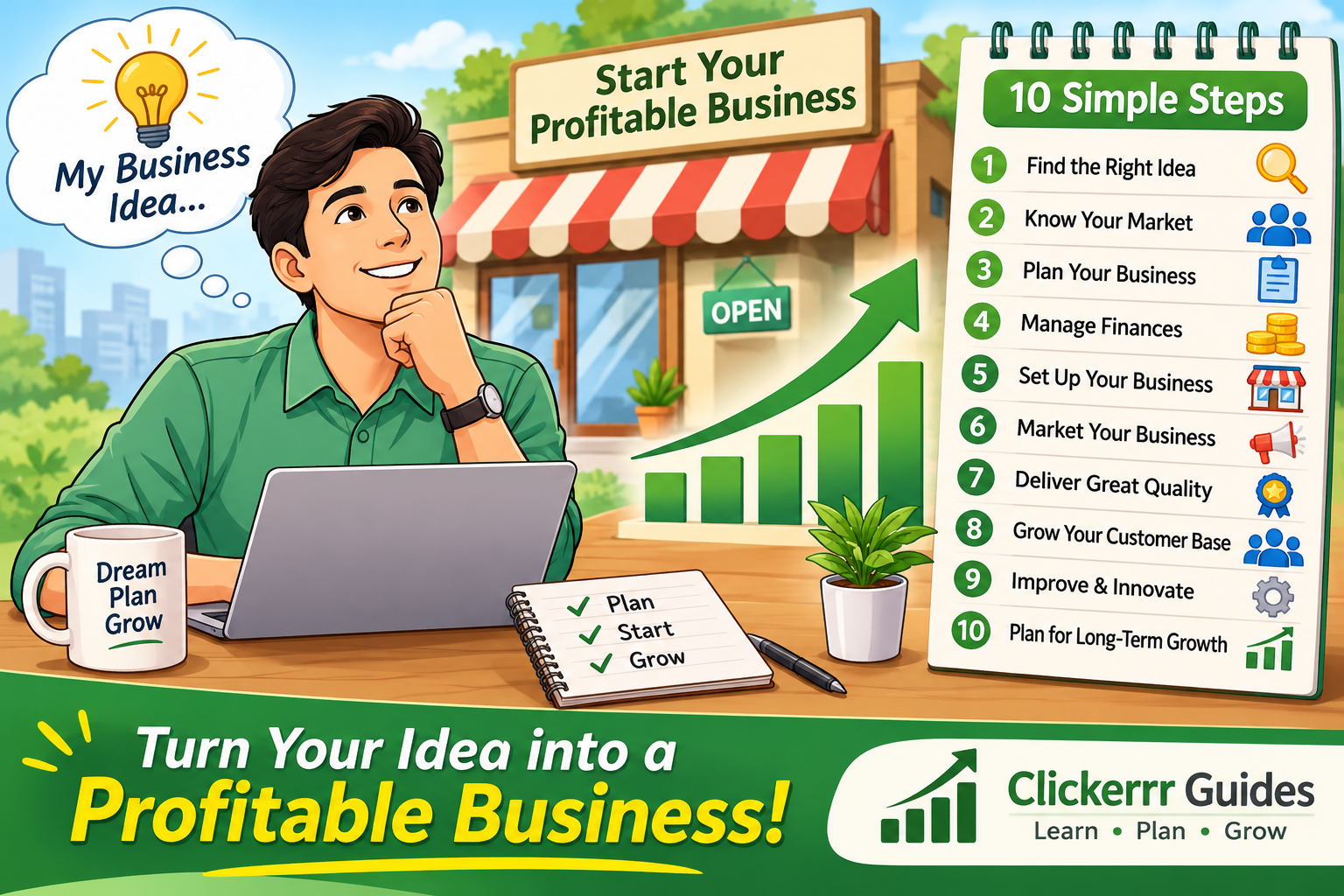
Follow the ten steps in order. Select a real customer problem, research the market, choose a focused business model, validate the offer, prepare a practical plan, calculate the capital requirement, set sustainable prices, establish reliable operations, build a measurable sales process and review performance. Keep your first launch small enough to learn from, but professional enough to deliver genuine value.
Remember that a business becomes profitable through the combined effect of customer demand, pricing discipline, cost control, operational quality and repeat sales. Do not judge progress only by how busy you are or how much revenue you generate. Judge it by whether customers receive value, whether the business retains sufficient contribution and whether cash flow can support continued operation.
Your next action should be simple: choose one customer group, identify one expensive or recurring problem and speak to ten potential buyers. Their real experiences will give you a stronger foundation than another month of untested planning.
Frequently Asked Questions About Starting a Profitable Business
1. What is the first step in starting a profitable business?
The first step is to identify a real problem experienced by a specific group of customers. Investigate how they currently solve it, how frequently it occurs and whether they are willing to pay for a better solution. Begin with customer demand rather than choosing a product solely because you like it.
2. Which business is most profitable for beginners?
There is no universally most profitable business for beginners. Profitability depends on customer demand, competition, pricing, delivery costs, skills, location and execution. Service businesses may be easier to test with limited capital, while product and digital businesses may offer different growth opportunities but have their own cost and acquisition challenges.
3. Can I start a profitable business with little money?
Yes, some businesses can be tested with limited capital, particularly skill-based services, consulting, small-batch products and certain digital offers. However, low startup cost does not mean zero cost. You still need time, tools, customer acquisition, working capital and any required licences or compliance arrangements.
4. How do I know whether my business idea is profitable?
Estimate the selling price, direct variable costs, monthly fixed costs and realistic sales volume. Calculate contribution per sale and break-even volume. Then test demand with paying customers. An idea is not proven profitable merely because a spreadsheet shows a positive result; actual sales and delivery costs must support the assumptions.
5. How much money should I invest to start a business?
The required investment depends on the business model, location, equipment, inventory, staffing and working-capital cycle. Prepare a detailed startup budget and a cash-flow forecast before investing. Start with the smallest credible version of the offer and avoid committing essential household funds to an unvalidated idea.
6. Do I need a business plan before starting?
A practical business plan is strongly recommended. It should explain the customer, problem, offer, business model, pricing, marketing, operations, costs, risks and milestones. A small business may begin with a one-page plan and a simple financial spreadsheet, then expand the document as funding or operational decisions require.
7. How can I get my first customers?
Start with a clearly defined target group and contact relevant prospects through appropriate channels. Referrals, professional networks, local partnerships, direct outreach, useful online content and local search visibility can help. Track enquiries, quotations, purchases and conversion rates so you can identify which channel produces paying customers.
8. What is the difference between revenue and profit?
Revenue is the income generated from sales. Profit is what remains after relevant business costs are deducted. A business may have high revenue but low or negative profit if product costs, salaries, rent, marketing, logistics, interest or other expenses are too high.
9. How long does it take for a new business to become profitable?
There is no fixed timeline. It depends on the industry, startup investment, sales cycle, repeat-purchase behaviour, competition, pricing and operating costs. Some small service businesses may reach operating break-even relatively quickly, while inventory-heavy or capital-intensive ventures may take longer. Use monthly financial reviews rather than assuming a particular date.
10. Should I take a business loan to start?
A loan should be considered only after you understand the business’s demand, cash-flow cycle, repayment capacity and downside risk. Borrowing creates repayment obligations even when sales are lower than expected. Compare the cost and terms of funding options and seek qualified financial advice where necessary.
11. Is an online business more profitable than an offline business?
Neither model is automatically more profitable. Online businesses may reduce some premises costs and reach wider markets, but they still face marketing, technology, logistics, returns, competition and customer-support costs. Offline businesses may benefit from local trust and direct customer access but can have higher fixed expenses. Compare the full economics of the specific model.
12. When should I expand my profitable business?
Consider expansion when customer demand is consistent, contribution margins are healthy, cash flow is manageable, quality is repeatable and the existing operation can handle growth. Estimate the additional fixed costs and sales required before hiring, adding locations, increasing inventory or entering a new market.
Editorial note: This guide provides general business education, not legal, tax, investment or accounting advice. Verify current regulatory requirements and obtain professional advice for your specific business and location.
Steply — Practical steps for moving from an idea to informed action.
More Guides from Clickerrr Guides
How to Manage Small Business Cash Flow: 10 Steps Guide
Cash flow is one of the most important aspects of running a successful small business. It represents the money moving into and out of your business during a particular period.
Read the Full Guide →
How to Start a Profitable E-Commerce Business: 10 Steps Guide
Starting an e-commerce business can be an attractive opportunity for entrepreneurs who want to sell products online and build a scalable business. With an online store, you can reach customers beyond your local area, showcase products around the clock, and manage sales through digital platforms.
Read the Full Guide →
How to Start a Service-Based Business
Follow practical steps to select a service, find your first clients, and build a sustainable business.
Read the Full Guide →
How to Write a Business Plan
Understand how to prepare a business plan, define your goals, and create a practical roadmap for your business.
Read the Full Guide →
How to Find a Profitable Business Niche
Getting your first 100 customers is one of the most important milestones when starting a new business. Whether you run an online business, a local shop, a service-based company, a freelance venture, or a startup, your first customers help you turn an idea into a real business.
Read the Full Guide →
How to Use AI to Grow a Small Business
Artificial intelligence (AI) is changing the way small businesses operate, market their products, serve customers, and compete in the digital marketplace.
Read the Full Guide →
How to Start an Online Business with No Experience
Starting an online business can be an exciting way to turn your skills, knowledge, interests, or business ideas into an income-generating opportunity. Unlike many traditional businesses, an online business can often be started from home with a computer, an internet connection, and a small initial investment.
Read the Full Guide →
How to Start a Small Business
Starting a small business can be an excellent way to turn your skills, knowledge, and ideas into a source of income. Whether you want to open a local shop, provide professional services, sell products online, or start a home-based business, the right approach can help you build a strong foundation. However, starting a business requires more than having a good idea.
Read the Full Guide →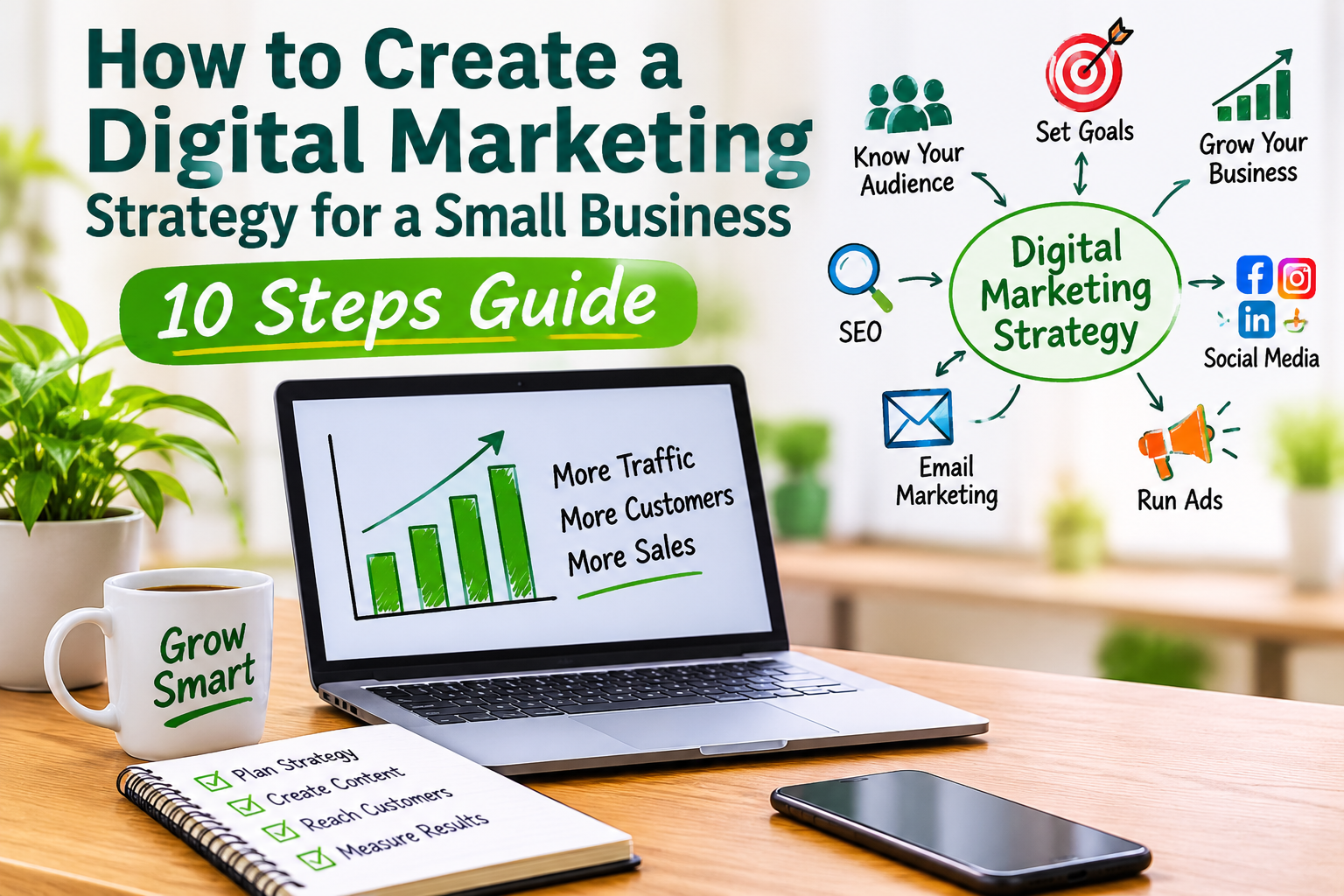
How to Create a Digital Marketing Strategy for a Small Business: 10 Steps Guide
A digital marketing strategy helps a small business attract potential customers, build brand awareness, generate enquiries, and increase sales through online channels.
Read the Full Guide →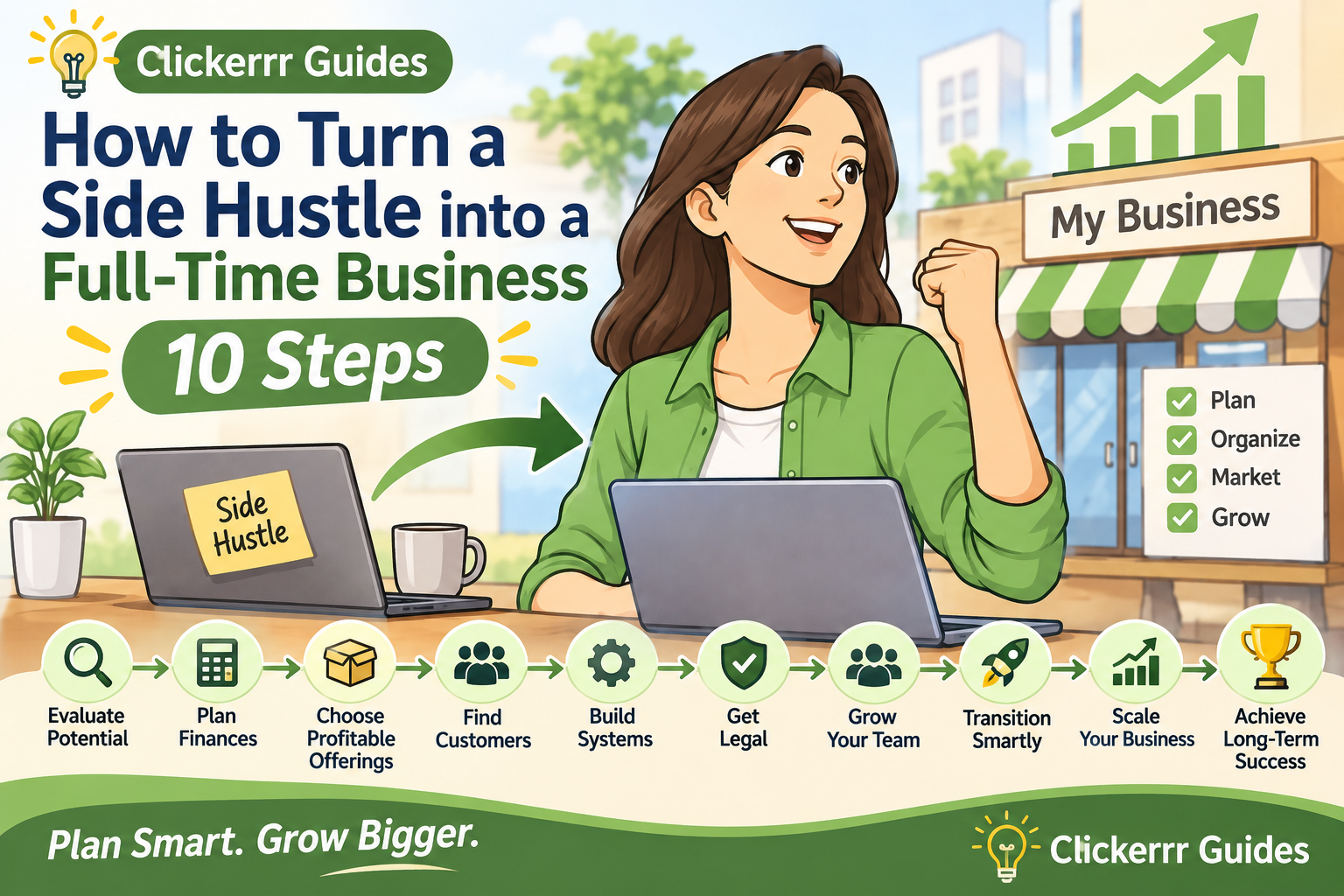
How to Turn a Side Hustle into a Full-Time Business: 10 Steps Guide
Turning a side hustle into a full-time business is an exciting opportunity to gain financial independence, build something of your own, and create a sustainable career. However, moving from a part-time activity to a full-time business requires more than simply increasing your working hours.
Read the Full Guide →
How to Grow a Small Business Faster: 10 Steps Guide
How to Grow a Small Business Faster: 10 Steps Guide? Growing a small business faster requires more than increasing sales or attracting new customers.
Read the Full Guide →
How to Start a Home-Based Business: 10 Steps Guide
Starting a home-based business is an attractive option for people who want to become entrepreneurs without investing heavily in commercial premises or maintaining a traditional office.
Read the Full Guide →