
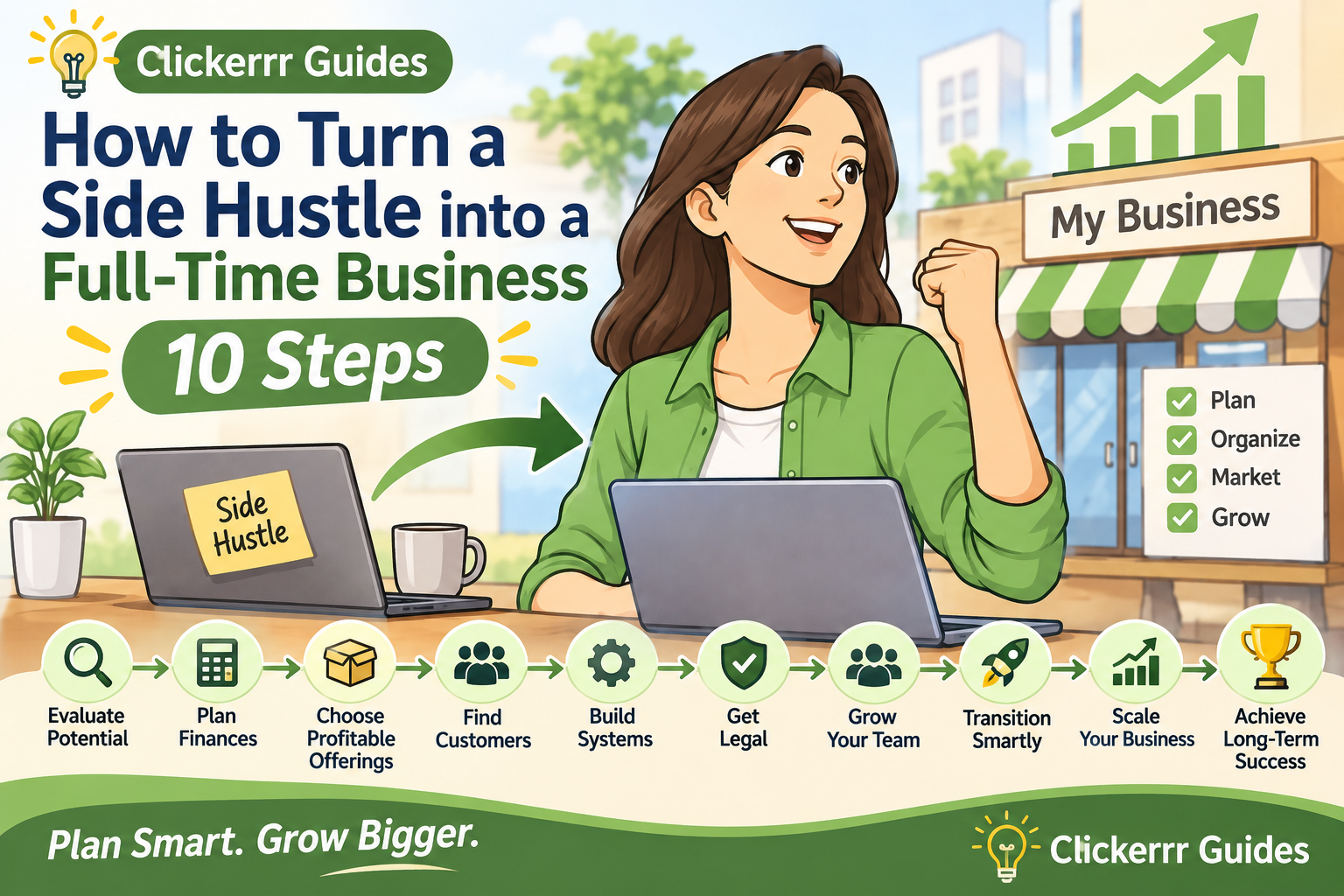
How to Turn a Side Hustle into a Full-Time Business: 10 Steps
Transform your small income-generating activity into a sustainable, profitable business with practical strategies for planning, marketing, financial management, and long-term growth.

Introduction
Turning a side hustle into a full-time business is an exciting opportunity to gain financial independence, build something of your own, and create a sustainable career. However, moving from a part-time activity to a full-time business requires more than simply increasing your working hours.
You need a reliable revenue model, consistent customers, sufficient savings, efficient operations, and a clear growth strategy. Whether you run a freelance service, online store, consulting business, home-based business, or digital product venture, the transition should be gradual and supported by real business data.
This guide explains how to turn a side hustle into a full-time business in 10 practical steps, from evaluating your current performance to leaving your job and building a professional, profitable enterprise.
What Is This Article About?
This guide provides a practical roadmap for converting a part-time business activity into your primary source of income.
- Evaluate whether your side hustle has genuine business potential.
- Calculate your income requirements and business expenses.
- Identify profitable products, services, and target customers.
- Build a consistent customer acquisition system.
- Create efficient business processes and operations.
- Transition from employment to entrepreneurship with lower financial risk.
Evaluate Whether Your Side Hustle Has Real Business Potential

Before turning your side hustle into a full-time business, determine whether it has the potential to generate sustainable income. An activity that produces occasional sales or small amounts of extra money is not necessarily a viable full-time business.
Examine its actual performance, customer demand, profitability, and growth opportunities. The objective is to establish whether your side hustle can develop into a reliable business rather than remain an occasional source of additional income.
How to evaluate your side hustle
- Review your current revenue: Calculate how much money your side hustle generates every month. Examine the previous six months instead of relying on your best-performing month.
- Calculate actual profit: Subtract product costs, marketing expenses, delivery charges, software subscriptions, platform fees, and other operating costs from revenue.
- Identify repeat customers: Determine whether customers return to purchase again or recommend your products and services to others.
- Measure customer demand: Examine inquiries, orders, bookings, website visitors, and completed transactions.
- Identify your most profitable offering: Find out which products or services generate the highest contribution margin and attract reliable customers.
- Check growth potential: Consider whether you can serve more customers without increasing expenses at the same rate.
- Evaluate your competitive advantage: Identify what makes your offering different, such as quality, pricing, convenience, or specialization.
- Examine market demand: Research competitors, customer reviews, and industry trends to understand whether demand is likely to continue.
- Identify operational limitations: Determine whether your working hours, equipment, skills, or resources restrict growth.
- Set performance benchmarks: Establish minimum monthly revenue, profit, and customer targets before considering full-time entrepreneurship.
Do not confuse revenue with income. A side hustle generating ₹1,00,000 in monthly sales may produce only ₹25,000 in operating profit. Focus on profitability, consistency, and customer demand rather than impressive sales figures.
Set Clear Financial Goals and Calculate Your Income Requirements

One of the biggest mistakes aspiring entrepreneurs make is leaving their jobs without understanding how much money they actually need. Your full-time business must support both your personal financial requirements and its operating expenses.
Create a financial plan that includes household expenses, business costs, taxes, savings, and emergency reserves. This will help you establish realistic revenue and profitability targets.
How to calculate your financial requirements
- Calculate monthly household expenses: List essential expenses such as rent, groceries, electricity, transportation, education, insurance, and healthcare.
- Determine your minimum personal income: Decide how much money you need every month to maintain your lifestyle.
- Calculate business operating expenses: Include salaries, rent, utilities, raw materials, inventory, transportation, marketing, and technology.
- Include taxes and statutory obligations: Estimate applicable income taxes, GST obligations, professional fees, and other regulatory costs.
- Create a minimum revenue target: Calculate the sales required to cover operating costs, taxes, and your desired personal income.
- Establish an emergency fund: Ideally, maintain six to twelve months of essential household expenses in accessible savings.
- Build a separate business reserve: Keep money aside for delayed payments, unexpected expenses, and temporary drops in sales.
- Calculate your break-even point: Determine the sales volume at which your business covers all its operating expenses.
- Set short-term financial milestones: Establish monthly targets for revenue, profit, savings, and cash flow.
- Review your financial position: Compare actual performance against your financial plan every month.
Maintain separate personal and business bank accounts. A profitable business can still experience cash shortages if customers pay late. Monitor cash flow, not just accounting profit.
Identify Your Most Profitable Products or Services

Not every product or service in your side hustle deserves to become part of your full-time business. Some offerings may generate substantial revenue but require too much time, while others may produce better margins with fewer resources.
Your objective should be to build a business around offerings that customers genuinely want and that can generate sustainable profits.
How to identify profitable offerings
- List all your current offerings: Record every product or service, its selling price, direct cost, and approximate profit.
- Calculate contribution margin: Subtract variable costs from selling prices to understand how much each sale contributes toward fixed expenses and profit.
- Identify customer favourites: Review your sales history to discover which products or services customers purchase most frequently.
- Study customer preferences: Ask existing customers what they value most and which additional offerings interest them.
- Remove weak offerings: Consider discontinuing products that generate low margins, excessive complaints, or unnecessary complexity.
- Develop premium options: Introduce higher-value packages, customized services, or premium products.
- Create recurring offers: Explore subscriptions, maintenance packages, memberships, and repeat-service contracts.
- Bundle complementary products: Combine related offerings into packages that increase average transaction value.
- Test new offerings on a small scale: Introduce products to a limited customer group before investing heavily.
- Concentrate on your strongest offerings: Allocate more marketing and resources to products with the best combination of demand and profitability.
A business does not need dozens of products to become successful. A focused offering with strong customer demand and healthy profit margins is often easier to manage and scale.
Define Your Target Customers and Build a Strong Market Position

A side hustle may initially attract customers through personal contacts, social media, or word-of-mouth recommendations. However, a full-time business needs a clearly defined customer base and a recognizable market position.
Understand exactly who your customers are, what problems they face, and why they should choose your business instead of competitors.
How to define your target market
- Identify your ideal customers: Determine their age group, profession, income range, location, interests, or business type.
- Understand their problems: Identify the challenges your products or services solve and why customers are willing to pay for a solution.
- Divide customers into segments: Group potential buyers according to their needs, purchasing behaviour, budget, and preferences.
- Study your competitors: Examine competing businesses, pricing, quality, reviews, and marketing strategies.
- Identify market gaps: Look for customer needs that existing businesses are not addressing effectively.
- Develop a unique selling proposition: Explain what makes your business different, such as specialized expertise, affordable pricing, or better service.
- Choose your market position: Decide whether you want to compete as an affordable provider, premium specialist, or niche expert.
- Test your positioning: Present your offer to potential customers and observe which benefits attract the most interest.
- Create consistent brand messaging: Use a clear business name, visual identity, and value proposition across your marketing channels.
- Refine your positioning: Adjust your target market and messaging according to customer feedback and sales performance.
Avoid trying to sell everything to everyone. A clearly defined niche can help a small business communicate its value, attract relevant customers, and compete more effectively against larger companies.
Build a Consistent Customer Acquisition System
A side hustle can survive on occasional orders from friends, family, and personal contacts. A full-time business cannot depend entirely on unpredictable sales.
You need a repeatable customer acquisition system that consistently brings potential buyers into your business and converts qualified prospects into paying customers.
How to attract customers consistently
- Create a professional website: Explain your products or services, display relevant information, answer common questions, and provide convenient purchasing or contact options.
- Optimize for search engines: Publish useful content targeting relevant search queries so potential customers can discover your business organically.
- Build a social media presence: Choose platforms where your target customers spend time and publish relevant content consistently.
- Use educational marketing: Share tutorials, demonstrations, product comparisons, and practical solutions to common customer problems.
- Develop an email list: Collect permission-based subscriptions and send useful updates, educational content, and relevant offers.
- Encourage customer referrals: Create a structured referral program that rewards existing customers for introducing new customers.
- Collect customer testimonials: Request genuine feedback and display authentic reviews with customer permission.
- Experiment with paid advertising: Test small advertising campaigns and measure the cost of acquiring each paying customer.
- Develop strategic partnerships: Collaborate with complementary businesses and professionals that can introduce relevant customers.
- Track marketing performance: Measure website conversions, inquiries, sales, acquisition costs, and return on marketing investment.
Do not try to master every marketing channel simultaneously. Start with two or three channels that reach your ideal customers and consistently measure their results. The objective is profitable customer acquisition, not simply traffic or followers.
Create Efficient Business Systems and Standard Operating Procedures

When your side hustle becomes busier, handling every task manually can become difficult. Customer inquiries, order processing, payments, delivery, accounting, and customer support can consume most of your time.
A full-time business needs systems that allow daily operations to run efficiently and consistently, even when the owner is not personally handling every activity.
How to build effective business systems
- Document your daily activities: Write down the important tasks involved in receiving orders, delivering services, communicating with customers, and managing payments.
- Create standard operating procedures: Develop simple step-by-step instructions for repetitive activities so tasks can be performed consistently.
- Automate repetitive work: Use suitable tools for appointment scheduling, invoice generation, payment reminders, and order notifications.
- Organize customer information: Maintain a structured database containing customer details, purchase history, inquiries, and follow-up requirements.
- Implement a payment system: Establish clear payment methods, billing procedures, refund policies, and processes for overdue invoices.
- Standardize customer service: Develop procedures for answering inquiries, resolving complaints, and handling feedback.
- Manage inventory and supplies: Track stock levels, supplier details, purchase costs, and reorder requirements.
- Monitor operational performance: Measure order completion time, delivery time, error rates, and customer satisfaction.
- Secure important business data: Maintain backups and control access to financial records and customer information.
- Review and improve processes: Identify unnecessary activities, operational bottlenecks, and opportunities to save time and money.
Create a simple Standard Operating Procedures (SOP) document for every important recurring activity. You do not need expensive business software at the beginning. Spreadsheets and basic productivity tools can handle many early-stage requirements.
Establish Your Business Legally and Professionally

Moving from a side hustle to a full-time business also means taking responsibility for legal compliance, financial records, business registration, and professional operations.
The requirements depend on your business model, location, industry, business structure, and annual turnover. Establishing the appropriate legal and administrative foundation can protect your business and improve its credibility.
How to establish a professional business
- Choose an appropriate business structure: Evaluate whether a sole proprietorship, partnership, Limited Liability Partnership (LLP), or private limited company is suitable.
- Select a business name: Choose a distinctive and professional name suitable for long-term brand development.
- Complete applicable registrations: Obtain the registrations, licences, and permissions required for your business activity.
- Understand tax requirements: Review applicable income tax, GST registration, invoicing, filing, and record-keeping obligations.
- Open a business bank account: Use a dedicated account where appropriate to maintain clear financial separation.
- Prepare professional contracts: Develop suitable agreements for customers, suppliers, contractors, employees, and business partners.
- Protect your intellectual property: Consider trademark registration, copyright protection, and other relevant measures to safeguard your brand and original work.
- Establish accounting procedures: Maintain records of sales, purchases, expenses, assets, liabilities, and tax-related transactions.
- Obtain suitable insurance: Evaluate whether business liability, property, professional indemnity, or other insurance coverage is necessary.
- Build professional documentation: Prepare quotations, invoices, receipts, policies, and proposals that support business operations.
Do not register an expensive or complicated business structure simply because it appears more professional. Select a structure based on liability, compliance costs, taxation, ownership, and future funding requirements. Consult a qualified professional about applicable Indian registrations and tax obligations.
Expand Your Capacity and Build a Reliable Team

As your side hustle grows, you may reach a stage where your personal time becomes the biggest limitation on business growth. If every sale, customer interaction, production activity, and administrative task depends entirely on you, increasing revenue becomes difficult.
The solution is to gradually expand your capacity through delegation, technology, outsourcing, and carefully planned hiring.
How to increase business capacity
- Identify time-consuming activities: Determine which repetitive tasks prevent you from focusing on important business activities.
- Delegate administrative work: Outsource suitable activities such as data entry, scheduling, bookkeeping, and routine customer communication.
- Hire essential employees: Recruit people only when additional capacity or expertise can justify the employment cost.
- Use freelancers and contractors: Hire independent professionals for graphic design, website development, marketing, and specialized assignments.
- Invest in productivity tools: Adopt project management, accounting, inventory, communication, and customer relationship management systems.
- Improve production capacity: Upgrade equipment, streamline service delivery, or arrange reliable suppliers when demand increases.
- Create clear employee responsibilities: Define duties, performance expectations, reporting procedures, and accountability.
- Train your team: Provide documented instructions and practical training so work quality remains consistent.
- Monitor employee productivity: Evaluate work quality, delivery time, customer satisfaction, and completed tasks.
- Maintain quality control: Introduce regular checks to ensure that increasing business volume does not reduce customer experience.
Do not hire employees simply because your business feels busy. First determine whether additional staff will generate more revenue, improve productivity, or remove a genuine operational bottleneck. Consider automation and outsourcing before creating permanent expenses.
Make a Planned Transition from Employment to Full-Time Entrepreneurship

Leaving a regular job to concentrate on your side hustle is one of the most important decisions in the transition process. A sudden resignation without adequate financial preparation can create unnecessary pressure and force you to make poor business decisions.
Instead, establish clear conditions that must be satisfied before moving into full-time entrepreneurship.
How to transition safely
- Set a resignation readiness target: Decide the minimum level of consistent business profit you must achieve before considering leaving your job.
- Track several months of performance: Review at least six to twelve months of business results to understand revenue stability and seasonal fluctuations.
- Build adequate savings: Maintain a separate emergency fund for household expenses and an operating reserve for the business.
- Reduce unnecessary personal expenses: Eliminate avoidable financial commitments before your transition.
- Develop a reliable customer pipeline: Ensure you have ongoing inquiries, confirmed orders, recurring clients, or credible sources of future revenue.
- Reduce dependence on one customer: Avoid building a business where losing one major customer could immediately threaten financial stability.
- Check employment obligations: Review your employment agreement, notice period, confidentiality obligations, and applicable workplace policies.
- Consider a gradual transition: Where permitted, explore reduced working hours, a planned career break, or a staged move to full-time business operations.
- Prepare a contingency plan: Decide what you will do if revenue drops, a major customer leaves, or business expenses increase unexpectedly.
- Choose a realistic transition date: Make the decision based on financial readiness and business performance rather than excitement or frustration.
Do not resign just because your side hustle earns the same amount as your salary for one or two months. Compare sustainable business profit with your salary, employment benefits, insurance, paid leave, and other advantages. Move into entrepreneurship from a position of financial strength rather than financial pressure.
Scale Your Business and Build Long-Term Sustainability

Once your side hustle becomes your primary occupation, the next challenge is to make it a sustainable and scalable business. Scaling does not simply mean increasing sales. It means growing revenue and profitability while maintaining operational efficiency, customer satisfaction, and financial stability.
Develop a long-term growth strategy that focuses on improving your existing business model before expanding into additional products, markets, and revenue streams.
How to scale your full-time business
- Set measurable growth objectives: Establish quarterly and annual targets for revenue, profit, customer acquisition, retention, and operational efficiency.
- Increase customer lifetime value: Encourage repeat purchases, upgrades, renewals, and long-term customer relationships.
- Introduce additional revenue streams: Explore complementary products, premium services, subscriptions, licensing, and digital products.
- Expand into new markets: Reach customers in additional geographical areas, industries, customer segments, or online channels.
- Strengthen your brand reputation: Publish valuable content, maintain consistent quality, encourage genuine reviews, and establish expertise.
- Improve profit margins: Negotiate better supplier terms, reduce unnecessary expenses, optimize pricing, and eliminate inefficient processes.
- Build strategic partnerships: Collaborate with distributors, service providers, complementary businesses, and industry professionals.
- Invest in technology: Adopt systems that improve production, customer management, marketing, reporting, and business decisions.
- Monitor key performance indicators: Review revenue growth, gross profit margin, net profit margin, customer acquisition cost, customer retention, and cash flow.
- Reinvest profits strategically: Allocate a portion of earnings toward marketing, equipment, product development, employee training, and profitable growth initiatives.
Avoid expanding into too many markets or launching multiple products before your existing business model becomes stable. Build one profitable business system first, then replicate and expand it using measurable results.
Your Side Hustle to Full-Time Business Transition Checklist
Use this checklist to assess your readiness before making the transition. Select each task as you complete it.
This checklist is a planning aid, not a guarantee of business success. Financial readiness depends on income stability, expenses, savings, and personal circumstances.
Final Thoughts
Turning a side hustle into a full-time business is a gradual process that requires financial preparation, customer understanding, consistent marketing, efficient operations, and disciplined decision-making.
The most important principle is to build a business that can operate sustainably rather than simply creating another full-time job for yourself.
Start by validating demand, understanding your numbers, establishing reliable customer acquisition channels, and developing systems that can support increasing business activity.
Frequently Asked Questions
Find answers to common questions about turning a side hustle into a full-time business.
1. How long does it take to turn a side hustle into a full-time business?
There is no fixed timeline. Depending on the business model, customer demand, profitability, and available resources, the transition may take several months or several years. The decision should be based on business performance rather than an arbitrary deadline.
2. How much money should a side hustle make before becoming a full-time business?
Ideally, it should generate enough consistent operating profit to cover your personal income requirements, business expenses, taxes, and necessary reserves. The required amount varies according to your lifestyle and business model.
3. Can I turn a side hustle into a business without quitting my job?
Yes. Building a business while maintaining employment can reduce financial risk. You can gradually increase customers, improve operations, and establish reliable revenue before making the transition, provided your employment obligations permit it.
4. What are the best side hustles to turn into full-time businesses?
Freelancing, consulting, online education, e-commerce, digital products, content publishing, home-based services, specialized agencies, and subscription-based businesses can develop into full-time ventures when they have sufficient customer demand and profitability.
5. How do I get my first regular customers?
Start with a clearly defined target market, offer a valuable solution, establish an online presence, use referrals, publish useful content, and develop relationships with potential customers. Focus on delivering a good customer experience that encourages repeat business.
6. Should I register my side hustle as a company?
Not necessarily. The appropriate legal structure depends on your business activity, ownership, liability, taxation, compliance requirements, and future plans. A sole proprietorship may be sufficient for some small businesses, while other ventures may benefit from an LLP or private limited company.
7. How can I manage a full-time business without working all day?
Develop standard operating procedures, automate repetitive tasks, delegate suitable responsibilities, use productivity software, and establish clear working hours. Efficient systems are essential for sustainable business management.
8. What is the biggest mistake people make when turning a side hustle into a business?
One common mistake is leaving employment before establishing consistent and profitable business revenue. Other mistakes include underestimating expenses, depending on a single customer, neglecting marketing, and expanding too quickly.
9. How can I grow my side hustle without investing a lot of money?
Focus on organic marketing, customer referrals, repeat business, partnerships, low-cost digital tools, and reinvesting profits. Improve the existing business model before committing to expensive infrastructure or large advertising budgets.
10. What should I do if my side hustle is not generating enough income?
Review your pricing, customer segment, product-market fit, marketing channels, operating expenses, and customer feedback. Identify the main reason for weak performance, test improvements on a small scale, and avoid increasing investment until the business model demonstrates better results.