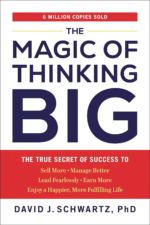
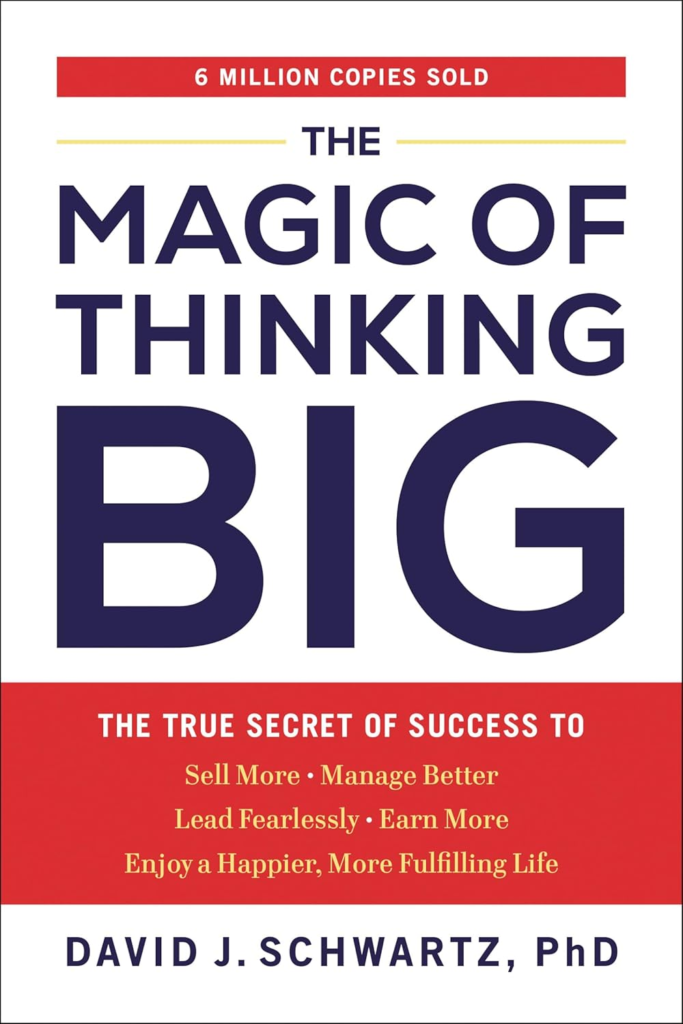
The Magic of Thinking Big is a self-help and personal-development book by American writer, professor, and motivational educator David J. Schwartz, Ph.D. First published in 1959, the book argues that achievement is influenced not only by ability, intelligence, education, or circumstances, but also by the size and quality of a person’s thinking. Schwartz encourages readers to develop larger ambitions, strengthen confidence, overcome fear and habitual excuses, cultivate constructive attitudes toward other people, act decisively, use goals, and develop leadership qualities. (Open Library)
The book became one of the enduring works of twentieth-century motivational literature. Simon & Schuster’s current author page reports that more than six million copies have been sold worldwide. (Simon & Schuster)
Despite its title, The Magic of Thinking Big is not principally a book about fantasy or wishful thinking. Schwartz uses “thinking big” to describe a deliberate expansion of one’s aspirations, expectations, confidence, goals, and willingness to act. His argument is essentially that people often limit their achievements before circumstances have had the opportunity to limit them.
Book Information
| Field | Details |
|---|---|
| Title | The Magic of Thinking Big |
| Author | David J. Schwartz, Ph.D. |
| First published | 1959 |
| Original publisher | Prentice-Hall |
| Original publication place | Englewood Cliffs, New Jersey |
| Language | English |
| Genre | Self-help, personal development, motivational literature |
| Subject | Success, confidence, achievement, leadership, goal-setting |
| Original length | 228 pages |
| Dewey classification | 150.13 / 158.1 in various catalog records |
| Major themes | Big thinking, confidence, action, goals, leadership |
| Author’s profession | Professor, writer, motivational educator |
| Academic affiliation | Georgia State University |
| Major related field | Motivation and leadership development |
| Later editions | Numerous editions, including Fireside and international editions |
Library catalogues identify the original 1959 edition as a Prentice-Hall publication of approximately 228 pages. (Open Library)
Different editions vary in pagination, formatting, and sometimes chapter presentation. Readers should therefore identify the specific edition when citing page numbers.
Overview
At the heart of The Magic of Thinking Big is an uncomfortable but potentially liberating question:
How much of our limitation comes from the world—and how much comes from the limits we place on ourselves?
Schwartz’s answer is that people frequently underestimate themselves.
They may:
- choose smaller goals because they seem safer;
- assume that other people are naturally more capable;
- interpret temporary setbacks as permanent failure;
- make excuses before attempting difficult things;
- worry excessively about what others think;
- wait for perfect conditions before taking action;
- or unconsciously surround themselves with ideas that reinforce small ambitions.
Schwartz calls this pattern “small thinking.”
His alternative is “big thinking.”
Big thinking does not mean believing that everything is possible without effort.
Instead, it means asking a larger question:
What might be possible if I stopped automatically assuming that it was impossible?
The Central Idea
Schwartz’s philosophy can be represented by a simple progression:
        THINK BIGGER
             ↓
       SET BIGGER GOALS
             ↓
       BUILD CONFIDENCE
             ↓
        TAKE ACTION
             ↓
        PERSIST LONGER
             ↓
       LEARN FROM DEFEAT
             ↓
       ACHIEVE MORE
The important connection is between thought and action.
Schwartz is not simply recommending optimism.
He repeatedly attempts to turn thinking into behaviour.
What Does “Thinking Big” Mean?
The title can easily be misunderstood.
Thinking big does not necessarily mean:
- becoming famous,
- becoming extremely wealthy,
- taking reckless risks,
- believing that you are superior to other people,
- ignoring practical limitations,
- or expecting success without preparation.
For Schwartz, thinking big is more closely associated with:
- larger aspirations,
- higher standards,
- greater confidence,
- broader possibilities,
- constructive expectations,
- creative problem-solving,
- ambitious goals,
- and decisive action.
A person thinking small may ask:
“Can I really do this?”
A person thinking big is more likely to ask:
“How could I do this?”
That small change in the question can produce a very different search for solutions.
The Book’s Fundamental Equation
A useful modern representation of Schwartz’s philosophy is:
Belief → Behaviour → Results
But the book goes further:
BELIEF
  ↓
EXPECTATION
  ↓
BEHAVIOR
  ↓
ACTION
  ↓
RESULT
  ↓
EXPERIENCE
  ↓
STRONGER OR WEAKER BELIEF
This creates a feedback loop.
Success can increase confidence.
Failure can reduce confidence.
But Schwartz’s philosophy encourages the reader to interpret failure as information rather than identity.
Author: David J. Schwartz
Biography
David Joseph Schwartz, Jr. was an American professor, writer, motivational educator, and consultant best known for The Magic of Thinking Big.
He was born on March 23, 1927, and died on December 6, 1987. He spent a significant part of his academic career at Georgia State University in Atlanta, where he became associated with marketing, motivation, and leadership education. (Wikipedia)
According to biographical records, Schwartz earned a bachelor’s degree from the University of Nebraska and subsequently obtained master’s and doctoral degrees from Ohio State University. (Wikipedia)
He later served as a professor at Georgia State University and became involved in leadership and motivational consulting.
Simon & Schuster describes Schwartz as a former professor at Georgia State University and president of Creative Educational Services, Inc., a consulting firm specializing in leadership development. (Simon & Schuster)
Academic and Professional Background
Schwartz’s academic background is significant because The Magic of Thinking Big was not written simply from the perspective of a motivational speaker.
His professional career combined:
- university teaching,
- marketing,
- leadership education,
- motivational training,
- writing,
- and consulting.
His work therefore sits at an interesting intersection of:
business education + psychology-inspired self-help + motivational literature + leadership development.
David Schwartz Information Box
| Personal Information | Details |
|---|---|
| Full name | David Joseph Schwartz, Jr. |
| Born | March 23, 1927 |
| Died | December 6, 1987 |
| Nationality | American |
| Occupation | Professor, author, motivational educator, consultant |
| Known for | The Magic of Thinking Big |
| Academic institution | Georgia State University |
| Education | University of Nebraska; Ohio State University |
| Consulting organization | Creative Educational Services, Inc. |
| Primary field | Motivation and leadership |
Simon & Schuster confirms his Georgia State University professorship, leadership-development consulting work, and death in 1987. (Simon & Schuster)
Publication History
The Magic of Thinking Big was first published in 1959 by Prentice-Hall in Englewood Cliffs, New Jersey. (WorldCat)
The book subsequently appeared in numerous editions.
Among the later editions was a Fireside edition published by Simon & Schuster. The bibliographic information for that edition records the original copyright dates as 1959 and 1965 and identifies the Fireside edition as a later publication. (FlipHTML5)
The book has also been published internationally and adapted into audio editions. Simon & Schuster currently offers both abridged and unabridged audio editions. (Simon & Schuster)
Table of Contents
The original edition contains 13 principal chapters. Open Library records the following chapter structure: (Open Library)
- Believe You Can Succeed and You Will
- Cure Yourself of Excusitis, the Failure Disease
- Build Confidence and Destroy Fear
- How to Think Big
- How to Think and Dream Creatively
- You Are What You Think You Are
- Manage Your Environment: Go First Class
- Make Your Attitudes Your Allies
- Think Right Toward People
- Get the Action Habit
- How to Turn Defeat Into Victory
- Use Goals to Help You Grow
- How to Think Like a Leader
The chapter titles themselves reveal the architecture of Schwartz’s argument.
The book begins with belief, moves through confidence and creative thinking, then addresses attitudes and relationships, before progressing to action, defeat, goals, and leadership.
In other words:
Think → Believe → Act → Persist → Lead
Chapter 1: Believe You Can Succeed and You Will
Schwartz begins with one of his most important propositions:
Belief precedes achievement.
If a person genuinely believes that an objective is impossible, they are unlikely to invest sustained effort in achieving it.
The reverse is also true.
A person who believes that improvement is possible is more likely to:
- attempt difficult tasks,
- continue after setbacks,
- look for solutions,
- ask for help,
- learn new skills,
- and take opportunities seriously.
Schwartz therefore treats belief as a practical resource.
The point is not that belief magically produces results.
Rather:
belief changes behaviour, and behaviour affects results.
The “Success Starts in the Mind” Model
        BELIEVE
           ↓
       ATTEMPT
           ↓
        ACTION
           ↓
       FEEDBACK
           ↓
        LEARN
           ↓
       IMPROVE
           ↓
        ACHIEVE
Without the initial willingness to attempt something, the rest of the sequence may never begin.
Chapter 2: “Excusitis” — The Failure Disease
One of the book’s most memorable concepts is “Excusitis.”
Schwartz uses the term humorously to describe the habit of creating explanations for why success is impossible.
He identifies several recurring forms of excuse-making.
“I don’t have enough education.”
“I am too old.”
“I am too young.”
“I don’t have enough money.”
“I don’t have the right background.”
“I don’t know the right people.”
“I am not lucky.”
The problem, according to Schwartz, is not that these circumstances are always irrelevant.
Some limitations are real.
The problem is allowing a limitation to become a permanent explanation for inaction.
Infographic: The Excusitis Cycle
       DIFFICULT GOAL
             ↓
        "I CAN'T"
             ↓
          EXCUSE
             ↓
         NO ACTION
             ↓
       NO PROGRESS
             ↓
      "SEE, I WAS RIGHT"
             ↓
        STRONGER EXCUSE
             ↺
Schwartz attempts to break this loop:
       DIFFICULT GOAL
             ↓
       "HOW CAN I?"
             ↓
       FIND OPTIONS
             ↓
          ACTION
             ↓
        FEEDBACK
             ↓
        IMPROVEMENT
             ↺
Chapter 3: Build Confidence and Destroy Fear
Schwartz does not present confidence as something a person either possesses or lacks permanently.
He treats confidence as something that can be developed.
One of the key ideas is that action can generate confidence.
A person does not necessarily need to wait until they feel fearless.
They can begin with a small action.
SMALL ACTION
     ↓
SMALL SUCCESS
     ↓
MORE CONFIDENCE
     ↓
BIGGER ACTION
     ↓
BIGGER CONFIDENCE
This creates a reinforcing cycle.
Fear, by contrast, can work in the opposite direction.
FEAR
 ↓
AVOIDANCE
 ↓
NO EXPERIENCE
 ↓
LOW CONFIDENCE
 ↓
MORE FEAR
Schwartz’s solution is therefore not simply “stop being afraid.”
It is:
Act despite fear and allow experience to weaken it.
Chapter 4: How to Think Big
This chapter gives the book its title and its central philosophy.
Schwartz asks readers to examine the size of their mental frame.
A person may think:
“I need a better job.”
Schwartz encourages a larger question:
“What kind of work would allow me to use my strongest abilities?”
The difference is subtle but powerful.
One question searches for an immediate improvement.
The other searches for a larger possibility.
Thinking Big vs Thinking Small
| Small Thinking | Big Thinking |
|---|---|
| “Can I afford it?” | “How could I afford it?” |
| “This is impossible.” | “What would make it possible?” |
| “I am not qualified.” | “What do I need to learn?” |
| “People like me don’t do that.” | “Why shouldn’t I try?” |
| “What if I fail?” | “What can I learn?” |
| “This is good enough.” | “How could this be better?” |
| “I have reached my limit.” | “What is my next level?” |
This table is a modern interpretation of Schwartz’s broader distinction between small and large thinking.
Thinking Big Does Not Mean Ignoring Reality
One of the easiest ways to misunderstand the book is to interpret “think big” as:
Ignore limitations.
That is not a useful interpretation.
A better interpretation is:
Do not assume that today’s limitations automatically define tomorrow’s possibilities.
For example:
A person may lack a particular skill today.
That is a fact.
But the conclusion:
“Therefore I can never develop that skill.”
is an interpretation.
Schwartz’s philosophy repeatedly asks readers to challenge the second statement.
Chapter 5: How to Think and Dream Creatively
Schwartz argues that creativity is not limited to artists, scientists, or inventors.
Creative thinking can be used in:
- business,
- management,
- relationships,
- education,
- careers,
- problem-solving,
- and everyday life.
The key question becomes:
Is there another way to look at this?
That question alone can expand the range of possible solutions.
The Creative Thinking Formula
PROBLEM
  ↓
DEFINE IT
  ↓
QUESTION ASSUMPTIONS
  ↓
GENERATE ALTERNATIVES
  ↓
COMPARE OPTIONS
  ↓
TEST ONE
  ↓
LEARN
The emphasis is on possibility generation.
Chapter 6: You Are What You Think You Are
Schwartz explores the relationship between self-image and behaviour.
A person’s internal picture of themselves can influence:
- how they speak,
- how they dress,
- what opportunities they pursue,
- how they respond to criticism,
- how they negotiate,
- and what they believe they deserve.
This can create a self-reinforcing pattern.
SELF-IMAGE
    ↓
EXPECTATION
    ↓
BEHAVIOR
    ↓
OTHER PEOPLE'S RESPONSE
    ↓
EXPERIENCE
    ↓
SELF-IMAGE
The implication is significant:
Change the internal picture, and behaviour may begin to change with it.
Chapter 7: Manage Your Environment — “Go First Class”
Schwartz argues that environment influences thinking.
The people we spend time with, the ideas we consume, the standards around us, and the expectations of our social environment can influence our own expectations.
He therefore encourages readers to deliberately choose environments that encourage growth.
The underlying principle can be represented as:
ENVIRONMENT
     ↓
IDEAS
     ↓
EXPECTATIONS
     ↓
STANDARDS
     ↓
BEHAVIOR
This is one of the book’s most modern-feeling concepts.
The people around us can normalize either ambition or limitation.
“Go First Class”
The phrase “go first class” should not be interpreted simply as a recommendation to spend more money.
In Schwartz’s larger argument, it is connected with standards.
The underlying question is:
What standard am I teaching myself to accept?
A person who consistently accepts poor-quality work may gradually normalize it.
A person who expects quality may become more attentive to:
- detail,
- presentation,
- reliability,
- professionalism,
- and personal standards.
Chapter 8: Make Your Attitudes Your Allies
Schwartz treats attitude as an active force.
The same situation can produce different responses depending upon how it is interpreted.
For example:
SAME SETBACK
     │
     ├───────────────┐
     ↓               ↓
NEGATIVE ATTITUDE   CONSTRUCTIVE ATTITUDE
     ↓               ↓
"I'M FINISHED"     "WHAT CAN I LEARN?"
     ↓               ↓
GIVE UP             ADAPT
The event is the same.
The response is different.
This is central to Schwartz’s philosophy.
Chapter 9: Think Right Toward People
The book is not exclusively about individual achievement.
Schwartz argues that success also depends upon relationships.
He encourages readers to:
- respect other people,
- avoid unnecessary hostility,
- listen,
- show genuine interest,
- recognize other people’s importance,
- and build cooperative relationships.
The underlying principle is simple:
People are not obstacles standing between you and success. They are part of the environment in which success happens.
Chapter 10: Get the Action Habit
This is one of the most important chapters because it prevents the book’s philosophy from becoming merely inspirational.
Schwartz argues that excessive thinking can become another form of procrastination.
A person may spend months:
- planning,
- researching,
- worrying,
- comparing,
- waiting,
- and preparing—
without actually beginning.
His answer is the action habit.
The Action Gap
        IDEA
         ↓
      EXCITEMENT
         ↓
       PLANNING
         ↓
      MORE PLANNING
         ↓
       DOUBT
         ↓
      PROCRASTINATION
         ↓
        NOTHING
Schwartz wants the sequence to become:
IDEA
 ↓
DECISION
 ↓
FIRST ACTION
 ↓
FEEDBACK
 ↓
ADJUSTMENT
 ↓
CONTINUED ACTION
This may be one of the most practically valuable concepts in the entire book.
Chapter 11: How to Turn Defeat Into Victory
Schwartz does not deny failure.
Instead, he challenges the meaning people assign to it.
A failure can become:
- information,
- experience,
- a warning,
- a new strategy,
- a motivation,
- or a redirection.
The important question is not merely:
“Did I fail?”
It is:
“What does this failure teach me?”
Defeat Conversion Model
       DEFEAT
          ↓
     ACCEPT FACTS
          ↓
     FIND THE CAUSE
          ↓
      EXTRACT LESSON
          ↓
     CHANGE STRATEGY
          ↓
        TRY AGAIN
          ↓
       NEW RESULT
This is one of the clearest examples of Schwartz’s preference for interpretation followed by action.
Chapter 12: Use Goals to Help You Grow
Goal-setting occupies an important place in Schwartz’s philosophy.
A goal gives thinking a direction.
Without a goal, ambition can remain vague.
With a goal, the mind can begin asking:
- What must I learn?
- What resources do I need?
- What people can help?
- What obstacles must I solve?
- What should I do first?
- What should I stop doing?
The Goal-Growth Cycle
       BIGGER GOAL
            ↓
       BIGGER THINKING
            ↓
       NEW REQUIREMENTS
            ↓
        NEW SKILLS
            ↓
        NEW ACTIONS
            ↓
         GROWTH
            ↓
     CAPACITY EXPANDS
            ↓
     BIGGER GOALS BECOME POSSIBLE
The goal is therefore not simply the final result.
The goal also becomes a mechanism for personal growth.
Chapter 13: How to Think Like a Leader
The final chapter expands the philosophy from personal achievement to leadership.
Schwartz’s leader is not merely someone with authority.
Leadership involves:
- thinking constructively about people,
- accepting responsibility,
- making decisions,
- communicating effectively,
- setting standards,
- and encouraging others.
The book therefore ends on a larger idea:
Big thinking ultimately becomes social rather than purely personal.
A person who learns to think bigger can influence the environment around them.
The Complete Schwartz Framework
The thirteen chapters can be organized into five broad stages:
┌──────────────────────────────────────┐
│  1. BELIEF                           │
│  Believe you can succeed             │
├──────────────────────────────────────┤
│  2. MINDSET                          │
│  Think bigger and more creatively     │
├──────────────────────────────────────┤
│  3. CHARACTER                        │
│  Build confidence and attitude       │
├──────────────────────────────────────┤
│  4. ACTION                           │
│  Act, persist, learn from defeat     │
├──────────────────────────────────────┤
│  5. LEADERSHIP                       │
│  Set goals and influence others      │
└──────────────────────────────────────┘
The Four Enemies of Big Thinking
Schwartz’s ideas can be condensed into four recurring obstacles.
1. Fear
Fear convinces a person not to begin.
2. Excuses
Excuses provide an explanation for inaction.
3. Small goals
Small goals may prevent a person from developing larger capabilities.
4. Inaction
Without action, even excellent ideas remain theoretical.
The Four Engines of Big Thinking
The corresponding positive forces are:
             BIG THINKING
                  │
       ┌──────────┼──────────┐
       ↓          ↓          ↓
    BELIEF      GOALS      ACTION
       │          │          │
       └──────────┼──────────┘
                  ↓
             PERSISTENCE
                  ↓
                GROWTH
“Excusitis” in Modern Life
Although Schwartz wrote in the 1950s, his discussion of excuses remains recognizable.
Modern excuses may sound different:
- “I don’t have enough followers.”
- “The market is already crowded.”
- “I am too old to learn technology.”
- “AI will make this impossible.”
- “I need a better laptop first.”
- “I need to learn everything before I start.”
- “I will begin next month.”
- “Someone else is already doing it.”
The underlying psychological pattern is the same:
A reason not to begin becomes more important than the possibility of beginning.
This is precisely the habit Schwartz’s concept of “excuseitis” attempts to expose.
Big Thinking and Goal Size
A major implication of Schwartz’s philosophy is that the size of the goal can influence the size of the effort.
Consider:
Goal A:
"Get slightly better."

             versus

Goal B:
"Become exceptionally good."
Goal B may require:
- more learning,
- more experimentation,
- better relationships,
- more discipline,
- greater persistence,
- and a longer time horizon.
Thus, a larger goal can change not only the destination but the person required to reach it.
The “Self-Image” Effect
Schwartz repeatedly returns to the idea that people behave consistently with their self-image.
A person who sees themselves as:
“Someone who cannot lead”
may avoid leadership opportunities.
A person who begins seeing themselves as:
“Someone learning to lead”
may begin accepting them.
The difference is not merely linguistic.
It can change behaviour.
Self-Image → Standards → Results
       SELF-IMAGE
            ↓
        EXPECTATIONS
            ↓
         STANDARDS
            ↓
         BEHAVIOR
            ↓
          RESULTS
            ↓
      SELF-CONFIDENCE
This feedback loop is one of the most important conceptual ideas in the book.
Big Thinking and Creativity
Schwartz treats creative thinking as a learnable habit.
He encourages readers to challenge assumptions.
For example:
Instead of asking:
“Why can’t this be done?”
ask:
“What would have to change for this to become possible?”
That second question is fundamentally different.
The first searches for barriers.
The second searches for conditions.
The “How Can I?” Question
One of the most useful ways to apply Schwartz’s philosophy is to replace:
“Can I?”
with:
“How can I?”
Compare:
“Can I build this business?”
with:
“How can I build this business?”
The second question assumes that obstacles exist but asks the mind to search for routes around them.
This is the practical heart of big thinking.
Big Thinking Is Not Reckless Thinking
A useful distinction is:
| Big Thinking | Reckless Thinking |
|---|---|
| Ambitious | Impulsive |
| Optimistic | Unrealistic |
| Creative | Careless |
| Long-term | Short-term |
| Prepared | Unprepared |
| Willing to learn | Assumes knowledge |
| Takes calculated risks | Ignores risk |
| Acts | Acts without thinking |
Schwartz’s book is much more useful when read in the first column.
Criticism and Limitations
Like many classic self-help books, The Magic of Thinking Big has limitations.
1. Strong emphasis on individual agency
Schwartz focuses heavily on what individuals can control.
But real-world outcomes are also influenced by:
- economic conditions,
- family circumstances,
- education,
- geography,
- health,
- discrimination,
- social networks,
- institutions,
- and chance.
Not every failure is caused by inadequate thinking.
2. Anecdotal evidence
The book relies heavily on stories and examples.
Stories can illustrate an idea effectively, but they are not equivalent to controlled scientific evidence.
Readers should therefore distinguish between:
motivational illustration
and
empirically established causal relationship.
3. “Think Big” can be misunderstood
Taken literally, the title might encourage unrealistic expectations.
The more useful interpretation is:
Expand the range of possibilities you consider, then combine ambition with preparation and action.
4. Historical context
The book was written in 1959.
Its examples, workplace assumptions, gender roles, social expectations, and business environment reflect mid-twentieth-century America.
Modern readers may therefore find some examples dated.
5. Success is not guaranteed
Thinking bigger can influence goals and behaviour.
It cannot guarantee:
- wealth,
- promotion,
- business success,
- perfect relationships,
- or any particular outcome.
External reality still matters.
The Book and Modern Psychology
Schwartz’s work belongs to popular motivational literature rather than contemporary academic psychology.
Some of its ideas overlap with concepts studied in psychology, including:
- self-efficacy,
- expectancy,
- goal-setting,
- cognitive framing,
- behavioural activation,
- motivation,
- and social influence.
However, readers should not assume that the presence of a psychological-sounding concept means that every claim in the book has been scientifically established.
The book should be understood primarily as a practical philosophy of achievement.
Reception and Influence
The book became a major commercial success.
A 1982 New York Times article identified The Magic of Thinking Big as one of Simon & Schuster’s all-time paperback best sellers and reported sales of approximately 1.494 million copies by the end of that year. Later reporting has placed worldwide sales above six million. (Wikipedia)
The book has also influenced business and motivational figures.
Thomas J. Stanley, who later became known for The Millionaire Next Door, credited Schwartz with encouraging him to focus more directly on how wealthy people became wealthy. (Wikipedia)
The book has also been associated with sports figures and coaches. Historical accounts note that football coach and broadcaster Lou Holtz identified it as a favourite book, while basketball coaches used copies with players as motivational reading. (Wikipedia)
These examples illustrate the book’s reach beyond conventional self-help readership.
Why the Book Became a Classic
Several characteristics help explain its longevity.
1. It is highly practical
Schwartz frequently translates abstract ideas into actions.
2. Its language is accessible
The book avoids academic complexity.
3. It addresses universal ambitions
Readers in different professions can recognize the desire to:
- improve,
- earn more,
- become confident,
- lead,
- and achieve meaningful goals.
4. It is action-oriented
The book repeatedly moves the reader toward behaviour.
5. It is memorable
Terms such as “excuseitis” give abstract psychological patterns memorable names.
The Magic of Thinking Big vs Positive Thinking
The book is often grouped with positive-thinking literature, but its emphasis is somewhat different.
| Positive Thinking | Thinking Big |
|---|---|
| Focuses on mental attitude | Focuses on scale of ambition |
| “Things can improve” | “What larger result is possible?” |
| Optimism | Ambition |
| Hope | Goal expansion |
| Emotional resilience | Achievement orientation |
| Positive self-talk | Action and growth |
The two ideas overlap, but Schwartz places unusually strong emphasis on size of aspiration.
The Magic of Thinking Big vs The Power of Positive Thinking
Norman Vincent Peale’s The Power of Positive Thinking and Schwartz’s The Magic of Thinking Big are often placed in the same self-help tradition.
Their emphases differ:
| Norman Vincent Peale | David J. Schwartz |
|---|---|
| Faith | Ambition |
| Christianity | Personal achievement |
| Prayer | Action |
| Spiritual confidence | Self-confidence |
| Positive thinking | Big thinking |
| Higher power | Goal-setting |
| Religious framework | Business/achievement framework |
Peale’s work is explicitly Christian, while Schwartz’s book is more secular and achievement-oriented.
The Magic of Thinking Big vs Dale Carnegie
Dale Carnegie’s books also belong to the same broad historical self-help tradition.
| Dale Carnegie | David Schwartz |
|---|---|
| Relationships | Achievement |
| Communication | Confidence |
| Worry | Ambition |
| Social skills | Goal-setting |
| Influence | Leadership |
| Handling people | Thinking bigger |
The three writers—Carnegie, Peale, and Schwartz—therefore represent different branches of twentieth-century popular self-development.
A 10-Point Practical Summary
The entire philosophy of The Magic of Thinking Big can be condensed into ten ideas:
1. Believe that success is possible.
2. Stop making excuses your identity.
3. Build confidence through action.
4. Think beyond the immediate limitation.
5. Use creativity to find alternatives.
6. Develop a stronger self-image.
7. Choose environments that raise your standards.
8. Treat people constructively.
9. Develop the action habit.
10. Set goals that require you to grow.
The Schwartz Growth Model
          BIGGER THINKING
                 ↓
          BIGGER POSSIBILITIES
                 ↓
            BIGGER GOALS
                 ↓
          BIGGER ACTION
                 ↓
            NEW SKILLS
                 ↓
             GROWTH
                 ↓
        GREATER CAPABILITY
                 ↓
        BIGGER POSSIBILITIES
                 ↺
The circular structure is important.
For Schwartz, the purpose of a bigger goal is not merely to obtain a bigger reward.
It is also to force personal growth.
A Practical “Think Big” Worksheet
1. What do I currently want?
Write the goal exactly as it exists today.
My goal: __________________________
2. Am I thinking too small?
Ask:
“If I were not afraid, what larger outcome would I pursue?”
Larger possibility: __________________
3. What is stopping me?
Separate:
- real obstacles,
- missing skills,
- assumptions,
- and excuses.
4. What would make it possible?
List five possibilities.
5. What must I learn?
Identify the skills or knowledge required.
6. Who can help?
Identify people, mentors, colleagues, or resources.
7. What is the first action?
Choose something that can actually be done.
8. When will I do it?
Convert intention into a date or time.
The “How Can I?” Transformation
SMALL QUESTION
"Why can't I?"

       ↓

LARGE QUESTION
"How can I?"

       ↓

POSSIBILITIES

       ↓

OPTIONS

       ↓

ACTION

       ↓

LEARNING

       ↓

PROGRESS
This may be the simplest practical application of the entire book.
One-Page Encyclopedia Summary
╔══════════════════════════════════════════════════╗
║          THE MAGIC OF THINKING BIG               ║
║              DAVID J. SCHWARTZ                   ║
╠══════════════════════════════════════════════════╣
║                                                  ║
║  BELIEVE                                         ║
║     ↓                                            ║
║  THINK BIGGER                                    ║
║     ↓                                            ║
║  BUILD CONFIDENCE                                ║
║     ↓                                            ║
║  DESTROY EXCUSES                                 ║
║     ↓                                            ║
║  THINK CREATIVELY                                ║
║     ↓                                            ║
║  IMPROVE SELF-IMAGE                              ║
║     ↓                                            ║
║  CHOOSE YOUR ENVIRONMENT                         ║
║     ↓                                            ║
║  BUILD GOOD RELATIONSHIPS                        ║
║     ↓                                            ║
║  TAKE ACTION                                     ║
║     ↓                                            ║
║  TURN DEFEAT INTO LEARNING                       ║
║     ↓                                            ║
║  SET BIGGER GOALS                                ║
║     ↓                                            ║
║  THINK LIKE A LEADER                             ║
║                                                  ║
╚══════════════════════════════════════════════════╝
Frequently Asked Questions
What is The Magic of Thinking Big about?
It is a self-help book about expanding one’s ambitions, developing confidence, overcoming excuses and fear, thinking creatively, taking action, setting meaningful goals, and developing leadership qualities.
Who wrote The Magic of Thinking Big?
It was written by David J. Schwartz, Ph.D., an American professor, motivational writer, and leadership consultant. (Simon & Schuster)
When was the book published?
It was first published in 1959 by Prentice-Hall. (WorldCat)
What does “thinking big” mean?
It means expanding one’s aspirations and possibilities rather than automatically accepting existing limitations. Schwartz connects big thinking with confidence, creativity, goal-setting, action, and persistence.
What is “excuseitis”?
“Excusitis” is Schwartz’s humorous term for the habitual tendency to create excuses for failure or inaction.
Does thinking big mean thinking unrealistically?
Not necessarily. A useful interpretation is to consider larger possibilities while still dealing with facts, preparation, constraints, and consequences.
What is the main lesson of the book?
One of its central lessons is that people should not automatically allow fear, excuses, social expectations, or present circumstances to determine the size of their ambitions.
Is The Magic of Thinking Big a psychology textbook?
No. It is a popular self-help and motivational book. Its anecdotes and recommendations should not be treated as equivalent to contemporary scientific research.
Is the book still relevant?
Many of its themes—confidence, goal-setting, action, leadership, creative problem-solving, and overcoming self-imposed limitations—remain recognizable in modern personal-development literature.
How many copies has the book sold?
Simon & Schuster currently states that more than six million copies have been sold worldwide. (Simon & Schuster)
Read More
Other Books by or Related to David J. Schwartz
- The Magic of Thinking Big
- Other editions and audio adaptations of The Magic of Thinking Big
Related Classic Self-Help Books
- How to Win Friends and Influence People — Dale Carnegie
- How to Stop Worrying and Start Living — Dale Carnegie
- The Power of Positive Thinking — Norman Vincent Peale
- Think and Grow Rich — Napoleon Hill
- As a Man Thinketh — James Allen
Related Subjects
- Personal development
- Motivation
- Goal-setting
- Self-confidence
- Leadership
- Success literature
- Creative thinking
- Positive thinking
- Entrepreneurship
- Career development
- Self-efficacy
- Decision-making
References
- Schwartz, David J. The Magic of Thinking Big. Prentice-Hall, Englewood Cliffs, New Jersey, 1959. Library records identify the original publication and pagination. (Open Library)
- WorldCat. The Magic of Thinking Big, David Joseph Schwartz. Bibliographic record for the 1959 Prentice-Hall edition. (WorldCat)
- Open Library. The Magic of Thinking Big. Edition and chapter information. (Open Library)
- Simon & Schuster. David Schwartz author page and current publication information. (Simon & Schuster)
- Simon & Schuster. The Magic of Thinking Big, official publisher information and audio editions. (Simon & Schuster)
- Google Books. The Magic of Thinking Big, David Schwartz. Contents and edition information. (Google Books)
- Historical bibliographic records and contemporary accounts of the book’s commercial reception and influence. (Wikipedia)
External Links
- Simon & Schuster — David Schwartz
- Simon & Schuster — The Magic of Thinking Big
- Open Library — The Magic of Thinking Big
- WorldCat — The Magic of Thinking Big
- Google Books — The Magic of Thinking Big
Editorial Note
This article is an original encyclopedia-style treatment of The Magic of Thinking Big. It summarizes and interprets the book’s ideas rather than reproducing its copyrighted text.
The chapter titles and bibliographic information are based on available library and publisher records. Pagination varies substantially between editions, so page-specific references should always identify the edition being cited.
The charts, diagrams, tables, equations, and infographic layouts in this article are original explanatory representations created for this encyclopedia entry and are not reproduced from Schwartz’s book.
The book should also be read in its historical context. Schwartz’s framework is best understood as motivational and practical self-help literature rather than as a comprehensive scientific theory of achievement. Its strongest practical message is not that positive thinking guarantees success, but that the size of a person’s goals, expectations, questions, and willingness to act can influence the range of possibilities they seriously pursue.
:::
Sources used for the article
The bibliographic backbone above is supported particularly by Open Library and WorldCat for the original 1959 edition and chapter structure, and Simon & Schuster for Schwartz’s professional biography and current publication information. (Open Library)
This page would fit your Books Encyclopedia particularly well as a core Self-Help / Personal Development article because its structure naturally creates internal-link opportunities to The Power of Positive Thinking, How to Stop Worrying and Start Living, Think and Grow Rich, positive thinking, goal-setting, self-confidence, leadership, creative thinking, and motivation.