🧭 Clickerrr Global Decision Blueprint
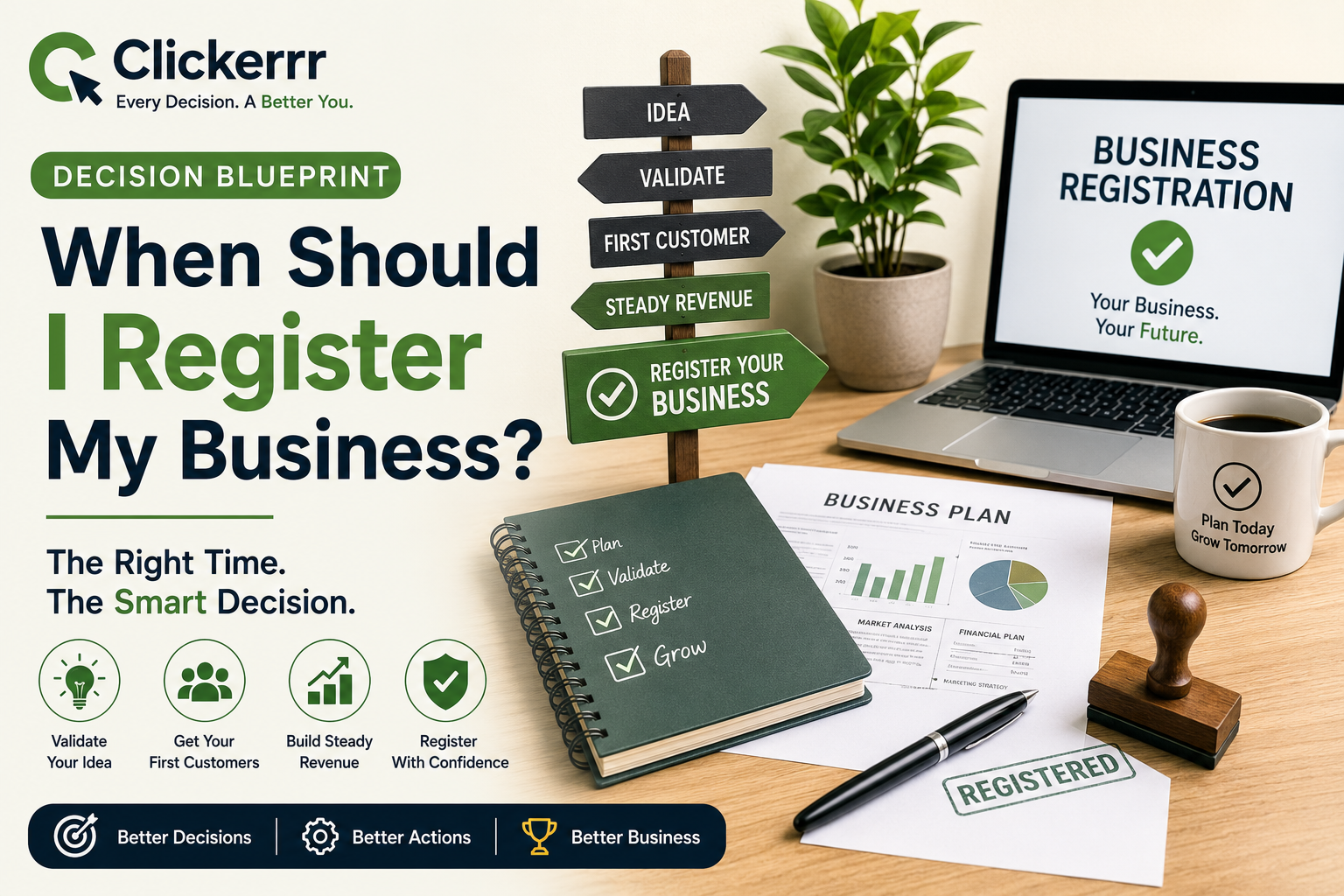
When Should I Register My Business?
The Right Time to Register—Not Too Early, Not Too Late.
Clickerrr Decision Blueprint
Category: Entrepreneurship → Business Registration → Business Setup
Decision Goal: Determine the right stage to legally register your business while minimising risk and maximising flexibility.
🌍 The Global Decision: When should I register my business?
One of the biggest mistakes first-time entrepreneurs make is believing that registering a business means starting a business.
It doesn’t.
Many founders spend weeks choosing a business name, designing logos, registering companies, opening bank accounts, and printing business cards before they’ve even spoken to a single customer.
Then reality arrives:
❌ No customers.
❌ No revenue.
❌ No product-market fit.
❌ Ongoing compliance costs.
A business registration is an important milestone, but it should support a validated business—not replace one.
The smartest entrepreneurs don’t ask the following:
“How do I register my business?”
They first ask:
“Has my business reached the stage where registration will create more value than cost?”
That is the decision this blueprint helps you make.
🎯 Decision Snapshot
| Factor | Assessment |
|---|---|
| Decision Type | Legal & Strategic |
| Difficulty | ⭐⭐☆☆☆ |
| Importance | ⭐⭐⭐⭐⭐ |
| Time Required | 30–90 Minutes |
| Cost | Low to Moderate |
| Risk if Done Too Early | High |
| Decision Confidence | 9.8 / 10 |
⚡ Quick Decision
Don’t register your business because you have an idea.
Register your business because you have evidence that the idea works.
Registration should support growth—not create unnecessary obligations.
📊 The Clickerrr Registration Decision Framework
Business Idea
      │
      ▼
Customer Validation
      │
      ▼
First Paying Customer
      │
      ▼
Consistent Revenue
      │
      ▼
Need for Legal Identity
      │
      ▼
Business Registration
      │
      ▼
Growth & Scaling
🤔 Before You Register
Ask yourself these questions honestly.
✅ Have I validated my idea?
✅ Has someone paid for my solution?
✅ Am I earning consistent revenue?
✅ Will registration help me grow?
✅ Do customers expect invoices?
✅ Do I need a business bank account?
✅ Do I need GST or tax registration?
✅ Am I hiring employees?
✅ Am I signing contracts?
If you answered “No” to most of these,
You probably don’t need to register yet.
🚦 Decision Confidence Meter
██████████████████████░ 98%

Decision Confidence

9.8 / 10
Why so high?
✅ Based on lean startup principles
✅ Reduces unnecessary costs
✅ Encourages customer validation first
✅ Supported by real entrepreneurial practices
At this stage:
💡 You only have an idea.
Maybe you’ve written notes.
Maybe you’ve designed a logo.
Maybe you’ve purchased a domain.
But nobody has paid you.
Should you register?
🔴 No.
Focus on learning.
You’re interviewing people.
Learning their problems.
Testing assumptions.
Collecting feedback.
Register now?
🔴 Still No.
Nothing legal requires registration yet.
Your job is learning.
You’ve built:
✔ MVP
✔ Prototype
✔ Sample
✔ Service
✔ Demo
Now people are trying it.
Some even pay.
Register now?
🟡 Usually not yet.
Continue validating.
Now something important happens.
People voluntarily pay.
Not friends.
Not family.
Real customers.
This changes everything.
Now your business has evidence.
Still…
You may not need immediate registration if you’re testing on a very small scale (requirements vary by country and business type).
Instead ask:
Will registration help me serve customers better?
You’re getting repeat customers.
Revenue becomes predictable.
You start thinking about:
✔ Branding
✔ Marketing
✔ Hiring
✔ Scaling
✔ Partnerships
Now registration becomes valuable.
This is where registration becomes almost essential.
You now need:
✅ Legal identity
✅ Contracts
✅ Tax compliance
✅ Business bank account
✅ Investors
✅ Employees
✅ Vendors
✅ Large clients
Registration creates trust.
You’re earning money consistently.
Customers ask for invoices.
You’re investing significant money.
You’re hiring people.
You need legal protection.
You want to build a long-term brand.
You’re signing agreements.
You’re opening business accounts.
❌ You only have an idea.
❌ Nobody wants your product.
❌ You’re still changing your business model every week.
❌ You haven’t spoken to customers.
❌ You’re afraid to sell.
❌ You’re registering only because “everyone does.”
✅ Professional credibility
Customers trust registered businesses.
✅ Legal protection
Separate personal and business liabilities (depending on business structure).
✅ Easier banking
Business bank accounts become available.
✅ Better partnerships
Companies prefer working with registered businesses.
✅ Access to funding
Loans and investors often require formal business information.
✅ Tax compliance
You can meet applicable tax obligations properly.
✅ Brand protection
Depending on your jurisdiction, registration can support your business identity and future trademark strategy.
❌ Registering before validation
The biggest mistake.
❌ Spending thousands on legal formalities
Before earning ₹100.
❌ Choosing a complicated business structure too early
Keep things simple until complexity becomes necessary.
❌ Ignoring legal requirements once you are actively operating
Waiting too long can also create problems.
❌ Thinking registration guarantees success
Customers create businesses.
Paperwork doesn’t.
| Situation | Register? |
|---|---|
| Just an idea | ❌ No |
| Customer interviews | ❌ No |
| Prototype testing | ❌ Usually No |
| First customer | 🟡 Depends |
| Consistent sales | ✅ Yes |
| Hiring employees | ✅ Yes |
| Seeking investors | ✅ Yes |
| Signing contracts | ✅ Yes |
| Expanding business | ✅ Definitely |
Idea
↓
Research
↓
Customer Interviews
↓
Prototype
↓
Validation
↓
First Customer
↓
Repeat Customers
↓
Consistent Revenue
↓
Register Business
↓
Scale
Write down your current stage honestly.
- Idea
- Research
- Validation
- First Customer
- Consistent Revenue
- Growth
Then ask yourself:
“If I register today, what practical problem will it solve?”
If you can’t answer clearly, continue validating first.
Complete these five tasks:
✔ Interview 10 potential customers
✔ Improve your offer based on feedback
✔ Try to get your first paying customer
✔ Estimate your monthly revenue
✔ Learn the registration requirements for your country or state so you’re prepared when the timing is right
📄 Business Validation Checklist
📄 Lean Startup Canvas
📄 Customer Interview Questions
📄 Business Model Canvas
📄 Startup Cost Calculator
📄 Cash Flow Planner
📄 Business Registration Readiness Checklist
📄 Business Structure Comparison Guide
📄 Tax & Compliance Planning Worksheet
📄 First-Year Business Roadmap
➡️ How do I choose a business idea?
➡️ How do I validate my business idea?
➡️ How much money do I need to start a business?
➡️ How do I write a business plan?
➡️ Should I start a business or keep my job?
➡️ How do I get my first customer?
➡️ Which business structure should I choose?
A business registration should be the result of progress, not the starting point of your entrepreneurial journey.
Validate first. Learn from customers. Generate real demand. Once your business demonstrates consistent traction and registration enables growth—through credibility, contracts, banking, compliance, or hiring—that is the right time to formalize it.
✅ Clickerrr Decision
Register your business when it begins creating real value, not when it exists only as an idea.
Better Decisions → Better Actions → Better Businesses.
When should I register my business?
Register your business only after you have validated your business idea and have signs that people are willing to pay for your product or service. Registration should support growth—not be the first step in your entrepreneurial journey.
Do I need to register my business before getting my first customer?
In many cases, no. Many entrepreneurs first validate demand, gain initial customers, and then complete formal registration when the business begins operating consistently. However, local laws and your business type may require earlier registration, so always check the regulations in your country.
What are the signs that it’s time to register my business?
Consider registering when you:
Have paying customers.
Generate regular revenue.
Need a business bank account.
Want to sign contracts.
Need to issue official invoices.
Plan to hire employees.
Want legal protection for your business.If several of these apply, registration is usually the next logical step.
What happens if I register my business too early?
Registering too early can lead to:
Unnecessary registration costs.
Ongoing compliance and tax obligations.
Annual filing requirements.
Administrative work before proving demand.
Extra stress while you’re still experimenting.Clickerrr’s recommendation is to validate first and register second.
Can I test my business idea without registering a company?
Yes. You can often validate your idea by:
Talking to potential customers.
Creating a landing page.
Offering consulting or freelance services (where legally permitted).
Running pre-orders.
Selling an MVP (Minimum Viable Product).
Collecting feedback before investing heavily.Always ensure you comply with local laws regarding commercial activities.
Which business structure should I choose after deciding to register?
The best structure depends on:
Your country.
Expected revenue.
Liability protection needs.
Tax considerations.
Number of founders.
Future funding plans.Common options include:
Sole Proprietorship
Partnership
Limited Liability Company (LLC)
Private Limited Company
CorporationChoose the structure that matches your long-term goals and seek professional advice where appropriate.
Should I register my company before building a website and brand?
Not necessarily. Your priority should usually be the following:
Validate the problem.
Validate the solution.
Get paying customers.
Improve your offer.
Then invest in branding, websites, and formal registration.This approach reduces unnecessary costs and risk.
How much does business registration usually cost?
Costs vary widely depending on:
Country.
State or province.
Business structure.
Government fees.
Professional assistance.
Licences and permits are required.Before registering, calculate not only the initial fee but also ongoing compliance costs such as renewals, accounting, and tax filings.
What documents are generally required to register a business?
Requirements differ by jurisdiction, but commonly include:
Personal identification.
Address proof.
Business name.
Business activity description.
Ownership details.
Tax registration information.
Required licenses or permits.Check the official government portal in your country for the exact requirements.
What is Clickerrr’s “Decision Blueprint” recommendation for business registration?
Clickerrr recommends following this decision path:
🟢 Step 1: Find a real problem.
🟢 Step 2: Validate your idea.
🟢 Step 3: Talk to real customers.
🟢 Step 4: Make your first sales.
🟢 Step 5: Improve your offer.
🟢 Step 6: Build repeatable revenue.
🟢 Step 7: Register your business when it helps you grow—not before.This sequence minimises unnecessary expenses while maximising the chances of building a sustainable business.