Decision Blueprint
How do I choose a business idea?
Stop Looking for a “Million-Dollar Idea”.
Start Looking for a Problem Worth Solving.
Decision Summary
Choosing a business idea is not about discovering a magical idea that nobody has ever thought of.
It is about finding the intersection of four things:
- Problems people already have
- Skills you already possess (or can learn)
- A market willing to pay
- A business model that can grow
Most beginners fail because they reverse this process.
They fall in love with an idea first.
Then they try to convince customers.
Successful entrepreneurs do exactly the opposite.
They understand customers first.
Then build the idea.
The Biggest Myth
Many people spend months waiting for the “perfect idea”.
The truth is…
Perfect ideas rarely exist.
Great businesses are usually improvements of existing solutions.
Google wasn’t the first search engine.
Facebook wasn’t the first social network.
Uber wasn’t the first taxi company.
Airbnb wasn’t the first hotel business.
The opportunity wasn’t an invention.
It was improvement.
First Principle
Never search for business ideas.
Search for problems.
Problems create demand.
Demand creates customers.
Customers create revenue.
Revenue creates businesses.
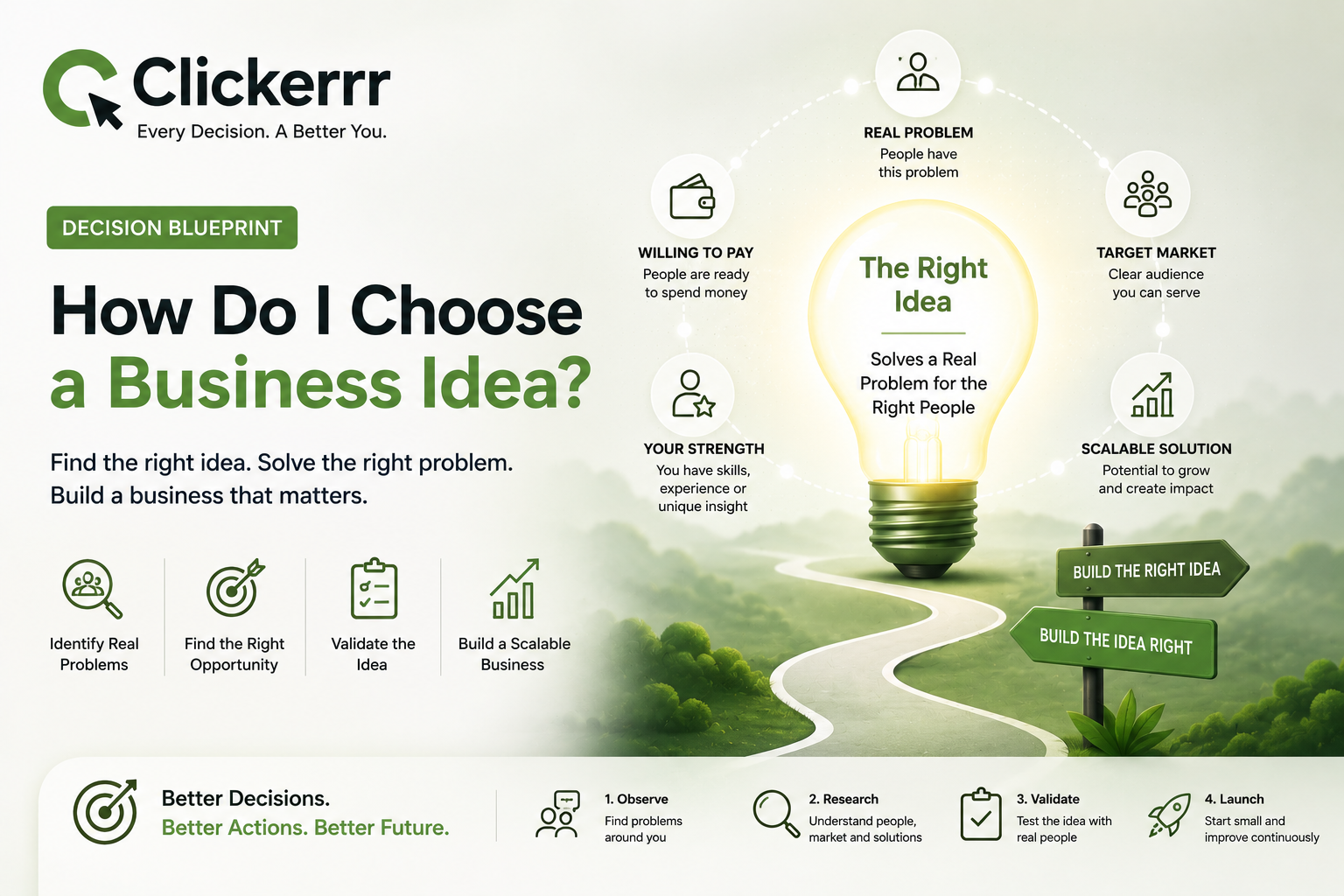
The Clickerrr Business Idea Formula
The best business ideas usually satisfy all five conditions.
1. Real Problem
People already experience the problem regularly.
If nobody feels the pain…
Nobody will pay.
2. Existing Spending
People are already paying someone.
This is a great sign.
It proves demand already exists.
Competing in an existing market is often easier than creating a completely new market.
3. Clear Target Customer
Avoid saying
“My product is for everyone.”
Instead, define one person.
Examples:
Busy doctors
College students
Small restaurants
Freelancers
Parents of toddlers
Fitness coaches
Software companies
The narrower the audience…
The easier marketing becomes.
4. Personal Advantage
Do you understand this market?
Maybe because
You worked there.
You studied there.
You have a hobby.
You faced this problem yourself.
Knowledge becomes an unfair advantage.
5. Scalable Solution
Can you serve
10 customers?
100?
1,000?
10,000?
A scalable business becomes more valuable over time.
Where Should You Look for Business Ideas?
Solve Your Own Problems
Many successful companies began this way.
Ask yourself
“What annoys me every week?”
Observe Professionals
Doctors
Teachers
Lawyers
Designers
Accountants
Engineers
Restaurant owners
Every profession has hidden inefficiencies.
Those inefficiencies become opportunities.
Read Online Communities
People publicly describe their frustrations every day.
Those frustrations are market research.
Read Product Reviews
Negative reviews reveal opportunities.
Study Existing Businesses
Never copy.
Instead ask
“What could be 10x easier?”
Evaluate Every Idea
For every idea, score it from 1 to 10.
Problem Severity
Does it genuinely hurt?
Frequency
How often does the problem occur?
Daily?
Weekly?
Monthly?
Willingness to Pay
Will customers actually spend money?
Market Size
How many people experience this?
Competition
Competition is good.
It proves demand.
The question isn’t
“Is there competition?”
The real question is
“Can I be better?”
The 10-Idea Rule
Before selecting one idea…
Write down ten.
Never stop after the first idea.
Your tenth idea is usually far better than your first.
Validate Before You Build
Do not build a website.
Do not register a company.
Do not design a logo.
Instead…
Talk to people.
Ask questions.
Understand pain points.
Validation is faster and cheaper than building.
Questions Every Entrepreneur Must Answer
Can I explain this idea in one sentence?
Who exactly will buy this?
What problem am I solving?
Why would someone choose me?
Can I find my first customer within 30 days?
If you cannot answer these…
The idea is still immature.
Common Mistakes
❌ Choosing ideas because they look exciting
❌ Copying billion-dollar startups
❌ Ignoring customer interviews
❌ Falling in love with technology
❌ Building before validating
❌ Trying to solve every problem
❌ Starting multiple businesses simultaneously
Clickerrr Recommendation
If you’re struggling to choose a business idea, don’t search for ideas in isolation.
Instead:
- Identify 25 problems you’ve personally experienced.
- Select the 10 that people frequently complain about.
- Speak with at least 20 potential customers.
- Rank each opportunity by pain level, willingness to pay, and market size.
- Build the smallest possible solution and seek your first paying customer before investing heavily.
A business idea should earn confidence through evidence, not excitement through imagination.
Today’s Decision
Write down 10 business ideas based on real problems you’ve observed.
Do not evaluate them yet.
Just capture them.
This Week’s Decision
Interview at least 10 people who experience one of those problems.
Listen far more than you speak.
Take notes on:
- Their biggest frustration
- Their current solution
- What they dislike about it
- Whether they have paid for a solution before
- How much better a new solution would need to be
Confidence Meter
9.5 / 10
This approach is highly reliable because it emphasises evidence over assumptions. Instead of chasing inspiration, you build around verified customer needs, significantly increasing the likelihood of creating a sustainable business.
Related Decision Blueprints
- Should I Start a Business or Keep My Job?
- How Do I Know If Entrepreneurship Is Right for Me?
- How do I start a business?
- How Do I Validate My Business Idea?
- How Much Money Do I Need to Start a Business?
- How Do I Get My First Customer?
- How Do I Find a Profitable Niche?
- Should I Build a Product or Offer a Service First?
- When Should I Register My Company?
- How Do I Price My Product or Service?
- How Do I Know If My Business Idea Will Work?






4 Comments
Comments are closed.