Decision Blueprint
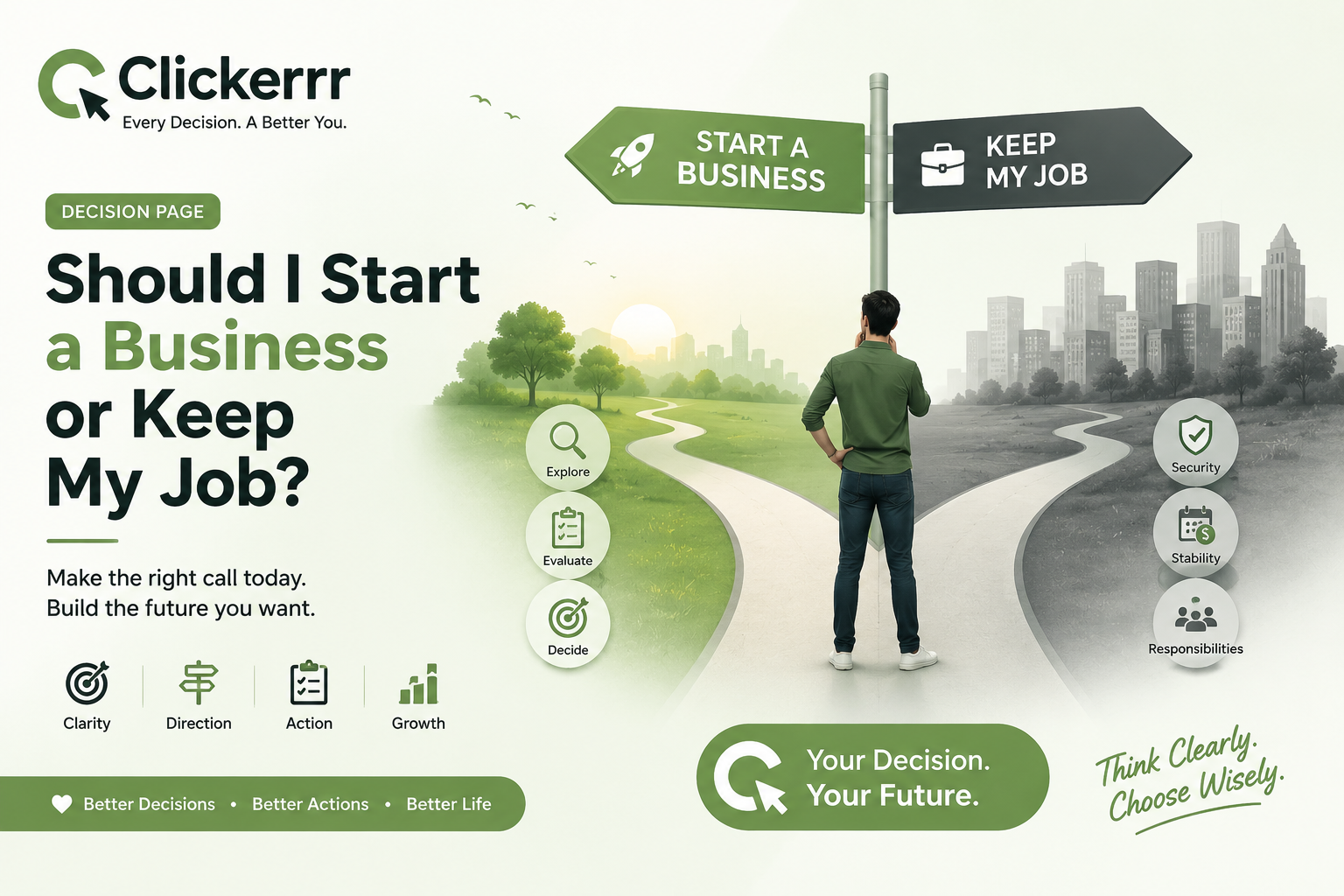
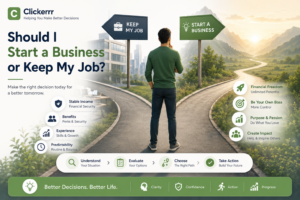
Should I Start a Business or Keep My Job?
Every successful career begins with one difficult decision.
One of the most common questions people ask themselves is:
“Should I continue with the security of my job, or should I take the risk of starting a business?”
There is no universal answer.
The right decision depends on your financial situation, responsibilities, personality, skills, opportunities, and long-term goals.
Many people quit too early and regret it.
Many people stay in a job for decades even though they secretly want to build something of their own.
The purpose of this Decision Blueprint is not to convince you to choose one side.
Its purpose is to help you make the right decision for your situation.
The Core Decision
You are actually deciding between two very different lifestyles.
Option A — Continue Your Job
A job offers:
- Stable monthly income
- Lower financial risk
- Predictable career path
- Employee benefits
- Easier financial planning
But it may also involve:
- Limited income ceiling
- Less freedom
- Dependency on employers
- Slower wealth creation
- Less control over your future
Option B — Start a Business
A business offers:
- Unlimited earning potential
- Freedom to create
- Ownership
- Scalability
- Long-term wealth creation
But it also requires:
- Uncertainty
- Financial discipline
- Emotional resilience
- Continuous learning
- Ability to solve customer problems
Neither option is automatically better.
Ask Yourself These Questions
Before making any decision, answer honestly.
Financial Questions
- Do I have emergency savings?
- Can I survive for 6–12 months without salary?
- Do I have debt?
- Does my family depend entirely on my income?
Personal Questions
- Do I enjoy solving problems?
- Can I tolerate uncertainty?
- Am I self-disciplined without external supervision?
- Do I enjoy selling ideas?
- Can I handle rejection?
Opportunity Questions
- Have I identified a real market problem?
- Do customers already exist?
- Have I spoken to potential customers?
- Can I get my first paying customer without quitting?
The Biggest Mistake
Many people believe:
“First quit the job.
Then I’ll be serious.”
Reality is often the opposite.
The safest path is usually:
Job → Validate → First Customers → Stable Revenue → Then Decide
Decision Matrix
Keep Your Job if…
✔ You have major financial responsibilities.
✔ You have no validated business idea.
✔ You have never sold anything.
✔ You are still learning valuable skills.
✔ You enjoy your current career.
Consider Starting a Business if…
✔ You have validated demand.
✔ Customers are already willing to pay.
✔ Your business income is becoming consistent.
✔ You understand your market.
✔ You have financial preparation.
The Hybrid Path (Recommended for Most People)
For most beginners, the smartest approach is not choosing one or the other immediately.
It is building both.
Phase 1
Keep your job.
Use evenings and weekends to build.
Phase 2
Validate the idea.
Talk to customers.
Sell before scaling.
Phase 3
Earn consistently.
Do not focus on revenue alone.
Focus on predictable revenue.
Phase 4
When business income consistently covers your essential living expenses for several months, evaluate whether transitioning full-time makes sense for your circumstances.
Risk Analysis
Staying Only in a Job
Advantages
- Stable income
- Lower stress
- Predictable career
Risks
- Salary dependency
- Limited wealth creation
- Career uncertainty if layoffs occur
Starting a Business Too Early
Advantages
- Full focus
Risks
- Financial pressure
- Emotional stress
- Poor decision-making
- Running out of money before finding customers
Confidence Meter
Recommendation Confidence
9.4 / 10
Reason:
The recommendation emphasises validating a business while maintaining financial stability. This approach generally reduces risk compared with quitting first, although individual situations can differ.
Today’s Action
Write answers to these five questions.
- Why do I want to start a business?
- What problem do I want to solve?
- Who would pay for this solution?
- Can I test it while keeping my current job?
- What would convince me that it is safe to transition?
This Week’s Action
Interview at least 10 potential customers.
Do not pitch.
Simply understand:
- their problems
- current solutions
- willingness to pay
- frustrations
The market should guide your decision—not your assumptions.
Common Mistakes
❌ Quitting because of frustration rather than preparation.
❌ Starting without talking to customers.
❌ Assuming passion guarantees success.
❌ Underestimating the time needed to build revenue.
❌ Ignoring family and financial responsibilities.
❌ Believing entrepreneurship automatically provides freedom.
Related Decisions
If you’re still uncertain, these ‘Decision Blueprints’ naturally come next:
- How do I know if entrepreneurship is right for me?
- How do I choose the right business idea?
- How do I validate my business idea?
- How Do I Start a Business?
- How much money do I need to start a business?
- When should I quit my job?
- How do I get my first paying customer?
- Should I bootstrap or raise funding?
Final Decision
If you already have:
- a validated business idea,
- paying customers,
- consistent revenue,
- financial preparation,
- and confidence in your execution,
then transitioning toward entrepreneurship may be a reasonable next step.
If you do not yet have these foundations, keeping your job while systematically building and validating your business is often the lower-risk path.
Clickerrr Decision Summary
Don’t choose between a job and a business based on emotion. Choose based on evidence. Build proof before making the leap. The strongest decisions are driven by validation, preparation, and timing—not impulse.


2 Comments
Comments are closed.