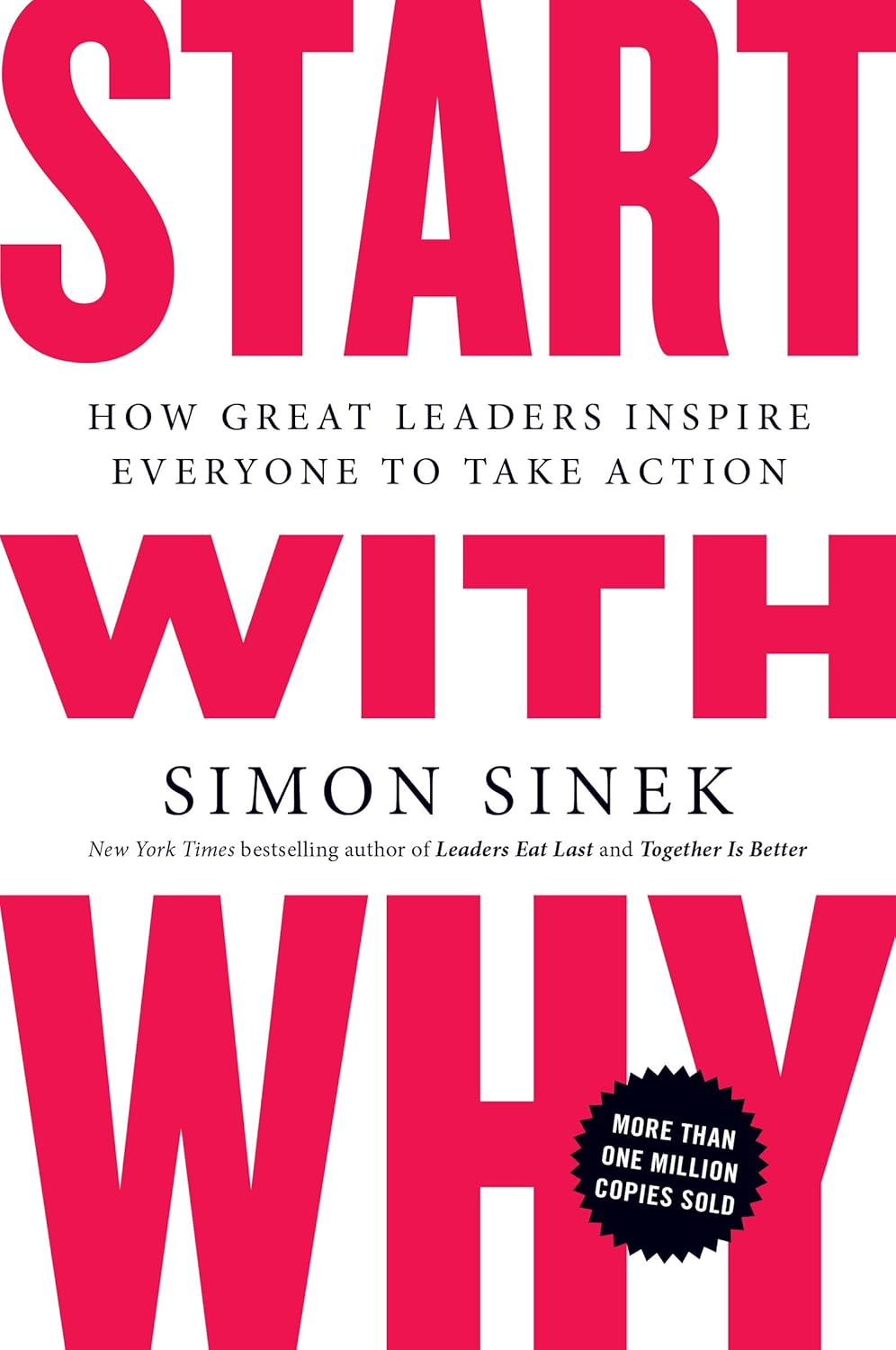
Start with Why: How Great Leaders Inspire Everyone to Take Action is a business and leadership book by Simon Sinek, first published in 2009 by Portfolio, an imprint of Penguin Group. The book explores why certain leaders, organizations and movements are able to inspire people to act, while others struggle to generate lasting loyalty even when they offer competitive products or services.
The central idea of the book is known as the Golden Circle, consisting of three concentric questions:
Why → How → What
Sinek argues that most organizations communicate from the outside inward: they explain what they do, sometimes how they do it, and only occasionally explain why they do it. Inspirational leaders, in his framework, communicate in the opposite direction, beginning with their underlying purpose, cause or belief—their WHY.
The book developed from Sinek’s earlier work on the Golden Circle and his 2009 TED Talk, How Great Leaders Inspire Action. The TED presentation helped popularize the concept internationally, while Start with Why expanded the idea into a broader framework for leadership, communication, marketing, organizational culture and innovation.
The book’s influence extends well beyond business. Its central question—Why do you do what you do?—has been applied to entrepreneurship, branding, employee engagement, leadership, personal purpose and organizational identity.
Bibliographic information
| Field | Details |
|---|---|
| Title | Start with Why: How Great Leaders Inspire Everyone to Take Action |
| Author | Simon Sinek |
| Original language | English |
| Country | United States |
| Subject | Leadership, business, marketing, organizational behavior |
| Genre | Business / non-fiction |
| Publisher | Portfolio, Penguin Group |
| Original publication | 2009 |
| Original edition | 256 pages |
| ISBN | 978-1-59184-280-4 |
| Central concept | The Golden Circle |
| Three elements | Why, How, What |
| Primary theme | Purpose-driven leadership and communication |
Google Books records the original Penguin Publishing Group edition as a 2009, 256-page work with ISBN 9781591842804.
The book has subsequently appeared in multiple editions. Penguin’s 15th-anniversary edition was released in 2025 with a new foreword by Sinek and runs to 272 pages.
Overview
At the heart of Start with Why is a deceptively simple question:
Why do some people and organizations inspire action while others do not?
Sinek’s answer is that inspiring organizations communicate their underlying purpose before explaining their products, services or methods.
The distinction can be represented as:
TRADITIONAL COMMUNICATION

WHAT
 ↓
HOW
 ↓
WHY


SINEK'S GOLDEN CIRCLE

WHY
 ↓
HOW
 ↓
WHAT
The difference is not merely about the order of words.
Sinek argues that starting with WHY changes the nature of the relationship between an organization and its audience.
A company that says:
“We make computers with powerful processors and beautiful displays.”
is primarily describing a product.
A company that communicates:
“We believe in challenging the status quo and thinking differently.”
is communicating a belief.
The product then becomes evidence of that belief.
This distinction forms the foundation of the book.
Origins of the book
The origins of Start with Why are closely connected to Sinek’s work on the Golden Circle.
Sinek’s 2009 TED Talk, How Great Leaders Inspire Action, presented the basic concept to a large public audience. His official site states that the talk was delivered at TEDxPugetSound in Seattle in 2009 and became the foundation for the ideas subsequently developed in Start with Why.
The book expanded the concept considerably.
Rather than treating WHY merely as a marketing slogan, Sinek connects it with:
- leadership,
- employee motivation,
- organizational culture,
- customer loyalty,
- innovation,
- decision-making,
- communication,
- hiring,
- and organizational succession.
The Smithsonian Libraries and Archives catalog describes the book’s contents as covering the Golden Circle, biology, trust, communication, leadership, discovering WHY and the challenge of maintaining a clear WHY as organizations become successful.
The Golden Circle
The Golden Circle is the central framework of Start with Why.
It consists of three concentric circles.
                 ┌───────────────────────┐
                 │                       │
                 │        WHAT           │
                 │                       │
                 │     ┌─────────────┐   │
                 │     │             │   │
                 │     │     HOW     │   │
                 │     │             │   │
                 │     │   ┌─────┐   │   │
                 │     │   │ WHY │   │   │
                 │     │   └─────┘   │   │
                 │     │             │   │
                 │     └─────────────┘   │
                 │                       │
                 └───────────────────────┘
Sinek defines the three layers as follows.
WHY
The organization’s purpose, cause or belief.
It answers:
Why does this organization exist beyond making money?
HOW
The principles, processes or distinctive methods through which the organization expresses its WHY.
It answers:
How do we bring our belief to life?
WHAT
The tangible products, services or activities of the organization.
It answers:
What do we actually do or sell?
Sinek’s official explanation of the Golden Circle describes WHY as the purpose or belief at the center, HOW as the way an organization brings that belief to life, and WHAT as the tangible products or services it provides.
WHY
The WHY is the most important element of the framework.
Sinek makes an important distinction between purpose and profit.
Profit is an outcome.
It tells an organization whether its economic activity is producing financial returns.
In Sinek’s framework, WHY describes the deeper reason for undertaking the activity in the first place.
For example:
WHY
"We believe education should be accessible."

        ↓

HOW
"We simplify complex subjects and make learning affordable."

        ↓

WHAT
"Online courses, books and educational tools."
The WHAT can change.
The HOW can evolve.
The WHY is intended to remain comparatively stable.
HOW
The HOW represents the principles, methods and distinctive practices through which an organization expresses its WHY.
Two organizations may believe similar things but express those beliefs differently.
For example:
WHY
"Make professional knowledge accessible."

        │
        ├───────────────┐
        │               │
        ▼               ▼
      HOW A           HOW B
  Personal coaching   Technology
        │               │
        ▼               ▼
      WHAT A           WHAT B
  Consulting          Learning platform
The HOW therefore provides the bridge between abstract purpose and tangible action.
WHAT
The WHAT is the easiest part to identify.
It consists of:
- products,
- services,
- activities,
- technologies,
- campaigns,
- programs,
- or other tangible outputs.
Almost every organization can clearly describe its WHAT.
The problem, according to Sinek, is that organizations often stop there.
They explain:
What they sell.
They may explain:
How they make it.
But they fail to explain:
Why they exist.
Inside-out communication
One of the book’s principal recommendations is to communicate from the inside out.
                    WHY
                     │
                     ▼
                    HOW
                     │
                     ▼
                    WHAT
                     │
                     ▼
                CUSTOMER ACTION
Sinek argues that this pattern is associated with organizations that inspire people rather than simply attempting to persuade them through product features or price.
The official Golden Circle explanation similarly presents the model as applicable to leadership, hiring, product development, sales and marketing.
Outside-in communication
Sinek contrasts the Golden Circle with a more common communication pattern:
WHAT
"We make excellent smartphones."

      ↓

HOW
"We use advanced technology."

      ↓

WHY
"We want to improve people's lives."
This approach provides information but may not create the same emotional connection that a purpose-led message is intended to create.
The difference is therefore not necessarily about whether the WHAT is communicated.
It is about where the communication begins.
Inspiration versus manipulation
Another important distinction in Start with Why is between inspiration and manipulation.
Sinek argues that businesses frequently use manipulative techniques to influence consumer behavior.
These may include:
- discounts,
- promotions,
- fear,
- urgency,
- novelty,
- price competition,
- rewards,
- and other short-term incentives.
Such mechanisms can be effective.
But Sinek distinguishes short-term behavioral manipulation from longer-term inspiration.
His argument is that people who genuinely identify with an organization’s WHY may develop stronger loyalty because their relationship with the organization is based on shared beliefs rather than merely on immediate incentives.
The power of belief
The book proposes that organizations do not necessarily need everyone to agree with every aspect of their operation.
Instead, they need people who identify with the underlying belief.
The logic can be summarized as:
Shared belief
     ↓
Emotional connection
     ↓
Trust
     ↓
Loyalty
     ↓
Long-term relationship
This is why Sinek repeatedly uses leaders and organizations that appear to attract unusually committed followers as examples.
Apple as the principal example
One of the most famous examples in Start with Why is Apple.
Sinek uses Apple to illustrate what he means by inside-out communication.
A conventional product-centered message might emphasize:
- processor speed,
- screen resolution,
- operating system,
- storage,
- battery life,
- price.
A WHY-centered message instead begins with a belief such as challenging conventional thinking and empowering people to think differently.
The products then become expressions of that belief.
The model can be represented as:
APPLE

WHY
Challenge the status quo
Think differently
        │
        ▼
HOW
Design products and experiences
that embody those principles
        │
        ▼
WHAT
Mac
iPhone
iPad
Services
etc.
Sinek uses Apple not simply because of its products, but because he considers its communication style an illustration of the Golden Circle.
The example became one of the most recognizable applications of his framework.
Martin Luther King Jr.
Sinek also discusses Martin Luther King Jr. as an example of leadership built around belief.
The distinction is between:
“I have a plan.”
and
“I have a dream.”
The latter communicates a vision of a different future.
Sinek argues that movements become powerful when people are invited to participate in a belief rather than merely instructed to perform an action.
This is why the book treats leadership as more than giving orders.
A leader must provide something that followers can believe in.
The Wright brothers
The Wright brothers are another important example.
Sinek contrasts the Wright brothers with Samuel Pierpont Langley, who also pursued powered flight.
The example is used to illustrate the difference between:
- having money,
- having resources,
- having technical capability,
and
- having people who genuinely believe in a cause.
The Wright brothers operated with fewer resources than some competitors but attracted individuals who shared their belief in achieving powered flight.
In Sinek’s interpretation, the example demonstrates the relationship between purpose and commitment.
The biology of WHY
One section of the book is titled “This Is Not Opinion, This Is Biology.”
Sinek attempts to connect the Golden Circle with the way the human brain processes information and makes decisions.
He associates:
- the WHAT with rational, tangible information,
- and the WHY with emotional and behavioral processes.
The argument draws on distinctions involving different regions and functions of the brain, particularly the relationship between the neocortex and the limbic brain.
Sinek’s simplified model is:
                  HUMAN BRAIN

             ┌───────────────────┐
             │    NEOCORTEX      │
             │                   │
             │ Rational thought  │
             │ Language          │
             │ Facts              │
             └─────────┬─────────┘
                       │
                       ▼
             ┌───────────────────┐
             │  LIMBIC SYSTEM    │
             │                   │
             │ Emotion           │
             │ Trust             │
             │ Decision-making   │
             └───────────────────┘
This section is one of the areas where modern readers should distinguish between Sinek’s popular explanatory model and the much more complicated scientific literature concerning neuroscience and decision-making.
The Golden Circle is a communication framework; it should not be treated as a complete scientific model of the brain.
“People don’t buy what you do”
One of the most memorable ideas associated with the book is that customers are influenced not merely by what an organization does, but by why it does it.
In practical terms:
PRODUCT
   ↓
"I can use this."

PURPOSE
   ↓
"I believe in this."

IDENTITY
   ↓
"This represents something I believe."
The strongest form of loyalty occurs, in Sinek’s framework, when the customer’s relationship with the organization becomes connected to identity and shared values.
The Celery Test
Sinek introduces an example sometimes called the Celery Test.
Imagine someone tells you that you should eat:
- celery,
- chocolate,
- ice cream,
- and rice cakes.
Without knowing why, the recommendation can feel arbitrary.
But suppose someone explains:
“I am training for a marathon and want to improve my diet.”
Now the recommendation has a context.
Celery makes sense.
The principle is:
WHY
"I want to run a marathon."

        ↓

HOW
"I need a disciplined nutrition strategy."

        ↓

WHAT
"Celery fits my strategy."
The metaphor illustrates how a clearly understood WHY can function as a filter for decisions.
If a proposed action does not fit the WHY, it can be rejected.
The WHY as a decision-making filter
A clear WHY therefore has an organizational function beyond marketing.
It can help answer:
- Should we enter this market?
- Should we launch this product?
- Should we hire this person?
- Should we accept this partnership?
- Should we change our pricing?
- Should we abandon this project?
The logic becomes:
NEW OPPORTUNITY
       │
       ▼
Does it fit our WHY?
       │
   ┌───┴───┐
   │       │
  YES      NO
   │       │
   ▼       ▼
Proceed   Reject /
           rethink
This is one of the practical strengths of the framework.
A WHY is not merely something an organization puts on its “About Us” page.
It can become a strategic filter.
Clarity, discipline and consistency
The book emphasizes three qualities necessary to make a WHY useful:
Clarity
The organization must know what it believes.
Discipline
The organization must consistently make decisions that reflect that belief.
Consistency
The organization’s actions and communications must reinforce the same underlying message.
This can be represented as:
          CLARITY
             │
             ▼
        DISCIPLINE
             │
             ▼
        CONSISTENCY
             │
             ▼
           TRUST
             │
             ▼
          LOYALTY
If an organization claims one thing but repeatedly behaves differently, the WHY loses credibility.
Leaders need followers
Sinek makes an important distinction between a leader and someone who merely holds a leadership position.
A formal title does not automatically create followers.
Leadership, in his framework, involves attracting people who voluntarily choose to participate in a shared vision.
POSITION
   ↓
Authority

BELIEF
   ↓
Leadership

SHARED BELIEF
   ↓
Following
This is why Sinek’s leadership model emphasizes inspiration rather than command.
The Law of Diffusion of Innovations
Another concept discussed in the book is the Law of Diffusion of Innovations, associated with the work of sociologist Everett Rogers.
The diffusion model commonly divides adopters into:
- innovators,
- early adopters,
- early majority,
- late majority,
- laggards.
A simplified representation is:
Innovators
   │
   ▼
Early Adopters
   │
   ▼
──────── Tipping Point ────────
   │
   ▼
Early Majority
   │
   ▼
Late Majority
   │
   ▼
Laggards
Sinek connects this model with the idea that organizations should first attract people who already believe what they believe.
Those early believers can help create momentum before the broader market follows.
The tipping point
The tipping point occurs when an idea moves beyond a relatively small group of committed supporters and begins to spread through a much larger population.
In Sinek’s framework:
Small group of believers
          ↓
Early adopters
          ↓
Trust + social proof
          ↓
Growing movement
          ↓
Mass adoption
The important idea is that mass-market success does not necessarily begin with the mass market.
It may begin with a small number of people who deeply identify with the underlying belief.
Trust and loyalty
Trust is one of the recurring themes in the book.
Sinek distinguishes between:
knowing what someone does
and
knowing what someone believes.
If an organization consistently behaves according to its stated WHY, people may begin to trust it.
Trust can then influence:
- customer loyalty,
- employee commitment,
- partnerships,
- recruitment,
- and organizational resilience.
However, a WHY statement by itself cannot create trust.
Trust requires consistency between:
what an organization says
and
what it actually does.
Communication is not simply speaking
Another important idea is that communication is not merely the transmission of information.
Sinek emphasizes that effective leaders must understand what their audience believes and what motivates them.
The goal is not simply:
“Make people understand us.”
It is:
“Find the people who already believe what we believe.”
This changes the role of communication.
Instead of attempting to persuade everyone, an organization communicates its WHY clearly and allows people who identify with it to recognize themselves in the message.
Hiring and organizational culture
The Golden Circle can also be applied internally.
A company that hires people solely because they possess technical skills may obtain competent employees.
A company that also considers whether candidates identify with its purpose may create stronger cultural alignment.
The framework can therefore be applied as:
WHY
Company purpose
   ↓
WHO
People who believe it
   ↓
HOW
Shared ways of working
   ↓
WHAT
Products and services
The idea is particularly relevant to organizations where employee motivation and cultural coherence are important.
The danger of success
One of the later sections of Start with Why examines what happens when organizations become successful.
Success can create a paradox.
An organization may begin with a clear WHY.
It then grows.
More employees join.
More products are launched.
More revenue is generated.
More managers become involved.
Eventually, the organization may become focused primarily on:
- targets,
- revenue,
- market share,
- processes,
- metrics,
- and quarterly performance.
The original WHY can become less visible.
Sinek describes this as the WHY becoming fuzzy.
CLEAR WHY
   ↓
Strong organization
   ↓
Growth
   ↓
Complexity
   ↓
More products / people / markets
   ↓
Operational focus
   ↓
WHY becomes less clear
   ↓
Loss of coherence
The challenge is therefore not simply finding a WHY.
It is preserving it while the organization grows.
Split Happens
Sinek uses the idea of a “split” to describe what can occur when the founder or original visionary is separated from the organization.
The founder may embody the WHY naturally.
But employees cannot simply see inside the founder’s mind.
As the organization grows, the WHY must become embedded in:
- people,
- systems,
- communication,
- decisions,
- products,
- and culture.
Otherwise, the organization can continue operating while gradually losing its original purpose.
The importance of authenticity
The book repeatedly returns to authenticity.
An organization’s WHY must correspond to something it genuinely believes.
A company cannot simply manufacture a purpose statement because purpose-driven marketing is fashionable.
If:
WHAT says one thing
        +
HOW does something else
        +
WHY claims something completely different
the inconsistency becomes visible.
Authenticity therefore depends on alignment:
WHY
 ↓
HOW
 ↓
WHAT
 ↓
BEHAVIOR
 ↓
EXPERIENCE
All five should tell essentially the same story.
The New Competition
The book’s final sections examine how competition changes when organizations stop thinking solely in terms of products and begin thinking in terms of beliefs.
If companies compete only on WHAT, products can become interchangeable.
If organizations compete through WHY, differentiation may become more difficult to copy because the underlying identity is embedded in culture and relationships.
This does not mean competitors cannot imitate a company’s messaging.
They can.
The more difficult element to copy is the organizational alignment behind the message.
The Golden Circle as a business model
The framework can be converted into a practical business model:
                 PURPOSE
                    │
                    ▼
                  WHY
                    │
                    ▼
             ORGANIZATIONAL
                PRINCIPLES
                    │
                    ▼
                  HOW
                    │
                    ▼
             PRODUCTS / SERVICES
                    │
                    ▼
                  WHAT
                    │
                    ▼
               CUSTOMER
                EXPERIENCE
                    │
                    ▼
                 TRUST
                    │
                    ▼
                LOYALTY
This is why the Golden Circle can be applied beyond advertising.
It can influence:
- product development,
- hiring,
- company culture,
- leadership,
- sales,
- customer service,
- partnerships,
- and strategic decisions.
Major examples used in the book
Sinek’s argument is developed through a series of historical and corporate examples.
Among the most prominent are:
| Example | Role in the book |
|---|---|
| Apple | Communicating from WHY |
| Martin Luther King Jr. | Inspiring movements through belief |
| Wright brothers | Purpose, belief and commitment |
| Samuel Pierpont Langley | Contrast with the Wright brothers |
| Southwest Airlines | Organizational identity and consistency |
| Harley-Davidson | Community and identity |
| Costco | Organizational values and customer relationships |
| TiVo | The consequences of communicating WHAT rather than WHY |
| Wal-Mart | The effects of organizational evolution |
| Microsoft | Organizational communication and competitive change |
These examples are not presented as identical cases. Each is used to illuminate a particular aspect of the Golden Circle or the relationship between purpose and organizational behavior.
A practical Golden Circle for an organization
A company attempting to apply Sinek’s framework can construct its own Golden Circle.
Step 1: Define WHY
Ask:
What do we believe?
Not:
What do we sell?
Step 2: Define HOW
Ask:
What principles make our approach distinctive?
Step 3: Define WHAT
Ask:
What products, services or activities express our WHY?
Step 4: Align decisions
Every major decision should be tested against the WHY.
Step 5: Communicate inside-out
Present the purpose before the product.
Step 6: Make behavior match the message
A WHY becomes meaningful only when it is reflected in actual organizational behavior.
Example: building a hypothetical company
Consider a fictional educational company.
Conventional approach
WHAT:
“We sell online courses.”
HOW:
“Our courses are affordable and easy to use.”
WHY:
“We want to make money by selling education.”
This communication is clear but transactional.
Golden Circle approach
WHY:
“We believe access to practical knowledge can change people’s opportunities.”
HOW:
“We simplify complex subjects and make useful knowledge accessible worldwide.”
WHAT:
“We create online courses, books and learning tools.”
The products have not changed dramatically.
The meaning surrounding the products has changed.
That is precisely the type of distinction Sinek wants organizations to understand.
Start with Why and branding
The book has had a particularly strong influence on modern discussions of branding.
Traditional branding often emphasizes:
- logos,
- colors,
- slogans,
- advertising,
- product features,
- positioning.
Sinek’s framework shifts attention toward:
What does the brand believe?
The brand then becomes an expression of that belief.
BELIEF
  ↓
PURPOSE
  ↓
BRAND IDENTITY
  ↓
PRODUCT
  ↓
CUSTOMER EXPERIENCE
The implication is that a strong brand is not simply visually recognizable.
It is conceptually recognizable.
Start with Why and entrepreneurship
For entrepreneurs, the WHY can serve as a filter during periods of uncertainty.
A startup may change:
- its product,
- pricing,
- technology,
- target market,
- business model,
- distribution method.
But if its underlying purpose remains stable, these changes need not destroy its identity.
                     WHY
                      │
        ┌─────────────┼─────────────┐
        ▼             ▼             ▼
      Product       Market       Business
       change       change         model
        │             │             │
        └─────────────┼─────────────┘
                      ▼
                Same purpose
This is particularly relevant to startups because the WHAT may change repeatedly before product-market fit is found.
Start with Why and leadership
The leadership philosophy of the book can be summarized as:
People do not necessarily follow leaders because they have authority. They follow when they believe in what the leader believes.
This changes the role of the leader from:
commander
to:
communicator of purpose.
A leader’s job becomes not merely to tell people what to do, but to create sufficient clarity about the destination and the reason for pursuing it.
Start with Why and employee motivation
The same principle can be applied internally.
An employee may work for:
- salary,
- promotion,
- job security,
- status.
Those are external incentives.
Sinek’s framework emphasizes another possibility:
the employee believes in the organization’s purpose.
The two can coexist.
A purpose-driven organization does not eliminate compensation.
Instead:
FAIR COMPENSATION
        +
MEANINGFUL PURPOSE
        +
CLEAR EXPECTATIONS
        +
TRUST
        ↓
EMPLOYEE COMMITMENT
The book’s argument is therefore not that money is irrelevant.
It is that money alone does not explain all forms of commitment.
Criticism and limitations
Start with Why has been widely influential, but its ideas should not be treated as universally established scientific laws.
Several aspects deserve critical examination.
1. The Golden Circle is a framework, not a complete theory
The WHY–HOW–WHAT model is useful as a communication framework, but organizations are more complicated than three concentric circles.
Organizational performance also depends on:
- capital,
- technology,
- competitive structure,
- regulation,
- execution,
- pricing,
- distribution,
- talent,
- timing,
- and market demand.
A strong WHY cannot compensate indefinitely for poor execution.
2. The neuroscience explanation is simplified
Sinek’s discussion of the brain provides an intuitive explanation for why purpose-driven communication might influence behavior.
However, human decision-making does not divide neatly into:
rational neocortex
versus
emotional limbic system.
Modern neuroscience describes decision-making as a highly interconnected process involving multiple brain systems.
Consequently, the neuroscience portion of the book is best understood as a simplified communication model rather than a comprehensive account of human neurobiology.
3. Correlation is not causation
The book presents organizations and leaders that appear highly influential and then identifies common patterns in how they communicate.
But a central methodological question remains:
Does starting with WHY cause organizations to become successful, or do successful organizations become better at articulating their WHY?
The distinction matters.
An organization can have a compelling purpose and still fail because its:
- product is poor,
- economics are unsustainable,
- operations are weak,
- or market does not exist.
4. Successful examples create selection bias
Apple, Martin Luther King Jr. and the Wright brothers are unusually memorable examples.
But studying successful examples can create a selection problem.
There may also be organizations with:
- clear WHY statements,
- strong internal purpose,
- excellent storytelling,
that nevertheless failed.
Those cases receive less attention because failure is less visible in popular management literature.
5. Purpose does not guarantee loyalty
Customers can strongly identify with a brand’s purpose, but loyalty is also affected by:
- price,
- convenience,
- product quality,
- switching costs,
- availability,
- competition,
- and customer experience.
A compelling WHY can strengthen a relationship, but it is not a substitute for delivering value.
Academic and practical reception
The book became highly influential in popular leadership and business culture.
Its central concept spread far beyond the book itself, partly because of Sinek’s TED Talk.
The official publisher currently describes Start with Why as a bestselling work that helped popularize the idea of purpose at work, while Simon Sinek’s own organization states that the book has sold more than one million copies in more than 50 languages.
The 15th-anniversary edition released in 2025 describes the book as having sold more than three million copies, illustrating its continued commercial reach.
The book has therefore had an influence that extends beyond conventional management publishing.
Its vocabulary—particularly “Start with Why” and “Golden Circle”—has entered everyday discussions about organizational purpose.
The book and Simon Sinek’s TED Talk
The relationship between the book and Sinek’s TED Talk is unusual.
Many readers encountered the idea first through the talk and then explored the book.
The 2009 TED presentation, How Great Leaders Inspire Action, became closely associated with the Golden Circle. Sinek’s official website reports that his TED Talks have reached more than 100 million people worldwide, while the publisher describes the original talk as one of the most widely viewed TED presentations.
The relationship can be represented as:
EARLY IDEA
    │
    ▼
GOLDEN CIRCLE
    │
    ▼
2009 TED TALK
    │
    ▼
GLOBAL ATTENTION
    │
    ▼
START WITH WHY
    │
    ▼
BROADER LEADERSHIP FRAMEWORK
The TED Talk therefore served as a major gateway through which the book’s ideas reached a worldwide audience.
Influence on modern business language
One of the book’s most visible contributions is linguistic.
Before Sinek’s work became widely known, companies certainly discussed:
- mission,
- purpose,
- vision,
- values,
- beliefs.
What changed was the simplicity of the question:
“What is your WHY?”
That question is easy to remember and easy to use in:
- business workshops,
- interviews,
- strategy meetings,
- startup discussions,
- marketing planning,
- leadership programs,
- and personal-development exercises.
Its simplicity is both its strength and its limitation.
Start with Why as a personal philosophy
Although the book is primarily concerned with leaders and organizations, its framework can also be applied personally.
A person can ask:
WHY
What do I believe?
HOW
What principles guide my behavior?
WHAT
What am I actually doing?
This creates a personal Golden Circle:
             PERSONAL WHY
                  │
                  ▼
          VALUES & PRINCIPLES
                  │
                  ▼
              BEHAVIOR
                  │
                  ▼
               ACTIONS
                  │
                  ▼
               RESULTS
The same framework can therefore be applied to:
- career decisions,
- entrepreneurship,
- education,
- creative work,
- relationships with teams,
- and long-term goals.
A complete Golden Circle infographic
                     ┌─────────────────────────┐
                     │                         │
                     │          WHAT           │
                     │                         │
                     │   Products / Services   │
                     │   Activities / Output   │
                     │                         │
                     │     ┌─────────────┐     │
                     │     │             │     │
                     │     │    HOW      │     │
                     │     │             │     │
                     │     │  Principles │     │
                     │     │  Processes  │     │
                     │     │             │     │
                     │     │   ┌─────┐   │     │
                     │     │   │ WHY │   │     │
                     │     │   │     │   │     │
                     │     │   │Purpose   │     │
                     │     │   │Belief    │     │
                     │     │   └─────┘   │     │
                     │     │             │     │
                     │     └─────────────┘     │
                     │                         │
                     └─────────────────────────┘
The Start with Why model in practice
The framework can be converted into a practical organizational sequence:
1. DISCOVER WHY
       ↓
2. DEFINE HOW
       ↓
3. IDENTIFY WHAT
       ↓
4. ALIGN PEOPLE
       ↓
5. ALIGN PRODUCTS
       ↓
6. ALIGN COMMUNICATION
       ↓
7. ALIGN DECISIONS
       ↓
8. REPEAT CONSISTENTLY
       ↓
9. BUILD TRUST
       ↓
10. CREATE LONG-TERM RELATIONSHIPS
The key word is alignment.
A WHY that exists only in marketing material is unlikely to have much organizational value.
The WHY becomes powerful when:
people + decisions + products + communication + behavior
all reinforce it.
Key concepts at a glance
| Concept | Meaning |
|---|---|
| WHY | Purpose, cause or belief |
| HOW | Principles and methods |
| WHAT | Products, services or activities |
| Golden Circle | WHY → HOW → WHAT framework |
| Inside-out communication | Communicating purpose before products |
| Inspiration | Connecting people with shared belief |
| Manipulation | Influencing behavior through short-term incentives |
| Celery Test | Using WHY as a decision filter |
| Diffusion of Innovations | How new ideas spread through populations |
| Tipping Point | The point at which adoption expands rapidly |
| Trust | Confidence created through consistency |
| Fuzzy WHY | Loss of clarity about organizational purpose |
The central argument of the book
The central argument of Start with Why can be summarized in one sentence:
Organizations and leaders are more capable of inspiring people when they clearly communicate the purpose, cause or belief behind what they do.
But the deeper argument is slightly more subtle.
Sinek is not simply telling companies to write a mission statement.
He is asking them to reverse the order in which they think about their organization.
Instead of asking:
What should we sell?
the organization begins by asking:
What do we believe?
Then:
How can we express that belief?
And finally:
What should we build, sell or do?
This creates:
BELIEF
   ↓
PURPOSE
   ↓
PRINCIPLES
   ↓
ACTION
   ↓
PRODUCT
   ↓
CUSTOMER EXPERIENCE
   ↓
RELATIONSHIP
Why Start with Why became so influential
The book’s success can be partly explained by the fact that it gives a complicated subject—leadership and human motivation—a remarkably simple vocabulary.
Three words are enough:
WHY. HOW. WHAT.
The framework is memorable.
It can be drawn on a whiteboard in seconds.
It can be explained to a team in minutes.
And it can be applied to a multinational corporation, a startup, a nonprofit organization or an individual career decision.
That simplicity helped the idea travel.
At the same time, simplicity should not be confused with completeness.
A business cannot be understood entirely through a Golden Circle.
But the Golden Circle can provide a useful starting question.
Legacy
Start with Why became the foundation of a broader body of work by Simon Sinek.
Later books include:
- Leaders Eat Last
- Together Is Better
- Find Your Why
- The Infinite Game
Penguin Random House currently lists these works among Sinek’s major books.
The book’s influence can also be seen in the continuing use of purpose-oriented language in discussions of:
- organizational culture,
- employer branding,
- customer loyalty,
- leadership,
- employee engagement,
- entrepreneurship,
- and corporate identity.
Its most enduring contribution may be the transformation of an abstract question about purpose into a simple management vocabulary.
About the author
Simon Sinek
Simon Oliver Sinek is a British-born American author, speaker and leadership thinker known for his work on purpose, leadership and organizational culture.
He is the author of Start with Why, Leaders Eat Last, Together Is Better, Find Your Why and The Infinite Game. Penguin Random House describes him as an author focused on helping organizations and individuals create workplaces characterized by inspiration, safety and fulfillment.
Sinek’s official biography describes him as an optimist whose work focuses on inspiring leaders and organizations. He has presented his ideas to organizations ranging from startups to large corporations and government institutions.
His work became internationally recognized following his 2009 TED Talk on the Golden Circle. His subsequent books expanded his thinking from purpose-driven communication into leadership, workplace culture and long-term organizational strategy.
Other books by Simon Sinek
Leaders Eat Last
Published after Start with Why, this book explores leadership, organizational culture, trust and the relationship between leaders and their teams.
Together Is Better
A shorter illustrated work focused on leadership, teamwork and relationships.
Find Your Why
Written with David Mead and Peter Docker, this book develops a more practical process for individuals and organizations attempting to identify and articulate their WHY.
The Infinite Game
This later work examines organizations through the distinction between finite and infinite games and argues for a longer-term perspective on competition and organizational purpose.
A concise summary of Simon Sinek’s Golden Circle
                    WHY
             ─────────────────
             Purpose / Belief
             Cause / Meaning
                    │
                    ▼
                    HOW
             ─────────────────
             Principles
             Processes
             Differentiation
                    │
                    ▼
                    WHAT
             ─────────────────
             Products
             Services
             Actions
                    │
                    ▼
                  TRUST
                    │
                    ▼
                 LOYALTY
                    │
                    ▼
              LONG-TERM IMPACT
The lasting question
The lasting contribution of Start with Why is not simply the Golden Circle itself.
It is the question that sits at its center.
Most organizations spend enormous amounts of time discussing:
- what they sell,
- how they sell it,
- how much it costs,
- how quickly they can produce it,
- how many customers they have,
- and how much revenue they generate.
Sinek asks the reader to step back.
Before asking what an organization should do, ask why it exists.
That question does not guarantee success.
It does not replace strategy, finance, technology, operations or execution.
But it can provide a coherent foundation around which those activities are organized.
And that is the essential proposition of Start with Why:
People may understand what you do, but they are more likely to connect deeply when they understand why you do it.
References
- Sinek, Simon. Start with Why: How Great Leaders Inspire Everyone to Take Action. Portfolio, Penguin Group, 2009. Bibliographic information is recorded by Google Books.
- Sinek, Simon. “Start with WHY.” The Optimism Company. Official book page describing the Golden Circle and the purpose of the book.
- Sinek, Simon. “The Golden Circle.” The Optimism Company. Official explanation of WHY, HOW and WHAT.
- Penguin Random House. Start with Why. Publisher information and author biography.
- Penguin Random House. Start with Why: 15th Anniversary Edition. Publication information for the 2025 anniversary edition.
- Penguin Random House India. Start With Why. Indian edition information and description.
- Smithsonian Libraries and Archives. Start with Why: How Great Leaders Inspire Everyone to Take Action. Catalog record and contents.
- National Institute of Standards and Technology (NIST). “Why ‘Why’ Is the Fundamental Question.” Discussion of Sinek’s Golden Circle and its communication model.
- The Optimism Company. Simon Sinek’s TED Talks. Background on the 2009 TED presentation and its relationship to Start with Why.
Further reading
- Leaders Eat Last — Simon Sinek
- Find Your Why — Simon Sinek, David Mead and Peter Docker
- Together Is Better — Simon Sinek
- The Infinite Game — Simon Sinek
- Built to Last — Jim Collins and Jerry I. Porras
- Good to Great — Jim Collins
- Drive — Daniel H. Pink
- The Culture Code — Daniel Coyle
- Purpose — Nikos Mourkogiannis
See also
- Leadership
- Organizational culture
- Brand management
- Corporate identity
- Organizational behavior
- Employee engagement
- Entrepreneurship
- Marketing
- Corporate purpose
- Brand loyalty
- Simon Sinek
- Golden Circle
- Purpose-driven organization
- Leaders Eat Last
- The Infinite Game
External links
Simon Sinek — Official Website
Simon Sinek’s official website
Start with WHY — Official Book Page
The Optimism Company — Start with WHY
The Golden Circle — Official Explanation
The Golden Circle
Penguin Random House — Simon Sinek
Simon Sinek at Penguin Random House
Editorial perspective
Start with Why is best read as a purpose-and-communication framework rather than a universal scientific theory of motivation or business success.
Its central model—WHY, HOW and WHAT—is deliberately simple. That simplicity is responsible for much of its popularity, but it also means that the framework leaves many dimensions of organizational performance outside its scope.
The book’s enduring contribution is therefore less about proving that every successful organization follows one particular communication sequence and more about encouraging leaders to articulate the underlying purpose behind their activities.
Its most useful question remains the simplest one:
Before explaining what you do, can you clearly explain why you do it?