
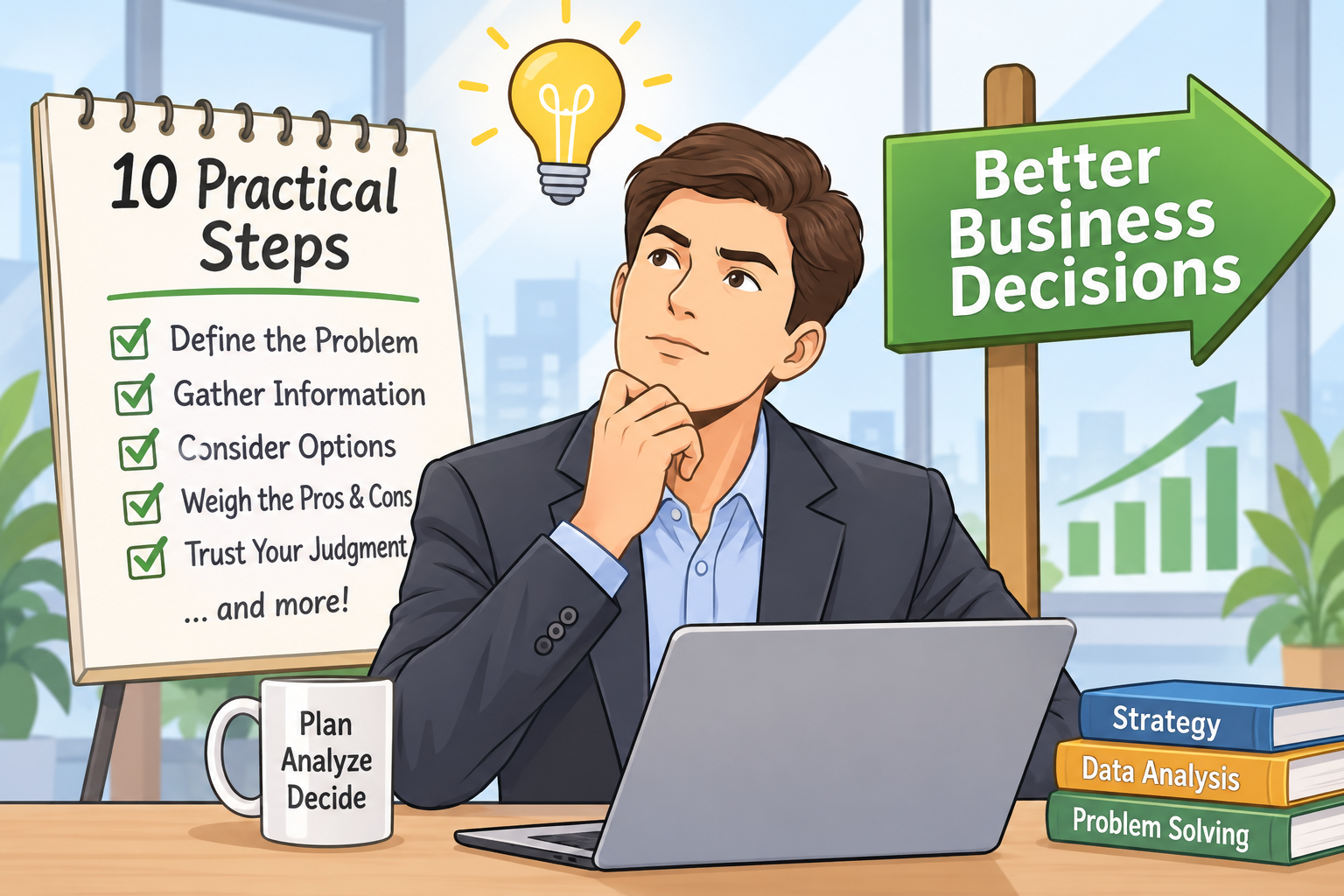
What Is This Article About?
How to Make Better Business Decisions? Making better business decisions is one of the most important skills an entrepreneur needs to build a successful and sustainable business. Every business owner makes decisions about customers, products, pricing, marketing, employees, investments, operations, and future growth. Some decisions produce excellent results, while others can lead to financial losses, wasted resources, and missed opportunities. The quality of these decisions often determines how efficiently a business operates and how successfully it competes in the market.
Many entrepreneurs make business decisions based on personal opinions, assumptions, emotions, incomplete information, or what competitors are doing. Although experience and intuition can be valuable, relying on them alone can create unnecessary risks. Better business decision-making requires a structured approach that combines accurate information, clear objectives, financial analysis, customer understanding, and careful evaluation of available alternatives.
You do not need to be an experienced business strategist or data analyst to improve your decision-making skills. Even a small business owner can make more informed choices by identifying the actual problem, collecting relevant information, comparing options, calculating potential costs and benefits, and reviewing the results after implementation. Simple tools such as spreadsheets, customer feedback, financial reports, and performance indicators can make the decision-making process more systematic.
This guide explains how to make better business decisions through ten practical steps. You will learn how to define business problems, set clear objectives, collect reliable information, analyze financial implications, evaluate alternatives, assess risks, consider customer needs, use data and experience, implement decisions effectively, and review their outcomes. These steps can help entrepreneurs make more confident, logical, and result-oriented business decisions.
How to Make Better Business Decisions: 10 Practical Steps
Follow these ten practical steps to improve your business decision-making process, reduce avoidable mistakes, evaluate opportunities, and make smarter choices for long-term business success.
Clearly Identify the Business Problem
🔍The first step towards making better business decisions is understanding exactly what needs to be solved. Business owners sometimes react to visible symptoms without identifying the underlying problem. For example, declining sales may appear to be a marketing problem, but the actual cause could be high prices, poor customer service, weak product quality, or changing customer preferences. Making a decision before understanding the real issue can result in wasted time and money. Clearly define the problem, examine its possible causes, and identify the areas of the business affected by it. A well-defined problem provides a clear starting point for finding an effective solution.
- Describe the problem clearly: Write down the specific issue affecting your business instead of using broad statements such as poor performance or slow growth.
- Separate symptoms from root causes: Identify whether the visible problem is the actual cause or merely a result of another underlying issue.
- Collect examples of the problem: Examine sales reports, customer complaints, employee feedback, operational records, and other relevant evidence.
- Identify the affected business areas: Determine whether the problem relates to marketing, sales, finance, employees, customer service, production, or operations.
- Prioritize the most important issue: Focus on problems that have the greatest effect on revenue, profitability, customer satisfaction, or business continuity.
Set Clear Business Goals and Decision Objectives
🎯Once you understand the problem, the next step is deciding what you want to achieve. Without a clearly defined objective, it becomes difficult to determine which solution is most appropriate. For example, if your business is experiencing declining revenue, your objective might be to increase monthly sales, improve customer retention, increase average transaction value, or improve profit margins. These are different goals and may require different decisions. Establish measurable objectives with realistic timelines so that you can compare potential solutions against a clearly defined result. A good decision should contribute directly to an important business goal rather than simply creating more activity.
- Define the desired result: Identify exactly what you want to achieve through the decision, such as higher revenue, lower costs, improved service, or increased productivity.
- Make your objectives measurable: Use specific indicators such as sales growth, profit margin, customer retention, conversion rate, or delivery time.
- Set a realistic deadline: Establish when the expected result should be achieved and when progress will be evaluated.
- Prioritize competing objectives: Decide which outcomes are most important when financial resources, time, or employees are limited.
- Define success criteria: Establish the specific conditions that will indicate whether the decision has achieved its intended purpose.
Collect Accurate and Relevant Business Information
📊Good business decisions depend on reliable information rather than assumptions alone. After defining your objective, collect the information needed to understand the situation and evaluate possible solutions. Relevant information may include sales figures, operating expenses, customer feedback, market trends, competitor activities, employee performance, supplier quotations, and industry reports. However, collecting large amounts of irrelevant data can make decisions unnecessarily complicated. Focus on information that directly helps answer the business question. Check whether the information is accurate, current, and obtained from trustworthy sources. Better information reduces uncertainty and provides a stronger foundation for evaluating different business alternatives.
- Review your internal business records: Examine sales reports, financial statements, customer databases, inventory records, and operational performance.
- Understand your customers: Collect relevant information through customer feedback, surveys, reviews, complaints, and purchasing behaviour.
- Research market conditions: Study industry developments, customer demand, emerging trends, competitor activities, and market opportunities.
- Consult knowledgeable people: Gather relevant insights from employees, experienced business owners, suppliers, professional advisers, and industry specialists.
- Verify information before using it: Check the source, accuracy, date, relevance, and completeness of the information you collect.
Analyze the Financial Impact of Each Decision
💰Every important business decision has financial consequences. A decision may increase revenue, reduce operating costs, require additional investment, or create new financial obligations. Before choosing a solution, estimate its initial cost, recurring expenses, expected financial benefits, cash flow requirements, and potential return on investment. For example, hiring additional employees may increase service capacity, but it also creates salary and training costs. Similarly, investing in advertising may generate more enquiries, but its effectiveness depends on customer acquisition costs and the profitability of resulting sales. Financial analysis helps you understand whether a decision is affordable, commercially sensible, and capable of producing sustainable benefits.
- Calculate the initial investment: Estimate equipment costs, setup expenses, deposits, technology requirements, training, and other upfront expenditure.
- Estimate recurring costs: Identify additional salaries, rent, maintenance, subscriptions, marketing expenditure, and other ongoing financial commitments.
- Forecast expected financial benefits: Estimate additional revenue, potential savings, improved productivity, and other measurable financial gains.
- Evaluate profitability and return: Calculate relevant profit margins, break-even requirements, payback period, or return on investment where appropriate.
- Check cash flow affordability: Determine whether your business can meet the investment and operating costs without creating financial pressure.
Compare Different Alternatives Before Choosing
⚖️One of the most common business decision-making mistakes is selecting the first solution that appears reasonable. A better approach is to develop and compare several alternatives before making a final choice. Different options may offer different levels of cost, profitability, convenience, operational efficiency, and risk. For instance, a small business looking to increase sales could invest in digital advertising, introduce a referral programme, improve existing customer retention, or develop a new sales channel. Comparing alternatives helps you identify the solution that offers the strongest overall value. Use consistent evaluation criteria so that each option is assessed fairly rather than being selected simply because it is familiar or attractive.
- Generate multiple possible solutions: Identify at least three realistic alternatives for addressing the business problem or achieving your objective.
- Compare implementation costs: Examine the financial investment, employee requirements, equipment, time, and operational resources needed for each option.
- Evaluate potential benefits: Compare expected revenue, profitability, productivity, customer satisfaction, and other important business outcomes.
- Use consistent evaluation criteria: Assess each alternative using the same factors, such as cost, expected return, feasibility, speed, and strategic value.
- Select the strongest overall option: Choose the alternative that best satisfies your business objectives while remaining financially and operationally practical.
Evaluate Risks and Prepare for Possible Problems
🛡️Every business decision involves some degree of uncertainty. Even a carefully planned decision may produce unexpected results because of changing customer demand, competitor actions, supplier problems, economic conditions, or operational difficulties. Before implementing a decision, identify what could go wrong and estimate how seriously each risk could affect your business. Consider both the likelihood of a problem occurring and the potential damage it could cause. High-impact risks deserve particular attention, even when their probability is relatively low. Preparing preventive measures and alternative plans can reduce the negative consequences of uncertainty and help your business respond more effectively when circumstances change.
- Identify possible risks: Consider financial, operational, market, technological, legal, regulatory, supplier, and customer-related risks associated with the decision.
- Estimate probability and impact: Assess how likely each risk is and how seriously it could affect business operations, finances, or reputation.
- Prioritize major risks: Focus on risks that combine a high likelihood of occurrence with significant potential consequences.
- Prepare preventive measures: Identify actions that can reduce the likelihood of problems, such as testing, staff training, quality checks, and supplier alternatives.
- Develop a contingency plan: Decide what your business will do if the chosen solution fails to deliver the expected results or creates unexpected difficulties.
Consider Customer Needs and Seek Relevant Feedback
👥Business decisions should consider the people who will be affected by them, particularly customers. A decision may appear financially attractive but still fail if it does not solve a genuine customer problem or improve the customer experience. Understanding customer expectations, preferences, purchasing behaviour, complaints, and feedback can help you make more relevant choices. You should also consider the perspectives of employees, suppliers, and other stakeholders who understand how the business operates. Listening to different viewpoints can reveal practical challenges and opportunities that may not be visible from the owner’s perspective alone. However, feedback should be evaluated carefully rather than treating every individual opinion as a universal market requirement.
- Understand your target customers: Identify their needs, purchasing priorities, expectations, common problems, and reasons for choosing particular products or services.
- Collect customer feedback: Use surveys, reviews, direct conversations, support enquiries, and complaints to understand customer experiences.
- Study customer behaviour: Examine purchasing frequency, repeat orders, product preferences, customer retention, and reasons for abandoned purchases.
- Consult relevant stakeholders: Seek practical input from employees, sales teams, suppliers, and other people who may be affected by the decision.
- Validate important assumptions: Check whether the proposed solution addresses a genuine customer need rather than relying only on internal opinions.
Combine Data Analysis with Experience and Logical Thinking
🧠Effective decision-making requires a balance between objective evidence and practical business judgment. Data analysis helps you understand measurable facts, identify trends, compare performance, and evaluate potential outcomes. Experience and logical thinking help you interpret that information in the context of real business situations. However, both approaches have limitations. Data may be incomplete or misleading, while personal experience can be influenced by outdated assumptions, overconfidence, or emotional bias. Examine the evidence carefully, question your assumptions, and consider alternative explanations before reaching a conclusion. When appropriate, use simple calculations, financial reports, performance indicators, and professional advice to strengthen your reasoning.
- Identify the most relevant business metrics: Select indicators that directly relate to the decision, such as revenue, conversion rates, costs, profit margins, or customer retention.
- Look for patterns and trends: Compare current performance with previous periods to identify meaningful changes rather than reacting to isolated results.
- Question your assumptions: Identify beliefs that may influence your judgment and examine whether they are supported by reliable evidence.
- Consider different viewpoints: Ask what could make your preferred option unsuccessful and examine whether another interpretation of the available information is possible.
- Use experience appropriately: Apply lessons from previous business situations while recognizing that market conditions, customer behaviour, and business circumstances may have changed.
Create an Action Plan and Implement the Decision
🚀A good business decision creates value only when it is implemented effectively. After selecting the most suitable option, convert it into a clear action plan with defined responsibilities, deadlines, resources, and measurable milestones. Decide who will execute each activity, what support they need, and how progress will be monitored. For major investments or operational changes, consider introducing the decision through a small pilot project before committing the entire business. Communicate the plan clearly to everyone involved and establish a process for addressing unexpected problems. A structured implementation approach helps prevent delays, confusion, unnecessary expenditure, and the failure of otherwise sound business decisions.
- Break the decision into specific tasks: Convert your chosen solution into a sequence of practical activities that can be completed and monitored.
- Assign responsibilities: Identify who will manage each task and make sure the people involved understand their responsibilities.
- Allocate the required resources: Arrange the necessary budget, employees, equipment, technology, materials, and other operational support.
- Set deadlines and milestones: Establish realistic completion dates and intermediate checkpoints to monitor implementation progress.
- Start with a pilot where appropriate: Test the decision on a limited scale, evaluate initial results, and make necessary improvements before expanding it.
Monitor Results, Learn from Mistakes, and Improve
📈Business decision-making does not end when a solution is implemented. You must monitor its actual results to determine whether it achieved the intended objectives. Compare real performance with your original targets, financial estimates, deadlines, and success criteria. For example, if you introduced a new marketing strategy to increase sales, evaluate the number of enquiries, customer conversions, acquisition costs, and resulting profit rather than looking only at advertising reach. If the results are below expectations, investigate the reasons and decide whether the strategy needs improvement, modification, or replacement. Even unsuccessful decisions can provide valuable lessons when their outcomes are reviewed objectively. Continuous evaluation helps entrepreneurs develop stronger judgment and make better future decisions.
- Measure actual performance: Collect relevant financial, operational, and customer-related information to evaluate the results of your decision.
- Compare results with original objectives: Check whether the decision achieved its expected revenue, profitability, productivity, service, or growth targets.
- Identify unexpected outcomes: Examine positive and negative results that were not anticipated during the original decision-making process.
- Determine necessary improvements: Decide whether to continue the current approach, modify specific activities, conduct further testing, or choose another solution.
- Document lessons for future decisions: Record what worked, what failed, why the results occurred, and what should be done differently next time.
Practical Tips for Making Better Business Decisions
- Do not rush important decisions: Take sufficient time to understand the problem, examine available information, and compare alternatives before committing significant resources.
- Separate facts from assumptions: Distinguish verified information from personal opinions, expectations, and untested beliefs.
- Focus on business priorities: Evaluate whether each decision supports your important financial, operational, customer, or strategic objectives.
- Consider the long-term consequences: Avoid choosing an option simply because it produces immediate benefits if it creates larger problems in the future.
- Use financial calculations: Estimate costs, profitability, cash flow requirements, and potential returns before making significant investments.
- Listen to different perspectives: Consider relevant feedback from customers, employees, experienced professionals, and other stakeholders.
- Recognize emotional bias: Avoid making major business decisions purely because of excitement, frustration, fear, personal attachment, or pressure from others.
- Do not ignore risks: Identify possible problems and prepare practical alternatives before implementing an important decision.
- Learn from unsuccessful decisions: Analyze mistakes objectively instead of repeating the same approach without understanding why it failed.
- Review decisions regularly: Monitor results and adapt your approach when business conditions, customer requirements, or market opportunities change.
Conclusion
Learning how to make better business decisions is essential for entrepreneurs who want to build profitable, competitive, and sustainable businesses. Every important business activity involves choices, from managing finances and hiring employees to setting prices, selecting suppliers, developing marketing strategies, and planning expansion. Decisions based on incomplete information, unrealistic assumptions, or emotional reactions can create unnecessary risks and prevent a business from achieving its objectives.
The ten practical steps in this guide provide a structured approach to improving business decision-making. Start by identifying the actual problem and defining clear objectives. Collect reliable information, evaluate financial implications, compare alternatives, and assess potential risks. Consider customer needs, combine data analysis with practical experience, prepare an implementation plan, and monitor the results after making your decision.
Remember that making better business decisions does not mean that every decision will produce a perfect outcome. Business environments involve uncertainty, changing customer expectations, competition, and unexpected challenges. The objective is to develop a consistent decision-making process that improves the quality of your choices, reduces avoidable mistakes, and helps you respond intelligently when circumstances change.
Start with one important business decision you need to make today. Define the problem, collect relevant information, compare your options, and identify the most practical solution. Review its results after implementation and use what you learn to improve your next decision. Consistent improvement in decision-making can become a significant competitive advantage for your business.
Frequently Asked Questions (FAQs)
Why is making better business decisions important?
Making better business decisions helps a business reduce risks, control expenses, improve productivity, satisfy customers, and achieve long-term growth. Well-informed decisions also help business owners use their time, money, and resources more effectively.
What are the 5 steps of effective business decision-making?
The five essential steps are
1. Identify the problem or opportunity.
2. Gather relevant information.
3. Evaluate available alternatives.
4. Choose and implement the best option.
5. Monitor the results and make improvements.How can small business owners make better decisions?
Small business owners can make better decisions by understanding their business goals, tracking finances, studying customer needs, comparing alternatives, evaluating risks, and learning from previous results.
What factors should be considered before making a business decision?
Important factors include financial costs, expected revenue, potential risks, customer expectations, available resources, market conditions, competition, and long-term business objectives.
How does data help in business decision-making?
Business data provides measurable information about sales, expenses, customer behaviour, cash flow, and performance. Analysing this information helps business owners identify patterns, evaluate opportunities, and make decisions based on evidence rather than assumptions.
How can business owners reduce the risk of making wrong decisions?
They can reduce decision-making risks by researching the situation, checking the accuracy of information, comparing multiple options, consulting relevant experts, estimating potential losses, and preparing alternative plans.
Should business decisions be based on data or experience?
Effective business decisions should combine both. Data provides measurable evidence, while experience helps interpret situations, understand practical challenges, and recognise factors that numbers alone may not reveal.
What are the common mistakes in business decision-making?
Common mistakes include:
1. Making decisions without sufficient information.
2. Ignoring customer feedback.
3. Overlooking financial consequences.
4. Following competitors blindly.
5. Allowing emotions to influence important decisions.
6. Ignoring potential risks.
7. Failing to monitor results.How can customer feedback improve business decisions?
Customer feedback helps businesses understand customer expectations, identify product or service problems, improve customer experiences, and discover new market opportunities. It provides valuable insights for decisions related to pricing, marketing, products, and services.
How can business owners know whether a decision was successful?
Business owners should compare actual results with the objectives established before implementing the decision. They can evaluate indicators such as revenue, profitability, expenses, customer satisfaction, productivity, and business growth. If results fall short, they should identify the reasons and make necessary adjustments.
More Guides from Clickerrr Guides
How to Manage Small Business Cash Flow: 10 Steps Guide
Cash flow is one of the most important aspects of running a successful small business. It represents the money moving into and out of your business during a particular period.
Read the Full Guide →
How to Start a Profitable E-Commerce Business: 10 Steps Guide
Starting an e-commerce business can be an attractive opportunity for entrepreneurs who want to sell products online and build a scalable business. With an online store, you can reach customers beyond your local area, showcase products around the clock, and manage sales through digital platforms.
Read the Full Guide →
How to Start a Service-Based Business
Follow practical steps to select a service, find your first clients, and build a sustainable business.
Read the Full Guide →
How to Write a Business Plan
Understand how to prepare a business plan, define your goals, and create a practical roadmap for your business.
Read the Full Guide →
How to Find a Profitable Business Niche
Getting your first 100 customers is one of the most important milestones when starting a new business. Whether you run an online business, a local shop, a service-based company, a freelance venture, or a startup, your first customers help you turn an idea into a real business.
Read the Full Guide →
How to Use AI to Grow a Small Business
Artificial intelligence (AI) is changing the way small businesses operate, market their products, serve customers, and compete in the digital marketplace.
Read the Full Guide →
How to Start an Online Business with No Experience
Starting an online business can be an exciting way to turn your skills, knowledge, interests, or business ideas into an income-generating opportunity. Unlike many traditional businesses, an online business can often be started from home with a computer, an internet connection, and a small initial investment.
Read the Full Guide →
How to Start a Small Business
Starting a small business can be an excellent way to turn your skills, knowledge, and ideas into a source of income. Whether you want to open a local shop, provide professional services, sell products online, or start a home-based business, the right approach can help you build a strong foundation. However, starting a business requires more than having a good idea.
Read the Full Guide →
How to Create a Digital Marketing Strategy for a Small Business: 10 Steps Guide
A digital marketing strategy helps a small business attract potential customers, build brand awareness, generate enquiries, and increase sales through online channels.
Read the Full Guide →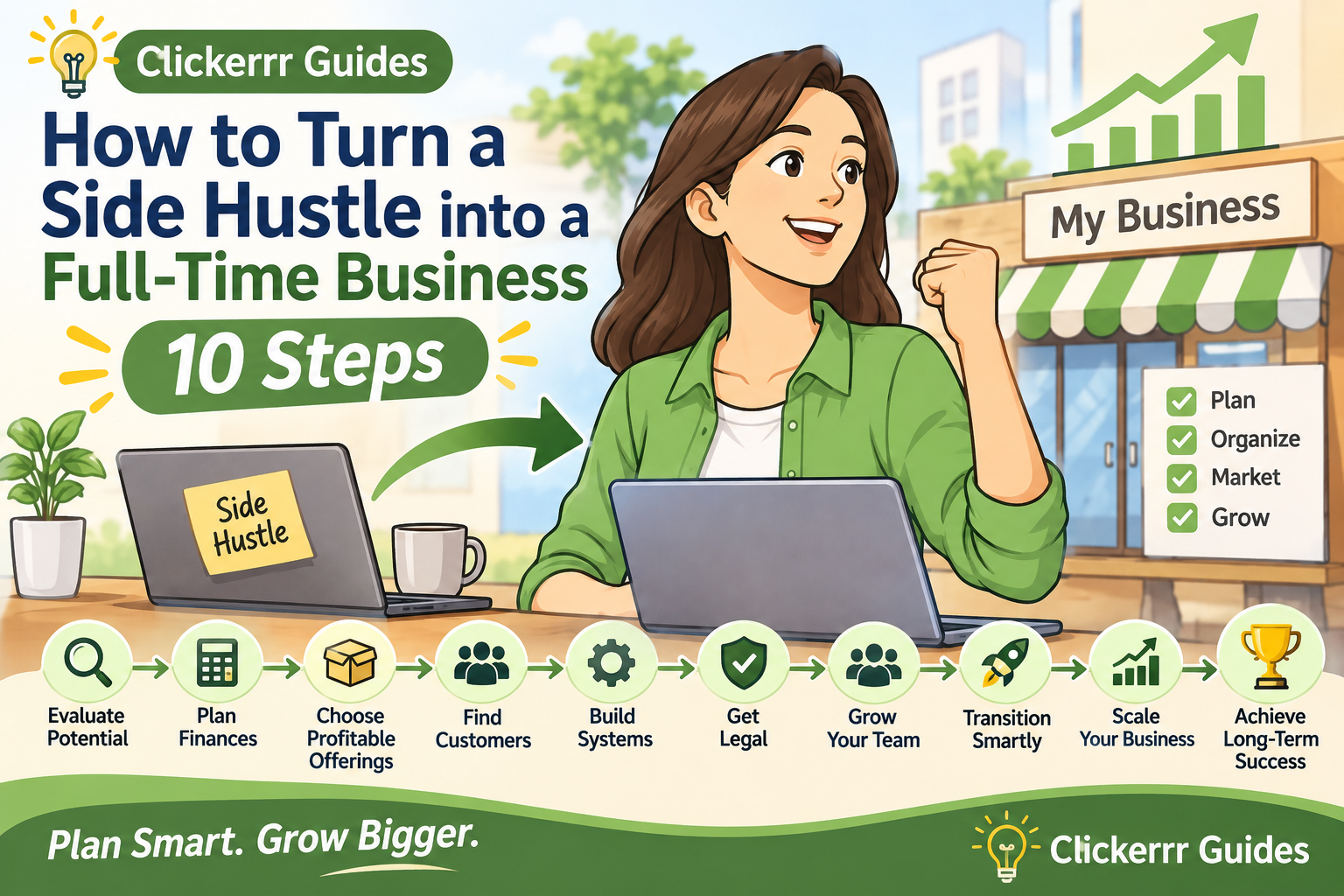
How to Turn a Side Hustle into a Full-Time Business: 10 Steps Guide
Turning a side hustle into a full-time business is an exciting opportunity to gain financial independence, build something of your own, and create a sustainable career. However, moving from a part-time activity to a full-time business requires more than simply increasing your working hours.
Read the Full Guide →
How to Grow a Small Business Faster: 10 Steps Guide
How to Grow a Small Business Faster: 10 Steps Guide? Growing a small business faster requires more than increasing sales or attracting new customers.
Read the Full Guide →
How to Start a Home-Based Business: 10 Steps Guide
Starting a home-based business is an attractive option for people who want to become entrepreneurs without investing heavily in commercial premises or maintaining a traditional office.
Read the Full Guide →