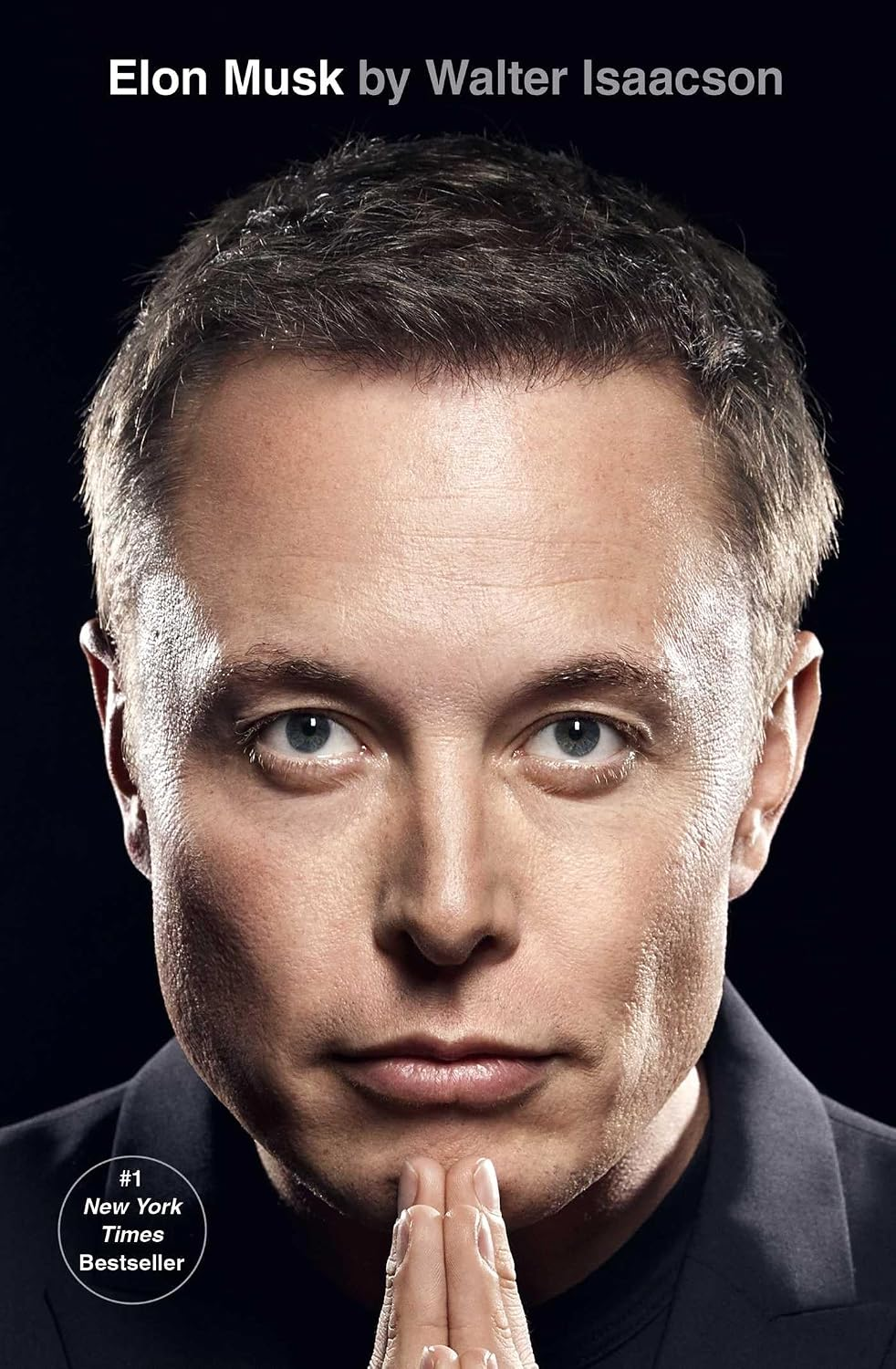
Elon Musk is a biography of entrepreneur Elon Musk written by American biographer and journalist Walter Isaacson. The book was published by Simon & Schuster on September 12, 2023, and became a major international bestseller. The hardcover edition contains 688 pages. (Simon & Schuster)
The biography follows Musk from his childhood in South Africa through his education and early internet ventures to his leadership roles at SpaceX, Tesla, Neuralink, The Boring Company, and his acquisition of Twitter, which he subsequently renamed X. Isaacson also examines Musk’s involvement in artificial intelligence and his ambitions for space exploration and the establishment of a multiplanetary civilization. (Simon & Schuster)
Unlike a conventional retrospective biography, Elon Musk was written while its subject was still actively building companies and making major technological, commercial and political decisions. Isaacson spent approximately two years shadowing Musk, attending meetings, visiting factories and launch facilities, and interviewing family members, friends, employees, colleagues, competitors and critics. (Simon & Schuster)
The result is both a biography of an individual and a contemporary account of several industries undergoing rapid transformation, particularly electric vehicles, private spaceflight, artificial intelligence and social media.
Bibliographic information
| Field | Details |
|---|---|
| Title | Elon Musk |
| Author | Walter Isaacson |
| Language | English |
| Subject | Elon Musk |
| Genre | Biography |
| Publisher | Simon & Schuster |
| Publication date | September 12, 2023 |
| Publication place | New York |
| Original format | Hardcover |
| Length | 688 pages |
| ISBN-13 | 978-1-982181-28-4 |
| Audiobook narrator | Jeremy Bobb |
| Principal subjects | Entrepreneurship, technology, space exploration, electric vehicles, artificial intelligence, social media |
| Period covered | Musk’s childhood through the early 2020s |
The publisher describes the book as the result of two years of close observation of Musk and his businesses. (Simon & Schuster)
Overview
Elon Musk attempts to answer a question that has accompanied Musk’s public career for much of the 21st century:
How can one individual combine extraordinary technological ambition with such a controversial and unpredictable public persona?
Isaacson approaches the question primarily through biography rather than through a conventional business analysis.
The book moves between Musk’s personal history and the development of his companies. The narrative therefore repeatedly shifts from childhood memories and family relationships to engineering meetings, manufacturing problems, rocket launches, financial crises and corporate decisions.
At its center is a tension that Isaacson repeatedly explores:
Are the same characteristics that make Musk unusually effective at pursuing difficult technological goals also responsible for some of his most destructive decisions and relationships?
The book does not provide a simple answer.
Instead, Isaacson constructs a portrait in which ambition, risk-taking, engineering obsession, emotional volatility, personal relationships and a desire to alter the future are intertwined.
Author
Walter Isaacson
Walter Isaacson is an American journalist, author and historian best known for biographies of influential figures in science, technology and public life.
Before becoming a full-time biographer, Isaacson held several prominent positions in American journalism and public institutions. He served as:
- editor of Time magazine;
- chairman and CEO of CNN;
- president and CEO of the Aspen Institute;
- professor of history at Tulane University.
He has also written biographies of Albert Einstein, Benjamin Franklin, Steve Jobs, Leonardo da Vinci and Jennifer Doudna. (Simon & Schuster)
Isaacson received the National Humanities Medal in 2023. (Simon & Schuster)
Selected works
| Year | Book | Subject |
|---|---|---|
| 2003 | Benjamin Franklin: An American Life | Benjamin Franklin |
| 2007 | Einstein: His Life and Universe | Albert Einstein |
| 2011 | Steve Jobs | Steve Jobs |
| 2014 | The Innovators | Digital revolution |
| 2017 | Leonardo da Vinci | Leonardo da Vinci |
| 2021 | The Code Breaker | Jennifer Doudna and CRISPR |
| 2023 | Elon Musk | Elon Musk |
Isaacson’s biographies frequently examine the relationship between personality and innovation. His earlier biography of Steve Jobs, for example, similarly focused on how an unusually intense personality interacted with technological ambition and organizational leadership. (Simon & Schuster)
How the biography was researched
One of the defining characteristics of Elon Musk is the degree of access Isaacson received.
For approximately two years, Isaacson accompanied Musk through different parts of his professional life.
According to the publisher, Isaacson:
- attended Musk’s meetings;
- walked through his factories;
- visited company facilities;
- observed important decisions;
- interviewed family members;
- interviewed friends;
- interviewed employees and coworkers;
- interviewed adversaries and critics. (Simon & Schuster)
Isaacson discussed his methodology publicly after publication. In an interview with The Washington Post, he described spending two years shadowing Musk and interviewing people around him. (The Washington Post)
This approach gave the book an unusual advantage: the author was able to observe events while they were happening rather than reconstructing them entirely from historical documents.
It also created a limitation.
Because Musk remained an active participant in the story, some accounts were necessarily based on the memories and interpretations of people who were themselves involved in highly consequential events.
That distinction is particularly important when the book describes motives, private conversations or disputed incidents.
Structure of the book
The biography is broadly chronological, but it is not simply a year-by-year account.
Isaacson frequently moves between:
personal history → technological problem → business crisis → family relationship → engineering decision → historical background
This creates a narrative that resembles the pace of Musk’s own life.
The book repeatedly returns to several central environments:
South Africa
Musk’s childhood and adolescence.
Silicon Valley
The emergence of his entrepreneurial career.
Tesla
Electric vehicles, manufacturing and Musk’s involvement with the company.
SpaceX
Reusable rockets, launch failures and the goal of making humanity multiplanetary.
Neuralink
Brain-computer interfaces and the possibility of linking human brains with computers.
Artificial intelligence
Musk’s concerns about AI and his involvement with AI companies and initiatives.
Twitter/X
The acquisition of Twitter and the subsequent transformation of the platform.
Childhood and South Africa
The biography begins with Musk’s childhood in South Africa.
Isaacson gives particular attention to Musk’s relationship with his father, Errol Musk, and to experiences of bullying at school.
According to Isaacson’s account, Musk was severely bullied as a child and suffered a particularly serious assault that resulted in hospitalization. The book presents these experiences, together with the difficult relationship with his father, as important parts of the psychological background to Musk’s later life. (Simon & Schuster)
The interpretation of childhood experiences is one of the more controversial aspects of the book because biography inevitably involves connecting past events with later behavior.
Isaacson’s narrative repeatedly suggests that the young Musk learned to respond to threats through confrontation, risk-taking and an intense drive to control his surroundings.
Readers and reviewers have differed over how convincingly the book establishes these connections.
Science fiction and imagination
Another recurring element of Musk’s childhood is his fascination with science fiction.
Books, comics and imaginative stories became important sources of inspiration.
The biography connects this early interest to several of Musk’s later ambitions, particularly:
- space exploration;
- artificial intelligence;
- human survival;
- technological progress;
- the establishment of a civilization beyond Earth.
This creates a recurring pattern throughout the biography:
CHILDHOOD
Science fiction
      │
      ▼
IMAGINATION
      │
      ▼
BIG FUTURE QUESTIONS
      │
      ▼
ENGINEERING PROBLEMS
      │
      ▼
ENTREPRENEURIAL VENTURES
      │
      ▼
REAL-WORLD TECHNOLOGY
For Isaacson, Musk’s childhood imagination is not simply background information. It becomes part of the explanation for why Musk repeatedly chooses goals that appear dramatically larger than ordinary business objectives.
Move to North America
Musk eventually left South Africa and moved to North America.
He attended Queen’s University in Canada before transferring to the University of Pennsylvania in the United States.
He studied:
- physics;
- economics.
His university years were followed by a brief period in a graduate program at Stanford University, which he left almost immediately to pursue opportunities associated with the emerging internet economy.
The decision reflected a pattern that would characterize much of his later career:
abandon a conventional path when a larger technological opportunity appears.
Zip2
Musk’s first major entrepreneurial venture was Zip2, an internet company that provided online city guides and related services to newspapers.
The company was eventually acquired by Compaq in 1999.
The sale provided Musk with substantial capital for his next ventures.
Early entrepreneurial sequence
Zip2
  │
  ▼
Capital
  │
  ▼
X.com
  │
  ▼
PayPal
  │
  ▼
Capital + reputation
  │
  ├──────────────┐
  ▼              ▼
SpaceX          Tesla
This sequence is important because Musk’s later technological ambitions were made possible partly by the financial resources and credibility accumulated during the internet boom.
X.com and PayPal
After Zip2, Musk founded X.com, an online financial services company.
X.com eventually became associated with PayPal.
PayPal’s success provided Musk with the financial foundation for the next stage of his career.
Rather than simply retiring after becoming wealthy, Musk invested heavily in projects with much greater technological and financial risk.
This became one of the defining patterns of his career.
SpaceX
Founding SpaceX
Musk founded Space Exploration Technologies Corp., commonly known as SpaceX, in 2002.
The company’s long-term objective became the reduction of launch costs and, ultimately, the establishment of a human presence beyond Earth.
Musk’s interest in Mars occupies an important position in Isaacson’s narrative.
The biography presents Mars not simply as a business opportunity but as part of Musk’s larger conception of human survival.
Early SpaceX failures
The early years of SpaceX were characterized by repeated technical and financial difficulties.
The company’s first Falcon 1 launches failed.
The fourth launch eventually succeeded in 2008.
That success came at a critical moment: another failure could have placed the company in severe financial danger.
The episode illustrates a recurring theme in Isaacson’s biography:
Musk repeatedly places companies in situations where failure would have existential consequences, then attempts to solve the immediate technical problem through extreme intensity and rapid iteration.
Reusable rockets
SpaceX eventually developed the Falcon 9 and its reusable first-stage technology.
The ability to recover and reuse rocket stages changed the economics and operational model of orbital launch.
In Isaacson’s narrative, SpaceX is one of the clearest examples of Musk’s engineering philosophy:
Traditional aerospace approach
          │
          ▼
High cost
          │
          ▼
Complex systems
          │
          ▼
Long development cycles

              VS.

Musk / SpaceX approach
          │
          ▼
Simplify
          │
          ▼
Build
          │
          ▼
Test
          │
          ▼
Failure
          │
          ▼
Fix
          │
          ▼
Repeat
The book repeatedly emphasizes Musk’s preference for first-principles reasoning, vertical integration, rapid iteration and aggressive cost reduction.
Tesla
Relationship with Tesla
Although Musk did not originally found Tesla, he became one of its most important early investors and eventually its central executive figure.
The biography describes the company’s struggle to develop electric vehicles at scale.
Tesla faced major challenges involving:
- battery technology;
- manufacturing;
- supply chains;
- financing;
- production capacity;
- quality control;
- demand;
- profitability.
The Roadster, Model S, Model X, Model 3 and subsequent vehicles became increasingly important parts of Tesla’s expansion.
The “production hell” period
One of the major episodes in the biography concerns Tesla’s effort to scale production of the Model 3.
Musk pushed Tesla toward highly automated manufacturing.
When automation created problems, the company had to rethink aspects of its production system.
The episode illustrates a broader theme in the biography:
technology can solve one bottleneck while simultaneously creating another.
More automation
       │
       ▼
Higher theoretical efficiency
       │
       ▼
Unexpected complexity
       │
       ▼
Production bottleneck
       │
       ▼
Human intervention
       │
       ▼
System redesigned
Tesla’s survival and eventual expansion are presented as products of both technological innovation and relentless organizational pressure.
First-principles thinking
One of the most important concepts associated with Musk in the book is first-principles reasoning.
Instead of accepting existing assumptions, the approach asks:
- What are the fundamental physical or economic facts?
- What does the product actually require?
- Which assumptions are inherited from tradition?
- Can the system be rebuilt from basic components?
This approach is particularly visible in the biography’s accounts of:
- rocket manufacturing;
- batteries;
- vehicle production;
- engineering costs;
- software;
- satellite communications.
First-principles model
Existing industry assumption
            │
            ▼
      Break it apart
            │
            ▼
Identify fundamental constraints
            │
            ▼
Question inherited costs
            │
            ▼
Design from fundamentals
            │
            ▼
Build → Test → Improve
Isaacson presents this as one of Musk’s most powerful intellectual tools, while also showing that an intense commitment to simplifying systems can create organizational problems when human or institutional factors are treated as secondary.
Neuralink
Another major subject of the biography is Neuralink, Musk’s brain-computer interface company.
Neuralink’s long-term ambition involves creating technology capable of communicating directly between the human brain and computers.
The project reflects another of Musk’s recurring concerns:
how can human beings remain relevant in a future increasingly shaped by artificial intelligence?
The book therefore connects Neuralink to the larger philosophical questions surrounding Musk’s technological worldview.
The Boring Company
The biography also discusses The Boring Company, established to develop underground transportation and tunneling systems.
Musk’s interest in tunneling developed partly from frustration with urban traffic.
The company reflects another characteristic of his approach:
Take an apparently ordinary infrastructure problem and attempt to solve it through aggressive engineering and technological simplification.
Artificial intelligence
Artificial intelligence occupies a particularly important place in the book.
Musk has simultaneously:
- promoted AI development;
- warned about AI risks;
- supported AI research;
- participated in the founding of OpenAI;
- later developed competing AI initiatives.
Isaacson presents this apparent contradiction as part of Musk’s broader worldview.
Musk’s concern is not simply whether AI will become powerful.
It is whether humans will retain meaningful control over increasingly capable artificial intelligence.
OpenAI
Musk was among the founders of OpenAI in 2015.
He later left the organization.
The biography examines Musk’s changing relationship with the organization and its leadership.
This episode is particularly revealing because it shows how Musk’s interest in AI moved between:
philanthropic/long-term safety concerns → organizational disagreements → competition.
The book treats AI as one of the technologies most capable of reshaping Musk’s broader ambitions.
Twitter acquisition
One of the most dramatic sections of the biography concerns Musk’s acquisition of Twitter in 2022.
The sequence was roughly:
Twitter investment
       │
       ▼
Musk becomes major shareholder
       │
       ▼
Offer to buy Twitter
       │
       ▼
Legal and financial conflict
       │
       ▼
Acquisition completed
       │
       ▼
Massive restructuring
       │
       ▼
Twitter → X
Musk’s purchase price was approximately $44 billion.
The acquisition transformed the final portion of the biography from a conventional technology-business story into a study of social media, free expression, corporate governance and political influence.
Twitter becomes X
After completing the acquisition, Musk renamed Twitter X.
The change reflected his longstanding interest in the letter “X”, which had appeared in several of his earlier ventures, including X.com.
The transformation was both corporate and cultural.
The platform experienced:
- major staff reductions;
- changes to content moderation;
- changes to verification;
- restoration of some previously banned accounts;
- changes to advertising relationships;
- substantial alterations to the company’s organizational structure.
The book treats Musk’s takeover of Twitter as an example of his willingness to accept enormous financial and reputational risks in pursuit of a personal vision.
Starlink and the Russia–Ukraine war
One of the most controversial episodes associated with the book concerns Starlink, SpaceX’s satellite-internet network, and the war in Ukraine.
Isaacson initially described an incident involving Musk and Starlink coverage around Crimea in a way that suggested Musk had deliberately prevented a Ukrainian attack.
The account was subsequently disputed and clarified.
Both Musk and Isaacson later stated that Starlink service in the relevant area had already been restricted and that Musk had not simply switched on service and then switched it off at the critical moment.
The Washington Post reported that Isaacson subsequently said future editions would reflect the clarification. (The Washington Post)
This episode became significant beyond the specific factual dispute because it demonstrated how difficult it can be to write a biography of a living person whose companies are simultaneously involved in ongoing geopolitical events.
Musk’s management philosophy
Isaacson describes several recurring features of Musk’s management style.
Extreme deadlines
Musk frequently sets deadlines that appear unrealistic to conventional managers.
The stated purpose is often to force teams to move faster.
Direct involvement
Rather than relying entirely on layers of management, Musk often intervenes directly in engineering and production decisions.
Cost reduction
He repeatedly challenges the cost of components and manufacturing processes.
Vertical integration
His companies frequently attempt to manufacture critical components internally rather than depending entirely on suppliers.
Rapid iteration
Products are developed through repeated cycles of building, testing and modification.
High tolerance for failure
Particularly at SpaceX, failed prototypes and launches are treated as part of the development process.
A recurring management cycle
AMBITION
   ↓
EXTREME DEADLINE
   ↓
ENGINEERING PRESSURE
   ↓
PROTOTYPE / PRODUCT
   ↓
FAILURE OR BOTTLENECK
   ↓
INTENSE DEBUGGING
   ↓
ITERATION
   ↓
BREAKTHROUGH
   ↓
NEW, LARGER AMBITION
   ↺
Isaacson’s biography suggests that this cycle is central to Musk’s achievements—but it also creates significant personal and organizational costs.
Musk’s personality in the biography
Isaacson does not portray Musk simply as a conventional business executive.
Instead, the book repeatedly describes a personality characterized by several apparently contradictory traits:
| Trait presented in the biography | Possible consequence |
|---|---|
| Extreme ambition | Willingness to pursue difficult goals |
| High risk tolerance | Acceptance of potential catastrophic failure |
| Engineering obsession | Deep involvement in technical details |
| Intense work ethic | Rapid execution |
| Impulsiveness | Sudden decisions |
| Emotional volatility | Turbulent relationships |
| Competitive drive | Relentless pursuit of rivals |
| Future orientation | Large technological ambitions |
| Desire for control | Direct intervention in organizations |
| Attraction to drama | Repeated crises and confrontations |
The biography’s central intellectual problem is therefore not simply:
“Why is Musk successful?”
It is:
“Can the characteristics that produce extraordinary achievement also generate destructive consequences?”
Family and personal life
Family relationships receive substantial attention in the book.
Isaacson examines Musk’s relationship with:
- his parents;
- siblings;
- romantic partners;
- children;
- friends;
- business associates.
The author gives particular importance to Musk’s relationship with his father and the lasting impact that Musk himself has described from his childhood.
The book also discusses Musk’s relationships with several women and the growth of his family.
These personal episodes are not merely biographical side stories. Isaacson uses them to explore how Musk divides his attention between family, work and his technological ambitions.
The central psychological question
A recurring interpretive framework in the book is the idea that Musk’s difficult experiences may have contributed to his later appetite for risk, confrontation and achievement.
However, this is an interpretation rather than a scientifically established explanation of his personality.
Readers should therefore distinguish between:
documented events
and
Isaacson’s interpretation of why those events mattered.
This distinction is particularly important in biographies of living people, where the subject can dispute the author’s interpretation.
Major themes
1. Innovation and personality
The book asks whether exceptional innovation requires an exceptional personality—or whether society sometimes romanticizes difficult personalities because of their achievements.
2. Risk
Risk is perhaps the book’s most persistent business theme.
Musk repeatedly places enormous amounts of capital, reputation and organizational energy behind projects whose failure could have severe consequences.
3. First principles
The biography emphasizes Musk’s tendency to reduce problems to fundamental physical and economic constraints.
4. Human survival
Mars, AI and Neuralink are connected by a larger question:
How can humanity increase its chances of surviving long-term technological and existential risks?
5. Power
The book also raises a more contemporary question:
What happens when technological power becomes concentrated in the hands of a small number of private individuals?
This question becomes especially important in the chapters involving Starlink, X and AI.
6. The cost of achievement
Perhaps the most human theme of the biography is the relationship between achievement and personal cost.
Musk’s career contains extraordinary technological and financial successes, but the biography also documents conflicts, damaged relationships, employee complaints and periods of personal turmoil.
The reader is left to consider whether those elements are connected or merely coincidental.
The major companies in the biography
| Company | Main field | Role in the narrative |
|---|---|---|
| Zip2 | Internet | Musk’s first major entrepreneurial success |
| X.com / PayPal | Online finance | Created substantial wealth |
| SpaceX | Aerospace | Mars and reusable rockets |
| Tesla | Electric vehicles | Mass-market electric transportation |
| SolarCity | Solar energy | Energy ecosystem |
| Neuralink | Neurotechnology | Brain-computer interfaces |
| The Boring Company | Infrastructure | Underground transportation |
| Twitter/X | Social media | Communication platform and political influence |
| xAI | Artificial intelligence | AI development and competition |
Musk’s technological worldview
The book can be understood as the story of several technological projects connected by a common philosophy.
                 ELON MUSK'S WORLDVIEW
                         │
        ┌────────────────┼────────────────┐
        │                │                │
        ▼                ▼                ▼
     TESLA            SPACEX             AI
 Electric cars       Spaceflight      Intelligence
        │                │                │
        ▼                ▼                ▼
 Sustainable        Multiplanetary    Human-machine
 transport           civilization       future
        │                │                │
        └────────────────┼────────────────┘
                         │
                         ▼
                 LONG-TERM HUMAN
                     FUTURE
                         │
                         ▼
                    NEURALINK
The individual businesses therefore appear less like isolated ventures and more like pieces of a larger technological worldview.
Timeline
| Year | Event |
|---|---|
| 1971 | Elon Musk is born in Pretoria, South Africa |
| 1980s | Develops an interest in computers and science fiction |
| 1990s | Moves to North America and studies at Queen’s University and the University of Pennsylvania |
| 1995 | Co-founds Zip2 |
| 1999 | Zip2 acquired by Compaq |
| 1999 | X.com founded |
| 2002 | Musk founds SpaceX |
| 2004 | Musk becomes an early major investor in Tesla |
| 2008 | Falcon 1 successfully reaches orbit |
| 2008 | Tesla launches Roadster |
| 2010 | Tesla becomes a public company |
| 2012 | SpaceX Dragon reaches the International Space Station |
| 2015 | OpenAI founded with Musk among its founders |
| 2016 | Neuralink founded |
| 2016 | The Boring Company established |
| 2018 | Falcon Heavy launches |
| 2020 | Crew Dragon carries astronauts to the ISS |
| 2021 | Tesla reaches major production scale |
| 2022 | Musk acquires Twitter |
| 2023 | Elon Musk published |
| 2023 | Twitter becomes X under Musk’s ownership |
The career arc
The book’s overall chronology can be reduced to five broad stages:
STAGE 1
South Africa
      ↓
Curiosity + adversity

STAGE 2
Internet
      ↓
Zip2 + PayPal
      ↓
Wealth

STAGE 3
Engineering
      ↓
SpaceX + Tesla
      ↓
Industrial transformation

STAGE 4
Human future
      ↓
Neuralink + AI + Mars
      ↓
Civilizational ambitions

STAGE 5
Information + power
      ↓
Twitter/X
      ↓
Technology, media and public influence
Reception
The book received substantial attention from reviewers and readers because it appeared while Musk remained one of the most visible and consequential technology entrepreneurs in the world.
The publisher reports that it became a #1 New York Times bestseller and global bestseller. (Simon & Schuster)
Critical responses were mixed.
Some reviewers regarded the book as an unusually detailed and valuable account of a highly consequential technology entrepreneur.
The Washington Post described it as an attempt to reconcile Musk’s achievements with his personal flaws. (The Washington Post)
The Observer called it a comprehensive biography and emphasized the unusual amount of detail contained in its 688 pages. (The Guardian)
Other reviewers were considerably more critical.
The Guardian published a strongly negative review that questioned Isaacson’s writing style and some of the psychological framing used throughout the biography. (The Guardian)
This division was partly predictable because the book attempts to explain a figure who inspires unusually polarized reactions.
The question of objectivity
One of the most discussed aspects of the biography is Isaacson’s access to Musk.
Access provided the author with unusual opportunities to observe Musk directly.
At the same time, it created an obvious journalistic challenge:
How can a biographer remain independent when the subject grants extraordinary access?
Isaacson has said that he did not approach the project with a predetermined agenda. In an interview with the Los Angeles Times, he described Musk as a highly polarizing figure and said his goal was not to write either a celebration or an attack. (Los Angeles Times)
Some reviewers nevertheless argued that the biography occasionally gives too much weight to Musk’s own explanations.
Other readers consider the extensive access one of the book’s greatest strengths.
Controversies
Starlink episode
The disputed description of Starlink and Ukraine became the most prominent factual controversy surrounding the book.
Isaacson subsequently clarified the account, and reporting by the Washington Post documented the dispute and the intention to update future editions. (The Washington Post)
The incident illustrates an important limitation of contemporary biography:
the historical record is still being created while the book is being written.
The book’s treatment of psychology
Isaacson uses psychological language and childhood experiences to interpret Musk’s behavior.
Some reviewers objected to this approach, particularly where speculation about personality or psychological characteristics appeared to overlap with clinical terminology.
A biography can document what a person has said about themselves and what witnesses observed, but it cannot substitute for a clinical evaluation.
For that reason, readers should treat psychological explanations in the book as biographical interpretations, not medical diagnoses.
Why the biography is significant
Elon Musk is significant for reasons beyond Musk himself.
It documents a period in which several technologies moved from specialized fields toward mainstream influence:
- reusable rockets;
- electric vehicles;
- satellite internet;
- artificial intelligence;
- brain-computer interfaces;
- large-scale social-media platforms.
Few contemporary entrepreneurs have simultaneously occupied so many technological domains.
The biography therefore functions partly as a history of the early 21st-century technology industry.
The “Musk method”
One of the most useful conceptual frameworks emerging from the book is a recurring engineering-management pattern.
Step 1 — Start with an ambitious objective
Examples:
- make electric cars mainstream;
- make rockets reusable;
- establish human civilization on Mars;
- connect brains to computers.
Step 2 — Question assumptions
Ask why something costs what it costs or why a process exists in its current form.
Step 3 — Reduce to fundamentals
Identify the physical, mathematical or economic constraints.
Step 4 — Build internally
When possible, manufacture or control important components.
Step 5 — Move quickly
Set aggressive deadlines.
Step 6 — Accept failure
Treat failed prototypes as information.
Step 7 — Iterate
Build again.
Step 8 — Increase the ambition
Once one problem is solved, move to the next.
BIG PROBLEM
     ↓
FIRST PRINCIPLES
     ↓
SIMPLIFICATION
     ↓
PROTOTYPE
     ↓
TEST
     ↓
FAIL
     ↓
LEARN
     ↓
REBUILD
     ↓
BREAKTHROUGH
     ↓
BIGGER PROBLEM
This framework is one of the most accessible business lessons readers can extract from the biography.
What the book says about innovation
The biography presents innovation as something considerably more complicated than simply having good ideas.
Its recurring pattern is:
idea + technical knowledge + capital + persistence + risk tolerance + execution
But the book also demonstrates that innovation occurs within organizations.
People must:
- manufacture components;
- write software;
- manage suppliers;
- raise money;
- satisfy regulators;
- maintain infrastructure;
- communicate with customers;
- respond to failures.
Consequently, even a visionary founder cannot create large-scale technology alone.
Infographic: The innovation equation
                    INNOVATION
                        │
       ┌────────────────┼────────────────┐
       │                │                │
       ▼                ▼                ▼
   BIG VISION       ENGINEERING       CAPITAL
       │                │                │
       └────────────────┼────────────────┘
                        │
                        ▼
                    EXECUTION
                        │
              ┌─────────┴─────────┐
              ▼                   ▼
           FAILURE             SUCCESS
              │                   │
              ▼                   ▼
           LEARNING          SCALE-UP
              │                   │
              └─────────┬─────────┘
                        ▼
                   NEXT PROBLEM
Comparison with Isaacson’s earlier biographies
Elon Musk can be read alongside Isaacson’s earlier biographies.
| Biography | Central question |
|---|---|
| Benjamin Franklin | How does an individual help create a nation? |
| Einstein | How does revolutionary scientific thinking emerge? |
| Steve Jobs | How do design, technology and personality reshape industries? |
| Leonardo da Vinci | How do curiosity and observation produce creativity? |
| The Code Breaker | How does scientific collaboration transform biology? |
| Elon Musk | How do extreme ambition, engineering and risk reshape technological industries? |
The comparison is particularly interesting because Isaacson repeatedly studies individuals whose ideas extend beyond the limits of their existing institutions.
His biographies therefore share a recurring theme:
the relationship between exceptional individuals and the systems they attempt to transform.
Criticism and limitations
A balanced reading of Elon Musk requires recognition of several limitations.
1. The subject was still alive
Unlike a historical biography, the story was unfinished when Isaacson wrote it.
2. Events were still developing
Tesla, SpaceX, X, Neuralink and AI remained active projects.
3. Some accounts were disputed
The Starlink episode demonstrated that even apparently definitive accounts could later require clarification. (The Washington Post)
4. Heavy reliance on access
Musk’s extraordinary access is both a strength and a potential source of narrative bias.
5. Psychological interpretation
Some explanations concerning the relationship between childhood experiences and adult behavior are interpretive rather than scientifically demonstrable.
6. Enormous scope
At 688 pages, the book attempts to cover childhood, technology, business, family, engineering, politics and geopolitics. The breadth is impressive but inevitably means that some areas receive less detailed treatment than others.
Who should read the book?
The biography may be particularly relevant to readers interested in:
- entrepreneurship;
- technology;
- engineering;
- artificial intelligence;
- electric vehicles;
- aerospace;
- leadership;
- business history;
- innovation;
- Silicon Valley;
- social media;
- contemporary geopolitics;
- biographies of influential individuals.
It is less useful as a conventional “how to become successful” manual.
Its greater value lies in showing the messiness of real-world innovation.
There are no clean formulas.
There are engineering failures, interpersonal conflicts, financial crises, impossible deadlines, lucky breaks and decisions whose consequences cannot be known in advance.
Key ideas from the book
1. Ambition can operate on a civilization-scale
Musk’s goals frequently extend beyond conventional business objectives.
2. First-principles thinking can challenge established costs
Instead of accepting an industry’s assumptions, Musk repeatedly asks what the underlying physical or economic constraints actually are.
3. Failure can be part of engineering
SpaceX’s history demonstrates the value of testing and learning from unsuccessful attempts.
4. Speed can create both advantages and problems
Rapid decision-making can produce breakthroughs, but it can also generate mistakes and organizational instability.
5. Personal characteristics matter in entrepreneurship
The book repeatedly connects Musk’s personality with his approach to business and engineering.
6. Technology creates power
The Starlink and X chapters demonstrate that technological infrastructure can give private companies—and their leaders—significant influence over public life.
7. The future is not predetermined
Musk’s career, as presented by Isaacson, is built around attempting to make possible futures become present realities.
A human reading of the biography
Perhaps the most striking feature of Elon Musk is that it refuses to present technological achievement as a clean success story.
The rockets explode.
Factories miss targets.
Companies nearly run out of money.
Relationships become complicated.
Employees leave.
Products succeed after repeated failures.
A business acquisition becomes a personal and corporate upheaval.
And yet the projects continue.
That is what makes the biography compelling even for readers who have little interest in Musk personally.
At its deepest level, the book is about a particular kind of human ambition: the refusal to accept that the future must look like the present.
Whether that ambition ultimately produces progress, unnecessary disruption, or both is a question the biography leaves readers to consider.
Visual summary
╔══════════════════════════════════════════════╗
║              ELON MUSK                      ║
║          Walter Isaacson                    ║
╠══════════════════════════════════════════════╣
║                                              ║
║  CHILDHOOD                                   ║
║  South Africa • Bullying • Science fiction  ║
║                    ↓                         ║
║  INTERNET                                    ║
║  Zip2 • X.com • PayPal                       ║
║                    ↓                         ║
║  ENGINEERING                                 ║
║  SpaceX • Tesla                              ║
║                    ↓                         ║
║  HUMAN FUTURE                                ║
║  Mars • Neuralink • AI                       ║
║                    ↓                         ║
║  INFORMATION                                 ║
║  Twitter → X                                 ║
║                    ↓                         ║
║  CENTRAL QUESTION                            ║
║  Can extraordinary ambition create           ║
║  extraordinary progress—and what does        ║
║  that ambition cost?                         ║
║                                              ║
╚══════════════════════════════════════════════╝
Frequently asked questions
Who wrote Elon Musk?
The biography was written by Walter Isaacson, an American journalist, historian and biographer. (Simon & Schuster)
When was Elon Musk published?
The first edition was published by Simon & Schuster on September 12, 2023. (Simon & Schuster)
How long is the book?
The hardcover edition contains 688 pages. (Simon & Schuster)
Is Elon Musk an authorized biography?
Yes. Musk gave Isaacson extensive access during the research and writing process. Isaacson followed him for approximately two years and interviewed people in Musk’s personal and professional circles.
Does the book cover Tesla?
Yes. Tesla is one of the major subjects of the biography.
Does it cover SpaceX?
Yes. SpaceX and Musk’s ambitions for reusable rockets and human settlement beyond Earth receive extensive attention.
Does it discuss Twitter?
Yes. The acquisition of Twitter in 2022 and its transformation into X form a major portion of the latter part of the book.
Does the book discuss artificial intelligence?
Yes. AI is one of the major technological and philosophical subjects explored in the biography.
Is the book only about business?
No. It also covers Musk’s childhood, family relationships, friendships, romantic relationships, management style, technological beliefs and public life.
Is everything in the book undisputed?
No. Some accounts and interpretations have been challenged or clarified. The Starlink episode involving Ukraine is a notable example. (The Washington Post)
Is this a business book?
It is primarily a biography. However, readers interested in entrepreneurship, engineering, leadership and innovation can find substantial business lessons within it.
See also
- Elon Musk
- Walter Isaacson
- Tesla
- SpaceX
- Neuralink
- The Boring Company
- X (formerly Twitter)
- PayPal
- Artificial intelligence
- Reusable launch system
- Electric vehicle
- Private spaceflight
- Brain–computer interface
- Silicon Valley
- Technology entrepreneurship
- Biography
References
- Simon & Schuster. Elon Musk by Walter Isaacson — official publisher page, publication information, author information and description. (Simon & Schuster)
- Simon & Schuster. Walter Isaacson — official author biography and bibliography. (Simon & Schuster)
- The Washington Post. Will Oremus, “Elon Musk has his demons. Walter Isaacson does his best to dissect them,” September 10, 2023. (The Washington Post)
- The Washington Post. Walter Isaacson interview concerning the biography, September 13, 2023. (The Washington Post)
- The Washington Post. Roxanne Roberts, “At Isaacson’s book party, they love Walter but fear Elon Musk,” September 18, 2023. (The Washington Post)
- The Washington Post. Will Oremus, “Twitter regrets and glass houses: 8 things we learned from the Musk bio,” September 20, 2023. (The Washington Post)
- The Guardian. Dan Milmo, “Eight things we learned from the Elon Musk biography,” September 12, 2023. (The Guardian)
- The Guardian. John Naughton, “Elon Musk by Walter Isaacson review – pillock, genius, or both?,” September 17, 2023. (The Guardian)
- The Guardian. Gary Shteyngart, “Elon Musk by Walter Isaacson review – arrested development,” September 13, 2023. (The Guardian)
- Los Angeles Times. Margot Roosevelt, “Manic moods and 3 a.m. texts: How Walter Isaacson navigated Elon Musk and his demons,” September 12, 2023. (Los Angeles Times)
- Simon & Schuster. Steve Jobs by Walter Isaacson — publisher information concerning Isaacson’s earlier biographical methodology. (Simon & Schuster)
- Simon & Schuster. Leonardo da Vinci by Walter Isaacson — publisher information concerning Isaacson’s approach to biography and creativity. (Simon & Schuster)
Further reading
By Walter Isaacson
- Steve Jobs
- Leonardo da Vinci
- The Innovators
- The Code Breaker
- Einstein: His Life and Universe
- Benjamin Franklin: An American Life
Related subjects
- History of Tesla
- History of SpaceX
- History of electric vehicles
- History of private spaceflight
- Development of reusable rockets
- Artificial intelligence
- Brain-computer interfaces
- History of social media
- Technology entrepreneurship
- Silicon Valley
Editorial perspective
Elon Musk is most useful when read neither as a celebration of Musk nor as an indictment of him.
It is better understood as an attempt to document a remarkably consequential period in technology through the life of one unusually ambitious individual.
Isaacson’s portrait contains two stories running simultaneously.
The first is the external story: rockets, electric cars, satellites, artificial intelligence, factories and social-media platforms.
The second is the internal story: ambition, insecurity, risk, competition, relationships, identity and the search for a mission large enough to justify an extraordinary life.
Those two stories continually collide.
That is what gives the book its lasting interest. The biography is not simply asking how Musk built companies. It is asking a much broader question:
What happens when an individual’s vision becomes powerful enough to reshape the technological environment in which everyone else lives?