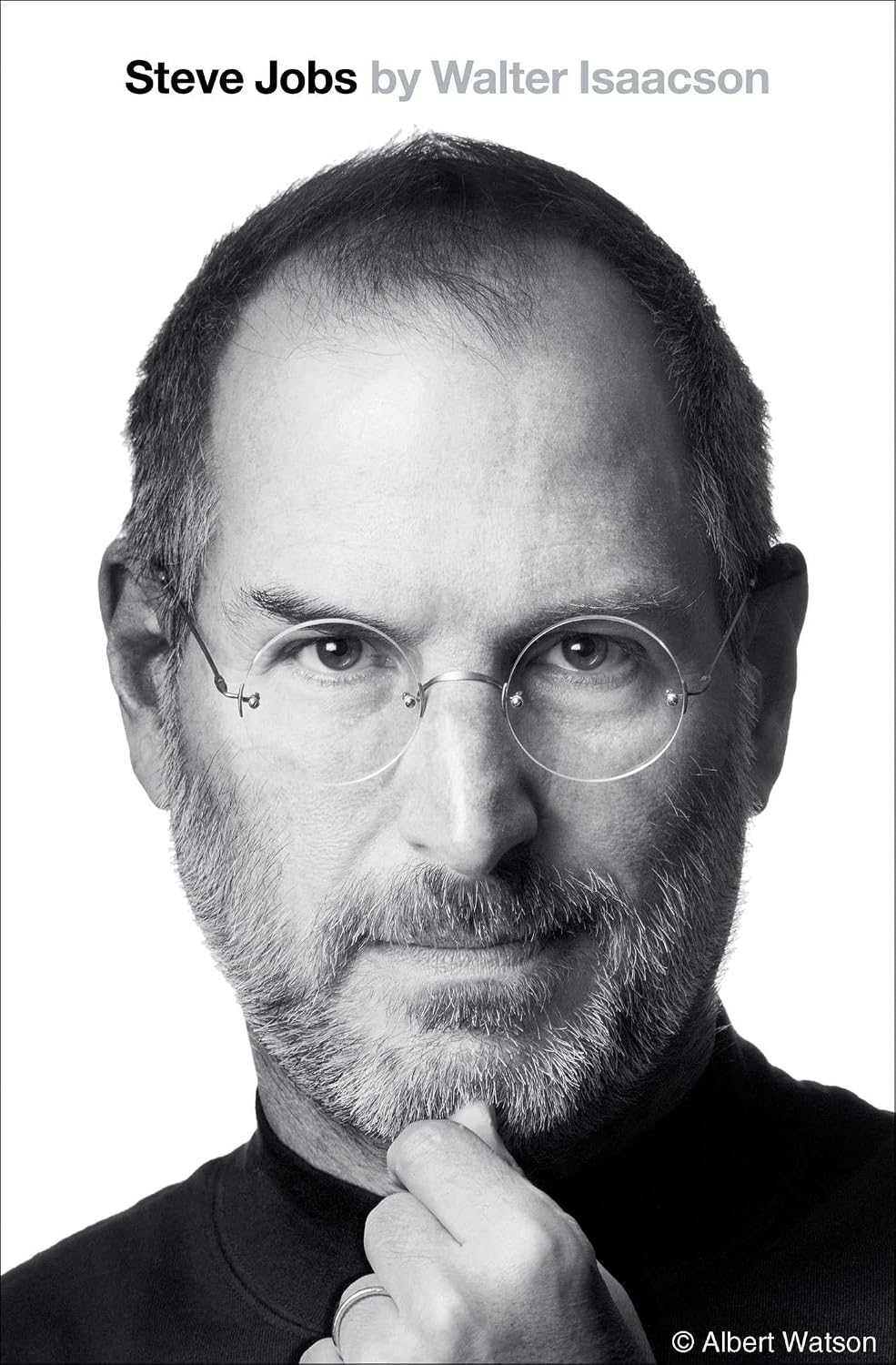
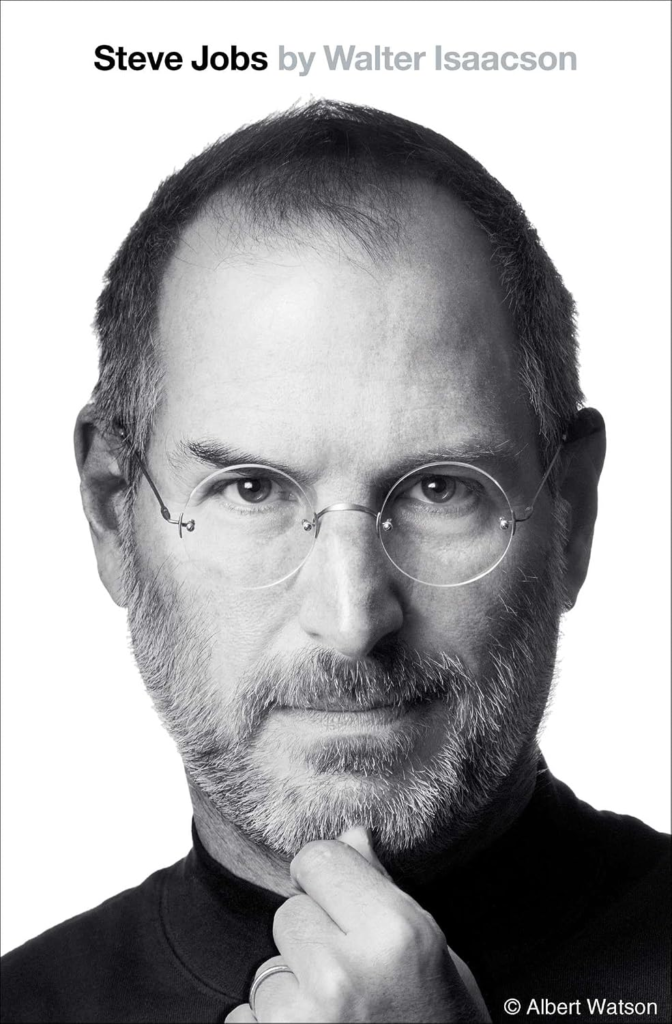
Steve Jobs is an authorized biography of American entrepreneur and Apple co-founder Steve Jobs, written by American journalist and biographer Walter Isaacson. First published by Simon & Schuster on October 24, 2011, the book appeared only a few weeks after Jobs’s death on October 5, 2011. It became one of the most widely read biographies of the technology entrepreneur and remains an important source for understanding both Jobs’s personal character and his role in the development of modern consumer technology.
Unlike a conventional corporate biography, Steve Jobs attempts to examine the relationship between Jobs’s personality, his methods of leadership, his aesthetic sensibility, and the products associated with Apple. Isaacson’s account covers Jobs’s childhood and adoption, his friendship with Steve Wozniak, the founding of Apple, his departure from the company, his work at NeXT and Pixar, his return to Apple, and the creation of products including the iMac, iPod, iPhone, and iPad.
The biography was based on more than 40 interviews with Jobs conducted over approximately two years, together with interviews with more than 100 family members, friends, colleagues, competitors, business associates, and other people who knew him.
Isaacson presents Jobs as a deeply contradictory figure: intensely creative and aesthetically demanding, capable of extraordinary concentration and persuasion, but also frequently abrasive, uncompromising, and difficult in personal and professional relationships. The book’s central interest is therefore not simply what Steve Jobs built, but how his personality shaped the way he built it.
Book information
| Field | Details |
|---|---|
| Title | Steve Jobs |
| Author | Walter Isaacson |
| Genre | Biography; business; technology |
| Subject | Steve Jobs |
| Country | United States |
| Language | English |
| Publisher | Simon & Schuster |
| Original publication | October 24, 2011 |
| Original format | Hardcover |
| Hardcover ISBN-13 | 978-1-4516-4853-9 |
| Length | 656 pages in the original hardcover edition |
| Audiobook | Published by Simon & Schuster Audio |
| Narrator | Dylan Baker |
| Status | Authorized biography |
Simon & Schuster lists the original hardcover as a 656-page edition with ISBN 9781451648539 and a publication date of October 24, 2011.
Overview
Steve Jobs is neither a traditional corporate history of Apple nor a straightforward chronological biography.
Its real subject is the intersection of personality, technology, design, business and culture.
Isaacson follows Jobs through several distinct stages:
- His childhood and adoption
- His education and early intellectual influences
- His friendship with Steve Wozniak
- The creation of Apple Computer
- The development of the Apple II and Macintosh
- Jobs’s conflict with Apple’s management
- His departure from Apple
- The creation of NeXT
- His involvement with Pixar
- His return to Apple
- The development of the iMac, iPod, iPhone and iPad
- His final years and declining health
- His continuing concern with products, design and legacy
The result is a portrait of a man whose professional life repeatedly moved between spectacular success and dramatic failure.
The central question of the book
One of the most interesting questions raised by Isaacson’s biography is deceptively simple:
What makes a person capable of imagining products that other people have not yet imagined?
Jobs’s answer was not primarily technical.
He believed that great products emerged from the intersection of technology and the humanities. He cared about engineering, but he also cared about typography, industrial design, music, architecture, storytelling and the emotional experience of using a product.
This philosophy became one of the defining characteristics of Apple’s identity.
Jobs’s creative equation
             TECHNOLOGY
                  │
                  ▼
        ┌──────────────────┐
        │     STEVE JOBS   │
        │                   │
        │  Taste            │
        │  Design           │
        │  Simplicity       │
        │  Storytelling     │
        │  User experience  │
        └──────────────────┘
                  │
                  ▼
             PRODUCT
                  │
                  ▼
        CULTURAL IMPACT
The biography repeatedly returns to this intersection.
Background and authorization
The book was commissioned with Jobs’s cooperation and is generally described as an authorized biography.
Isaacson was given unusually extensive access to Jobs and to people around him. The publisher states that Isaacson conducted more than forty interviews with Jobs over two years and interviewed more than one hundred people from Jobs’s personal and professional circles.
An important characteristic of the arrangement was that Jobs did not exercise conventional editorial control over the finished manuscript. This allowed Isaacson to include both favorable and unfavorable accounts of his subject.
That distinction matters because the book does not attempt to portray Jobs as an uncomplicated hero.
Instead, it records many of the contradictions that surrounded him.
Structure of the biography
The book is broadly chronological, but Isaacson organizes the narrative around important episodes and products rather than simply presenting a year-by-year account.
The major phases can be represented as follows:
CHILDHOOD
    │
    ▼
ADOPTION & IDENTITY
    │
    ▼
REED COLLEGE / INDIA
    │
    ▼
STEVE WOZNIAK
    │
    ▼
APPLE
    │
    ▼
APPLE II
    │
    ▼
MACINTOSH
    │
    ▼
CONFLICT & DEPARTURE
    │
    ▼
NeXT + PIXAR
    │
    ▼
RETURN TO APPLE
    │
    ├── iMac
    ├── iPod
    ├── iTunes
    ├── iPhone
    └── iPad
            │
            ▼
       FINAL YEARS
            │
            ▼
          LEGACY
This structure allows Isaacson to connect personal experiences with particular stages of Jobs’s career.
Childhood and adoption
Steve Jobs was born in San Francisco in 1955 and was adopted by Paul and Clara Jobs.
Isaacson treats Jobs’s adoption as an important psychological and biographical element. Jobs himself often spoke about the experience of being adopted and the importance of his adoptive parents.
Paul Jobs, in particular, influenced Steve’s early fascination with craftsmanship.
He taught his son that the unseen parts of an object mattered just as much as the visible parts.
That lesson would later become one of the recurring ideas in Jobs’s approach to product design.
The craftsmanship principle
VISIBLE PRODUCT
      │
      ├── Shape
      ├── Materials
      ├── Interface
      └── Appearance

            +

INVISIBLE PRODUCT
      │
      ├── Internal construction
      ├── Engineering
      ├── Organization
      └── Attention to detail

            ↓

       TRUE QUALITY
The lesson was simple:
Good craftsmanship should extend beyond what the customer can see.
That philosophy would later influence Apple’s obsession with the internal arrangement of its products.
Education and counterculture
Jobs attended Reed College but did not follow a conventional academic path.
He became interested in subjects that would later appear unrelated to computing, including calligraphy and Eastern philosophy.
Isaacson presents these experiences as important pieces of a larger creative vocabulary.
The famous story of Jobs attending calligraphy classes after dropping out of Reed is particularly significant because Jobs later connected those experiences with the typography and visual design of the Macintosh.
The biography therefore challenges the assumption that technological innovation comes exclusively from technical training.
Instead, it suggests that apparently unrelated experiences can become valuable later.
India and spiritual influences
Jobs travelled to India during his early adulthood, seeking spiritual and philosophical insight.
The experience contributed to his interest in Zen Buddhism and intuitive approaches to thinking.
Isaacson does not present the journey as a simple explanation for Jobs’s later success. Rather, it becomes one element in a larger combination of influences.
Jobs developed an enduring attraction to simplicity, intuition and the idea of cutting through unnecessary complexity.
These ideas would eventually become visible in Apple’s product philosophy.
Steve Jobs and Steve Wozniak
The relationship between Steve Jobs and Steve Wozniak is one of the foundational relationships in the biography.
Wozniak possessed exceptional engineering and electronics skills.
Jobs possessed a different combination of abilities: product vision, persuasion, aesthetics, marketing instincts and an unusual sensitivity to how technology could be packaged and presented.
Their talents were therefore complementary.
Jobs–Wozniak creative partnership
             STEVE WOZNIAK
                  │
        Engineering genius
                  │
                  ▼
             TECHNOLOGY
                  ▲
                  │
       Product vision
       Design
       Marketing
       Storytelling
                  │
                  │
             STEVE JOBS
The biography does not reduce Apple’s creation to a single genius.
Instead, it demonstrates how technological breakthroughs often emerge from different kinds of talent working together.
The founding of Apple
Apple was founded in 1976 by Steve Jobs, Steve Wozniak and Ronald Wayne.
The Apple I was an early step, but the Apple II transformed the company’s prospects.
Jobs recognized that a personal computer could not remain merely an electronic kit for hobbyists.
It needed to become a complete product.
That distinction was crucial.
From component to consumer product
Traditional electronics
        ↓
   Components
        ↓
   Engineering
        ↓
    Function

          VS.

Apple's emerging model
        ↓
   Technology
        +
     Design
        +
     Packaging
        +
   User experience
        +
     Marketing
        ↓
   CONSUMER PRODUCT
This approach became one of the recurring patterns of Jobs’s career.
The Macintosh
The Macintosh project became one of the defining episodes of Jobs’s first period at Apple.
Jobs wanted the computer to be more accessible and visually appealing than conventional computers.
The graphical user interface, mouse-based interaction, typography and emphasis on design represented a different conception of personal computing.
The Macintosh was commercially complicated: its cultural influence was enormous, but its early market performance did not immediately match Jobs’s ambitions.
Isaacson uses the episode to demonstrate one of the recurring tensions in Jobs’s career:
Products can be historically important without immediately being commercially dominant.
Conflict at Apple
Jobs’s intensity became increasingly difficult for Apple’s organizational structure.
He clashed with executives and colleagues and developed a reputation for demanding extremely high standards.
Eventually, his relationship with Apple’s leadership deteriorated.
In 1985, Jobs left Apple.
This departure became one of the great turning points of his life.
Rather than ending his career, however, it created the circumstances for another phase of experimentation.
NeXT
After leaving Apple, Jobs founded NeXT.
The company attempted to create advanced computers for higher education and professional users.
Although NeXT did not become a mass-market hardware success, its technology later became strategically important.
Apple acquired NeXT in 1996.
The acquisition brought Jobs back into the company he had helped create.
The software technology developed at NeXT subsequently became part of the foundation of Apple’s modern operating systems.
Pixar
One of the most fascinating sections of Isaacson’s biography concerns Jobs’s involvement with Pixar.
Jobs acquired what became Pixar from George Lucas’s organization and initially treated it largely as a technology company.
The company eventually evolved into an animation powerhouse.
The success of Toy Story demonstrated the potential of computer-generated feature animation.
Pixar became an extraordinary example of Jobs’s ability to recognize and combine technology with storytelling.
Pixar’s importance in the biography
COMPUTER TECHNOLOGY
        +
ANIMATION
        +
STORYTELLING
        +
CHARACTER
        +
EMOTION
        ↓
      PIXAR
        ↓
DIGITAL ANIMATION REVOLUTION
The Pixar experience also reinforced a principle that would recur throughout Jobs’s career:
Technology becomes more powerful when people care about what it enables them to experience.
The return to Apple
Jobs returned to Apple after Apple’s acquisition of NeXT.
At the time, Apple was struggling strategically and financially.
Jobs dramatically simplified the company’s product strategy.
Instead of allowing Apple to pursue numerous products, he concentrated attention on a smaller number of products that he believed could make a meaningful difference.
The resulting philosophy was often represented by a simple matrix:
                 CONSUMER       PROFESSIONAL

DESKTOP          iMac            Power Mac

PORTABLE         iBook           PowerBook
The underlying idea was not merely organizational.
Jobs believed that focus was a competitive advantage.
The iMac
The iMac became one of the most important products of Jobs’s return.
Its distinctive design made the computer visually recognizable and helped reposition Apple as a company concerned with both technology and industrial design.
The iMac also represented the beginning of Apple’s renewed consumer identity.
The computer was no longer presented merely as a technical machine.
It was presented as an object people could enjoy owning.
Design as a competitive strategy
One of the strongest themes running through Isaacson’s biography is Jobs’s belief that design was not decoration.
For Jobs, design involved the entire experience.
DESIGN
│
├── Physical appearance
├── Materials
├── Interface
├── Packaging
├── Typography
├── Sound
├── Retail experience
├── Software
└── User interaction
        │
        ▼
   TOTAL EXPERIENCE
This is why Jobs could become intensely involved in seemingly minor details.
To him, small details were not necessarily small if they affected the user’s experience.
The iPod and digital music
The iPod marked another transformation.
Portable music players already existed, but Jobs and Apple approached the problem as an ecosystem rather than simply as a piece of hardware.
The iPod worked together with iTunes and Apple’s broader digital-music strategy.
This illustrates another important concept in the biography:
Innovation can occur through integration rather than invention alone.
Apple did not invent every underlying technology associated with digital music.
Instead, it combined hardware, software, distribution and user experience into a coherent system.
The digital music ecosystem
             iPod
              │
              │
              ▼
           iTunes
              │
       ┌──────┴──────┐
       ▼             ▼
     Music       Computer
       │
       ▼
    Consumer
The result was a transformation of how many consumers purchased, organized and carried music.
The iPhone
The iPhone became perhaps the most consequential product associated with Jobs’s later career.
It combined a phone, music player and internet-connected computing device in a single product.
Its introduction changed expectations about mobile phones and helped accelerate the development of the modern smartphone industry.
Isaacson presents the development process as intensely iterative, secretive and demanding.
Jobs wanted the device to feel simple even though the technology underneath it was extraordinarily complex.
The apparent simplicity principle
              COMPLEXITY
        ┌───────────────────┐
        │ Hardware          │
        │ Software          │
        │ Networks          │
        │ Sensors           │
        │ Manufacturing     │
        │ Supply chain      │
        └───────────────────┘
                  │
                  ▼
             SIMPLIFICATION
                  │
                  ▼
          SIMPLE USER EXPERIENCE
This became one of the defining characteristics of Apple’s products.
The iPad
The iPad represented another attempt to create a new category of computing device.
Jobs viewed it not simply as a large iPhone but as a different form of computer.
The product continued Apple’s emphasis on a tightly integrated hardware-and-software experience.
Its launch also illustrates another recurring feature of Jobs’s personality: he took criticism of new products personally and remained intensely focused on how customers responded to them. Contemporary accounts of the biography note the degree to which product launches and public reactions affected him.
Jobs’s leadership style
Perhaps the most controversial subject in the book is Jobs’s treatment of other people.
Isaacson records numerous incidents involving:
- harsh criticism
- abrupt dismissals
- intense demands
- emotional confrontations
- perfectionism
- pressure on employees
- refusal to accept mediocre work
- manipulation and persuasion
- sudden changes of direction
Supporters saw these characteristics as part of what enabled Jobs to push teams beyond conventional expectations.
Critics viewed the same behavior as unnecessarily cruel and destructive.
Isaacson does not eliminate this contradiction.
Instead, he makes it central to the portrait.
The “reality distortion field”
One of the concepts associated with Jobs’s management style is the reality distortion field.
The phrase describes his extraordinary ability to persuade people that seemingly impossible goals could be achieved.
At its best, this produced ambition.
At its worst, it could result in unrealistic demands.
Reality distortion field
NORMAL EXPECTATION
        │
        ▼
   "Impossible"
        │
        ▼
   ┌─────────────┐
   │ JOBS'S      │
   │ PERSUASION  │
   └─────────────┘
        │
        ▼
"Let's find a way."
        │
        ▼
ENGINEERING PRESSURE
        │
        ▼
POSSIBLE BREAKTHROUGH
The same force that could inspire innovation could also generate conflict.
That duality is one of the biography’s most important observations.
Perfectionism
Jobs’s perfectionism appears throughout the book.
He repeatedly rejected products, interfaces, designs and ideas that he considered inadequate.
This sometimes resulted in delays and organizational frustration.
But it also contributed to Apple’s unusually strong emphasis on coherence.
Jobs did not want individual components to feel as though they had been assembled independently.
He wanted the whole product to feel intentional.
Jobs’s product philosophy
GOOD PRODUCT
     │
     ├── Works
     ├── Looks good
     ├── Feels good
     ├── Is understandable
     └── Fits into a larger system

              ↓

        GREAT EXPERIENCE
Simplicity
Simplicity is perhaps the most recognizable philosophical theme associated with Jobs.
But the biography makes clear that simplicity was not necessarily achieved by doing less work.
In many cases, simplicity required more work behind the scenes.
The user sees fewer choices because someone else has already dealt with the complexity.
This distinction can be summarized as:
Simple on the surface; complex underneath.
That became one of the defining principles of Apple’s design culture.
Technology and the humanities
Isaacson repeatedly emphasizes the relationship between technology and the humanities.
Jobs believed that technological products became meaningful when they connected with human interests.
This helps explain his interest in:
- typography
- music
- animation
- industrial design
- storytelling
- architecture
- advertising
- popular culture
The book therefore presents Jobs less as a conventional engineer and more as a technology-driven product creator.
Major themes
1. Innovation
Innovation in the book is not presented simply as inventing something that has never existed.
It often involves combining existing technologies in a new way.
2. Design
Design is treated as a fundamental component of product development rather than an afterthought.
3. Focus
Jobs repeatedly attempted to reduce the number of things Apple was doing.
His philosophy was that concentration could produce better products.
4. Perfectionism
Jobs’s relentless standards could produce exceptional results, but they also created interpersonal and organizational tensions.
5. Control
Jobs preferred integrated systems over fragmented ones.
This philosophy appeared in Apple’s hardware, software, retail strategy and ecosystem.
6. Reality versus persuasion
Jobs frequently attempted to change people’s perception of what was possible.
The book asks whether this was visionary leadership, manipulation, or some combination of both.
7. Technology and art
The biography repeatedly connects computing with design, music, typography, animation and storytelling.
8. Personal identity
Jobs’s adoption, search for biological parents, relationships and experiences in youth are presented as elements that influenced his identity.
9. Mortality
The final sections of the biography inevitably become reflections on illness, death and legacy.
Jobs’s awareness of mortality intensified his focus on what he wanted to leave behind.
Steve Jobs’s contradictions
One of the strongest aspects of Isaacson’s portrait is its refusal to make Jobs psychologically simple.
The Jobs paradox
| Quality | Positive expression | Negative expression |
|---|---|---|
| Perfectionism | Exceptional products | Impossible standards |
| Confidence | Bold decisions | Arrogance |
| Focus | Strategic clarity | Narrowness |
| Passion | Extraordinary commitment | Emotional volatility |
| Persuasion | Inspired teams | Manipulated people |
| Secrecy | Product surprises | Organizational opacity |
| Control | Integrated experience | Limited flexibility |
| Simplicity | Elegant products | Complex development |
| Intensity | High achievement | Difficult relationships |
This table captures one of the biography’s central ideas:
The characteristics that contributed to Jobs’s success could also create serious problems.
Jobs’s relationship with Apple
The book can almost be read as the story of a complicated relationship between one person and one institution.
1976
 │
 ▼
APPLE FOUNDED
 │
 ▼
EARLY SUCCESS
 │
 ▼
MACINTOSH
 │
 ▼
CONFLICT
 │
 ▼
JOBS LEAVES
 │
 ▼
NeXT + PIXAR
 │
 ▼
APPLE STRUGGLES
 │
 ▼
JOBS RETURNS
 │
 ▼
iMac
 │
 ▼
iPod
 │
 ▼
iPhone
 │
 ▼
iPad
 │
 ▼
JOBS'S FINAL YEARS
The remarkable feature is that the story does not move in a straight line.
Failure becomes preparation for later success.
Illness and final years
Jobs was diagnosed with a pancreatic neuroendocrine tumor in 2003.
His health became an increasingly important part of the final period of his life.
Isaacson documents Jobs’s reactions to illness, his decisions concerning treatment and his continuing involvement with Apple.
The final chapters are particularly significant because Jobs continued working while confronting his mortality.
His illness gives the earlier chapters a different meaning in retrospect.
The book becomes not only a biography of technological achievement but also a meditation on time.
Death
Steve Jobs died on October 5, 2011, at the age of 56.
Isaacson’s biography was published on October 24, 2011, less than three weeks later. The timing made the book an immediate cultural event and contributed to the extraordinary public interest surrounding its publication.
Rather than ending simply with a celebration of Jobs’s accomplishments, Isaacson leaves the reader with the more complicated portrait developed throughout the book.
Jobs was simultaneously:
- creator and critic
- visionary and manager
- perfectionist and improviser
- charismatic and abrasive
- intensely private and publicly iconic
- deeply interested in spirituality and aggressively commercial
- capable of extraordinary empathy for products and sometimes very little patience for people
These contradictions are central to the book’s enduring interest.
The role of Steve Jobs’s personality in his success
A recurring question raised by the biography is whether Apple’s success depended upon Jobs’s personality.
Isaacson’s evidence suggests that personality was deeply intertwined with Apple’s culture.
Jobs did not merely manage product development.
He personally shaped:
- product concepts
- industrial design
- software experience
- advertising
- presentations
- retail environments
- corporate strategy
- secrecy
- product launches
The result was a company culture strongly associated with its founder.
Jobs and the idea of “the whole widget”
One of the most important concepts associated with Jobs was the desire to control the complete user experience.
Rather than specializing in one component, Apple often sought control over multiple layers:
┌─────────────────────────┐
│       USER EXPERIENCE   │
├─────────────────────────┤
│        SOFTWARE         │
├─────────────────────────┤
│        HARDWARE         │
├─────────────────────────┤
│       PROCESSOR         │
├─────────────────────────┤
│       ECOSYSTEM         │
├─────────────────────────┤
│       SERVICES          │
└─────────────────────────┘
This integrated approach became one of Apple’s distinguishing characteristics.
The six industries transformed
Simon & Schuster describes Jobs as having helped revolutionize six major industries: personal computers, animated movies, music, phones, tablet computing and digital publishing.
Infographic: Jobs’s six major arenas
                 STEVE JOBS
                     │
     ┌───────────────┼────────────────┐
     │               │                │
     ▼               ▼                ▼
 COMPUTERS         ANIMATION         MUSIC
   Apple             Pixar           iPod
     │               │                │
     └───────────────┼────────────────┘
                     │
            ┌────────┴────────┐
            ▼                 ▼
          PHONES           TABLETS
         iPhone             iPad
            │                 │
            └────────┬────────┘
                     ▼
             DIGITAL PUBLISHING
This six-industry framework is one of the clearest ways to understand why Jobs’s influence extended beyond personal computers.
Narrative style
Isaacson writes the biography in a journalistic style rather than in the detached tone of a conventional academic biography.
The narrative frequently shifts between:
- interviews
- historical reconstruction
- personal anecdotes
- product development
- corporate history
- conversations
- technical explanations
- descriptions of personalities
This gives the book an almost oral-history quality.
The Guardian noted that the biography contains extensive material about Jobs’s personal shortcomings as well as his achievements, while also praising its ability to capture the contradictions surrounding him.
Why the book feels unusually personal
Isaacson had access not only to Apple’s corporate history but also to Jobs’s family, friends, colleagues and competitors.
As a result, the book frequently moves away from boardrooms and product launches and into kitchens, homes, hospitals and personal conversations.
This creates a portrait of Jobs outside the familiar black-turtleneck public image.
The reader encounters a man who could obsess over a product’s smallest detail while simultaneously making decisions that deeply affected the people around him.
Reception
The biography received substantial critical attention immediately after publication.
Kirkus Reviews described it as a thoroughly researched and engaging portrait of Jobs, emphasizing both his extraordinary ability to combine technology and the arts and his difficult treatment of colleagues.
Book Marks’ collection of contemporary reviews shows that many reviewers regarded the biography as compelling and substantial, while some questioned its scale, emphasis and occasional tendency toward admiration of its subject.
The Guardian similarly emphasized the book’s willingness to document Jobs’s unpleasant characteristics rather than producing a purely celebratory account.
At the same time, the biography attracted criticism from some people who had worked closely with Jobs.
Reported reactions from figures including Tim Cook and Jony Ive were substantially less favorable than the book’s reception among many reviewers. These responses are important because they demonstrate that Isaacson’s interpretation of Jobs was not universally accepted by those who knew him personally.
A balanced view of the biography
The book’s greatest strength is also one of its potential weaknesses.
Isaacson gives the reader an enormous amount of information.
That produces a richly documented portrait, but it can sometimes make the book feel more like a comprehensive archive than a tightly edited narrative.
Some reviewers praised its scope and reporting, while others argued that Isaacson occasionally devoted excessive attention to minor details or allowed the mythology surrounding Jobs to influence the narrative.
The biography should therefore be read as a major source about Jobs, but not as the final word on his life.
Controversies and limitations
Authorized biography
Because Jobs cooperated with Isaacson and participated in interviews, the book is formally an authorized biography.
However, authorization does not mean endorsement of every interpretation.
The biography contains substantial criticism of Jobs’s personality and behavior.
Dependence on recollection
Much of the narrative depends on interviews conducted years after many events occurred.
Human memory is selective, and people who worked with Jobs had different relationships with him.
Consequently, individual recollections sometimes conflict.
The Jobs mythology
By the time the book appeared, Steve Jobs had already become a cultural icon.
That created a challenge for any biographer.
The author had to distinguish between:
THE MAN
   +
THE EXECUTIVE
   +
THE INVENTOR/PRODUCT CREATOR
   +
THE PUBLIC ICON
   +
THE MYTH
Isaacson attempts to address all five.
What the book says about innovation
Perhaps the book’s most enduring lesson is that innovation is rarely the product of one isolated idea.
Jobs’s achievements emerged from combinations:
TECHNOLOGY
     +
DESIGN
     +
HUMANITIES
     +
MARKETING
     +
ENGINEERING
     +
TIMING
     +
EXECUTION
     =
PRODUCT INNOVATION
This is an important distinction.
The biography is not simply a story about inventing new machines.
It is a story about integrating existing technologies into experiences that people want to use.
What the book says about leadership
Isaacson’s biography does not provide a simple leadership formula.
Instead, it presents a difficult question:
Can extraordinary results justify extraordinary behavior?
The book does not offer an easy answer.
Jobs’s behavior produced both extraordinary achievements and significant human costs.
For readers interested in management, the useful lesson is therefore not simply to imitate Jobs.
It is to examine which parts of his approach created value and which created unnecessary damage.
What the book says about failure
Jobs’s career is often remembered as a sequence of triumphs.
Isaacson provides a different picture.
The biography includes:
- failed products
- internal conflicts
- organizational mistakes
- the Macintosh’s limitations
- Jobs’s departure from Apple
- NeXT’s commercial difficulties
- disputes with colleagues
- strategic failures
This makes the book more interesting than a conventional success story.
Jobs’s later achievements cannot be understood without understanding his failures.
Jobs’s personal philosophy
Several principles repeatedly appear throughout the biography.
1. Focus
Do fewer things, but do them exceptionally well.
2. Simplicity
Remove unnecessary complexity from the user’s experience.
3. Integration
Control the complete experience whenever possible.
4. Taste
Technology alone does not guarantee a great product.
5. Storytelling
People respond to products through narratives as well as specifications.
6. Persistence
A failed project does not necessarily mean the underlying idea should be abandoned.
7. Product obsession
Start with what the user should experience rather than what the technology can technically do.
A visual map of Jobs’s creative philosophy
                 ┌───────────────┐
                 │   CURIOSITY   │
                 └───────┬───────┘
                         │
                         ▼
                 ┌───────────────┐
                 │   TECHNOLOGY  │
                 └───────┬───────┘
                         │
          ┌──────────────┼──────────────┐
          ▼              ▼              ▼
       DESIGN         HUMANITIES     ENGINEERING
          │              │              │
          └──────────────┼──────────────┘
                         ▼
                    INTEGRATION
                         │
                         ▼
                      PRODUCT
                         │
                         ▼
                    EXPERIENCE
                         │
                         ▼
                       IMPACT
The book’s significance
Steve Jobs became significant for several reasons.
First, it was one of the earliest comprehensive biographies of Jobs written with his direct cooperation.
Second, it appeared immediately after his death, when global interest in his life was exceptionally high.
Third, it documented the development of products that had already transformed multiple industries.
Finally, it challenged the simplistic image of Jobs as either a flawless genius or merely an unpleasant executive.
Instead, Isaacson presents a complicated human being whose strengths and weaknesses were frequently intertwined.
The most important lesson of the biography
The most useful way to read Steve Jobs is not as a manual for becoming another Steve Jobs.
It is better understood as a study of how creativity, personality, technology, ambition and organizational power can interact.
Jobs’s story demonstrates that:
VISION without EXECUTION
        → remains an idea

EXECUTION without VISION
        → produces ordinary products

TECHNOLOGY without DESIGN
        → can become difficult to use

DESIGN without TECHNOLOGY
        → can become superficial

AMBITION without FOCUS
        → becomes scattered

FOCUS + TECHNOLOGY + DESIGN + EXECUTION
        ↓
     TRANSFORMATION
The biography’s deeper lesson is therefore about integration.
Author: Walter Isaacson
Walter Seff Isaacson is an American journalist, writer and biographer born in New Orleans, Louisiana, in 1952.
He studied at Harvard University and later at Pembroke College, Oxford.
Before becoming known primarily as a biographer, Isaacson had a long career in journalism and media. He served as editor of Time, chairman and CEO of CNN, and later CEO of the Aspen Institute. Simon & Schuster identifies him as the author of biographies of Benjamin Franklin, Albert Einstein, Steve Jobs, Leonardo da Vinci, Jennifer Doudna and Elon Musk.
He has also held academic and public-service roles and became a professor of history at Tulane University. Simon & Schuster notes that he received the National Humanities Medal in 2023.
Major works by Walter Isaacson
| Year | Book |
|---|---|
| 1986 | The Wise Men — with Evan Thomas |
| 1992 | Kissinger: A Biography |
| 2003 | Benjamin Franklin: An American Life |
| 2007 | Einstein: His Life and Universe |
| 2009 | American Sketches |
| 2011 | Steve Jobs |
| 2014 | The Innovators |
| 2017 | Leonardo da Vinci |
| 2021 | The Code Breaker |
| 2023 | Elon Musk |
Isaacson’s biographies frequently focus on individuals whose work connects science, technology, creativity, politics, business and culture.
Isaacson’s biographical method
Isaacson’s approach is particularly suited to subjects such as Jobs because he combines:
- archival research
- interviews
- corporate history
- personal anecdotes
- technical explanations
- social history
- psychological observation
- conversations with supporters and critics
In Steve Jobs, this method allows the narrative to move between an individual’s private life and the much larger history of technology.
Comparison with conventional business biographies
| Conventional business biography | Steve Jobs |
|---|---|
| Focuses heavily on companies | Focuses on both company and personality |
| Emphasizes achievements | Includes achievements and failures |
| Often celebrates leadership | Examines leadership critically |
| Product history | Product history + personal history |
| Corporate strategy | Strategy + design + culture |
| Executive profile | Human portrait |
| Success-oriented | Contradiction-oriented |
This is one reason the book has remained popular beyond the technology industry.
Major figures appearing in the narrative
Among the important people associated with the story are:
- Steve Wozniak — Apple co-founder and engineering partner
- Ronald Wayne — early Apple co-founder
- Mike Markkula — early Apple investor and executive influence
- Jony Ive — Apple industrial designer and later Chief Design Officer
- Tim Cook — Apple executive who eventually succeeded Jobs as CEO
- John Sculley — Apple executive involved in Jobs’s departure
- Ed Catmull — Pixar executive
- John Lasseter — Pixar animator and creative leader
- Laurene Powell Jobs — Jobs’s wife
- Paul Jobs — Jobs’s adoptive father
- Clara Jobs — Jobs’s adoptive mother
- Bill Gates — Microsoft co-founder and longtime Apple/Jobs rival and counterpart
- Jeffrey Katzenberg — entertainment executive associated with Pixar’s history
The significance of these relationships varies, but together they help Isaacson construct a social network around Jobs rather than portraying him as a completely isolated genius.
Steve Jobs and Bill Gates
The relationship between Steve Jobs and Bill Gates occupies an important place in the biography.
They represented two different approaches to personal computing.
Simplified contrast
APPLE / JOBS
     │
     ├── Integrated hardware
     ├── Integrated software
     ├── Design control
     ├── Closed ecosystem
     └── Consumer experience


MICROSOFT / GATES
     │
     ├── Software platform
     ├── Licensing
     ├── Broad hardware ecosystem
     ├── Scale
     └── Platform adoption
The rivalry demonstrates that there was more than one viable model for building the personal-computer industry.
The book as a history of the digital revolution
Although the book is centered on one person, its scope is considerably larger.
It is also a history of several technological transitions:
PERSONAL COMPUTERS
        ↓
GRAPHICAL INTERFACES
        ↓
DIGITAL ANIMATION
        ↓
DIGITAL MUSIC
        ↓
MOBILE COMPUTING
        ↓
SMARTPHONES
        ↓
TABLET COMPUTING
        ↓
DIGITAL CONTENT ECOSYSTEMS
Jobs appears throughout these transitions as a participant, competitor, strategist, product creator and cultural figure.
Infographic: Steve Jobs’s career arc
1955
 │
 ├── Born in San Francisco
 │
 ▼
1970s
 │
 ├── Electronics & counterculture
 ├── Reed College
 ├── India
 └── Steve Wozniak
 │
 ▼
1976
 │
 └── Apple founded
 │
 ▼
1977
 │
 └── Apple II
 │
 ▼
1984
 │
 └── Macintosh
 │
 ▼
1985
 │
 └── Leaves Apple
 │
 ▼
1986
 │
 └── Pixar acquired
 │
 ▼
1985–1996
 │
 └── NeXT
 │
 ▼
1997
 │
 └── Returns to Apple
 │
 ▼
1998
 │
 └── iMac
 │
 ▼
2001
 │
 └── iPod
 │
 ▼
2007
 │
 └── iPhone
 │
 ▼
2010
 │
 └── iPad
 │
 ▼
2011
 │
 ├── Final Apple period
 ├── Resigns as CEO
 ├── Dies October 5
 └── Biography published October 24
Chronological map of the book
| Period | Major development | Significance |
|---|---|---|
| Childhood | Adoption and family life | Formation of identity |
| Early adulthood | Reed College and India | Intellectual and spiritual influences |
| 1970s | Wozniak and Apple | Entry into computing |
| Early 1980s | Macintosh | Design-driven computing |
| 1985 | Departure from Apple | Major career setback |
| 1986 onward | NeXT and Pixar | Second phase of experimentation |
| 1997 | Return to Apple | Corporate transformation |
| 1998 | iMac | Apple revival |
| 2001 | iPod | Digital music |
| 2007 | iPhone | Mobile computing |
| 2010 | iPad | Tablet computing |
| 2011 | Final period | Mortality and legacy |
Adaptation
The biography was later adapted into the 2015 feature film Steve Jobs, written by Aaron Sorkin and directed by Danny Boyle, with Michael Fassbender portraying Jobs.
The film is not a conventional screen adaptation of the entire biography. Instead, it uses several major product-launch events as dramatic settings and constructs fictionalized conversations around them.
The film should therefore be regarded as a separate interpretation rather than a literal reproduction of Isaacson’s book.
Audiobook
The audiobook edition was published by Simon & Schuster Audio and narrated by actor Dylan Baker.
Kirkus lists the unabridged audio edition at approximately 25 hours.
The audiobook offers an alternative way to experience Isaacson’s extensive narrative, particularly for readers interested in the conversational and interview-based sections of the biography.
Reception in the years after publication
The book has remained commercially and culturally influential.
Its continued popularity is partly explained by the continuing relevance of the companies and products associated with Jobs.
Apple’s products remain central to global consumer technology, while Jobs’s approach to design, branding and product development continues to be discussed in business schools, technology companies and creative industries.
Goodreads lists the book with more than one million reader ratings, illustrating the scale of its continuing readership, although reader ratings should be understood as community opinion rather than scholarly evaluation.
Why Steve Jobs remains important
More than a decade after its publication, the biography remains useful for readers interested in:
- Apple
- entrepreneurship
- innovation
- product design
- technology history
- Silicon Valley
- leadership
- creativity
- business strategy
- organizational culture
- the relationship between art and technology
Its continuing value comes from the fact that Jobs’s career sits at the intersection of several major changes in modern life.
Critical interpretation
A careful reading of the book suggests that its real subject is not simply genius.
It is the complicated relationship between talent and character.
Jobs’s ability to see possibilities before others did was extraordinary.
But the biography also shows that extraordinary vision does not automatically produce extraordinary relationships.
His strengths could become weaknesses when taken too far:
VISION
  ↓
AMBITION
  ↓
FOCUS
  ↓
PERFECTIONISM
  ↓
CONTROL
  ↓
CONFLICT
At the same time:
VISION
  ↓
AMBITION
  ↓
FOCUS
  ↓
PERFECTIONISM
  ↓
EXCEPTIONAL EXECUTION
  ↓
INNOVATION
Both chains appear in Isaacson’s biography.
That is precisely why the book is more interesting than a conventional success story.
Human dimension of the book
Behind the Apple products and business milestones, the biography is ultimately a story about a human being trying to create something that would outlast him.
Jobs was fascinated by the possibility that a product could become a kind of cultural artifact.
He wanted technology to feel meaningful.
He cared about the details because he believed details accumulated into experience.
And he cared about experience because he believed technology should ultimately serve human beings.
This is perhaps the most human thread running through the biography.
Selected ideas associated with the biography
The book repeatedly returns to several broad ideas:
“Focus”
Do not attempt to make everything.
“Simplicity”
Remove what is unnecessary.
“Integration”
Connect hardware, software and experience.
“Taste”
Technical capability is not enough.
“End-to-end control”
The whole product matters.
“Humanities + technology”
The most interesting products can emerge where disciplines overlap.
“Reality distortion”
Sometimes extraordinary goals require people to believe they are possible before there is evidence that they are.
What readers can take away from the book
The biography can be read at several different levels.
As a technology history
It explains the development of major products and companies that shaped the digital era.
As a business biography
It examines strategy, competition, product positioning and corporate transformation.
As a leadership study
It explores the advantages and dangers of an intensely demanding leader.
As a creativity study
It demonstrates how technology can be combined with design, art and the humanities.
As a personal biography
It examines identity, family, ambition, illness and mortality.
As a cautionary story
It demonstrates that extraordinary achievement and personal virtue are not necessarily the same thing.
References
- Isaacson, Walter. Steve Jobs. Simon & Schuster, 2011. The original hardcover edition was published on October 24, 2011; ISBN 9781451648539.
- Simon & Schuster. Steve Jobs — official publisher page. The publisher describes the book as based on more than forty interviews with Jobs and more than one hundred additional interviews with people in his personal and professional circles.
- Kirkus Reviews. Steve Jobs by Walter Isaacson. Review published in October 2011.
- Leith, Sam. “Steve Jobs: The Exclusive Biography by Walter Isaacson — review.” The Guardian, October 25, 2011.
- Conrad, Peter. “Steve Jobs: The Exclusive Biography by Walter Isaacson — review.” The Guardian, October 2011.
- Book Marks. Steve Jobs — collection of contemporary critical reviews.
- Simon & Schuster. Walter Isaacson author biography and bibliographic information.
- Kirkus Reviews. Steve Jobs audiobook edition, narrated by Dylan Baker.
Further reading
Books by Walter Isaacson
- Benjamin Franklin: An American Life
- Einstein: His Life and Universe
- The Innovators: How a Group of Inventors, Hackers, Geniuses, and Geeks Created the Digital Revolution
- Leonardo da Vinci
- The Code Breaker: Jennifer Doudna, Gene Editing, and the Future of the Human Race
- Elon Musk
Books about Apple and Steve Jobs
Readers interested in expanding beyond Isaacson’s biography may also explore works dealing with:
- the history of Apple Computer
- the Macintosh project
- Pixar and computer animation
- Silicon Valley
- the history of personal computing
- digital music
- smartphone history
- industrial design
- Steve Wozniak and the early Apple years
Related topics
- Steve Jobs
- Apple Inc.
- Steve Wozniak
- Jony Ive
- Pixar
- NeXT
- Macintosh
- iPod
- iPhone
- iPad
- Silicon Valley
- Personal computer
- Industrial design
- Digital revolution
- Walter Isaacson
Read more
Official and primary resources
- Simon & Schuster’s official edition of Steve Jobs
- Walter Isaacson’s author and academic work
- Apple historical materials concerning Steve Jobs and Apple products
- Archival material concerning the development of Macintosh, NeXT, Pixar and the iPhone
External links
- Simon & Schuster — Steve Jobs by Walter Isaacson
- Simon & Schuster — current Steve Jobs edition
- Kirkus Reviews — Steve Jobs
- The Guardian — review of Steve Jobs
- Book Marks — Steve Jobs reviews
Bibliographic note
The original hardcover edition published by Simon & Schuster in 2011 is 656 pages and carries ISBN-13 9781451648539. Different later editions, formats and international editions may have different pagination and ISBNs.
Conclusion
Walter Isaacson’s Steve Jobs is ultimately more than a biography of an Apple co-founder.
It is a study of how technology, design, ambition, personality and culture can converge around one unusually forceful individual.
The book’s lasting strength is its refusal to make Jobs easy to categorize. He appears as a visionary and a businessman, an artist and an executive, a demanding leader and a difficult colleague, a private man and a global icon.
His career contained spectacular successes, painful failures, remarkable collaborations and bitter conflicts.
The products associated with him changed the way millions of people interacted with computers, music, telephones, films and digital media. But Isaacson’s biography makes clear that the products alone do not explain the phenomenon.
The more interesting story lies behind them.
It lies in the obsessive attention to detail, the willingness to reject conventional assumptions, the ability to connect seemingly unrelated disciplines, the insistence on simplicity, and the extraordinary intensity with which Jobs pursued his vision.
At the same time, the book leaves readers with an important caution: great creative achievement does not erase human complexity.
That tension is what makes Steve Jobs an enduring biography—not simply of a technology executive, but of one of the most consequential and controversial figures of the digital age.