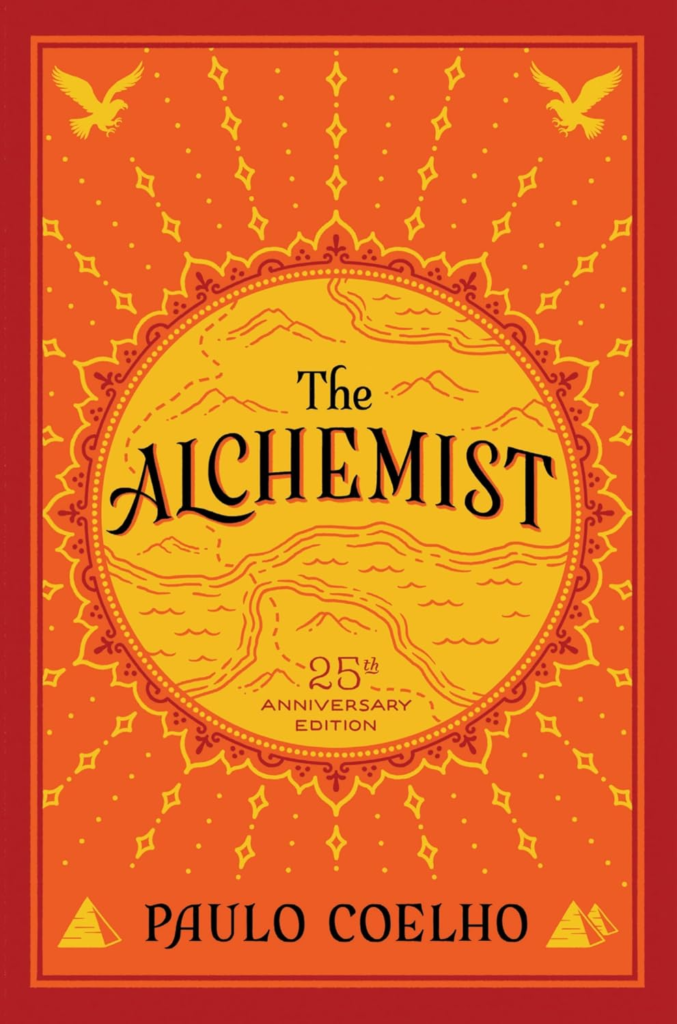
The Alchemist is a philosophical novel and modern fable by Brazilian author Paulo Coelho. Originally published in Portuguese as O Alquimista in Brazil in 1988, the novel follows Santiago, a young Andalusian shepherd who leaves Spain after experiencing a recurring dream about a treasure near the Egyptian pyramids.
What begins as a conventional treasure hunt gradually becomes a journey of self-discovery. Along the way, Santiago encounters a gypsy woman, an enigmatic king, an Englishman, an alchemist, a desert caravan and Fatima, a woman he falls in love with. Each encounter contributes something to his understanding of dreams, fear, love, destiny, work, faith and the meaning of personal fulfillment.
The book’s central idea is that people have a deeply personal purpose or calling and that pursuing it requires courage, attention, perseverance and a willingness to learn from experience. Rather than presenting success simply as the acquisition of wealth, The Alchemist gradually transforms the meaning of “treasure” into something more internal.
The novel became an international bestseller and is now widely regarded as one of the most commercially successful works of contemporary Portuguese-language fiction. HarperCollins editions describe it as having sold more than 80 million copies worldwide and having been published in dozens of languages.
Book information
| Field | Details |
|---|---|
| Title | The Alchemist |
| Original title | O Alquimista |
| Author | Paulo Coelho |
| Country of origin | Brazil |
| Original language | Portuguese |
| Genre | Philosophical fiction, fable, magical realism, allegory |
| Original publication | 1988 |
| Original publisher | Editora Rocco, Rio de Janeiro |
| English translation | Alan R. Clarke |
| First English publication | 1993 |
| English publisher | HarperSanFrancisco |
| Principal character | Santiago |
| Setting | Andalusia, Tangier, the Sahara Desert and Egypt |
| Central subjects | Dreams, destiny, self-discovery, spirituality, love, courage, personal purpose |
| Narrative form | Philosophical quest / allegorical fable |
| Original language title | O Alquimista |
Library records identify the original work as a 1988 Portuguese publication and the first English translation as a 1993 HarperSanFrancisco edition translated by Alan R. Clarke.
Overview
At first glance, The Alchemist appears to be a simple adventure story.
A shepherd has a dream.
He believes the dream contains a message.
He decides to follow it.
He loses money.
He works.
He travels.
He meets strangers.
He falls in love.
He faces danger.
He becomes afraid.
And eventually he discovers that the treasure he has been searching for has a surprising connection with the place from which he began.
But the simplicity is deliberate.
Coelho constructs the novel almost like a traditional fable: the characters are memorable, the sentences are accessible, the symbolism is clear, and the events repeatedly point toward larger philosophical questions.
The result is a story that can be read on several levels.
A young reader may see an adventure.
A traveler may see a story about following a dream.
A spiritual reader may see a story about destiny and divine guidance.
A psychologically minded reader may see a story about overcoming fear and developing self-knowledge.
A literary reader may see an allegory about the relationship between desire, identity and transformation.
That flexibility is one reason the novel has remained internationally popular.
Plot summary
Santiago and the recurring dream
Santiago is a young shepherd from Andalusia who has chosen a life of travel rather than the conventional future his parents imagined for him.
His sheep allow him to move from place to place, and he enjoys the freedom of his existence.
One night, however, Santiago experiences a recurring dream.
In the dream, a child takes him to the Egyptian pyramids and indicates that treasure is waiting for him there.
The dream troubles him because it feels unusually significant.
Instead of dismissing it, Santiago seeks an interpretation.
He visits a gypsy woman who tells him that he should go to Egypt and search for the treasure.
The advice sounds irrational.
The journey would be difficult.
There is no guarantee that the treasure exists.
Yet the idea begins to take hold of him.
Melchizedek and the idea of a Personal Legend
Santiago’s next important encounter is with an old man who introduces himself as Melchizedek, the King of Salem.
Melchizedek tells Santiago that every person has a unique purpose or destiny. In Coelho’s terminology, this becomes the idea of a Personal Legend.
The concept is central to the novel.
A Personal Legend is not simply a career objective.
It is closer to the deepest purpose an individual feels called to pursue.
The tragedy, according to the novel, is that many people gradually abandon such aspirations because of fear, social expectations or the desire for security.
Melchizedek encourages Santiago to take his dream seriously.
Santiago eventually sells his sheep and begins his journey toward Africa.
Tangier: the first major setback
When Santiago reaches Tangier, he immediately discovers that pursuing a dream does not mean receiving a smooth path toward it.
A thief steals his money.
Suddenly, the young shepherd is stranded in a foreign country.
He cannot speak the local language well, has little money and is far from home.
This is an important structural moment in the novel.
Santiago could interpret the theft as proof that his dream was foolish.
Instead, he finds work in a crystal shop.
The crystal merchant
The crystal merchant becomes one of the most important secondary characters in the story.
The merchant has his own unrealized dream: he wants to travel to Mecca.
Yet he never leaves.
He has spent years imagining the journey while remaining within the safety of his existing life.
Through this character, Coelho introduces one of the novel’s most important contrasts:
A dream can inspire action, but it can also become a substitute for action.
Santiago works at the crystal shop and introduces practical improvements that increase the business’s success.
The experience teaches him several things:
- work can create opportunity;
- unfamiliar situations can produce unexpected skills;
- setbacks do not necessarily end a journey;
- financial security and personal fulfillment are not identical;
- a person can become trapped by fear even when opportunity is available.
Eventually Santiago has enough money to return home and buy another flock of sheep.
But he chooses not to.
He decides to continue toward Egypt.
The desert caravan
Santiago joins a caravan crossing the Sahara.
The desert changes the scale of the story.
Earlier, his problems were personal and financial.
Now he is moving through an enormous landscape in which human beings appear small.
During the journey he meets an Englishman who is searching for an alchemist.
The Englishman represents another form of seeking.
He approaches knowledge through books, study and intellectual theory.
Santiago, meanwhile, learns through observation and experience.
Their different approaches create one of the book’s recurring contrasts:
Knowledge from books vs. knowledge from experience
| Book learning | Experiential learning |
|---|---|
| Study | Observation |
| Theory | Practice |
| Intellectual knowledge | Intuitive knowledge |
| Written instructions | Direct experience |
| Understanding concepts | Understanding life |
Coelho does not necessarily reject formal knowledge. Instead, the novel suggests that knowledge becomes meaningful when it is connected with lived experience.
The Englishman
The Englishman has spent years studying alchemy.
He believes that the legendary Philosopher’s Stone can transform base metals into gold and that the Elixir of Life can provide extraordinary longevity.
His obsession is intellectual and technical.
Santiago’s approach is different.
He pays attention to people, animals, landscapes and what the novel calls the language of the world.
The contrast between the two characters reinforces a larger theme:
There are things that can be learned from books, and things that must be learned by living.
Fatima and the meaning of love
At an oasis, Santiago meets Fatima, a young woman of the desert.
He falls in love with her.
This creates one of the novel’s most important tests.
Santiago must decide whether love should cause him to abandon his quest.
Fatima does not ask him to remain.
Instead, the novel presents genuine love as something that should not destroy an individual’s deeper purpose.
This produces another important idea:
Love and personal purpose
False choice:
Love OR dream
Coelho’s ideal:
Love + dream + personal growth
The relationship between Santiago and Fatima therefore becomes more than a romantic subplot.
It becomes part of the novel’s argument that love should enlarge a person’s life rather than reduce it.
The Alchemist
Eventually Santiago meets the mysterious alchemist.
Unlike the Englishman, who seeks knowledge primarily through books, the alchemist appears to possess a more intuitive and experiential understanding of transformation.
The alchemist becomes Santiago’s guide.
He teaches Santiago to listen carefully, recognize fear and pay attention to the signs surrounding him.
The journey now becomes increasingly spiritual.
Santiago is no longer simply looking for physical treasure.
He is learning how to understand himself.
The desert as a symbol
The desert performs several functions in the novel.
It is:
- a physical landscape;
- a place of danger;
- a test of endurance;
- a place of silence;
- a space where Santiago becomes more attentive;
- a metaphor for uncertainty;
- a setting in which the ordinary assumptions of life are stripped away.
The desert therefore operates almost like a second teacher.
Santiago cannot control it.
He must learn to observe it.
The final journey
Santiago eventually reaches the pyramids.
The physical destination of his dream is finally before him.
Yet reaching the destination does not immediately solve everything.
He is attacked and robbed.
One of the thieves tells Santiago about a dream he once had about treasure hidden in an abandoned church in Spain—but he dismisses the dream as meaningless.
Santiago realizes the significance of what he has heard.
The story comes full circle.
The treasure is ultimately located back in the place where Santiago’s journey began.
The journey was therefore necessary even though the treasure was geographically close to his starting point.
This is the novel’s central structural paradox:
Sometimes we have to travel far away to understand what was close to us all along.
Ending and meaning of the treasure
Santiago returns to Spain and finds the treasure.
But the physical treasure is only one level of the ending.
By the time he reaches it, Santiago is no longer the same person who first dreamed about the pyramids.
He has acquired:
- courage;
- independence;
- practical experience;
- emotional maturity;
- spiritual awareness;
- knowledge of love;
- confidence in his ability to act;
- a deeper understanding of his own desires.
The treasure therefore has both material and symbolic value.
Central themes
1. Following one’s dreams
The most recognizable theme of The Alchemist is the importance of pursuing meaningful dreams.
However, Coelho’s argument is more complicated than “dream big.”
The novel repeatedly shows that pursuing a dream involves:
Dream → Decision → Risk → Work → Failure → Learning → Persistence → Transformation
A dream that remains purely imaginary produces little change.
Santiago’s dream becomes meaningful because he acts on it.
2. The Personal Legend
The Personal Legend is the philosophical center of the book.
It represents an individual’s deepest aspiration or calling.
The novel suggests that people can lose contact with this calling because of:
- fear;
- social expectations;
- financial insecurity;
- comfort;
- disappointment;
- self-doubt;
- attachment to routine.
The Personal Legend is therefore not merely an ambition.
It represents the life a person feels they are meant to live.
The Personal Legend cycle
             DREAM
               ↓
          RECOGNITION
               ↓
            DECISION
               ↓
             ACTION
               ↓
          OBSTACLES
               ↓
           LEARNING
               ↓
          TRANSFORMATION
               ↓
        FULFILLMENT
The important point is that the obstacles are part of the process, not simply interruptions to it.
3. Fear
Fear is arguably the strongest opposing force in the novel.
People do not always abandon their dreams because the dreams are impossible.
Sometimes they abandon them because they are afraid of discovering what will happen if they try.
This creates an interesting psychological tension:
Dream
  ↓
Possibility
  ↓
Fear
  ↓
"I might fail"
  ↓
Avoidance
  ↓
Temporary security
  ↓
Regret
Santiago repeatedly encounters situations where fear could stop him.
His development comes partly from learning to act despite uncertainty.
4. Destiny and free will
The novel frequently speaks in the language of destiny.
But Santiago is not simply carried toward his future.
He must make decisions.
He chooses to sell his sheep.
He chooses to work in the crystal shop.
He chooses to continue toward Egypt.
He chooses to leave the oasis.
This creates an important philosophical tension:
Destiny does not eliminate choice.
Instead, the novel presents destiny as something that becomes visible through choices and actions.
5. Omens and signs
Throughout the story, Santiago learns to recognize what the novel calls omens.
An omen is essentially a meaningful sign or coincidence that appears to guide him.
The idea is closely connected with the book’s spiritual worldview.
However, an interesting interpretation is that omens also represent attention.
A person who is completely absorbed in routine may miss opportunities that are visible to everyone.
Santiago becomes increasingly observant.
He learns to ask:
- What is happening?
- What can I learn from it?
- What opportunity exists here?
- What does my intuition tell me?
- What should I do next?
6. The Language of the World
One of the novel’s most memorable philosophical concepts is the idea that the world communicates through a kind of universal language.
This does not necessarily mean ordinary spoken language.
It can include:
- symbols;
- intuition;
- coincidence;
- nature;
- emotions;
- human relationships;
- observation;
- patterns.
The concept allows Coelho to connect spirituality with attentiveness.
7. Love
Love is another major theme.
Santiago’s relationship with Fatima raises a question familiar to many readers:
Should pursuing a personal dream require sacrificing love?
The novel’s answer is largely no.
Healthy love, in Coelho’s framework, does not imprison the individual.
Instead, love and personal growth can coexist.
8. Work and persistence
One of the book’s quieter lessons is that dreams require practical effort.
Santiago does not simply imagine success.
He works in a crystal shop.
He learns.
He saves money.
He joins a caravan.
He travels across the desert.
He survives setbacks.
This makes the novel’s philosophy more practical than the phrase “follow your dreams” might initially suggest.
9. Transformation
Alchemy traditionally involves transforming one substance into another.
Coelho turns this physical idea into a metaphor for human transformation.
Literary equation
Lead → Gold
becomes
Ordinary life → Conscious life
or:
Fear → Courage
Ignorance → Understanding
Dream → Action
Experience → Wisdom
In this sense, Santiago himself becomes the true object of the alchemist’s work.
The title: Why “The Alchemist”?
The title has both literal and symbolic meanings.
In the story, the alchemist is a mysterious person who understands transformation.
But the deeper symbolism concerns human transformation.
Alchemy traditionally seeks to transform matter.
Coelho’s story transforms something else:
A person’s relationship with his own life.
Santiago begins as a shepherd who dreams of treasure.
He ends as someone who understands himself more deeply.
The physical gold matters.
The internal transformation matters more.
Major characters
Santiago
Santiago is the protagonist.
He is a young Andalusian shepherd whose recurring dream begins the entire adventure.
He is curious, observant and willing to change.
His most important characteristic is not fearlessness.
It is his willingness to continue learning.
Santiago’s transformation
Shepherd
   ↓
Dreamer
   ↓
Traveler
   ↓
Worker
   ↓
Seeker
   ↓
Lover
   ↓
Apprentice
   ↓
Self-aware individual
Melchizedek
Melchizedek, who identifies himself as the King of Salem, introduces Santiago to the concept of the Personal Legend.
He functions as the mentor who initiates the quest.
The Crystal Merchant
The crystal merchant represents the person who has a dream but does not pursue it.
He is one of the novel’s most human characters because his situation is understandable.
He has responsibilities.
He has fear.
He has become comfortable.
His tragedy is not that his dream is impossible.
It is that he has become accustomed to postponing it.
The Englishman
The Englishman represents intellectual knowledge and the study of alchemy.
He provides a useful contrast to Santiago’s experiential learning.
Fatima
Fatima represents love, emotional connection and the possibility of combining personal relationships with personal purpose.
The Alchemist
The alchemist functions as Santiago’s final major mentor.
He pushes Santiago beyond intellectual understanding toward direct experience.
The Gypsy Woman
The gypsy woman is the first person to interpret Santiago’s dream as a potential sign of his future.
Her role initiates the chain of events leading to his journey.
Character and symbolic map
| Character | Narrative function | Symbolic meaning |
|---|---|---|
| Santiago | Protagonist | The seeker |
| Melchizedek | Mentor | Destiny and possibility |
| Gypsy woman | Dream interpreter | Intuition |
| Crystal merchant | Warning/example | Unfulfilled dreams |
| Englishman | Fellow seeker | Intellectual knowledge |
| Fatima | Love interest | Love and acceptance |
| Alchemist | Final mentor | Transformation |
| Thieves | Obstacles | Fear, uncertainty and setbacks |
Santiago’s journey
ANDALUSIA
    │
    ▼
TANGIER
    │
    ▼
CRYSTAL SHOP
    │
    ▼
CARAVAN
    │
    ▼
SAHARA DESERT
    │
    ▼
OASIS
    │
    ▼
ALCHEMIST
    │
    ▼
EGYPTIAN PYRAMIDS
    │
    ▼
RETURN TO SPAIN
    │
    ▼
TREASURE
This geographical movement mirrors Santiago’s psychological development.
The story as a Hero’s Journey
Although The Alchemist is written as a relatively simple fable, its structure resembles the broad pattern often associated with the hero’s journey.
| Hero’s Journey Stage | Santiago’s experience |
|---|---|
| Ordinary world | Shepherding in Andalusia |
| Call to adventure | Recurring dream |
| Mentor | Melchizedek |
| Crossing the threshold | Journey to Africa |
| Trials | Theft, work, desert journey |
| Allies | Englishman, Fatima, alchemist |
| Major ordeal | Desert and danger |
| Revelation | Deeper understanding of his quest |
| Return | Journey back to Spain |
| Reward | Treasure and self-knowledge |
This structure helps explain why the story feels familiar even though its setting and spiritual vocabulary are distinctive.
Major symbols
The sheep
The sheep represent Santiago’s existing life.
They provide:
- income;
- familiarity;
- security;
- companionship;
- freedom.
Leaving them therefore means leaving a known identity.
The pyramids
The pyramids symbolize the distant goal.
They represent something that appears to contain the answer to Santiago’s dream.
Yet the ultimate irony is that reaching them is necessary even though the physical treasure is elsewhere.
The desert
The desert symbolizes uncertainty, isolation and transformation.
It removes distractions and forces Santiago to pay attention.
Gold
Gold represents material treasure but also transformation and achievement.
The crystal shop
The crystal shop represents a temporary life that can become permanent if a person stops pursuing the deeper goal.
The oasis
The oasis symbolizes safety, abundance and love.
It is significant because Santiago could remain there and live comfortably.
His decision to continue demonstrates the difference between comfort and fulfillment.
An infographic of the novel’s philosophy
                    THE ALCHEMIST
                         │
        ┌────────────────┼────────────────┐
        ▼                ▼                ▼
      DREAM            COURAGE          LOVE
        │                │                │
        ▼                ▼                ▼
     PURPOSE           ACTION        CONNECTION
        │                │                │
        └────────────────┼────────────────┘
                         ▼
                      LEARNING
                         │
                         ▼
                     OBSTACLES
                         │
                         ▼
                  TRANSFORMATION
                         │
                         ▼
                    SELF-DISCOVERY
                         │
                         ▼
                    "TREASURE"
The book’s central philosophical equation
A useful way of understanding the novel is:
Dream + Action + Attention + Persistence = Transformation
The book does not suggest that wanting something automatically makes it happen.
Santiago’s dream becomes meaningful because he repeatedly acts upon it.
The paradox at the heart of the novel
One of the most interesting aspects of The Alchemist is its paradox:
The hero must leave home to discover the value of home.
Santiago believes that treasure is somewhere far away.
He travels across countries and deserts.
He meets people he would never otherwise have known.
He learns about work, love, fear and spirituality.
Only after completing the journey can he understand the significance of the place where he started.
This gives the novel a circular structure:
HOME
  ↓
DREAM
  ↓
DEPARTURE
  ↓
TRIALS
  ↓
DISCOVERY
  ↓
RETURN
  ↓
HOME — UNDERSTOOD DIFFERENTLY
Spiritual dimension
Spirituality is woven throughout The Alchemist.
The novel draws on several traditions and ideas, including:
- Christian imagery;
- Islamic and Middle Eastern settings;
- mystical traditions;
- alchemical symbolism;
- ideas of destiny;
- intuition;
- universal interconnectedness;
- pilgrimage;
- personal revelation.
Rather than presenting spirituality as a rigid theological system, Coelho uses it as a narrative language for discussing meaning and purpose.
The novel therefore speaks to readers from different cultural and religious backgrounds without requiring them to adopt a single interpretation.
Is The Alchemist a religious book?
Not in the conventional sense.
It contains religious and spiritual imagery, but its central concern is broader:
How should a person understand and pursue a meaningful life?
Readers can interpret its ideas through religious, spiritual, philosophical or psychological frameworks.
That openness is part of its international appeal.
Psychological interpretation
The story can also be read without accepting its supernatural elements literally.
From a psychological perspective, Santiago’s journey can represent:
1. Self-efficacy
He gradually develops confidence in his ability to act.
2. Identity development
He moves beyond the identity of “shepherd” and discovers additional capabilities.
3. Risk tolerance
He becomes more capable of acting under uncertainty.
4. Meaning-making
He learns to interpret events as part of a larger personal narrative.
5. Resilience
Setbacks become experiences from which he learns rather than permanent definitions of failure.
What the book says about failure
The novel does not present failure as the opposite of success.
Instead:
Attempt
  ↓
Failure
  ↓
Reflection
  ↓
Learning
  ↓
Adaptation
  ↓
Another attempt
This is one reason the story continues to resonate with readers interested in entrepreneurship, personal development and career change.
Dreams versus wishes
An important distinction can be made between a wish and a dream in the world of the novel.
| Wish | Dream that becomes a mission |
|---|---|
| “I would like this.” | “I will pursue this.” |
| Passive | Active |
| Comfortable | Risk-bearing |
| Imagined | Tested |
| Easily abandoned | Revisited after setbacks |
| Requires hope | Requires action |
Santiago’s transformation begins when his dream moves from imagination into behavior.
The role of coincidence
Coincidence is unusually important in The Alchemist.
Characters appear at precisely the moments when Santiago needs new information.
Events repeatedly redirect him.
This can be interpreted literally as destiny, or metaphorically as a reminder that opportunities often become visible only when people are actively pursuing something.
The novel leaves room for both readings.
Reception and international success
The Alchemist began modestly.
Its original Portuguese edition appeared in Brazil in 1988. The book later reached a much larger audience through international publication and translation. Library records document numerous editions and translations, including the English translation by Alan R. Clarke.
Its later success was extraordinary.
HarperCollins currently describes the novel as having sold more than 80 million copies worldwide and notes that it has been translated into numerous languages.
WorldCat describes the work as a modern classic and records a 25th-anniversary edition published by Harper Luxe in 2014.
The book’s enormous international readership has made Santiago one of the more recognizable protagonists in contemporary inspirational fiction.
Why the novel became so internationally accessible
Several characteristics helped the book travel across linguistic and cultural boundaries.
Simple language
The story is easy to follow.
Universal problem
Almost every culture has stories about dreams, destiny, love and journeys.
Short narrative
The book is considerably shorter than many major novels.
Strong symbolism
Its symbols can be interpreted across cultures.
Philosophical accessibility
The novel introduces philosophical ideas without requiring academic knowledge.
Fable-like structure
Its narrative resembles traditional storytelling more than experimental literary fiction.
Literary style
Coelho’s style in The Alchemist is deliberately straightforward.
The prose serves the story rather than drawing attention to itself.
The novel uses:
- short episodes;
- symbolic characters;
- philosophical conversations;
- recurring motifs;
- dreams;
- coincidences;
- journey imagery;
- simple moral propositions.
This contributes to the book’s readability.
It also means that readers looking for highly complex characterization or elaborate narrative experimentation may experience the novel differently from readers who value philosophical simplicity.
Criticism and limitations
The book’s popularity does not mean that every reader interprets it positively.
Some readers and critics have questioned the simplicity of its philosophy.
Common points of criticism include:
1. Oversimplification
The idea that people should simply pursue their dreams can appear too straightforward when viewed against poverty, illness, family obligations or structural inequality.
2. Spiritual universalism
The novel combines ideas from different traditions into a broad spiritual worldview. Some readers find this inspiring; others may consider it too generalized.
3. Character development
Santiago functions strongly as an allegorical figure, which means that some secondary characters are more symbolic than psychologically complex.
4. Repetition of philosophical ideas
The novel repeatedly returns to its central messages.
For some readers, this reinforces the fable-like quality.
For others, it can feel didactic.
These differences help explain why The Alchemist can simultaneously function as an inspirational classic for one reader and a philosophically simplistic novel for another.
The book’s greatest literary strength
One of the book’s distinctive strengths is its simplicity of architecture.
The entire novel can almost be reduced to one movement:
A PERSON HAS A DREAM
        ↓
THE PERSON LEAVES THE FAMILIAR
        ↓
THE WORLD TESTS THE PERSON
        ↓
THE PERSON LEARNS
        ↓
THE PERSON CHANGES
        ↓
THE PERSON RETURNS
        ↓
THE DREAM ACQUIRES A DEEPER MEANING
The simplicity makes the story easy to remember.
It also makes the book unusually adaptable to different interpretations.
The Alchemist and personal development
Although it is fundamentally a work of fiction, The Alchemist has become widely associated with personal development.
Its ideas can be applied to:
- career changes;
- entrepreneurship;
- education;
- creative work;
- travel;
- relationships;
- leadership;
- spiritual exploration;
- overcoming fear;
- setting personal goals.
However, the book should not be mistaken for a scientific or evidence-based psychology manual.
Its lessons are presented through fiction, metaphor and allegory.
The Alchemist as a book about career decisions
Santiago’s story can be particularly relevant to people who feel trapped between:
security and purpose.
The crystal merchant illustrates the security side.
Santiago represents the willingness to accept uncertainty.
The novel does not say that everyone should abandon their job and travel.
Its more useful question is:
What important part of your life have you repeatedly postponed because it feels safer not to pursue it?
That question is broader—and more practical—than simply “What is your dream?”
The Alchemist and entrepreneurship
Entrepreneurs may recognize several patterns in Santiago’s journey:
VISION
  ↓
RISK
  ↓
LIMITED RESOURCES
  ↓
UNEXPECTED SETBACK
  ↓
ADAPTATION
  ↓
NEW OPPORTUNITY
  ↓
GROWTH
Santiago’s experience in the crystal shop is particularly relevant.
He does not wait for ideal circumstances.
He improves the situation available to him.
That is a useful distinction:
Progress often begins with the resources already available.
The Alchemist and education
The contrast between Santiago and the Englishman also raises an educational question:
Is knowledge something we acquire—or something we experience?
The novel’s answer is essentially both.
Books can provide maps.
Experience teaches us how to travel.
The Alchemist and relationships
The relationship between Santiago and Fatima suggests that meaningful relationships should not necessarily require the abandonment of individuality.
The novel presents love as compatible with growth.
This is particularly significant because many traditional adventure stories make the hero choose between the quest and romantic attachment.
Coelho attempts to reconcile them.
A practical reading framework
Readers can approach The Alchemist through five questions:
Question 1
What is my “Personal Legend”?
Question 2
What fear is preventing me from pursuing it?
Question 3
What is the smallest action I can take now?
Question 4
What can my current circumstances teach me?
Question 5
What would I regret not attempting?
These questions are interpretations of the novel’s themes, not instructions explicitly presented as a modern self-help program.
The Alchemist in one visual map
                    SANTIAGO
                       │
                       ▼
                 RECURRING DREAM
                       │
                       ▼
                PERSONAL LEGEND
                       │
                       ▼
                     RISK
                       │
                       ▼
                  FIRST FAILURE
                       │
                       ▼
                     WORK
                       │
                       ▼
                   LEARNING
                       │
                       ▼
                    DESERT
                       │
                       ▼
                    LOVE
                       │
                       ▼
                  FEAR TEST
                       │
                       ▼
                 THE ALCHEMIST
                       │
                       ▼
                  PYRAMIDS
                       │
                       ▼
                    RETURN
                       │
                       ▼
                   TREASURE
                       │
                       ▼
              SELF-DISCOVERY
Ten major lessons from The Alchemist
1. A meaningful dream deserves attention
Not every desire is a calling, but repeatedly ignoring an important aspiration can become its own form of regret.
2. Action is more important than imagination
Santiago’s dream matters because he acts on it.
3. Fear is often part of the journey
The presence of fear does not necessarily mean that a decision is wrong.
4. Setbacks can contain information
The robbery, difficult work and desert journey all change Santiago.
5. Learn from the situation you are in
The crystal shop becomes part of Santiago’s education.
6. Love should not automatically require abandoning purpose
The relationship with Fatima illustrates this principle.
7. Pay attention
Opportunities are easier to recognize when a person is observant.
8. Knowledge needs experience
The Englishman’s intellectual knowledge and Santiago’s practical learning complement one another.
9. The destination may not mean what you originally thought
Santiago reaches the pyramids but discovers a deeper meaning to his journey.
10. The journey changes the traveler
Perhaps the book’s most important lesson is that achieving the original goal is only part of the story.
One-page encyclopedia summary
| Element | Summary |
|---|---|
| Protagonist | Santiago |
| Starting identity | Andalusian shepherd |
| Inciting event | Recurring dream about treasure |
| Main goal | Find the treasure near the Egyptian pyramids |
| Central concept | Personal Legend |
| Major obstacle | Fear and uncertainty |
| Major mentor | The Alchemist |
| Major romantic figure | Fatima |
| Important symbolic character | Crystal merchant |
| Major setting | Sahara Desert |
| Major symbol | Alchemy |
| Central conflict | Security vs. purpose |
| Major philosophical idea | Pursuing one’s deepest purpose |
| Transformation | Santiago becomes more courageous, observant and self-aware |
| Ending | The treasure is found near the place where Santiago’s journey began |
| Overall structure | Departure → Trial → Transformation → Return |
Author: Paulo Coelho
Author information
Paulo Coelho de Souza was born on 24 August 1947 in Rio de Janeiro, Brazil. He is a Brazilian novelist and lyricist and became internationally known for works combining spiritual searching, personal transformation and philosophical storytelling.
Coelho’s path to becoming a writer was unconventional.
As a young man, he wanted to become a writer but initially studied law. He later worked in several creative fields, including journalism, theatre and songwriting. His experience on the Santiago de Compostela pilgrimage route in Spain became an important turning point in his life and writing.
His first major book associated with that spiritual journey was The Pilgrimage. The Alchemist, published in Portuguese in 1988, followed soon afterward.
The success of The Alchemist transformed Coelho into an internationally recognized writer.
Paulo Coelho — author infobox
| Field | Details |
|---|---|
| Full name | Paulo Coelho de Souza |
| Born | 24 August 1947 |
| Birthplace | Rio de Janeiro, Brazil |
| Nationality | Brazilian |
| Occupations | Novelist, lyricist |
| Languages | Portuguese; works widely translated |
| Major genres | Fiction, spiritual fiction, philosophical fiction |
| Best-known work | The Alchemist |
| Other notable works | The Pilgrimage, Brida, By the River Piedra I Sat Down and Wept, Veronika Decides to Die, The Fifth Mountain, Eleven Minutes, The Zahir |
| Brazilian Academy of Letters | Member since 2002 |
Publisher information describes Coelho as the author of 30 books whose works have sold hundreds of millions of copies internationally and notes numerous awards and honors.
Coelho’s writing philosophy
Coelho’s fiction frequently returns to a group of related questions:
- Why are we here?
- What happens when we ignore our deepest desires?
- How do we recognize meaningful opportunities?
- What role does destiny play in human life?
- Can suffering contribute to transformation?
- What does it mean to live authentically?
This thematic consistency helps explain why The Alchemist is often read alongside Coelho’s other spiritually oriented novels.
Other notable works by Paulo Coelho
Some of Coelho’s best-known books include:
- The Pilgrimage (1987)
- The Alchemist (1988)
- Brida (1990)
- The Valkyries (1992)
- By the River Piedra I Sat Down and Wept (1994)
- The Fifth Mountain (1996)
- Manual of the Warrior of Light (1997)
- Veronika Decides to Die (1998)
- The Devil and Miss Prym (2000)
- Eleven Minutes (2003)
- The Zahir (2005)
- The Witch of Portobello (2006)
Together, these works establish Coelho as a writer particularly interested in spirituality, personal transformation and the search for meaning.
Publication history
The original Portuguese edition, O Alquimista, was published in Brazil by Editora Rocco in 1988. The English-language edition followed in 1993, translated by Alan R. Clarke and published by HarperSanFrancisco.
The English-language work has subsequently appeared in numerous editions.
Open Library records more than a hundred editions and translations associated with the work, illustrating the novel’s extensive international publication history.
A 25th-anniversary edition was published in 2014 and included a new foreword by Coelho.
A deluxe edition published by HarperCollins in 2025 contains 208 pages and continues the book’s long publication history in English.
Translation and global reach
The novel’s international success is closely connected to translation.
The English edition was translated by Alan R. Clarke, and library records document editions in multiple languages, including Spanish, French, Russian, Chinese and Polish.
Publisher and bookseller records associated with anniversary and later editions describe the novel as having been published in around 80–89 languages, depending on the edition and counting method.
Because exact translation counts can vary by edition and publisher, figures should be treated as edition-specific rather than as a permanent bibliographic constant.
Adaptations and popular culture
The popularity of The Alchemist has generated long-standing interest in adapting the story for other media.
Film adaptation discussions have occurred for decades. Earlier reports documented Warner Bros.’ acquisition of film rights and plans for a feature-film adaptation, although those plans did not result in the long-discussed film at that time.
The book has also appeared in illustrated and graphic adaptations and numerous special editions.
Its continued presence in publishing demonstrates that the story has developed beyond its original 1988 publication into a broader cultural property.
Why The Alchemist remains relevant
The modern world is full of information but often short on certainty.
People still struggle with questions that Santiago faces:
- Should I stay with what is safe?
- Should I change careers?
- Should I pursue a long-delayed ambition?
- What if I fail?
- What if I succeed and my life changes?
- How do I distinguish a genuine goal from a temporary desire?
- Can relationships coexist with ambition?
- How do I know when to continue and when to stop?
That is why the novel continues to attract new readers.
Its setting may be exotic.
Its language may be spiritual.
But its central conflict is remarkably ordinary:
A person knows there is something more they want from life, but does not know whether they are brave enough to pursue it.
A modern interpretation
Read today, The Alchemist can be understood less as a literal instruction to believe that the universe will deliver whatever one desires and more as a meditation on attention, commitment and personal meaning.
Its most useful modern interpretation may therefore be:
A meaningful life requires knowing what matters to you, acting toward it, learning from what happens, and remaining open to the possibility that the journey will change your original definition of success.
This interpretation preserves the novel’s spiritual character without requiring every supernatural element to be accepted literally.
The Alchemist: central ideas at a glance
                THE DREAM
                    │
                    ▼
              PERSONAL PURPOSE
                    │
                    ▼
                  COURAGE
                    │
                    ▼
                  ACTION
                    │
                    ▼
               EXPERIENCE
                    │
          ┌─────────┴─────────┐
          ▼                   ▼
        FAILURE             LOVE
          │                   │
          └─────────┬─────────┘
                    ▼
                 LEARNING
                    │
                    ▼
              SELF-DISCOVERY
                    │
                    ▼
               TRANSFORMATION
Frequently asked questions
What is The Alchemist about?
The Alchemist follows Santiago, a young Andalusian shepherd who travels toward the Egyptian pyramids after dreaming about a hidden treasure. His physical quest gradually becomes a spiritual and psychological journey about purpose, courage, love and self-discovery.
Who wrote The Alchemist?
The novel was written by Brazilian author Paulo Coelho.
When was The Alchemist first published?
The original Portuguese edition, O Alquimista, was published in 1988.
What is Santiago’s Personal Legend?
It is the novel’s term for a person’s deepest purpose or calling—the life they feel they are meant to pursue.
Who is the Alchemist?
The Alchemist is a mysterious spiritual teacher who guides Santiago during the later part of his journey.
Who is Fatima?
Fatima is the woman Santiago meets at the oasis and falls in love with.
What does the treasure symbolize?
The treasure is both literal and symbolic. It represents material reward, but also the knowledge, courage and self-understanding gained through Santiago’s journey.
What does alchemy symbolize in the novel?
Alchemy becomes a metaphor for transformation: just as alchemy traditionally concerns changing matter, Santiago’s journey transforms his understanding of himself and his life.
Is The Alchemist a true story?
No. It is a work of fiction and an allegorical fable.
Is The Alchemist a self-help book?
It is primarily a novel. However, its philosophical themes have caused it to be widely read as inspirational or personal-development literature.
What is the main message of The Alchemist?
At its broadest level, the novel explores the idea that pursuing a meaningful personal purpose requires courage, action, learning and persistence.
Related books
Readers interested in The Alchemist may also explore:
- The Pilgrimage — Paulo Coelho
- The Prophet — Kahlil Gibran
- Siddhartha — Hermann Hesse
- The Little Prince — Antoine de Saint-Exupéry
- Man’s Search for Meaning — Viktor E. Frankl
- The Power of Now — Eckhart Tolle
- Jonathan Livingston Seagull — Richard Bach
- The Monk Who Sold His Ferrari — Robin Sharma
- The Seven Spiritual Laws of Success — Deepak Chopra
These works are not identical in genre or philosophy, but they share themes involving meaning, personal transformation, spirituality, self-discovery or the search for a purposeful life.
Read more
About Paulo Coelho
Explore the life, literary career and other major works of Paulo Coelho.
About Santiago de Compostela
Coelho’s experience walking the Santiago de Compostela pilgrimage route became an important part of his spiritual and literary development.
About Alchemy
The historical practice of alchemy provides the symbolic foundation for the novel’s title and transformation imagery.
About Fables
The Alchemist can be understood within the broader tradition of philosophical and moral fables.
About Magical Realism
The novel can also be examined in relation to magical and spiritual approaches to fiction, although its classification varies among readers and critics.
References
- Open Library. The Alchemist by Paulo Coelho. Bibliographic records for editions of O Alquimista, including the original 1988 work and English editions.
- WorldCat. The Alchemist, Paulo Coelho; English-language 25th-anniversary edition, Harper Luxe/HarperCollins, 2014.
- HarperCollins / Google Books. The Alchemist, 25th-anniversary and later editions. Bibliographic and publisher information.
- HarperReach. Paulo Coelho author information and bibliography.
- Biography.com. Paulo Coelho biography and background information.
- Libraries of South Australia. Bibliographic record for the 25th-anniversary large-print edition of The Alchemist.
- Al Jazeera. Background report on the early publication history and international development of The Alchemist.
External links
- Paulo Coelho — author information: publisher and author resources. HarperReach — Paulo Coelho
- The Alchemist — library record: Open Library — The Alchemist
- The Alchemist — WorldCat: WorldCat — The Alchemist
- The Alchemist — Google Books: Google Books — The Alchemist
Editorial note
This article is an original encyclopedia-style overview of The Alchemist. It summarizes the novel’s plot, characters, themes, symbolism, publication history and cultural significance without reproducing the copyrighted text of the book.
The diagrams and conceptual charts in this article are original explanatory representations created for encyclopedia readers. They are not reproductions of diagrams from Paulo Coelho’s book.
Last reviewed: September 2026.