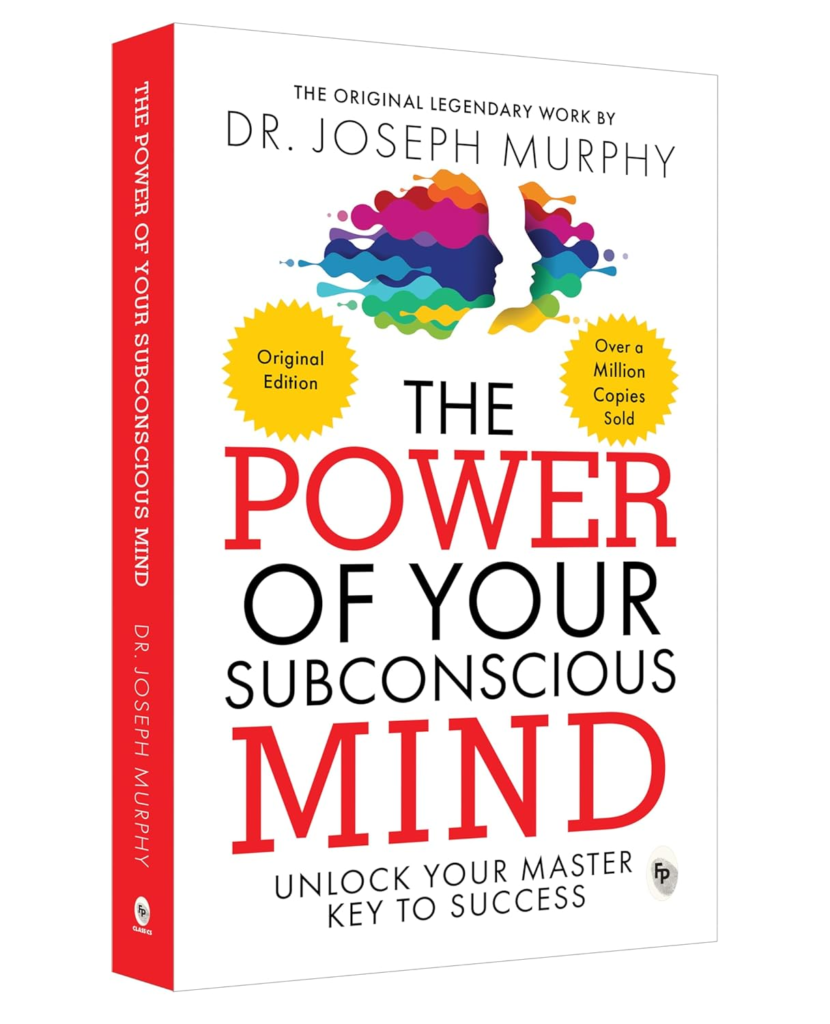
The Power of Your Subconscious Mind is a self-help and New Thought book by Irish-born writer and minister Joseph Murphy, first published in 1963. The book presents Murphy’s theory that the human subconscious mind has a powerful influence on thought, behavior, health, relationships, prosperity, and personal achievement. It argues that people can deliberately influence their lives by changing habitual thoughts, beliefs, mental images, and forms of prayer or affirmation.
Murphy combines elements of New Thought philosophy, Christian spirituality, metaphysical teaching, autosuggestion, positive thinking, visualization, and popular psychology. Throughout the book, he presents the subconscious as a creative inner power that responds to repeated ideas and beliefs.
The book became one of the most enduring works of the twentieth-century self-help movement. It has remained continuously available through numerous editions and translations, and its central vocabulary—particularly ideas about affirmations, visualization, subconscious programming, prosperity, and the relationship between belief and experience—has influenced later personal-development literature.
At the same time, Murphy’s interpretation of the subconscious should not be confused with the contemporary scientific understanding of unconscious or implicit mental processes. His strongest claims, particularly those concerning miraculous healing and the ability of belief to directly produce external events, belong to his metaphysical and spiritual worldview rather than established scientific psychology.
Book information
| Field | Details |
|---|---|
| Title | The Power of Your Subconscious Mind |
| Author | Joseph Murphy |
| First published | 1963 |
| Genre | Self-help, New Thought, metaphysics, spirituality |
| Subject | Subconscious mind, belief, prayer, personal development |
| Language | English |
| Original audience | General readers interested in personal transformation and spirituality |
| Major themes | Belief, affirmation, visualization, healing, prosperity, relationships, fear, happiness |
| Notable features | Case histories, biblical references, mental exercises, affirmations |
| Later editions | Numerous revised, expanded, abridged and annotated editions |
The original book is generally organized into approximately twenty major chapters, although chapter titles and pagination vary between editions. Google Books records editions containing chapters such as “The Treasure House Within You,” “How Your Own Mind Works,” “The Miracle-Working Power of Your Subconscious,” “Practical Techniques in Mental Healings,” “How to Get the Results You Want,” “Your Right to Be Rich,” and “How to Stay Young in Spirit Forever.”
Overview
At the heart of Murphy’s book is a remarkably simple proposition:
What a person repeatedly thinks, feels, imagines, and believes can influence the way that person experiences and responds to life.
Murphy develops this idea into a much larger philosophy.
He divides the mind conceptually into two interacting levels:
Conscious mind → chooses, thinks, reasons, imagines
Subconscious mind → accepts impressions, develops patterns, and expresses them through automatic responses
According to Murphy, the conscious mind acts like a gardener, while the subconscious mind is like fertile soil. Whatever is repeatedly planted in the mind may eventually become part of one’s habitual experience.
This metaphor is one of the most memorable features of the book.
Murphy’s basic model
        THOUGHT
           ↓
        BELIEF
           ↓
       EMOTION
           ↓
     MENTAL IMAGE
           ↓
     SUBCONSCIOUS
        PATTERN
           ↓
       HABITUAL
       RESPONSE
           ↓
        BEHAVIOR
           ↓
       EXPERIENCE
Murphy extends this model much further than contemporary psychology would normally do. In his philosophy, the subconscious is not merely a collection of automatic mental processes. It is portrayed as a deeper creative intelligence connected to what Murphy variously describes in spiritual terms as divine intelligence, universal intelligence, or the healing power within.
That distinction is essential to understanding the book.
The central idea
Murphy’s argument can be summarized in four stages:
1. The mind receives ideas
A person is constantly exposed to thoughts, beliefs, memories, expectations, fears, images, and suggestions.
2. Repetition gives ideas psychological force
Ideas that are repeatedly entertained may become familiar and emotionally convincing.
3. Familiar beliefs influence behavior
A person who expects failure may hesitate, avoid opportunities, interpret setbacks negatively, or give up quickly. Someone who expects success may behave with greater confidence and persistence.
4. Changed mental patterns can produce changed experiences
Murphy believes that deliberately replacing negative beliefs with constructive ones can change a person’s life.
This fourth step is where Murphy moves from relatively ordinary observations about thought and behavior into his broader metaphysical philosophy.
Conscious and subconscious mind
Murphy’s distinction between the conscious and subconscious mind is the structural foundation of the book.
The conscious mind
Murphy describes the conscious mind as the part of the mind involved in reasoning, choosing, judging, planning, and deciding.
It asks questions such as:
- What do I want?
- What should I believe?
- What should I do?
- What outcome do I desire?
- Which idea should I accept?
The conscious mind therefore acts as the gatekeeper of mental impressions.
The subconscious mind
Murphy presents the subconscious as a deeper level of mental activity that operates continuously, including during sleep.
He attributes to it functions such as:
- maintaining habitual patterns;
- responding to suggestions;
- influencing emotional reactions;
- supporting bodily processes;
- producing intuitive responses;
- helping solve problems;
- influencing dreams;
- reinforcing beliefs;
- assisting memory and learning.
Modern psychology does recognize extensive unconscious and automatic mental processing. However, Murphy’s concept is broader and more spiritual than the terminology normally used in contemporary cognitive science.
The “garden” metaphor
One of Murphy’s most accessible teaching devices is the metaphor of the mind as a garden.
The individual is imagined as the gardener.
Thoughts are the seeds.
The subconscious is the soil.
Repeated thoughts therefore become analogous to repeated planting.
Infographic: Murphy’s garden metaphor
                 YOUR MIND
                    │
          ┌─────────┴─────────┐
          │                   │
       CONSCIOUS          SUBCONSCIOUS
          │                   │
     "What I plant"       "What grows"
          │                   │
          └─────────┬─────────┘
                    ↓
             REPEATED IDEAS
                    ↓
              MENTAL HABITS
                    ↓
              LIFE RESPONSES
The metaphor is powerful because it shifts attention away from a single thought and toward repetition.
One fearful thought is not necessarily a permanent belief. A fearful thought repeated every day can become a pattern.
Likewise, a constructive thought repeatedly rehearsed may become easier to access.
The role of belief
Belief occupies a central position in Murphy’s philosophy.
He argues that people frequently behave in accordance with what they deeply believe rather than what they merely say they believe.
For example, a person may consciously say:
“I want to succeed.”
Yet internally believe:
“People like me never succeed.”
Murphy would regard the second belief as the more influential mental program.
This creates an important distinction:
Conscious wish ≠ deep belief
A person can consciously desire one outcome while emotionally expecting another.
Murphy’s method therefore focuses not simply on wanting something but on repeatedly impressing a desired idea upon the deeper mind.
Affirmations
One of the most influential elements of the book is Murphy’s use of affirmations.
An affirmation is a deliberately formulated statement expressing a desired condition, attitude, or belief.
Examples of the type of statements used in Murphy’s approach include ideas concerning:
- confidence;
- health;
- peace;
- prosperity;
- forgiveness;
- harmonious relationships;
- courage;
- success;
- security.
The purpose is not merely to repeat words mechanically.
Murphy emphasizes emotional acceptance and mental imagery.
The Murphy-style affirmation process
Choose a constructive idea
          ↓
Formulate it clearly
          ↓
Relax
          ↓
Repeat it calmly
          ↓
Visualize the desired condition
          ↓
Allow the idea to become familiar
          ↓
Act consistently with it
This is one of the areas in which Murphy’s ideas have had a particularly long afterlife in modern self-help culture.
Visualization and mental imagery
Murphy frequently encourages readers to create a mental picture of the result they desire.
Instead of concentrating exclusively on the problem, the reader is encouraged to imagine the desired outcome.
For example:
Problem-oriented thinking
“I am afraid I will fail.”
becomes:
Outcome-oriented thinking
“I can imagine myself calmly completing the task successfully.”
The psychological usefulness of mental rehearsal is not necessarily dependent on Murphy’s metaphysical explanation. Visualization and mental rehearsal have also been used in various performance contexts.
Murphy, however, interprets visualization as more than a behavioral preparation technique. He treats the mental image as an impression that can be communicated to the subconscious and subsequently expressed in life.
The importance of repetition
Repetition is another recurring principle.
Murphy believes that a new mental pattern requires repeated reinforcement.
This creates a kind of mental conditioning:
ONE THOUGHT
    ↓
REPEATED THOUGHT
    ↓
FAMILIAR THOUGHT
    ↓
BELIEF
    ↓
AUTOMATIC RESPONSE
The idea resembles the broader concept that repeated behavior and repeated mental activity can become habitual.
However, Murphy’s claim that repetition can directly cause external circumstances to change belongs to his metaphysical framework and should not be presented as an established scientific law.
The “law of belief”
A major theme of the book is what Murphy calls the law of belief.
In simplified form, his argument is:
What a person sincerely accepts as true can influence that person’s experience.
Murphy uses this principle to explain:
- confidence;
- fear;
- success;
- failure;
- relationships;
- prosperity;
- habits;
- physical well-being;
- personal happiness.
The concept is closely related to the broader New Thought tradition, which emphasizes the relationship between thought, belief and lived experience.
The subconscious and healing
The book devotes considerable attention to healing.
Murphy discusses historical and religious examples of healing and presents prayer, belief, imagination, and subconscious processes as mechanisms through which healing may occur.
He argues that the body possesses an inherent tendency toward restoration and that the subconscious participates in this process.
Important distinction
Murphy’s discussion should be understood as spiritual and metaphysical teaching, not as a substitute for evidence-based medicine.
Modern medicine does recognize relationships between psychological states and aspects of physical health—for example, through stress, sleep, behavior, adherence to treatment, and other mind-body pathways.
That does not establish Murphy’s stronger claims that belief or subconscious suggestion alone can cure serious disease.
This distinction is particularly important because the book includes accounts of dramatic physical recoveries.
Mental healing in ancient and modern times
Several chapters explore historical ideas about healing.
Murphy discusses traditions and figures associated with:
- prayer;
- faith healing;
- suggestion;
- mesmerism;
- spiritual healing;
- religious belief;
- mental influence.
Among the historical figures and traditions appearing in the book’s conceptual landscape are Franz Anton Mesmer, Phineas Parkhurst Quimby, Émile Coué, and various Christian and biblical traditions.
Murphy attempts to find a common principle behind these apparently different approaches.
His conclusion is essentially that the human mind possesses an underlying creative or healing power that different cultures have described in different ways.
The power of suggestion
Suggestion is central to Murphy’s explanation.
A suggestion is an idea presented to the mind in a way that encourages acceptance.
Suggestions may come from:
- other people;
- advertising;
- family;
- teachers;
- social environments;
- books;
- repeated experiences;
- self-talk.
Murphy’s contribution is his emphasis on self-suggestion.
Instead of allowing the surrounding world to program the mind automatically, he encourages the individual to deliberately choose the ideas that are repeatedly rehearsed.
The “sleep technique”
One of Murphy’s best-known practical methods involves using the period immediately before sleep.
The basic idea is:
- Become physically relaxed.
- Quiet the conscious mind.
- Select one clear idea.
- Repeat the idea gently.
- Visualize the desired result.
- Fall asleep while maintaining the mental impression.
Murphy gives particular importance to the drowsy state because he considers conscious resistance to be reduced during that period.
Bedtime method
RELAX
  ↓
QUIET THE MIND
  ↓
SELECT ONE IDEA
  ↓
REPEAT GENTLY
  ↓
VISUALIZE
  ↓
FEEL THE RESULT
  ↓
SLEEP
The technique has become one of the most recognizable practical exercises associated with Murphy.
How to get the results you want
Murphy repeatedly returns to the question of how a person should convert desire into results.
His approach can be reduced to a sequence:
Desire → Mental image → Belief → Repetition → Action → Result
However, the book places considerably more emphasis on the internal stages than a conventional productivity book would.
Murphy’s philosophy assumes that changing the inner mental pattern can remove psychological obstacles and help produce corresponding external results.
Wealth and prosperity
The book contains several chapters devoted specifically to wealth and prosperity.
Murphy argues against a mental attitude dominated by:
- scarcity;
- fear;
- resentment toward wealth;
- guilt about money;
- expectations of poverty;
- feelings of unworthiness.
He encourages readers to develop a more constructive mental relationship with prosperity.
Murphy’s prosperity framework
SCARCITY THINKING
"I cannot"
"I will never have enough"
        ↓
     FEAR
        ↓
  RESTRICTED ACTION
        ↓
 MISSED OPPORTUNITIES

              VS.

ABUNDANCE THINKING
"There are possibilities"
"I can create value"
        ↓
   CONFIDENCE
        ↓
  CONSTRUCTIVE ACTION
        ↓
   MORE OPPORTUNITIES
The second half of this diagram can be interpreted psychologically without accepting Murphy’s stronger metaphysical claims.
A confident person may indeed behave differently from a person consumed by fear.
But the book sometimes goes beyond this behavioral explanation by suggesting that belief itself has a direct creative influence on financial circumstances.
That stronger claim remains a matter of metaphysical belief rather than established economic or psychological science.
“Your Right to Be Rich”
The chapter commonly titled “Your Right to Be Rich” is an important part of Murphy’s prosperity philosophy.
Murphy rejects the idea that spirituality necessarily requires poverty.
For him, wealth is not inherently immoral. The ethical question is how prosperity is understood and used.
He connects financial prosperity with:
- constructive thought;
- service;
- creativity;
- confidence;
- useful work;
- freedom from limiting beliefs.
This section helped establish the book’s connection with the later prosperity-consciousness and manifestation literature.
The subconscious mind and success
Murphy treats success as partly a psychological phenomenon.
A person’s internal assumptions may influence:
- confidence;
- persistence;
- willingness to take risks;
- reaction to rejection;
- ability to concentrate;
- expectations about achievement.
A person who repeatedly expects failure may stop trying before a realistic opportunity has been fully explored.
Conversely, someone who expects that improvement is possible may continue experimenting after setbacks.
Murphy interprets this process through the language of the subconscious.
The subconscious and sleep
Sleep occupies an unusual place in Murphy’s philosophy.
He considers sleep not merely a biological necessity but an important period for mental programming.
The book encourages readers to avoid falling asleep while mentally rehearsing:
- fear;
- anger;
- resentment;
- financial anxiety;
- failure;
- illness.
Instead, Murphy recommends peaceful thoughts and constructive mental images.
This idea has become one of the most frequently repeated elements of his teaching.
Fear and phobias
Murphy also discusses fear and phobias.
His basic strategy is to replace a fearful mental image with a calm and constructive one.
Fear-replacement model
FEARFUL THOUGHT
      ↓
   ANXIETY
      ↓
  AVOIDANCE
      ↓
 FEAR REINFORCED

          ↓

CALM MENTAL IMAGE
      ↓
CONTROLLED EXPOSURE / ACTION
      ↓
NEW EXPERIENCE
      ↓
GREATER CONFIDENCE
The first half describes a recognizable psychological cycle.
The second reflects a broader behavioral principle, although Murphy’s own method is primarily presented through prayer, suggestion, imagery, and belief.
Relationships and marriage
Murphy applies his philosophy to interpersonal relationships as well.
He argues that resentment, suspicion, jealousy and hostility can become destructive mental patterns.
He encourages:
- forgiveness;
- goodwill;
- understanding;
- constructive expectations;
- appreciation;
- emotional self-control.
His discussion of marriage reflects the social assumptions of the mid-twentieth century and can therefore feel dated to contemporary readers.
Nevertheless, the broader idea—that repeated resentment can damage relationships and that constructive communication can improve them—remains readily understandable.
Forgiveness
Forgiveness receives a separate treatment in the book.
Murphy views resentment as a form of psychological bondage.
His argument can be represented as:
HURT
 ↓
RESENTMENT
 ↓
REPETITION OF MEMORY
 ↓
EMOTIONAL REACTION
 ↓
CONTINUED DISTRESS
Forgiveness interrupts this cycle.
For Murphy, forgiveness does not simply mean approving another person’s behavior. It means releasing the continuing emotional burden associated with it.
This is one of the book’s more psychologically accessible themes, even though Murphy frames it in spiritual language.
Happiness
Murphy does not define happiness simply as pleasure.
His concept of happiness is associated with:
- inner peace;
- harmonious relationships;
- constructive thinking;
- gratitude;
- confidence;
- purpose;
- spiritual faith.
He repeatedly returns to the idea that external circumstances alone cannot guarantee inner peace.
Harmonious human relations
Another recurring theme is the importance of mental attitudes toward other people.
Murphy encourages readers to reduce:
- envy;
- hostility;
- resentment;
- condemnation;
- suspicion.
Instead, he advocates:
- goodwill;
- appreciation;
- forgiveness;
- understanding;
- constructive expectations.
The underlying message is that interpersonal relationships are affected not only by what people say publicly but also by the attitudes they repeatedly maintain privately.
“Mental blocks”
Murphy uses the concept of a mental block to explain situations in which an individual consciously wants something but repeatedly behaves in ways that prevent achieving it.
For example:
CONSCIOUS DESIRE
"I want success."
        ↓
SUBCONSCIOUS BELIEF
"I am not capable."
        ↓
SELF-DOUBT
        ↓
HESITATION
        ↓
INCONSISTENT ACTION
        ↓
POOR RESULT
        ↓
"See, I knew I couldn't do it."
This circular pattern is one of the most useful ways of interpreting Murphy’s ideas in modern psychological language.
Murphy’s use of stories and case histories
The book is not written like a scientific textbook.
Murphy relies heavily on:
- personal anecdotes;
- stories about individuals;
- religious examples;
- historical incidents;
- reported cases of healing;
- stories of financial success;
- examples involving relationships and fear.
These stories give the book much of its readability.
They also create one of its major evidentiary weaknesses.
Anecdotes can illustrate an idea, but they cannot establish that a particular mental technique caused an outcome.
For example:
Person used affirmation → person recovered
does not by itself establish:
affirmation caused recovery.
Many other variables may be involved.
This distinction is crucial when reading Murphy today.
New Thought background
Murphy’s philosophy belongs broadly to the New Thought tradition.
New Thought emerged in the United States during the nineteenth century and developed around ideas concerning:
- mind;
- spirituality;
- healing;
- divine intelligence;
- positive belief;
- prosperity;
- personal transformation.
Murphy inherited and reorganized many of these ideas for a twentieth-century popular audience.
His approach is distinctive because he presents metaphysical ideas in relatively practical language.
Rather than simply telling readers to have faith, he frequently tells them what to think, how to imagine it, when to repeat it, and how to incorporate it into daily life.
Murphy and Émile Coué
Murphy’s approach has important connections with Émile Coué, the French psychologist and pharmacist associated with autosuggestion.
Coué became famous for his emphasis on deliberate repetition of positive suggestions.
Murphy incorporates a related idea:
repeated mental suggestions can influence deeper patterns of thought and behavior.
Murphy’s system, however, embeds autosuggestion within a much broader spiritual framework involving prayer, God, healing, prosperity and universal intelligence.
Murphy and the Bible
Biblical language appears throughout the book.
Murphy interprets biblical passages not merely as theological statements but also as descriptions of psychological and spiritual principles.
This allows him to combine:
Biblical teaching + New Thought + autosuggestion + visualization + metaphysics
into a single system.
For readers with a Christian background, this may make the book especially accessible.
For secular readers, some of the same passages may feel more metaphysical than psychological.
Is Murphy’s “subconscious mind” the same as the scientific subconscious?
Not exactly.
This is one of the most important distinctions when discussing the book.
Murphy uses “subconscious mind” as a broad concept encompassing many things:
- automatic mental processes;
- habits;
- emotional patterns;
- bodily processes;
- intuition;
- memory;
- creativity;
- spiritual intelligence;
- healing;
- responses to suggestion.
Modern psychology and neuroscience use more specific concepts such as:
- unconscious processing;
- implicit memory;
- automatic cognition;
- procedural learning;
- attentional processes;
- predictive processing;
- emotional conditioning.
Therefore:
Murphy’s subconscious
A broad spiritual-psychological creative power
Modern unconscious processing
A collection of mental processes that occur without conscious awareness
The two concepts overlap metaphorically in places, but they are not scientifically equivalent.
What modern readers can take from the book
The book can be read at several different levels.
Level 1: Practical self-talk
A reader can use the book as a prompt to examine habitual negative self-talk.
Level 2: Mental rehearsal
Visualization can be used as a way of mentally preparing for desired behavior.
Level 3: Habit awareness
The book encourages readers to notice repetitive mental patterns.
Level 4: Spiritual practice
Readers with a spiritual worldview may interpret affirmations and prayer as forms of faith practice.
Level 5: Historical reading
The book provides a window into twentieth-century New Thought and the development of modern self-help literature.
The reader does not have to accept every metaphysical claim in order to find the book historically or personally interesting.
Scientific criticism and limitations
The book’s greatest limitation is also its greatest intellectual controversy: the gap between the scale of its claims and the evidence used to support them.
Murphy frequently uses anecdotal cases as evidence that subconscious belief produces dramatic changes.
From a modern scientific perspective, anecdotes are insufficient to establish causal relationships.
Several concerns arise.
1. Lack of controlled evidence
The book was written as inspirational and metaphysical literature rather than as an experimental psychology text.
2. Anecdotal reasoning
Successful cases receive substantial attention, while unsuccessful cases are not systematically documented.
3. Broad causal claims
Murphy sometimes moves from psychological observations to very large claims about health, wealth and external reality.
4. Confirmation bias
People naturally remember striking successes more readily than ordinary failures.
5. Historical language
The book’s understanding of “the subconscious” reflects the intellectual environment of the mid-twentieth century rather than contemporary neuroscience.
6. Risk of over-attributing responsibility
Taken literally, the idea that beliefs create circumstances can lead to an overly simplistic interpretation of illness, poverty or misfortune.
Human outcomes are also influenced by:
- genetics;
- biology;
- environment;
- social conditions;
- economics;
- education;
- chance;
- institutions;
- other people.
No mental technique can eliminate these realities.
Healing claims: an important caution
Murphy’s writing contains stories involving physical illness and recovery.
These accounts should not be treated as medical evidence.
A person who is seriously ill should not interpret the book as a reason to stop, delay, or replace appropriate medical diagnosis and treatment.
A more defensible modern interpretation is that psychological factors can influence aspects of health and behavior—but that is substantially narrower than Murphy’s claim that subconscious belief can itself produce extraordinary physical healing.
What the book gets right—and what it overstates
A useful way to read Murphy is to separate his psychological insight from his metaphysical explanation.
| Theme | Reasonable modern interpretation | Murphy’s broader interpretation |
|---|---|---|
| Self-talk | Can influence mood and behavior | Can program the subconscious |
| Visualization | Can support mental rehearsal | Can help create desired reality |
| Repetition | Can strengthen habits | Impresses ideas upon the subconscious |
| Expectations | Can influence perception and behavior | Help determine experience |
| Prayer | May provide meaning, comfort and emotional regulation | Can activate deeper healing power |
| Confidence | Can influence action and persistence | Can unlock subconscious power |
| Fear | Can produce avoidance and stress | Can become a subconscious program |
| Sleep | Important for memory and emotional processing | A particularly receptive period for suggestion |
| Positive thinking | Can sometimes improve coping and motivation | Can transform circumstances |
| Healing | Mind and body interact | Subconscious power can produce healing |
This distinction makes the book easier to appreciate without treating every assertion as scientific fact.
The book’s practical philosophy
Murphy’s overall philosophy can be condensed into a single cycle:
          DESIRE
             ↓
          BELIEF
             ↓
       MENTAL IMAGE
             ↓
        REPETITION
             ↓
       SUBCONSCIOUS
          PATTERN
             ↓
          ACTION
             ↓
         EXPERIENCE
             ↓
       NEW BELIEF
             ↺
The circular structure is important.
A belief can influence behavior.
Behavior produces experience.
Experience can reinforce belief.
Thus, changing the cycle at the level of thought may sometimes change the cycle at the level of behavior.
This is arguably the most psychologically useful way to reinterpret Murphy’s central message today.
Twenty major themes in the book
Different editions vary somewhat in chapter organization, but the book consistently develops a group of recurring themes.
| No. | Theme | Central idea |
|---|---|---|
| 1 | Inner potential | The mind contains resources that people often fail to use |
| 2 | Conscious mind | Conscious thought selects and directs ideas |
| 3 | Subconscious mind | Repeated impressions influence automatic patterns |
| 4 | Belief | Deeply accepted beliefs shape experience |
| 5 | Suggestion | Ideas can influence mental patterns |
| 6 | Affirmation | Repeated constructive statements can reinforce desired beliefs |
| 7 | Visualization | Mental imagery can strengthen desired outcomes |
| 8 | Prayer | Prayer can function as a spiritual and mental practice |
| 9 | Healing | Murphy connects belief with physical well-being |
| 10 | Habit | Repeated thinking can become automatic |
| 11 | Wealth | Prosperity requires freedom from limiting beliefs |
| 12 | Success | Inner confidence supports purposeful action |
| 13 | Sleep | Pre-sleep thoughts receive special emphasis |
| 14 | Relationships | Constructive attitudes can improve interpersonal life |
| 15 | Forgiveness | Releasing resentment promotes inner peace |
| 16 | Happiness | Inner harmony matters more than external possessions |
| 17 | Fear | Fear can be replaced by constructive mental imagery |
| 18 | Mental blocks | Hidden beliefs can interfere with conscious goals |
| 19 | Youth | Mental attitude influences one’s experience of aging |
| 20 | Spiritual intelligence | Murphy ultimately places the subconscious within a larger spiritual framework |
Chapter structure
The precise chapter titles and pagination vary among editions, but a commonly reproduced structure includes the following subjects:
1. The Treasure House Within You
Introduces the idea that the individual possesses enormous internal potential.
2. How Your Own Mind Works
Explains Murphy’s distinction between conscious and subconscious activity.
3. The Miracle-Working Power of Your Subconscious
Develops the central argument that subconscious activity can transform life.
4. Mental Healings in Ancient Times
Explores religious and historical traditions of healing.
5. Mental Healings in Modern Times
Connects historical healing traditions with modern examples.
6. Practical Techniques in Mental Healings
Introduces prayer, affirmation, imagery and related methods.
7. The Tendency of the Subconscious Is Lifeward
Presents the subconscious as fundamentally constructive and oriented toward life.
8. How to Get the Results You Want
Explains how desire and mental programming should be directed toward specific outcomes.
9. How to Use the Power of Your Subconscious for Wealth
Applies the philosophy to money and prosperity.
10. Your Right to Be Rich
Challenges guilt or negative attitudes associated with financial prosperity.
11. Your Subconscious Mind as a Partner in Success
Connects mental patterns with professional achievement.
12. Scientists Use the Subconscious Mind
Discusses creativity, discovery and problem-solving.
13. Your Subconscious and the Wonders of Sleep
Explains Murphy’s distinctive pre-sleep technique.
14. Your Subconscious Mind and Marital Problems
Applies the philosophy to marriage and intimate relationships.
15. Your Subconscious Mind and Your Happiness
Examines the relationship between inner attitudes and happiness.
16. Your Subconscious Mind and Harmonious Human Relations
Focuses on interpersonal relationships.
17. How to Use Your Subconscious Mind for Forgiveness
Explores resentment, forgiveness and emotional release.
18. How Your Subconscious Removes Mental Blocks
Addresses fear, self-doubt and internal resistance.
19. How to Use Your Subconscious Mind to Remove Fear
Applies affirmation and visualization to anxiety and fear.
20. How to Stay Young in Spirit Forever
Concludes with Murphy’s philosophy of maintaining vitality, purpose and constructive mental attitudes.
Joseph Murphy
Joseph Denis Murphy was an Irish-born writer, lecturer and minister associated with the New Thought movement.
He was born on 20 May 1898 in County Cork, Ireland, and died in December 1981 in California. He came from a strongly religious family and received a Catholic education. Accounts of his early life describe his initial interest in religious study and the priesthood.
Murphy later moved to the United States, where his interests increasingly shifted toward metaphysics, religious philosophy, mind-power teaching and spiritual healing.
He became associated with Divine Science and Religious Science, two movements within the wider New Thought tradition.
Early life and education
Murphy was born into a Catholic family in Ireland.
His father was an educator, and Murphy grew up in an intellectually and religiously oriented environment.
He entered religious studies with the intention of pursuing the priesthood, but eventually left the Catholic path.
After moving to the United States, he worked for a period as a pharmacist and continued his intellectual exploration of religion, philosophy and metaphysics.
Accounts of Murphy’s life differ in their treatment of his academic credentials and the exact sequence of his education. Modern readers should therefore distinguish between biographical details supplied by later publisher profiles and independently documented historical facts.
Interest in religion and metaphysics
Murphy became increasingly interested in religious and metaphysical traditions outside conventional Catholic theology.
He studied ideas associated with:
- New Thought;
- Divine Science;
- Religious Science;
- affirmative prayer;
- metaphysics;
- Eastern religious traditions;
- psychology of belief;
- mind-body relationships.
He eventually became a minister and lecturer.
His work increasingly focused on the practical question:
How can spiritual principles be translated into everyday life?
That question became the foundation of his writing career.
Ministry in Los Angeles
Murphy eventually became associated with the Church of Divine Science in Los Angeles.
His sermons and lectures attracted substantial audiences, and he developed a reputation as a speaker on mysticism, prayer and the power of the mind.
This ministry provided an important context for The Power of Your Subconscious Mind.
The book did not emerge from an academic psychology laboratory. It grew out of Murphy’s experience as a spiritual teacher, lecturer and minister.
That background explains the book’s unusual combination of:
religion + psychology + metaphysics + self-help + practical exercises.
Murphy’s other books
Murphy wrote more than thirty books during his career.
Among his better-known works are:
- The Power of Your Subconscious Mind
- The Miracle of Mind Dynamics
- The Amazing Laws of Cosmic Mind
- Your Infinite Power to Be Rich
- How to Attract Money
- The Cosmic Power Within You
- The Miracles of Your Mind
His books repeatedly return to the same broad subjects:
mind → belief → prayer → subconscious → prosperity → healing → personal transformation.
Publication history
The Power of Your Subconscious Mind was first published in 1963.
It has subsequently appeared in a large number of editions from different publishers.
Some editions preserve the original text, while others:
- update language;
- modernize terminology;
- add introductions;
- include additional Murphy material;
- combine the book with other works;
- abridge the original;
- revise gendered or dated language.
Because of these variations, readers comparing two editions may find differences in:
- chapter titles;
- pagination;
- introductory material;
- wording;
- supplementary chapters;
- appendices;
- explanatory notes.
Google Books records numerous editions, including editions published by Penguin, Rupa Publications India, Jaico and other publishers.
Global popularity
The book has achieved exceptional longevity.
Penguin Random House India describes Murphy as the author of more than thirty self-help books and states that his books sold more than 15 million copies during his lifetime. Other editions and publisher descriptions use broader claims concerning the book’s international readership.
The exact number of copies sold by the book itself is difficult to establish because of the large number of editions and publishers over several decades.
Its continued publication in multiple countries and languages is a more reliable indication of its enduring commercial and cultural influence.
Influence on modern self-help
The book occupies an important position in the history of modern self-help literature.
Its influence can be seen in later writing about:
- affirmations;
- visualization;
- manifestation;
- subconscious programming;
- abundance;
- prosperity consciousness;
- positive thinking;
- personal transformation;
- spiritual psychology.
The vocabulary has changed over time.
Earlier writers often spoke about:
subconscious mind, divine intelligence and prayer.
Later personal-development writers frequently speak about:
mindset, visualization, manifestation, identity, mental programming and abundance.
The terminology is different, but there is a recognizable historical continuity.
Influence on “manifestation” culture
Modern manifestation culture often emphasizes the idea that thoughts, beliefs and visualization can attract desired outcomes.
Murphy is frequently associated with this tradition because of his emphasis on:
- belief;
- mental imagery;
- affirmations;
- subconscious conditioning;
- prosperity;
- expectation.
However, Murphy’s system is more explicitly religious than much of contemporary manifestation culture.
He frequently places his ideas within a framework of God, prayer, scripture and spiritual intelligence.
Why the book remains popular
More than sixty years after its original publication, the book continues to attract readers for several reasons.
Simplicity
Its central message is easy to understand.
Hope
The book tells readers that change is possible.
Practical exercises
It does not merely discuss ideas; it tells readers what to do.
Spiritual dimension
It provides a religious interpretation of personal development.
Personal agency
The reader is encouraged to examine internal beliefs rather than waiting passively for circumstances to change.
Repetition
Murphy repeats his central ideas frequently, making them memorable.
That last quality is both a strength and a weakness.
Some readers find the repetition reinforcing; others find the book unnecessarily repetitive.
Criticism of the book
The most important criticism concerns scientific validity.
Murphy often writes with the confidence of a teacher presenting a universal law, but his supporting evidence is primarily anecdotal and theological rather than experimental.
Critics have therefore questioned:
- whether the subconscious has the powers Murphy attributes to it;
- whether affirmations can directly produce external events;
- whether belief can cure physical diseases;
- whether prosperity can be generated through mental programming;
- whether his case histories establish causation.
These criticisms do not make the book historically unimportant.
They simply require readers to distinguish between:
a spiritual philosophy
and
an experimentally established scientific theory.
The problem of anecdotal evidence
Suppose someone says:
“I practiced Murphy’s method and then my life improved.”
That experience may be completely genuine.
But it does not establish why the improvement occurred.
Possible explanations could include:
- increased confidence;
- changed behavior;
- greater persistence;
- improved communication;
- coincidence;
- natural recovery;
- environmental changes;
- selective memory;
- placebo or expectancy effects;
- or, from Murphy’s perspective, subconscious influence.
Anecdotal evidence cannot reliably distinguish among these explanations.
This is one of the most important lessons for a modern reader.
A balanced interpretation
The most useful way to approach Murphy is neither to accept every claim literally nor to dismiss the entire book as meaningless.
A balanced reading separates three layers.
Layer 1 — Psychological observation
Repeated thoughts can influence attention, expectations, emotions and behavior.
Layer 2 — Self-development technique
Affirmation, visualization, reflection and mental rehearsal can be used as personal-development practices.
Layer 3 — Metaphysical claim
The subconscious is a powerful creative intelligence capable of producing extraordinary changes in health, wealth and external circumstances.
The first layer has considerable compatibility with modern psychological thinking.
The second can be evaluated technique by technique.
The third belongs primarily to Murphy’s spiritual philosophy and should not be confused with established scientific evidence.
The book’s lasting message
Stripped of its more controversial metaphysical claims, Murphy’s enduring message can be expressed simply:
Pay attention to the mental patterns you repeatedly rehearse, because they can influence the way you behave and experience your life.
That is a smaller claim than Murphy himself makes—but it is also a more defensible modern interpretation.
The book asks a question that remains relevant:
What happens when a person stops allowing every habitual thought to run automatically and begins deliberately choosing which thoughts deserve attention?
That question has survived long after many of Murphy’s specific explanations have become dated.
A modern reinterpretation
A contemporary reader might translate Murphy’s system like this:
| Murphy’s language | Possible modern interpretation |
|---|---|
| Subconscious programming | Habitual and automatic mental processes |
| Negative suggestion | Negative self-talk or expectancy |
| Law of belief | Expectations influencing behavior and perception |
| Mental picture | Visualization or mental rehearsal |
| Affirmation | Deliberate self-directed cognition |
| Mental block | Limiting belief or maladaptive pattern |
| Prayer | Spiritual reflection or meaning-making |
| Inner healing | Mind-body interaction and coping |
| Prosperity consciousness | Constructive financial attitudes and behavior |
| Faith | Confidence, meaning or spiritual conviction |
| Infinite intelligence | Murphy’s metaphysical concept of divine intelligence |
This translation does not replace Murphy’s original philosophy. It simply gives contemporary readers another way of understanding why parts of the book continue to resonate.
A practical “Murphy model”
For readers interested in applying the book without accepting every metaphysical claim, its practical philosophy can be reduced to seven steps:
1. IDENTIFY
   What do I repeatedly think?

             ↓

2. QUESTION
   Is that thought useful or destructive?

             ↓

3. REFRAME
   What constructive belief could replace it?

             ↓

4. VISUALIZE
   What would successful behavior look like?

             ↓

5. REPEAT
   Reinforce the new mental pattern.

             ↓

6. ACT
   Behave consistently with the new belief.

             ↓

7. REVIEW
   Observe what actually changes.
The crucial seventh step is often missing from simplistic interpretations of manifestation literature.
Reality should be used as feedback.
If a belief does not produce the expected result, the answer should not automatically be that the person “did not believe hard enough.”
Key ideas at a glance
The Murphy Formula
            THOUGHT
               +
            BELIEF
               +
          REPETITION
               +
          IMAGINATION
               +
             FAITH
               ↓
       SUBCONSCIOUS PATTERN
               ↓
          HABIT / ACTION
               ↓
           LIFE RESULT
The deeper lesson
You cannot control everything
that happens to you.

But you can examine:

what you repeatedly think,
what you repeatedly expect,
what you repeatedly imagine,
and what you repeatedly do.
That is perhaps the most useful modern reading of Murphy’s philosophy.
Reception and legacy
The book’s greatest legacy is its popularization of the idea that the inner mental world deserves deliberate attention.
It helped make concepts such as:
- affirmation;
- visualization;
- subconscious conditioning;
- prosperity thinking;
- positive expectation;
- spiritual self-help
accessible to a mass audience.
Its influence extends well beyond readers who identify with New Thought.
Many contemporary self-help books, motivational programs and manifestation practices use ideas that are recognizably related to Murphy’s framework, even when they no longer use his religious vocabulary.
Frequently asked questions
When was The Power of Your Subconscious Mind published?
It was first published in 1963.
Who wrote The Power of Your Subconscious Mind?
The book was written by Joseph Murphy, an Irish-born writer, lecturer and New Thought minister.
What is the book about?
It argues that subconscious beliefs and habitual mental patterns influence people’s behavior, experiences and circumstances, and presents prayer, affirmation, visualization and suggestion as methods for changing those patterns.
Is the book scientific?
Not in the modern academic sense. It is primarily a New Thought, metaphysical and self-help work. Some of its psychological observations can be interpreted in ways compatible with modern psychology, but its broader claims about miraculous healing and the direct power of belief over external events are not established scientific principles.
Is the subconscious mind really powerful?
Unconscious and automatic mental processes are unquestionably important in human behavior. However, Murphy’s concept of the subconscious is much broader than the concepts normally used in contemporary psychology and neuroscience.
Does the book teach manifestation?
It is often associated with modern manifestation and “law of attraction” ideas. Murphy emphasizes belief, visualization, affirmation and subconscious influence over circumstances, although his framework is explicitly spiritual and religious.
Can affirmations change your life?
Affirmations may influence attention, self-talk, expectations or motivation for some people. That does not mean that repeating a statement can automatically produce any desired external event.
Does Murphy claim that the subconscious can heal illness?
Yes. Healing is one of the book’s major themes, and Murphy presents numerous stories of physical recovery associated with prayer and subconscious belief.
Those stories should not be treated as medical evidence or as a substitute for appropriate medical care.
What is Murphy’s bedtime technique?
It involves relaxing before sleep and repeatedly focusing on a chosen constructive idea or desired outcome while in a drowsy state.
What is the main lesson of the book?
The central lesson is that people should become more conscious of the thoughts and beliefs they repeatedly impress upon their minds and deliberately cultivate constructive mental patterns.
Author bibliography
Joseph Murphy wrote extensively on mind, spirituality and personal development.
Selected works include:
- The Power of Your Subconscious Mind
- The Miracle of Mind Dynamics
- Your Infinite Power to Be Rich
- The Amazing Laws of Cosmic Mind
- How to Attract Money
- The Cosmic Power Within You
- The Miracles of Your Mind
See also
- New Thought
- Autosuggestion
- Positive thinking
- Visualization
- Self-help literature
- Philosophy of mind
- Unconscious mind
- Mind–body interaction
- Spiritual healing
- Prosperity theology
- Manifestation
- Law of attraction
- Émile Coué
- Phineas Parkhurst Quimby
- Ernest Holmes
Read more
Books
- The Power of Your Subconscious Mind — Joseph Murphy
- The Miracle of Mind Dynamics — Joseph Murphy
- The Law of Attraction — William Walker Atkinson
- The Secret — Rhonda Byrne
- Think and Grow Rich — Napoleon Hill
- As a Man Thinketh — James Allen
Related subjects
Readers interested in Murphy’s ideas may also explore:
- New Thought history
- autosuggestion;
- cognitive psychology;
- habit formation;
- visualization;
- self-efficacy;
- placebo and expectancy effects;
- psychology of religion;
- philosophy of mind.
References
- Murphy, Joseph. The Power of Your Subconscious Mind. Originally published in 1963.
- Google Books editions and bibliographic records for The Power of Your Subconscious Mind.
- Penguin Random House India. The Power of Your Subconscious Mind, Joseph Murphy.
- Divine Science Ministers Association. Biography of Rev. Dr. Joseph Murphy.
- WorldCat. The Power of Your Subconscious Mind, Joseph Murphy, 1963.
- Murphy, Joseph. The Miracle of Mind Dynamics.
- Murphy, Joseph. Your Infinite Power to Be Rich.
Editorial note
The Power of Your Subconscious Mind is best understood in the historical context in which it was written. It is a work of New Thought and metaphysical self-help, not a contemporary textbook of neuroscience or clinical psychology.
Its enduring appeal comes from a simple and emotionally powerful proposition: the mind is not merely a passive observer of life; the way we think can influence the way we live.
Murphy extends that proposition into spiritual and metaphysical territory. Readers may find value in his emphasis on constructive thinking, visualization, forgiveness, confidence and personal responsibility while remaining appropriately cautious about claims that go beyond established evidence.
The most productive reading is therefore neither blind acceptance nor automatic dismissal.
It is to ask:
Which parts describe a useful psychological practice?
Which parts express a spiritual belief?
And which claims require evidence that the book itself does not provide?
That distinction allows the book to be appreciated both as a landmark of twentieth-century self-help literature and as a fascinating document in the history of popular ideas about the human mind.
One-sentence summary
The Power of Your Subconscious Mind is Joseph Murphy’s influential 1963 New Thought classic arguing that deliberately cultivated beliefs, thoughts, imagery, prayer and suggestion can transform one’s inner life and, in Murphy’s broader metaphysical view, one’s health, relationships, prosperity and circumstances.