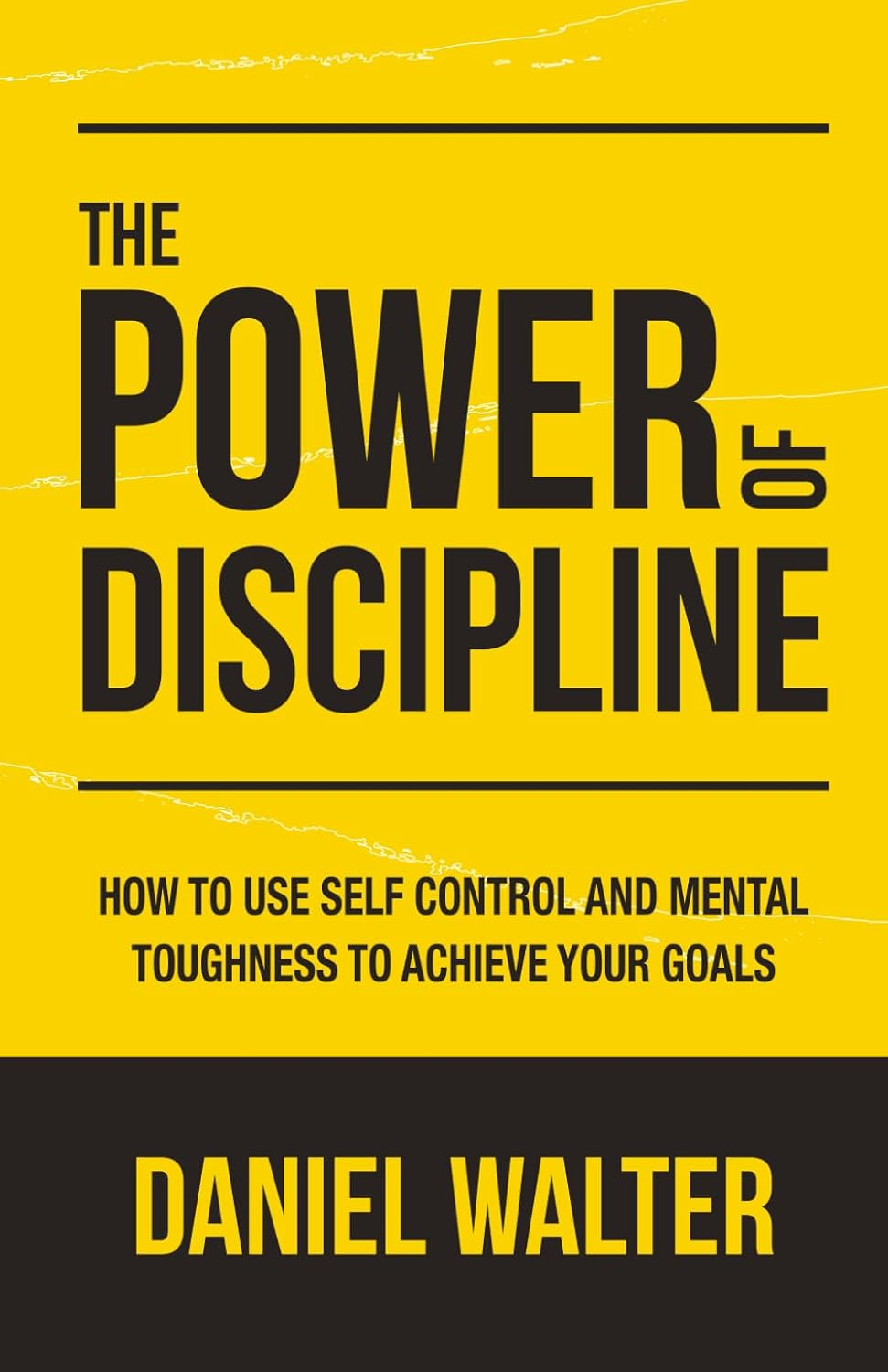
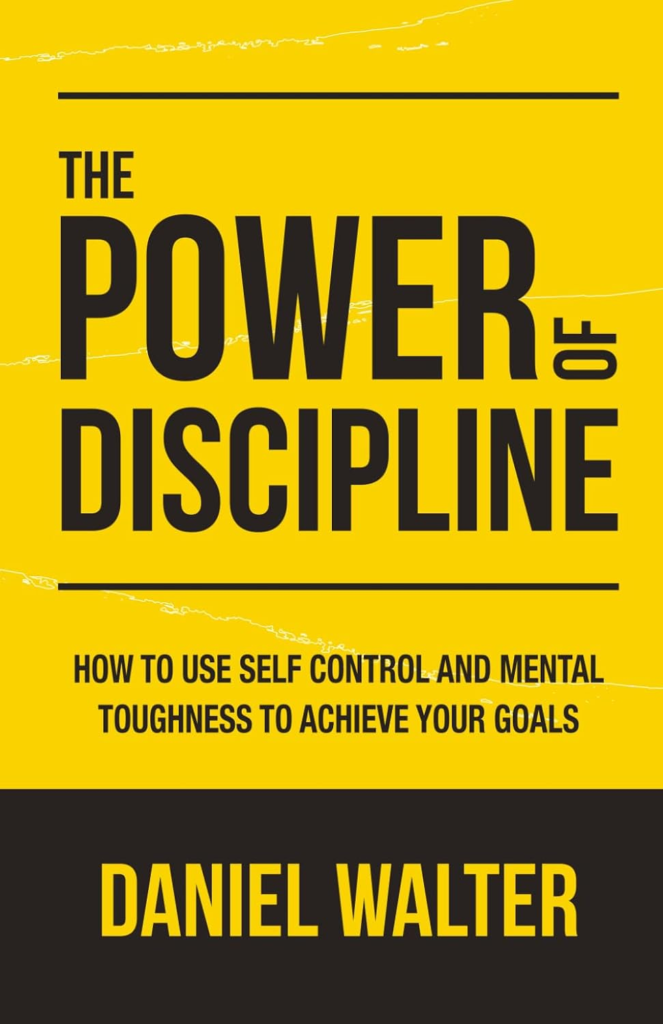
The Power of Discipline: How to Use Self Control and Mental Toughness to Achieve Your Goals is a self-help book by Daniel Walter that examines self-discipline, habit formation, motivation, mental toughness, focus, procrastination, and goal achievement. The book argues that meaningful personal change depends less on temporary motivation and more on developing the ability to act consistently, particularly when an individual does not feel like doing the required work.
Originally published in 2020, the book combines popular psychology, behavioral concepts, practical advice, examples, and references to ideas drawn from areas such as habit formation, meditation, Zen philosophy, cognitive biases, and goal-setting. One edition published by Pristine Publishing is listed at 132 pages, while other editions vary slightly in pagination and publication details. [1]
At the center of Walter’s argument is a relatively simple proposition: motivation may initiate action, but discipline is what allows action to continue after motivation fades.
The book is aimed primarily at readers interested in personal development, productivity, habit change, self-management, and achieving long-term goals.
Bibliographic information
| Field | Details |
|---|---|
| Title | The Power of Discipline |
| Full title | The Power of Discipline: How to Use Self Control and Mental Toughness to Achieve Your Goals |
| Author | Daniel Walter |
| Language | English |
| Genre | Self-help, personal development, psychology |
| Subject | Self-discipline, habits, motivation, mental toughness, goal achievement |
| Publisher | Pristine Publishing / independently published editions |
| Publication period | 2020 |
| ISBN of one edition | 979-8631735408 |
| Length | Approximately 132–134 pages in the cited edition |
| Primary audience | General readers interested in personal development and behavioral change |
Bibliographic records differ somewhat between editions, particularly in page count and publication date. Google Books, for example, lists a 2020 independently published edition of 132 pages. [1]
Author
Daniel Walter
Daniel Walter is an author associated primarily with self-help and personal-development books. His writing focuses on subjects including discipline, motivation, habits, productivity, mindset, and personal achievement.
Unlike many academic writers in psychology, Walter’s work is directed principally toward a general readership rather than a university or research audience. The Power of Discipline reflects this orientation: psychological concepts are introduced largely because of their perceived practical usefulness rather than as an exhaustive examination of the academic literature.
The author’s approach is therefore best understood as popular psychology and practical self-development, rather than as a formal psychological treatise.
This distinction matters when reading the book. A reader looking for an accessible framework for thinking about discipline may find the book useful, while a reader looking for a systematic review of contemporary behavioral science would need to consult academic sources in addition to Walter’s work.
Background
The problem addressed by The Power of Discipline is familiar across cultures and professions.
People frequently know what they want to accomplish but struggle to translate intentions into repeated behavior.
A person may want to:
- exercise regularly;
- study for an examination;
- write a book;
- start a business;
- lose weight;
- save money;
- learn a language;
- reduce social-media use;
- wake up earlier;
- stop procrastinating; or
- complete an important long-term project.
The difficulty is rarely the ability to identify the desired outcome.
The difficulty is continuing to behave in accordance with that outcome when immediate comfort points in another direction.
Walter places this problem at the heart of his discussion of discipline.
Central thesis
The book’s central thesis can be represented as follows:
                DESIRED GOAL
                     │
                     ▼
              INTENTION / PLAN
                     │
                     ▼
               DAILY ACTION
                     │
              ┌──────┴──────┐
              ▼             ▼
          Comfort        Discomfort
              │             │
              ▼             ▼
         "Later"           DISCIPLINE
                            │
                            ▼
                     REPEATED ACTION
                            │
                            ▼
                         HABIT
                            │
                            ▼
                     LONG-TERM RESULT
The important point is that the goal itself does not produce the result.
The repeated behavior between the goal and the eventual outcome does.
Walter consequently treats discipline as a behavioral bridge between intention and achievement.
Structure and contents
The book is divided into an introduction, a series of chapters dealing with self-discipline and behavior, and a conclusion.
Available editions and reproduced tables of contents identify chapters dealing with topics including biological arguments for self-discipline, the benefits of discipline, status quo bias, the Dunning–Kruger effect, daily habits, habit formation, obstacles to discipline, discomfort, systems, Zen philosophy, meditation, action, identity, emotional states, the Pareto principle, Sturgeon’s law, and burnout. [2]
A representative outline is:
- Self-Discipline — The Biological Argument
- The Benefits of Self-Discipline
- The Status Quo Bias — Why We Resist Change
- A Reality Check — The Dunning–Kruger Effect
- Daily Habits to Improve Self-Discipline
- Tips for Building Better Habits
- What Is Hindering Your Discipline
- Get Comfortable With Being Uncomfortable
- Focus on the System
- Zen Philosophy and Goal Attainment
- Meditation for Self-Discipline and Focus
- Why You Should Never “Try and Do” Anything
- Winner or Loser, Which One Are You?
- Fall in Love With the Process
- How to Make Your Negative Emotions Work for You
- The Pareto Principle and Sturgeon’s Law
- How to Avoid Burnout
The exact organization can vary between editions.
Self-discipline
The concept of self-discipline is the foundation of the book.
Walter presents discipline not simply as punishment, deprivation, or rigid behavior. Instead, it is presented as the ability to regulate one’s behavior in accordance with a chosen objective.
In practical terms:
Discipline means doing what needs to be done even when the immediate emotional preference is to do something else.
This distinction separates discipline from motivation.
Motivation is frequently dependent upon emotional state.
Discipline attempts to make behavior less dependent upon emotional state.
Motivation versus discipline
MOTIVATION
"I feel like doing it."
        │
        ▼
      ACTION
        │
        ▼
May disappear when
mood or circumstances change


DISCIPLINE
"I decided to do it."
        │
        ▼
      ACTION
        │
        ▼
Repeated despite changing
mood or circumstances
The book therefore encourages readers to stop treating motivation as the sole engine of achievement.
The biological argument
One of the book’s early discussions considers the biological and evolutionary forces that influence human behavior.
Humans are naturally responsive to immediate rewards and threats. Avoiding discomfort and seeking pleasure can be useful from a survival perspective, but the same tendencies can interfere with modern long-term objectives.
For example:
LONG-TERM BENEFIT
Exercise
Study
Saving
Writing
Healthy eating
       │
       │ requires delayed gratification
       ▼
IMMEDIATE DISCOMFORT
       │
       ▼
TEMPTATION
       │
       ▼
EASIER ALTERNATIVE
       │
       ▼
SHORT-TERM REWARD
The conflict is therefore not necessarily between a “good person” and a “lazy person.”
It can be understood as a conflict between immediate reinforcement and delayed rewards.
The benefits of self-discipline
Walter connects self-discipline with several areas of life, including:
- productivity;
- health;
- education;
- professional development;
- financial behavior;
- relationships;
- personal projects;
- emotional regulation; and
- long-term goal achievement.
The underlying mechanism is cumulative.
One disciplined action rarely transforms a life.
Thousands of relatively ordinary actions can.
The compounding effect
Day 1       ──► Small action
Day 10      ──► Repeated action
Day 30      ──► Emerging habit
Day 100     ──► Established routine
Day 365     ──► Significant behavioral difference
This is one of the book’s most accessible ideas: discipline is valuable because repeated small behaviors accumulate.
Status quo bias
Walter discusses status quo bias, the tendency to prefer existing conditions over change.
Changing behavior has a psychological cost.
Even when an existing habit is undesirable, it is familiar.
A new behavior requires attention, effort, uncertainty, and repeated decision-making.
This produces an important paradox:
A person can dislike the results produced by a habit while simultaneously resisting the effort required to replace it.
For example, someone may dislike being physically inactive but still prefer the familiarity of an inactive routine.
The book encourages readers to recognize this resistance rather than interpreting it automatically as proof that change is impossible.
The Dunning–Kruger effect
Another concept discussed in the book is the Dunning–Kruger effect, a psychological phenomenon associated with inaccurate self-assessment, particularly when people have limited knowledge or competence in a particular domain.
Walter uses the concept as a warning against overestimating one’s current abilities.
The practical lesson is straightforward:
"I already know enough."
          │
          ▼
No learning
          │
          ▼
No improvement
          │
          ▼
Repeated mistakes
A more productive approach is:
"I may be missing something."
          │
          ▼
Learn
          │
          ▼
Practice
          │
          ▼
Measure
          │
          ▼
Correct
          │
          ▼
Improve
The concept is therefore connected to intellectual humility and continuous improvement.
Habit formation
Habit formation is one of the most practical themes in the book.
Walter argues that discipline becomes easier when desired behaviors are transformed into routines.
Instead of repeatedly asking:
“Do I feel like doing this today?”
the individual attempts to establish a structure in which the behavior becomes increasingly automatic.
From effort to routine
DECISION
   ↓
REPEATED ACTION
   ↓
CONSISTENCY
   ↓
ROUTINE
   ↓
HABIT
   ↓
LESS DECISION-MAKING
This is an important shift.
The goal of discipline is not necessarily to require heroic willpower forever.
It is to construct a life in which desirable behaviors require less negotiation.
Daily habits
Walter emphasizes the importance of small daily practices.
Examples include:
- establishing consistent routines;
- breaking large objectives into manageable actions;
- controlling distractions;
- maintaining focus;
- creating productive environments;
- practicing uncomfortable tasks;
- monitoring progress; and
- returning to the routine after failure.
The approach can be summarized as:
small action → repetition → consistency → behavioral change.
Getting comfortable with discomfort
One of the recurring themes of the book is the idea that meaningful progress frequently involves temporary discomfort.
Learning something difficult is uncomfortable.
Exercise can be uncomfortable.
Starting a business can be uncomfortable.
Public speaking can be uncomfortable.
Studying when entertainment is available can be uncomfortable.
Writing when inspiration is absent can be uncomfortable.
Walter therefore encourages readers to distinguish between discomfort that accompanies productive effort and unnecessary suffering.
This distinction is important.
Discipline does not mean deliberately making everything painful.
Rather, it means becoming less dependent upon comfort as a prerequisite for action.
The system versus the goal
A particularly useful distinction in the book is between goals and systems.
A goal describes the desired destination.
A system describes what a person repeatedly does.
For example:
| Goal | System |
|---|---|
| Lose weight | Exercise and manage food intake consistently |
| Write a book | Write a specified amount regularly |
| Learn Spanish | Practice every day |
| Pass an examination | Follow a study schedule |
| Build a business | Perform defined business activities consistently |
The book’s philosophy can therefore be represented as:
          GOAL
           │
           ▼
       SYSTEM DESIGN
           │
           ▼
      DAILY BEHAVIOR
           │
           ▼
       REPETITION
           │
           ▼
         HABIT
           │
           ▼
         RESULT
This shifts attention from wishing for an outcome toward controlling the process that can produce it.
Zen philosophy and discipline
Walter also brings Zen philosophy into his discussion of discipline and goal attainment.
The connection is particularly relevant to the book’s emphasis on:
- presence;
- concentration;
- process;
- meditation;
- acceptance of discomfort;
- reduction of unnecessary mental distraction.
Rather than treating every moment as a battle against one’s own mind, the book presents focused awareness as another way of strengthening behavioral control.
The broader message is that discipline is not merely about forcing oneself forward.
It can also involve learning to remain present with an activity instead of constantly escaping into distraction.
Meditation and self-discipline
Meditation is discussed as a practice related to attention and mental control.
The practical connection is relatively simple:
DISTRACTION
    ↓
NOTICE
    ↓
RETURN ATTENTION
    ↓
REPEAT
This process resembles a miniature version of disciplined behavior.
The mind wanders.
The individual notices.
Attention is redirected.
The cycle repeats.
From the book’s perspective, this repeated practice can help develop greater awareness of impulses rather than automatically acting upon them.
“Trying” versus doing
Walter questions the usefulness of language centered on “trying.”
There is a meaningful psychological difference between:
“I will try to exercise.”
and:
“I will exercise at 7:00 a.m.”
The first statement leaves the outcome open.
The second establishes a behavioral commitment.
This idea is closely connected to implementation intentions and behavioral planning, although the broader scientific literature on goal achievement is considerably more nuanced than a simple rule that changing one’s wording guarantees success.
The practical lesson is still valuable:
replace vague intentions with observable actions whenever possible.
Identity and discipline
The book also explores the relationship between behavior and identity.
People frequently describe themselves using statements such as:
- “I’m not disciplined.”
- “I’m a procrastinator.”
- “I’m terrible at studying.”
- “I never finish anything.”
Such statements can become self-reinforcing.
A different approach is to concentrate on repeated behavior.
Instead of asking:
“Am I a disciplined person?”
a person can ask:
“What would a disciplined person do next?”
This changes the focus from an abstract self-description to a concrete action.
Falling in love with the process
One of the book’s more important philosophical themes is the distinction between enjoying an outcome and learning to tolerate—or eventually appreciate—the process required to reach it.
People often want:
- the degree without studying;
- the body without training;
- the business without uncertainty;
- the book without writing;
- the financial result without saving;
- the skill without practice.
The process is often less glamorous than the result.
Walter encourages readers to shift their attention toward the process itself.
Outcome-oriented versus process-oriented thinking
OUTCOME MINDSET

"I want the result."
        ↓
Result does not arrive quickly
        ↓
Frustration
        ↓
Reduced effort


PROCESS MINDSET

"I will execute today's task."
        ↓
Task completed
        ↓
Repeat tomorrow
        ↓
Progress accumulates
This is arguably one of the book’s most practical ideas because it places attention on something the individual can directly control.
Negative emotions
The book also considers the role of negative emotions.
Fear, frustration, boredom, disappointment, and irritation are generally treated as experiences that can influence behavior rather than as automatic commands.
A disciplined response does not require eliminating negative emotions.
Instead:
EMOTION
   ↓
AWARENESS
   ↓
PAUSE
   ↓
INTERPRETATION
   ↓
CHOICE
   ↓
ACTION
The distinction between feeling something and obeying that feeling immediately is central to self-regulation.
The Pareto principle and Sturgeon’s law
Walter introduces two broad principles in discussing productivity and decision-making.
Pareto principle
The Pareto principle, often described as the 80/20 rule, suggests that a disproportionate share of results may come from a relatively small proportion of inputs.
In practical terms, the idea encourages people to identify activities that produce significant results instead of distributing effort indiscriminately.
INPUTS
████████████████████

                 ↓

HIGH-VALUE ACTIVITIES
████
                 ↓

DISPROPORTIONATE
RESULTS
████████████████
The 80/20 relationship should not be treated as a universal mathematical law. Its value in this context is primarily heuristic: look for high-leverage activities.
Sturgeon’s law
Sturgeon’s law is commonly summarized as the observation that a large proportion of almost everything may be of relatively low quality.
Walter connects this concept with the need to focus attention selectively.
The practical implication is that discipline is not simply about doing more.
It is also about deciding what deserves attention in the first place.
Avoiding burnout
A discussion of discipline that ignores exhaustion can become counterproductive.
Walter therefore addresses burnout and the danger of pushing oneself without adequate recovery.
This creates an important balance:
DISCIPLINE
    +
RECOVERY
    +
REALISTIC EXPECTATIONS
    +
SUSTAINABLE ROUTINE
    =
LONG-TERM PERFORMANCE
Discipline should therefore not be confused with working continuously.
A sustainable system must contain periods of rest, recovery, adjustment, and reassessment.
Discipline, motivation and willpower
One of the book’s central distinctions can be represented in three parts:
| Concept | Primary question |
|---|---|
| Motivation | “Why do I want to do this?” |
| Willpower | “Can I resist this impulse right now?” |
| Discipline | “What behavior will I repeatedly perform regardless of temporary feelings?” |
These concepts overlap, but they are not identical.
Motivation can help initiate action.
Willpower can help overcome immediate temptation.
Discipline attempts to make desired behavior sufficiently consistent that constant internal struggle becomes less necessary.
The discipline loop
Walter’s ideas can be synthesized into a broader behavioral model:
                 ┌───────────────┐
                 │     GOAL      │
                 └───────┬───────┘
                         ↓
                 ┌───────────────┐
                 │    SYSTEM     │
                 └───────┬───────┘
                         ↓
                 ┌───────────────┐
                 │ DAILY ACTION  │
                 └───────┬───────┘
                         ↓
              ┌──────────┴──────────┐
              ↓                     ↓
         DISCOMFORT              DISTRACTION
              │                     │
              └──────────┬──────────┘
                         ↓
                    DISCIPLINE
                         ↓
                    REPETITION
                         ↓
                       HABIT
                         ↓
                      IDENTITY
                         ↓
                       RESULT
The model illustrates an important characteristic of the book: discipline is presented less as a single act of willpower and more as a repeated behavioral architecture.
A practical discipline framework
The book’s ideas can be translated into a simple daily framework.
Step 1: Define the target
The objective should be concrete.
Instead of:
“I want to become successful.”
use:
“I will complete three hours of focused work each weekday.”
Step 2: Define the behavior
Identify the action that produces progress.
Step 3: Remove unnecessary friction
Make the desired behavior easier to start.
Step 4: Remove predictable distractions
Do not depend entirely on willpower to resist a distraction that can simply be removed.
Step 5: Accept temporary discomfort
Expect boredom, resistance, uncertainty, or inconvenience.
Step 6: Track execution
Measure whether the behavior happened.
Step 7: Recover from failure
A missed day should become a data point, not a reason to abandon the entire system.
Discipline as environmental design
A major practical implication of the book is that self-control should not be treated solely as an internal battle.
The environment matters.
Consider two people attempting to read before sleeping.
Person A
Phone beside the bed
Notifications enabled
Television available
Book difficult to reach
Person B
Phone outside the bedroom
Notifications disabled
Book placed beside the bed
Reading schedule predetermined
Person B has not necessarily developed a stronger personality.
The environment simply creates fewer opportunities for distraction.
This leads to a broader principle:
Good discipline often means designing circumstances in which the desired behavior becomes easier and the undesired behavior becomes harder.
Procrastination
Procrastination is treated as a behavioral obstacle rather than simply a character defect.
The procrastinator often knows what should be done.
The problem is the gap between:
knowing → starting → continuing → finishing.
A useful model is:
TASK
 ↓
ANTICIPATED EFFORT
 ↓
DISCOMFORT
 ↓
AVOIDANCE
 ↓
IMMEDIATE RELIEF
 ↓
TASK REMAINS
 ↓
GREATER STRESS
Breaking this cycle requires interrupting avoidance.
The most practical intervention is often to make the first action extremely specific.
Instead of:
“Work on my project.”
define:
“Open the document and write the first 100 words.”
Discipline and goal achievement
The book’s philosophy can be summarized through a distinction between goals and behavior.
A goal is something a person wants.
A behavior is something a person does.
Only the second occurs in the present.
FUTURE
"I want to achieve X."
        │
        ▼
PRESENT
"What must I do today?"
        │
        ▼
ACTION
        │
        ▼
REPETITION
        │
        ▼
FUTURE RESULT
This is why Walter places so much emphasis on disciplined execution.
Discipline and personal identity
Repeated behavior can influence self-perception.
If an individual repeatedly keeps promises made to themselves, the person may begin to see themselves as more reliable.
Conversely, repeatedly abandoning commitments may reinforce an identity associated with inconsistency.
The process can be represented as:
ACTION
  ↓
REPETITION
  ↓
EVIDENCE
  ↓
SELF-PERCEPTION
  ↓
IDENTITY
  ↓
FUTURE BEHAVIOR
This does not mean identity alone determines behavior. Rather, it illustrates how behavioral patterns and self-perception can interact.
Scientific perspective
The Power of Discipline belongs primarily to the popular self-help genre, not to academic psychology.
This distinction is important.
The book discusses concepts associated with psychology and behavioral science, but a reader should not assume that every recommendation in a popular self-help book represents scientific consensus.
Several areas of the discipline literature are considerably more complicated than popular accounts sometimes suggest.
For example:
- self-control is influenced by context;
- habits depend on cues and environments;
- motivation varies by task and individual;
- goal achievement depends on resources and circumstances;
- personality influences behavior but does not completely determine it;
- rest and recovery influence sustained performance;
- socioeconomic conditions can constrain people’s choices;
- mental health conditions can affect motivation, attention, and behavior; and
- not every failure to achieve a goal is a failure of discipline.
Consequently, the book is most appropriately read as a practical framework for reflection and behavior change, rather than as a definitive scientific theory of human behavior.
Criticism and reader reception
The book has attracted a substantial readership on platforms such as Goodreads. At the time of the available Goodreads record, it had a rating of approximately 4.1/5 from more than 8,000 ratings, alongside hundreds of written reviews. [3]
Reader responses are not uniform.
Positive readers commonly describe the book as:
- accessible;
- practical;
- motivating;
- easy to read;
- useful for establishing routines; and
- effective as an introduction to discipline.
Some readers, however, regard its advice as familiar or repetitive, and some reviews criticize the book for presenting relatively basic self-help ideas or for relying heavily on concepts that readers may have encountered elsewhere. StoryGraph reviews similarly show a more mixed reception, with an average around the mid-3s for the edition represented there. [4]
This divergence is understandable.
For a reader new to personal-development literature, familiar principles can be genuinely useful when assembled into a coherent framework.
For an experienced reader, the same principles may feel repetitive because many have already appeared in books on habits, productivity, motivation, and behavioral psychology.
What the book does particularly well
Several features help explain its appeal.
Accessibility
The book uses relatively straightforward language rather than academic terminology.
Practical orientation
Its emphasis is generally on what a reader can do rather than on abstract theory alone.
Integration of multiple ideas
Walter brings together discipline, habits, discomfort, focus, meditation, cognitive biases, systems, and emotional regulation.
Emphasis on consistency
The book repeatedly returns to the idea that occasional bursts of motivation are less useful than sustainable action.
Process orientation
Readers are encouraged to pay attention to what they repeatedly do rather than obsess exclusively over distant outcomes.
Limitations
A balanced reading also requires acknowledging several limitations.
1. Popular psychology is not the same as scientific literature
Psychological terminology does not automatically make a self-help argument scientifically established.
2. Discipline is not the only variable
Achievement can also depend on:
- opportunity;
- health;
- finances;
- education;
- social support;
- environment;
- luck;
- institutional constraints;
- skill;
- timing; and
- access to resources.
3. Willpower should not be romanticized
Constantly forcing oneself through exhaustion is not necessarily productive discipline.
4. Individual differences matter
A strategy that works for one person may be ineffective for another.
5. Failure is not always a discipline problem
A person may fail to reach an objective because the objective was unrealistic, circumstances changed, resources were inadequate, or the strategy was wrong.
This is an important corrective to overly simplistic self-help messages.
The book’s broader philosophy
At a deeper level, The Power of Discipline is not really a book about becoming tougher for the sake of toughness.
It is about the relationship between choice, behavior and time.
The book repeatedly directs attention away from the dramatic moment of transformation and toward ordinary actions.
A person rarely changes their life in one spectacular afternoon.
More often, change looks like this:
ONE ORDINARY MORNING
        ↓
ONE SMALL DECISION
        ↓
ONE COMPLETED TASK
        ↓
REPEAT
        ↓
REPEAT AGAIN
        ↓
MONTHS OF REPETITION
        ↓
A DIFFERENT PATTERN OF LIFE
That is perhaps the most human aspect of the book.
Discipline is rarely glamorous.
Most of it happens when nobody is watching.
Key ideas at a glance
| Idea | Central lesson |
|---|---|
| Self-discipline | Act according to chosen priorities rather than temporary impulses |
| Motivation | Useful, but unreliable as a permanent source of action |
| Habits | Repetition can reduce the effort required to perform behavior |
| Status quo bias | Familiar behavior can persist even when it produces poor outcomes |
| Dunning–Kruger effect | Self-assessment can be inaccurate, especially with limited knowledge |
| Discomfort | Progress often requires tolerating temporary difficulty |
| Systems | Repeated processes can matter more than distant goals |
| Meditation | Attention can be deliberately trained |
| Identity | Repeated behavior can influence self-perception |
| Emotions | Feelings need not automatically dictate behavior |
| Pareto principle | Identify high-leverage activities |
| Burnout | Discipline must be sustainable |
| Process | Focus on execution rather than obsessing exclusively over outcomes |
Infographic: The architecture of discipline
                    ┌───────────────┐
                    │     PURPOSE   │
                    └───────┬───────┘
                            │
                            ▼
                    ┌───────────────┐
                    │     GOAL      │
                    └───────┬───────┘
                            │
                            ▼
                    ┌───────────────┐
                    │    SYSTEM     │
                    └───────┬───────┘
                            │
                            ▼
                    ┌───────────────┐
                    │ DAILY ACTION  │
                    └───────┬───────┘
                            │
                 ┌──────────┴──────────┐
                 ▼                     ▼
             TEMPTATION            DISCOMFORT
                 │                     │
                 └──────────┬──────────┘
                            ▼
                       SELF-CONTROL
                            │
                            ▼
                        REPETITION
                            │
                            ▼
                          HABIT
                            │
                            ▼
                       CONSISTENCY
                            │
                            ▼
                          RESULT
Infographic: Goal versus system
             GOAL
              │
              │
       "I want to lose 10 kg"
              │
              ▼
           SYSTEM
              │
      ┌───────┼────────┐
      ▼       ▼        ▼
    Food   Exercise   Sleep
      │       │        │
      └───────┼────────┘
              ▼
          DAILY ACTION
              │
              ▼
          REPETITION
              │
              ▼
           RESULT
The point is not that a goal is unimportant. Rather, the goal establishes direction while the system determines what happens repeatedly.
Infographic: The procrastination trap
        IMPORTANT TASK
              │
              ▼
       "This will be hard."
              │
              ▼
          DISCOMFORT
              │
              ▼
           AVOIDANCE
              │
              ▼
      IMMEDIATE RELIEF
              │
              ▼
        TASK REMAINS
              │
              ▼
        MORE PRESSURE
              │
              └──────────────┐
                             │
                             ▼
                        MORE AVOIDANCE
Breaking the cycle requires replacing the vague instruction “do the task” with a specific first action.
Infographic: Sustainable discipline
                 DISCIPLINE
                     │
        ┌────────────┼────────────┐
        ▼            ▼            ▼
     FOCUS        ROUTINE      SELF-CONTROL
        │            │            │
        └────────────┼────────────┘
                     ▼
                 EXECUTION
                     │
                     ▼
                RECOVERY
                     │
                     ▼
               CONSISTENCY
                     │
                     ▼
                LONG-TERM
                 PROGRESS
The addition of recovery is important because sustainable discipline is different from continuous exhaustion.
An everyday example
Consider someone who wants to write a book.
A goal-based approach might be:
“I want to become an author.”
A discipline-based approach asks different questions:
- When will I write?
- Where will I write?
- How much will I write?
- What distractions will I remove?
- What happens when I do not feel inspired?
- How will I track progress?
- What will I do after missing a day?
The resulting system might be:
07:00
  ↓
Phone away
  ↓
Open manuscript
  ↓
Write for 45 minutes
  ↓
Record word count
  ↓
Stop
  ↓
Repeat tomorrow
The individual does not need to feel inspired every morning.
The system supplies the structure.
Influence and related works
The Power of Discipline belongs to a large tradition of books concerned with self-control, habits, productivity, and personal effectiveness.
Readers interested in related themes may also encounter works dealing with:
- habit formation;
- delayed gratification;
- behavioral psychology;
- motivation;
- mindfulness;
- productivity;
- goal-setting;
- personal effectiveness; and
- deliberate practice.
The book therefore fits into a much broader popular literature concerned with the question:
How can people make their everyday behavior more consistent with the future they want?
See also
- Self-control
- Self-discipline
- Habit
- Habit formation
- Motivation
- Procrastination
- Goal-setting
- Delayed gratification
- Mental toughness
- Mindfulness
- Meditation
- Productivity
- Behavioral psychology
- Cognitive bias
- Pareto principle
- Burnout
References
- Walter, Daniel. The Power of Discipline: How to Use Self Control and Mental Toughness to Achieve Your Goals. Pristine Publishing / independently published edition, 2020. ISBN 979-8631735408. Bibliographic information is listed by Google Books.
- Walter, Daniel. The Power of Discipline. Table-of-contents information available in published/reproduced editions of the work.
- Goodreads. The Power of Discipline: How to Use Self Control and Mental Toughness to Achieve Your Goals, author page and reader ratings/reviews.
- StoryGraph. The Power of Discipline, reader reviews and edition-level reception.
- Walter, Daniel. The Power of Discipline. Various published editions, 2020.
- Dunning, David; Kruger, Justin. “Unskilled and Unaware of It: How Difficulties in Recognizing One’s Own Incompetence Lead to Inflated Self-Assessments.” Journal of Personality and Social Psychology, 1999.
- Lally, Phillippa et al. “How Are Habits Formed: Modelling Habit Formation in the Real World.” European Journal of Social Psychology, 2010.
- Gollwitzer, Peter M. “Implementation Intentions: Strong Effects of Simple Plans.” American Psychologist, 1999.
- Baumeister, Roy F. et al. Research on self-regulation and self-control.
- Kahneman, Daniel. Thinking, Fast and Slow. Farrar, Straus and Giroux, 2011.
Further reading
For readers who want to investigate the subjects introduced in the book from additional perspectives, useful areas of further reading include:
Habits
Research on habit formation, environmental cues, repetition, and behavioral automaticity.
Self-control
Academic literature examining self-regulation, goal pursuit, temptation, and behavioral persistence.
Motivation
Research into intrinsic and extrinsic motivation, autonomy, expectancy, incentives, and goal commitment.
Cognitive biases
Research into the ways human judgment and decision-making can systematically deviate from objective assessment.
Mindfulness
Literature examining attention, meditation, emotional regulation, and metacognition.
Behavioral change
Research on implementation intentions, environmental design, reinforcement, and behavior modification.
External links
- Google Books: The Power of Discipline by Daniel Walter
- Goodreads: The Power of Discipline — reader ratings and reviews
- StoryGraph: The Power of Discipline — reader reception
- Daniel Walter’s author/publishing information
- ISBN databases and library catalogues for edition-specific bibliographic information
Conclusion
The Power of Discipline presents discipline as a trainable behavioral capacity rather than an innate personality trait possessed only by exceptionally successful people.
Its recurring message is uncomplicated:
Decide what matters, build a system around it, act repeatedly, tolerate the inevitable discomfort, and continue long enough for the behavior to become part of ordinary life.
Some of the book’s ideas are familiar, and readers already experienced with the self-help literature may find portions of it repetitive. Its scientific discussions should also be read with the understanding that the book is written for a general audience rather than as an academic review.
Yet its central practical question remains remarkably relevant:
What would change if you stopped waiting to feel motivated and started designing your behavior around what you have already decided matters?
That question captures the spirit of The Power of Discipline better than any promise of instant transformation. The book’s real subject is not extraordinary willpower. It is the accumulation of ordinary decisions—and what those decisions can become when repeated over time.