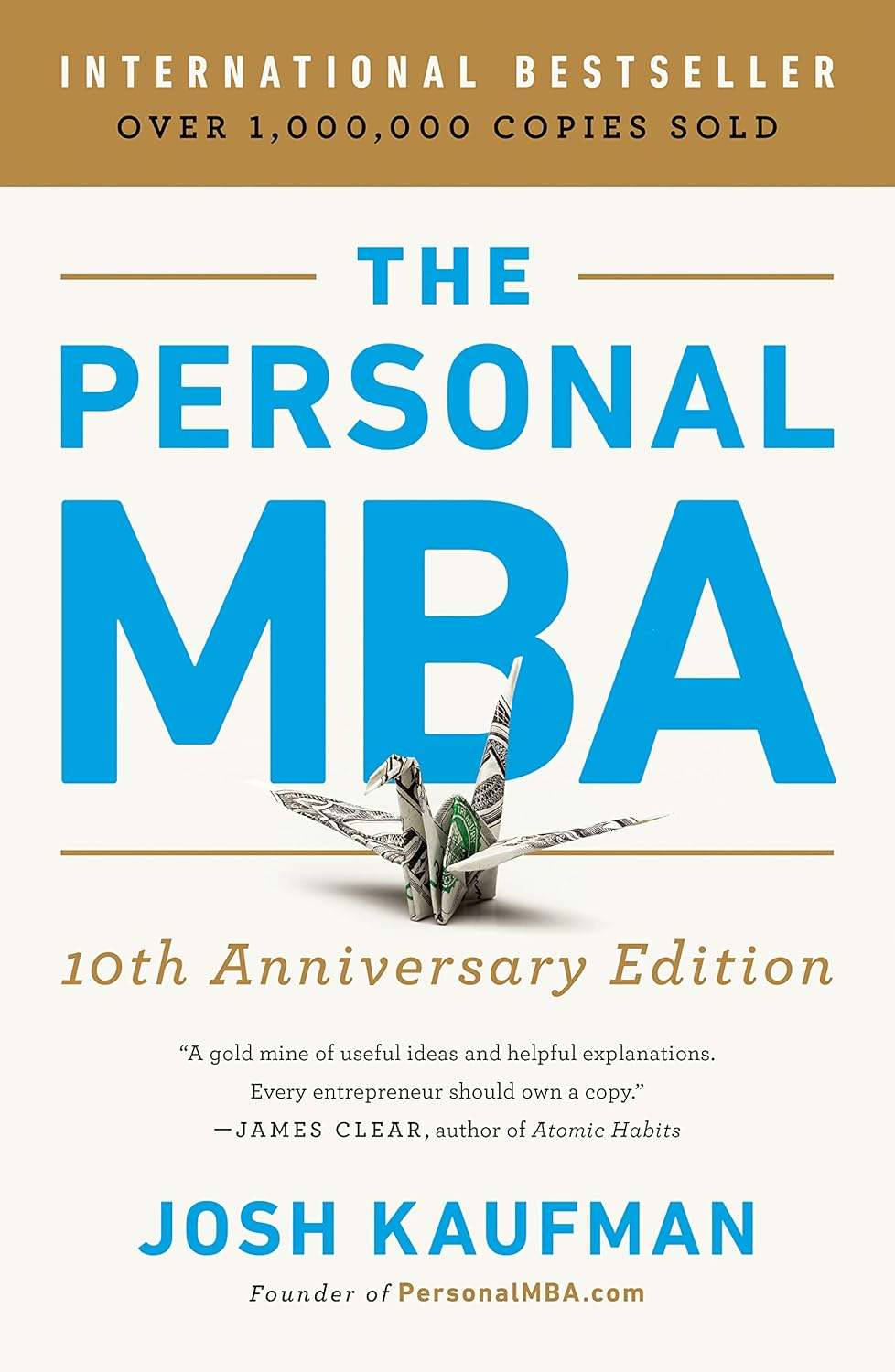
The Personal MBA: Master the Art of Business is a business and management book by American author and independent business educator Josh Kaufman. First published in 2010 by Portfolio/Penguin, the book presents a broad survey of fundamental business concepts through a collection of practical mental models, frameworks, and principles.
Rather than treating business education as a collection of specialized academic disciplines, Kaufman attempts to show how the major parts of a business fit together. The book discusses value creation, marketing, sales, value delivery, finance, human psychology, decision-making, productivity, systems, negotiation, experimentation, and strategy.
The title deliberately plays on the idea of an MBA, or Master of Business Administration, but Kaufman’s approach is not intended to reproduce a conventional graduate business-school curriculum. His argument is that many useful business concepts can be learned independently through reading, observation, experimentation, and practical application.
The book became one of Kaufman’s best-known works and was subsequently published in revised and expanded editions. A 10th-anniversary edition was published by Portfolio in 2020 and contains 496 pages.
Book information
| Field | Details |
|---|---|
| Title | The Personal MBA: Master the Art of Business |
| Author | Josh Kaufman |
| First published | 2010 |
| Original publisher | Portfolio / Penguin |
| Genre | Business, management, entrepreneurship, self-education |
| Language | English |
| Original edition | 402 pages |
| 10th Anniversary Edition | 496 pages |
| ISBN | 978-1-59184-352-8 |
| Subject areas | Business, management, entrepreneurship, marketing, finance, psychology, productivity |
| Country of origin | United States |
| Website | Josh Kaufman’s official website |
The original 2010 edition was published by Portfolio/Penguin and catalogued as a work concerning management, management education, and business. Library records identify the first edition as 402 pages.
Overview
The central idea behind The Personal MBA is relatively simple: a person does not necessarily need to attend business school in order to understand the fundamental mechanisms of business.
Kaufman developed the concept partly as an alternative to what he considered an unnecessarily expensive and time-consuming approach to business education. Before the book appeared, he had built the Personal MBA website as a project for identifying and explaining important business ideas found across books, disciplines, and practical experience. His book grew out of that larger project.
The result is unusual in structure. It is neither a traditional textbook nor a conventional inspirational business book. It is closer to a conceptual map of business.
Kaufman repeatedly asks readers to look beneath the terminology of business and identify the mechanisms underneath it.
For example:
- What does a customer actually value?
- Why does someone choose to buy?
- How does a business create something people want?
- How does that value reach the customer?
- How does the business receive money in return?
- What causes a profitable business to become unprofitable?
- How do incentives affect human behaviour?
- How can uncertainty be reduced?
- How can a complicated business process be converted into a repeatable system?
This emphasis on fundamental mechanisms is what gives the book its distinctive character.
Josh Kaufman
Josh Kaufman
Josh Kaufman is an American author, researcher, and independent business educator whose work focuses on business, entrepreneurship, skill acquisition, applied psychology, and practical knowledge.
According to Kaufman’s official biography, he is the author of three books:
- The Personal MBA: Master the Art of Business
- The First 20 Hours: How to Learn Anything… Fast!
- How to Fight a Hydra: Face Your Fears, Pursue Your Ambitions, and Become the Hero You Are Destined to Be
Kaufman’s official website states that his research focuses particularly on business, entrepreneurship, skill acquisition, applied psychology, and practical wisdom. It also reports that his books have sold more than 1.5 million copies worldwide.
His earlier professional experience included work at Procter & Gamble, where he was involved in new-product development and online marketing measurement.
Kaufman’s approach is strongly interdisciplinary. Instead of restricting business learning to accounting, finance, or management theory, he combines ideas from economics, psychology, marketing, systems thinking, productivity, decision science, and entrepreneurship.
That approach became the intellectual foundation of The Personal MBA.
Background and development of the book
The Personal MBA concept originated before the publication of the book.
Kaufman created PersonalMBA.com as an educational project designed to identify the most useful business ideas from a large body of existing literature.
The premise was that business knowledge is distributed across many sources. A useful understanding of business might require ideas from marketing, economics, psychology, finance, operations, negotiation, communication, and organizational behaviour.
Instead of asking readers to master every field independently, Kaufman attempted to identify the concepts that provide the greatest amount of explanatory power.
This eventually produced the book.
The original edition was published in 2010 by Portfolio/Penguin. Subsequent editions appeared under somewhat different subtitles and page counts, reflecting revisions and expanded content.
The 10th-anniversary edition was published in 2020 by Portfolio. Penguin Random House lists it at 496 pages.
What does “Personal MBA” mean?
The phrase Personal MBA should not be interpreted as an academic degree.
Kaufman’s “MBA” is metaphorical. It refers to an individual’s self-directed education in the fundamental principles of business.
The distinction can be represented as follows:
Traditional business-school model
Institution → Curriculum → Classes → Exams → Degree
Personal MBA model
Curiosity → Books → Mental Models → Experimentation → Experience → Judgment
The difference is important.
Kaufman does not claim that reading one book is equivalent to receiving a formal MBA qualification. Instead, the book argues for a different way of approaching business education: learn the fundamental concepts, understand how they interact, and then apply them to real situations.
The architecture of a business
One of the most useful characteristics of The Personal MBA is its attempt to reduce the complexity of business into a relatively small number of interconnected activities.
Kaufman’s framework can be understood through five broad processes:
                 THE BUSINESS SYSTEM

                    CUSTOMER NEED
                         │
                         ▼
                 ┌───────────────┐
                 │ VALUE CREATION │
                 └───────┬───────┘
                         │
                         ▼
                 ┌───────────────┐
                 │   MARKETING   │
                 └───────┬───────┘
                         │
                         ▼
                 ┌───────────────┐
                 │     SALES     │
                 └───────┬───────┘
                         │
                         ▼
                 ┌───────────────┐
                 │ VALUE DELIVERY│
                 └───────┬───────┘
                         │
                         ▼
                 ┌───────────────┐
                 │    FINANCE    │
                 └───────┬───────┘
                         │
                         └──────► REINVESTMENT
                                      │
                                      └──► Better Value
The model emphasizes a basic reality of commerce: a business must create something valuable, communicate that value, persuade people to exchange money or another resource for it, deliver the promised value, and retain enough economic surplus to remain viable.
The Five Parts of Every Business
A central framework in the book is the idea that a business can be understood through five fundamental processes.
1. Value Creation
A business begins by creating something that people value.
This could be:
- a physical product
- a service
- information
- entertainment
- convenience
- status
- security
- access
- an experience
- a solution to a problem
The important point is that a business does not create value merely because it produces something.
Value exists from the customer’s perspective.
A company may manufacture an excellent product that nobody wants. Technically sophisticated production therefore does not automatically equal economic value.
2. Marketing
Marketing is concerned with attracting the attention of potential customers and helping them understand why an offering might be relevant to them.
Kaufman’s framework treats marketing as more than advertising.
It includes:
- identifying potential customers
- understanding their needs
- communicating benefits
- positioning an offering
- attracting attention
- creating awareness
- generating interest
A useful distinction is:
Marketing gets attention; sales converts attention into an exchange.
This distinction helps separate two activities that are often mixed together.
3. Sales
Sales occurs when a potential customer decides to exchange something valuable for the value being offered.
That exchange might involve money, but the underlying principle is broader.
Sales depends upon factors such as:
- perceived value
- trust
- urgency
- risk
- alternatives
- price
- confidence
- clarity of the offer
The book therefore treats selling as an important business mechanism rather than something that belongs only to professional salespeople.
Every business ultimately depends upon successful exchanges.
4. Value Delivery
After a customer buys something, the business has another responsibility: delivering what was promised.
This includes:
- production
- logistics
- customer service
- fulfillment
- quality control
- maintenance
- communication
- support
A business that markets and sells successfully but cannot deliver reliably creates a structural problem.
The distinction can be summarized:
Marketing
   ↓
Customer Attention
   ↓
Sales
   ↓
Customer Purchase
   ↓
Value Delivery
   ↓
Customer Experience
   ↓
Trust / Repeat Business
5. Finance
Finance measures whether the business model actually works economically.
Revenue alone does not establish business success.
A business can have:
- high sales
- rapid growth
- large customer numbers
- impressive publicity
and still lose money.
The financial side therefore connects the other parts of the business.
Revenue
   │
   ├── Operating Costs
   ├── Employee Costs
   ├── Marketing Costs
   ├── Capital Costs
   └── Taxes / Other Costs
          │
          ▼
        PROFIT
The book repeatedly encourages readers to understand the numbers underlying business decisions rather than treating finance as an isolated accounting function.
The Twelve Forms of Value
One of the book’s best-known frameworks is Kaufman’s Twelve Forms of Value.
The idea is that businesses can create value in many ways, and a product or service is only one possible expression of that value.
The framework is useful because it encourages entrepreneurs to think beyond conventional categories.
Examples include:
- Product — a physical object.
- Service — work performed for another person.
- Shared resource — access to a resource used by multiple customers.
- Subscription — continuing access to a product or service.
- Resale — purchasing and selling an existing item.
- Lease — temporary use of an asset.
- Agency — arranging or facilitating transactions.
- Audience aggregation — attracting an audience and monetizing access to it.
- Loan — providing capital in exchange for repayment and compensation.
- Option — selling the right to make a future decision.
- Insurance — transferring or pooling risk.
- Human capital — providing specialized knowledge, skill, or expertise.
The precise business model may combine several of these forms.
Example
A modern software company might combine:
Software Product
       +
Subscription
       +
Shared Infrastructure
       +
Customer Support
       +
Professional Services
This is one reason Kaufman’s framework is particularly useful for entrepreneurs: it encourages them to examine the underlying economic structure of an offering rather than becoming attached to a particular format.
The Iron Law of the Market
Another important idea in The Personal MBA is what Kaufman calls the Iron Law of the Market.
In simplified form:
If there is insufficient demand, even excellent execution cannot rescue a business indefinitely.
The framework places market demand ahead of many other considerations.
                 MARKET DEMAND
                       │
             ┌─────────┴─────────┐
             ▼                   ▼
       Strong Demand        Weak Demand
             │                   │
             ▼                   ▼
      Execution matters    Execution alone
             │             cannot create
             ▼               sufficient
       Business growth       demand
This is particularly important for entrepreneurs because people frequently begin with an idea rather than a demonstrated need.
A technically impressive product can fail if the market does not care.
The Pricing Uncertainty Principle
Kaufman also discusses pricing as a flexible rather than purely mathematical phenomenon.
The underlying idea is that customers do not necessarily evaluate price independently from perceived value.
A higher price can sometimes be supported when an offering:
- solves a valuable problem
- reduces risk
- saves significant time
- produces an important result
- provides convenience
- carries strong credibility
- serves a specialized market
The important lesson is not simply “charge more.”
Rather:
Price and perceived value must be considered together.
A low price does not automatically create a compelling offer, just as a high price does not automatically destroy demand.
The Four Methods of Increasing Revenue
Kaufman identifies four broad mechanisms through which a business can increase revenue:
                  REVENUE
                     │
       ┌─────────────┼─────────────┐
       │             │             │
       ▼             ▼             ▼
 More Customers   More per      More Often
                  Transaction
       │             │             │
       └─────────────┴─────────────┘
                     +
              Higher Prices
More precisely, the business can increase revenue by:
- increasing the number of customers;
- increasing the average transaction value;
- increasing the frequency of transactions;
- increasing prices.
This framework is deceptively simple.
It prevents entrepreneurs from assuming that “more customers” is always the only route to growth.
For example, a business with 1,000 customers may be able to improve its economics by increasing average transaction value rather than attempting to acquire another 1,000 customers.
The Value of Mental Models
Perhaps the defining feature of The Personal MBA is its reliance on mental models.
A mental model is a simplified representation of how something works.
The purpose is not to capture every detail.
The purpose is to make useful reasoning possible.
For example:
Complex Reality
      ↓
Important Variables
      ↓
Simplified Model
      ↓
Better Question
      ↓
Better Decision
      ↓
Real-World Test
Kaufman’s approach assumes that business becomes easier to understand when the reader possesses a vocabulary of useful models.
This makes the book especially accessible to people who have never studied business formally.
Human Psychology and Business
A substantial portion of the book moves beyond conventional business subjects and examines human behaviour.
This is important because businesses are ultimately systems operated by people and purchased from by people.
Kaufman discusses psychological concepts such as:
- confirmation bias
- loss aversion
- social proof
- scarcity
- contrast
- reciprocity
- mental accounting
- hedonic adaptation
- status seeking
- motivation
- attention
- decision-making
The implication is straightforward:
Business strategy without an understanding of human behaviour is incomplete.
A pricing strategy, advertising campaign, product design, or management system can fail because the people involved do not behave as the model assumes.
Attention and the Human Brain
Attention is treated as a scarce resource.
People cannot evaluate everything around them in detail. Consequently, businesses compete not merely for money but for attention.
This creates an important sequence:
Attention
   ↓
Interest
   ↓
Understanding
   ↓
Trust
   ↓
Action
Marketing therefore has a cognitive dimension.
An offering may be genuinely useful and still fail commercially if potential customers never notice it or cannot understand its relevance.
Productivity and Personal Effectiveness
The book also extends its business framework to individual productivity.
Kaufman treats personal effectiveness as a business-relevant capability because organizations ultimately depend on people allocating limited resources.
The key resources include:
- time
- attention
- energy
- money
- knowledge
- willpower
The objective is not simply to become “busy.”
Instead, the objective is to allocate scarce resources toward activities that create meaningful results.
Systems Thinking
One of the book’s recurring themes is systems thinking.
A business is not merely a collection of independent departments.
Marketing affects sales.
Sales affects cash flow.
Cash flow affects operations.
Operations affect customer satisfaction.
Customer satisfaction affects reputation and repeat purchases.
The resulting structure resembles a network:
                CUSTOMER
                  ▲  │
                  │  ▼
             MARKETING
                  │
                  ▼
                SALES
                  │
                  ▼
            VALUE DELIVERY
                  │
                  ▼
               FINANCE
                  │
                  ▼
             INVESTMENT
                  │
                  └────────► Better Value
This systems perspective is one of the book’s strongest educational features.
Testing and Experimentation
Kaufman’s framework places considerable importance on experimentation.
Instead of assuming that an idea will work, a business can test it.
The general process is:
ASSUMPTION
    ↓
HYPOTHESIS
    ↓
SMALL TEST
    ↓
MEASURE
    ↓
LEARN
    ↓
ADJUST
    ↓
REPEAT
This approach reduces the cost of being wrong.
A small experiment can sometimes answer a question that months of planning cannot.
For entrepreneurs, this principle can be especially valuable because uncertainty is unavoidable.
Uncertainty and Decision-Making
Business decisions are rarely made with complete information.
Managers and entrepreneurs commonly face:
- incomplete data
- changing markets
- unknown customer preferences
- competitors
- limited resources
- time pressure
- conflicting objectives
The book therefore emphasizes decision-making under uncertainty rather than pretending that perfect information exists.
One useful interpretation of Kaufman’s approach is:
Do not wait for uncertainty to disappear. Reduce the uncertainty that matters most.
Risk and Expected Value
A decision should not be evaluated solely by asking whether it can fail.
Almost every worthwhile business activity carries some risk.
A more useful question is:
What is the potential benefit compared with the probability and cost of failure?
A simplified model is:
Expected Value
      =
Potential Benefit × Probability of Success
      −
Potential Cost × Probability of Failure
This is not presented as a universal accounting formula. Rather, it illustrates a way of thinking about uncertain decisions.
The Structure of a Sustainable Business
The various concepts in The Personal MBA can be combined into a single model:
                    CUSTOMER NEED
                         │
                         ▼
                   VALUE CREATION
                         │
                         ▼
                    MARKETING
                         │
                         ▼
                       SALES
                         │
                         ▼
                  VALUE DELIVERY
                         │
                         ▼
                      REVENUE
                         │
                         ▼
                       COSTS
                         │
                         ▼
                      PROFIT
                         │
                         ▼
                   REINVESTMENT
                         │
                         └──────────► FUTURE VALUE
But there is another layer underneath the entire structure:
                 HUMAN PSYCHOLOGY
                         +
                 DECISION MAKING
                         +
                  SYSTEMS THINKING
                         +
                    STRATEGY
This is what makes the book broader than a simple introduction to accounting, marketing, or entrepreneurship.
Major themes
1. Business is a system
A business should be viewed as a connected system rather than as isolated departments.
2. Customers determine value
Businesses create value only when customers perceive something worth exchanging resources for.
3. Attention is scarce
Marketing exists partly because customer attention is limited.
4. Exchange is fundamental
Revenue ultimately comes from successful exchanges of value.
5. Cash flow matters
A profitable-looking business can still experience financial distress if money does not arrive when needed.
6. Human behaviour matters
Customers, employees, managers, and entrepreneurs are not perfectly rational decision-makers.
7. Experimentation beats speculation
When uncertainty is high, small tests can produce useful information.
8. Business knowledge is cumulative
An entrepreneur can combine ideas from economics, psychology, management, marketing, technology, and other disciplines.
9. Simplicity is useful
A good mental model does not need to explain everything. It needs to explain enough to improve decisions.
The Personal MBA as a Business “Map”
A useful way of understanding the book is to think of it as a map rather than a destination.
A map does not make someone an expert traveler.
Likewise, The Personal MBA does not attempt to turn a beginner into an expert in every business discipline.
Instead, it tells the reader:
- what the major territories are;
- what vocabulary is used in each territory;
- how the territories connect;
- which questions are worth asking;
- where deeper study may be necessary.
This distinction explains both the book’s strength and its limitation.
Conceptual Infographic: The Personal MBA in One View
╔══════════════════════════════════════════════════════╗
║                 THE PERSONAL MBA                     ║
║              Josh Kaufman's Framework                ║
╠══════════════════════════════════════════════════════╣
║                                                      ║
║  1. VALUE                                             ║
║     What do people actually want?                    ║
║                       ↓                              ║
║  2. MARKETING                                         ║
║     How do they discover it?                         ║
║                       ↓                              ║
║  3. SALES                                             ║
║     Why would they exchange resources for it?        ║
║                       ↓                              ║
║  4. DELIVERY                                          ║
║     Can you reliably deliver the promised value?     ║
║                       ↓                              ║
║  5. FINANCE                                          ║
║     Does the economic model work?                    ║
║                                                      ║
║  ─────────────────────────────────────────────────   ║
║                                                      ║
║  HUMAN PSYCHOLOGY + SYSTEMS + DECISIONS + STRATEGY   ║
║                                                      ║
╚══════════════════════════════════════════════════════╝
Why the book is called a “Personal” MBA
The word Personal is important.
Kaufman’s approach is based on the premise that business education can be customized to the learner.
A person starting a small business may need:
- pricing
- marketing
- sales
- cash-flow management
A manager may need:
- leadership
- communication
- decision-making
- organizational systems
An employee may need:
- negotiation
- productivity
- financial literacy
- strategic thinking
An entrepreneur may need:
- customer research
- value creation
- experimentation
- business-model design
The same conceptual toolkit can therefore be adapted to different circumstances.
Who should read The Personal MBA?
The book is particularly accessible to:
Aspiring entrepreneurs
Someone considering a first business can use the book as a broad introduction to the major components of commercial activity.
Small-business owners
Owners who learned business through experience may use the book to organize knowledge they already possess intuitively.
Managers
Managers can use the framework to understand how decisions in one part of an organization affect other parts.
Students
Students who have never studied business formally can use the book as an introduction to business vocabulary and concepts.
Professionals changing careers
Someone moving from a technical, medical, creative, scientific, or academic field into management may find the broad overview useful.
Independent learners
The book is particularly aligned with readers who prefer self-directed education.
Who may need more than this book?
The book’s breadth is also its limitation.
A reader who needs advanced expertise in a specific discipline will need additional sources.
For example:
| Need | Likely deeper field |
|---|---|
| Corporate finance | Finance |
| Investment analysis | Financial analysis |
| Tax planning | Taxation |
| Complex accounting | Accounting |
| Organizational leadership | Organizational behaviour |
| Consumer research | Marketing research |
| Operations optimization | Operations management |
| Corporate strategy | Strategic management |
| Venture capital | Entrepreneurial finance |
| Negotiation expertise | Negotiation theory and practice |
| Human resources | HR management |
| Data-driven decision-making | Statistics / analytics |
Thus, The Personal MBA is best understood as a foundation, not a substitute for specialized expertise.
Criticism and limitations
Breadth versus depth
The most obvious limitation of a broad business survey is that it cannot provide the same depth as a specialist text.
A single volume covering marketing, finance, psychology, operations, negotiation, systems, productivity, and strategy necessarily sacrifices detail.
For beginners, that trade-off can be valuable.
For experts, it can feel superficial.
The danger of premature confidence
There is another potential limitation inherent in survey-style books.
Understanding the vocabulary of a subject can create the impression of understanding the subject itself.
Knowing what “cash flow,” “market segmentation,” “loss aversion,” or “pricing” means does not automatically make someone competent at managing those areas.
The reader must move from:
Recognition → Understanding → Practice → Judgment
The book is strongest in the first two stages.
Real-world experience becomes increasingly important in the latter two.
Business is not completely reducible to formulas
Mental models are useful precisely because they simplify reality.
But businesses contain people, institutions, cultures, regulations, technologies, and unpredictable events.
No framework can completely predict human behaviour.
Consequently, Kaufman’s models should be treated as thinking tools, not mechanical laws.
The MBA debate
The book’s premise is deliberately provocative because it questions the economic value of traditional MBA education.
That argument should not be interpreted as a universal claim that formal MBA programs have no value.
An MBA can provide things that a book cannot easily reproduce, including:
- structured education;
- faculty interaction;
- peer networks;
- recruiting opportunities;
- alumni networks;
- internships;
- institutional credibility;
- access to specialized courses.
The Personal MBA instead addresses a different question:
How much business knowledge can an individual acquire independently without first entering a formal degree program?
That is a more useful way to understand Kaufman’s argument.
Reception
The book has attracted a substantial readership and became Kaufman’s best-known work.
The author describes it as an international bestseller, while Penguin Random House’s 10th-anniversary edition identifies it as a major foundational business title.
Library records also show continued availability of multiple editions and translations.
The book’s appeal has largely come from its accessibility: complicated business ideas are introduced through short explanations and memorable conceptual models rather than through lengthy academic treatment.
Contemporary endorsements reproduced by Penguin Random House include positive comments from figures such as Seth Godin and David Allen, although such endorsements represent individual opinions rather than independent measures of the book’s effectiveness.
Influence and legacy
The Personal MBA occupies an interesting position in popular business literature.
It belongs to a broader movement toward self-directed professional education.
Its underlying philosophy has become increasingly relevant in an environment where people can learn from:
- books
- online courses
- podcasts
- professional communities
- open educational resources
- experimentation
- independent research
- entrepreneurial experience
Kaufman’s own subsequent work expanded the self-education philosophy beyond business.
His second major book, The First 20 Hours, applies a similar emphasis on rapid, deliberate skill acquisition. His official biography describes his broader research interests as including skill acquisition and applied psychology.
The Personal MBA and modern entrepreneurship
The book remains relevant because many of its fundamental questions have not changed.
Technology changes.
Platforms change.
Advertising channels change.
Payment systems change.
But entrepreneurs still have to answer basic questions:
Who is the customer?
What does the customer value?
Why would the customer buy?
Can the business deliver reliably?
Does the revenue model work?
Can the operation survive financially?
These are remarkably durable questions.
The modern entrepreneur may build an AI company, a subscription software business, a dental clinic, an online education platform, an e-commerce brand, or a consulting practice.
The technology may differ enormously.
The underlying economic logic does not change nearly as quickly.
The Personal MBA in the digital economy
The book’s frameworks can be applied to modern digital businesses.
Consider a subscription-based online service:
                DIGITAL BUSINESS

             Customer Problem
                    ↓
              Digital Product
                    ↓
                Marketing
                    ↓
             Free / Paid Trial
                    ↓
                  Sales
                    ↓
              Subscription
                    ↓
             Value Delivery
                    ↓
              Retention
                    ↓
              Recurring Revenue
                    ↓
                Profit
The technology might involve cloud computing, artificial intelligence, mobile applications, or automation.
But the fundamental business structure remains recognizable.
A practical application framework
A reader can convert the book’s ideas into a practical business diagnostic.
Step 1 — Identify the customer
Who specifically experiences the problem?
Step 2 — Identify the problem
What is frustrating, expensive, risky, slow, inconvenient, or desirable?
Step 3 — Define the value
What outcome does the customer actually want?
Step 4 — Identify the form of value
Is the offering a product, service, subscription, access model, information product, agency, or combination?
Step 5 — Test demand
Can the idea be tested before substantial resources are committed?
Step 6 — Determine the acquisition mechanism
How will potential customers discover the offering?
Step 7 — Design the transaction
What makes the exchange sufficiently attractive and trustworthy?
Step 8 — Deliver reliably
Can the promised value be delivered consistently?
Step 9 — Understand the economics
What are revenue, variable costs, fixed costs, cash requirements, and margins?
Step 10 — Improve the system
What can be simplified, automated, delegated, tested, or redesigned?
Business diagnostic chart
A simple diagnostic can therefore be constructed:
| Business question | Diagnostic |
|---|---|
| Is there a real problem? | Customer need |
| Do people care enough? | Demand |
| Is the solution valuable? | Value proposition |
| Can people find it? | Marketing |
| Will they buy? | Sales |
| Can you deliver? | Operations |
| Will they pay enough? | Pricing |
| Does money remain after costs? | Profitability |
| Does cash arrive in time? | Cash flow |
| Can the model repeat? | Scalability |
| Can the business survive change? | Adaptability |
This is perhaps the most practical way to read The Personal MBA: not as a collection of definitions, but as a set of questions that can be repeatedly applied to real businesses.
The book’s intellectual character
The Personal MBA sits somewhere between a business textbook, a self-education manual, and a collection of mental models.
It is not primarily a case-study book.
It is not a conventional academic treatise.
It is not a memoir of entrepreneurship.
It is not simply a motivational book.
Its distinctive form is business synthesis.
Kaufman’s contribution is largely organizational: he gathers concepts from multiple disciplines and attempts to arrange them into a coherent mental framework that an independent learner can use.
That distinction matters when evaluating the book.
Its strength lies less in presenting a single groundbreaking theory of business than in helping readers see relationships between theories and practical business problems.
A one-page visual summary
╔══════════════════════════════════════════════════════╗
║                  THE PERSONAL MBA                    ║
║                    JOSH KAUFMAN                      ║
╠══════════════════════════════════════════════════════╣
║                                                      ║
║              UNDERSTAND THE BUSINESS                 ║
║                       │                              ║
║        ┌──────────────┼──────────────┐               ║
║        ▼              ▼              ▼               ║
║      VALUE          PEOPLE        SYSTEMS             ║
║        │              │              │               ║
║        ▼              ▼              ▼               ║
║    MARKETING       PSYCHOLOGY     PROCESSES          ║
║        │              │              │               ║
║        ▼              ▼              ▼               ║
║      SALES        DECISIONS      OPERATIONS           ║
║        │              │              │               ║
║        └──────────────┼──────────────┘               ║
║                       ▼                              ║
║                    FINANCE                            ║
║                       │                              ║
║                       ▼                              ║
║                  SUSTAINABILITY                       ║
║                                                      ║
╚══════════════════════════════════════════════════════╝
Key ideas at a glance
| Concept | Central question |
|---|---|
| Value creation | What do people actually want? |
| Marketing | How will potential customers discover the offer? |
| Sales | Why will they exchange resources for it? |
| Value delivery | Can the promised value be delivered reliably? |
| Finance | Does the business model work economically? |
| Twelve Forms of Value | In what form can value be created? |
| Iron Law of the Market | Is there sufficient demand? |
| Pricing | How does perceived value relate to price? |
| Psychology | How do humans actually make decisions? |
| Systems | How do business components interact? |
| Experimentation | What can be tested rather than assumed? |
| Productivity | Where should scarce resources be allocated? |
| Mental models | What simplified framework improves the decision? |
Frequently asked questions
Is The Personal MBA an actual MBA degree?
No. It is a business book, not an accredited academic qualification.
The title describes Kaufman’s concept of self-directed business education.
When was The Personal MBA published?
The original edition was published in 2010 by Portfolio/Penguin.
Who wrote The Personal MBA?
The book was written by Josh Kaufman, an independent business educator and author whose work covers business, entrepreneurship, skill acquisition, applied psychology, and practical wisdom.
How long is the book?
The original edition is catalogued at 402 pages. Other editions have different pagination. The 10th-anniversary edition published in 2020 contains 496 pages.
What is the central idea of the book?
The central idea is that people can learn many of the fundamental concepts required to understand business through self-directed study, mental models, experimentation, and practical experience.
What are the most important concepts?
Among the book’s most prominent frameworks are the Five Parts of Every Business, the Twelve Forms of Value, the Iron Law of the Market, pricing principles, revenue mechanisms, human psychology, systems thinking, and experimentation.
Is the book only for entrepreneurs?
No. Its concepts can also be applied by managers, employees, freelancers, consultants, professionals, students, and independent learners.
Can the book replace an MBA?
It cannot literally replace the institutional, networking, credentialing, and specialized educational functions of an MBA program.
It can, however, serve as a broad introduction to business concepts for someone who wants to learn independently.
Is the book suitable for beginners?
Yes. Its broad conceptual approach makes it particularly accessible to readers who do not have formal business training.
Is the book useful for experienced business owners?
It can be, particularly as a framework for organizing existing knowledge. However, experienced professionals may need more specialized material when dealing with advanced problems.
See also
- The First 20 Hours
- The Lean Startup
- Zero to One
- The Hard Thing About Hard Things
- Entrepreneurship
- Business model
- Management
- Marketing
- Strategic management
- Self-directed learning
- Mental model
- Business education
- Decision-making
Further reading
Readers interested in the ideas developed in The Personal MBA may wish to explore works dealing with entrepreneurship, management, strategy, psychology, productivity, and business-model design.
Kaufman’s own later work extends the self-directed learning philosophy into skill acquisition and personal development. His official website provides information about his books and current research interests.
The 10th-anniversary edition of The Personal MBA provides the most recent major published edition listed by Penguin Random House.
References
- Kaufman, Josh. The Personal MBA: A World-Class Business Education in a Single Volume. Portfolio/Penguin, 2010. ISBN 978-1-59184-352-8.
- Kaufman, Josh. The Personal MBA: Master the Art of Business. Penguin, 2010. Bibliographic record via Google Books.
- Kaufman, Josh. The Personal MBA: Master the Art of Business, 10th Anniversary Edition. Portfolio, 2020. ISBN 9780525543022.
- Open Library. The Personal MBA, first edition bibliographic record.
- Kaufman, Josh. Official author biography.
- Kaufman, Josh. Official website and author information.
External links
- Josh Kaufman’s official website
- Josh Kaufman’s official biography
- The Personal MBA — Penguin Random House
- The Personal MBA — Google Books
- The Personal MBA — Open Library
Conclusion
The Personal MBA is ultimately a book about learning how to see a business.
Its lasting usefulness does not depend on memorizing every framework in the book. The more important change is conceptual: instead of seeing a business as a mysterious institution made up of departments, jargon, spreadsheets, and executives, the reader is encouraged to see a set of connected processes.
Someone wants something.
A business creates something valuable.
The business communicates that value.
A customer decides to exchange resources for it.
The business delivers what it promised.
Money moves through the system.
People make decisions.
Processes repeat.
Feedback reveals what works and what does not.
The business either becomes stronger—or the system breaks.
That is the enduring appeal of Kaufman’s approach. It does not promise that business will become easy. Instead, it attempts to make business understandable.
And that distinction is probably the most important idea behind the title itself: a “Personal MBA” is not a degree hanging on a wall. It is an ongoing process of learning how value, people, systems, and money interact in the real world.