


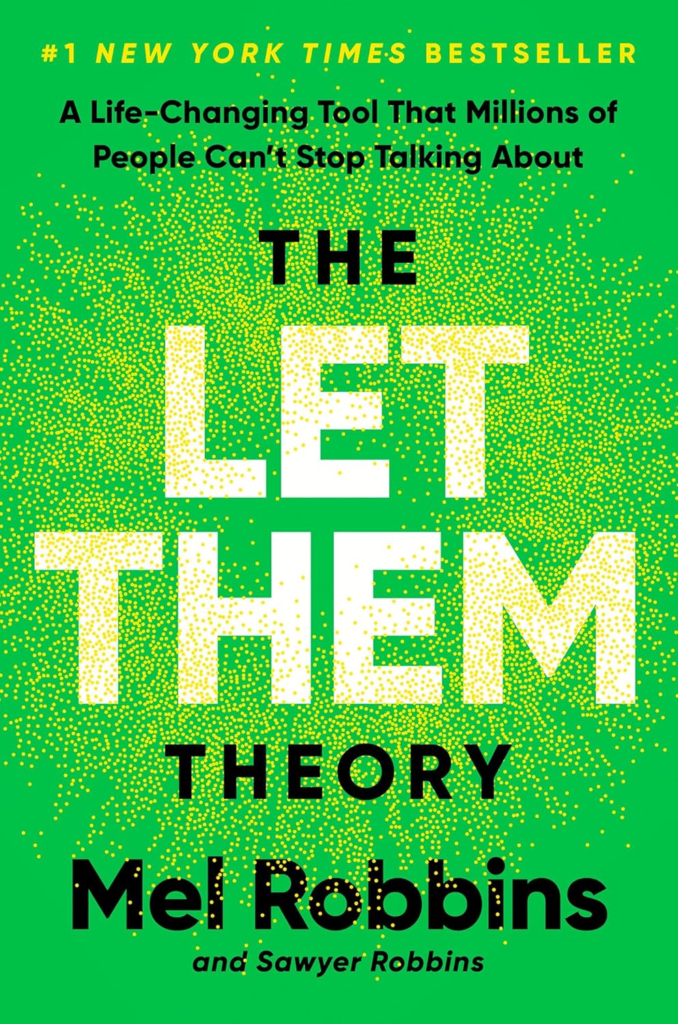
The Let Them Theory: A Life-Changing Tool That Millions of People Can’t Stop Talking About is a 2024 self-help and personal-development book by American author, speaker, podcast host, and former lawyer Mel Robbins, with contributions from her son Sawyer Robbins in some editions and bibliographic listings. Published by Hay House, the book presents the “Let Them” theory, a personal-development framework built around relinquishing attempts to control other people’s choices, opinions, reactions, and behavior while redirecting attention toward one’s own decisions and actions. (Penguin Random House)
The book became a major international publishing phenomenon following its release on December 24, 2024. According to the author’s official website and publisher materials, The Let Them Theory became a No. 1 bestseller in several major markets and sold more than 10 million copies within its first year. (Mel Robbins)
At its simplest, the book asks readers to replace the exhausting question “How do I make other people behave differently?” with two separate questions:
Let them.
Let me.
The first phrase concerns accepting what belongs to other people. The second concerns reclaiming responsibility for one’s own response.
Bibliographic information
| Field | Details |
|---|---|
| Title | The Let Them Theory: A Life-Changing Tool That Millions of People Can’t Stop Talking About |
| Author | Mel Robbins |
| Contributor | Sawyer Robbins is credited in several editions |
| Publisher | Hay House |
| Publication date | December 24, 2024 |
| Language | English |
| Genre | Self-help; personal development; psychology-oriented popular nonfiction |
| Hardcover length | 336 pages |
| E-book length | Approximately 257 pages |
| Original ISBN | 978-1-4019-7136-6 |
| Primary subject | Personal agency and relationships |
| Central concept | The Let Them Theory |
| Related concepts | Boundaries, acceptance, emotional regulation, people-pleasing, personal responsibility |
The U.S. hardcover edition is listed by Penguin Random House at 336 pages and carries ISBN 9781401971366. Hay House likewise lists December 24, 2024 as the publication date. (Penguin Random House)
International editions differ in pagination, ISBN and sometimes contributor attribution. For example, Penguin Random House India lists a 336-page edition published in December 2024, while Google Books records different page counts for other editions. (Penguin Random House India)
About the author: Mel Robbins


Mel Robbins is the creator and host of The Mel Robbins Podcast, which is the most shared and followed podcast in the world and is nominated for the first-ever Golden Globe for Best Podcast, and author of The Let Them Theory, the chart-topping, #1 selling book of 2025.
She has amassed 40 million followers online and is one of the most respected experts in mindset, life improvement, and behavior change. The Wall Street Journal calls her a “billion-view podcaster,” and TIME Magazine says she gives millions of listeners around the globe “a reason to believe in themselves.”
Her books have been translated into 65 languages and include the #1 New York Times, #1 Amazon, #1 Audible, and #1 Sunday Times bestselling The Let Them Theory, which is the top-selling book of 2025 according to Publishers Weekly, with 8+ million copies sold in its first eleven months. The Let Them Theory was named one of the Best Books of the Year by Amazon, Goodreads, Barnes & Noble, Audible, Books-A-Million, Publishers Weekly, Target, and Waterstones, and is on pace to become the most successful nonfiction book launch of all time. Robbins is also the author of the multimillion-copy-selling The 5 Second Rule, The High 5 Habit, and seven #1 audiobook releases on Audible.
USA Today calls Mel “a force to be reckoned with.” She is a global phenomenon in the publishing industry and podcasting. Her Boston-based media production company, 143 Studios, produces award-winning content, podcasts, events, audio series, online courses, journals, and books, along with professional development education for partners like Starbucks, Ulta Beauty, JPMorgan Chase, LinkedIn, Headspace, and Audible.
The Mel Robbins Podcast is one of the most popular podcasts in the world. It is nominated for the first-ever Golden Globe Award for Best Podcast, and was named the #1 most-followed show on Apple Podcasts and selected as one of the best podcasts of 2025 by the Apple Podcasts’ editorial team. It was recognized as the third largest show in the world by both Spotify and Apple Podcasts for 2025, and had the #1 most-shared episode of the year on both platforms. It also has won some of the most prestigious awards given to podcasts, including Webby, Signal, Spotify Creator, and iHeartPodcast Awards.
Notable accolades for Robbins include being named to TIME 100 Creators as one of the most influential digital voices of 2025, USA Today Top Mindset & Performance Coaches in the World, one of the fifty most influential influencers on The Hollywood Reporter’s Creator A-List, and a Forbes 50 Over 50 Honoree.
Overview
At the heart of The Let Them Theory is a deceptively simple observation: a considerable amount of human frustration comes from trying to control things that belong to other people.
People may spend enormous amounts of mental energy worrying about:
- what others think of them;
- whether somebody approves of them;
- whether a friend invites them somewhere;
- whether a partner changes;
- whether colleagues respect them;
- whether family members understand their choices;
- whether other people behave fairly; or
- whether someone makes the decision they themselves would have made.
Robbins argues that this constant attempt to manage other people produces unnecessary emotional exhaustion.
Her proposed response is the phrase “Let Them.”
If people want to behave differently from what you hoped, let them.
If someone does not invite you, let them.
If someone disagrees with you, let them.
If someone chooses a different path, let them.
But Robbins does not present “Let Them” as the end of the process. The second half is “Let Me.”
Once another person’s behavior is accepted as outside one’s direct control, the individual can ask:
What will I do now?
That shift—from controlling others to directing oneself—is the central philosophical movement of the book.
The Let Them Theory
The basic principle
The framework can be represented as:
                 THE LET THEM THEORY
                         │
              ┌──────────┴──────────┐
              │                     │
           LET THEM               LET ME
              │                     │
      Other people's          My choices
      choices                  My response
      opinions                My boundaries
      emotions                My actions
      behavior                My priorities
              │                     │
              └──────────┬──────────┘
                         │
                         ▼
                  PERSONAL AGENCY
The distinction is crucial.
“Let Them” is not intended to mean “do nothing.”
Instead:
Let them control what belongs to them.
Let me control what belongs to me.
This distinction transforms the phrase from passive resignation into a framework for personal responsibility.
From “Let Them” to “Let Me”
One of the book’s most important contributions is the addition of the second phrase.
A simplified version of the framework is:
| Situation | Old response | Let Them response | Let Me response |
|---|---|---|---|
| Someone dislikes you | Convince them | Let them | Decide how you want to behave |
| Someone excludes you | Chase approval | Let them | Choose people who value you |
| Someone criticizes you | Defend yourself immediately | Let them have their opinion | Decide whether criticism contains useful information |
| Partner refuses to change | Try harder to change them | Let them choose | Decide what you will accept |
| Family disagrees | Argue repeatedly | Let them disagree | Make your own decision |
| Colleague behaves badly | Obsess over their behavior | Let them be responsible for themselves | Set boundaries and act professionally |
The book therefore does not eliminate personal responsibility. It relocates it.
Instead of:
“How can I make them change?”
the reader is encouraged to ask:
“What can I do?”
What the theory is—and is not
The simplicity of the phrase is part of its appeal, but it can also create misunderstanding.
“Let Them” does mean:
- stop trying to control other adults;
- accept that people have their own choices;
- stop chasing approval;
- reduce unnecessary emotional resistance;
- recognize what is outside your control;
- redirect attention toward your own actions.
“Let Them” does not necessarily mean:
- tolerate abuse;
- accept disrespect indefinitely;
- abandon personal boundaries;
- ignore illegal behavior;
- stop communicating;
- remain in harmful relationships;
- become indifferent to people you love.
This distinction is important because acceptance of another person’s autonomy and acceptance of harmful behavior are not the same thing.
A person can simultaneously say:
“I cannot control you.”
and
“I will not allow this behavior in my life.”
That is where the “Let Me” principle becomes especially important.
Origins of the idea
Robbins has described the Let Them concept as something that emerged from conversations and experiences in her own life rather than as an entirely new academic theory.
The idea became widely known through social media and podcast discussions before becoming the foundation of the book.
The official book description presents the concept as a tool for stopping the attempt to manage other people’s opinions, drama and judgment and instead focusing on one’s own goals and happiness. (Mel Robbins)
The simplicity of the phrase contributed significantly to its spread online.
Rather than requiring readers to remember a complicated psychological model, the framework could be expressed in two everyday words:
Let Them.
The psychological idea behind the framework
Although The Let Them Theory is written for a general audience rather than as an academic psychology textbook, its central idea intersects with several established psychological concepts.
Locus of control
Psychology distinguishes between aspects of life people can influence directly and circumstances they cannot.
The Let Them framework encourages readers to move attention toward their own sphere of influence.
          WHAT I CAN CONTROL
       ┌─────────────────────────┐
       │ My choices              │
       │ My actions              │
       │ My boundaries           │
       │ My communication        │
       │ My priorities           │
       │ My response             │
       └─────────────────────────┘

          WHAT I CANNOT CONTROL
       ┌─────────────────────────┐
       │ Other people's opinions │
       │ Other people's choices  │
       │ Other people's moods    │
       │ Other people's approval │
       │ Other people's behavior │
       └─────────────────────────┘
The book repeatedly directs attention from the second box toward the first.
Acceptance versus resistance
Another major idea is the difference between accepting reality and resisting reality.
Suppose a friend does not invite you to an event.
There are two possible responses.
Resistance
“Why did they do this? I need to know. Maybe I should message them. Maybe they don’t like me. What can I do to change their mind?”
Acceptance
“They chose not to invite me. Let them. Now what do I want to do?”
The second response does not necessarily feel good.
It simply stops wasting additional energy fighting a fact that has already happened.
Kirkus Reviews identified this acceptance principle as one of the book’s strengths, describing Robbins’ argument as a practical form of allowing people to act as they choose while taking responsibility for oneself. (Kirkus Reviews)
People-pleasing
The theory is particularly relevant to people-pleasing.
People-pleasing often involves attempting to maintain relationships by anticipating and managing other people’s reactions.
The internal calculation can become:
"What will they think?"
        ↓
"What should I say?"
        ↓
"Will they be upset?"
        ↓
"How can I prevent that?"
        ↓
"I'll change my behavior."
        ↓
"Temporary approval"
        ↓
"Long-term exhaustion"
Robbins’ alternative is:
"What will they think?"
        ↓
             LET THEM
        ↓
"What do I think?"
        ↓
             LET ME
        ↓
"What do I choose?"
The distinction is subtle but powerful.
Relationships
Relationships are one of the major applications of the theory.
Romantic relationships
The framework asks readers to distinguish between:
loving someone and controlling someone.
A partner has their own:
- preferences;
- habits;
- emotions;
- priorities;
- decisions;
- personality.
Trying to force a partner to become a different person can create resentment on both sides.
The Let Them approach instead asks:
If this person never changed, what would I choose?
That question can be uncomfortable—but it can also be clarifying.
Friendships
Friendships provide another natural application.
People sometimes obsess over:
- who initiated the last conversation;
- who received an invitation;
- who responded to a message;
- who appears closer to somebody else;
- who liked or ignored a social-media post.
The Let Them framework suggests allowing people to reveal their level of interest.
If someone consistently chooses not to invest in a friendship, the answer may not be to chase harder.
It may be to let them—and choose differently for yourself.
Family relationships
Family relationships are more complicated because emotional obligations are stronger.
Robbins’ framework can be applied by distinguishing between:
acceptance of another person’s autonomy
and
acceptance of unacceptable behavior.
A family member may disagree with your career, marriage, lifestyle or priorities.
You may let them disagree.
At the same time, you can establish a boundary:
“You are entitled to your opinion. I am also entitled to make my decision.”
This is where the theory becomes more nuanced than simply “ignore everyone.”
Work and career
The workplace creates another major arena for the theory.
Employees may spend considerable time worrying about:
- whether their manager likes them;
- whether a colleague receives more recognition;
- whether another employee is competitive;
- whether someone takes credit;
- whether coworkers approve of their career ambitions.
The Let Them approach encourages individuals to separate office politics they cannot control from professional behavior they can control.
OTHERS                         ME
──────────────────             ─────────────────
Their opinions                My work
Their politics                My professionalism
Their ambition                My goals
Their choices                 My choices
Their reactions               My response
This does not mean ignoring workplace misconduct. It means avoiding the psychological trap of believing that every person’s behavior must first change before one can move forward.
Social media and modern life
The theory has particular relevance in the age of social media.
Platforms constantly expose users to other people’s:
- achievements;
- opinions;
- relationships;
- lifestyles;
- political positions;
- appearance;
- travel;
- wealth;
- careers.
This creates a continuous comparison environment.
The result can be an endless internal conversation:
“Why don’t I have that?”
“Why didn’t they respond?”
“Why did they choose her?”
“Why do they think that?”
The Let Them framework offers a mental interruption:
Let them live their life.
Then:
Let me live mine.
This may be one reason the idea translated so naturally into short-form social-media content.
Eight major areas of application
Publisher descriptions state that Robbins applies the Let Them Theory across eight key areas of life. (Google Books)
A useful conceptual representation is:
                 THE LET THEM THEORY
                         │
       ┌─────────┬───────┼───────┬─────────┐
       │         │       │       │         │
  Relationships  Work   Goals  Happiness  Family
       │         │       │       │         │
       └─────────┴───────┼───────┴─────────┘
                         │
                   SOCIAL LIFE
                         │
                    SELF-WORTH
                         │
                    PERSONAL
                     AGENCY
The precise chapter organization can vary between editions and formats, so the diagram is best understood as a conceptual map rather than a reproduction of the book’s table of contents.
The “control” problem
The book’s central diagnosis can be summarized as follows:
Human energy is limited.
If a person spends large amounts of that energy attempting to control other people, less remains for:
- personal growth;
- meaningful relationships;
- creative work;
- health;
- career;
- family;
- goals;
- rest;
- happiness.
Robbins therefore treats attention as a resource.
Conceptual energy allocation
WITHOUT LET THEM

Other people's behavior
████████████████████████
My own goals
██████
My own priorities
████
My own growth
███


WITH LET THEM

Other people's behavior
████
My own goals
████████████████
My own priorities
████████████
My own growth
██████████████
Note: This is a conceptual infographic, not empirical quantitative data.
“Let Them” and boundaries
One of the most important distinctions when interpreting the book is between control and boundaries.
A boundary says:
“I cannot control what you do, but I can decide what I will do in response.”
Control says:
“I need you to behave differently.”
Boundary says:
“If you behave this way, I will choose a different response.”
This produces a simple formula:
Let Them + Let Me = Boundary
For example:
Control:
“You cannot speak to me like that.”
Boundary:
“If you continue speaking to me that way, I will end this conversation.”
The second statement does not attempt to control another person’s choice. It defines the speaker’s own choice.
Personal responsibility
The book ultimately shifts the reader from victim thinking toward personal agency, although the concept should not be interpreted as blaming people for circumstances genuinely beyond their control.
The essential question becomes:
What is mine to do?
That question can be surprisingly difficult.
It requires a person to accept that:
- another person may never apologize;
- another person may never understand;
- another person may never approve;
- another person may never change;
- another person may choose someone else;
- another person may disagree.
And yet one’s own life still has to be lived.
The “Let Them” decision process
The book can be translated into a practical decision sequence:
              SOMETHING HAPPENS
                     │
                     ▼
        "Is this under my control?"
                     │
              ┌──────┴──────┐
             YES            NO
              │              │
              ▼              ▼
          LET ME           LET THEM
              │              │
              │              ▼
              │       Accept their choice
              │              │
              └──────┬───────┘
                     ▼
             "What do I want?"
                     │
                     ▼
               TAKE ACTION
This is perhaps the simplest visual representation of the book’s practical philosophy.
The role of personal stories
Robbins does not present the concept solely as an abstract rule.
The book combines:
- personal stories;
- practical exercises;
- observations about relationships;
- research references;
- psychological ideas;
- examples from everyday life; and
- conversations with experts.
Publisher descriptions emphasize that the book incorporates research and perspectives from experts in areas including psychology, neuroscience, relationships, happiness and ancient wisdom. (Google Books)
This mixture is characteristic of Robbins’ broader communication style: complex ideas are reduced to memorable phrases and then converted into practical behavioral tools.
The book’s relationship to Robbins’ earlier work
The Let Them Theory follows two earlier major books by Robbins:
The 5 Second Rule
Published in 2017, The 5 Second Rule introduced Robbins’ well-known technique of counting backward from five and then taking action before hesitation takes over.
The High 5 Habit
Published in 2021, The High 5 Habit focuses on self-encouragement and changing the relationship a person has with themselves.
The Let Them Theory
The 2024 book extends Robbins’ work into interpersonal relationships and personal boundaries.
The progression can therefore be represented as:
THE 5 SECOND RULE
       │
       ▼
Take action despite hesitation
       │
       ▼
THE HIGH 5 HABIT
       │
       ▼
Change your relationship with yourself
       │
       ▼
THE LET THEM THEORY
       │
       ▼
Stop trying to control other people
       │
       ▼
Take responsibility for your own life
Robbins’ official website identifies these three works as her principal bestselling books. (Mel Robbins)
Publication history
The Let Them Theory was released by Hay House on December 24, 2024. The original U.S. hardcover carries ISBN 9781401971366 and contains 336 pages. (Penguin Random House)
The book was accompanied by substantial promotional activity through Robbins’ podcast, social-media channels and broader media presence.
Its publication coincided with an unusually large digital conversation around the phrase “Let Them,” helping the concept circulate beyond traditional book audiences.
Reception
The book received strong commercial attention as well as generally favorable critical commentary.
Kirkus Reviews
Kirkus described the book as a useful self-help guide and praised its central idea of allowing other people freedom to act while concentrating on one’s own life. (Kirkus Reviews)
The review also noted that the theory should not be understood as simple indifference. Instead, the philosophy concerns recognizing the limits of personal control.
Commercial success
The commercial performance of The Let Them Theory has been extraordinary.
According to the author’s current official website, the book has sold more than 10 million copies within its first twelve months and became the No. 1 selling book of 2025. (Mel Robbins)
Penguin Random House currently describes the book as:
- a No. 1 New York Times bestseller;
- a No. 1 Sunday Times bestseller;
- a No. 1 Amazon bestseller; and
- a No. 1 Audible bestseller. (Penguin Random House)
The author’s website states that the book has been translated into 66 languages. (Mel Robbins)
Commercial trajectory
2024
│
├── Publication
│
▼
2025
│
├── Major bestseller
├── #1 bestseller claims across major lists
├── Rapid international expansion
│
▼
2026
│
├── 10M+ copies reported in first 12 months
├── 66-language reach reported
└── Continuing global readership
These figures are publisher/author-reported commercial statistics rather than independent academic measurements. (Mel Robbins)
Why the book became a cultural phenomenon
The unusual popularity of The Let Them Theory is closely connected to the simplicity of its central phrase.
Self-help books often struggle with a problem:
How do you turn a 300-page argument into one sentence that people remember?
Robbins solved that problem with:
Let Them.
The phrase is:
- short;
- emotionally intuitive;
- easy to remember;
- easy to repeat;
- applicable to relationships;
- suitable for social media;
- adaptable to everyday situations.
The second phrase—
Let Me.
—then prevents the idea from becoming merely passive.
Together they form a compact philosophy:
Let other people be responsible for themselves.
Let yourself be responsible for yourself.
Criticism and limitations
Despite its popularity, the theory has limitations.
Oversimplification
Human relationships can be much more complicated than a two-word framework suggests.
People have legitimate responsibilities toward:
- children;
- partners;
- employees;
- patients;
- elderly relatives;
- vulnerable people.
In such situations, simply “letting them” may be inadequate.
The danger of passivity
If interpreted incorrectly, the phrase could become an excuse for avoiding difficult conversations.
A healthier interpretation is:
Let Them ≠ Do Nothing
Instead:
Let Them → Understand Reality → Let Me → Choose My Response
Not a substitute for professional help
The book is a self-help work, not a clinical treatment manual.
People dealing with serious psychological distress, abuse, trauma, addiction or dangerous relationships may require professional, legal or emergency support rather than relying on a general self-help principle.
Author
Mel Robbins
Mel Robbins is an American author, motivational speaker, podcast host and former attorney. Her full name is Melanie Lee Robbins, née Schneeberger. She was born in 1968 and attended Dartmouth College before earning a law degree from Boston College Law School. (Wikipedia)
She first gained broad public recognition through her TEDx talk “How to Stop Screwing Yourself Over” and subsequently developed a career centered on personal development and behavioral change.
Her best-known books include:
- The 5 Second Rule;
- The High 5 Habit; and
- The Let Them Theory.
According to Robbins’ official biography, her books have been translated into dozens of languages and have reached millions of readers worldwide. (Mel Robbins)
She is also the creator and host of The Mel Robbins Podcast, which has become a major international podcast in the personal-development category. Her company, 143 Studios, produces podcasts, courses, live events and other media projects. (Mel Robbins)
Mel Robbins’ philosophy of behavior change
Across her books and media work, Robbins tends to use a consistent strategy:
1. Identify the problem
Recognize the behavior or thought pattern that is keeping you stuck.
2. Give it a memorable name
Examples include:
- The 5 Second Rule
- The High 5 Habit
- Let Them
3. Reduce complexity
Turn a complicated behavioral problem into an actionable rule.
4. Encourage immediate action
The reader is encouraged not merely to understand an idea but to practice it.
This explains why Robbins’ books often feel closer to behavioral toolkits than traditional philosophical works.
Sawyer Robbins
Some editions of The Let Them Theory list Sawyer Robbins alongside Mel Robbins.
Bibliographic records from Google Books and Apple Books identify the work as by Mel Robbins and Sawyer Robbins in certain editions. (Google Books)
The core public identity of the book, however, remains strongly associated with Mel Robbins and her broader body of personal-development work.
Major ideas at a glance
| Idea | Meaning |
|---|---|
| Let Them | Stop trying to control other people’s choices |
| Let Me | Focus on what you can choose and do |
| Personal agency | Take responsibility for your own response |
| Acceptance | Recognize reality rather than continuously resisting it |
| Boundaries | Decide what you will and will not accept |
| People-pleasing | Reduce dependence on external approval |
| Relationships | Allow people to reveal who they are |
| Self-focus | Redirect energy toward your own goals |
| Emotional freedom | Reduce unnecessary mental struggle over others |
The central message in one diagram
                OLD PATTERN
                     │
                     ▼
           "How do I change them?"
                     │
                     ▼
                Frustration
                     │
                     ▼
                 Exhaustion
                     │
                     ▼
              Loss of focus
                     │
                     │
                     ▼
              LET THEM
                     │
                     ▼
          "They are choosing."
                     │
                     ▼
               LET ME
                     │
                     ▼
          "What will I choose?"
                     │
                     ▼
              PERSONAL POWER
                     │
                     ▼
                 ACTION
A practical example
Imagine a person applying for a job.
They are rejected.
The initial reaction might be:
“Why didn’t they choose me? What did the interviewer think? Maybe I should contact them again. Maybe somebody else influenced the decision.”
The Let Them framework changes the sequence:
Let Them
Let the employer make its decision.
Let Me
Improve the résumé.
Prepare better.
Apply elsewhere.
Ask for feedback if appropriate.
Continue building skills.
The rejection has not changed.
But the person’s relationship with the rejection has changed.
That is the central mechanism behind the theory.
Broader significance
The popularity of The Let Them Theory illustrates a broader trend in modern self-help culture: audiences increasingly gravitate toward psychological concepts that can be compressed into memorable phrases.
The success of the book also demonstrates how contemporary publishing, podcasting and social media can reinforce one another.
             PODCAST
                │
                ▼
          Short-form idea
                │
                ▼
          SOCIAL MEDIA
                │
                ▼
         Public discussion
                │
                ▼
              BOOK
                │
                ▼
       Deeper explanation
                │
                ▼
         Global audience
                │
                └──────────────┐
                               ▼
                          PODCAST AGAIN
The cycle allows an idea to move rapidly between long-form and short-form media.
Legacy
It is still too early to assess the long-term literary legacy of The Let Them Theory, but its commercial and cultural impact is already substantial.
The book transformed a simple conversational phrase into a recognizable personal-development framework.
Its lasting contribution may ultimately be less about the phrase itself and more about the question it encourages readers to ask:
“Is this actually mine to control?”
If the answer is no, Robbins’ next question is equally important:
“Then what is mine to do?”
That movement—from control of others to responsibility for oneself—is the central idea around which the entire book is built.
Book at a glance
╔══════════════════════════════════════════════╗
║             THE LET THEM THEORY              ║
║                 Mel Robbins                  ║
╠══════════════════════════════════════════════╣
║ Published: 2024                              ║
║ Publisher: Hay House                         ║
║ Genre: Self-help / Personal Development      ║
║ Pages: 336 (U.S. hardcover)                  ║
║ ISBN: 9781401971366                          ║
╠══════════════════════════════════════════════╣
║ CENTRAL IDEA                                 ║
║                                              ║
║              LET THEM                       ║
║                   +                          ║
║               LET ME                        ║
║                   ↓                          ║
║          PERSONAL AGENCY                     ║
╚══════════════════════════════════════════════╝
See also
- Mel Robbins
- The 5 Second Rule
- The High 5 Habit
- Self-help
- Personal development
- Positive psychology
- Locus of control
- Emotional regulation
- Boundaries
- People-pleasing
- Interpersonal relationships
- The Mel Robbins Podcast
Read more
- Mel Robbins — Official Website
- The Let Them Theory — Official Book Page
- Hay House — The Let Them Theory
- Penguin Random House — The Let Them Theory
- The Mel Robbins Podcast
- Mel Robbins — Author Biography
References
- Robbins, Mel. The Let Them Theory: A Life-Changing Tool That Millions of People Can’t Stop Talking About. Hay House, 2024. (Penguin Random House)
- Penguin Random House. The Let Them Theory — bibliographic and publisher information. (Penguin Random House)
- Hay House. The Let Them Theory — publication details and description. (Hay House)
- Robbins, Mel. Official The Let Them Theory book page. (Mel Robbins)
- Robbins, Mel. Official author biography. (Mel Robbins)
- Robbins, Mel. Official press information and sales statistics. (Mel Robbins)
- Kirkus Reviews. “The Let Them Theory.” Review, December 24, 2024. (Kirkus Reviews)
- Google Books. The Let Them Theory bibliographic records and book description. (Google Books)
- Penguin Random House India. The Let Them Theory — Indian edition details. (Penguin Random House India)
- Apple Books. The Let Them Theory — Mel Robbins and Sawyer Robbins edition. (Apple)
External links
Mel Robbins — Official Website
The Let Them Theory — Official Book Page
Penguin Random House — The Let Them Theory
Hay House — The Let Them Theory
Kirkus Reviews — The Let Them Theory