


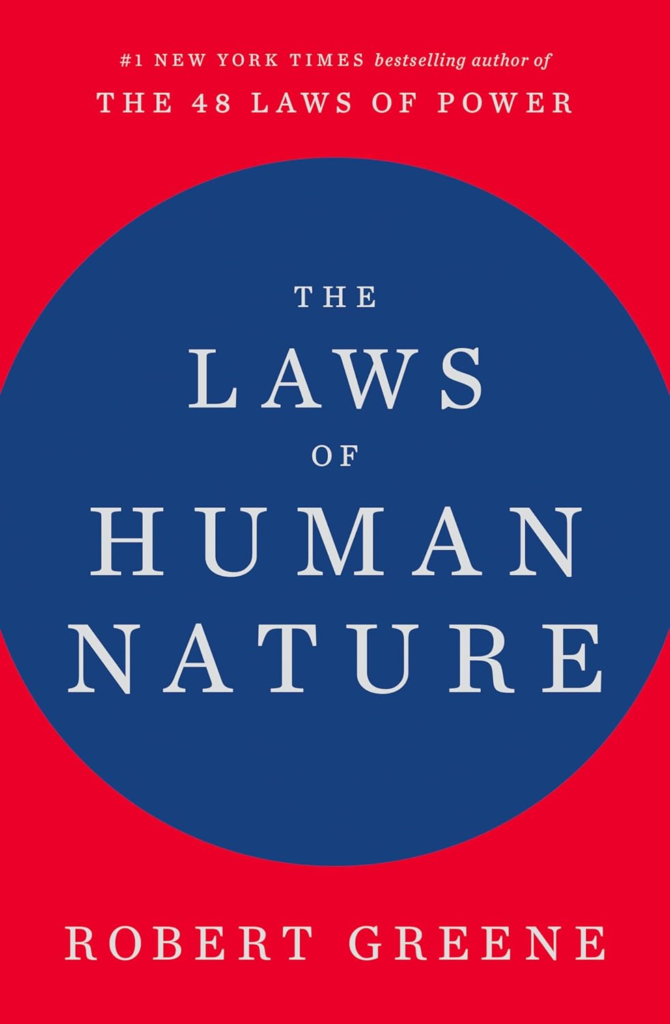
The Laws of Human Nature is a nonfiction book by the American author Robert Greene, published in 2018. The book examines recurring patterns in human behavior, focusing on emotions, self-interest, interpersonal relationships, social influence, group behavior, ambition, envy, aggression, and mortality. Greene presents these patterns as 18 “laws” intended to help readers understand both their own behavior and the behavior of other people.
First published in the United States on October 23, 2018, by Penguin Books, the book runs to 624 pages in the U.S. hardcover edition. The British edition was published by Profile Books in October 2018 and is listed at 609 pages in some editions.
The book belongs broadly to the fields of popular psychology, self-help, personal development, leadership, social behavior, and business strategy. Greene combines historical anecdotes, observations about psychology and social behavior, philosophical ideas, and practical strategies. Historical figures discussed in connection with the book’s themes include Pericles, Queen Elizabeth I, Martin Luther King Jr., Joseph Stalin, Anton Chekhov, Coco Chanel, Lyndon B. Johnson, and others.
The central argument of The Laws of Human Nature is that people frequently believe they act rationally while their decisions are influenced by emotions, unconscious motivations, social pressures, personal insecurities, habitual behavior, and the desire for recognition. Greene therefore encourages readers to develop greater self-awareness and observational ability rather than accepting people’s stated motives at face value.
Bibliographic information
| Field | Information |
|---|---|
| Author | Robert Greene |
| Original language | English |
| Country | United States |
| Genre | Nonfiction; self-help; popular psychology; business and personal development |
| Subject | Human behavior, psychology, social relationships, self-mastery |
| Publisher | Penguin Books / Penguin Publishing Group; Profile Books in the United Kingdom |
| Publication date | October 2018 |
| U.S. hardcover | October 23, 2018 |
| UK edition | October 2018 |
| U.S. hardcover length | 624 pages |
| UK edition length | 609 pages in some editions |
| ISBN | 978-0525428145 / 978-1781259191 among major editions |
| Preceded by | Mastery |
| Followed by | The Daily Laws |
The publisher’s U.S. listing identifies October 23, 2018 as the hardcover publication date and gives the book a length of 624 pages. Profile Books lists October 25, 2018 for its UK publication and identifies the work with ISBN 9781781259191. Different international editions consequently vary in pagination and ISBN.
Author
Robert Greene
Robert Greene is an American author known for books examining power, strategy, persuasion, human behavior, and personal mastery. His best-known works include The 48 Laws of Power, The Art of Seduction, The 33 Strategies of War, Mastery, The 50th Law (with rapper 50 Cent), The Laws of Human Nature, and The Daily Laws. Penguin Random House describes him as a New York Times bestselling author and an internationally recognized writer on power strategies and human behavior.
Greene was born in 1959 in Los Angeles, California. He studied classical studies and worked in a variety of occupations before publishing his first major book, The 48 Laws of Power, in 1998. His writing frequently combines historical examples with observations about psychology and strategy.
His background in classical studies is particularly relevant to The Laws of Human Nature. Rather than presenting the book as a conventional academic psychology textbook, Greene approaches human behavior through a mixture of history, philosophy, biography, literature, and popular psychology.
Profile Books states that Greene’s books have sold more than 10 million copies worldwide and identifies him as an author whose work has influenced or been cited by figures in business, entertainment, and popular culture.
Background and development
The Laws of Human Nature followed Greene’s earlier books on power, seduction, warfare, and mastery. While his earlier work frequently concentrated on strategy and interpersonal power, this book turns more explicitly toward the psychological forces that shape human decisions.
The book’s premise can be summarized as a progression:
Observe behavior → identify emotional forces → understand motivations → recognize recurring patterns → regulate oneself → respond more intelligently
Greene’s argument is not that every person behaves identically. Rather, he proposes that certain tendencies recur across cultures and historical periods. The historical examples serve as case studies through which he attempts to make those tendencies easier to recognize.
The publisher describes the book as an examination of people’s conscious and unconscious drives and emphasizes the importance of understanding why people behave as they do.
Structure of the book
The book is organized around 18 laws of human nature. Each major section generally introduces a recurring human tendency, develops the idea through historical or biographical examples, and then discusses ways readers might recognize or manage that tendency.
The 18 laws are:
- The Law of Irrationality
- The Law of Narcissism
- The Law of Role-Playing
- The Law of Compulsive Behavior
- The Law of Covetousness
- The Law of Shortsightedness
- The Law of Defensiveness
- The Law of Self-Sabotage
- The Law of Repression
- The Law of Envy
- The Law of Grandiosity
- The Law of Gender Rigidity
- The Law of Aimlessness
- The Law of Conformity
- The Law of Fickleness
- The Law of Aggression
- The Law of Generational Myopia
- The Law of Death Denial
Library catalogues and published contents listings confirm the 18-chapter structure and the corresponding chapter titles.
The 18 Laws of Human Nature
1. The Law of Irrationality
Master your emotional self
Greene begins with the proposition that people frequently overestimate their rationality.
According to the book, emotions influence perception and decision-making before people construct conscious explanations for what they have done. Anger, fear, jealousy, insecurity, excitement, resentment, and the desire for approval can therefore influence decisions while the individual believes that the decision was purely logical.
The practical objective is self-observation.
Instead of asking only:
“What do I think?”
the reader is encouraged to ask:
“What emotion might be influencing what I think?”
This distinction is important throughout the book because Greene repeatedly treats self-knowledge as the foundation for understanding other people.
Core idea
Emotion → interpretation → rationalization
rather than always:
Facts → reasoning → decision
2. The Law of Narcissism
Transform self-love into empathy
Greene argues that some degree of self-interest is a universal feature of human interaction. People naturally pay greater attention to their own experiences, concerns, ambitions, and problems.
The problem arises when self-focus becomes excessive.
The chapter therefore distinguishes between ordinary self-involvement and more destructive forms of narcissism. Greene encourages readers to move from excessive self-focus toward empathy, particularly the ability to understand what other people are experiencing.
The practical lesson is straightforward:
The better you understand what other people want, fear, value, and protect, the better you can understand their behavior.
3. The Law of Role-Playing
See through people’s masks
Social life requires people to perform different roles.
A person may behave differently as a parent, employee, manager, friend, customer, subordinate, public figure, or romantic partner. Greene argues that people frequently present a socially acceptable version of themselves rather than revealing every thought or motivation.
This does not necessarily mean that every social interaction is deliberately deceptive.
Rather, social behavior involves impression management.
Greene consequently recommends paying attention to behavior that is difficult to consciously control, including:
- tone of voice
- facial expressions
- gestures
- changes in attention
- contradictions between words and actions
- recurring behavioral patterns
The chapter’s larger lesson is that behavior can contain information that spoken language does not.
4. The Law of Compulsive Behavior
Determine the strength of people’s character
Greene argues that character becomes easier to understand through patterns over time.
A single impressive action can be misleading. A person may behave exceptionally well on one occasion while repeatedly behaving differently under pressure.
The more revealing question is therefore:
What does this person repeatedly do?
Greene suggests observing how people behave when:
- frustrated
- criticized
- ignored
- given authority
- denied something they want
- placed under pressure
- dealing with someone who has less power than themselves
Repeated behavior can reveal tendencies that a person’s public image conceals.
5. The Law of Covetousness
Become an elusive object of desire
Greene examines the human tendency to desire things that appear scarce, distant, exclusive, or difficult to obtain.
The phenomenon is closely connected with fantasy. People do not simply desire objects; they often desire the imagined version of those objects.
This creates an important paradox:
Availability can reduce perceived value, while scarcity can increase desire.
The law is presented not merely as a manipulation technique but as a way of understanding why human desire frequently intensifies around things that seem difficult to possess.
6. The Law of Shortsightedness
Elevate your perspective
People naturally respond strongly to immediate rewards and immediate threats.
A short-term benefit can therefore appear more attractive than a larger long-term benefit. Similarly, an immediate problem can dominate attention even when it is relatively unimportant in the broader picture.
Greene uses historical examples, including financial speculation, to illustrate the consequences of collective short-term thinking.
The antidote is long-range perspective.
Before making an important decision, the reader is encouraged to ask:
- What happens next?
- What happens after that?
- What will this decision look like in one year?
- What unintended consequences might follow?
7. The Law of Defensiveness
Soften people’s resistance by confirming their self-opinion
People generally want to feel autonomous, competent, intelligent, and morally acceptable.
When those qualities are threatened, they may become defensive.
Consequently, direct criticism does not always produce rational reconsideration. It can instead produce resistance.
Greene’s approach is to understand the person’s self-image before attempting to influence them.
The principle can be represented as:
Threat to identity → defensiveness → resistance
whereas:
Respect → reduced defensiveness → greater openness
This chapter is particularly relevant to leadership, negotiation, management, persuasion, and interpersonal communication.
8. The Law of Self-Sabotage
Change your circumstances by changing your attitude
Greene explores the possibility that individuals can unintentionally contribute to the very circumstances they dislike.
A fearful or hostile interpretation of events can change behavior. That behavior then affects other people, potentially producing results that appear to confirm the original belief.
For example:
Suspicion → defensive behavior → strained relationship → negative response → stronger suspicion
The chapter therefore emphasizes the relationship between attitude, perception, behavior, and circumstances.
The central lesson is that changing external circumstances sometimes begins with changing the internal frame through which those circumstances are interpreted.
9. The Law of Repression
Confront your dark side
People often suppress emotions and impulses that conflict with the image they wish to maintain.
Greene argues that the rejected parts of personality do not necessarily disappear. They can instead emerge indirectly through irritability, projection, resentment, sudden emotional reactions, or behavior that contradicts one’s stated values.
The concept encourages readers to examine the less flattering aspects of themselves rather than constructing an artificially perfect self-image.
In simplified form:
Recognized weakness → manageable weakness
Denied weakness → hidden influence
10. The Law of Envy
Beware the fragile ego
Envy is presented as one of the more difficult emotions to identify because people rarely describe themselves as envious.
Instead, envy may appear as:
- criticism
- sarcasm
- excessive comparison
- subtle hostility
- dismissing another person’s achievement
- suspicious interpretations of another person’s success
Greene advises readers to pay attention to patterns rather than isolated incidents.
The chapter also turns the observation inward: recognizing one’s own envy can prevent destructive comparisons and redirect attention toward personal development.
11. The Law of Grandiosity
Know your limits
Greene examines the tendency to develop an exaggerated perception of one’s own importance, intelligence, abilities, or uniqueness.
Success can increase this danger because accomplishments may reinforce an inflated self-image.
The antidote is not necessarily low self-esteem. Greene instead advocates grounded self-assessment.
A useful distinction is:
Confidence: “I have developed this ability.”
versus
Grandiosity: “Because I have developed this ability, I am exceptional in every situation.”
The chapter encourages readers to seek feedback, recognize limitations, and remain aware of changing circumstances.
12. The Law of Gender Rigidity
Reconnect with the masculine and feminine within you
Greene discusses the psychological and social qualities traditionally associated with masculinity and femininity.
His argument is that people can become psychologically restricted when they identify too rigidly with a narrow social role.
The chapter encourages flexibility in developing qualities that may traditionally have been associated with either gender, such as:
- assertiveness
- receptivity
- analytical thinking
- emotional sensitivity
- competitiveness
- intuition
- patience
The concept is presented as a form of psychological integration rather than simply a discussion of biological sex.
13. The Law of Aimlessness
Advance with a sense of purpose
Greene argues that people can become vulnerable to distraction when they lack a meaningful direction.
Without a strong purpose, attention can easily be captured by:
- other people’s goals
- social comparison
- short-term pleasure
- status competition
- changing trends
The chapter therefore emphasizes purpose as an organizing principle.
A meaningful goal provides a filter:
Does this move me toward what I actually want?
This idea connects The Laws of Human Nature with themes that appear throughout Greene’s earlier work on mastery and long-term development.
14. The Law of Conformity
Resist the downward pull of the group
Human beings are social animals, and belonging to groups offers obvious advantages. However, group membership can also influence individual judgment.
People may suppress their doubts because:
- everyone else appears to agree
- disagreement carries social costs
- group identity becomes more important than evidence
- individuals assume that other people know more than they do
Greene therefore distinguishes between independent thinking and merely following the emotional direction of the crowd.
The law is particularly relevant to organizations, political movements, workplaces, online communities, markets, and social media.
15. The Law of Fickleness
Make people want to follow you
Greene examines the complicated relationship between individuals and authority.
People may want leadership, but they can also resent excessive control. They may admire strength while becoming suspicious of leaders who appear weak or inconsistent.
The chapter therefore discusses leadership as a psychological relationship rather than merely a formal position.
Authority is presented as something that depends partly upon:
- competence
- consistency
- confidence
- emotional control
- understanding followers
- creating a sense of direction
16. The Law of Aggression
See the hostility behind the friendly façade
Greene argues that aggression does not always appear openly.
It can be expressed indirectly through:
- passive aggression
- obstruction
- manipulation
- hostility disguised as humor
- excessive control
- deliberate delays
- subtle retaliation
Recognizing aggression early can prevent people from being caught off guard by it.
At the same time, Greene distinguishes between destructive aggression and the energy required to pursue difficult goals, defend boundaries, or overcome obstacles.
The broader lesson is that aggression should be understood rather than simply denied.
17. The Law of Generational Myopia
Seize the historical moment
People are shaped partly by the historical period in which they grow up.
Technology, economic conditions, cultural movements, wars, political events, social norms, and major historical transitions can influence the assumptions shared by a generation.
Greene argues that people can become blind to these influences because they experience their own cultural environment as normal.
Understanding one’s historical context can therefore reveal assumptions that otherwise remain invisible.
18. The Law of Death Denial
Meditate on our common mortality
The final law deals with mortality.
Greene argues that people generally avoid thinking deeply about death even though awareness of mortality can radically change one’s perception of time and priorities.
Rather than treating death merely as something frightening, the chapter explores mortality as a source of perspective.
Awareness of limited time can encourage people to:
- clarify their priorities
- stop wasting attention
- pursue meaningful work
- appreciate relationships
- confront unnecessary fears
- take responsibility for how they spend their lives
The book therefore ends not with power over other people but with a confrontation with the ultimate limit shared by everyone.
Visual overview of the 18 laws
The psychological architecture of the book
                    THE LAWS OF HUMAN NATURE
                              │
          ┌───────────────────┼───────────────────┐
          │                   │                   │
       THE SELF             OTHERS              GROUPS
          │                   │                   │
   ┌──────┼──────┐      ┌─────┼─────┐       ┌────┼────┐
   │      │      │      │     │     │       │    │    │
Irrationality Narcissism  Masks Character  Conformity Generations
Self-sabotage Repression  Envy Defensiveness Fickleness Death
Grandiosity Aimlessness   Aggression
Gender rigidity            Covetousness
Compulsive behavior        Shortsightedness
This is a conceptual visualization of the book’s major themes rather than a classification supplied by Greene himself.
The book’s central progression
One of the most useful ways of understanding The Laws of Human Nature is to see the book as a progression from self-awareness to social awareness.
             1. OBSERVE YOURSELF
                     ↓
             2. CONTROL EMOTION
                     ↓
             3. UNDERSTAND MOTIVATION
                     ↓
             4. OBSERVE OTHER PEOPLE
                     ↓
             5. RECOGNIZE BEHAVIORAL PATTERNS
                     ↓
             6. UNDERSTAND GROUP PRESSURE
                     ↓
             7. DEVELOP LONG-TERM PERSPECTIVE
                     ↓
             8. ACT WITH PURPOSE
This progression explains why the book repeatedly returns to self-awareness. Greene’s framework is not simply about “reading other people”; it begins with recognizing one’s own biases, emotional reactions, desires, and blind spots.
Major themes
Rationality and emotion
One of the book’s recurring themes is the tension between rational thought and emotional impulses.
Greene’s framework assumes that humans frequently construct rational explanations for decisions that have already been influenced by emotion.
The practical consequence is an emphasis on emotional observation before decision-making.
Self-knowledge
Self-knowledge functions as a recurring foundation of the book.
A reader attempting to understand other people’s envy, defensiveness, narcissism, grandiosity, or aggression is simultaneously encouraged to recognize those tendencies within themselves.
This gives the book a two-directional structure:
Study others → discover yourself
and:
Study yourself → understand others
Empathy
Greene treats empathy as a practical form of observation rather than merely an expression of sympathy.
Understanding another person’s perspective can reveal:
- what they want
- what they fear
- what they value
- what threatens their identity
- what motivates their behavior
This becomes especially important in negotiation, leadership, conflict, and relationships.
Character
A major distinction in the book is between reputation and character.
Reputation is what people display publicly.
Character becomes clearer through repeated behavior.
Greene therefore places considerable emphasis on observing patterns over time rather than making judgments from isolated incidents.
Social influence
Several laws address persuasion and influence.
The book examines why people resist direct pressure, why they respond to status and authority, why groups influence individuals, and why desire can increase when something becomes less available.
Envy and comparison
The book treats social comparison as a powerful source of emotional disturbance.
People do not evaluate achievements in isolation. They frequently evaluate themselves relative to others.
This can make another person’s success feel personally threatening even when it has no direct effect on one’s own circumstances.
Purpose
Greene argues that people who lack a strong internal direction can become overly dependent on external signals.
Purpose therefore acts as a stabilizing mechanism.
The idea is particularly connected with the book’s discussions of conformity, generational influence, and shortsightedness.
Mortality
The final chapter changes the scale of the book.
The earlier chapters focus heavily on interpersonal behavior. The final law asks the reader to step outside everyday competition and consider the finite nature of human existence.
In that sense, the book moves from:
How do people behave?
to:
What should I do with the limited time available to me?
Historical examples
A distinctive feature of The Laws of Human Nature is its use of historical and biographical examples.
Rather than presenting abstract psychological propositions alone, Greene frequently examines individuals and events from different periods.
Among the figures associated with the book are:
- Pericles
- Queen Elizabeth I
- Martin Luther King Jr.
- Joseph Stalin
- Anton Chekhov
- Coco Chanel
- Lyndon B. Johnson
- Michael Eisner
- Howard Hughes
- Flannery O’Connor
The examples serve several purposes.
First, they demonstrate Greene’s argument that certain psychological tendencies recur across historical periods.
Second, they make abstract concepts easier to visualize.
Third, they allow the reader to compare radically different personalities and circumstances.
The publisher specifically highlights historical figures such as Pericles, Queen Elizabeth I, and Martin Luther King Jr. in its description of the book.
Greene’s method
Greene’s writing method is unusual within popular self-help literature.
He combines several traditions:
History
Historical episodes provide examples of human behavior under pressure.
Biography
Individual lives are examined for recurring behavioral patterns.
Psychology
Concepts such as narcissism, envy, projection, emotional reactions, and social conformity form part of the book’s conceptual vocabulary.
Philosophy
The book repeatedly raises questions about self-knowledge, desire, purpose, mortality, and human limitations.
Strategy
Many chapters conclude with practical approaches for dealing with the behavioral tendencies being discussed.
This combination gives the book a style that is closer to a historical-psychological strategy manual than to a conventional academic psychology textbook.
A practical framework for reading the book
The 18 laws can also be understood through five broad questions.
| Question | Relevant laws |
|---|---|
| What is happening inside me? | Irrationality, Self-Sabotage, Repression, Grandiosity |
| What is happening inside another person? | Narcissism, Role-Playing, Compulsive Behavior, Envy |
| What influences desire and resistance? | Covetousness, Defensiveness, Fickleness |
| What influences groups and society? | Conformity, Generational Myopia, Aggression |
| How should I orient my own life? | Aimlessness, Shortsightedness, Death Denial |
This five-part framework is an interpretive summary rather than Greene’s formal classification.
Influence and reception
The Laws of Human Nature received substantial attention in the business, self-development, and popular psychology markets.
Profile Books identifies the book as the winner of the International Business Book Award 2019. Contemporary publisher material also collected positive reviews from publications including The Guardian, Quartz, Inc., and Forbes.
The book has subsequently been published in multiple formats and editions, including hardcover, paperback, ebook, audiobook, and a shorter edition titled The Concise Laws of Human Nature. The latter was published in 2020 and is listed at 320 pages by Hachette India.
Its continued presence in international editions and audiobook and ebook catalogues reflects the book’s broad appeal within the personal-development and business-reading markets.
Criticism and limitations
Although Greene presents the book’s ideas as “laws,” the term should not be confused with a scientific law in the sense used in physics or other experimentally established sciences.
The book is best understood as popular psychology and strategic interpretation, not as a systematic academic theory of human behavior.
Several limitations follow from this distinction.
1. Historical examples are selective
Greene’s arguments are often supported through striking historical cases. Such examples can make an argument memorable, but individual historical cases cannot by themselves establish that a behavioral tendency is universal.
2. The book is interpretive
Greene frequently interprets motivations behind historical actions. Such interpretations can be interesting and illuminating, but historical motivation is often difficult to establish with certainty.
3. Human behavior is more variable than the word “law” suggests
Human behavior is influenced by culture, personality, development, social institutions, economic circumstances, biology, and individual experience.
A useful reader should therefore treat Greene’s laws as heuristics—ways of noticing patterns—rather than deterministic rules.
4. Some concepts overlap with established psychology
Ideas involving narcissism, social conformity, emotional regulation, cognitive biases, aggression, and self-perception have extensive academic literatures. Greene’s treatment is selective and written for a general audience rather than as a systematic review of that research.
5. Strategic interpretation can become overly suspicious
A reader who applies every concept mechanically could begin interpreting ordinary disagreements, criticism, or social behavior as evidence of hidden manipulation.
The more productive use of the book is therefore observational rather than paranoid:
Look for patterns, but distinguish evidence from assumption.
Relationship to Greene’s other books
The Laws of Human Nature occupies an interesting position within Robert Greene’s bibliography.
| Book | Central subject |
|---|---|
| The 48 Laws of Power | Power and social strategy |
| The Art of Seduction | Attraction and interpersonal influence |
| The 33 Strategies of War | Conflict and strategic thinking |
| The 50th Law | Fearlessness and independence |
| Mastery | Skill development and mastery |
| The Laws of Human Nature | Human behavior and psychological patterns |
| The Daily Laws | Daily reflections based on Greene’s broader ideas |
The progression suggests a broadening of Greene’s subject matter—from external strategy toward the psychological mechanisms that influence both the strategist and the people around them.
Penguin Random House lists The Laws of Human Nature among Greene’s major works alongside The 48 Laws of Power, The 33 Strategies of War, The Art of Seduction, Mastery, The 50th Law, and The Daily Laws.
Why the book remains distinctive
The book’s distinctive feature is not that it introduces a single new theory of psychology.
Its strength lies in synthesis.
Greene brings together:
history + biography + psychology + philosophy + strategy + self-observation
and turns those materials into a unified framework for thinking about people.
The result is a book that can be read at several levels.
A casual reader can treat it as a collection of observations about everyday behavior.
A manager can read it as a guide to workplace dynamics.
A student can use it as an introduction to questions about motivation and social behavior.
A writer can approach it as a collection of historical character studies.
And a person interested in self-development can read it primarily as a manual for examining personal reactions and habits.
The book’s central message
If the entire book had to be reduced to one conceptual chain, it would look like this:
        HUMAN BEHAVIOR
              │
              ▼
        Hidden emotions
              │
              ▼
       Unconscious motives
              │
              ▼
      Repeated behavioral patterns
              │
              ▼
       Social interaction
              │
              ▼
       Group influence
              │
              ▼
        Personal choices
              │
              ▼
        Life direction
The important point is that Greene does not place the reader outside the problem.
The reader is both observer and observed.
The same tendencies that make other people irrational, defensive, envious, ambitious, fearful, or conformist can also exist within oneself.
That is arguably the book’s most important structural idea.
Infographic: The 18 Laws at a glance
┌─────────────────────────────────────────────────────────┐
│             THE LAWS OF HUMAN NATURE                    │
├────┬──────────────────────────┬─────────────────────────┤
│ 01 │ Irrationality            │ Master emotional self   │
│ 02 │ Narcissism               │ Develop empathy         │
│ 03 │ Role-Playing             │ Read beneath masks     │
│ 04 │ Compulsive Behavior      │ Study character        │
│ 05 │ Covetousness             │ Understand desire      │
│ 06 │ Shortsightedness          │ Think long-term        │
│ 07 │ Defensiveness             │ Reduce resistance      │
│ 08 │ Self-Sabotage             │ Examine your attitude  │
│ 09 │ Repression                │ Face the shadow        │
│ 10 │ Envy                      │ Watch fragile egos     │
│ 11 │ Grandiosity               │ Know your limits       │
│ 12 │ Gender Rigidity           │ Develop flexibility    │
│ 13 │ Aimlessness               │ Find purpose           │
│ 14 │ Conformity                │ Think independently    │
│ 15 │ Fickleness                │ Understand leadership  │
│ 16 │ Aggression                │ Recognize hostility    │
│ 17 │ Generational Myopia       │ Understand your era    │
│ 18 │ Death Denial              │ Remember mortality     │
└────┴──────────────────────────┴─────────────────────────┘
Reading the book as a self-development system
A useful way to approach the book is not to attempt to memorize all 18 laws.
Instead, the reader can use four stages.
Stage 1 — Observe
Before judging another person, watch what they actually do.
Stage 2 — Question
Ask what emotions, incentives, fears, or desires might explain the behavior.
Stage 3 — Compare
Look for repeated patterns rather than relying on one incident.
Stage 4 — Respond
Once a pattern becomes clearer, decide how to respond without allowing the other person’s emotional state to dictate your own.
This approach is particularly compatible with the book’s first law: master your own emotional reactions before attempting to interpret somebody else’s.
Legacy
The Laws of Human Nature has become one of Robert Greene’s most recognizable works and an important part of his broader body of writing on power, strategy, self-mastery, and human behavior.
Its appeal comes partly from its unusual combination of intellectual traditions. It does not ask the reader to study psychology only through experiments or theories. Instead, it invites the reader to look at history, literature, biography, everyday relationships, and personal experience as sources of psychological observation.
The book’s lasting idea is therefore less about memorizing eighteen rules than about developing a particular habit of mind:
observe before reacting.
People often explain their own behavior through the reasons they consciously give. Greene asks the reader to look one level deeper—to emotions, incentives, habits, social pressures, personal history, and recurring patterns.
That shift in perspective is the organizing principle connecting the book’s eighteen laws.
See also
- [[Robert Greene]]
- [[The 48 Laws of Power]]
- [[The Art of Seduction]]
- [[The 33 Strategies of War]]
- [[Mastery]]
- [[The Daily Laws]]
- [[Popular psychology]]
- [[Self-help]]
- [[Social psychology]]
- [[Emotional intelligence]]
- [[Human behavior]]
- [[Personality psychology]]
- [[Leadership]]
- [[Persuasion]]
References
- Greene, Robert. The Laws of Human Nature. Penguin Publishing Group, 2018. Google Books records the U.S. edition as published October 23, 2018, with 624 pages.
- Greene, Robert. The Laws of Human Nature. Profile Books, 2018. Profile Books lists the UK publication in October 2018 and ISBN 9781781259191.
- Penguin Random House. The Laws of Human Nature — Robert Greene. The publisher’s catalogue provides publication details, description, author information, and selected contemporary reviews.
- WorldCat. The Laws of Human Nature. Library catalogue records identify Robert Greene as author and Profile Books as publisher of the 2018 English edition.
- Open Library. The Laws of Human Nature. Catalogue information includes the book’s table of contents and the 18 principal chapters.
- Hachette India. The Laws of Human Nature. Bibliographic information and author biography for the Indian edition.
- Profile Books. The Laws of Human Nature. Publisher information, editions, reviews, and award information.
Further reading
By Robert Greene
- The 48 Laws of Power
- The Art of Seduction
- The 33 Strategies of War
- Mastery
- The 50th Law with 50 Cent
- The Daily Laws
Related fields
Readers interested in the ideas explored by Greene may also wish to explore literature on:
- social psychology
- cognitive biases
- emotional intelligence
- personality psychology
- behavioral economics
- leadership psychology
- persuasion
- group dynamics
- interpersonal communication
- motivation
- self-regulation
External links
- Penguin Random House — The Laws of Human Nature
- Profile Books — The Laws of Human Nature
- Google Books — The Laws of Human Nature
- WorldCat — The Laws of Human Nature
- Robert Greene — Penguin Random House author page
Article note
This article is an original encyclopedia-style overview and interpretation of The Laws of Human Nature. It is not a reproduction of the book. The descriptions of the 18 laws are intentionally summarized in original language, while bibliographic and publication information is based on publisher and library records.