



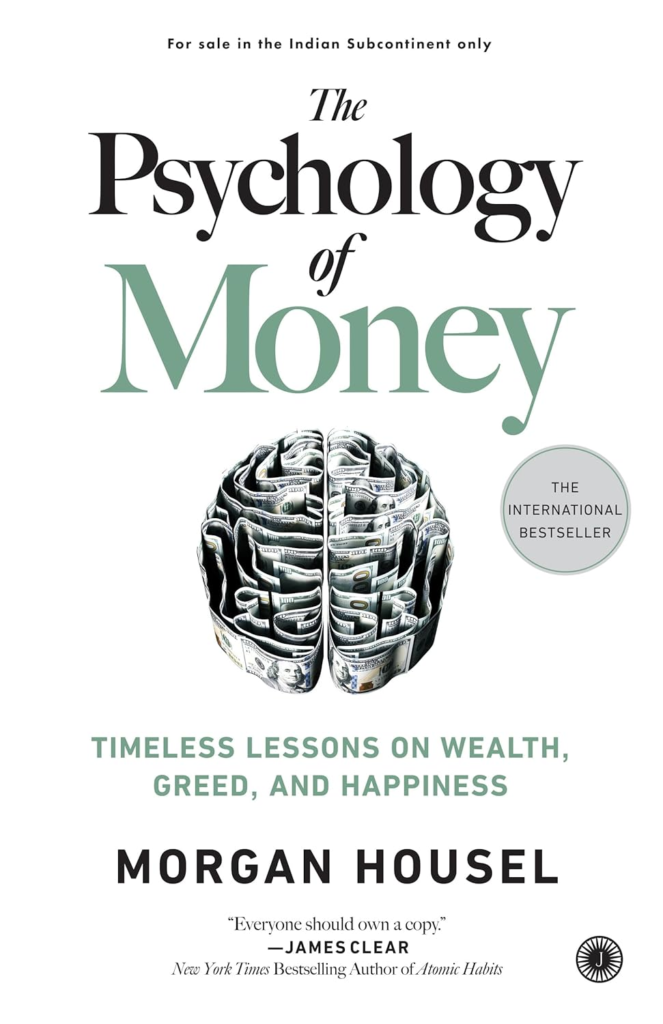
The Psychology of Money: Timeless Lessons on Wealth, Greed, and Happiness is a personal finance and behavioral-finance book by American author Morgan Housel. First published by Harriman House in September 2020, the book examines the psychological, emotional, and behavioral forces that influence how people earn, save, invest, spend, and think about wealth.
Rather than presenting personal finance primarily as a mathematical discipline, Housel approaches money as a human-behavior problem. His central argument is that financial outcomes are shaped not only by knowledge, intelligence, or technical expertise, but also by personal history, incentives, emotions, patience, ego, risk perception, luck, and the ability to behave consistently over long periods.
The book is structured as a collection of short essays and stories rather than as a conventional step-by-step financial manual. Its recurring themes include wealth versus status, compounding, saving, financial independence, risk, luck, uncertainty, reasonable behavior, room for error, and the importance of controlling one’s time.
Since its publication, The Psychology of Money has become an international bestseller and has been translated into numerous languages. The publisher describes it as a collection of 19 short stories about the ways people think about money, while bibliographic editions organize the material into 20 numbered chapters plus a postscript.
Book information
| Field | Details |
|---|---|
| Title | The Psychology of Money: Timeless Lessons on Wealth, Greed, and Happiness |
| Author | Morgan Housel |
| Country | United States |
| Language | English |
| Genre | Personal finance, behavioral finance, economics, psychology |
| Publisher | Harriman House |
| First publication | September 2020 |
| Original edition | First edition |
| Original ISBN | 9780857197689 |
| eBook ISBN | 9780857197696 |
| Original edition length | 256 pages |
| Structure | 20 chapters, postscript, endnotes and acknowledgements |
| Main subject | Human behavior and decision-making around money |
| Major themes | Wealth, saving, investing, risk, luck, compounding, freedom, psychology and happiness |
Overview
Most books about money begin with numbers.
They discuss budgets, asset allocation, interest rates, investment products, taxes, retirement accounts, or financial formulas.
The Psychology of Money begins somewhere else: inside the human mind.
Housel asks readers to consider why two intelligent people can look at exactly the same financial opportunity and make completely different decisions. One person may see an investment as an opportunity; another may see it as a dangerous gamble. One person may spend heavily after receiving a salary increase; another may continue living modestly. One investor may sell during a market crash because the loss feels unbearable, while another sees the same decline as a temporary part of a long journey.
The difference is not necessarily financial knowledge.
It can be experience.
A person who grew up during a recession may have a very different relationship with debt from someone who grew up during a period of economic expansion. Someone who became wealthy quickly may think differently about risk from someone whose wealth accumulated slowly over decades.
This is the foundation of Housel’s approach:
People make financial decisions according to the personal history through which they have experienced money.
The book therefore treats financial behavior as deeply personal.
The central idea
The central thesis of The Psychology of Money can be represented as follows:
                 MONEY
                   │
                   ▼
        ┌────────────────────┐
        │   Human behavior   │
        └────────────────────┘
                   │
       ┌───────────┼───────────┐
       ▼           ▼           ▼
    Emotions     History      Incentives
       │           │           │
       └───────────┼───────────┘
                   ▼
             Decisions
                   │
                   ▼
              Outcomes
                   │
                   ▼
              Future behavior
The book does not argue that financial knowledge is irrelevant.
Instead, it emphasizes that knowing what to do and actually doing it are different abilities.
Someone can understand diversification but panic during a crash.
Someone can understand compound interest but fail to save.
Someone can know that excessive debt is dangerous but continue borrowing because consumption provides immediate emotional rewards.
In this sense, the book is less concerned with finding the mathematically perfect financial strategy and more concerned with developing a strategy that a real human being can actually follow.
Why the psychology of money matters
Money is unusual because its numerical value is objective while its emotional meaning is subjective.
A $10,000 gain is mathematically identical for two people.
Psychologically, it may represent completely different things.
For one person, it may be a minor portfolio fluctuation.
For another, it may represent a year of savings.
For a third, it may be the difference between financial security and financial distress.
This difference explains why financial decisions cannot always be understood through mathematics alone.
Housel repeatedly returns to the idea that personal finance is personal.
There is no single financial behavior that makes sense for every person in every circumstance.
The major ideas in the book
1. No One’s Crazy
One of the book’s most important ideas is that people often behave rationally according to their own experiences.
A person’s financial decisions are shaped by the economic environment in which they grew up.
Consider two people:
- One grew up during a severe economic depression.
- Another grew up during decades of strong economic growth.
- One experienced unemployment in the family.
- Another watched parents become wealthy through stocks.
- One was taught that debt is dangerous.
- Another was taught that borrowing can create opportunity.
Both may later make apparently irrational financial decisions.
But from their own perspectives, those decisions may make perfect sense.
The lesson
Before judging another person’s financial behavior, ask:
“What experiences caused this person to see money this way?”
This principle also applies to ourselves.
Understanding our own financial history can reveal why certain choices feel comfortable or uncomfortable.
2. Luck and Risk
Housel places luck and risk side by side because financial outcomes rarely depend entirely on personal ability.
Success can contain an element of favorable circumstances.
Failure can contain an element of unfavorable circumstances.
This does not mean that effort is irrelevant. It means that outcomes should not automatically be treated as perfect evidence of individual skill.
The Luck–Risk Framework
             DECISION
                 │
        ┌────────┴────────┐
        ▼                 ▼
      Skill             Chance
        │                 │
        │          ┌──────┴──────┐
        │          ▼             ▼
        │        Luck           Risk
        │          │             │
        └──────────┴─────────────┘
                   ▼
                Outcome
The idea is particularly important when studying extremely successful people.
A spectacular success story may contain:
- extraordinary ability,
- favorable timing,
- unusual opportunity,
- survivorship,
- access to resources,
- and luck.
Therefore, copying the visible behavior of a successful person does not guarantee copying the outcome.
3. Never Enough
The book examines the psychological danger of constantly moving the definition of “enough.”
If $1 million feels sufficient, obtaining $2 million may make $1 million feel insufficient.
If a person earns more money, lifestyle expectations can rise alongside income.
The resulting cycle can look like this:
More income
     ↓
Higher lifestyle
     ↓
Higher expectations
     ↓
Higher definition of "enough"
     ↓
Need for still more income
     ↓
Cycle continues
Housel’s concern is not wealth itself.
The concern is the inability to define a stopping point.
Without a concept of “enough,” a person can take unnecessary risks simply because the next level of wealth has become psychologically necessary.
4. The power of compounding
Compounding is one of the most important financial concepts discussed in the book.
Its basic mechanism is simple:
Initial money
     ↓
Return
     ↓
Larger amount
     ↓
Return on the larger amount
     ↓
Still larger amount
     ↓
More returns
     ↓
Compounding
The remarkable feature of compounding is that time can become more important than dramatic short-term performance.
A moderate return sustained for a very long period can produce an extraordinary result.
This leads to an important distinction:
Good investing is not necessarily about maximizing every year’s return.
It can instead be about:
- staying invested,
- avoiding catastrophic losses,
- allowing time to work,
- and maintaining a strategy long enough for compounding to operate.
5. Getting wealthy versus staying wealthy
Housel separates two abilities that are often treated as the same.
Getting wealthy
This can involve:
- taking risks,
- entrepreneurship,
- concentration,
- aggressive opportunity-seeking,
- and accepting uncertainty.
Staying wealthy
This often requires:
- humility,
- diversification,
- caution,
- liquidity,
- patience,
- and avoiding ruin.
The two skill sets are therefore different.
GETTING WEALTHY
Risk + Opportunity + Growth
          │
          ▼
       Wealth
          │
          ▼
STAYING WEALTHY
Survival + Discipline + Margin
          │
          ▼
   Preserved Wealth
A strategy that is excellent for creating wealth can be inappropriate for preserving it.
6. Tails, you win
Housel discusses the importance of outlier outcomes, sometimes called tail events.
In many fields, a small number of exceptional outcomes can account for a disproportionately large share of total results.
This phenomenon appears in:
- investing,
- entrepreneurship,
- venture capital,
- technology,
- entertainment,
- and business.
A portfolio or career may contain many ordinary outcomes and a few extraordinary successes.
Those few successes can dominate the overall result.
Simplified illustration
Many ordinary outcomes
████ ███ ███ ███ ███ ███ ███

                         One huge outcome
                         ███████████████████████████
The implication is psychologically difficult.
A person can make many decisions that appear unsuccessful and still achieve a strong overall result if a small number of decisions generate very large gains.
This is one reason judging investment skill over short periods can be misleading.
7. Freedom: the highest dividend money pays
Perhaps the most human theme in the book is the connection between money and control over time.
Housel argues that one of the greatest benefits of having money is not owning expensive objects.
It is having greater control over one’s life.
Financial resources can provide the ability to:
- leave an unpleasant job,
- spend more time with family,
- take a break,
- pursue meaningful work,
- handle unexpected expenses,
- or simply say no.
This produces a different definition of wealth:
Wealth is not merely the ability to buy more things. It is the ability to control more of your time.
The Time Dividend
Money
  │
  ▼
Financial flexibility
  │
  ▼
More choices
  │
  ▼
More control over time
  │
  ▼
Greater autonomy
This is one of the book’s strongest bridges between finance and quality of life.
8. The Man in the Car Paradox
Housel examines a curious feature of status consumption.
People often buy expensive cars, houses, watches, clothing, or other visible possessions because they want to be admired.
But observers frequently notice the object rather than the owner.
A person seeing an expensive car may think:
“I wish I had that car.”
They may not be thinking:
“I wish I were that person.”
This creates a paradox:
We may spend money trying to obtain admiration from people who are primarily thinking about themselves.
The result is a potentially expensive attempt to purchase status.
9. Wealth is what you don’t see
This is one of the book’s most memorable distinctions.
Rich
Someone who has a high income or owns expensive things may appear rich.
Wealthy
Someone who has accumulated financial resources that have not yet been spent possesses wealth that may be invisible.
The distinction can be expressed as:
INCOME → What enters your life

SPENDING → What leaves your life

WEALTH → What remains after spending
A person driving a luxury car may have a high income but little financial wealth.
A person driving an ordinary car may have substantial investments and savings.
Visible consumption tells us very little about invisible financial strength.
10. Saving without a specific goal
Housel presents saving as valuable even when the money does not yet have a specific purpose.
Traditional financial planning often asks:
“What are you saving for?”
Housel’s perspective expands the question:
“What if you save simply to create flexibility?”
Savings can provide:
- emergency capacity,
- career freedom,
- protection against uncertainty,
- opportunity during crises,
- psychological security,
- and the ability to respond to unexpected events.
Savings as optionality
                    SAVINGS
                       │
       ┌───────────────┼───────────────┐
       ▼               ▼               ▼
   Emergency        Opportunity      Freedom
   protection         capital         to choose
       │               │               │
       └───────────────┼───────────────┘
                       ▼
                  Optionality
The value of savings therefore goes beyond the interest earned on the account.
11. Reasonable is often better than perfectly rational
Traditional financial models often assume that people behave rationally.
Real people do not always behave that way.
Housel therefore distinguishes between rational and reasonable behavior.
A mathematically optimal strategy may be psychologically impossible for someone to maintain.
Suppose an investment strategy has the highest expected return but causes the investor so much anxiety that they abandon it during every major market decline.
A theoretically inferior strategy that the person can maintain for decades may produce a better real-world outcome.
The relevant question becomes:
What financial strategy can you actually live with?
This is a practical form of behavioral finance.
12. Surprise and the limits of historical experience
Financial history is full of events that people once considered unlikely.
Markets have experienced:
- crashes,
- bubbles,
- depressions,
- wars,
- technological revolutions,
- inflation,
- deflation,
- financial crises,
- and extraordinary periods of growth.
The problem is that people often use recent experience as if it were a complete representation of the future.
Housel encourages readers to recognize that the future can contain events that history has not adequately prepared us to imagine.
This leads naturally to the concept of margin for error.
13. Room for error
One of the book’s most practical principles is to build financial plans that can survive being wrong.
A plan with no margin for error can fail because of:
- an unexpected expense,
- lower investment returns,
- unemployment,
- illness,
- inflation,
- a market crash,
- a change in family circumstances,
- or a poor personal decision.
A resilient plan contains a buffer.
The Margin-of-Safety Model
        EXPECTED PLAN
             │
             ▼
      ┌──────────────┐
      │ Safety Buffer│
      └──────────────┘
             │
     ┌───────┴────────┐
     ▼                ▼
Better-than-expected  Worse-than-expected
     │                │
     ▼                ▼
Extra benefit      Still survivable
The objective is not to predict the future perfectly.
It is to remain financially alive when the prediction is wrong.
14. You’ll change
People often construct financial plans as if their future selves will have exactly the same goals, preferences, ambitions, and lifestyles as their present selves.
Housel challenges this assumption.
A person at 25 may value:
- career acceleration,
- adventure,
- prestige,
- and maximum income.
At 45, that same person may value:
- family time,
- health,
- stability,
- flexibility,
- and reduced stress.
A financial plan should therefore leave room for changing preferences.
The changing-self principle
TODAY'S SELF
     │
     ▼
Experience
     │
     ▼
New priorities
     │
     ▼
FUTURE SELF
     │
     ▼
Different definition of "enough"
Financial planning is therefore partly an exercise in planning for a person who does not yet fully exist.
15. Nothing’s free
Every financial return has a price.
Sometimes the price is obvious.
Sometimes it is psychological.
For example, the price of earning potentially higher long-term investment returns may include:
- volatility,
- uncertainty,
- temporary losses,
- boredom,
- patience,
- and the emotional discomfort of seeing prices fall.
Housel’s important insight is that investors often interpret volatility as a fine rather than as the price of admission.
This changes the mental model.
Instead of:
“Why is my investment falling?”
the investor can ask:
“Am I willing to pay the temporary price required by this strategy?”
16. You and Me
People often assume that everyone is playing the same financial game.
They are not.
An individual investor, a pension fund, a billionaire entrepreneur, a young worker, a retiree, and a central bank may all participate in financial markets while having completely different:
- time horizons,
- objectives,
- risk tolerances,
- liquidity requirements,
- and definitions of success.
Therefore, copying another person’s financial behavior without understanding their circumstances can be dangerous.
Same market, different games
                   FINANCIAL MARKET
                          │
        ┌─────────────────┼─────────────────┐
        ▼                 ▼                 ▼
     Young worker       Retiree         Entrepreneur
     30-year horizon    income need     business risk
        │                 │                 │
        └─────────────────┼─────────────────┘
                          ▼
                 Different strategies
A strategy can be sensible for one person and unsuitable for another without either person being irrational.
17. The Seduction of Pessimism
Housel examines why negative financial stories often feel more convincing than positive ones.
A dramatic prediction of economic collapse attracts attention.
Gradual improvement does not.
Pessimistic narratives often have three advantages:
- They sound intellectually serious.
- They explain why something is going wrong.
- They create an immediate emotional response.
Optimistic progress is often slower and less visible.
This creates a psychological imbalance:
Bad news
   ↓
Fear
   ↓
Attention
   ↓
More bad news
   ↓
More attention
The chapter does not imply that pessimism is always wrong.
Rather, it encourages readers to distinguish between possible danger and inevitable disaster.
18. When you’ll believe anything
Financial uncertainty creates a powerful demand for explanations.
When people do not understand why markets are moving, they may accept simple stories:
- “The market is going up because of X.”
- “The economy is collapsing because of Y.”
- “This asset will definitely rise.”
- “This time is different.”
The human mind prefers coherent narratives.
But a coherent story is not necessarily a reliable prediction.
The lesson is to remain skeptical when certainty exceeds the available evidence.
19. All Together Now
Near the end of the book, Housel brings the major ideas together.
The resulting philosophy can be summarized as:
              FINANCIAL WELL-BEING
                       │
      ┌────────────────┼────────────────┐
      ▼                ▼                ▼
     Save            Invest           Behave
      │                │                │
      ▼                ▼                ▼
  Optionality      Compounding       Discipline
      │                │                │
      └────────────────┼────────────────┘
                       ▼
                    TIME
                       │
                       ▼
                Financial freedom
The book’s philosophy is therefore not about discovering a secret investment.
It is about constructing a financial life that can survive uncertainty and benefit from time.
20. Confessions: Housel’s own financial philosophy
The final numbered chapter is unusually personal.
Rather than ending with an abstract set of rules, Housel describes how he approaches his own finances.
The importance of this chapter is that it demonstrates the difference between financial theory and a financial life.
His approach emphasizes ideas such as:
- maintaining a significant margin for error,
- valuing independence,
- saving,
- avoiding unnecessary complexity,
- and building a financial system that allows him to sleep well.
The broader point is important:
A financial plan should serve your life rather than turn your life into an attempt to optimize a spreadsheet.
Wealth, rich and wealthy
One of the most important conceptual distinctions in the book is between being rich and being wealthy.
| Concept | Meaning |
|---|---|
| Income | Money earned |
| Spending | Money consumed |
| Rich | High visible financial resources or consumption |
| Wealth | Financial resources that have not been spent |
| Financial independence | Ability to support desired life without depending entirely on earned income |
| Freedom | Control over one’s time and choices |
This distinction is fundamental to the book.
A large income does not automatically create wealth.
A modest income does not automatically prevent wealth.
The difference is strongly influenced by the gap between what you earn and what you consume.
The psychology of compounding
Compounding is often presented mathematically.
Housel presents it psychologically.
The investor must possess enough patience to allow the mathematics to work.
YEAR 1
Capital
  ↓
Return

YEAR 2
Capital + previous return
  ↓
Return

YEAR 3
Larger capital base
  ↓
Larger potential return

...

LONG PERIOD
  ↓
Compounding becomes increasingly powerful
This produces an important behavioral requirement:
You must survive long enough for compounding to matter.
That means avoiding decisions that permanently interrupt the process.
The role of time
Time appears throughout the book as an invisible financial asset.
Money can buy many things.
But perhaps its most valuable purchase is control over time.
The hierarchy can be illustrated as:
Money
  ↓
Savings
  ↓
Financial flexibility
  ↓
Choice
  ↓
Control
  ↓
Time
  ↓
Freedom
This is why Housel’s concept of wealth goes beyond material consumption.
Financial independence in the book
The book does not present financial independence as a single numerical target.
Instead, independence is connected to autonomy.
A person becomes financially stronger when money reduces the number of situations in which they must say:
“I have no choice.”
Savings can create choices.
Investments can create future choices.
Low fixed expenses can create choices.
Avoiding excessive debt can create choices.
Thus:
Financial independence = increased control over one’s future decisions.
The importance of behavior
The book repeatedly returns to a fundamental distinction:
Financial knowledge
Knowing:
- what compound interest is,
- how markets work,
- what diversification means,
- how inflation works,
- and how investment returns are calculated.
Financial behavior
Actually:
- saving regularly,
- avoiding panic,
- remaining patient,
- controlling spending,
- accepting uncertainty,
- and staying disciplined.
The two are not the same.
Knowledge
   │
   ▼
Understanding
   │
   ▼
Decision
   │
   ▼
Behavior
   │
   ▼
Repeated behavior
   │
   ▼
Long-term outcome
The book’s argument is that the final four stages often matter more than simply possessing information.
A one-page infographic of the book
╔════════════════════════════════════════════╗
║        THE PSYCHOLOGY OF MONEY             ║
║          MORGAN HOUSEL — CORE IDEAS        ║
╠════════════════════════════════════════════╣
║                                            ║
║  1. MONEY IS PERSONAL                      ║
║     Your history shapes your behavior.     ║
║                                            ║
║  2. LUCK + RISK MATTER                     ║
║     Outcomes are never pure skill.         ║
║                                            ║
║  3. KNOW YOUR "ENOUGH"                     ║
║     More is not always better.             ║
║                                            ║
║  4. RESPECT COMPOUNDING                    ║
║     Time magnifies repeated returns.       ║
║                                            ║
║  5. SURVIVAL MATTERS                       ║
║     Getting wealthy ≠ staying wealthy.    ║
║                                            ║
║  6. SAVE FOR FLEXIBILITY                   ║
║     Savings create options.                ║
║                                            ║
║  7. WEALTH IS OFTEN INVISIBLE              ║
║     What you don't spend can build wealth. ║
║                                            ║
║  8. BE REASONABLE                          ║
║     The best plan is one you can follow.   ║
║                                            ║
║  9. EXPECT SURPRISES                       ║
║     The future will not perfectly repeat.  ║
║                                            ║
║ 10. BUILD ROOM FOR ERROR                   ║
║     Make plans that survive being wrong.   ║
║                                            ║
║ 11. ACCEPT CHANGE                          ║
║     Your future self may want different    ║
║     things from your present self.         ║
║                                            ║
║ 12. BUY FREEDOM                            ║
║     The greatest dividend may be time.     ║
║                                            ║
╚════════════════════════════════════════════╝
A practical mental model
The book can be reduced to five questions:
1. What does “enough” mean to me?
Without an answer, wealth accumulation can become an endless race.
2. What risks can permanently damage me?
Not every loss is equal. Temporary volatility is different from financial ruin.
3. How much uncertainty can I tolerate?
A mathematically attractive strategy is useless if it causes behavior that destroys the strategy.
4. Am I building wealth or displaying wealth?
Visible consumption and invisible financial strength are different things.
5. What does money allow me to do?
Money ultimately has value because of what it enables a person to experience, protect, or choose.
What the book is not
Despite its title, The Psychology of Money is not primarily a textbook on psychology.
It is also not a detailed technical manual for:
- stock selection,
- portfolio construction,
- tax planning,
- retirement calculations,
- insurance planning,
- real-estate analysis,
- or professional investment management.
Its strength lies elsewhere.
It tries to explain why financially intelligent people can still behave badly with money.
This distinction matters because readers looking for precise investment instructions may find the book intentionally broad.
Criticism and limitations
A useful encyclopedia article should not present the book’s arguments as unquestionable truths.
Several limitations have been identified by reviewers and commentators.
Anecdotes are persuasive but not equivalent to evidence
Housel is an exceptionally story-driven writer.
He uses memorable examples involving investors, entrepreneurs, businesses, economic events, and ordinary people.
Stories make abstract concepts easier to understand.
However, a compelling example does not by itself establish that a particular behavior is the dominant cause of financial success.
A recent critical review in The Behavioral Scientist specifically argues that some of Housel’s examples demonstrate that a factor matters without proving that it matters more than competing explanations such as intelligence, income, opportunity, or luck.
The distinction is important:
Anecdote can illustrate an idea; it does not automatically prove the idea.
The book is more philosophical than technical
Readers looking for detailed portfolio construction or financial planning instructions may find relatively little technical guidance.
That is not necessarily a flaw in relation to the book’s stated purpose, but it does define its scope.
Some ideas overlap
Because the book consists of short essays, certain concepts recur:
- patience,
- saving,
- uncertainty,
- long-term thinking,
- independence,
- and behavior.
Some readers regard this repetition as reinforcement.
Others may experience it as redundancy.
The American context
Many of the book’s examples are drawn from American financial history, markets, companies, and economic conditions.
Readers elsewhere can apply many of the behavioral principles, but specific financial mechanisms, taxation, retirement systems, and investment products differ significantly between countries.
The book should therefore be read as a framework for thinking, not as a universal financial-planning manual.
Behavioral wisdom is not a guarantee of financial success
Saving, patience, discipline, and long-term thinking can improve financial decision-making.
They cannot eliminate:
- economic uncertainty,
- market risk,
- structural inequality,
- unexpected expenses,
- poor health,
- unemployment,
- or bad luck.
Financial behavior matters, but it is not the only determinant of financial outcomes.
Relationship to behavioral finance
The Psychology of Money sits comfortably alongside the broader field of behavioral finance, which studies how psychological factors influence financial decisions.
The book discusses themes associated with behavioral economics and finance, including:
- loss aversion,
- overconfidence,
- incentives,
- social comparison,
- mental accounting,
- risk perception,
- uncertainty,
- and the influence of personal experience.
However, Housel’s method is primarily narrative rather than academic.
He uses stories and observations to make financial psychology accessible to a general audience.
This is part of the book’s appeal: readers do not need an academic background in economics or psychology to understand its central ideas.
Housel’s writing style
One of the defining features of the book is its accessibility.
Housel generally avoids turning the discussion into a mathematical textbook.
Instead, he uses:
- short chapters,
- historical anecdotes,
- business stories,
- psychological observations,
- memorable contrasts,
- and simple conceptual frameworks.
The writing repeatedly moves from a story to a principle and then from the principle to everyday financial behavior.
A typical Housel-style intellectual movement can be represented as:
STORY
  ↓
Unexpected outcome
  ↓
"What caused this?"
  ↓
Psychological principle
  ↓
Financial lesson
  ↓
Application to ordinary life
This structure makes the book approachable even for readers who normally avoid financial literature.
Author: Morgan Housel
Morgan Housel is an American financial writer and author known for writing about investing, economics, psychology, risk, and human behavior.
He is a partner at Collaborative Fund and previously worked as a columnist for The Motley Fool and The Wall Street Journal.
Housel has received the Best in Business Award from the Society of American Business Editors and Writers twice, won the New York Times Sidney Award, and has twice been a finalist for the Gerald Loeb Award for Distinguished Business and Financial Journalism.
His writing career has focused heavily on the intersection of money and human behavior rather than on conventional financial product advice.
Housel later published Same as Ever: A Guide to What Never Changes and The Art of Spending Money, extending his exploration of decision-making, uncertainty, spending, and human behavior.
He is also a partner at Collaborative Fund and serves on the board of directors of Markel.
His official biography describes him as the author of The Psychology of Money, Same as Ever, and The Art of Spending Money.
Housel’s broader intellectual theme
Although The Psychology of Money is classified as a personal-finance book, Housel’s larger subject is arguably human behavior under uncertainty.
Money provides the setting.
The deeper questions are:
- Why do people take risks?
- Why do they fear losses?
- Why do they compare themselves with others?
- Why do they chase more even after becoming successful?
- Why do people repeat mistakes?
- Why is patience so difficult?
- Why does financial independence matter emotionally?
- Why do people confuse visible consumption with wealth?
This makes the book relevant beyond investing.
Its ideas can be applied to:
- entrepreneurship,
- career decisions,
- business strategy,
- retirement planning,
- family finances,
- and personal definitions of success.
Publication history and editions
The original edition of The Psychology of Money was published by Harriman House in September 2020.
The original publisher’s bibliographic information lists 256 pages and ISBN 9780857197689 for the print edition and 9780857197696 for the eBook.
Subsequent editions have appeared in different markets and formats.
Later editions have also added bonus material. For example, a 2025 hardback edition contains additional chapter material and is longer than the original edition.
The book has also been translated extensively. Publisher information has documented editions across a wide range of languages, including several Indian languages.
Table of contents
The original book is organized around the following chapters:
- No One’s Crazy
- Luck & Risk
- Never Enough
- Confounding Compounding
- Getting Wealthy vs. Staying Wealthy
- Tails, You Win
- Freedom
- Man in the Car Paradox
- Wealth is What You Don’t See
- Save Money
- Reasonable > Rational
- Surprise!
- Room for Error
- You’ll Change
- Nothing’s Free
- You & Me
- The Seduction of Pessimism
- When You’ll Believe Anything
- All Together Now
- Confessions
The book also contains a postscript concerning the history of American consumer thinking.
Key concepts at a glance
| Concept | Core message |
|---|---|
| Personal history | Your experiences influence your financial decisions |
| Luck and risk | Outcomes contain both controllable and uncontrollable elements |
| Enough | Endless accumulation can create unnecessary risk |
| Compounding | Time can be extraordinarily powerful |
| Survival | Preserving wealth is different from creating it |
| Tail outcomes | A few extraordinary results can drive overall performance |
| Freedom | Money’s highest value may be control over time |
| Status | Visible consumption does not necessarily represent wealth |
| Saving | Savings create flexibility and optionality |
| Reasonable behavior | A sustainable strategy may beat a theoretically optimal one |
| Uncertainty | The future will contain surprises |
| Margin of error | Financial plans need buffers |
| Changing preferences | Your future self may have different goals |
| Price of investing | Volatility can be the cost of long-term returns |
| Different games | Other people’s financial strategies may not fit your circumstances |
The book’s core philosophy in one diagram
                 THINK DIFFERENTLY ABOUT MONEY
                              │
             ┌────────────────┼────────────────┐
             ▼                ▼                ▼
         Understand        Respect          Control
          yourself        uncertainty        behavior
             │                │                │
             └────────────────┼────────────────┘
                              ▼
                         Save regularly
                              │
                              ▼
                       Invest patiently
                              │
                              ▼
                      Avoid financial ruin
                              │
                              ▼
                       Let time compound
                              │
                              ▼
                     Gain greater freedom
Frequently asked questions
What is The Psychology of Money about?
It is a book about how psychological and behavioral factors influence the way people earn, save, spend, invest, and think about wealth.
What is Morgan Housel’s main message?
One of the book’s central messages is that financial success depends heavily on behavior. Knowing financial theory is not enough; people must also be able to behave sensibly and consistently over long periods.
Is The Psychology of Money an investing book?
It is partly about investing, but it is broader than an investment manual. It focuses on financial behavior, wealth, saving, risk, psychology, and decision-making.
Does the book teach stock picking?
No. It does not function primarily as a stock-picking guide.
What does Housel mean by wealth?
In the book’s framework, wealth is largely associated with financial resources that have not been spent. Visible consumption can demonstrate income or spending power, but it does not necessarily demonstrate accumulated wealth.
Why does Housel discuss luck?
Because financial outcomes are influenced by circumstances outside an individual’s control. Recognizing luck and risk can make people more cautious about copying successful individuals and more humble about interpreting their own outcomes.
What is the difference between getting wealthy and staying wealthy?
Getting wealthy may require taking calculated risks and pursuing opportunities. Staying wealthy requires survival, discipline, diversification, humility, and avoiding decisions that could cause permanent financial damage.
Why is saving important according to the book?
Saving provides more than money for future purchases. It creates flexibility, resilience, and the ability to respond to uncertainty.
What is the “Man in the Car Paradox”?
It describes the tendency to buy visible status symbols in the hope of receiving admiration, even though observers may care more about the object than the person who owns it.
Is the book scientifically rigorous?
It is better understood as a narrative and philosophical work on behavioral finance than as a formal academic research monograph. Its stories and observations are useful for thinking about money, but individual anecdotes should not be treated as proof of universal financial laws.
Is the book useful outside the United States?
Many of its behavioral ideas are broadly applicable. However, readers outside the United States should adapt specific financial implications to their own tax systems, financial markets, currencies, retirement systems, and economic environments.
Modern interpretation
More than a book about investing, The Psychology of Money can be read as a book about decision-making under uncertainty.
Its enduring ideas can be summarized in a modern framework:
1. Build wealth quietly
Do not confuse financial appearance with financial strength.
2. Define enough
A person without a stopping point can turn success into an endless competition.
3. Protect against ruin
The ability to remain financially solvent is often more important than maximizing short-term returns.
4. Give compounding time
The most powerful financial forces often operate slowly.
5. Keep flexibility
A financial plan should leave room for unexpected events and changing goals.
6. Know your own psychology
The strategy you can actually follow is more important than a theoretically perfect strategy you will abandon.
7. Remember that everyone is playing a different game
Another person’s portfolio, lifestyle, income, or risk tolerance may have been designed for circumstances completely different from yours.
Why the book remains relevant
The financial world has changed dramatically through technology, digital banking, cryptocurrencies, social media, algorithmic trading, online investing platforms, and increasingly rapid access to financial information.
Yet many psychological problems remain remarkably familiar.
People still:
- compare themselves with others,
- chase recent winners,
- fear losses,
- underestimate uncertainty,
- spend to demonstrate status,
- underestimate the power of long periods,
- and confuse information with wisdom.
That is why the book’s central question remains relevant:
How should a human being behave when money, uncertainty, ambition, fear, and time all interact?
Legacy and reception
The book received substantial attention from financial writers and the broader personal-finance community.
Its accessible style has helped introduce behavioral-finance ideas to readers who might not ordinarily read academic economics.
The publisher has reported that the book has sold millions of copies worldwide and been translated into dozens of languages. By 2025, Harriman House reported more than seven million copies sold worldwide and publication in 60 languages; its more recent publishing material describes the book as having surpassed 10 million copies worldwide.
The book has also received strong praise from prominent financial writers and authors, although critical commentary has noted its reliance on anecdotes, repetition, and its limited treatment of detailed financial implementation.
Its popularity is therefore best understood not simply as a response to a new investing strategy, but as evidence of the appeal of explaining finance through ordinary human behavior.
See also
- Behavioral finance
- Behavioral economics
- Personal finance
- Financial independence
- Compound interest
- Risk management
- Investment psychology
- Wealth management
- Financial literacy
- Same as Ever by Morgan Housel
- The Art of Spending Money by Morgan Housel
- Thinking in Bets by Annie Duke
- The Most Important Thing by Howard Marks
Read more
Readers interested in the ideas behind The Psychology of Money may also explore:
Morgan Housel
Housel’s essays provide a broader view of his thinking about markets, risk, business, uncertainty, and human behavior.
Behavioral finance
The academic field provides a more research-oriented treatment of the psychological forces that influence financial decisions.
Personal finance
Readers looking for practical implementation can supplement Housel’s conceptual framework with detailed resources on budgeting, taxation, retirement planning, insurance, diversification, and investment management.
Long-term investing
The book’s discussion of compounding, patience, risk, and survival can be studied alongside literature on long-term portfolio management.
References
- Harriman House. The Psychology of Money: Timeless Lessons on Wealth, Greed, and Happiness. Bibliographic and publisher information.
- Morgan Housel. Official author website and biography.
- Collaborative Fund. Morgan Housel author page and published essays.
- Google Books. Bibliographic record and table of contents for The Psychology of Money.
- Open Library. Bibliographic record and chapter listing for The Psychology of Money.
- Harriman House. Publishing and international-rights information concerning the book’s worldwide editions and translations.
- The Behavioral Scientist. Critical review and evidence assessment of The Psychology of Money, September 2026.
- Jurnal Keuangan dan Perbankan. Critical review of The Psychology of Money from a behavioral-finance perspective.
- Pan Macmillan / Harriman House. Later editions and publication information.
Editorial note
The Psychology of Money is best understood as a framework for thinking about financial behavior, rather than a universal formula for becoming wealthy.
Its greatest contribution is not a particular investment technique. It is the invitation to examine the human side of financial decisions: the stories people tell themselves, the risks they are willing to accept, the lifestyles they want, the uncertainty they can tolerate, and the amount of freedom they actually want money to provide.
The book’s most useful question may therefore be simpler than “How can I make more money?”
It is:
“What kind of financial life will allow me to remain secure, patient, flexible, and free?”
That question shifts the goal of personal finance from maximizing wealth on paper to building a life that money can support.
In one sentence
The Psychology of Money argues that financial success is not primarily a test of mathematical intelligence; it is a long-term test of behavior, patience, self-awareness, risk management, and the ability to use money to create freedom rather than merely display status.