


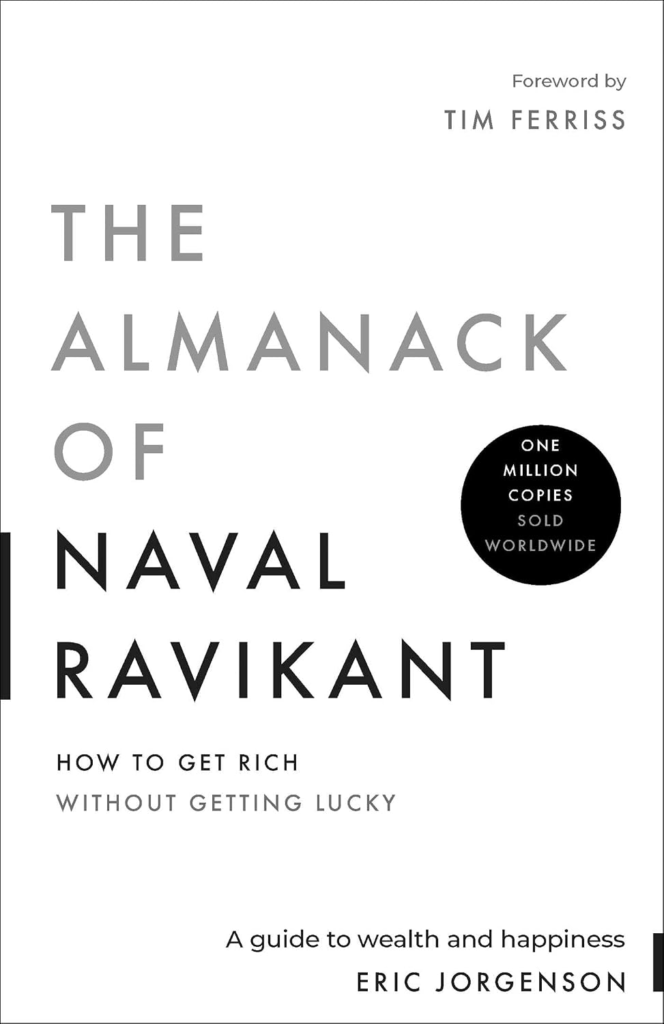
The Almanack of Naval Ravikant: A Guide to Wealth and Happiness is a nonfiction book compiled and edited by American entrepreneur, writer, and investor Eric Jorgenson. First published independently in 2020, the book is a curated collection of the ideas of entrepreneur and investor Naval Ravikant, drawn primarily from his tweets, essays, podcasts, interviews, and public conversations.
Rather than presenting a conventional biography or a linear argument written from beginning to end, The Almanack of Naval Ravikant attempts to organize a decade of Ravikant’s thinking around two broad questions: How can a person build wealth without sacrificing freedom, and how can a person become happier without depending entirely on external circumstances?
The book became particularly influential among entrepreneurs, technology professionals, investors, independent creators, and readers interested in personal development. Its central concepts include specific knowledge, accountability, leverage, ownership, long-term relationships, judgment, reading, freedom, desire, happiness, and inner peace.
The work is unusual in that much of its underlying material consists of Ravikant’s own previously published words. Jorgenson’s principal contribution is therefore one of selection, organization, editing, contextualization, and presentation, rather than the creation of an entirely new philosophical system. The official book website describes the work as a collection of Ravikant’s wisdom from Twitter, podcasts, essays, and interviews, with illustrations by Jack Butcher and a foreword by Tim Ferriss.
Bibliographic information
| Field | Details |
|---|---|
| Title | The Almanack of Naval Ravikant: A Guide to Wealth and Happiness |
| Author / Compiler | Eric Jorgenson |
| Subject of the book | Naval Ravikant |
| Foreword | Tim Ferriss |
| Illustrations | Jack Butcher |
| Original publisher | Magrathea Publishing |
| Original publication | 2020 |
| Original edition length | 242 pages |
| Original ISBN | 978-1-5445-1422-2 (hardcover) |
| Major subjects | Wealth, entrepreneurship, investing, leverage, judgment, happiness, philosophy, personal development |
| Genre | Nonfiction; business; personal development; philosophy |
| Language | English |
| Later editions | Published by various publishers internationally |
| 2025 edition publisher | Authors Equity; distributed by Simon & Schuster |
| 2025 edition length | 256 pages |
The original edition was published by Magrathea Publishing in 2020 and runs to approximately 242 pages. Later international editions were published by publishers including HarperCollins. A second edition was released in 2025 through Authors Equity and distributed by Simon & Schuster.
The physical and digital editions vary somewhat in pagination and ISBN because of differences in formatting and publication markets.
About the author: Eric Jorgenson


Eric Jorgenson curates the most useful ideas from our greatest thinkers and doers—and preserves them in our most permanent format: books.
He’s the author of The Almanack of Naval Ravikant (2M+ copies sold) and The Anthology of Balaji. He’s CEO of Scribe Media, where authors retain full financial and creative control of their books.
Eric lives in Kansas City with his wife and son in a house that’s slowly becoming a library. He invests in obsessive geniuses building utopian technology.
Overview
At first glance, The Almanack of Naval Ravikant looks like a book about getting rich.
It is certainly about wealth. But that description is incomplete.
The deeper argument of the book is that wealth, freedom, judgment, and happiness are connected but distinct forms of human development.
Ravikant argues that people frequently confuse wealth with money, work with employment, happiness with pleasure, and success with social status. His philosophy attempts to separate these concepts.
In his framework:
Wealth is not simply money.
Wealth is the ownership of productive assets and systems that can generate value without requiring a person’s continuous physical presence.
Likewise:
Happiness is not simply pleasure.
Happiness is presented as a state of inner well-being, reduced desire, acceptance of reality, and freedom from unnecessary psychological disturbance.
The result is a philosophy that combines ideas from entrepreneurship, economics, investing, psychology, Stoicism, Buddhism, evolutionary thinking, and modern technology culture.
The book’s appeal lies partly in its simplicity. Ravikant frequently expresses complicated ideas in short, memorable statements. Jorgenson then places these ideas into larger thematic sections.
The unusual nature of the book
One of the most important things to understand about The Almanack is that it is not a conventional book in the traditional sense.
Jorgenson did not sit down and write a 250-page treatise in which every argument originated from the blank page.
Instead, he collected material produced by Ravikant over approximately a decade.
The source material includes:
- tweets
- interviews
- podcasts
- essays
- conversations
- lectures
- public discussions
- previously published reflections
Jorgenson explains that the book was inspired by works such as Poor Charlie’s Almanack, Principles, Zero to One, and Seeking Wisdom. His goal was to turn Ravikant’s scattered public thinking into a permanent, readable collection.
This distinction explains both the book’s greatest strength and one of its greatest weaknesses.
Its strength is density: readers can encounter hundreds of ideas in a relatively small volume.
Its weakness is that the book can sometimes feel more like a carefully assembled intellectual archive than a conventional, continuously developing argument.
Structure of the book
The book is broadly divided into two major intellectual territories:
- Building Wealth
- Learning Happiness
These are supplemented by sections concerning judgment, self-knowledge, philosophy, and recommended reading.
The official table of contents includes topics such as:
- Understanding How Wealth Is Created
- Finding and Building Specific Knowledge
- Playing Long-Term Games with Long-Term People
- Taking on Accountability
- Building or Buying Equity
- Finding Leverage
- Getting Paid for Judgment
- Prioritizing and Focusing
- Finding Work That Feels Like Play
- Getting Lucky
- Being Patient
- Building Judgment
- Thinking Clearly
- Shedding Identity
- Learning to Read
- Happiness
- Saving Yourself
- Philosophy
- Naval’s Recommended Reading
Naval Ravikant
Naval Ravikant is an entrepreneur, investor, and technology figure whose ideas form the intellectual foundation of the book.
He became particularly well known in Silicon Valley and the wider technology world through his involvement in startups, venture investing, AngelList, and online writing.
The Almanack presents him not simply as a businessman but as a thinker interested in the intersection of:
- technology
- entrepreneurship
- economics
- philosophy
- psychology
- investing
- happiness
- human behavior
This combination explains why the book reaches beyond the conventional business-book audience.
Eric Jorgenson
Eric Jorgenson is the author and curator of The Almanack of Naval Ravikant.
Jorgenson is an entrepreneur, writer, product strategist, and investor. He joined the founding team of Zaarly in 2011 and became known for his writing through his business blog, Evergreen. His biography on the book’s official website states that the blog has educated and entertained more than one million readers.
Jorgenson’s role in the book is unusual. He is not presenting his own philosophy as the central subject. Instead, he functions as a curator and editor of another person’s intellectual output.
His task was essentially:
Find → Select → Organize → Edit → Contextualize → Preserve
That distinction is crucial to understanding the work.
The book’s voice may feel like Naval’s because most of its intellectual material comes from Naval, while its overall architecture is Jorgenson’s.
As of the 2025 edition, Jorgenson is also described as CEO of Scribe Media and author of The Anthology of Balaji.
The central philosophy of the book
The book can be understood through a simple conceptual equation:
Wealth + Judgment + Freedom + Inner Peace
These four elements interact throughout the work.
                    THE ALMANACK
                         │
          ┌──────────────┴──────────────┐
          │                             │
       WEALTH                        HAPPINESS
          │                             │
   ┌──────┼──────┐                ┌─────┼─────┐
   │      │      │                │     │     │
Knowledge Leverage Ownership    Desire Mind  Reality
   │      │      │                │     │     │
   └──────┼──────┘                └─────┼─────┘
          │                             │
       FREEDOM ←────── JUDGMENT ─────→ PEACE
Conceptual infographic — not an empirical model.
Wealth: a different definition of being rich
One of the book’s most important distinctions is between money and wealth.
Money is described as a medium through which wealth can be transferred.
Wealth, by contrast, is productive capacity.
A person becomes wealthy when they own assets, systems, intellectual property, businesses, equity, or other productive resources capable of creating value.
This leads to one of the book’s recurring ideas:
Do not merely sell your time.
Traditional employment often works approximately like this:
Time → Labor → Salary
Ravikant’s preferred model is closer to:
Knowledge + Judgment + Leverage + Ownership → Wealth
This is particularly relevant in the digital economy because software, media, intellectual property, and online businesses can potentially serve millions of customers without requiring a proportional increase in the creator’s working hours.
Specific knowledge
Perhaps no concept is more closely associated with Ravikant’s philosophy than specific knowledge.
Specific knowledge is knowledge that cannot easily be replaced by generic training or formal instruction.
It often emerges from the combination of:
- natural curiosity
- unusual interests
- accumulated experience
- personality
- creativity
- obsession
- individual strengths
The important point is that specific knowledge is often discovered rather than deliberately manufactured.
A person might spend years studying something because they are naturally fascinated by it. Eventually, that unusual knowledge can become economically valuable.
The book therefore challenges the idea that everyone should follow exactly the same educational or career path.
Generic knowledge
Learn what everyone learns
          ↓
Become replaceable
          ↓
Compete on credentials
          ↓
Compete on time
Specific knowledge
Follow curiosity
       ↓
Develop unusual expertise
       ↓
Combine it with judgment
       ↓
Apply leverage
       ↓
Create disproportionate value
This is one of the book’s strongest ideas because it changes the question from:
“What job should I get?”
to:
“What can I become unusually good at?”
Leverage
Ravikant argues that modern wealth creation increasingly depends on leverage.
The book identifies several forms of leverage, including:
- labor
- capital
- technology
- media
- software
- intellectual property
Technology is particularly powerful because it can replicate a person’s work at very low marginal cost.
A programmer can write software once and distribute it millions of times.
A writer can create a book once and sell it repeatedly.
A YouTuber can create a video once and potentially reach millions of viewers.
A software entrepreneur can build a platform whose users generate much of the activity themselves.
This creates a fundamental transformation:
WITHOUT LEVERAGE

1 hour of work
       ↓
1 hour of economic output


WITH LEVERAGE

1 hour of work
       ↓
Software / Media / Capital / Systems
       ↓
Repeated output
       ↓
Potentially enormous scale
Conceptual illustration.
The implication is not that everyone should become an entrepreneur. Rather, the book encourages readers to understand the difference between linear work and scalable work.
Ownership and equity
Another central principle is ownership.
Ravikant argues that employees are often compensated primarily for their time and labor, whereas owners participate in the upside created by an enterprise.
This is why the book repeatedly emphasizes:
- equity
- entrepreneurship
- ownership
- investing
- intellectual property
- scalable businesses
The underlying economic logic can be expressed simply:
| Model | Primary resource exchanged | Potential scalability |
|---|---|---|
| Hourly work | Time | Low |
| Salary | Time + expertise | Moderate |
| Consulting | Expertise | Moderate |
| Productized service | Expertise + systems | Higher |
| Software | Intellectual property | Very high |
| Equity ownership | Capital + ownership | Potentially very high |
| Media/IP | Ideas + distribution | Potentially very high |
These are conceptual comparisons, not guarantees of financial outcomes.
Accountability
The book also emphasizes accountability.
Taking accountability means accepting responsibility for outcomes rather than simply performing assigned tasks.
Ravikant connects accountability with ownership.
If a person is willing to put their reputation behind a decision, take responsibility for its consequences, and accept the possibility of failure, that person can potentially earn greater trust and greater economic upside.
In simplified form:
Responsibility → Trust → Reputation → Opportunity
This is especially relevant to entrepreneurs, investors, professionals, and independent creators.
Long-term games
One of the book’s most memorable ideas is the importance of playing long-term games with long-term people.
The argument is fundamentally about repeated interactions.
A person who expects to deal with another person only once has an incentive structure different from someone who expects to interact with that person for decades.
Long-term relationships create incentives for:
- trust
- reputation
- cooperation
- patience
- fairness
- compounding
The concept extends beyond business.
Friendships, professional partnerships, investment relationships, communities, and families can all benefit from thinking in longer time horizons.
The compounding relationship
Good relationship
      ↓
Trust
      ↓
More opportunities
      ↓
Better cooperation
      ↓
Better outcomes
      ↓
Greater trust
      ↓
COMPOUNDING
This is one reason the book’s philosophy is broader than conventional financial advice.
Judgment
The second major pillar of the book is judgment.
If wealth comes partly from leverage and ownership, deciding where to apply those resources requires judgment.
The book therefore encourages readers to develop:
- independent thinking
- probabilistic reasoning
- first-principles thinking
- intellectual curiosity
- the ability to recognize reality
- the ability to distinguish signal from noise
Ravikant repeatedly emphasizes the value of reading and learning.
But reading, in this philosophy, is not merely an academic exercise.
The purpose is to construct better mental models.
Reading as a superpower
The book places unusually high value on reading.
But it does not recommend reading merely to finish books.
Instead, reading is presented as a way of acquiring models of reality.
A useful book can compress decades of another person’s experience into several hours.
Human experience
      ↓
Research / experimentation
      ↓
Book
      ↓
Reader
      ↓
Mental model
      ↓
Better decisions
The book also contains a section devoted to Naval’s recommended reading, reflecting his broad intellectual interests.
His recommendations range across:
- philosophy
- mathematics
- science
- psychology
- economics
- investing
- literature
- history
This eclecticism is important because Ravikant’s philosophy does not come exclusively from business literature.
Happiness
The book’s second half moves away from financial wealth and toward happiness.
This transition is deliberate.
The argument is essentially:
A person can become financially successful without becoming psychologically free.
Therefore, money cannot be the final objective.
Ravikant’s treatment of happiness draws heavily on ideas associated with:
- Buddhism
- Stoicism
- meditation
- self-inquiry
- desire reduction
- acceptance
- present-moment awareness
Happiness and desire
One of the recurring arguments in the book is that desire can generate suffering.
The basic mechanism is:
Desire
  ↓
Expectation
  ↓
Comparison
  ↓
Fear of losing
  ↓
Anxiety
  ↓
Dissatisfaction
This does not mean that the book advocates complete passivity.
Instead, it distinguishes between pursuing worthwhile goals and becoming psychologically dependent on obtaining particular outcomes.
A person may work toward wealth while simultaneously refusing to make happiness conditional upon becoming wealthy.
That distinction is central to the book.
Happiness versus pleasure
The book also separates pleasure from happiness.
Pleasure is generally associated with an attractive external experience.
Happiness is presented as a deeper condition of the mind.
This leads to a paradox:
A person can possess considerable wealth and still be unhappy.
Conversely, a person with relatively little wealth may experience peace, friendship, meaning, and contentment.
The book therefore refuses to treat financial success as the final measure of a successful life.
Saving yourself
The section sometimes summarized as “Saving Yourself” examines personal responsibility.
The underlying message is uncomfortable but powerful:
Nobody else can permanently take responsibility for the quality of your life.
Teachers can help.
Parents can help.
Friends can help.
Governments can help.
Employers can help.
But eventually the individual must make decisions concerning:
- health
- relationships
- career
- money
- attention
- habits
- beliefs
- time
The book’s philosophy therefore contains a strong element of personal agency.
Freedom as the ultimate objective
Perhaps the deepest connection between the wealth and happiness sections is the concept of freedom.
Money is valuable partly because it can buy freedom.
But financial freedom alone is insufficient if a person remains psychologically dependent upon:
- status
- approval
- possessions
- social comparison
- constant stimulation
- other people’s expectations
The book therefore suggests two kinds of freedom:
External freedom
Freedom from excessive financial dependence.
Internal freedom
Freedom from excessive psychological dependence.
              FREEDOM
                 │
       ┌─────────┴─────────┐
       │                   │
   FINANCIAL             MENTAL
   FREEDOM               FREEDOM
       │                   │
   Ownership             Less desire
   Leverage              Less fear
   Savings               Less ego
   Optionality           More awareness
       │                   │
       └─────────┬─────────┘
                 ↓
             AUTONOMY
Conceptual infographic — not an empirical psychological model.
Reality and identity
Another philosophical thread concerns identity.
People often construct identities around:
- profession
- nationality
- religion
- political ideology
- social class
- achievements
- wealth
- reputation
- personal history
The book encourages readers to question these identities.
The reasoning is that an identity can become a filter through which reality is interpreted.
If a person becomes emotionally attached to being “a successful entrepreneur,” for example, admitting failure can become psychologically difficult.
Similarly, if someone identifies strongly with being “right,” disagreement becomes a threat to the ego.
The book therefore advocates intellectual flexibility.
Productizing yourself
The concept of productizing yourself is another important idea associated with the book.
It does not mean literally turning oneself into a product.
Rather, it means combining one’s:
specific knowledge + reputation + leverage + judgment
into something that can create value at scale.
For example:
- a consultant can create a course
- a writer can create books
- a programmer can create software
- an expert can create educational media
- an investor can develop a specialized investment thesis
- a designer can build a scalable product
The concept reflects a broader transition from the industrial economy toward an economy in which individual expertise can increasingly be distributed digitally.
The role of luck
The book does not completely reject luck.
Instead, it proposes that people can increase their exposure to favorable randomness.
This is an important distinction.
Rather than saying:
“Luck doesn’t matter.”
the philosophy is closer to:
“You cannot control luck, but you can increase the number of situations in which luck can find you.”
The book associates this with:
- developing valuable skills
- building reputation
- meeting people
- creating things
- taking intelligent risks
- remaining visible
- developing expertise
A useful conceptual model is:
Preparation
     +
Specific knowledge
     +
Reputation
     +
Persistence
     +
Many opportunities
     ↓
Greater exposure to luck
Patience and compounding
The book repeatedly returns to the power of compounding.
Compounding applies not only to money.
It can occur in:
- knowledge
- reputation
- relationships
- skills
- businesses
- investments
- habits
A small improvement repeated for many years can become enormous.
This is why the book emphasizes patience.
The modern culture of instant results is fundamentally incompatible with compounding.
The philosophy of “play”
One of the more provocative ideas in the book is the recommendation to find work that feels like play.
This does not mean that meaningful work is always easy.
Rather, the idea is that individuals should identify activities in which their curiosity naturally produces sustained effort.
The best work, according to this philosophy, is not necessarily the work that requires the least effort.
It is the work where effort feels meaningful enough that the person is willing to continue.
The relationship between wealth and happiness
The entire book can be summarized through the following conceptual framework:
| Wealth | Happiness |
|---|---|
| Build specific knowledge | Reduce unnecessary desire |
| Use leverage | Understand the mind |
| Seek ownership | Accept reality |
| Build reputation | Practice awareness |
| Play long-term games | Develop inner independence |
| Improve judgment | Reduce dependence on external validation |
| Create value | Cultivate peace |
| Seek financial freedom | Seek psychological freedom |
The two sides are related, but neither completely replaces the other.
Major ideas at a glance
| Concept | Core idea |
|---|---|
| Specific knowledge | Develop knowledge that is difficult to teach and difficult to replace |
| Leverage | Use technology, capital, media, labor, and code to multiply output |
| Ownership | Participate in the upside of value creation |
| Accountability | Take responsibility and put reputation behind decisions |
| Long-term games | Build relationships and enterprises around repeated interactions |
| Judgment | Improve the quality of decisions rather than merely increasing effort |
| Reading | Build mental models through compressed experience |
| Desire | Recognize that excessive desire can produce dissatisfaction |
| Happiness | Develop internal well-being rather than depending entirely on external rewards |
| Freedom | Seek both financial and psychological independence |
| Compounding | Allow skills, relationships, reputation, and capital to grow over time |
A conceptual “Naval formula”
The book does not present a literal mathematical formula for success, but its philosophy can be represented conceptually as:
SPECIFIC KNOWLEDGE
        ×
JUDGMENT
        ×
LEVERAGE
        ×
OWNERSHIP
        ×
TIME
        ↓
WEALTH

WEALTH
        +
SELF-KNOWLEDGE
        +
LOWER DEPENDENCE ON DESIRE
        +
ACCEPTANCE
        ↓
FREEDOM

FREEDOM
        +
INNER PEACE
        ↓
HAPPINESS
This is an interpretive infographic rather than a formula proposed by the author.
Why the book became influential
The book appeared at a particularly interesting moment in the evolution of the internet economy.
Its ideas resonated with a generation increasingly interested in:
- remote work
- entrepreneurship
- creator businesses
- startups
- software
- venture capital
- online education
- personal brands
- financial independence
- digital products
Ravikant’s short, highly quotable statements were particularly compatible with social media.
Instead of requiring a reader to absorb an entire chapter to encounter an idea, many of the book’s concepts can be reduced to a sentence.
That made the philosophy highly shareable.
Jorgenson’s own description emphasizes that the book’s raw material consists heavily of Naval’s tweets, interviews, podcasts, and essays, helping explain its aphoristic character.
The book’s relationship with social media
There is an interesting feedback loop behind The Almanack.
Ravikant’s ideas became popular partly because of social media.
Jorgenson then collected those ideas into a book.
The book subsequently introduced the ideas to readers who might never have followed Ravikant online.
The process can be visualized as:
Naval's ideas
      ↓
Tweets / Podcasts / Interviews
      ↓
Online audience
      ↓
Eric Jorgenson's curation
      ↓
The Almanack
      ↓
New readers
      ↓
Further online discussion
In this sense, the book is not simply a collection of ideas.
It is also a document of how ideas travel in the internet age.
Reception
The book has received a strongly positive response from many readers.
Goodreads has reported an average rating of approximately 4.37 out of 5, based on more than 75,000 ratings, with the majority of ratings being four or five stars. The exact number changes continuously as readers add new ratings.
The book’s popularity is also reflected in its later editions and the author’s statement that more than one million copies have been sold worldwide. This figure is an author/publisher claim rather than an independently audited sales figure.
Its strongest appeal tends to be among readers interested in:
- entrepreneurship
- technology
- investing
- self-improvement
- personal freedom
- independent work
- philosophy
Criticism
The book has also attracted significant criticism.
The most common criticism concerns its structure.
Because the work is constructed from previously published material, some readers find that ideas are repeated, transitions are abrupt, and concepts do not always develop as systematically as they would in a conventional book.
Some readers appreciate the book precisely because it is a collection of concentrated ideas. Others believe that its aphoristic style occasionally makes complex questions appear simpler than they actually are.
Reader criticism has also questioned whether some of the book’s claims are sufficiently supported by empirical evidence or whether they sometimes function more effectively as philosophical provocations than universal rules. Goodreads reviews illustrate both sides: many readers praise the density and memorability of the ideas, while others criticize the organization and perceived reliance on generalized aphorisms.
These criticisms are important because the book is best understood as a philosophical and entrepreneurial framework, not as a scientific textbook or a comprehensive financial-planning manual.
Limitations of the wealth philosophy
Some of Ravikant’s ideas are especially attractive to technology entrepreneurs because they reflect the environment in which scalable technology businesses operate.
However, they should not automatically be interpreted as universal instructions.
For example, not every occupation can be productized.
Not every worker can obtain equity.
Not every person has equal access to capital.
Not every business can scale exponentially.
And leverage can amplify failure just as effectively as success.
The book is therefore most useful when its ideas are treated as principles for thinking, rather than guaranteed formulas for becoming wealthy.
Limitations of the happiness philosophy
The book’s ideas about happiness are similarly philosophical rather than clinical.
Reducing unnecessary desire, becoming less dependent on external validation, and accepting reality can be valuable ideas.
But happiness is influenced by many factors, including:
- relationships
- physical health
- socioeconomic conditions
- personality
- environment
- psychological well-being
- community
- circumstances
Consequently, the book should not be read as claiming that every form of unhappiness can be solved simply by changing one’s thinking.
Its contribution is better understood as a philosophical perspective on the relationship between desire, attention, identity, and peace of mind.
Is The Almanack actually a book about money?
Only partly.
The title may initially attract readers interested in financial success, but the book ultimately asks a larger question:
What is the point of becoming wealthy if wealth does not make you freer?
This question changes the entire meaning of the book.
Money is treated as a tool.
Freedom is treated as a more important objective.
And inner peace is treated as something that cannot simply be purchased.
This is perhaps why the book appeals even to readers who have little interest in entrepreneurship.
A practical interpretation of the book
The philosophy can be translated into a seven-stage personal development model:
1. Discover
Identify what naturally interests you.
2. Specialize
Develop specific knowledge.
3. Create
Build something valuable.
4. Leverage
Use technology, capital, media, systems, or other scalable mechanisms.
5. Own
Seek equity or ownership where appropriate.
6. Compound
Allow skills, reputation, relationships, and capital to accumulate.
7. Detach
Do not make your happiness completely dependent on the outcome.
DISCOVER
   ↓
SPECIALIZE
   ↓
CREATE
   ↓
LEVERAGE
   ↓
OWN
   ↓
COMPOUND
   ↓
DETACH
   ↓
FREEDOM
Conceptual infographic based on themes in the book.
Why the book remains relevant
The central ideas have become arguably more relevant as the economy has become increasingly digital.
Software, artificial intelligence, social media, online education, digital publishing, creator businesses, and global marketplaces have increased the number of ways an individual can potentially reach large audiences.
At the same time, these technologies have created new problems:
- information overload
- constant comparison
- attention fragmentation
- status competition
- algorithmic stimulation
- career uncertainty
The book addresses both sides of this transformation.
Its wealth philosophy asks:
How can technology give an individual more leverage?
Its happiness philosophy asks:
How can an individual avoid becoming psychologically controlled by the same technology?
That tension is one of the most interesting aspects of the work.
The book as a modern philosophy of independence
Taken as a whole, The Almanack of Naval Ravikant can be interpreted as a philosophy of individual independence.
Financial independence means having enough productive assets and income-generating capacity that survival does not depend completely on selling one’s time.
Intellectual independence means thinking for oneself.
Emotional independence means not requiring constant external validation.
Philosophical independence means being capable of questioning inherited assumptions.
The book therefore moves toward a larger definition of freedom:
Freedom is the ability to choose how you spend your limited time.
This is arguably the common thread connecting the book’s apparently separate subjects of money, work, reading, entrepreneurship, meditation, desire, and happiness.
Legacy and influence
The Almanack of Naval Ravikant occupies an unusual position in contemporary business literature.
It is neither a conventional autobiography nor a conventional self-help manual.
It is not a traditional investment book.
It is not an academic work of philosophy.
Instead, it sits at the intersection of:
entrepreneurship + investing + technology + philosophy + personal development
Its distinctive format has also demonstrated the value of curation as authorship.
In an age when influential thinkers publish thousands of tweets, podcasts, interviews, essays, and videos, the problem is no longer simply access to information.
The problem is selection and organization.
Jorgenson’s work illustrates how a curator can transform a decade of scattered digital material into a durable intellectual artifact.
At-a-glance summary
| Question | The book’s general answer |
|---|---|
| What is wealth? | Ownership of productive assets and systems |
| How is wealth created? | Specific knowledge + leverage + judgment + ownership |
| What is leverage? | A way to multiply the output of one’s effort |
| Why seek equity? | To participate in the upside of value creation |
| Why play long-term games? | Trust and relationships compound |
| Why develop judgment? | Better decisions create better outcomes |
| Why read? | To build better mental models |
| What causes unhappiness? | Excessive desire, attachment, comparison and lack of inner freedom |
| What is happiness? | A form of inner well-being and freedom from unnecessary psychological dependence |
| What is the ultimate goal? | Freedom and a meaningful life |
Recommended reading alongside The Almanack
Readers interested in the book’s ideas may also find value in:
- Poor Charlie’s Almanack by Charles T. Munger
- Principles: Life and Work by Ray Dalio
- Zero to One by Peter Thiel and Blake Masters
- Seeking Wisdom by Peter Bevelin
- The Psychology of Money by Morgan Housel
- The Intelligent Investor by Benjamin Graham
- Antifragile by Nassim Nicholas Taleb
- The 7 Habits of Highly Effective People by Stephen R. Covey
- Atomic Habits by James Clear
- Man’s Search for Meaning by Viktor E. Frankl
These books approach wealth, decision-making, philosophy, psychology, or personal development from different perspectives.
See also
- Naval Ravikant
- Entrepreneurship
- Angel investing
- Venture capital
- Financial independence
- Personal development
- Behavioral finance
- Decision theory
- Mental models
- Stoicism
- Buddhism
- Compound interest
- Leverage
- Equity
- Intellectual property
- Digital entrepreneurship
- Creator economy
Read more
Official book website: The Almanack of Naval Ravikant
Eric Jorgenson’s official page for the book: Eric Jorgenson — The Almanack of Naval Ravikant
Official publisher page: Simon & Schuster — The Almanack of Naval Ravikant
Naval Ravikant’s essays and other work: Naval Ravikant’s website
References
- Jorgenson, Eric. The Almanack of Naval Ravikant: A Guide to Wealth and Happiness. Magrathea Publishing, 2020. The original edition identifies Jorgenson as author/compiler and lists the original ISBN and publication details.
- Jorgenson, Eric. The Almanack of Naval Ravikant: A Guide to Wealth and Happiness. Later editions published internationally by publishers including HarperCollins.
- Simon & Schuster. The Almanack of Naval Ravikant, 2025 edition. Authors Equity; distributed by Simon & Schuster.
- Almanack of Naval Ravikant. Official website. Information concerning the book’s origins, structure, contributors, free digital availability, and source material.
- Jorgenson, Eric. Official author biography and information about the book.
- Google Books. Bibliographic records for the 2020, 2021, 2022, and 2025 editions.
- Goodreads. Reader ratings and reviews for The Almanack of Naval Ravikant.
External links
- Official Almanack website and free online edition
- Eric Jorgenson’s official website
- Naval Ravikant’s official website
- Official Simon & Schuster publisher page
Editorial perspective
The Almanack of Naval Ravikant is best understood neither as a guaranteed recipe for wealth nor as a definitive philosophical account of happiness.
Its real contribution is more modest—and arguably more useful.
It asks readers to reconsider several assumptions that modern life encourages them to accept without much thought:
Must work always be exchanged for time?
Must earning more money require sacrificing more freedom?
Is intelligence useful if judgment is poor?
What happens when success becomes dependent on status?
Can technology increase freedom while simultaneously reducing it?
How much of our unhappiness is created by circumstances, and how much by our relationship with desire?
The book does not provide definitive answers to all of these questions. Instead, it supplies a vocabulary with which to think about them.
Its most enduring idea may therefore not be “how to get rich” or even “how to become happy.”
It is the idea that a successful life should ultimately be designed around freedom—freedom to choose what to work on, whom to work with, what to learn, where to place one’s attention, and how to spend the finite amount of time one has.
That makes The Almanack of Naval Ravikant less a conventional business book than a compact philosophy of wealth, autonomy, judgment, and living well in the modern economy.