


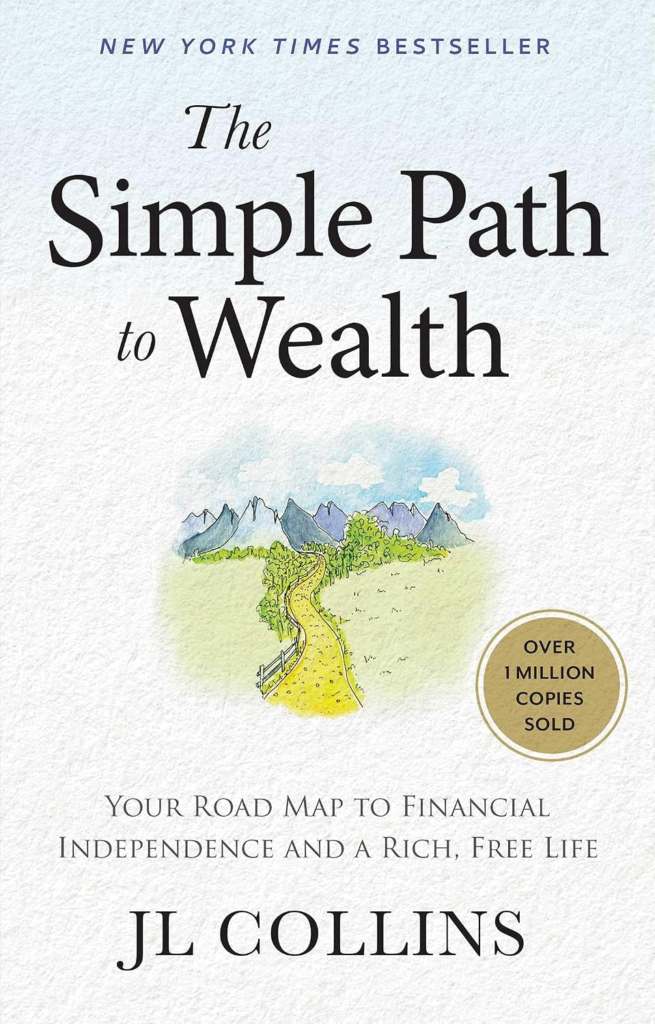
The Simple Path to Wealth: Your Road Map to Financial Independence and a Rich, Free Life is a personal-finance and investing book by American financial writer J. L. Collins. First published independently in 2016, the book developed from a series of letters Collins originally wrote for his daughter, Jessica, about money, investing, and financial independence. It subsequently became one of the better-known books associated with the Financial Independence, Retire Early (FIRE) movement.
A substantially revised and expanded edition was published in May 2025. The new edition incorporates updated material, frequently asked questions, a “Simple Path to Wealth Punchlist,” and additional resources and tools. The publisher describes the book as an updated guide to financial independence, while Google Books classifies it under personal finance, investing, and retirement planning.
At the heart of Collins’s philosophy is an intentionally uncomplicated proposition: avoid consumer debt, spend less than you earn, invest the difference in low-cost broad-market index funds, and remain invested for the long term. The book argues that successful investing is less about predicting markets or selecting individual securities than about controlling costs, maintaining discipline, and allowing compounding to work over decades.
Book information
| Field | Details |
|---|---|
| Title | The Simple Path to Wealth: Your Road Map to Financial Independence and a Rich, Free Life |
| Author | J. L. Collins |
| Country | United States |
| Language | English |
| Subject | Personal finance, investing, financial independence |
| Original publication | 2016 |
| Original publisher | CreateSpace Independent Publishing Platform |
| Revised and expanded edition | 2025 |
| 2025 publisher | Authors Equity |
| Distribution | Simon & Schuster |
| ISBN (2025 hardcover) | 9798893310474 |
| ISBN (2025 eBook) | 9798893310856 |
| Original edition length | Approximately 265–286 pages, depending on format |
| 2025 edition | Approximately 300+ pages, depending on format |
| Preceded by | J. L. Collins’s financial blog and “Stock Series” |
| Subject classification | Business & Economics / Personal Finance / Investing / Retirement Planning |
Bibliographic records differ somewhat in page counts because of different formats and editions. Google Books lists the 2025 edition at 304 pages, while other records list the hardcover at 320 pages.
About the author: J.L. Collins


These days, I’m a book author and financial blogger on jlcollinsnh.com, but it wasn’t always so.
I started selling flyswatters door-to-door and picking up empty pop bottles from the side of the road for the 2-cent deposit. Gimme a break. I was eight.
My first real job was scrubbing out big metal ice cream cans. I was 13. It paid $1.25 per hour.
From there: Busboy, dishwasher, order-puller, grocery bagger, stock clerk, produce clerk and gas station pump jockey back in the day when someone pumped your gas, washed your windows and checked your oil (ask your grandparents).
Mail clerk, tree-trimmer, landscaper, ad agency founder, account executive, ad space salesman, investment officer, entrepreneur, consultant, sales trainer, speaker, writer, radio talk show host and magazine publisher. Pretty much in that order although I’ve done some more than once. And I may have forgotten one or two.
My work has taken me to most U.S. states as well as Canada, Germany and England. One of my few regrets is that I’ve never had an international posting.
But I’ve had the good fortune to see a bit of the planet on my own: Mexico, Canada, Ireland, Wales, England, Greece, Crete, Puerto Rico, Tahiti, Venezuela, Curacao, Scotland, Italy, Germany, Spain, Paris, India, Kashmir, Goa, Nepal, Zanzibar, Tanzania, Eleuthera, St. Thomas, St. Martin, Barbados, Antigua, Martinique, Ecuador, Perú, Bolivia, Chile, Prague, Guatemala, Galápagos. Pretty much in that order although I’ve visited some more than once. And I may have forgotten one or two.
I’ve traveled by plane, train, bus, boat, subway, taxi, hired car, motorcycle, bicycle, rickshaw, hitch-hiking, foot, horse, donkey and elephant. Not only traveled by elephant, but herded rhinoceroses by elephant back in Nepal.
My degree in English Literature is from the University of Illinois at Champaign-Urbana. They still send me alumni letters mostly, I think, hoping I’ve become rich and famous. I’m working on it.
Here’s my favorite cartoon:
The visual is two guys in a corn field, up on racks dressed in shabby clothes. Straw coming out from their shirt cuffs and pant legs. They are serving as scarecrows. One is looking over at the other and saying…
“English Major. How about you?”
A pal of mine once said I had won the family lottery. He is right. My wife Jane and I have been married for 41 years. Our daughter Jessica graduated Summa Cum Laude from the University of Rhode Island and is well on her own Simple Path to Wealth.
Background
Origins
The origins of The Simple Path to Wealth can be traced to 2011, when Collins began writing a series of articles about investing on his personal website, JLCollinsNH. The material was not initially intended to become a book.
Collins has explained that he originally wrote financial letters for his daughter Jessica because he wanted her to understand money and investing. A friend subsequently suggested that he publish the material as a blog. The blog eventually attracted a much larger audience than Collins had anticipated.
The resulting “Stock Series” became the intellectual foundation of the book. It developed into an extensive sequence of articles covering index funds, bonds, international diversification, withdrawal rates, retirement accounts, debt, asset allocation, market volatility, and financial independence.
Collins published the first edition of The Simple Path to Wealth in 2016. In announcing the publication, he explained that he had spent approximately three years bringing the project from its original concept to a finished book.
The book was subsequently published in multiple countries and languages. The publisher states that it has sold more than one million copies across twenty languages.
2025 revised and expanded edition
A substantially revised edition was released on 20 May 2025. The new edition retains the central philosophy of the original book while updating and expanding its material.
Among the additions identified by the publisher are:
- updated financial and investing information;
- a frequently asked questions section;
- a “Simple Path to Wealth Punchlist”;
- additional resources and tools;
- expanded treatment of subjects relevant to contemporary investors.
The 2025 edition became an instant New York Times bestseller, according to its publisher. Collins’s own website also notes that the new edition reached number seven on the New York Times bestseller list.
The revised edition is therefore best regarded not as a completely different book but as an expanded version of the philosophy established in the original 2016 work.
Central thesis
The book’s central argument is that wealth-building does not require a complicated investment strategy.
Collins challenges the assumption that successful investors must continually:
- predict market movements;
- identify the next winning stock;
- trade frequently;
- employ sophisticated financial products;
- hire expensive investment managers;
- monitor financial news every day.
Instead, he argues for a small number of durable principles.
The basic sequence
Earn → Spend less than you earn → Eliminate destructive debt → Invest the surplus → Keep costs low → Stay invested → Ignore market noise → Reach financial independence
The philosophy can be represented as follows:
                INCOME
                  │
                  ▼
          ┌────────────────┐
          │ Spend less     │
          │ than you earn  │
          └───────┬────────┘
                  │
                  ▼
          ┌────────────────┐
          │ Eliminate      │
          │ harmful debt   │
          └───────┬────────┘
                  │
                  ▼
          ┌────────────────┐
          │ Invest surplus │
          │ systematically │
          └───────┬────────┘
                  │
                  ▼
          ┌────────────────┐
          │ Low-cost broad │
          │ index funds    │
          └───────┬────────┘
                  │
                  ▼
          ┌────────────────┐
          │ Stay invested  │
          │ for decades    │
          └───────┬────────┘
                  │
                  ▼
             COMPOUNDING
                  │
                  ▼
        FINANCIAL INDEPENDENCE
This simplicity is deliberate. Collins’s argument is not that investing itself is inherently easy. Rather, he argues that investors can make the system surrounding investing simple enough that good behavior becomes easier to maintain.
Investment philosophy
Index funds
The most recognizable feature of Collins’s strategy is his preference for low-cost broad-market index funds.
An index fund seeks to track an established market index rather than attempting to outperform the market through individual security selection or active management.
Collins has particularly emphasized Vanguard’s Total Stock Market Index Fund, historically represented by VTSAX, which provides exposure to a broad range of publicly traded United States companies. He has also discussed its ETF counterpart, VTI.
His reasoning rests on several characteristics:
- Broad diversification
- Low expense ratios
- Market-wide exposure
- Simplicity
- Low portfolio turnover
- Long-term participation in economic growth
Collins’s argument is that an investor does not need to identify which individual companies will dominate the future if the portfolio owns the market itself.
Why low costs matter
Investment fees receive considerable attention in the book.
A fee that appears small on an annual basis can have a substantial effect over several decades because money paid in fees is money that cannot compound for the investor.
A simplified illustration:
Higher fees
     │
     ▼
Less money remains invested
     │
     ▼
Less compounding
     │
     ▼
Smaller final portfolio


Lower fees
     │
     ▼
More money remains invested
     │
     ▼
More compounding
     │
     ▼
Larger final portfolio
Collins therefore treats cost minimization as one of the few areas where investors can exercise significant control.
The broader philosophy is:
Investors cannot control future market returns, but they can control many of the costs and behaviors surrounding their investments.
Diversification
A core principle of the book is diversification through ownership of a broad market rather than dependence on a small number of securities.
An individual investor who owns one company faces company-specific risk.
An investor who owns hundreds or thousands of companies spreads that risk across the market.
Simplified comparison
| Strategy | Main risk |
|---|---|
| One stock | Company failure |
| Several individual stocks | Concentration risk |
| Sector fund | Industry concentration |
| S&P 500 fund | Large-cap U.S. concentration |
| Total U.S. stock market fund | Broader domestic exposure |
| Global index portfolio | Broader geographic exposure |
Collins’s historical emphasis has been on the broad U.S. market. His later writing has also addressed international funds and portfolio allocation, illustrating that his thinking has evolved beyond a single fund recommendation.
The role of VTSAX and VTI
The book became closely associated with VTSAX, Vanguard’s Total Stock Market Index Fund.
VTSAX is a mutual fund, while VTI is an exchange-traded fund designed to provide exposure to essentially the same underlying U.S. total-stock-market portfolio. Collins has explicitly stated that the two represent the same portfolio in different structures.
The significance of this recommendation is less about a particular ticker symbol than about the underlying principle:
Own a low-cost fund representing a broad portion of the market.
This distinction is important for international readers. The exact fund available to an investor in India, Europe, Canada, Australia, or another country may differ because of local taxation, regulations, currency, brokerage availability, and fund structures.
Therefore, the philosophy is more internationally transferable than the specific U.S. securities named in the book.
Asset allocation
Although Collins is strongly associated with stocks, The Simple Path to Wealth does not simply argue that every investor should hold 100% equities under every circumstance.
The book and Collins’s broader Stock Series discuss:
- stocks;
- bonds;
- asset allocation;
- retirement accounts;
- taxable accounts;
- risk tolerance;
- withdrawal strategies;
- market crashes.
Collins’s later material also discusses situations in which bonds can play a role in a portfolio. His Stock Series contains dedicated discussions of bonds and asset allocation.
The underlying principle is that asset allocation should reflect the investor’s circumstances and ability to tolerate volatility, rather than being selected solely because a particular allocation is fashionable.
Market volatility
One of the book’s most important behavioral lessons concerns market declines.
Stock markets periodically experience:
- corrections;
- bear markets;
- recessions;
- crashes;
- periods of stagnation.
The investor’s natural response may be to sell.
Collins argues that this can transform temporary declines into permanent losses.
The psychological cycle
Market rises
     ↓
Confidence rises
     ↓
More people buy
     ↓
Market falls
     ↓
Fear increases
     ↓
Investors sell
     ↓
Loss becomes permanent
The alternative advocated by Collins is:
Market rises
     ↓
Continue investing

Market falls
     ↓
Remain disciplined

Market recovers
     ↓
Continue participating

Long-term growth
     ↓
Compounding
His broader writing repeatedly emphasizes that the investor’s behavior during market declines is one of the decisive factors determining long-term results.
“Don’t just do something, stand there”
A recurring theme in Collins’s philosophy is that inaction can be an investment skill.
Investors are surrounded by information:
- financial television;
- market forecasts;
- economic predictions;
- analyst opinions;
- political news;
- interest-rate commentary;
- stock-market commentary.
The danger is that information creates an illusion that constant action is necessary.
Collins instead argues that once a sensible investment strategy is established, excessive activity can be harmful.
His summary of the philosophy includes the idea that the less investors interfere with a sound long-term strategy, the better.
Financial independence
The ultimate objective of the book is not simply accumulating a large investment account.
It is financial independence.
Financial independence occurs when a person’s invested assets can reasonably support their required spending without requiring continued employment.
This changes the meaning of money.
Money becomes less about:
“How much can I buy?”
and more about:
“How much control do I have over my time?”
That distinction is central to the FIRE movement.
The “F-you money” concept
An important concept associated with Collins’s writing is “F-you money.”
The term refers to having enough financial reserves that a person is no longer completely dependent on a particular employer, client, business relationship, or source of income.
Its significance is psychological as much as financial.
Financial reserves can provide the ability to:
- leave an abusive workplace;
- reject an unreasonable demand;
- take a career break;
- change careers;
- start a business;
- relocate;
- spend more time with family;
- pursue meaningful work.
Thus, financial independence is presented not merely as a retirement strategy but as a form of personal autonomy.
Savings rate
Savings rate is one of the most powerful variables in Collins’s framework.
Two people with identical investment returns can reach financial independence at very different speeds if their savings rates differ substantially.
Conceptual relationship
Higher income
      +
Lower spending
      =
Higher savings

Higher savings
      +
Long-term investing
      +
Compounding
      =
Faster financial independence
This is why the book gives considerable attention to lifestyle and spending decisions rather than treating investing as an isolated activity.
The 4% rule
The book discusses the widely known 4% withdrawal rule in connection with financial independence.
In simplified form:
Required portfolio ≈ Annual spending × 25
For example:
| Annual spending | Approximate portfolio at 4% |
|---|---|
| $20,000 | $500,000 |
| $30,000 | $750,000 |
| $40,000 | $1,000,000 |
| $50,000 | $1,250,000 |
| $60,000 | $1,500,000 |
| $80,000 | $2,000,000 |
| $100,000 | $2,500,000 |
The calculation is simply:
Portfolio × 4% = annual withdrawal
or:
Annual spending ÷ 0.04 = approximate required portfolio
Collins’s Stock Series discusses the relationship between a roughly 4% withdrawal rate and a portfolio equal to approximately 25 times annual spending.
Important qualification
The 4% rule is not a guarantee.
It is a historical planning framework derived from research into withdrawal rates. Actual outcomes depend on:
- valuation levels;
- inflation;
- sequence of returns;
- portfolio allocation;
- withdrawal flexibility;
- taxes;
- fees;
- lifespan;
- market conditions.
A sensible reader should therefore treat the 4% figure as a planning heuristic, not a law of nature.
Compounding
Compounding is another fundamental concept in the book.
If an investment generates returns and those returns remain invested, future returns are earned not only on the original capital but also on accumulated gains.
The process can be represented as:
Initial capital
      ↓
Investment return
      ↓
Larger capital base
      ↓
Return on larger base
      ↓
Even larger capital base
      ↓
More return
      ↓
Compounding accelerates
The effect is particularly powerful over long periods.
Illustrative growth chart
The following is a conceptual illustration rather than a prediction. If $10,000 were compounded at a hypothetical 8% annual rate without additional contributions:
Year 0     $10,000
Year 10    $21,589
Year 20    $46,610
Year 30    $100,627
Year 40    $217,245
The important point is not the assumed 8% return. It is the shape of the curve: time becomes increasingly important because each period builds on the accumulated capital of previous periods.
Debt
Collins takes a strongly negative view of consumer debt.
High-interest debt can work against wealth accumulation because the borrower is effectively paying a guaranteed cost while investments offer uncertain future returns.
The logic is straightforward:
Debt
 ↓
Interest expense
 ↓
Less money available to invest
 ↓
Lower invested capital
 ↓
Less future compounding
This is particularly important with high-interest consumer debt such as credit-card balances.
The book’s approach is therefore not simply:
“Invest everything.”
It is closer to:
“Build a strong financial foundation first, then invest systematically.”
Tax-advantaged accounts
The book also discusses the importance of using tax-advantaged investment accounts.
Examples in the U.S. system include:
- 401(k) plans;
- 403(b) plans;
- traditional IRAs;
- Roth IRAs;
- Health Savings Accounts.
Collins discusses how different asset classes can be positioned within taxable and tax-advantaged accounts.
For readers outside the United States, however, these specific account types should not be copied literally.
The general principle is:
Use the legally available tax-efficient investment structures in your own country.
For example, an investor in India would need to consider Indian taxation, mutual-fund structures, retirement accounts, capital-gains taxation, and currency considerations rather than simply reproducing an American portfolio.
Dollar-cost averaging
Dollar-cost averaging receives a nuanced treatment in Collins’s work.
Regular investing can help investors avoid the emotional difficulty of attempting to determine the “perfect” moment to invest.
However, Collins has also written critically about dollar-cost averaging when it is used as a way to delay investing a lump sum that is already available. His Stock Series contains a specific discussion titled “Why I don’t like Dollar Cost Averaging.”
The distinction is important:
- Regularly investing money as it is earned is a normal investing process.
- Holding a large amount of cash while waiting for an ideal entry point can become market timing disguised as caution.
Behavior over intelligence
One of the deeper themes of The Simple Path to Wealth is that investment success depends heavily on psychology.
An investor may understand:
- compound interest;
- index funds;
- diversification;
- tax efficiency;
- asset allocation;
and still produce poor results through emotional decisions.
Typical behavioral errors include:
- panic selling;
- performance chasing;
- market timing;
- excessive trading;
- reacting to headlines;
- constantly changing strategies;
- abandoning investments after a crash.
Collins’s solution is not to become a better market predictor.
It is to construct a strategy that minimizes the need for prediction.
The book’s view of financial advice
Collins is skeptical of unnecessary complexity and expensive investment advice.
His argument is not that every financial professional is incompetent or dishonest. Rather, he questions whether the average investor needs to pay substantial fees for services that can be replaced by a simple, low-cost investment strategy.
His broader writing argues that investors can learn enough about basic investing to manage straightforward portfolios themselves.
This position is controversial because financial planning encompasses areas beyond portfolio selection, including:
- estate planning;
- insurance;
- taxation;
- retirement-income planning;
- business ownership;
- inheritance;
- complex family structures.
Consequently, Collins’s philosophy is most directly applicable to the investment-management component of personal finance.
Relationship with the FIRE movement
The Simple Path to Wealth became closely associated with the FIRE movement.
FIRE stands for:
Financial Independence, Retire Early.
The movement generally emphasizes:
- increasing income;
- controlling expenses;
- achieving high savings rates;
- investing consistently;
- allowing investments to compound;
- reaching a point where employment becomes optional.
Collins’s contribution to the movement is primarily the investment framework.
Rather than emphasizing elaborate asset-selection techniques, he advocates a deliberately boring approach.
That “boring” quality is arguably one of the book’s central ideas: once a sound system is established, the investor should have relatively little to do.
A conceptual map of the Simple Path
                 FINANCIAL FREEDOM
                        ▲
                        │
                 Long-term investing
                        ▲
                        │
                  Compounding
                        ▲
                        │
               Broad index funds
                        ▲
                        │
                 Regular saving
                        ▲
                        │
              Spend less than earned
                        ▲
                        │
                  Control debt
                        ▲
                        │
                Increase income
The framework is intentionally repetitive.
Collins does not attempt to give readers hundreds of investment decisions.
He attempts to reduce the number of decisions they need to make.
Major themes
Simplicity
The book’s defining theme is simplicity.
Collins argues that complicated financial products often create the appearance of sophistication without necessarily producing better results.
A simple strategy can be easier to:
- understand;
- implement;
- automate;
- monitor;
- maintain;
- explain to family members;
- continue during market turmoil.
Patience
Investing is presented as a decades-long process rather than a sequence of short-term opportunities.
The investor’s advantage comes partly from remaining invested while time does its work.
Discipline
The strategy requires behavioral discipline.
An investor must continue following the plan when:
- stocks are expensive;
- stocks are falling;
- the economy is weak;
- the financial media is pessimistic;
- other investors appear to be becoming rich quickly.
Freedom
The ultimate purpose of wealth is presented as freedom rather than consumption.
Money can buy goods, but financial independence can buy options.
This is one reason the book appeals to readers interested in lifestyle design as well as investing.
Reception and influence
The book has become influential within personal-finance and FIRE communities.
The publisher describes Collins as the “Godfather of FI” and states that the book has sold more than one million copies in twenty languages.
It has also received endorsements from prominent personal-finance writers, including Morgan Housel, author of The Psychology of Money. Simon & Schuster describes the revised edition as an instant New York Times bestseller.
Its influence is partly attributable to the fact that Collins’s investment philosophy predates the book. The book consolidated years of publicly available blog material into a more accessible narrative.
Criticism and limitations
Despite its popularity, the philosophy has limitations.
U.S.-centric framework
Much of the book’s specific investment discussion is written for U.S. investors.
The emphasis on:
- Vanguard;
- VTSAX;
- VTI;
- 401(k)s;
- Roth IRAs;
- traditional IRAs;
does not translate directly into every country’s financial system.
International readers must adapt the underlying principles to their own:
- tax systems;
- investment products;
- currencies;
- retirement schemes;
- regulatory environment.
Equity-market risk
A strategy dominated by stocks can experience substantial volatility.
Broad diversification does not eliminate market risk.
A total-market fund can still decline dramatically during a severe bear market.
An investor who cannot psychologically or financially tolerate a major decline may need a different asset allocation.
The 4% rule is not guaranteed
The 4% rule provides a useful planning framework but does not guarantee that a portfolio will support a particular lifestyle for every investor.
Long retirements, unusual market sequences, high inflation, taxes, and changing spending patterns can alter the outcome.
Personal circumstances differ
The book is strongest as a framework for ordinary long-term investing.
It is less comprehensive as a complete financial-planning manual for people with:
- complex businesses;
- substantial inheritance;
- international taxation;
- complicated estates;
- special-needs dependents;
- unusual insurance requirements;
- concentrated stock positions;
- major pension entitlements.
Such circumstances can require professional financial, tax, or legal advice.
What the book is really arguing
At first glance, The Simple Path to Wealth appears to be a book about index funds.
That description is incomplete.
The deeper argument is about decision-making.
Collins is essentially asking:
What if successful investing requires fewer decisions rather than more?
From that perspective, the book’s philosophy can be reduced to five layers:
Layer 1 — Lifestyle
Spend less than you earn.
Layer 2 — Financial foundation
Avoid destructive debt and build financial resilience.
Layer 3 — Investment
Own productive assets through low-cost diversified index funds.
Layer 4 — Behavior
Do not repeatedly interfere with the portfolio.
Layer 5 — Freedom
Allow accumulated assets to eventually give you control over your time.
This makes the book as much a book about behavioral discipline as about investment products.
The Simple Path in one diagram
                  ┌───────────────────┐
                  │      EARN         │
                  └─────────┬─────────┘
                            │
                            ▼
                  ┌───────────────────┐
                  │ SPEND LESS THAN   │
                  │      YOU EARN     │
                  └─────────┬─────────┘
                            │
                            ▼
                  ┌───────────────────┐
                  │    AVOID / PAY   │
                  │    OFF BAD DEBT  │
                  └─────────┬─────────┘
                            │
                            ▼
                  ┌───────────────────┐
                  │ INVEST THE SURPLUS│
                  └─────────┬─────────┘
                            │
                            ▼
                  ┌───────────────────┐
                  │ LOW-COST BROAD    │
                  │   INDEX FUNDS     │
                  └─────────┬─────────┘
                            │
                            ▼
                  ┌───────────────────┐
                  │ STAY THE COURSE   │
                  └─────────┬─────────┘
                            │
                            ▼
                  ┌───────────────────┐
                  │   COMPOUNDING     │
                  └─────────┬─────────┘
                            │
                            ▼
                  ┌───────────────────┐
                  │ FINANCIAL         │
                  │ INDEPENDENCE      │
                  └───────────────────┘
Author
J. L. Collins
J. L. Collins is an American financial writer and investor known primarily for his work on financial independence and low-cost index investing.
The publisher describes Collins as an investor with approximately five decades of experience in the stock market and as the author of The Simple Path to Wealth. His work has developed a worldwide following through his blog and the book.
Collins has described himself as an English major rather than a traditionally trained finance academic. His early professional experiences included working in advertising, and his later writing career developed through his personal financial blog.
His blog began in 2011 after he started writing financial letters for his daughter. What began as a private educational exercise eventually became a large public collection of articles about money and investing.
Writing style
Collins’s writing is notable for its conversational and occasionally humorous tone.
Rather than presenting investing exclusively through technical terminology, he frequently uses ordinary language, anecdotes, analogies, and blunt observations.
This style helped distinguish his work from traditional investment literature and contributed to the accessibility of his ideas for readers who were not finance professionals.
Relationship with Jessica Collins
Jessica Collins, J. L. Collins’s daughter, was the original intended audience for much of the financial material that eventually became The Simple Path to Wealth.
The book was explicitly dedicated to her.
The unusual origin of the book is significant: it was not initially conceived as a mass-market investment manual. It began as a parent’s attempt to explain money to his child.
That personal origin remains visible in the book’s conversational voice and practical emphasis.
Legacy
The Simple Path to Wealth occupies an important place in the literature of the modern FIRE movement.
Its lasting influence is less about any single fund than about its reduction of investing to a small set of repeatable behaviors:
earn → save → invest → remain invested → let compounding work.
Its popularity demonstrates the appeal of an unusual proposition in modern finance: that the best investment strategy for many ordinary investors may be one that is intentionally boring.
The book also helped popularize the idea that financial independence is not necessarily about becoming extraordinarily wealthy. Instead, it can be about reaching a level of financial security at which employment becomes a choice rather than an absolute necessity.
Global relevance
Although the book was written primarily from an American perspective, its broader principles can be applied internationally.
For example, a reader in India might replace U.S.-specific products such as VTSAX, 401(k)s, or Roth IRAs with appropriate Indian equivalents while retaining the broader concepts of:
- diversified investing;
- low costs;
- long investment horizons;
- disciplined saving;
- tax efficiency;
- avoiding destructive debt;
- resisting market timing;
- maintaining an appropriate asset allocation.
The distinction between principle and product is therefore essential.
The principle may travel across borders.
The exact investment product may not.
A one-page summary
| Principle | Collins’s basic argument |
|---|---|
| Income | Increase earning power where possible |
| Spending | Spend less than you earn |
| Debt | Avoid high-cost consumer debt |
| Saving | Maintain a meaningful savings rate |
| Investing | Prefer broad, low-cost index funds |
| Diversification | Own many companies rather than betting on a few |
| Fees | Keep investment costs low |
| Taxes | Use appropriate tax-advantaged accounts |
| Market timing | Avoid trying to predict short-term movements |
| Volatility | Expect market declines |
| Behavior | Avoid panic selling |
| Compounding | Give investments decades to grow |
| Retirement | Build assets that can support spending |
| 4% rule | Use as a planning framework, not a guarantee |
| Financial independence | Make work optional |
| Ultimate objective | Greater control over time and life |
See also
- Financial independence
- FIRE movement
- Index fund
- Exchange-traded fund
- Passive management
- Asset allocation
- Diversification
- Compound interest
- Personal finance
- Retirement planning
- Vanguard Group
- Bogleheads
- The Psychology of Money — Morgan Housel
- Your Money or Your Life — Vicki Robin and Joe Dominguez
- A Random Walk Down Wall Street — Burton Malkiel
References
- Collins, J. L. The Simple Path to Wealth: Your Road Map to Financial Independence and a Rich, Free Life. CreateSpace Independent Publishing Platform, 2016.
- Collins, J. L. The Simple Path to Wealth: Your Road Map to Financial Independence and a Rich, Free Life. Revised and Expanded Edition. Authors Equity, 2025.
- Simon & Schuster. “J. L. Collins — About the Author.” The publisher identifies Collins as an investor with five decades of stock-market experience and reports that The Simple Path to Wealth has sold more than one million copies across twenty languages.
- Collins, J. L. “The Simple Path to Wealth is now Published!” JLCollinsNH, 2016.
- Collins, J. L. “How I Failed My Daughter and a Simple Path to Wealth.” JLCollinsNH.
- Collins, J. L. “What We Own and Why We Own It.” JLCollinsNH.
- Collins, J. L. “Stock Series.” JLCollinsNH. The series includes discussions of international funds, bonds, withdrawal rates, target-date funds, asset allocation, retirement accounts, debt, and estate planning.
- Collins, J. L. “Pulling the 4%.” JLCollinsNH.
- Collins, J. L. “32 Things to Know about Following The Simple Path to Wealth.” JLCollinsNH.
- Google Books. The Simple Path to Wealth: Your Road Map to Financial Independence and a Rich, Free Life, revised edition. Simon & Schuster, 2025.
Further reading
By J. L. Collins
- JLCollinsNH — Stock Series: the original long-form series from which much of the book’s investment philosophy developed.
- What We Own and Why We Own It: Collins’s explanation of the rationale behind broad-market index investing.
- 32 Things to Know about Following The Simple Path to Wealth: a concise restatement of many of the book’s principles.
- Pulling the 4%: discussion of portfolio withdrawals and financial independence.
Related books
- The Psychology of Money — Morgan Housel
- Your Money or Your Life — Vicki Robin and Joe Dominguez
- A Random Walk Down Wall Street — Burton G. Malkiel
- The Little Book of Common Sense Investing — John C. Bogle
- The Millionaire Next Door — Thomas J. Stanley and William D. Danko
External links
- J. L. Collins’s official website and blog — JLCollinsNH.
- Official book page — Simon & Schuster — The Simple Path to Wealth.
- Google Books — 2025 revised edition — bibliographic information and edition history.
Conclusion
The Simple Path to Wealth is ultimately an argument against unnecessary complexity.
Its most memorable lesson is not a particular Vanguard ticker, withdrawal percentage, or retirement-account strategy. Those details can change with time, country, taxation, and personal circumstances.
The enduring idea is simpler:
Build a gap between what you earn and what you spend. Invest that gap in productive, diversified assets at low cost. Then have the discipline to leave those assets alone long enough for compounding to matter.
For Collins, wealth is not the final destination.
Freedom is.