


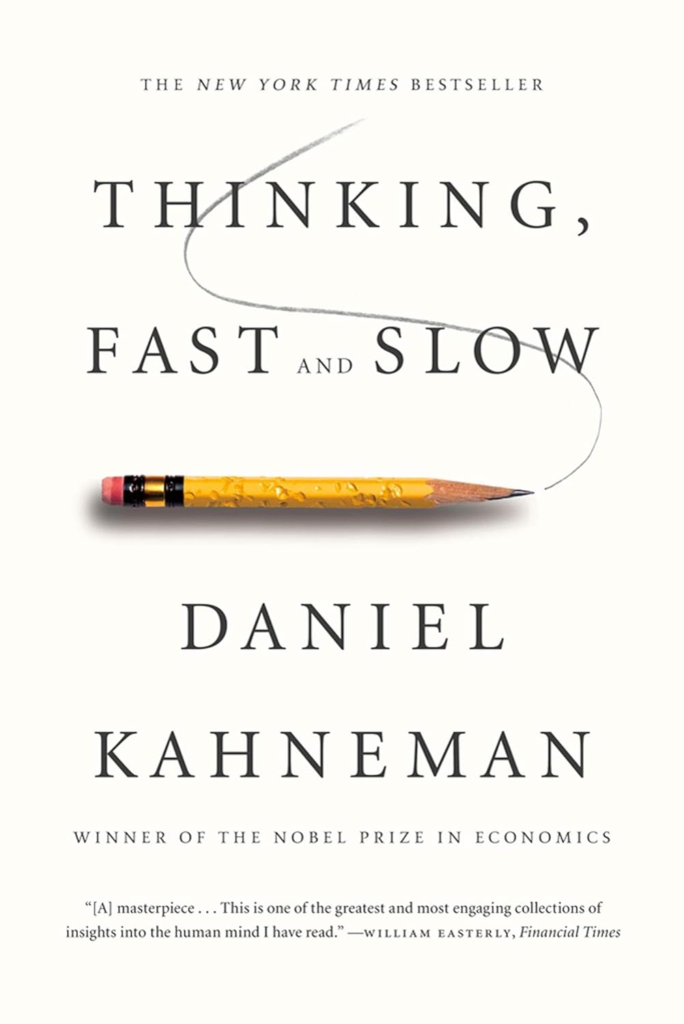
Thinking, Fast and Slow is a 2011 nonfiction book by Israeli-American psychologist Daniel Kahneman, winner of the 2002 Nobel Memorial Prize in Economic Sciences. The book synthesizes several decades of Kahneman’s research in cognitive psychology, judgment, decision-making, and behavioral economics, including work conducted with psychologist Amos Tversky.
First published in the United States in October 2011 by Farrar, Straus and Giroux, the book presents a broad account of how people form judgments and make decisions. Its central organizing concept is a distinction between two modes of mental activity, which Kahneman calls System 1 and System 2.
System 1 represents fast, automatic, associative, and largely effortless mental activity. System 2 represents slower, more deliberate, effortful, and consciously controlled reasoning. Kahneman emphasizes that the two systems are not literally two separate anatomical structures in the brain; rather, they are a conceptual framework for describing different characteristics of thought.
The book examines how intuitive judgments can be remarkably effective in familiar circumstances but can also produce systematic errors. It discusses heuristics, cognitive biases, anchoring, availability, representativeness, overconfidence, framing effects, loss aversion, prospect theory, the endowment effect, regression to the mean, and the distinction between experienced and remembered well-being.
The book became an international bestseller and introduced ideas from decades of academic research to a broad general readership. It has also become one of the most widely discussed popular works on human judgment and decision-making.
Book information
| Title | Thinking, Fast and Slow |
|---|---|
| Author | Daniel Kahneman |
| Genre | Nonfiction |
| Subjects | Psychology, decision-making, behavioral economics, cognitive science |
| Language | English |
| Publisher | Farrar, Straus and Giroux |
| Publication date | October 25, 2011 |
| Pages | 499 pages in the original hardcover edition |
| ISBN | 978-0-374-27563-1 |
| Country | United States |
| Major concepts | System 1, System 2, heuristics, biases, prospect theory, loss aversion, overconfidence, framing |
| Academic fields | Cognitive psychology, behavioral economics, judgment and decision-making |
The publisher describes the book as a synthesis of Kahneman’s research into the two systems that shape human judgment and choice.
Author
Daniel Kahneman

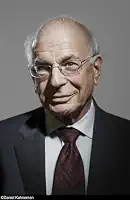
Daniel Kahneman (5 March 1934 – 27 March 2024) was an Israeli-American psychologist whose research profoundly influenced psychology, economics, and the emerging field of behavioral economics.
He was born in Tel Aviv in 1934 while his mother was visiting relatives there; his family normally lived in Paris. During the Second World War, his family experienced the German occupation of France, an experience Kahneman later described in his autobiography.
Kahneman studied psychology at the Hebrew University of Jerusalem and later received his Ph.D. in psychology from the University of California, Berkeley, in 1961. His early research included studies of attention, mental effort, perception, and judgment.
His most influential scientific partnership was with Amos Tversky. Beginning in the late 1960s, the two researchers developed a series of studies showing that human judgment frequently departs from the assumptions of classical models of rational decision-making.
Their research on heuristics and biases, followed by their development of prospect theory, became foundational to modern behavioral economics.
Kahneman was awarded the 2002 Sveriges Riksbank Prize in Economic Sciences in Memory of Alfred Nobel for integrating insights from psychological research into economic science, particularly concerning human judgment and decision-making under uncertainty.
The Nobel committee specifically recognized Kahneman’s work on decision-making under uncertainty and noted the importance of his collaboration with Tversky.
Kahneman died on 27 March 2024 at the age of 90.
Kahneman and Amos Tversky
No serious account of Thinking, Fast and Slow can treat Kahneman’s intellectual development as an entirely individual achievement.
Much of the research underlying the book emerged from Kahneman’s exceptionally productive collaboration with Amos Tversky (1937–1996).
The two researchers studied how people make judgments when faced with uncertainty and incomplete information.
Their work challenged a prevailing assumption in economics and decision theory: that people generally make decisions according to consistent rules of rational calculation.
Their research demonstrated that human judgment often relies on mental shortcuts—or heuristics—which can be useful but can also generate predictable errors.
Kahneman later described Tversky as an exceptionally gifted intellectual collaborator whose influence was central to their joint research. The Nobel Prize recognized Kahneman for work conducted jointly with Tversky, although Tversky had died before the prize was awarded.
Their collaboration produced influential work on:
- representativeness;
- availability;
- anchoring;
- judgment under uncertainty;
- prospect theory;
- framing;
- loss aversion;
- and bounded rationality.
Background and purpose
Thinking, Fast and Slow was written partly as a synthesis of a lifetime of psychological research.
Rather than presenting one narrow theory, Kahneman brings together several research programs that developed over decades.
The book’s underlying question is:
Why do intelligent people make predictable errors in judgment?
Kahneman’s answer is not that human beings are simply irrational.
Instead, human thinking is described as an efficient system operating under constraints.
People usually cannot analyze every possibility, calculate every probability, or examine every piece of available information.
The mind therefore uses shortcuts.
Those shortcuts are often extremely useful.
But under particular circumstances, they can lead to systematic biases.
The two systems
The most famous framework in the book is the distinction between System 1 and System 2.
Kahneman uses these terms as a metaphorical description of mental processes rather than as literal neurological systems.
System 1
System 1 operates quickly and automatically.
It is associated with:
- intuition;
- pattern recognition;
- emotional reactions;
- automatic perception;
- associative memory;
- rapid judgments;
- familiar skills;
- and effortless mental activity.
Examples include:
- recognizing a friend’s face;
- detecting anger in someone’s voice;
- answering simple arithmetic such as 2 + 2;
- reading a familiar word;
- avoiding an approaching object;
- completing familiar phrases.
System 1 often produces an answer before conscious reasoning begins.
System 2
System 2 is associated with deliberate and effortful thought.
It becomes more important when a task requires:
- concentration;
- calculation;
- conscious comparison;
- logical reasoning;
- self-control;
- unfamiliar problem-solving;
- or sustained attention.
Examples include:
- calculating 17 × 24;
- comparing mortgage rates;
- solving a complicated puzzle;
- checking a statistical calculation;
- learning a new technical procedure;
- or carefully evaluating competing arguments.
System 1 and System 2 infographic
┌──────────────────────────────────────────────────────────┐
│              TWO MODES OF HUMAN THINKING                 │
├──────────────────────────┬───────────────────────────────┤
│       SYSTEM 1           │          SYSTEM 2             │
├──────────────────────────┼───────────────────────────────┤
│ Fast                     │ Slow                          │
│ Automatic                │ Deliberate                    │
│ Associative              │ Analytical                    │
│ Effortless               │ Effortful                    │
│ Intuitive                │ Reflective                    │
│ Emotional                │ Rule-governed                 │
│ Usually unconscious      │ Usually conscious              │
│ Pattern-based            │ Calculation-based             │
└──────────────────────────┴───────────────────────────────┘
The distinction is one of the book’s organizing metaphors. Kahneman describes System 1 as more influential in everyday judgment than people ordinarily realize, while System 2 is capable of monitoring and sometimes overriding intuitive responses.
The relationship between the two systems
It would be misleading to interpret the book as saying:
System 1 = bad
and
System 2 = good.
That is not Kahneman’s argument.
System 1 is indispensable.
Without automatic perception and intuition, ordinary life would become impossibly slow.
Imagine consciously calculating every step involved in:
- walking;
- recognizing objects;
- understanding familiar language;
- driving a familiar route;
- recognizing faces;
- or responding to ordinary social signals.
The mind’s ability to automate these processes is one of its greatest strengths.
The problem occurs when a fast intuitive process is applied to a situation where careful reasoning is actually required.
Cognitive ease
Kahneman introduces the concept of cognitive ease to describe the subjective experience of processing information smoothly.
Information that is:
- familiar;
- repeated;
- clearly presented;
- easy to read;
- emotionally comfortable;
- or previously encountered
often feels more credible and familiar.
This creates an important psychological phenomenon:
Ease of processing can be mistaken for truth.
Something can feel familiar without being correct.
A statement repeatedly encountered in the media may eventually seem more believable simply because it has become cognitively familiar.
Associative memory
System 1 is strongly associated with the mind’s capacity to make connections between ideas.
One thought can activate another.
A word can trigger:
- an image;
- a memory;
- an emotion;
- another word;
- or a behavioral tendency.
Kahneman uses this associative structure to explain why mental activity can move rapidly from one concept to another without conscious deliberation.
This also explains how seemingly irrelevant information can influence judgment.
Heuristics
A heuristic is a mental shortcut used to make judgments or decisions.
Heuristics are not necessarily irrational.
They exist partly because complete calculation is often impossible.
For example, someone choosing a restaurant might rely on:
- familiarity;
- reputation;
- appearance;
- recommendations;
- distance;
- or previous experience.
The person does not calculate the probability of every possible dining outcome.
Instead, the mind uses available cues.
The problem is that a shortcut that works reasonably well in one environment can become misleading in another.
Representativeness heuristic
The representativeness heuristic involves judging the probability that something belongs to a category based on how closely it resembles one’s mental image of that category.
For example, if someone is described as quiet, intellectual, and interested in books, a person might immediately judge that individual as more likely to be a librarian than a salesperson.
The intuitive judgment may ignore an important fact:
The size of the underlying population matters.
If there are vastly more salespeople than librarians, the statistical base rate may substantially change the probability.
This leads to the phenomenon known as base-rate neglect.
The law of small numbers
People frequently expect small samples to resemble the larger population from which they are drawn.
For example, imagine a fair coin.
A person may intuitively regard:
H H H H H H
as less representative of randomness than:
H T H T T H
Yet a short sequence can legitimately contain clusters.
The mind often expects random processes to “look random” even over very small samples.
Kahneman uses such examples to illustrate how intuitive reasoning can misinterpret statistical randomness.
Availability heuristic
The availability heuristic occurs when people estimate the likelihood or frequency of an event according to how easily examples come to mind.
Events that are:
- vivid;
- recent;
- emotionally powerful;
- heavily publicized;
- personally experienced;
- or easily imagined
may appear more common than they actually are.
For example, extensive media coverage of a rare disaster can increase people’s perceived probability of encountering that disaster.
The mental shortcut is understandable:
If examples come to mind easily, the event feels common.
But ease of recall is not the same thing as statistical frequency.
Anchoring
Anchoring occurs when an initial number or reference point influences subsequent judgments.
For example, consider a negotiation in which the first figure mentioned is $100,000.
Even if that number is arbitrary, subsequent discussion may remain psychologically connected to it.
The anchor does not necessarily determine the final answer.
It shifts the mental starting point.
Kahneman and Tversky’s research on anchoring became one of the most influential examples of systematic judgment bias. Their work demonstrated that numerical estimates can be influenced by preceding information even when people know that the initial information is irrelevant.
Overconfidence
One of the book’s strongest themes is overconfidence.
People frequently possess more confidence in their judgments than the available evidence warrants.
This can happen because people construct coherent explanations from incomplete information.
Once a story seems coherent, uncertainty tends to disappear psychologically.
Kahneman describes this tendency as a major limitation of human judgment.
A useful conceptual formula is:
Limited information
        +
Coherent explanation
        ↓
Subjective certainty
The problem is that:
coherence is not evidence of correctness.
The illusion of understanding
People often believe they understand the past better than they actually did while events were unfolding.
After an event occurs, its sequence can appear obvious.
This produces what is commonly called hindsight bias.
For example, after a company becomes highly successful, observers may construct a narrative suggesting that its success was predictable from the beginning.
The story may be coherent.
But coherence after the fact does not prove predictability beforehand.
Kahneman therefore urges readers to distinguish between:
“We can explain what happened.”
and
“We could have predicted what happened.”
These are not the same claim.
The illusion of validity
People can become confident in a judgment even when the underlying information is weak.
This is especially likely when several pieces of information appear consistent with one another.
Consistency creates confidence.
But multiple pieces of information may not actually be independent.
A series of correlated observations can create the appearance of substantial evidence without providing as much new information as people assume.
Regression to the mean
Regression to the mean is another important concept discussed in the book.
Suppose an athlete performs exceptionally well on one occasion.
It is statistically likely that the athlete’s next performance will be closer to their normal level.
Similarly, an unusually poor performance is often followed by something closer to average.
People frequently misinterpret this phenomenon as causation.
For example:
Excellent performance
        ↓
Poorer performance
        ↓
"Something caused the decline"
But part of the change may simply be statistical regression.
Expert intuition
Kahneman does not reject intuition.
He asks a more difficult question:
When should intuition be trusted?
Expert intuition can be highly effective when:
- the environment contains meaningful regularities;
- those regularities are sufficiently stable;
- the individual has extensive experience;
- the individual receives rapid and informative feedback.
A chess grandmaster recognizing a familiar position is very different from an executive predicting a highly uncertain market.
The first environment may contain stable patterns that expertise can exploit.
The second may contain enormous randomness.
The outside view
One of the book’s practical recommendations is to use the outside view when making predictions.
Instead of asking:
“How long will our project take?”
a decision-maker should ask:
“How long have similar projects actually taken?”
The first is an inside view.
The second is an outside view.
The outside view forces the decision-maker to consider historical evidence rather than relying entirely on the particular story being constructed around the current project.
Planning fallacy
The planning fallacy describes people’s tendency to underestimate the time, cost, and difficulty of completing projects.
Individuals often focus on:
- their plan;
- their intentions;
- the specific circumstances of the current project;
- and the best-case scenario.
They may fail to consider the actual distribution of outcomes from comparable projects.
This is one reason the outside view can be useful.
Prospect theory
One of Kahneman’s most important scientific contributions, developed with Amos Tversky, is prospect theory.
Prospect theory describes how people evaluate risky choices.
Classical economic models often assume that people evaluate outcomes according to their objective values and probabilities.
Kahneman and Tversky demonstrated that actual human decision-making systematically departs from this model.
People evaluate outcomes relative to a reference point and generally respond more strongly to losses than to equivalent gains.
Loss aversion
The idea of loss aversion is among the most influential concepts associated with Kahneman’s work.
In simplified terms:
Psychological impact

Loss of $100
████████████████████

Gain of $100
██████████
The exact relationship is not a universal numerical law. The important principle is that the psychological effect of losing something can be greater than the psychological pleasure of gaining the same amount.
This helps explain why people sometimes reject objectively attractive gambles.
Prospect theory infographic
                 SUBJECTIVE VALUE

                       │
                       │             /
                       │           /
                       │         /
                       │       /
───────────────────────┼──────/──────────── REFERENCE POINT
                       │    /
                       │   /
                       │  /
                       │ /
                       │
                       │
                LOSSES │ GAINS
                       │
              Losses tend
              to feel steeper
The curve represents the conceptual structure of prospect theory rather than a precise empirical graph.
Its important features include:
- a reference point;
- diminishing sensitivity;
- and greater sensitivity to losses than equivalent gains.
Kahneman’s Nobel lecture describes his joint work with Tversky as addressing heuristics of judgment, risky choice, and framing effects.
The endowment effect
The endowment effect describes people’s tendency to value something more once they possess it.
An item can therefore become psychologically more valuable merely because it has become “mine.”
This phenomenon challenges the assumption that preferences are always stable and independent of ownership.
It has implications for:
- consumer behavior;
- negotiations;
- markets;
- selling and buying;
- property decisions;
- and organizational choices.
Framing effects
A framing effect occurs when different presentations of essentially equivalent information produce different judgments.
Consider:
“This treatment has a 90% survival rate.”
versus:
“This treatment has a 10% mortality rate.”
The numerical information is equivalent.
The psychological response may not be.
Kahneman’s research demonstrated that the way choices are described can affect decisions even when the underlying outcomes remain unchanged.
The fourfold pattern
Prospect theory predicts that people’s attitudes toward risk can change depending on whether the possible outcomes involve gains or losses and whether those outcomes are probable or unlikely.
This produces what Kahneman describes as a fourfold pattern.
| Situation | Typical tendency described by prospect theory |
|---|---|
| High probability of gains | Risk aversion |
| Small probability of gains | Risk seeking |
| High probability of losses | Risk seeking |
| Small probability of losses | Risk aversion |
This helps explain apparently inconsistent behavior.
A person may buy insurance against a small probability of a large loss while simultaneously purchasing a lottery ticket involving a small probability of a large gain.
From a purely expected-value perspective, the two behaviors may appear inconsistent.
From the perspective of prospect theory, they can be psychologically understandable.
Rare events
People can respond disproportionately to rare events.
A small probability can become psychologically magnified when an outcome is:
- vivid;
- emotionally powerful;
- frightening;
- or easily imagined.
This can influence:
- insurance purchases;
- gambling;
- financial decisions;
- public policy;
- and reactions to disasters.
The two selves
The final major section of Thinking, Fast and Slow examines the distinction between the experiencing self and the remembering self.
Experiencing self
The experiencing self is concerned with what is happening now.
It experiences:
- pleasure;
- pain;
- boredom;
- excitement;
- discomfort;
- and satisfaction moment by moment.
Remembering self
The remembering self evaluates an experience retrospectively.
It constructs a story about:
- how good the experience was;
- how bad it was;
- how it ended;
- and whether it should be repeated.
These two selves do not always agree.
The peak-end rule
Kahneman discusses the peak-end rule, according to which people’s retrospective evaluation of an experience can be strongly influenced by:
- the most intense moment; and
- the way the experience ended.
Duration may receive less psychological weight than traditional theories of total experience would predict.
A simplified representation is:
EXPERIENCE

Intensity
   │
   │           PEAK
   │            ▲
   │           / \
   │          /   \
   │     ____/     \____
   │                    \____ END
   └──────────────────────────────► Time

Remembered evaluation
        ≈ peak + ending
This distinction between immediate experience and retrospective memory became one of the book’s most intriguing contributions to popular discussions of happiness and well-being.
Experienced utility and remembered utility
Traditional approaches to welfare may implicitly treat an individual’s evaluation of an event as a straightforward measure of the event’s value.
Kahneman’s work suggests a more complicated picture.
The experience occurring in real time and the story constructed afterward can diverge.
A vacation, medical procedure, concert, meal, or holiday may therefore be:
- experienced one way;
- remembered another way;
- and anticipated differently again.
This creates three psychologically distinct stages:
ANTICIPATED EXPERIENCE
          ↓
EXPERIENCED EXPERIENCE
          ↓
REMEMBERED EXPERIENCE
The three need not coincide.
The focusing illusion
Another important concept is the focusing illusion.
It can be summarized as:
Nothing is as important as you think it is while you are thinking about it.
When attention becomes concentrated on one factor, that factor can appear disproportionately important.
For example, people may overestimate how much a particular event will affect their long-term happiness because imagining the event causes attention to become concentrated on it.
The concept is closely related to the difficulty people have in predicting their own future emotional states.
Happiness and well-being
The book distinguishes between different ways of thinking about happiness.
A person can ask:
“How do I feel right now?”
or:
“How satisfied am I with my life?”
These questions may generate different answers.
The immediate emotional state is not identical to an overall judgment about one’s life.
This distinction is particularly important when people make major decisions based on predictions about future happiness.
Decision-making under uncertainty
One of the book’s broader messages is that human beings routinely make decisions without knowing the future.
The uncertainty may involve:
- investments;
- careers;
- relationships;
- business;
- health;
- education;
- politics;
- technology;
- or everyday choices.
People nevertheless tend to construct stories that make uncertain situations appear more predictable than they really are.
The result is often:
UNCERTAINTY
     ↓
INCOMPLETE INFORMATION
     ↓
MENTAL STORY
     ↓
COHERENCE
     ↓
CONFIDENCE
The final confidence can be much greater than the evidence warrants.
The danger of narrative
Humans are natural storytellers.
Once an event has happened, people instinctively search for causes.
This tendency is useful because causal stories help us understand the world.
But stories can also become overly simple.
For example:
Company succeeds → excellent leadership caused success.
The explanation may be partly true.
But the outcome could also reflect:
- timing;
- market conditions;
- competitors’ mistakes;
- luck;
- regulation;
- technology;
- random events;
- or survivorship bias.
Kahneman therefore repeatedly warns readers against confusing a compelling story with a complete explanation.
Survivorship and selection effects
A particularly important implication of Kahneman’s work is that observed success can be misleading.
Suppose a thousand entrepreneurs launch businesses.
A small number become spectacularly successful.
Observers may study the winners and identify common characteristics.
But this does not automatically demonstrate that those characteristics caused success.
The unsuccessful entrepreneurs may have possessed the same characteristics.
The missing information is the comparison group.
This is a recurring problem in reasoning about success.
Regression, randomness and performance
The book also challenges the common belief that exceptional performance necessarily reflects exceptional underlying ability.
Performance often contains both:
ABILITY
   +
CONDITIONS
   +
OPPORTUNITY
   +
RANDOMNESS
   =
OBSERVED RESULT
A single outstanding outcome therefore provides less information than people often assume.
This has implications for:
- investing;
- sports;
- business;
- education;
- employee evaluation;
- and management.
Applications
Although the book is rooted in academic psychology and economics, its concepts have broad applications.
Finance
Investors may be affected by:
- loss aversion;
- anchoring;
- overconfidence;
- availability;
- framing;
- and the tendency to construct explanations for market movements.
An investor who buys a stock at $100 may psychologically treat $100 as a meaningful reference point even if the market has no reason to consider that price special.
Business
Managers can fall victim to:
- planning fallacy;
- overconfidence;
- confirmation bias;
- sunk-cost thinking;
- anchoring;
- and excessive faith in forecasts.
The outside view can be particularly useful when evaluating large projects.
Medicine
Medical decision-making involves uncertainty, probabilities, incomplete information, and emotionally charged outcomes.
The principles discussed by Kahneman can therefore be relevant to:
- diagnostic reasoning;
- risk communication;
- treatment decisions;
- probability interpretation;
- and shared decision-making.
However, professional medical decisions require validated clinical evidence and should not be reduced to popular psychology.
Law
Legal reasoning may involve:
- probability judgments;
- eyewitness evidence;
- anchoring;
- framing;
- risk perception;
- and retrospective interpretation.
Because legal decisions can have significant consequences, awareness of cognitive bias is particularly important.
Education
Students and teachers can encounter:
- overconfidence;
- availability effects;
- memory distortions;
- framing;
- and mistaken judgments about ability.
The distinction between intuitive familiarity and genuine understanding is particularly relevant to learning.
Decision-making infographic
              INFORMATION
                   │
                   ▼
          ┌─────────────────┐
          │   SYSTEM 1      │
          │ Intuition       │
          │ Associations    │
          │ Heuristics      │
          └────────┬────────┘
                   │
             Quick judgment
                   │
                   ▼
          ┌─────────────────┐
          │   SYSTEM 2      │
          │ Check           │
          │ Calculate       │
          │ Compare         │
          │ Override        │
          └────────┬────────┘
                   │
                   ▼
              DECISION
                   │
                   ▼
        ┌────────────────────┐
        │ Possible bias from │
        │ anchoring, framing,│
        │ availability, etc. │
        └────────────────────┘
Major cognitive biases discussed in the book
| Bias / effect | Basic description |
|---|---|
| Anchoring | Initial information influences later judgments |
| Availability | Easily recalled events appear more common |
| Representativeness | Similarity is mistaken for probability |
| Base-rate neglect | General statistical information is underweighted |
| Overconfidence | Confidence exceeds evidential support |
| Hindsight bias | Past events appear more predictable afterward |
| Planning fallacy | Projects are expected to take less time than they often do |
| Loss aversion | Losses tend to have greater psychological impact than equivalent gains |
| Endowment effect | Ownership increases perceived value |
| Framing effect | Presentation changes judgment |
| Regression neglect | Random variation is mistaken for causal change |
| Focusing illusion | Attention makes one factor seem disproportionately important |
The book’s five-part structure
Thinking, Fast and Slow is divided into five major parts.
Part I — Two Systems
The opening section introduces System 1 and System 2 and explains their characteristics, interactions, and limitations.
The purpose is to provide a conceptual language for discussing intuitive and deliberate thought.
Part II — Heuristics and Biases
The second section examines the shortcuts people use when making judgments.
It discusses:
- representativeness;
- availability;
- anchoring;
- statistical reasoning;
- sample-size intuition;
- and the conflict between causal stories and statistical information.
Part III — Overconfidence
The third section examines people’s excessive confidence in:
- their predictions;
- their explanations;
- their memories;
- their understanding;
- and their ability to identify patterns.
The section includes the planning fallacy, the outside view, expert intuition, and the role of uncertainty.
Part IV — Choices
The fourth section focuses on decision-making under risk and uncertainty.
It develops the ideas associated with:
- prospect theory;
- reference points;
- loss aversion;
- the endowment effect;
- framing;
- rare events;
- and risk preferences.
Part V — Two Selves
The final section examines the difference between:
- the experiencing self;
- and the remembering self.
It explores happiness, life evaluation, duration neglect, the peak-end rule, and the difficulties involved in predicting future emotional states.
Conceptual map of the entire book
                    THINKING
                       │
          ┌────────────┴────────────┐
          │                         │
       SYSTEM 1                 SYSTEM 2
          │                         │
     Intuition                 Deliberation
          │                         │
          └────────────┬────────────┘
                       │
                       ▼
                 JUDGMENT
                       │
         ┌─────────────┼─────────────┐
         │             │             │
     HEURISTICS     BIASES      OVERCONFIDENCE
         │             │             │
         └─────────────┼─────────────┘
                       │
                       ▼
                 DECISION-MAKING
                       │
                       ▼
              PROSPECT THEORY
                       │
          ┌────────────┴────────────┐
          │                         │
      GAINS                       LOSSES
          │                         │
          └────────────┬────────────┘
                       │
                       ▼
                 TWO SELVES
                       │
             ┌─────────┴─────────┐
             │                   │
        EXPERIENCING          REMEMBERING
             │                   │
             └─────────┬─────────┘
                       ▼
                    LIFE
                 EVALUATION
Why the book became influential
The book succeeded partly because it translated highly technical academic research into language accessible to general readers.
Several factors contributed to its influence.
Academic authority
Kahneman was already one of the world’s most influential researchers in judgment and decision-making and had received the Nobel Memorial Prize in Economic Sciences.
Practical relevance
The book connects psychological research with decisions people make every day.
Memorable terminology
Terms such as:
- System 1;
- System 2;
- anchoring;
- availability;
- loss aversion;
- framing;
- planning fallacy;
- and focusing illusion
are relatively easy to remember.
Demonstrations
Kahneman frequently asks readers to perform small mental experiments.
This makes abstract psychological principles personally observable.
Instead of merely telling readers that intuition can be misleading, he attempts to make them experience the phenomenon themselves.
Influence on behavioral economics
Kahneman’s research played a major role in the development of behavioral economics, a field that combines economic analysis with psychological evidence about actual human behavior.
Traditional economic models often begin with highly simplified assumptions about rational agents.
Behavioral economics asks what happens when those assumptions are relaxed.
Kahneman’s work showed that human decisions are systematically affected by psychological factors.
The Nobel Prize committee described his contribution as integrating psychological insights into economic science, particularly concerning judgment and decision-making under uncertainty.
It is important to note that Kahneman himself emphasized the major role played by economists such as Richard Thaler in integrating psychological insights into economics.
Scientific qualifications and replication debate
A modern article about Thinking, Fast and Slow should not ignore developments in psychology that occurred after many of the studies discussed in the book.
Some findings associated with the broader social priming literature became controversial as researchers attempted to reproduce earlier experiments.
Kahneman himself publicly acknowledged concerns about the robustness and replicability of priming research in a 2012 letter to researchers in the field. In that letter, he referred to multiple reported replication failures and methodological concerns, while still describing himself as a general believer in the research area.
This episode is important because Thinking, Fast and Slow sometimes presents individual research findings with a degree of confidence that later methodological debates have complicated.
A contemporary reader should therefore distinguish between:
- well-established principles;
- findings with substantial supporting evidence;
- specific experimental effects that remain debated;
- and illustrative examples used primarily to explain a broader concept.
The replication debate does not erase Kahneman’s contribution. Rather, it illustrates one of the book’s own central lessons:
confidence should be calibrated to the strength of the evidence.
The irony of the book
There is an interesting intellectual irony at the center of Thinking, Fast and Slow.
The book teaches readers to be skeptical of:
- intuition;
- confidence;
- simple explanations;
- memorable examples;
- and compelling narratives.
Yet some of the individual psychological findings used to illustrate those lessons have themselves become subjects of scientific scrutiny.
This does not make the book useless.
It makes it more interesting.
The appropriate response is not to accept every experiment in the book as an established fact, nor to dismiss the entire framework because some findings have been challenged.
Instead, the book is best read as an influential synthesis of a major research tradition whose individual claims vary in evidential strength.
Criticism
Complexity
At nearly 500 pages, the book is considerably more demanding than a conventional popular psychology book.
Some readers find its numerous experiments and examples repetitive.
Simplification
The System 1/System 2 framework is deliberately simplified.
Human cognition is considerably more complex than two metaphorical “characters.”
The framework is useful as a teaching model, but it should not be confused with a complete neuroscientific description of the human brain.
Generalization
Some psychological effects may depend on:
- context;
- population;
- culture;
- task;
- experimental design;
- and environmental conditions.
Consequently, a finding demonstrated under controlled experimental conditions does not automatically imply that the same effect will be equally strong in every real-world situation.
Replication concerns
As discussed above, parts of the broader literature on priming and some other behavioral effects have faced replication challenges.
This has encouraged researchers to place greater emphasis on:
- larger samples;
- preregistration;
- replication;
- statistical power;
- transparent methods;
- and cumulative evidence.
Strengths and limitations
| Strengths | Limitations |
|---|---|
| Major synthesis of decades of research | Very long and dense |
| Written for a general audience | Simplifies complex cognitive processes |
| Introduces behavioral economics concepts | Not every cited finding has equal evidential status |
| Highly memorable examples | Some experiments have faced replication questions |
| Explains difficult statistical ideas accessibly | Can encourage readers to over-label ordinary mistakes as “biases” |
| Connects psychology and economics | System 1/System 2 is a conceptual metaphor, not a literal brain architecture |
| Encourages intellectual humility | Some conclusions require contextual qualification |
What the book gets especially right
One of the book’s most valuable contributions is its attack on unwarranted confidence.
Humans are remarkably good at producing explanations.
The difficulty is knowing when those explanations are actually reliable.
A person can be:
- intelligent;
- experienced;
- articulate;
- successful;
- and completely sincere,
while still being wrong.
The book’s deeper message is therefore not simply:
“You have biases.”
It is:
“Your confidence is not a reliable measure of the quality of your judgment.”
That distinction is considerably more important.
Practical lessons from the book
The book does not offer a simple checklist for eliminating cognitive biases.
In fact, Kahneman repeatedly suggests that many biases are difficult to eliminate because they arise from normal features of cognition.
Nevertheless, several practical habits follow from the research.
1. Slow down when the stakes are high
If a decision is consequential, unfamiliar, or difficult to reverse, intuitive judgment deserves scrutiny.
2. Look for base rates
Ask:
“What normally happens in similar cases?”
rather than relying exclusively on the story surrounding the current case.
3. Search for disconfirming evidence
Ask:
“What would make my current conclusion wrong?”
4. Beware the first number
An initial estimate can influence subsequent judgments.
5. Separate confidence from evidence
Ask:
“How strong is the evidence?”
rather than:
“How confident do I feel?”
6. Use the outside view
Compare the current situation with comparable historical cases.
7. Expect regression to the mean
Extreme outcomes are often followed by less extreme outcomes.
8. Treat predictions cautiously
The future is frequently less predictable than the narrative constructed around it suggests.
9. Distinguish experience from memory
What you remember about an event may not perfectly represent what you experienced throughout it.
10. Accept uncertainty
Not knowing is sometimes the most accurate conclusion available.
A decision-making checklist inspired by Kahneman
BEFORE MAKING A MAJOR DECISION:

□ What is my immediate intuitive reaction?
□ What evidence supports it?
□ Am I anchored by a number or first impression?
□ What is the relevant base rate?
□ Am I relying on a vivid example?
□ Am I confusing a plausible story with evidence?
□ Am I overconfident?
□ What happened in similar cases?
□ Am I ignoring regression to the mean?
□ What would I think if the situation were framed differently?
□ Am I evaluating gains and losses asymmetrically?
□ What information would change my mind?
□ How uncertain is the prediction?
□ Am I making a decision for my experiencing self
  or for my remembering self?
Legacy
Daniel Kahneman’s influence extends far beyond Thinking, Fast and Slow.
His research with Amos Tversky helped transform the study of human judgment and decision-making.
It influenced:
- economics;
- finance;
- psychology;
- public policy;
- medicine;
- law;
- management;
- marketing;
- education;
- and decision science.
The Nobel Prize committee described Kahneman’s research as a major contribution to understanding how psychological processes shape economic decisions.
His work also helped establish the idea that deviations from idealized rationality are not merely random mistakes.
They can be systematic, predictable, and experimentally measurable.
That was one of the key intellectual shifts behind behavioral economics.
Historical significance
The historical importance of Thinking, Fast and Slow lies less in the creation of a completely new theory than in its synthesis.
Kahneman brought together:
COGNITIVE PSYCHOLOGY
        +
JUDGMENT RESEARCH
        +
PROSPECT THEORY
        +
BEHAVIORAL ECONOMICS
        +
RESEARCH ON HAPPINESS
        ↓
THINKING, FAST AND SLOW
The book made decades of specialized research available to millions of general readers.
It also gave the public a vocabulary for discussing the imperfections of human reasoning.
See also
- Behavioral economics
- Cognitive psychology
- Cognitive bias
- Decision theory
- Prospect theory
- Heuristics
- Rational choice theory
- Bounded rationality
- Loss aversion
- Anchoring effect
- Availability heuristic
- Representativeness heuristic
- Framing effect
- Planning fallacy
- Regression toward the mean
- Amos Tversky
- Richard Thaler
- Herbert A. Simon
- The Undoing Project by Michael Lewis
References
- Kahneman, Daniel. Thinking, Fast and Slow. Farrar, Straus and Giroux, 2011. ISBN 978-0-374-27563-1. Publisher description and book information.
- Nobel Prize Outreach. “Daniel Kahneman — Facts.” The Nobel Prize, 2002. Biographical information, Nobel citation, and research overview.
- Nobel Prize Outreach. “Daniel Kahneman — Biographical.” The Nobel Prize. Detailed account of Kahneman’s life and scientific career.
- Kahneman, Daniel. “Maps of Bounded Rationality: A Perspective on Intuitive Judgment and Choice.” Nobel Lecture, 8 December 2002.
- Nobel Prize Committee. Advanced Information on the Prize in Economic Sciences 2002. Nobel Foundation. Discussion of Kahneman’s contributions to behavioral economics and decision-making under uncertainty.
- Kahneman, Daniel. Letter concerning concerns about the robustness and replicability of social priming research, 26 September 2012.
- Macmillan Publishers. Thinking, Fast and Slow. Book description, contents, and publication information.
Further reading
Academic and foundational works
- Kahneman, Daniel; Tversky, Amos. “Judgment under Uncertainty: Heuristics and Biases.” Science, 1974.
- Kahneman, Daniel; Tversky, Amos. “Prospect Theory: An Analysis of Decision under Risk.” Econometrica, 1979.
- Kahneman, Daniel; Knetsch, Jack L.; Thaler, Richard H. “Fairness and the Assumptions of Economics.” Journal of Business, 1986.
- Simon, Herbert A. Administrative Behavior.
- Tversky, Amos; Kahneman, Daniel. “The Framing of Decisions and the Psychology of Choice.”
Books for general readers
- Lewis, Michael. The Undoing Project: A Friendship That Changed Our Minds.
- Thaler, Richard H. Misbehaving: The Making of Behavioral Economics.
- Thaler, Richard H.; Sunstein, Cass R. Nudge.
- Kahneman, Daniel; Sibony, Olivier; Sunstein, Cass R. Noise: A Flaw in Human Judgment.
External links
- Nobel Prize biography of Daniel Kahneman. Nobel Prize — Daniel Kahneman
- Nobel Prize lecture, Maps of Bounded Rationality. Nobel Prize — Kahneman’s Nobel Lecture
- Publisher information for Thinking, Fast and Slow. Macmillan — Thinking, Fast and Slow
Conclusion
Thinking, Fast and Slow is ultimately a book about a problem that is both ordinary and profound: human beings have to make decisions in a world they do not fully understand, using minds that were not designed to calculate every uncertainty explicitly.
Our intuitive judgments are often impressive. They allow us to navigate an extraordinarily complicated world without consciously analyzing every detail.
But the same machinery can produce predictable errors.
We see patterns where there is randomness. We construct explanations from incomplete evidence. We become attached to initial numbers. We fear losses more than we value equivalent gains. We underestimate uncertainty. We overestimate our ability to predict the future. And, perhaps most importantly, we often become confident in a story before we have sufficient evidence to justify that confidence.
Kahneman’s lasting contribution is therefore not simply the distinction between “fast” and “slow” thinking.
It is the invitation to become more skeptical of the feeling of certainty itself.
The book does not promise that human beings can eliminate bias. Nor does it suggest that deliberate reasoning can replace intuition in every situation.
Its more realistic lesson is that good judgment requires knowing when intuition deserves trust, when it deserves examination, and when the most rational response is to acknowledge uncertainty.
That is what makes Thinking, Fast and Slow more than a book about psychology. It is a sustained examination of one of the most consequential facts about human life: we must make decisions with imperfect minds, incomplete information, and a future we cannot see.