

How to Find Profitable Business Niches in the AI Industry: 10 Steps Guide
How to Find Profitable Business Niches in the AI Industry? The rapid development of artificial intelligence is creating new business opportunities across healthcare, education, finance, retail, manufacturing, professional services and almost every other major industry. Businesses are increasingly exploring AI-powered software, automation, intelligent assistants, predictive analytics and specialised AI services to improve productivity, reduce operating costs and deliver better customer experiences. However, identifying an opportunity that can generate sustainable revenue is considerably more difficult than simply finding an interesting AI technology.
The most promising Profitable Business Niches in the AI industry are not necessarily the ones receiving the most media attention. They are often specialised markets where customers experience expensive, repetitive or time-consuming problems and are willing to pay for a reliable solution. An AI startup that solves a specific problem for a clearly defined customer group may have a more practical commercial opportunity than a general-purpose AI product competing directly with established technology companies.
For entrepreneurs, freelancers, consultants and aspiring startup founders, the challenge is to discover where artificial intelligence creates measurable business value. This requires understanding the AI market, researching customer workflows, evaluating niche demand, studying competitors, selecting an appropriate AI business model and calculating the economics of delivering a solution.
This comprehensive guide explains how to find profitable business niches in the AI industry through ten practical steps. You will learn how to identify underserved AI markets, discover industry-specific problems, evaluate AI startup ideas, validate customer demand, estimate profitability and develop a focused AI business opportunity without investing heavily before the market has been tested.

In This Guide: Explore All 10 Steps
- Understand the AI industry and its opportunities
- Identify industries with expensive problems
- Discover underserved AI niche markets
- Find specific customer problems and workflows
- Choose the right AI business model
- Research market demand and competition
- Validate willingness to pay
- Calculate AI business profitability
- Build and test an AI minimum viable product
- Differentiate and scale your AI business
- Interactive AI niche evaluation tools
- AI niche selection checklist
- Frequently asked questions
Understand the AI Industry and Identify Its Business Opportunities
Discover where artificial intelligence creates commercial value
The first step in finding Profitable Business Niches is to understand what the AI industry actually includes. Artificial intelligence is not one single product category. It is a broad technology ecosystem containing multiple tools, capabilities, applications and business models. Each area creates different opportunities for entrepreneurs.
For example, generative AI can create text, images, audio, video and software code. Machine learning can identify patterns in large datasets and support predictions. Natural language processing can analyse documents, conversations and customer enquiries. Computer vision can interpret images and video. AI agents can perform multi-step tasks by interacting with software tools under defined permissions and supervision.
These capabilities can be converted into commercial products and services. However, customers generally do not purchase artificial intelligence simply because it is technologically impressive. They purchase faster service, lower costs, fewer errors, improved decisions, increased sales or better customer experiences.
Content generation, document creation, marketing production, product design, coding assistance and specialised content workflows.
Automating repetitive administrative tasks, business processes, customer enquiries, reporting and data entry.
Demand forecasting, sales predictions, inventory planning, risk analysis and operational decision support.
Voice assistants, customer support agents, appointment systems, sales qualification and multilingual communication.
Visual inspection, document recognition, image analysis, product quality monitoring and image-based workflows.
Industry-specific AI applications designed for the unique needs of a particular profession or customer segment.
Now distinguish between building AI technology and using existing AI technology to solve a commercial problem. These are very different business strategies.
Developing a new foundation model may require substantial computing infrastructure, specialised researchers, capital and technical expertise. By comparison, building an AI-enabled workflow solution for a specific customer group may be possible using existing AI models, APIs, automation platforms and conventional software.
For a new entrepreneur, the second approach can be a more accessible starting point. You do not necessarily need to invent a new AI model. You need to identify a valuable problem, understand the workflow and deliver a solution that customers prefer over their current alternatives.
Identify Industries Where AI Can Solve Expensive Business Problems
Look for industries with strong demand and measurable operational inefficiencies
One of the most effective ways to discover profitable AI business niches is to investigate established industries rather than searching only within the technology sector. Many attractive opportunities exist in traditional businesses where administrative work, communication, documentation, scheduling and data management consume considerable time.
Industries often have specialised workflows that general-purpose AI tools do not fully address. A small medical clinic, for example, has different administrative requirements from a law firm, logistics company, insurance broker or manufacturing unit.
Study industries where repetitive processes, information overload, labour-intensive activities or delayed decisions create measurable costs. These conditions can create demand for specialised AI solutions.
Appointment coordination, administrative document processing, patient communication and non-diagnostic workflow support. Clinical applications require appropriate professional oversight and regulatory compliance.
Learning support, assessment administration, educational content adaptation, tutoring workflows and institutional reporting.
Document organisation, contract workflow assistance, research support and matter administration with qualified human review.
Product information management, customer support, demand forecasting, inventory assistance and product discovery.
Visual quality inspection, predictive maintenance, production planning and equipment monitoring.
Property enquiry management, document workflows, project reporting, estimation support and lead qualification.
Invoice processing, transaction categorisation, document extraction, financial reporting support and reconciliation assistance.
Route planning assistance, shipment communication, document processing, scheduling and operational forecasting.
Do not assume that every large industry offers an attractive opportunity. A large market may already have powerful software companies, established suppliers and high customer acquisition costs. A smaller industry segment may be commercially more accessible if customers have an urgent problem and existing solutions are inadequate.
Evaluate each industry using five questions:
- Does the industry perform repetitive tasks that could benefit from AI?
- Are the existing processes expensive, slow or difficult to manage?
- Do businesses already spend money on software, employees or outsourced services to solve these problems?
- Can you identify and reach the actual decision-makers?
- Can an AI solution improve the process without creating unacceptable operational, legal or security risks?
Pay particular attention to industries where the problem occurs frequently. A task performed hundreds of times each month may offer a stronger commercial opportunity than an interesting task performed only occasionally.
Discover Underserved AI Business Niches and Micro-Niches
Move from broad industries to narrowly defined customer segments
After identifying promising industries, narrow your research to specific customer segments. This is where many entrepreneurs discover more attractive Profitable Business Niches.
A broad market such as healthcare includes hospitals, diagnostic laboratories, dental clinics, independent doctors, pharmacies, nursing facilities, medical distributors and many other customer groups. Their workflows, budgets, software requirements and purchasing decisions are not identical.
A specialised AI solution for independent dental clinics, for example, could focus on appointment reminders, enquiry classification, treatment follow-up administration or routine front-desk workflow automation. Such a solution has a clearer target customer than a generic AI assistant designed for every healthcare business.
| Broad industry | Specific AI niche | Potential customer |
|---|---|---|
| Healthcare | Appointment and front-desk workflow automation | Independent clinics |
| Education | AI-assisted question and assessment generation | Coaching institutes |
| Real estate | Property enquiry qualification and follow-up | Small property agencies |
| Legal services | Document intake and classification | Small law firms |
| E-commerce | Product catalogue enrichment | Online retailers |
| Manufacturing | Visual defect detection | Specialised factories |
| Logistics | Shipment document processing | Freight operators |
| Hospitality | Multilingual guest enquiry automation | Independent hotels |
| Accounting | Invoice data extraction and review | Accounting practices |
| Recruitment | Candidate document organisation | Recruitment agencies |
Notice the structure of these examples. Each opportunity identifies an industry, a specific customer segment and a particular business activity. This is more useful than simply saying that healthcare AI or education AI is a profitable market.
Look for underserved customer groups. Large enterprises may already have sophisticated technology departments and expensive software systems. Small and medium-sized businesses may have similar operational problems but lack the resources to develop their own AI solutions.
However, do not assume that small businesses will automatically pay for a solution. Their budgets may be limited, and owners may be reluctant to change established processes. You must establish that the economic benefit justifies the cost.
Also consider language and geographic specialisation. An AI product designed for regional languages, local business practices, industry-specific terminology or a particular country’s regulatory environment may address needs that generic international products overlook.
Micro-niches should be sufficiently narrow to support focused marketing but sufficiently large to contain enough potential paying customers. If a market contains only a handful of buyers, it may be difficult to build a scalable business unless the customer value is exceptionally high.
Find Specific Customer Problems and Repetitive Workflows
Identify the problem customers actually want to pay to solve
Identifying a niche is only the beginning. The next step is to understand the exact problem that customers experience. A commercially viable AI product should solve a problem that is important enough to justify a purchase.
Many AI startup ideas fail because founders begin with a technology demonstration and then search for customers who might use it. A stronger approach is to investigate real customer workflows first and determine whether AI can improve them.
For example, consider a small accounting firm. Employees may spend several hours receiving invoices, extracting information, checking supplier details, categorising expenses and transferring information into accounting software. The opportunity is not simply to build an AI chatbot for accountants. It may be to create an invoice-processing workflow that extracts data, identifies missing fields and prepares entries for human verification.
How often does the customer encounter the problem: daily, weekly, monthly or occasionally?
How many employee hours are spent completing the activity?
Does the problem increase costs, reduce revenue, delay payments or create avoidable losses?
Does the existing process create mistakes, compliance problems or customer dissatisfaction?
How do customers currently solve the problem? Employees, spreadsheets, conventional software or outsourcing?
Would customers adopt a new workflow if it offered measurable improvement?
Speak directly to potential customers. Ask them to describe their work rather than asking whether they like your AI idea. Questions such as “Which task takes the most time every week?” and “What happens when this process is delayed or completed incorrectly?” can reveal more useful information.
Investigate the entire workflow. A task that appears simple may involve several hidden stages, different employees, approval requirements, software integrations and exceptions. Understanding these details helps you avoid building a product that works in a demonstration but fails in actual business conditions.
Separate problems that genuinely require AI from problems that can be solved more simply. Sometimes a form, database, notification system or conventional automation tool is cheaper, faster and more reliable than an AI model.
AI should be used where it provides a meaningful advantage, such as interpreting unstructured information, understanding natural language, classifying documents, recognising patterns or generating context-sensitive responses.
Choose the Right AI Business Model for Your Niche
Decide how your AI solution will create value and generate revenue
After identifying a customer problem, decide how you will deliver the solution and earn revenue. Choosing the right business model is an important part of finding profitable AI business niches because different models have different capital requirements, sales cycles, operating costs and growth potential.
You do not need to develop a full software platform immediately. Depending on the market, an AI-enabled service or specialised automation consultancy may be a more practical way to enter the niche, understand customers and generate early revenue.
Sell specialised AI software through monthly or annual subscriptions. Suitable when customers need continuing access to a repeatable solution.
Design and implement AI-enabled workflows for businesses. Revenue may come from implementation fees and continuing maintenance.
Help organisations identify, evaluate and implement AI opportunities. Revenue may be based on projects, retainers or advisory engagements.
Develop specialised AI software for a particular profession, industry or customer workflow.
Connect AI capabilities with existing business systems, databases and applications.
Provide industry-specific AI training, implementation workshops and employee education.
Sell specialised templates, workflow packages, knowledge resources and reusable AI-assisted products.
Combine software subscriptions, implementation services, support and training where customers need continuing assistance.
Consider a niche such as AI-powered customer enquiry management for independent clinics. You could begin by charging a one-time setup fee to configure the workflow, followed by a monthly fee for software access, monitoring and support.
Alternatively, you could develop a self-service software platform that multiple clinics can subscribe to. This may have greater scalability, but it also requires product development, technical support, security, maintenance and customer acquisition.
Compare business models using the following criteria:
- Initial investment: How much money and technical work is required before the first sale?
- Revenue predictability: Can you generate recurring income or will every project require a new sale?
- Delivery cost: How much human labour, AI usage and infrastructure does each customer require?
- Scalability: Can you serve additional customers without increasing costs at the same rate?
- Customer retention: Is the solution important enough for customers to continue paying?
- Competition: Can you develop a meaningful advantage over existing providers?
A recurring revenue model is attractive when customers receive continuous value. However, subscriptions do not automatically produce profitable businesses. High support costs, AI API consumption, customer churn and expensive sales processes can make subscription economics unattractive.
For beginners, a service-led model can be useful because it allows you to learn directly from paying customers before investing in a larger software platform. Once the same problem and workflow appear repeatedly, you can consider turning the service into a standardised product.
Research AI Market Demand, Search Trends and Competitors
Determine whether customers are actively looking for solutionsA business idea can sound attractive without representing a real commercial opportunity. Before investing time or money, research whether the market has genuine demand, whether customers already spend money on similar solutions and whether you can compete effectively.
Begin with search behaviour. Search engines reveal the questions, problems and solutions that people actively investigate. Look for keywords that describe a business problem rather than only broad AI terminology.
For example, instead of researching only “AI tools”, investigate specific searches such as:
- AI appointment scheduling software for clinics.
- AI invoice processing for small businesses.
- AI customer support automation for online stores.
- AI document management for law firms.
- AI inventory forecasting software for retailers.
- AI lead qualification for real estate agencies.
- AI assessment tools for coaching institutes.
Compare relative search interest, investigate seasonal patterns and identify rising topics. It does not provide absolute keyword search volume.
Explore keyword ideas and available search-volume estimates for relevant markets and locations.
Study autocomplete suggestions, People Also Ask questions, competing websites and search-result intent.
Examine software competitors, customer reviews, missing features and recurring complaints.
Discover real user frustrations, unmet needs, workarounds and discussions about existing products.
Understand business decision-makers, industry priorities and emerging operational requirements.
Next, analyse competitors. Search for existing AI products, traditional software providers, automation agencies and businesses offering manual solutions to the same problem.
Do not assume that competition is always negative. Existing competitors may demonstrate that customers already recognise the problem and are willing to spend money. A market without competitors may indicate an untapped opportunity, but it may also indicate weak demand or difficult economics.
| Factor | What to investigate |
|---|---|
| Target customers | Which industries, company sizes and professional groups do competitors serve? |
| Product features | Which workflows and customer problems do they address? |
| Pricing | Are products subscription-based, usage-based or project-based? |
| Customer reviews | What do users appreciate, complain about or request? |
| Distribution | How do competitors acquire customers and build trust? |
| Weaknesses | Are there problems with accuracy, integrations, support, pricing or usability? |
Look for gaps that matter to customers. These may include poor localisation, complicated setup, lack of industry-specific functionality, weak customer support, high pricing, missing integrations or unsuitable workflows.
Finally, estimate the reachable market. Do not rely only on a global AI market-size report. Estimate how many potential customers exist in your target geography and segment, what they might reasonably pay and how many you could realistically acquire.
Validate the AI Business Niche and Test Willingness to Pay
Find evidence of purchasing intent before developing the complete productMarket research can suggest that an AI niche is attractive, but it cannot prove that customers will buy your product. The next step is market validation: testing whether actual potential customers recognise the problem, consider your proposed solution valuable and are willing to pay for it.
This is one of the most important steps when finding profitable business niches because it reduces the risk of spending months developing a product that nobody needs.
Start with customer interviews. Speak with owners, managers and employees who experience the problem directly. Ask about their current workflow, existing software, monthly expenditure, operational difficulties and purchasing decisions.
- Identify a specific buyer: Decide who has the authority and budget to purchase the solution.
- Describe the problem: Explain the operational issue without exaggerating its impact.
- Understand the existing solution: Find out how the customer currently manages the task.
- Demonstrate the proposed improvement: Show a prototype, workflow diagram or working demonstration.
- Test purchasing interest: Present a realistic price and ask whether the customer would consider a paid pilot.
- Record objections: Understand concerns about cost, reliability, privacy, integration and implementation.
- Run a limited pilot: Test the solution with a small group of genuine users.
Build a simple landing page describing the product, target customer, problem solved, main features and pricing approach. Use it to collect qualified enquiries or requests for demonstrations.
Another useful method is a concierge MVP. Instead of building a fully automated platform, deliver the service using a combination of existing AI tools and human supervision. This allows you to understand the workflow and measure customer value before investing in complete automation.
For example, if you want to develop an AI document-processing product for small accounting firms, begin with a small number of real documents supplied with appropriate permission. Process them using existing tools, verify the extracted information and measure the time saved. Present the results to the customer.
Where possible, seek a paid pilot rather than relying only on free trials. A customer who commits money provides stronger commercial evidence than someone who simply says that the product sounds interesting.
Calculate AI Business Profitability, Costs and Revenue Potential
Evaluate whether the niche can support a sustainable businessAn AI business niche may have strong customer demand and still be commercially unattractive. This can happen when the cost of serving each customer is too high, customers pay too little, customer acquisition is expensive or ongoing technical support consumes too many resources.
Before choosing a niche, prepare a basic financial model. Estimate how much customers will pay, how much it costs to deliver the solution and how many customers you need to cover your operating expenses.
- AI model usage: API charges, tokens, image generation, audio processing and other usage-based costs.
- Software infrastructure: Hosting, databases, storage, networking and monitoring.
- Development: Programming, integrations, testing, maintenance and product improvements.
- Human supervision: Reviewing AI outputs, correcting errors and handling exceptions.
- Customer support: Onboarding, troubleshooting, training and ongoing assistance.
- Marketing and sales: Advertising, lead generation, sales staff, demonstrations and customer acquisition.
- Compliance and security: Data protection, contractual requirements, audits and applicable professional advice.
Consider an illustrative AI SaaS product charging $100 per customer per month. If it has 100 paying customers, monthly recurring revenue is $10,000. However, this is not profit. You must deduct AI usage, hosting, payment processing, customer support, development, marketing and other business expenses.
Estimate contribution margin. If a customer pays $100 monthly and the direct variable cost of serving that customer is $25, the monthly contribution before fixed costs is $75, or 75% of revenue.
Also estimate customer acquisition cost. If you spend $2,000 acquiring 20 paying customers, your customer acquisition cost is $100 per customer. Compare this with the contribution generated over the customer’s expected relationship with your business, not just the first payment.
For recurring AI products, pay close attention to customer usage. A customer who makes thousands of expensive AI requests may cost substantially more to serve than a customer who uses the product occasionally. Pricing and usage limits should reflect this difference.
The recurring subscription revenue generated by active paying customers.
Revenue remaining after the relevant cost of delivering the product or service.
The sales and marketing expenditure required to acquire a paying customer.
The expected economic value generated over the customer relationship.
The proportion of paying customers who cancel during a given month.
The number of customers required to cover fixed operating expenses at the assumed contribution per customer.
Do not build financial projections around optimistic assumptions. Prepare conservative, moderate and optimistic scenarios. Test what happens if customer acquisition is slower, AI usage is higher, support requirements increase or customers cancel earlier than expected.
Finally, compare the niche with alternative opportunities. A market with lower headline revenue potential but stronger margins, easier customer acquisition and lower technical complexity may be the better business choice.
Build and Test a Minimum Viable AI Product
Turn a validated business problem into a small working solution
Once you have evidence of customer demand and a reasonable business model, begin developing a minimum viable product, commonly called an MVP. An MVP is the smallest practical version of a solution that can test whether customers receive the intended value.
Do not attempt to build a complete AI platform at the beginning. Focus on the single workflow that produces the greatest benefit. If your niche involves invoice processing, the first version might simply accept documents, extract selected fields, flag uncertain information and allow a human reviewer to approve the results.
You can often use existing AI services rather than training a model from scratch. Depending on the application, an MVP may combine a language model API, a database, a user interface, an automation tool and conventional software logic.
Useful for prototypes, internal workflows, forms, integrations and initial demonstrations.
Provide access to language, image, audio and other AI capabilities without training a foundation model.
Useful when you require greater control over user experience, integrations, permissions and product functionality.
May provide greater deployment control, but require technical evaluation, infrastructure and ongoing maintenance.
Build the MVP around a measurable customer outcome. Define what the system should receive, what it should produce and how success will be evaluated.
For example, an AI lead-management tool might receive incoming enquiries, classify the customer’s requirements, extract contact details, assign a priority and prepare a suggested response for human approval.
Test the solution using realistic data and edge cases. Evaluate accuracy, consistency, speed, cost per transaction, system availability and the frequency of human intervention required.
AI systems can generate incorrect information, misunderstand instructions, misclassify documents or behave unpredictably when inputs change. High-impact decisions should have appropriate human oversight. Use access controls, secure data handling, logging and clear escalation procedures.
Also consider the legal and regulatory environment of your chosen niche. Healthcare, finance, employment, education and other sensitive applications may involve additional requirements. Do not assume that using a third-party AI API automatically makes the resulting business compliant.
Differentiate, Acquire Customers and Scale Your AI Business
Build a competitive advantage and turn a niche solution into a sustainable company
After validating your niche and testing an MVP, the final step is to build a sustainable business around the solution. Having a working AI product is not the same as having a successful company. You must establish a clear market position, acquire customers consistently, deliver dependable service and maintain attractive business economics.
Start by defining why customers should choose your product instead of existing alternatives. A competitive advantage does not necessarily require a completely new AI model. It may come from industry expertise, better workflow integration, local language support, simpler implementation, reliable human assistance or superior customer experience.
- Industry specialisation: Understand one customer segment better than general-purpose AI providers.
- Workflow integration: Connect the solution with the software and processes customers already use.
- Domain knowledge: Incorporate relevant industry terminology, business rules and specialised workflows.
- Data quality: Develop reliable processes for handling, organising and evaluating customer information with appropriate permissions.
- Customer experience: Make the product easy to understand, configure and use.
- Trust and reliability: Provide transparent limitations, human escalation and dependable support.
- Localisation: Address regional language, geographic, industry and operational requirements.
Next, build a customer acquisition strategy. Start with the channels most appropriate for your niche rather than attempting every marketing method simultaneously.
Publish practical articles explaining industry problems, AI workflows, implementation methods and measurable business benefits.
Contact relevant decision-makers with a specific explanation of the problem your solution addresses.
Show potential customers how the product works using realistic, appropriate examples.
Work with consultants, industry associations, software providers and service businesses that already serve your target customers.
Develop a repeatable sales process. Track enquiries, demonstrations, trial users, paid conversions, customer acquisition cost and retention. Understand which customer profiles are most likely to purchase and remain customers.
Once the product works reliably for the initial niche, investigate adjacent markets. For example, an AI document-processing product developed for accounting firms might eventually serve specialised financial consultants or other professional service providers. However, expansion should follow additional customer research rather than assumptions that similar industries have identical requirements.
As the business grows, strengthen technical infrastructure, security, customer support, onboarding and product management. Review AI model costs and performance regularly because changes in technology providers, pricing and capabilities can affect your margins.
Develop a long-term product roadmap based on customer needs. Add features that improve retention, increase measurable customer value or reduce delivery costs. Avoid adding features simply because competitors advertise them.
Finally, monitor the business using a small set of meaningful performance indicators: recurring revenue, gross margin, customer acquisition cost, customer lifetime value, churn, usage cost, customer satisfaction and support requirements.
AI Business Niche Opportunity Evaluator
Compare the commercial potential of an AI niche using six important factors. Rate each factor from 1 (very weak) to 5 (very strong). Use evidence from your research rather than assumptions.
This is a preliminary decision-support score, not a market forecast or guarantee of profitability. The competition rating measures your ability to compete, not the absence of competitors.
AI Business Profitability Calculator
Estimate the monthly contribution and break-even customer volume of an AI SaaS or recurring AI service business.
This simplified model excludes taxes, financing costs, depreciation, one-time development costs and other expenses not entered above. It calculates contribution after variable costs and before fixed operating costs.
AI Niche Revenue Target Calculator
Estimate how many paying customers are required to achieve your desired monthly recurring revenue.
The calculator estimates the customer base needed to reach the revenue target at the stated monthly price. Churn is used to estimate monthly customer replacements once the target customer base is established. It is not a growth forecast.
Profitable AI Business Niche Selection Checklist
Use this checklist before committing substantial money or time to an AI startup idea.
Key Takeaways: Finding Profitable Business Niches in AI
- The AI industry contains opportunities across software, automation, consulting, integration, training and specialised digital products.
- Commercially attractive AI opportunities usually solve specific and measurable customer problems.
- Industry-specific AI niches can offer clearer positioning than generic AI products.
- Customer interviews and workflow research help reveal problems that customers actually want to solve.
- AI SaaS, automation agencies, consulting and vertical AI software have different business economics.
- Search trends and competitor analysis help assess demand, but do not prove willingness to pay.
- Paid pilots provide stronger validation than compliments or expressions of interest.
- AI usage costs, customer acquisition, support and infrastructure must be included in profitability calculations.
- An MVP should test one important customer workflow before expanding into multiple features.
- Long-term differentiation comes from customer value, domain knowledge, integrations, reliability and trust.
Conclusion: Find the Customer Problem Before Building the AI Business
The search for profitable business niches in the AI industry should begin with a clear understanding of customer problems, not with a list of fashionable AI tools. Artificial intelligence creates many possibilities, but only a smaller proportion of those possibilities will become sustainable commercial businesses.
The most practical opportunities often exist where a particular industry performs repetitive, expensive or information-intensive activities that can be improved through intelligent automation, document processing, predictive analytics, conversational interfaces or specialised software.
Follow the ten steps systematically. Understand the AI industry, investigate attractive sectors, identify underserved customer groups, study their workflows, choose an appropriate business model, research competition, validate willingness to pay, calculate the economics, test an MVP and develop a customer acquisition strategy.
Remember that a technically impressive AI product is not necessarily a profitable business. Commercial success depends on solving a problem that matters, reaching customers at a reasonable cost, delivering reliable results and retaining customers over time.
Your next action is to choose three potential AI niche markets and investigate one specific customer problem in each. Speak to real buyers before deciding which opportunity deserves your investment.
Frequently Asked Questions About Profitable Business Niches in AI
1. What are the most profitable business niches in the AI industry?
Potential opportunities include vertical AI software, business process automation, AI customer support, document processing, industry-specific analytics, AI integration services, AI consulting and specialised training. Profitability depends on customer demand, competition, pricing, delivery costs and customer retention. No category is automatically profitable.
2. How do I find profitable AI business ideas?
Start by researching industries with repetitive or expensive workflows. Identify specific customer problems, interview potential buyers, investigate existing solutions, analyse competitors and test whether customers will pay for an improvement. Choose an opportunity based on evidence rather than technology trends alone.
3. Do I need coding skills to start an AI business?
No. Some AI businesses can begin with existing AI platforms, APIs, no-code tools and automation services. However, building and maintaining more sophisticated AI software usually requires technical expertise or qualified development support. Understanding the customer problem and business model is essential regardless of your coding experience.
4. Can I start an AI business without developing my own AI model?
Yes. Many AI applications use existing models through APIs or commercially available software. Entrepreneurs can build specialised products, integrations and services around these technologies. The business advantage may come from workflow design, industry knowledge, customer experience and reliable implementation rather than ownership of the underlying model.
5. What is a vertical AI business?
A vertical AI business develops AI products or services for a specific industry or professional segment. Examples include document-processing systems for accounting firms, enquiry automation for property agencies and workflow tools for healthcare administration. Vertical AI focuses on specialised customer requirements rather than serving every industry with the same general-purpose product.
6. Is an AI automation agency a good business opportunity?
An AI automation agency may be attractive when businesses need help implementing practical workflows and lack internal technical resources. Revenue can come from setup projects, integration work, training and ongoing support. Profitability depends on delivery efficiency, project pricing, customer acquisition and the ability to standardise solutions.
7. How much money is required to start an AI business?
There is no universal investment requirement. An AI consulting service or small automation business may begin with existing software subscriptions and limited infrastructure. A sophisticated SaaS product may require substantially more spending on development, hosting, security, testing and customer acquisition. Estimate the cost of validating and delivering the first version before committing capital.
8. How can I identify low-competition AI niches?
Investigate specialised industries, underserved customer segments, regional languages, local workflows and problems that general-purpose AI products do not address effectively. Study customer complaints, competitor limitations and existing manual processes. Low competition should be evaluated alongside demand, because a market with no competitors may also have limited commercial potential.
9. How do I know whether an AI business niche has sufficient demand?
Use keyword research, customer interviews, competitor analysis, industry forums, existing software spending and paid pilot projects. Stronger evidence includes repeated customer complaints, existing expenditure on alternatives, actual product usage and customers willing to pay for a solution.
10. What is the difference between an AI SaaS business and an AI automation agency?
An AI SaaS business sells access to standardised software, usually through subscriptions or usage-based pricing. An AI automation agency designs and implements workflows for individual clients, often charging project fees and continuing support. SaaS can be more scalable when the product is standardised, while an agency can be a practical way to learn customer requirements and generate early revenue.
11. How can I validate an AI startup idea before investing money?
Interview potential customers, map their existing workflows, demonstrate a simple prototype, present realistic pricing and attempt to secure paid pilot projects. Test the solution with a limited group before building a complete product. Measure whether it improves the customer’s actual business outcome.
12. Which industries offer AI business opportunities?
Potential application areas include healthcare administration, education, finance, accounting, legal services, retail, e-commerce, logistics, manufacturing, hospitality, real estate, agriculture and professional services. The most suitable niche depends on the specific problem, customer requirements and commercial feasibility.
13. Can a small business compete with large AI companies?
A small business may compete by focusing on a specialised customer group, offering better workflow integration, local expertise, tailored support or simpler implementation. Competing directly with major AI providers on general-purpose model development is a different and much more resource-intensive challenge.
14. What are the biggest risks of starting an AI business?
Risks include weak customer demand, intense competition, changing AI model prices, inaccurate outputs, data privacy issues, security vulnerabilities, customer acquisition costs, technical dependency on third-party providers and regulatory requirements. These risks should be assessed before selecting a niche.
15. What should I do after identifying a profitable AI niche?
Validate the problem with real customers, choose an appropriate business model, calculate delivery economics, build a minimum viable product, test paid demand and improve the product based on actual usage. Expand only after establishing reliable customer value and a repeatable acquisition process.
Editorial note: This guide is for general business education and opportunity research. Examples of AI applications are illustrative and do not establish market demand or guaranteed profitability. AI products involving personal, financial, health, employment or other sensitive information require appropriate privacy, security, accuracy, human oversight and regulatory safeguards.
Clickerrr Guides — Practical knowledge. Clear steps. Better decisions.
More Guides from Clickerrr Guides

How to Manage Small Business Cash Flow: 10 Steps Guide
Cash flow is one of the most important aspects of running a successful small business. It represents the money moving into and out of your business during a particular period.
Read the Full Guide →
How to Start a Profitable E-Commerce Business: 10 Steps Guide
Starting an e-commerce business can be an attractive opportunity for entrepreneurs who want to sell products online and build a scalable business. With an online store, you can reach customers beyond your local area, showcase products around the clock, and manage sales through digital platforms.
Read the Full Guide →
How to Start a Service-Based Business
Follow practical steps to select a service, find your first clients, and build a sustainable business.
Read the Full Guide →
How to Write a Business Plan
Understand how to prepare a business plan, define your goals, and create a practical roadmap for your business.
Read the Full Guide →
How to Find a Profitable Business Niche
Getting your first 100 customers is one of the most important milestones when starting a new business. Whether you run an online business, a local shop, a service-based company, a freelance venture, or a startup, your first customers help you turn an idea into a real business.
Read the Full Guide →
How to Use AI to Grow a Small Business
Artificial intelligence (AI) is changing the way small businesses operate, market their products, serve customers, and compete in the digital marketplace.
Read the Full Guide →
How to Start an Online Business with No Experience
Starting an online business can be an exciting way to turn your skills, knowledge, interests, or business ideas into an income-generating opportunity. Unlike many traditional businesses, an online business can often be started from home with a computer, an internet connection, and a small initial investment.
Read the Full Guide →
How to Start a Small Business
Starting a small business can be an excellent way to turn your skills, knowledge, and ideas into a source of income. Whether you want to open a local shop, provide professional services, sell products online, or start a home-based business, the right approach can help you build a strong foundation. However, starting a business requires more than having a good idea.
Read the Full Guide →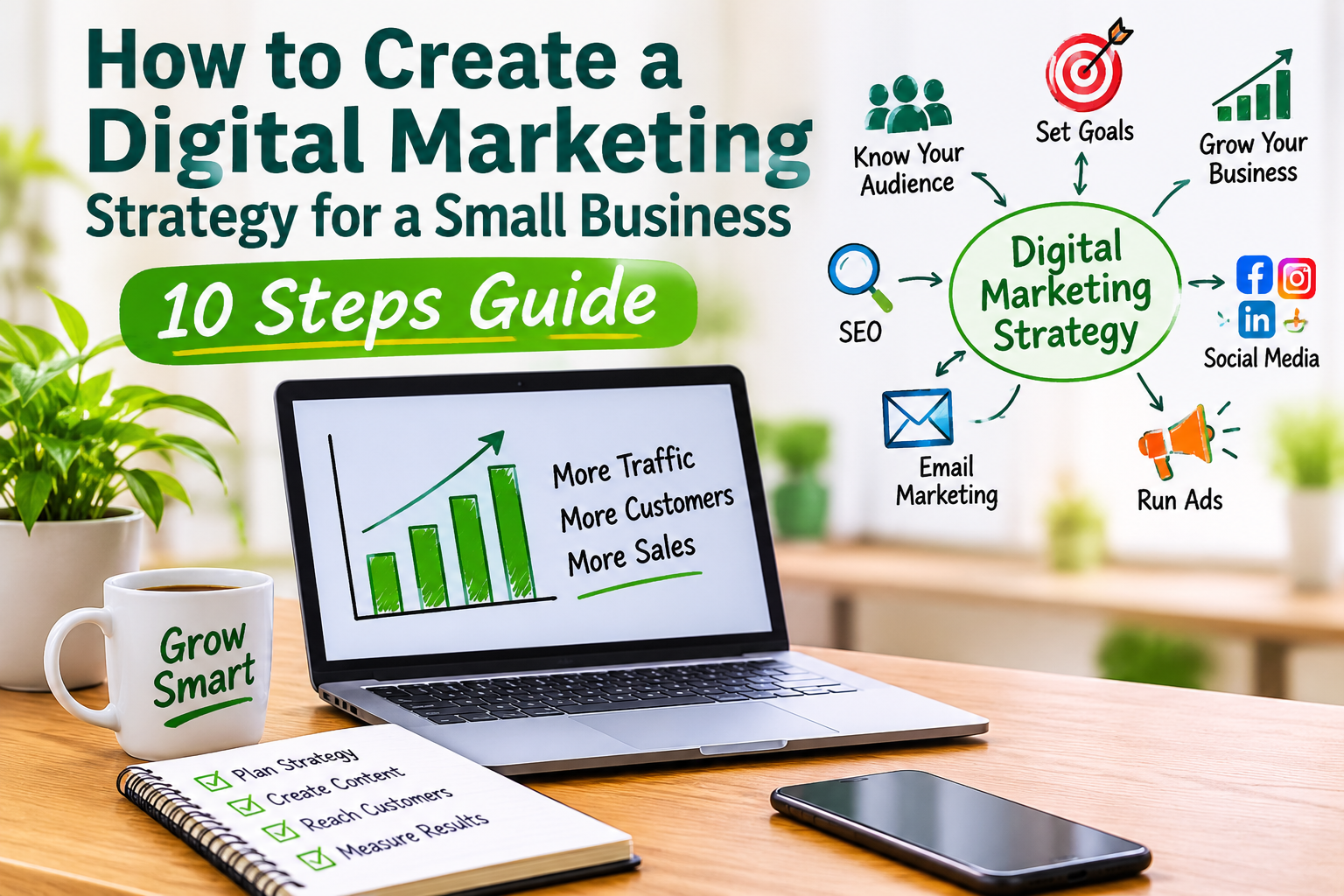
How to Create a Digital Marketing Strategy for a Small Business: 10 Steps Guide
A digital marketing strategy helps a small business attract potential customers, build brand awareness, generate enquiries, and increase sales through online channels.
Read the Full Guide →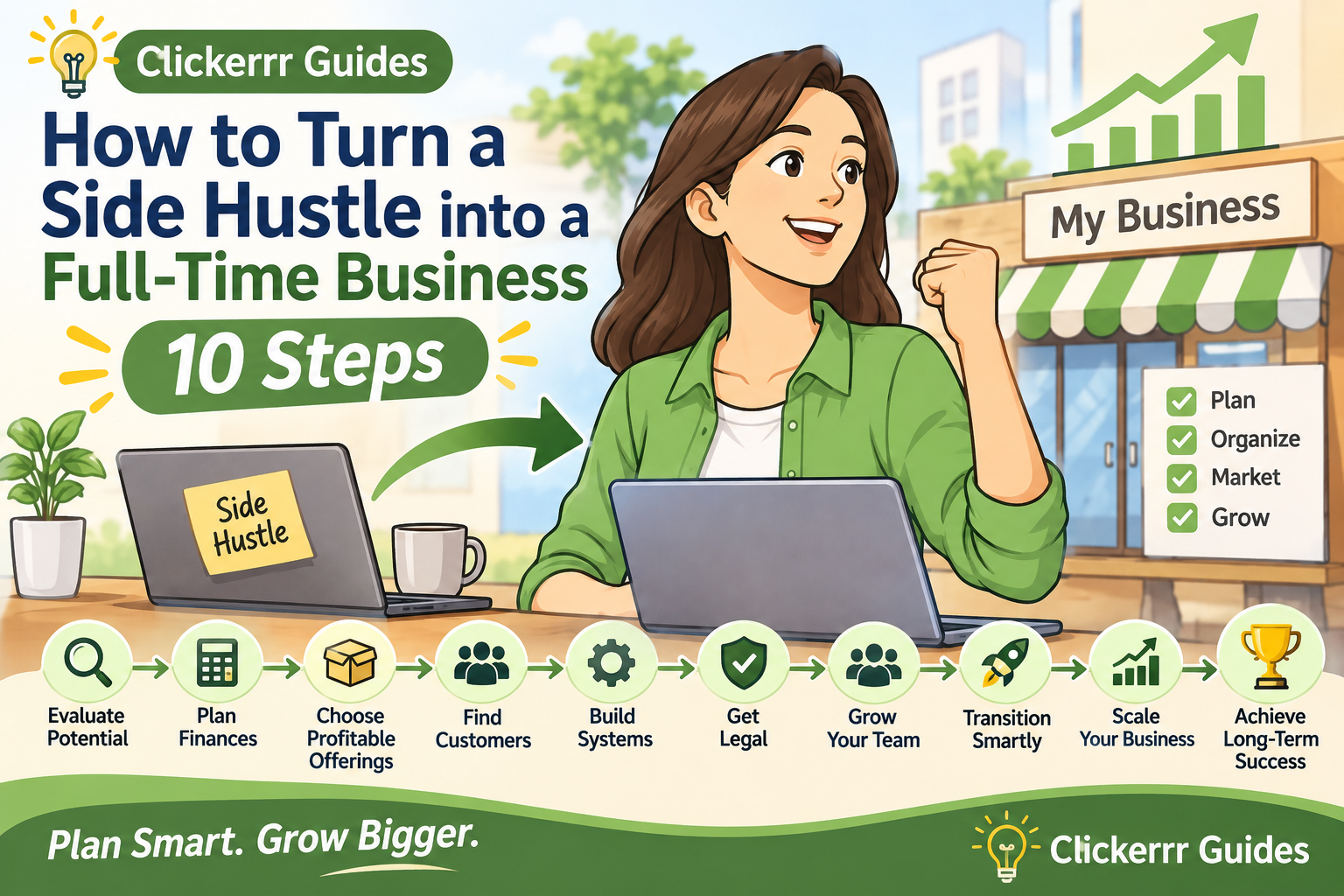
How to Turn a Side Hustle into a Full-Time Business: 10 Steps Guide
Turning a side hustle into a full-time business is an exciting opportunity to gain financial independence, build something of your own, and create a sustainable career. However, moving from a part-time activity to a full-time business requires more than simply increasing your working hours.
Read the Full Guide →
How to Grow a Small Business Faster: 10 Steps Guide
How to Grow a Small Business Faster: 10 Steps Guide? Growing a small business faster requires more than increasing sales or attracting new customers.
Read the Full Guide →
How to Start a Home-Based Business: 10 Steps Guide
Starting a home-based business is an attractive option for people who want to become entrepreneurs without investing heavily in commercial premises or maintaining a traditional office.
Read the Full Guide →