

What Is This Article About?
Differentiating your business from competitors means giving customers clear and meaningful reasons to choose your products or services instead of the alternatives available in the market. In a competitive business environment, simply offering a good product or providing a standard service may not be enough. Customers often compare businesses based on quality, pricing, convenience, customer experience, reputation, expertise, and the overall value they receive.
A strong business differentiation strategy helps you establish a distinctive market position, communicate your competitive advantages, attract the right customers, and build long-term customer loyalty. Your business does not necessarily need an entirely new product or groundbreaking technology. Sometimes, a better customer experience, specialized expertise, faster service, unique product features, or a more convenient buying process can create a meaningful competitive advantage.
Whether you operate a retail store, restaurant, professional service, consultancy, manufacturing business, or online company, identifying what makes your business different is essential for sustainable growth.
This guide explains how to differentiate your business from competitors through 10 practical steps, with actionable activities that can help you develop a distinctive and recognizable market position.
How to Differentiate Your Business from Competitors: 10 Steps
Follow these ten practical steps to identify your competitive advantages, strengthen your brand positioning, and create a business that customers can recognize and prefer.

Identify What Makes Your Business Unique
The first step towards business differentiation is understanding what your business can offer that customers may not easily find elsewhere. Examine your products, services, expertise, processes, business experience, and customer relationships. Your unique strengths may include specialized knowledge, exceptional product quality, personalized service, convenient delivery, innovative solutions, or a particular way of solving customer problems. You do not need to invent something completely new. Your competitive advantage may come from combining existing features in a way that provides greater value to a specific group of customers. Identify the strengths that are genuinely important to customers and that your business can consistently deliver.
- Evaluate your products and services: Identify the features, benefits, quality standards, and service elements that distinguish your offerings from competing alternatives.
- Identify your business expertise: Examine your professional experience, technical knowledge, specialized skills, industry understanding, and capabilities.
- Review your customer advantages: Determine whether your business offers greater convenience, personalized attention, faster delivery, or better customer support.
- Examine your existing achievements: Review customer feedback, successful projects, repeat purchases, testimonials, and other evidence of business strengths.
- Identify your strongest differentiator: Select the one or two advantages that customers value most and that competitors may find difficult to replicate.

Research Your Competitors and Their Market Position
Understanding your competitors helps you discover opportunities to position your business differently. Study businesses offering similar products or services and examine their pricing, product quality, marketing messages, customer reviews, delivery methods, and customer service. Look for areas where competitors perform well as well as areas where customers express dissatisfaction. These gaps may reveal opportunities to provide better value. Avoid copying competitors simply because they appear successful. Instead, use competitor research to understand what customers already receive and identify what your business could do differently or better. Effective competitive analysis helps you make informed positioning decisions rather than relying on assumptions.
- Identify your direct competitors: List businesses that offer similar products or services and target the same customer groups in your market.
- Study their products and pricing: Compare product features, service packages, quality, price ranges, warranties, and additional benefits.
- Examine their marketing strategies: Review their websites, social media accounts, advertisements, promotional messages, and brand positioning.
- Read customer reviews: Analyze online reviews and customer feedback to understand what people appreciate and what problems they frequently experience.
- Identify market gaps: Find customer needs, service expectations, or product requirements that competing businesses are not addressing effectively.

Focus on a Specific Target Customer Group
Trying to serve everyone can make it difficult for a business to establish a clear identity. A more effective approach is to understand a specific customer group and develop products, services, and experiences around its requirements. Customer specialization allows you to understand particular problems more deeply and provide solutions that are more relevant than general alternatives. For example, a clothing business could specialize in affordable formal wear for young professionals, while a consultancy could focus on helping small manufacturers improve their operations. A clearly defined target market also makes marketing communication more focused and helps customers recognize whether your business is suitable for their needs.
- Define your ideal customers: Identify relevant characteristics such as age group, profession, business type, location, purchasing behavior, and interests.
- Understand their major problems: Research the difficulties, frustrations, expectations, and unmet needs that influence their purchasing decisions.
- Segment your market: Divide potential customers into meaningful groups based on their requirements, budgets, preferences, and buying patterns.
- Select your primary customer segment: Choose a group whose needs match your business capabilities and whose requirements you can serve effectively.
- Adapt your offering: Modify product features, service packages, communication, and customer support to address the selected group’s priorities.

Deliver an Exceptional Customer Experience
Customer experience can become one of the strongest ways to differentiate your business. Customers remember more than the products they purchase. They also remember how easily they could contact your business, how professionally they were treated, whether their questions were answered, and how problems were resolved. A business that provides a consistently convenient, respectful, transparent, and reliable experience can develop stronger customer relationships. Examine every stage of the customer journey, from the first interaction and purchasing process to delivery, after-sales support, and complaint resolution. Improving these interactions can help your business stand out even when competitors offer similar products at comparable prices.
- Simplify the purchasing process: Make product information, pricing, ordering procedures, payment methods, and delivery arrangements easy to understand.
- Provide personalized attention: Understand individual customer requirements and recommend suitable products or services rather than using a one-size-fits-all approach.
- Respond promptly to enquiries: Establish practical communication procedures to answer questions and provide accurate information within reasonable timeframes.
- Resolve complaints professionally: Listen carefully, investigate customer concerns, explain solutions, and take corrective action where necessary.
- Improve the after-sales experience: Provide appropriate follow-up support, product guidance, maintenance information, and assistance after a purchase.

Develop Unique Products, Services, or Solutions
Product and service differentiation allows your business to provide something that customers can recognize as distinct and valuable. This does not always require expensive research or technological innovation. You could improve product quality, introduce useful features, combine complementary services, offer customized solutions, or make an existing service more convenient. The important consideration is whether the difference solves a genuine customer problem or improves the value customers receive. Avoid introducing unnecessary features simply to appear innovative. Focus on improvements that customers understand, appreciate, and are willing to pay for. Regular product development and service improvement can help your business remain relevant as customer expectations change.
- Identify product improvement opportunities: Examine customer complaints, product limitations, quality issues, and frequently requested features.
- Introduce meaningful customization: Offer suitable variations, personalized packages, flexible service options, or solutions designed around specific customer requirements.
- Combine complementary offerings: Develop useful product bundles or integrated services that solve multiple related customer problems.
- Test new ideas before launching: Use prototypes, sample offerings, pilot projects, or limited launches to evaluate customer interest and practical feasibility.
- Continuously improve quality: Collect feedback, monitor performance, and update your offerings to maintain consistent standards and customer satisfaction.

Build a Strong and Recognizable Brand Identity
Your brand identity influences how customers recognize, understand, and remember your business. A distinctive brand is more than a logo or attractive colour scheme. It includes your business values, personality, positioning, communication style, visual presentation, and the experience customers associate with your name. When these elements are consistent, customers can develop a clearer understanding of what your business represents. Decide what you want your brand to be known for and communicate that message consistently across your website, packaging, social media, advertisements, and customer interactions. A strong brand identity helps distinguish your business from competitors and supports long-term recognition and trust.
- Define your brand positioning: Decide what your business should represent in the minds of your target customers and which competitive advantage you want to emphasize.
- Create a consistent visual identity: Develop a recognizable logo, colour palette, typography, packaging style, and other visual elements.
- Develop a clear brand message: Explain what your business offers, whom it serves, and why customers should consider choosing it.
- Maintain consistent communication: Use a recognizable tone, message, and visual style across your website, marketing materials, and customer interactions.
- Deliver on your brand promise: Ensure that the actual quality and experience customers receive match the expectations created by your branding.

Create a Distinctive Pricing and Value Strategy
Pricing can influence how customers compare your business with competing alternatives. However, differentiation does not mean that you must always charge less than competitors. Competing exclusively on low prices can reduce profit margins and make it difficult to maintain quality. Instead, develop a pricing strategy that reflects the value customers receive, your operating costs, market conditions, and business positioning. You may differentiate through transparent pricing, flexible packages, premium quality, bundled services, convenient payment options, or different service levels. The objective is to communicate why your offering represents good value and ensure that customers understand the benefits associated with the price.
- Research competitor pricing: Compare market prices, product features, service inclusions, payment conditions, and additional charges.
- Understand your business costs: Calculate product costs, operating expenses, labour, distribution, marketing, and other expenses before setting prices.
- Develop different pricing packages: Consider basic, standard, and premium options that serve customers with different budgets and requirements.
- Communicate value clearly: Explain the quality, convenience, expertise, support, or additional benefits included in your offering.
- Review pricing performance: Monitor sales conversion, customer feedback, profit margins, and repeat purchases to evaluate your pricing strategy.

Use Technology and Innovation to Improve Your Business
Technology can help your business differentiate itself by improving convenience, accuracy, speed, accessibility, and operational efficiency. Even small businesses can use affordable digital tools to provide better customer experiences and streamline daily activities. Online ordering, digital payments, customer relationship management systems, automated communication, appointment scheduling, inventory management, and data analytics can improve how customers interact with your business. Technology becomes a competitive advantage when it solves practical problems rather than simply adding complexity. Select tools according to your business requirements, available budget, employee capabilities, and customer preferences.
- Identify operational inefficiencies: Find repetitive tasks, delays, communication gaps, and manual processes that affect customer service or business productivity.
- Establish a professional online presence: Maintain an informative website, accurate business information, and relevant digital communication channels.
- Introduce convenient digital services: Evaluate online ordering, digital payments, appointment booking, tracking, or other useful customer-facing features.
- Use automation where practical: Automate suitable repetitive activities such as reminders, invoice generation, customer follow-ups, and routine reporting.
- Measure the results: Evaluate whether new technology improves customer satisfaction, reduces delays, saves time, or lowers operating costs.

Build Trust Through Expertise, Reputation, and Relationships
Trust is an important competitive advantage because customers are more likely to choose businesses they consider reliable, knowledgeable, and professional. A strong reputation develops through consistent product quality, transparent communication, ethical business practices, dependable service, and positive customer experiences. Demonstrating expertise through educational content, useful guidance, case studies, and professional knowledge can also help customers understand your capabilities. In addition, strong relationships with customers, suppliers, industry professionals, and business partners can create opportunities that competitors may not easily replicate. Reputation takes time to develop, so focus on delivering consistent value rather than relying on promotional claims.
- Demonstrate your expertise: Share useful information, practical guidance, industry insights, and educational resources relevant to your customers.
- Maintain transparent business practices: Communicate accurate product information, pricing, delivery conditions, limitations, and service commitments.
- Collect genuine customer feedback: Encourage honest feedback and use it to identify opportunities for improvement in products and services.
- Develop professional relationships: Build reliable connections with suppliers, industry experts, complementary businesses, and relevant professional networks.
- Maintain consistent service quality: Ensure that every customer receives dependable service and that business promises are fulfilled.

Monitor Your Competitive Advantage and Keep Improving
Business differentiation is not a one-time activity. Customer preferences, market conditions, technology, and competitor strategies continue to change. A business that becomes complacent may gradually lose the advantages that once made it distinctive. Establish a regular process to measure customer satisfaction, repeat purchases, market position, product performance, and other indicators related to your differentiation strategy. Review whether customers actually recognize and appreciate the differences you are trying to create. Use feedback and performance data to identify weaknesses, refine your offerings, and respond to changing market requirements. Continuous improvement helps protect your competitive advantage and supports sustainable business growth.
- Define measurable performance indicators: Track relevant measures such as customer retention, repeat purchases, customer satisfaction, sales conversion, and product quality.
- Collect customer feedback regularly: Use surveys, conversations, reviews, complaints, and purchasing data to understand how customers perceive your business.
- Monitor competitor developments: Review changes in competitor products, prices, marketing activities, technology, and customer service.
- Evaluate your differentiation strategy: Determine whether your unique selling points continue to provide meaningful value and influence customer decisions.
- Update your business approach: Improve products, processes, communication, and customer experiences according to changing market requirements.
Practical Tips for Differentiating Your Business from Competitors
- Focus on customer value: Differentiate your business through benefits that customers genuinely appreciate rather than superficial differences.
- Avoid competing only on price: Build advantages through quality, expertise, convenience, specialization, and customer experience.
- Understand your market: Research competitors and customer requirements regularly to identify new differentiation opportunities.
- Keep your brand consistent: Communicate a clear and recognizable business identity across all customer touchpoints.
- Specialize where appropriate: Develop expertise in a specific customer segment, product category, or service area.
- Listen to customers: Use customer feedback to improve your offerings and identify unmet needs.
- Make realistic promises: Promote only those advantages your business can consistently deliver.
- Use technology strategically: Adopt digital tools that improve convenience, efficiency, and customer satisfaction.
- Build long-term relationships: Develop customer trust through reliable service, transparent communication, and consistent quality.
- Keep improving: Review your competitive position regularly and adapt to changing customer expectations.
Conclusion
Differentiating your business from competitors is essential for establishing a distinctive market position and creating long-term customer value. In competitive markets, businesses need more than ordinary products, standard services, or attractive prices. They need clear reasons why customers should recognize, trust, and choose them.
The ten steps in this guide provide a practical framework for developing a business differentiation strategy. Start by identifying your unique strengths, studying competitors, and understanding your target customers. Then improve customer experience, develop distinctive offerings, strengthen your brand, establish a suitable pricing strategy, and use technology to create additional value.
Remember that successful differentiation does not necessarily require a revolutionary invention or a large marketing budget. A small business can build a strong competitive advantage through specialized expertise, personalized attention, reliable service, consistent quality, and a better understanding of customer needs.
Start by identifying one meaningful difference your business can offer and make it a consistent part of the customer experience. Over time, continuous improvement and reliable delivery can help your business build a recognizable identity, stronger customer relationships, and a more sustainable competitive position.
10 FAQs – How to Differentiate Your Business from Competitors
What does it mean to differentiate your business from competitors?
Business differentiation means making your products, services, customer experience, or brand identity distinct from competing businesses. It gives customers a clear reason to choose your business over other available options.
Why is business differentiation important?
Business differentiation helps your company stand out in a crowded market. It can attract the right customers, build brand recognition, improve customer loyalty, reduce price-based competition, and support long-term business growth.
How can I identify what makes my business unique?
Start by examining your strengths, expertise, product quality, service standards, pricing, and customer feedback. Identify what your business does particularly well and determine which of those qualities matter most to your target customers.
How can a small business compete with larger companies?
A small business can compete by focusing on a specific customer group, offering personalized service, responding quickly, building strong local relationships, and solving customer problems that larger competitors may overlook.
Does offering lower prices help differentiate a business?
Not necessarily. Lower prices can attract price-sensitive customers, but they may reduce profit margins and make your business difficult to sustain. Differentiation through quality, convenience, expertise, reliability, or customer experience can create stronger long-term value.
How can I make my business different without spending a lot of money
Focus on affordable improvements such as better customer communication, faster responses, personalized service, useful product information, consistent branding, customer feedback, and a more convenient buying experience.
How does branding help a business stand out from competitors?
Branding creates a recognizable identity through your business name, logo, colours, messaging, values, and customer experience. Consistent branding helps customers remember your business and understand what makes it different.
How can customer service become a competitive advantage?
You can make customer service a competitive advantage by responding promptly, listening carefully, resolving complaints fairly, providing clear information, and maintaining relationships after a sale. A consistently positive experience encourages repeat purchases and referrals.
How often should a business review its competitive strategy?
A business should review its competitive strategy at least every three to six months. It should also reassess its approach when customer preferences, competitor activities, market conditions, or business performance change significantly.
What is the most effective way to build a sustainable competitive advantage?
Focus on a combination of customer understanding, consistent product or service quality, distinctive brand positioning, excellent customer experience, and continuous improvement. A sustainable advantage comes from delivering value that competitors find difficult to replicate.
More Guides from Clickerrr Guides
How to Manage Small Business Cash Flow: 10 Steps Guide
Cash flow is one of the most important aspects of running a successful small business. It represents the money moving into and out of your business during a particular period.
Read the Full Guide →
How to Start a Profitable E-Commerce Business: 10 Steps Guide
Starting an e-commerce business can be an attractive opportunity for entrepreneurs who want to sell products online and build a scalable business. With an online store, you can reach customers beyond your local area, showcase products around the clock, and manage sales through digital platforms.
Read the Full Guide →
How to Start a Service-Based Business
Follow practical steps to select a service, find your first clients, and build a sustainable business.
Read the Full Guide →
How to Write a Business Plan
Understand how to prepare a business plan, define your goals, and create a practical roadmap for your business.
Read the Full Guide →
How to Find a Profitable Business Niche
Getting your first 100 customers is one of the most important milestones when starting a new business. Whether you run an online business, a local shop, a service-based company, a freelance venture, or a startup, your first customers help you turn an idea into a real business.
Read the Full Guide →
How to Use AI to Grow a Small Business
Artificial intelligence (AI) is changing the way small businesses operate, market their products, serve customers, and compete in the digital marketplace.
Read the Full Guide →
How to Start an Online Business with No Experience
Starting an online business can be an exciting way to turn your skills, knowledge, interests, or business ideas into an income-generating opportunity. Unlike many traditional businesses, an online business can often be started from home with a computer, an internet connection, and a small initial investment.
Read the Full Guide →
How to Start a Small Business
Starting a small business can be an excellent way to turn your skills, knowledge, and ideas into a source of income. Whether you want to open a local shop, provide professional services, sell products online, or start a home-based business, the right approach can help you build a strong foundation. However, starting a business requires more than having a good idea.
Read the Full Guide →
How to Create a Digital Marketing Strategy for a Small Business: 10 Steps Guide
A digital marketing strategy helps a small business attract potential customers, build brand awareness, generate enquiries, and increase sales through online channels.
Read the Full Guide →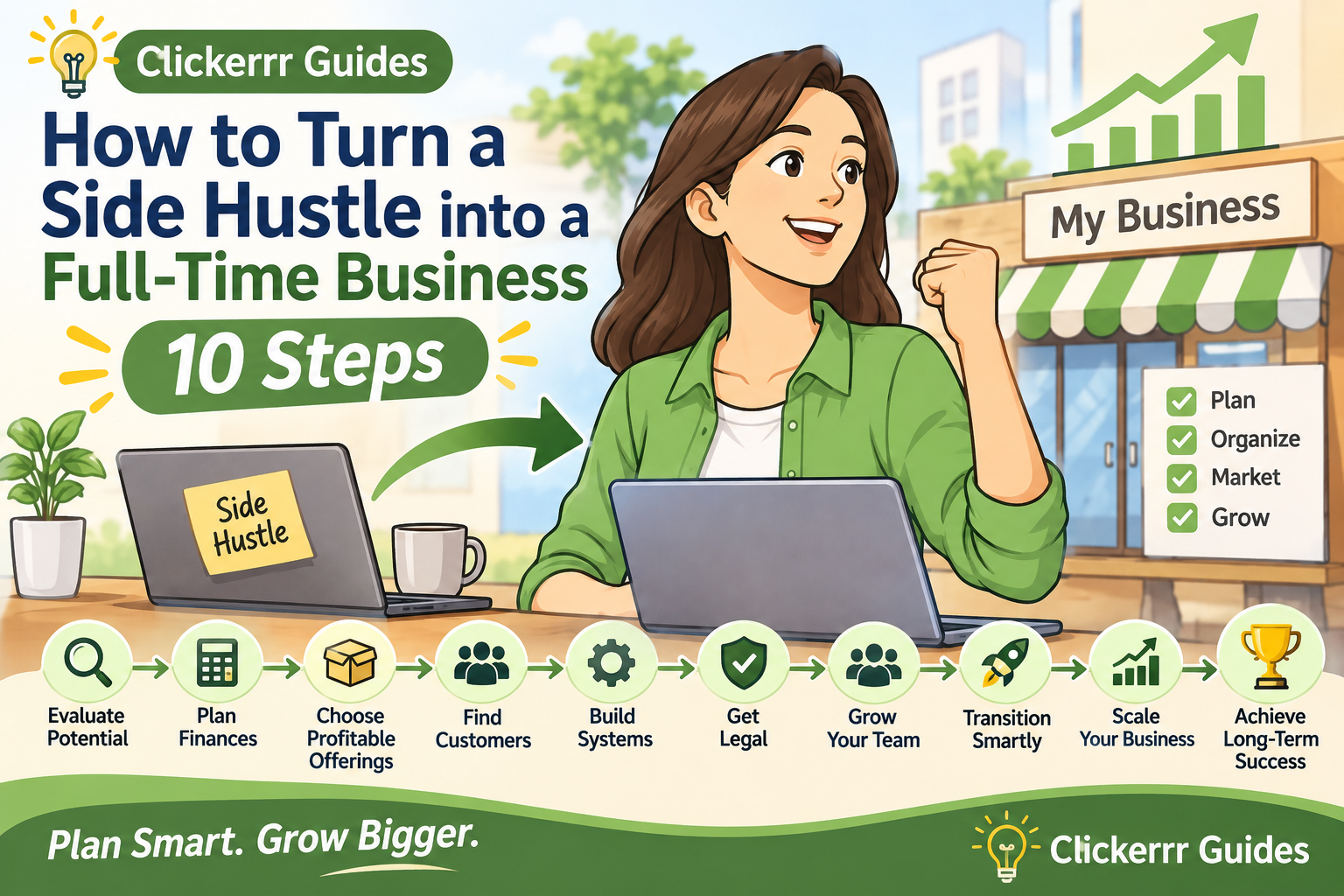
How to Turn a Side Hustle into a Full-Time Business: 10 Steps Guide
Turning a side hustle into a full-time business is an exciting opportunity to gain financial independence, build something of your own, and create a sustainable career. However, moving from a part-time activity to a full-time business requires more than simply increasing your working hours.
Read the Full Guide →
How to Grow a Small Business Faster: 10 Steps Guide
How to Grow a Small Business Faster: 10 Steps Guide? Growing a small business faster requires more than increasing sales or attracting new customers.
Read the Full Guide →
How to Start a Home-Based Business: 10 Steps Guide
Starting a home-based business is an attractive option for people who want to become entrepreneurs without investing heavily in commercial premises or maintaining a traditional office.
Read the Full Guide →