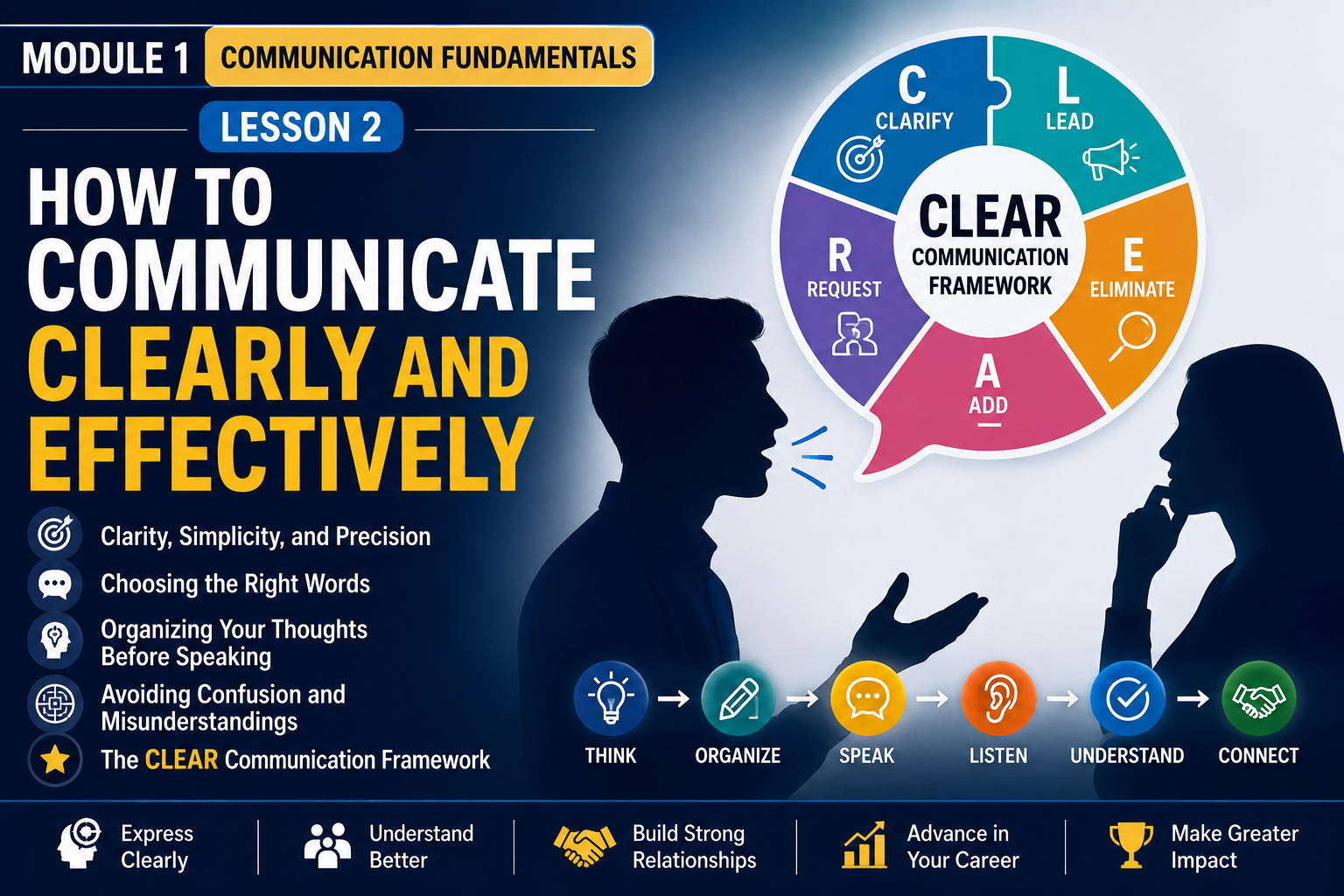
Don’t just say it. Make it easy to understand.
Have you ever explained something perfectly in your own mind—only to discover that the other person understood something completely different?
You said:
“I’ll do it soon.”
They understood:
“I’ll do it today.”
You meant:
“I’ll do it when I get some free time.”
The problem was not necessarily vocabulary.
The problem was clarity.
Effective communication is not about using impressive words, speaking for a long time, or sounding intelligent.
It is about making the intended meaning easy to understand, difficult to misinterpret, and easy to act upon.
That is the skill this lesson will help you develop.
1. The Difference Between Saying Something and Saying It Clearly
Consider these two messages:
Message A
“We should probably try to finish this as soon as possible.”
Message B
“Please send the final report by 4:00 PM today.”
Which one is easier to act on?
Obviously, Message B.
Why?
Because it answers the questions that matter:
What?
Final report
When?
4:00 PM
By when?
Today
This leads to an important principle:
Clarity reduces the amount of guessing required from the listener.
The more guessing your message requires, the greater the possibility of misunderstanding.
2. The Three Pillars of Clear Communication
A clear message has three fundamental qualities:
                 CLEAR COMMUNICATION
                         │
          ┌──────────────┼──────────────┐
          ↓              ↓              ↓
       CLARITY        SIMPLICITY      PRECISION
          │              │              │
       Easy to         Easy to       Exact enough
       understand      process       to act on
① Clarity — “What exactly do you mean?”
Your message should communicate the intended meaning without unnecessary ambiguity.
Instead of:
“We need to improve the situation.”
Say:
“We need to reduce customer response time from 24 hours to 12 hours.”
The second statement tells people what improvement actually means.
② Simplicity — “Can I understand it quickly?”
Simplicity does not mean making your ideas shallow.
It means removing unnecessary complexity.
Instead of:
“We are currently in the process of implementing a comprehensive strategy designed to facilitate improvements in customer engagement.”
Say:
“We are developing a strategy to improve customer engagement.”
Same basic idea.
Less cognitive effort.
Remember:
Simple language can carry sophisticated ideas.
③ Precision — “Exactly what?”
Precision removes uncertainty.
Compare:
“Come early.”
with:
“Please arrive by 8:45 AM.”
Or:
“Send me the details.”
with:
“Please send the final price, delivery date, and payment terms.”
Precision becomes especially important when:
Giving instructions
Setting deadlines
Assigning responsibilities
Discussing money
Making commitments
Giving feedback
Handling important decisions
3. The Clarity Pyramid
Think of communication as a pyramid.
                    ▲
                   / \
                  /   \
                 /     \
                /PRECISION\
               /-----------\
              /  SIMPLICITY \
             /---------------\
            /     CLARITY      \
           /_____________________\
Start with clarity.
Then simplify the message.
Then add enough precision to make the message actionable.
The goal is not:
“Say as little as possible.”
The goal is:
“Say exactly what is necessary, in the easiest form to understand.”
4. Choosing the Right Words
Words are tools.
The right word can clarify an idea.
The wrong word can create confusion.
Compare:
| Vague Word/Phrase | Better Alternative |
|---|---|
| Soon | By 3 PM today |
| Later | After lunch |
| A lot | 25 units |
| Some changes | Three changes |
| Improve | Reduce waiting time |
| Thing | Customer report |
| Better | Faster and more reliable |
| Maybe | I need to confirm by Friday |
| ASAP | By 5 PM today |
| Regularly | Every Monday |
This does not mean you should eliminate every conversational word such as “soon” or “later.”
Context matters.
The principle is:
Use precise language when precision matters.
5. The “Vague → Specific” Transformation
One of the fastest ways to improve communication is to train yourself to recognize vague language.
Example 1
❌ “Your presentation needs some improvement.”
What exactly should improve?
Better:
✅ “Your presentation has strong content, but the slides contain too much text. Reduce each slide to the main three points.”
Example 2
❌ “Please take care of the customer issue.”
Better:
✅ “Please call the customer, understand the problem, and send me an update before 2 PM.”
Example 3
❌ “We need to market this better.”
Better:
✅ “We need to increase website traffic by creating three educational posts every week for the next month.”
The pattern
VAGUE IDEA
    ↓
What exactly?
    ↓
WHO?
WHAT?
WHEN?
WHERE?
HOW?
    ↓
SPECIFIC MESSAGE
Whenever you notice yourself using a vague phrase, ask:
“Can I make this more specific?”
6. Organize Your Thoughts Before You Speak
One of the biggest causes of unclear communication is disorganized thinking.
The speaker knows what they want to say, but the ideas come out in random order.
For example:
“Actually, I was thinking that maybe we could change the design because yesterday I noticed that the users weren’t really clicking on it, although I’m not completely sure, but perhaps if we…”
The listener has to work too hard.
Instead, organize the thought first.
Use this simple sequence:
POINT → REASON → ACTION
Example
Point:
“We should change the homepage design.”
Reason:
“Visitors are not noticing the main course categories.”
Action:
“Let’s test a simpler layout this week.”
Now the listener can follow the logic.
             YOUR IDEA
                 ↓
               POINT
                 ↓
               REASON
                 ↓
               ACTION
                 ↓
          CLEAR MESSAGE
7. The 3-Second Thought Organizer
Before an important statement, take a short pause and mentally ask:
1. What is my main point?
2. Why does it matter?
3. What do I want the listener to do or understand?
Then speak.
This tiny pause can dramatically improve your communication.
Instead of speaking while thinking:
Think → Organize → Speak
rather than:
Speak → Think → Correct → Explain → Apologize → Clarify
8. The One-Sentence Test
Here is a powerful exercise.
Before explaining a complicated idea, try to summarize it in one sentence.
For example:
Instead of:
“There are several things happening with the project, and we’ve been looking at the numbers and there are some concerns regarding the timeline…”
Try:
“The project is three days behind schedule, and we need two additional people to finish on time.”
Once your main sentence is clear, add supporting details.
Structure:
              MAIN POINT
                  ↓
          Supporting Detail 1
                  ↓
          Supporting Detail 2
                  ↓
            Example / Data
                  ↓
              ACTION
This prevents the listener from getting lost.
9. Avoid the “Information Dump”
A common mistake is giving people everything you know instead of giving them what they need.
Imagine someone asks:
“What time is the meeting?”
You respond with:
“The meeting was originally planned for Tuesday, but then because of the availability of the team and some other scheduling issues, we had to reconsider…”
The listener only wanted:
“10 AM tomorrow.”
Information ≠ Communication
More information can sometimes create less understanding.
A better approach:
Give the answer first. Add context second.
10. The “Answer First” Technique
For important communication, especially professional communication, start with the main answer.
Weak structure
Background → History → Explanation → More explanation → Answer
Strong structure
Answer → Reason → Relevant details → Next step
Example:
“Yes, we can complete the project by Friday.
We have already finished three of the four major components.
The remaining testing should take two days.
I’ll send you the final version by 5 PM Friday.”
The listener knows the answer immediately.
11. Avoid Communication Traps
Some communication habits repeatedly create misunderstandings.
Trap 1: Ambiguous Pronouns
“Tell him that they will send it to her.”
Who is “him”?
Who is “they”?
Who is “her”?
Better:
“Please tell Rahul that the finance team will send the invoice to Priya.”
Trap 2: Unclear Deadlines
“I’ll send it tomorrow.”
Tomorrow morning?
Afternoon?
End of day?
Better:
“I’ll send it by 5 PM tomorrow.”
Trap 3: Hidden Requests
“The room is getting quite noisy.”
Is this:
An observation?
A complaint?
A request to reduce the noise?
If you want action:
“Could we lower the volume, please?”
Trap 4: Too Many Ideas in One Sentence
❌
“We should redesign the website because the current one isn’t working well and maybe add more courses and improve the navigation and perhaps change the colors…”
Better:
“I recommend three changes: redesign the homepage, simplify navigation, and reorganize the course categories.”
Trap 5: Jargon
Don’t use specialized language simply to sound knowledgeable.
Ask:
“Will this person understand this term?”
If not, translate it into ordinary language.
12. The “Could This Be Misunderstood?” Test
Before sending an important message, pause and ask:
“Could a reasonable person interpret this differently from what I intend?”
If yes, rewrite it.
Example
“Please review the document.”
Possible meanings:
Check grammar
Check facts
Check design
Approve it
Suggest changes
Better:
“Please review the document for factual errors and send me your corrections by 3 PM.”
Now the task is much clearer.
13. The CLEAR Communication Framework
Now we bring everything together.
Our signature framework for this course is:
C.L.E.A.R.
       C — CLARIFY
       L — LEAD WITH THE MAIN POINT
       E — ELIMINATE AMBIGUITY
       A — ADD RELEVANT CONTEXT
       R — REQUEST / REVIEW
Let’s examine each step.
C — Clarify Your Purpose
Before communicating, ask:
“Why am I saying this?”
Are you trying to:
Inform?
Explain?
Request?
Persuade?
Solve?
Warn?
Teach?
Connect?
One message can have multiple purposes, but usually one is dominant.
Example
Instead of beginning with a long explanation:
“I wanted to talk to you about something that happened…”
Identify the purpose:
“I want to discuss yesterday’s deadline and find a way to prevent the delay from happening again.”
Now the conversation has direction.
L — Lead With the Main Point
Don’t make people search for your message.
Give them the headline first.
Instead of:
“There are a few things we’ve noticed over the past couple of weeks…”
Say:
“Customer response time has increased significantly, and we need to fix it.”
Then explain why.
Formula:
MAIN POINT → SUPPORT → DETAILS
This is especially powerful for:
Meetings
Presentations
Emails
Reports
Interviews
Management conversations
E — Eliminate Ambiguity
Look for words that could have multiple interpretations.
Watch for:
Soon
Later
Maybe
Some
Many
Better
Quickly
Regularly
ASAP
They
It
This
That
Replace them with specific information when necessary.
Example
❌ “Let’s finish this quickly.”
✅ “Let’s finish the first draft by Wednesday.”
A — Add Relevant Context
Clarity does not mean removing all context.
Sometimes the listener needs to know why.
Use context strategically.
Example
“Please move the meeting to 3 PM because the client is available only during that hour.”
Now the request makes sense.
But avoid:
Background → History → Personal story → Unnecessary details → Request
Instead:
Request → Relevant reason → Necessary detail
R — Request or Review
A strong communicator does not simply send a message and assume success.
End with one of two things:
Request
Tell the person what you need.
“Please confirm by 4 PM.”
“Could you send me the revised document?”
“I’d like you to review these three points.”
Review
Check whether the message was understood.
“Does that make sense?”
“What questions do you have?”
“Could you repeat the deadline so we’re aligned?”
This creates a feedback loop.
The Complete CLEAR Model
                 C.L.E.A.R.
                    │
                    ▼
              C — CLARIFY
          Why am I communicating?
                    ↓
                L — LEAD
          What's my main point?
                    ↓
              E — ELIMINATE
          What could be misunderstood?
                    ↓
                 A — ADD
          What context is necessary?
                    ↓
                R — REQUEST
           What happens next?
                    ↓
          EFFECTIVE COMMUNICATION
Memorize this:
Clarify → Lead → Eliminate → Add → Request
14. CLEAR in Action
Let’s transform a weak message.
Before
“Hi, just wanted to let you know that there are some changes that we might need to make to the presentation because the client has given us some feedback and we should probably update it soon.”
What’s wrong?
No clear main point
“Some changes” is vague
“Soon” is vague
No specific action
No deadline
Apply CLEAR
C — Clarify
Purpose: Tell the designer to update the presentation.
L — Lead
“The client has requested three changes to the presentation.”
E — Eliminate ambiguity
Specify the changes.
A — Add context
Explain why they matter.
R — Request
Give a deadline.
After
“The client has requested three changes to the presentation: simplify slides 4 and 5, replace the current chart, and add the revised pricing. Please make these updates and send me the final version by 3 PM tomorrow.”
Notice the difference.
Same basic situation.
Completely different communication quality.
15. CLEAR for Everyday Conversations
The framework isn’t only for workplaces.
Situation: A friend is late.
Instead of:
“You are always late.”
Use CLEAR:
Clarify: I want to address the repeated delays.
Lead:
“I’d like us to start meeting on time.”
Eliminate ambiguity:
“When we agree to meet at 7, I’d like us both to arrive around 7.”
Add context:
“I’ve been waiting 20–30 minutes several times recently.”
Request:
“Can we agree to let each other know if we’re going to be more than 10 minutes late?”
That’s clearer, less accusatory, and more actionable.
16. CLEAR for Emails
Before sending an important email, check:
C — Clarify
What is the purpose?
L — Lead
Is the main point visible immediately?
E — Eliminate
Could anything be misunderstood?
A — Add
Have I included the necessary context?
R — Request
Is the required action and deadline clear?
Example
Subject: Revised Presentation — Approval Required by Friday
I’ve completed the revised presentation and incorporated the client’s three requested changes.
Please review slides 4–8 and confirm your approval by 5 PM Friday.
If you recommend further changes, please mark them directly in the file.
Short.
Clear.
Actionable.
17. The 10-Second Message Test
Before sending a message, ask:
Can the recipient understand these five things within 10 seconds?
1. What is this about?
2. What is the main point?
3. What do you need from me?
4. When do you need it?
5. Is anything important missing?
If the answer is yes, your message is probably well structured.
18. Your Practical Challenge: Rewrite the Message
Try improving this message yourself:
“Hi, we need to do something about the website because there are some issues and the users don’t seem to be happy, so please look into it and make it better as soon as possible.”
Your task
Rewrite it using the CLEAR framework.
Think about:
What is the actual problem?
What needs to change?
What does “better” mean?
What action is required?
What is the deadline?
One possible improved version
“The website’s checkout page is causing users to abandon their purchases. Please review the page, identify the three biggest usability problems, and send me your recommendations by Thursday.”
Notice:
Vague → Specific
General → Actionable
Long → Focused
19. A Daily Exercise to Build Communication Muscle
For the next seven days, take one message per day and improve it.
Day 1
Find a vague message and make it specific.
Day 2
Take a long sentence and simplify it.
Day 3
Put the main point first.
Day 4
Remove unnecessary jargon.
Day 5
Add a clear deadline or action.
Day 6
Ask someone to explain how they understood one of your messages.
Day 7
Use the complete CLEAR Framework.
At the end of seven days, compare your communication with how you communicated before the exercise.
20. The Golden Rule of Clear Communication
Here is the principle you should carry with you beyond this course:
Don’t make the listener do unnecessary work to understand you.
Your listener should not have to:
Guess what you mean
Search for the main point
Decode jargon
Infer the deadline
Figure out what action you want
Separate important information from unnecessary information
Your job as a communicator is to make understanding easier.
21. Lesson Summary
Let’s compress this entire lesson into one visual:
          EFFECTIVE COMMUNICATION
                    │
                    ▼
             KNOW YOUR PURPOSE
                    │
                    ▼
            ORGANIZE YOUR IDEA
                    │
                    ▼
             SAY THE MAIN POINT
                    │
                    ▼
          USE SIMPLE, PRECISE WORDS
                    │
                    ▼
          REMOVE POSSIBLE AMBIGUITY
                    │
                    ▼
            ADD RELEVANT CONTEXT
                    │
                    ▼
             STATE NEXT ACTION
                    │
                    ▼
            CHECK UNDERSTANDING
                    │
                    ▼
                CONNECTION
The five things to remember
1. Clarity
Make your meaning easy to understand.
2. Simplicity
Remove unnecessary complexity.
3. Precision
Give enough detail to eliminate uncertainty.
4. Structure
Organize your thoughts before speaking.
5. Feedback
Don’t assume understanding—check it.
⚡ Your Communication Upgrade
From today, replace:
“Did I say everything I wanted to say?”
with:
“Did I make it easy for the other person to understand what matters?”
That single change can transform the way you communicate.
Remember the framework:
C — Clarify
L — Lead
E — Eliminate
A — Add
R — Request
CLEAR communication is not about saying more.
It is about creating more understanding with fewer unnecessary words.
🎯 Coming Next: Module 2 — Speak With Confidence
In the next module, we move from clear communication to confident communication.
You will learn how to control nervousness, develop a confident voice, speak without excessive hesitation, and communicate your ideas with greater presence.