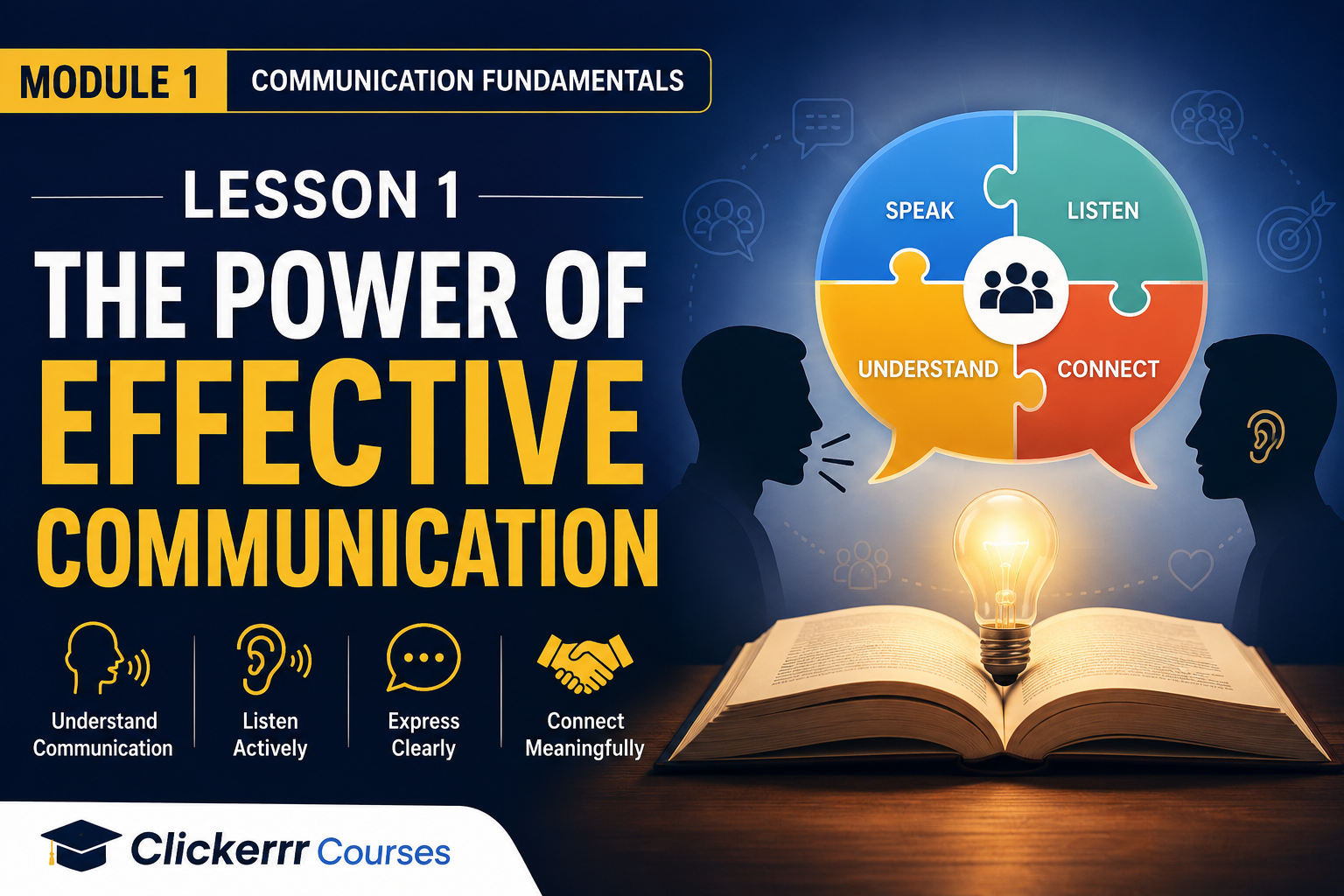
Lesson 1: The Power of Effective Communication
Speak. Listen. Understand. Connect.
Think about the most successful person you know.
It may be a leader, teacher, entrepreneur, doctor, manager, salesperson, parent, or friend.
Now ask yourself:
What makes that person effective?
Knowledge? Intelligence? Experience? Confidence?
Probably all of them.
But there is one skill that connects almost everything they do:
The ability to communicate.
You can have an excellent idea—but if you cannot explain it, people may not understand it.
You can have exceptional knowledge—but if you cannot communicate it, others may never recognize its value.
You can care deeply about someone—but if you cannot express yourself or understand them, the relationship can still suffer.
That is why communication is not merely a “soft skill.”
Communication is a life skill.
It influences how people understand you, trust you, work with you, respond to you, and remember you.
1. What Communication Really Means
Most people think communication means:
“I said something, and the other person heard it.”
That is only the beginning.
Communication is better understood as:
The process of creating shared understanding between people.
The key word is understanding.
A simple formula
Communication = Message + Meaning + Understanding + Response
For example:
You tell a colleague:
“Please send me the report soon.”
You have delivered a message.
But what does “soon” mean?
In 10 minutes?
By lunchtime?
By the end of the day?
Tomorrow?
The words were delivered.
But the meaning was unclear.
Therefore:
Message ≠ Communication
Communication becomes effective when the intended meaning is understood sufficiently by the receiver.
2. Communication Is More Than Words
When we communicate, we use several channels simultaneously.
The Communication Triangle
                 COMMUNICATION
                       │
        ┌──────────────┼──────────────┐
        ↓              ↓              ↓
      WORDS           VOICE        BEHAVIOR
   What you say     How you say   What you show
        │              │              │
        └──────────────┼──────────────┘
                       ↓
                 OVERALL MESSAGE
                       ↓
                  UNDERSTANDING
Your communication includes:
🗣️ Verbal communication
The actual words you use.
Examples:
“I understand.”
“I disagree.”
“Could you explain that again?”
🎙️ Vocal communication
How your voice sounds.
This includes:
Tone
Pace
Volume
Pauses
Emphasis
Compare:
“That’s fine.”
It can communicate completely different meanings depending on your tone.
👀 Non-verbal communication
Your body may communicate before you say anything.
Examples:
Eye contact
Facial expression
Posture
Gestures
Physical distance
Attention
Someone saying “I’m listening” while constantly looking at their phone is sending two different messages.
3. Why Communication Matters in Personal Life
Communication is the infrastructure of relationships.
Think about relationships you value.
They depend on your ability to:
Express your thoughts
Understand another person’s perspective
Ask for what you need
Set boundaries
Resolve disagreements
Show appreciation
Apologize
Listen
Give emotional support
Consider this situation:
A friend becomes unusually quiet.
You think:
“They’re probably angry with me.”
Instead of asking, you stop talking to them.
They notice your distance and think:
“Maybe they’re upset with me.”
Now both people are making assumptions.
No one has communicated.
The result?
A problem that could have been solved with one question becomes a relationship problem.
A simple alternative:
“You seem a little quiet today. Is everything okay?”
One question can replace a large amount of guessing.
4. Why Communication Matters in Professional Life
In the workplace, communication affects almost everything.
Communication influences:
| Area | Why Communication Matters |
|---|---|
| Leadership | Leaders must explain direction and expectations |
| Teamwork | Teams need coordination and information sharing |
| Customer service | Customers need to feel heard and understood |
| Sales | Value must be communicated clearly |
| Meetings | Ideas must be presented efficiently |
| Negotiation | Interests and expectations must be understood |
| Problem-solving | Problems must be described accurately |
| Feedback | People need specific, constructive feedback |
| Career growth | Visibility and professional relationships matter |
| Conflict | Disagreements require productive dialogue |
A powerful workplace equation
Clear Communication → Fewer Misunderstandings → Better Coordination → Better Results
Poor communication often creates hidden costs:
Unclear instruction
↓
Wrong interpretation
↓
Wrong action
↓
Rework
↓
Wasted time
↓
Frustration
Effective communication can interrupt this chain at the very beginning.
5. The Communication Process
Communication is not a one-way event.
It is a dynamic process.
The Communication Loop
             ┌───────────────┐
             │    SENDER     │
             └───────┬───────┘
                     ↓
                  INTENT
                     ↓
                  ENCODE
                     ↓
                  MESSAGE
                     ↓
                  CHANNEL
                     ↓
             ┌───────▼───────┐
             │   RECEIVER    │
             └───────┬───────┘
                     ↓
                  DECODE
                     ↓
             INTERPRETATION
                     ↓
                  RESPONSE
                     │
                     └──────────────┐
                                    ↓
                              FEEDBACK
                                    │
                                    └──→ SENDER
Let’s understand each stage.
① Sender
The person who initiates the communication.
Example:
A manager wants an employee to complete a task.
② Intent
What does the sender actually want to communicate?
This is often overlooked.
Before speaking, ask:
“What exactly do I want the other person to understand or do?”
③ Encoding
The sender converts the idea into:
Words
Images
Gestures
Tone
Written text
④ Message
The actual communication being sent.
⑤ Channel
How the message travels.
Examples:
Face-to-face
Phone
Email
WhatsApp
Video meeting
Presentation
⑥ Receiver
The person receiving the message.
⑦ Decoding
The receiver interprets the message.
This is where problems frequently occur.
The sender may mean one thing.
The receiver may understand something else.
⑧ Feedback
The receiver responds.
Feedback tells the sender whether the message was understood.
6. The Hidden Problem: Meaning Is Not Automatically Transferred
Imagine this:
A manager says:
“I need this quickly.”
The employee thinks:
“By tomorrow morning.”
The manager actually meant:
“Within the next hour.”
Both people heard the same sentence.
But they created different meanings.
This demonstrates a fundamental principle:
People don’t respond only to what you say. They respond to what they understand.
Therefore, effective communicators don’t merely send messages.
They check understanding.
7. The Five Most Common Communication Barriers
Communication can fail even when both people have good intentions.
Here are five major barriers.
Barrier 1: Assumptions
We assume we know what another person means.
Example
Your colleague doesn’t reply to your message.
You think:
“They’re ignoring me.”
Possible reality:
They’re in a meeting.
They didn’t see the message.
Their phone battery died.
They are dealing with an urgent problem.
Better approach
Replace:
Assumption
with:
Clarification
Ask before concluding.
Barrier 2: Poor Listening
Many people listen while preparing their response.
They are not actually processing what the other person is saying.
The difference
Waiting to speak ≠ Listening
Active listening means:
Understanding before responding.
Barrier 3: Emotional Noise
Strong emotions can distort communication.
Examples:
Anger
Fear
Anxiety
Frustration
Embarrassment
Excitement
When emotions are high, people may:
Speak too quickly
Misinterpret neutral statements
Become defensive
Interrupt
Use aggressive language
Rule
When emotion rises, communication accuracy often falls.
A short pause can sometimes prevent a long conflict.
Barrier 4: Jargon and Complexity
You may understand a subject extremely well.
That does not mean everyone else understands your terminology.
For example, instead of saying:
“We need to optimize the conversion funnel.”
you might say:
“We need to make it easier for visitors to become customers.”
Effective communication is not about sounding intelligent.
It is about being understood.
Barrier 5: Information Overload
More information does not always produce more understanding.
Imagine receiving a 20-paragraph message when you only need three pieces of information:
What needs to be done?
Who will do it?
When is it due?
The message contains information.
But the important information is buried.
Better communication:
Essential → Relevant → Organized → Actionable
8. Talking vs Communicating vs Connecting
These three words may sound similar.
They are not.
🗣️ Talking
You are producing words.
Focus: Expression
Example:
“I explained everything to him.”
But did he understand?
Not necessarily.
💬 Communicating
You are intentionally exchanging information and meaning.
Focus: Understanding
Example:
“I explained the task and asked him to repeat the key requirements.”
Now there is a feedback loop.
🤝 Connecting
You create understanding plus trust, empathy, and relationship.
Focus: Human connection
Example:
“I understood what he was concerned about, acknowledged it, and worked with him to find a solution.”
The Communication Ladder
          CONNECTING
              ▲
              │
       COMMUNICATING
              ▲
              │
           TALKING
Or think of it this way:
Talking = “I said something.”
Communicating = “You understood me.”
Connecting = “You understood me, I understood you, and we built trust.”
The goal is not to become a person who talks more.
The goal is to become a person who connects better.
9. A Real-Life Example
Imagine a team member submits work late.
Version A — Talking
Manager:
“You are always late with your work.”
The employee becomes defensive.
Version B — Communicating
Manager:
“The report was due yesterday, and I received it this morning. What caused the delay?”
Now the manager is seeking information.
Version C — Connecting
Manager:
“The report came in a day late. I know you’ve had several deadlines this week. What made this one difficult to complete, and how can we make sure the next one is on time?”
Now there is:
Clarity
Curiosity
Empathy
Accountability
Problem-solving
That is communication at a higher level.
10. The 4C Test for Effective Communication
Before sending an important message, run it through this simple test:
C — Clear
Will the person understand exactly what I mean?
C — Concise
Can I remove unnecessary information?
C — Complete
Have I provided everything necessary?
C — Considerate
Have I considered the other person’s perspective?
             YOUR MESSAGE
                  │
        ┌─────────┼─────────┐
        ↓         ↓         ↓
      CLEAR    CONCISE   COMPLETE
        \         |         /
         \        |        /
          └── CONSIDERATE ─┘
                  ↓
          EFFECTIVE MESSAGE
Use this especially for:
Important emails
Instructions
Feedback
Difficult conversations
Workplace messages
Presentations
11. The “Communication Gap” Exercise
Here is a quick practical exercise.
Think about one recent conversation that did not go as expected.
Write down:
1. What did I want to communicate?
2. What exactly did I say?
3. What did the other person probably understand?
4. What response did I receive?
5. Where might the communication gap have occurred?
6. What could I have said or done differently?
This exercise changes communication from an abstract concept into a skill you can observe and improve.
12. Your First Communication Challenge
For the next 24 hours, practice one simple habit:
Replace one assumption with one question.
Instead of thinking:
“They don’t care.”
Ask:
“Is there something I’m missing?”
Instead of:
“They didn’t understand.”
Ask:
“Which part would you like me to explain?”
Instead of:
“They’re angry.”
Ask:
“Is something bothering you?”
Instead of:
“They know what I mean.”
Ask:
“Does that make sense?”
This tiny habit can dramatically improve communication.
13. Key Takeaways
Remember these five ideas:
1. Communication is about understanding—not merely speaking.
2. Your message includes more than words.
Your tone, body language, timing, and behavior also communicate.
3. Communication is a two-way process.
Send → Receive → Interpret → Respond → Feedback
4. Assumptions are one of communication’s biggest enemies.
When in doubt:
Ask. Don’t assume.
5. The highest level of communication is connection.
Talking → Communicating → Connecting
⚡ 60-Second Communication Check
Before your next important conversation, ask yourself:
What do I want them to understand?
What is the simplest way to say it?
How might they interpret it?
Am I actually listening to their response?
Have I created understanding—or merely delivered words?
That last question is the one to remember throughout this entire course.
Communication is successful not when you have spoken, but when understanding has been created.