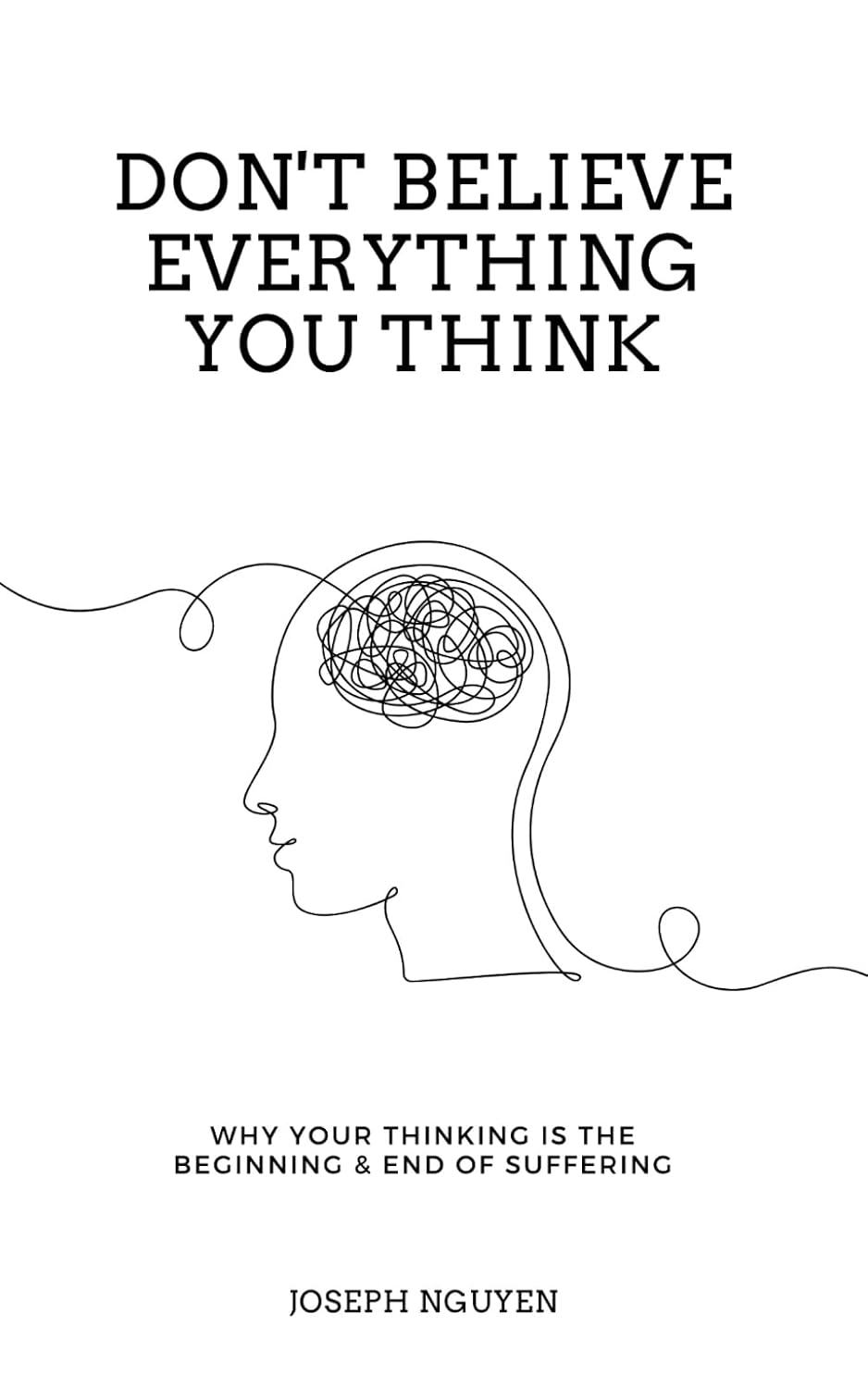
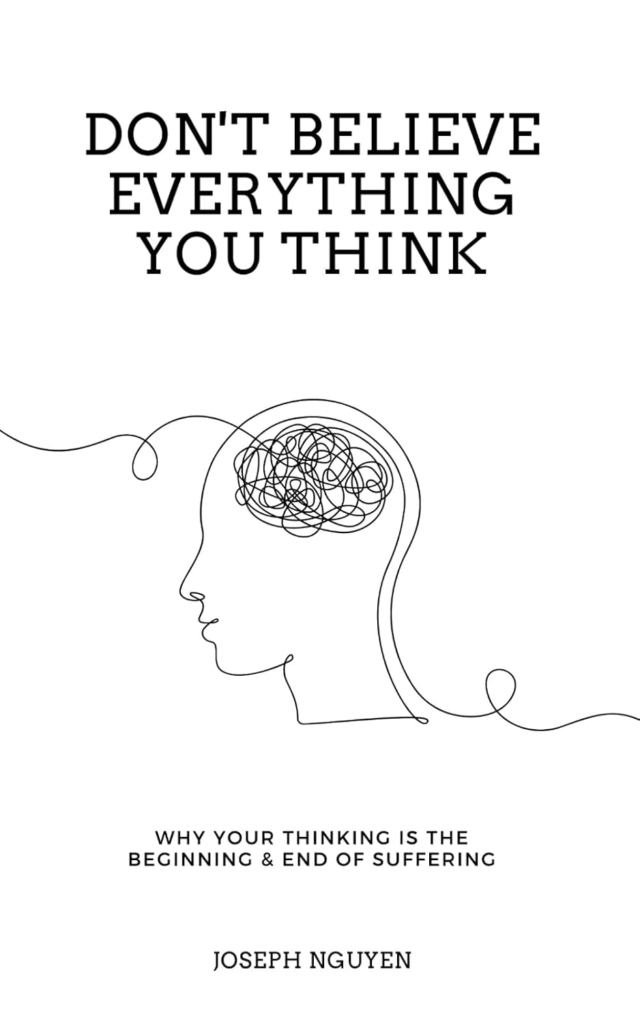
Don’t Believe Everything You Think: Why Your Thinking Is the Beginning & End of Suffering is a self-help and personal-development book by Joseph Nguyen. First published independently in 2022, the book explores the relationship between thought, thinking, emotions, psychological suffering, intuition, and the experience of the present moment.
The book’s central proposition is that suffering is generated not simply by external circumstances, but by the habitual process of engaging with one’s thoughts as though they were necessarily true. Nguyen distinguishes between individual thoughts that arise spontaneously and thinking, which he describes as the act of repeatedly engaging with, analyzing, judging, or attaching to those thoughts.
Rather than advocating conventional positive thinking, Nguyen argues that freedom from psychological suffering comes from learning to stop compulsively engaging with thought and allowing a quieter state of awareness—described in the book as “non-thinking”—to emerge.
The book combines elements of self-help, spirituality, philosophy, and popular psychology. It draws particularly upon the Three Principles framework associated with Scottish-born spiritual teacher Sydney Banks, which describes human experience through the principles of Mind, Consciousness, and Thought. Nguyen explicitly credits Banks and others for influencing the framework presented in the book.
The book became an international bestseller and developed a large readership through word of mouth and social-media exposure. Nguyen’s official website describes it as a #1 international bestseller translated into more than 30 languages, while the current publisher biography states that his work has been translated into more than 40 languages. These figures are publisher/author claims and are best understood as such.
Bibliographic information
| Field | Details |
|---|---|
| Title | Don’t Believe Everything You Think |
| Full title | Don’t Believe Everything You Think: Why Your Thinking Is the Beginning & End of Suffering |
| Author | Joseph Nguyen |
| Genre | Self-help, personal development, philosophy, spirituality |
| Primary subjects | Thought, suffering, overthinking, consciousness, intuition, emotional well-being |
| Original publication | 2022 |
| Original publisher | Independently published |
| Original ISBN | 9798427063852 |
| Original edition | Approximately 173 pages in one catalogued edition |
| Expanded edition | 2024 |
| Expanded-edition publisher | Authors Equity |
| Expanded-edition distributor | Simon & Schuster |
| Language | English |
| Related framework | Three Principles |
| Principal concepts | Thought vs. thinking, non-thinking, consciousness, intuition, present-moment awareness |
The bibliographic record varies substantially between editions. Google Books lists a 2022 independently published edition at 173 pages, while library records identify a 2024 expanded edition from Authors Equity.
Author
Joseph Nguyen
Joseph Nguyen is an author and speaker whose work focuses on psychological and emotional suffering, self-awareness, consciousness, spirituality, and personal transformation.
Nguyen’s official biography describes him as a writer interested in helping people recognize what lies beyond habitual thinking and conditioning. His books combine ideas drawn from philosophy, spirituality, and psychology and present them in an accessible self-help format.
His best-known work is Don’t Believe Everything You Think, which became an international bestseller and was subsequently expanded and republished by Authors Equity.
According to Simon & Schuster’s author biography, Nguyen’s work has been translated into more than 40 languages and has reached millions of readers worldwide. The publisher also states that he was named a NAMI ambassador in 2025.
Nguyen’s official website states that he spends his time writing, teaching, speaking, and sharing ideas concerning consciousness, inner freedom, and psychological suffering.
His writing is notable for its attempt to express philosophical and spiritual concepts in extremely simple language. Rather than presenting a conventional sequence of psychological techniques, Nguyen asks readers to reconsider an assumption that most people rarely question:
Does every thought deserve our attention?
That question becomes the doorway into the book’s central argument.
Publication history
2022 original edition
Don’t Believe Everything You Think was first published on March 28, 2022, as an independently published book. Goodreads and library catalogues identify the original publication date as March 28, 2022.
One independently published edition is catalogued with ISBN 9798427063852 and 173 pages. Other early editions have different ISBNs and page counts, reflecting the book’s rapid international publication in multiple formats.
Expanded edition
An expanded edition was subsequently published by Authors Equity.
The expanded edition reorganized and expanded the material, adding chapters and practical guidance concerning non-thinking, intuition, creating space for insight, potential obstacles, and related exercises.
Library catalogues identify the expanded edition as a 2024 Authors Equity publication.
The publisher’s current edition presents the book as an international bestseller and describes it as a guide for overcoming anxiety, self-doubt, and self-sabotage without relying primarily on motivation or willpower.
Title
The title Don’t Believe Everything You Think functions as both the book’s title and its central instruction.
It does not literally mean that every thought is false.
Instead, Nguyen asks the reader to distinguish between:
having a thought
and
believing, analyzing, and repeatedly engaging with that thought.
For example:
A thought appears:

"I might fail."

        │
        ▼

OPTION A
Notice the thought
        │
        ▼
Let it pass
        │
        ▼
Continue with life


OPTION B
"What if I fail?"
        │
        ▼
"Why would I fail?"
        │
        ▼
"I always fail."
        │
        ▼
"What will everyone think?"
        │
        ▼
"I am probably doomed."
        │
        ▼
ANXIETY / SUFFERING
The difference between the two pathways is central to Nguyen’s philosophy.
Central thesis
The book argues that thinking itself is not necessarily the problem.
Rather, Nguyen focuses on compulsive psychological thinking: the process of repeatedly engaging with mental narratives, judgments, fears, memories, predictions, and interpretations.
His framework can be simplified as:
             EXPERIENCE
                 │
                 ▼
             THOUGHT
                 │
                 ▼
          ATTACHMENT TO THOUGHT
                 │
                 ▼
              THINKING
                 │
                 ▼
             EMOTION
                 │
                 ▼
             SUFFERING
The proposed alternative is:
             EXPERIENCE
                 │
                 ▼
             THOUGHT
                 │
                 ▼
              NOTICE
                 │
                 ▼
       DON'T FEED THE THOUGHT
                 │
                 ▼
          MENTAL QUIET
                 │
                 ▼
        CLARITY / PRESENCE
The book therefore does not primarily ask readers to replace negative thoughts with positive thoughts.
It asks them to change their relationship with thought itself.
Suffering and pain
One of the book’s foundational distinctions is between pain and suffering.
Pain can result from circumstances that are objectively difficult:
- illness;
- loss;
- rejection;
- financial problems;
- relationship breakdown;
- failure;
- physical injury;
- uncertainty; or
- grief.
Nguyen’s argument is that additional suffering can sometimes be generated by the mind’s prolonged interpretation of those events.
A simplified model is:
PAINFUL EVENT
     │
     ▼
INITIAL EXPERIENCE
     │
     ▼
MENTAL STORY
     │
     ├── "Why me?"
     ├── "This should not happen."
     ├── "What if it gets worse?"
     ├── "My life is ruined."
     └── "This will never end."
     │
     ▼
PROLONGED PSYCHOLOGICAL SUFFERING
The book does not deny that difficult events can genuinely hurt.
Instead, it concentrates on the additional layer created through repetitive mental engagement.
The root cause of suffering
The book presents a strong thesis:
The root of psychological suffering is not the thought itself but our identification and continued engagement with thought.
This is one of the book’s most consequential claims.
Nguyen argues that people often attempt to solve suffering by changing external circumstances or by replacing negative thoughts with positive ones.
He proposes a different level of inquiry:
What if the problem is not the content of thought, but our relationship with thinking?
The publisher’s description explicitly says the book is not primarily about rewiring the brain, rewriting the past, or positive thinking, but about understanding how the mind creates one’s experience.
Thoughts versus thinking
This distinction is perhaps the most important conceptual tool in the book.
Thought
A thought is something that appears in consciousness.
Examples include:
- “I might lose my job.”
- “She doesn’t like me.”
- “I should have done something differently.”
- “What if this goes wrong?”
Thoughts can appear spontaneously.
Thinking
Nguyen uses thinking to describe the process of engaging with thoughts—analyzing them, judging them, building stories around them, and repeatedly returning to them.
The distinction
THOUGHT
"I might fail."
     │
     ▼
A MENTAL EVENT


THINKING
"What if I fail?"
     ↓
"Why would I fail?"
     ↓
"I always fail."
     ↓
"What will people say?"
     ↓
"My future is ruined."

     ↓
MENTAL SUFFERING
The book’s proposed freedom comes from recognizing that a thought does not automatically require participation.
The mind as a thought generator
Nguyen’s framework treats thoughts as something that naturally arises.
The mind produces:
- memories;
- predictions;
- associations;
- images;
- judgments;
- possibilities;
- fears;
- desires; and
- interpretations.
The presence of a thought therefore does not necessarily indicate that the thought is important.
Thought stream
THOUGHT 1 ──► THOUGHT 2 ──► THOUGHT 3
                  │
                  ▼
             THOUGHT 4
                  │
                  ▼
             THOUGHT 5
                  │
                  ▼
             THOUGHT 6
Nguyen’s suggestion is that people often suffer not because thoughts arise, but because they grab onto one thought and construct an increasingly elaborate mental reality around it.
Why do humans think?
The book asks why thinking exists if it can create suffering.
Nguyen’s answer is not that thinking is useless.
Thinking has obvious practical functions.
Human beings need thought for:
- planning;
- mathematics;
- communication;
- engineering;
- writing;
- problem-solving;
- learning;
- remembering;
- organizing;
- designing; and
- making practical decisions.
The distinction is between functional thinking and psychological rumination.
Two forms of thinking
| Functional thinking | Psychological rumination |
|---|---|
| Solves a problem | Repeats the problem |
| Produces an action | Produces more questions |
| Has a defined purpose | Continues indefinitely |
| Uses thought as a tool | Becomes absorbed in thought |
| Ends when the task is complete | Often feeds itself |
This distinction prevents the book’s concept of non-thinking from being interpreted as intellectual inactivity.
The Three Principles
One of the most distinctive parts of the book is its presentation of the Three Principles:
- Mind
- Consciousness
- Thought
Nguyen explicitly attributes this framework to Sydney Banks, describing these three principles as the basis through which human beings experience life.
The framework is associated with the Three Principles psychological/spiritual movement and is different from mainstream experimental psychology.
Universal Mind
Within the Three Principles framework, Mind refers to an underlying universal intelligence or source from which human experience arises.
This is a philosophical and spiritual proposition rather than a conventional empirical psychological construct.
Nguyen presents Mind as the fundamental source underlying human experience.
Consciousness
In the book’s framework, Consciousness is what allows human beings to be aware of experience.
Without consciousness, thoughts would not become a lived experience.
The conceptual relationship can be represented as:
MIND
  │
  ▼
CONSCIOUSNESS
  │
  ▼
AWARENESS
  │
  ▼
EXPERIENCE
Thought
Thought provides the content of experience.
It includes mental images, interpretations, memories, predictions, and stories.
Together, the three principles are presented as:
             MIND
              │
              ▼
        CONSCIOUSNESS
              │
              ▼
            THOUGHT
              │
              ▼
         HUMAN EXPERIENCE
This model is the philosophical foundation for much of Nguyen’s later discussion.
Non-thinking
The book’s most distinctive concept is non-thinking.
Non-thinking does not mean:
- becoming unintelligent;
- refusing to solve problems;
- losing consciousness;
- suppressing thoughts;
- avoiding responsibility;
- never planning; or
- permanently eliminating the mind.
Instead, Nguyen presents non-thinking as a state in which the individual is not compulsively engaging with thought.
A useful representation is:
THOUGHT APPEARS
       │
       ▼
NOTICE IT
       │
       ▼
DO NOT FEED IT
       │
       ▼
NO MENTAL STORY
       │
       ▼
QUIET / PRESENCE
       │
       ▼
CLARITY
The expanded edition devotes substantial attention to practical steps for entering and sustaining this state. Library catalogues list sections concerning how to stop thinking, practical steps, thriving without thinking, and potential obstacles to living in non-thinking.
Non-thinking versus thought suppression
The distinction between non-thinking and suppression is important.
Suppression
"I must not think about this."
        │
        ▼
"Don't think about it."
        │
        ▼
MORE ATTENTION ON THE THOUGHT
Non-thinking
Thought appears
       │
       ▼
Notice
       │
       ▼
No resistance
       │
       ▼
No elaboration
       │
       ▼
Thought passes
The first process can paradoxically increase attention to the unwanted thought.
The second attempts to remove the struggle with the thought itself.
Positive thinking
Nguyen explicitly questions the assumption that the solution to negative thinking is simply positive thinking.
The logic is:
NEGATIVE THOUGHT
       ↓
"I should replace it
with a positive thought."
       ↓
POSITIVE THOUGHT
       ↓
ANOTHER THOUGHT
       ↓
CONTINUED IDENTIFICATION
From Nguyen’s perspective, this still leaves the individual dependent upon thought content.
Instead of replacing one thought with another, the book proposes stepping outside the struggle over thought content.
This is why the book’s approach differs from many conventional self-help books.
The problem with overthinking
Overthinking is one of the main problems addressed by the book.
Overthinking frequently involves:
- replaying past events;
- predicting future disasters;
- repeatedly analyzing decisions;
- imagining what other people think;
- searching for certainty;
- mentally rehearsing conversations;
- asking unanswerable questions; and
- attempting to solve emotional problems through more analysis.
The overthinking loop
QUESTION
   ↓
ANALYSIS
   ↓
MORE QUESTIONS
   ↓
MORE ANALYSIS
   ↓
UNCERTAINTY
   ↓
MORE ANALYSIS
   ↓
ANXIETY
   ↓
MORE ANALYSIS
The loop can become self-perpetuating because the mind interprets uncertainty as evidence that more thinking is required.
Nguyen challenges this assumption.
Sometimes, the book argues, more thinking does not produce more clarity.
It produces more thought.
Thinking and suffering
The book’s core model can therefore be summarized as:
THOUGHT
  ↓
IDENTIFICATION
  ↓
THINKING
  ↓
EMOTIONAL REACTION
  ↓
STORY
  ↓
MORE THINKING
  ↓
SUFFERING
The alternative is:
THOUGHT
  ↓
AWARENESS
  ↓
NO ATTACHMENT
  ↓
THOUGHT PASSES
  ↓
PRESENCE
  ↓
CLARITY
Feelings
Nguyen’s philosophy does not suggest that emotions should simply be ignored.
Instead, feelings are treated as indicators of the quality of one’s current thinking.
The book asks readers to consider the possibility that emotional experience is generated through the interaction of thought and consciousness.
This can be visualized as:
THOUGHT
   +
CONSCIOUSNESS
   │
   ▼
LIVED EXPERIENCE
   │
   ▼
FEELING
The practical implication is that a feeling does not necessarily require an external explanation.
Sometimes the mind is creating an internal experience around a thought.
Present-moment awareness
A recurring theme is the importance of the present moment.
Much psychological suffering occurs through mental movement away from what is happening now:
PRESENT
  │
  ├──► PAST
  │      "Why did this happen?"
  │
  └──► FUTURE
         "What if this happens?"
The present moment itself may be relatively neutral while the mind constructs suffering through memories and imagined futures.
This does not mean that planning or learning from the past is inherently harmful.
The distinction is between using the past and future as practical tools and becoming psychologically trapped in them.
Past regret
The book’s approach to regret can be summarized as:
PAST EVENT
     ↓
MEMORY
     ↓
"IT SHOULD HAVE BEEN DIFFERENT"
     ↓
MENTAL REPLAY
     ↓
SUFFERING
The past cannot be changed.
However, the interpretation of the past can change.
The book therefore encourages readers to stop repeatedly reopening events that have already occurred.
Future anxiety
The same principle is applied to the future.
A person may spend hours mentally constructing scenarios that have not happened.
FUTURE POSSIBILITY
        ↓
MENTAL PROJECTION
        ↓
"WHAT IF?"
        ↓
MORE SCENARIOS
        ↓
ANXIETY
Nguyen’s framework asks whether the future actually requires additional thinking or whether the mind is simply trying to achieve impossible certainty.
Goals and ambitions
One of the book’s most interesting questions is:
If we stop compulsive thinking, what happens to ambition?
This question is important because modern life depends heavily on planning.
People need to set goals.
They need to make schedules.
They need to solve problems.
They need to make decisions.
Nguyen’s argument is not that goals should disappear.
Instead, the book distinguishes between:
setting a goal
and
mentally obsessing over the goal.
Healthy goal process
VISION
  ↓
GOAL
  ↓
PLAN
  ↓
ACTION
  ↓
ADAPT
  ↓
CONTINUE
Obsessive goal process
GOAL
 ↓
"What if I fail?"
 ↓
"What if everyone judges me?"
 ↓
"What if the plan doesn't work?"
 ↓
"Maybe I should change everything."
 ↓
MORE THINKING
 ↓
LESS ACTION
The book therefore suggests that action can emerge from clarity rather than anxiety.
Intuition
Nguyen places considerable emphasis on intuition.
The book suggests that when excessive analytical thinking becomes quiet, people may become more aware of intuitive insight.
This is presented as an alternative to endless intellectual analysis.
NOISY MIND
     │
     ▼
CONSTANT ANALYSIS
     │
     ▼
CONFUSION


QUIETER MIND
     │
     ▼
GREATER AWARENESS
     │
     ▼
INTUITIVE INSIGHT
This should be understood as part of Nguyen’s philosophical framework rather than as an established scientific claim that suppressing conscious thought reliably produces superior decisions.
Intuition can sometimes be valuable, particularly in areas where a person has substantial experience, but intuition can also be biased or inaccurate.
“Nothing is either good or bad”
Another philosophical theme in the book is the idea that events do not necessarily carry fixed emotional meanings independent of interpretation.
An event may be experienced differently by different people.
For example:
EVENT
  │
  ├──► INTERPRETATION A
  │       "This is terrible."
  │
  ├──► INTERPRETATION B
  │       "This is an opportunity."
  │
  └──► INTERPRETATION C
          "This is simply what happened."
The book uses this idea to challenge automatic judgments.
It does not necessarily mean that all events are objectively equivalent.
A physical injury, death, abuse, or natural disaster can have serious real-world consequences.
Rather, the philosophical point is that the mind adds layers of meaning to events, and those layers influence subjective experience.
Unconditional love
Nguyen also discusses unconditional love.
Within the book’s philosophical framework, unconditional love is not simply romantic attachment.
It is presented as a state of being less dependent upon external circumstances for one’s fundamental sense of peace and completeness.
This is closely connected with the book’s broader argument:
EXTERNAL CONDITION
        │
        ▼
     CHANGES
        │
        ▼
IF INNER STATE DEPENDS
ENTIRELY ON CONDITIONS
        │
        ▼
EMOTIONAL INSTABILITY
The alternative is presented as an inner sense of well-being that does not depend entirely upon external validation.
Creating space for insight
The expanded edition includes material concerning creating space for insight and living with less compulsive thought. Library catalogues list “Creating space for insight” and related sections among the expanded edition’s contents.
The basic idea can be represented as:
CONSTANT MENTAL NOISE
        ↓
LESS ATTENTION AVAILABLE
        ↓
LESS CLARITY


QUIETER MENTAL STATE
        ↓
MORE AWARENESS
        ↓
MORE SPACE FOR INSIGHT
The metaphor of “space” is important.
The book suggests that insight does not always emerge from adding more information.
Sometimes it emerges when mental noise becomes quieter.
Practical method
Although the book is philosophical, it also provides practical guidance.
A generalized version of the approach is:
Step 1: Notice the thought
Do not automatically assume that the thought is true.
Step 2: Separate thought from thinking
Recognize that a thought has appeared.
Then ask whether you are choosing to elaborate it.
Step 3: Stop feeding the thought
Do not repeatedly analyze, defend, attack, or justify it.
Step 4: Allow the experience
Rather than fighting the emotion, allow it to exist without constructing an additional story.
Step 5: Return to the present
Shift attention toward what is actually happening now.
Step 6: Wait for clarity
Instead of forcing an answer through endless analysis, allow space for insight.
Step 7: Act
When clarity emerges, take the appropriate practical action.
The process
NOTICE
  ↓
SEPARATE
  ↓
ALLOW
  ↓
LET GO
  ↓
BECOME PRESENT
  ↓
GAIN CLARITY
  ↓
ACT
The “PAUSE” approach
Readers and secondary discussions of the book frequently associate its practical approach with creating a pause between thought and engagement.
The essential principle is:
TRIGGER
   ↓
THOUGHT
   ↓
      PAUSE
   ↓
OBSERVE
   ↓
CHOOSE
   ↓
RESPOND
The pause is important because it breaks automatic identification with mental content.
Instead of:
thought → reaction
the desired pattern becomes:
thought → awareness → choice → response.
Non-thinking and productivity
A common misunderstanding is that non-thinking would make a person less productive.
Nguyen approaches the issue differently.
Constant thinking is not identical to productive thinking.
A person can spend hours thinking about work without actually doing the work.
For example:
PRODUCTIVE MODE

Think → Decide → Act → Observe → Adjust


UNPRODUCTIVE MODE

Think → Analyze → Doubt → Reconsider
      → Analyze → Doubt → Repeat
The book suggests that reducing unnecessary mental activity can create more capacity for actual action.
Non-thinking and creativity
The same principle is applied to creativity.
Creative insight can sometimes emerge when conscious analytical effort temporarily relaxes.
Examples include moments when an idea appears:
- while walking;
- while showering;
- during meditation;
- after sleeping;
- while resting; or
- during an unrelated activity.
The book interprets such experiences as evidence that valuable insight does not always require continuous conscious analysis.
Again, this is best treated as a philosophical interpretation rather than a universal scientific law.
Non-thinking and decision-making
The book argues that decisions do not always require endless analysis.
A simplified decision model is:
INFORMATION
     ↓
ANALYSIS
     ↓
ANALYSIS
     ↓
MORE ANALYSIS
     ↓
UNCERTAINTY
     ↓
DECISION PARALYSIS
Nguyen proposes an alternative:
INFORMATION
     ↓
UNDERSTANDING
     ↓
QUIET
     ↓
INTUITION / INSIGHT
     ↓
DECISION
The model is particularly relevant to people who habitually seek perfect certainty before acting.
Decision-making: an important qualification
The book’s approach should not be interpreted as a recommendation to ignore evidence.
For consequential decisions involving:
- medicine;
- finance;
- law;
- safety;
- engineering;
- professional obligations; or
- major life commitments,
deliberate reasoning and reliable evidence remain important.
“Don’t believe everything you think” is not equivalent to:
“Don’t think.”
The more defensible interpretation is:
Don’t confuse every mental event with reliable information.
Psychological and philosophical influences
The book occupies an unusual position between several traditions.
Buddhism
Its emphasis on observing thought without attachment resembles Buddhist approaches to mental phenomena and present-moment awareness.
Taoism
Its emphasis on allowing rather than forcing and trusting natural processes has similarities with Taoist ideas concerning effortless action.
Mindfulness
The practice of observing thoughts without automatically following them overlaps conceptually with mindfulness.
Spiritual self-inquiry
The book’s language concerning consciousness, inner freedom, and one’s deeper nature reflects a spiritual rather than strictly clinical orientation.
Three Principles
The book most explicitly identifies the Three Principles of Mind, Consciousness, and Thought, associated with Sydney Banks, as the framework through which human experience is understood.
Relationship to psychology
Although Don’t Believe Everything You Think uses psychological language, it should not be classified as a conventional academic psychology textbook.
Its argument contains ideas that overlap with established areas such as:
- cognitive appraisal;
- rumination;
- metacognition;
- mindfulness;
- acceptance;
- emotion regulation;
- cognitive behavioral approaches;
- attentional processes; and
- psychological flexibility.
However, Nguyen’s broader claims about consciousness, non-thinking, universal Mind, and the ultimate source of suffering belong more clearly to a philosophical and spiritual framework than to mainstream empirical psychology.
This distinction is essential for an encyclopedia article.
The “Three Principles” and mainstream science
The Three Principles framework associated with Sydney Banks is a distinct philosophical/spiritual approach.
Nguyen uses it as the conceptual foundation for explaining human experience.
The framework should not be confused with universally accepted principles of psychology.
In particular, statements about a universal Mind or the claim that all psychological experience arises through the same three principles are philosophical propositions rather than conclusions established by mainstream experimental psychology.
The book’s value can therefore be assessed on two separate levels:
as a philosophical/self-help framework, and
as a scientific account of human psychology.
Those are not the same question.
Criticism
The book’s central thesis has attracted both enthusiastic support and criticism.
Supportive readers often appreciate its simplicity.
The argument can be understood quickly:
A thought is not necessarily true merely because it appears in the mind.
For people who struggle with rumination, that can be a powerful distinction.
Critics, however, argue that the book sometimes presents a complicated subject too categorically.
One Goodreads review, for example, criticized the book for reducing the problem to a simple “don’t think” proposition and argued that the distinction between useful thought and harmful thinking was not sufficiently developed.
Other readers have criticized the writing style, repetition, or reliance on philosophical claims that are not extensively supported by conventional scientific evidence. Goodreads reviews show a wide range of reactions despite the book’s strong overall readership.
These criticisms do not invalidate the book’s usefulness as a self-help work, but they do indicate why it should not be read as a definitive scientific explanation of suffering.
Reader reception
The book has achieved substantial readership.
At the time of the current Goodreads record, Don’t Believe Everything You Think had approximately 3.79/5 from more than 70,000 ratings and more than 5,400 reviews.
The rating distribution is notable because it indicates a broad range of reactions:
| Rating | Approximate share |
|---|---|
| 5 stars | 34% |
| 4 stars | 28% |
| 3 stars | 23% |
| 2 stars | 9% |
| 1 star | 4% |
These figures reflect Goodreads user ratings and should not be interpreted as a scientific evaluation of the book’s claims.
The book’s popularity is also reflected in Nguyen’s official and publisher biographies, which describe it as a major international bestseller translated into dozens of languages.
Why the book resonated with readers
The book appeared during a period in which overthinking, anxiety, burnout, mindfulness, and emotional well-being had become increasingly prominent topics in popular culture.
Its appeal partly comes from its radical simplicity.
Many self-help books say:
Change your thoughts.
Nguyen essentially asks:
What if you don’t need to change every thought at all?
That difference is significant.
A person who believes:
“I must stop having negative thoughts”
can become frustrated whenever another negative thought appears.
The book offers a different possibility:
“The thought can appear. I don’t have to follow it.”
That is a much lighter psychological task.
Infographic: The central idea
                    THOUGHT APPEARS
                           │
                           ▼
                  ┌─────────────────┐
                  │  IS IT TRUE?    │
                  └────────┬────────┘
                           │
                   ┌───────┴───────┐
                   ▼               ▼
                 ANALYZE         OBSERVE
                   │               │
                   ▼               ▼
               MORE THOUGHT     LET IT PASS
                   │               │
                   ▼               ▼
               MORE STORIES     MORE SPACE
                   │               │
                   ▼               ▼
                SUFFERING       PRESENCE
The book’s radical proposition is that the second pathway often requires less effort.
Infographic: Thought versus thinking
┌──────────────────────────────────────────────┐
│                    THOUGHT                   │
│                                              │
│ "I might fail."                              │
│                                              │
│ A mental event                               │
└──────────────────────┬───────────────────────┘
                       │
                       ▼
              ┌────────────────┐
              │ YOUR RESPONSE  │
              └───────┬────────┘
                      │
            ┌─────────┴──────────┐
            ▼                    ▼
        OBSERVE               ENGAGE
            │                    │
            ▼                    ▼
      Let it pass          "What if?"
                                 ↓
                            "Why me?"
                                 ↓
                         "What will happen?"
                                 ↓
                            MORE THINKING
                                 ↓
                             SUFFERING
Infographic: The overthinking machine
             ┌──────────────┐
             │    EVENT     │
             └──────┬───────┘
                    ▼
             ┌──────────────┐
             │    THOUGHT   │
             └──────┬───────┘
                    ▼
             ┌──────────────┐
             │    ANALYZE   │
             └──────┬───────┘
                    ▼
             ┌──────────────┐
             │  UNCERTAINTY │
             └──────┬───────┘
                    ▼
             ┌──────────────┐
             │    ANALYZE   │
             └──────┬───────┘
                    ▼
             ┌──────────────┐
             │ MORE QUESTIONS│
             └──────┬───────┘
                    │
                    └──────────────► ANALYZE AGAIN
The book’s proposed intervention is to step out of the loop rather than attempting to solve every question generated by it.
Infographic: The path from suffering to freedom
       SUFFERING
           │
           ▼
    "What am I thinking?"
           │
           ▼
    "Is this actually true?"
           │
           ▼
    "Do I need to engage?"
           │
           ▼
        PAUSE
           │
           ▼
      LET IT PASS
           │
           ▼
       PRESENCE
           │
           ▼
       CLARITY
           │
           ▼
        ACTION
A practical example
Imagine receiving a message from someone:
“We need to talk.”
The message itself contains little information.
But the mind can immediately begin generating possibilities:
"We need to talk."
       ↓
"Did I do something wrong?"
       ↓
"Are they angry?"
       ↓
"Am I going to lose the relationship?"
       ↓
"What if everything falls apart?"
       ↓
ANXIETY
Nothing new has actually happened.
The majority of the suffering was generated by imagined scenarios.
The book’s approach would be:
"We need to talk."
       ↓
NOTICE ANXIETY
       ↓
NOTICE THE THOUGHTS
       ↓
DON'T BUILD A STORY
       ↓
WAIT FOR ACTUAL INFORMATION
       ↓
RESPOND TO REALITY
This example captures the practical appeal of the book.
A deeper interpretation
At a deeper level, Don’t Believe Everything You Think is not simply a book about reducing anxiety.
It is asking a philosophical question:
What is the difference between reality and the story we continuously construct about reality?
A person experiences an event.
The mind immediately creates meaning.
That meaning becomes a belief.
The belief influences emotion.
The emotion influences behavior.
Behavior influences the next experience.
Thus:
EVENT
  ↓
MEANING
  ↓
BELIEF
  ↓
EMOTION
  ↓
BEHAVIOR
  ↓
CONSEQUENCE
  ↓
NEW INTERPRETATION
Nguyen attempts to interrupt this cycle at its earliest stage:
before thought becomes unquestioned psychological reality.
The role of awareness
Awareness is therefore more important in the book than willpower.
Traditional self-help might say:
“Control your thoughts.”
Nguyen’s approach is closer to:
“Notice that you are thinking.”
That is a subtle but important difference.
Trying to control every thought can itself become another form of thinking.
Awareness requires less struggle.
CONTROL
  ↓
"I must stop thinking."
  ↓
MORE EFFORT
  ↓
MORE THINKING


AWARENESS
  ↓
"I notice that I am thinking."
  ↓
NO STRUGGLE
  ↓
THOUGHT PASSES
Non-thinking and ordinary life
The book does not argue that people should permanently withdraw from ordinary life.
The expanded edition explicitly asks how people can thrive, pursue goals, work, and create while living with less compulsive thinking. Its table of contents includes sections on goals and ambitions, work, destructive habits, and creating a non-thinking environment.
The intended model is therefore not:
THINKING = BAD
NON-THINKING = GOOD
A more nuanced interpretation is:
USE THOUGHT WHEN USEFUL
          +
DON'T BECOME A PRISONER OF THOUGHT
That distinction makes the book considerably more practical.
The paradox of trying not to think
One of the book’s most interesting philosophical problems is that attempting to stop thinking can itself produce more thinking.
For example:
“I must stop thinking.”
is itself a thought.
Then:
“Am I thinking?”
is another thought.
Then:
“Why can’t I stop?”
creates another thought.
The resulting loop is:
TRY NOT TO THINK
       ↓
NOTICE THINKING
       ↓
JUDGE THINKING
       ↓
TRY HARDER
       ↓
THINK MORE
The book therefore favors allowing thoughts to arise without feeding them rather than aggressively attempting to eliminate them.
What the book does well
Simplicity
Its central distinction between thoughts and thinking is easy to understand.
Accessibility
The book avoids heavy academic terminology and is written for a general audience.
Philosophical depth
Although short compared with many self-help books, it raises substantial questions about consciousness, identity, suffering, and reality.
Practical relevance
The framework can be applied immediately to everyday overthinking.
Memorability
The title itself functions as a useful mental reminder:
A thought is not automatically a fact.
Limitations
1. The central thesis can be interpreted too literally
“Thinking causes suffering” is a much broader statement than the evidence from mainstream psychology would support if interpreted literally.
Many forms of thinking are useful and necessary.
2. Non-thinking is not an established clinical treatment
The book’s concept of non-thinking belongs primarily to its philosophical framework.
It should not automatically be treated as an evidence-based treatment for anxiety, depression, trauma, or other psychiatric conditions.
3. External circumstances matter
Human suffering can result from real-world conditions.
Poverty, violence, illness, bereavement, discrimination, relationship abuse, and other circumstances cannot simply be reduced to thinking.
4. Some problems require deliberate reasoning
Important decisions often require evidence, analysis, consultation, and planning.
5. Intuition can be unreliable
Intuition may be useful in some contexts but can also reflect bias, incomplete information, or learned assumptions.
6. Spiritual claims are philosophical
Claims concerning universal Mind, consciousness, divinity, or the ultimate nature of reality belong to the book’s philosophical/spiritual framework rather than established scientific consensus.
Comparison with conventional self-help
| Conventional self-help approach | Nguyen’s approach |
|---|---|
| Change negative thoughts | Change relationship with thought |
| Replace negative with positive | Let thought pass |
| Control your mindset | Observe the mind |
| Use motivation | Reduce dependence on motivation |
| Analyze the problem | Create space from analysis |
| Think about solutions | Allow insight to emerge |
| Control emotions | Stop feeding the thinking behind them |
| Achieve a desired state | Recognize peace in the present |
This comparison is necessarily simplified, but it highlights why the book feels different from many productivity-oriented self-help books.
Comparison with mindfulness
The book has substantial conceptual overlap with mindfulness, particularly in its emphasis on observing thoughts without automatically identifying with them.
However, the frameworks are not identical.
Mindfulness has a large body of academic research and encompasses many formal and informal practices.
Nguyen’s framework is more philosophical and is explicitly connected to the Three Principles.
A simplified comparison is:
| Mindfulness | Nguyen’s framework |
|---|---|
| Observe thoughts | Notice thoughts |
| Return to present | Remain in present |
| Reduce identification | Don’t engage with thought |
| Cultivate awareness | Allow awareness to emerge |
| Accept experience | Let experience be |
The similarities make the book accessible to readers already familiar with mindfulness, while its Three Principles foundation gives it a distinct philosophical identity.
Comparison with cognitive behavioral approaches
Cognitive behavioral approaches generally examine relationships among:
thoughts → emotions → behavior.
Nguyen’s approach overlaps with this model but takes a different philosophical direction.
A conventional cognitive restructuring approach may ask:
“Is this thought accurate?”
Nguyen more often asks:
“Why do I need to engage with this thought at all?”
That is a fundamental difference.
One approach examines the content of thought.
The other emphasizes the relationship with thought.
Influence of Sydney Banks
Sydney Banks is particularly important to understanding Nguyen’s intellectual framework.
Banks developed the Three Principles approach during the 1970s and became associated with a spiritual-psychological understanding of human experience based on Mind, Consciousness, and Thought.
Nguyen explicitly identifies Banks as the originator of the Three Principles used in his book.
Consequently, Don’t Believe Everything You Think should not be read as an isolated theory invented entirely by Nguyen.
It is better understood as a contemporary, accessible presentation of ideas influenced by an existing philosophical/spiritual tradition.
Legacy and popularity
The book’s popularity has made Nguyen a prominent contemporary writer in the online personal-development space.
His official website currently describes Don’t Believe Everything You Think as an international bestseller, reports more than two million copies sold, and states that the book has been translated into more than 30 languages. The publisher gives a broader current figure of more than 40 languages for Nguyen’s work.
The book’s success has also led to an expanded edition and additional books addressing related themes, including decision-making and life beyond habitual thought.
Its popularity demonstrates the continuing appeal of a very old philosophical question in a modern form:
Can human beings experience life differently by changing their relationship with their own minds?
Key ideas at a glance
| Concept | Explanation |
|---|---|
| Thought | A mental event that can arise spontaneously |
| Thinking | Continued engagement with thoughts |
| Suffering | Psychological distress amplified by identification with thought |
| Non-thinking | A state of reduced compulsive engagement with thought |
| Consciousness | Awareness through which experience is perceived |
| Mind | A universal principle in the Three Principles framework |
| Present moment | Immediate lived experience before extensive mental elaboration |
| Intuition | Insight that may become clearer when compulsive thinking quiets |
| Acceptance | Allowing experience without unnecessary resistance |
| Awareness | Observing thought without automatically becoming identified with it |
| Unconditional love | Well-being less dependent on external conditions |
| Insight | Clarity that can emerge when mental noise decreases |
The book’s central model
The entire philosophy can be condensed into one diagram:
                 LIFE HAPPENS
                      │
                      ▼
                 THOUGHT APPEARS
                      │
                      ▼
              ┌───────────────┐
              │   AWARENESS   │
              └───────┬───────┘
                      │
             ┌────────┴────────┐
             ▼                 ▼
          ENGAGE             OBSERVE
             │                 │
             ▼                 ▼
         THINKING          NO FEEDING
             │                 │
             ▼                 ▼
          STORY              SPACE
             │                 │
             ▼                 ▼
        EMOTIONAL           PRESENCE
        SUFFERING              │
                               ▼
                            CLARITY
                               │
                               ▼
                             ACTION
A practical daily exercise inspired by the book
A reader can translate the philosophy into a simple five-minute exercise.
1. Sit quietly
Do not attempt to manufacture a particular emotional state.
2. Notice what the mind is producing
Thoughts may involve work, family, money, health, relationships, or the future.
3. Do not argue with the thoughts
You do not need to prove them wrong.
4. Do not solve every thought
Let unanswered questions remain unanswered temporarily.
5. Return to immediate experience
Notice breathing, sounds, physical sensations, or the environment.
6. Wait
Allow the mind to settle without forcing it.
7. Act when action becomes clear
The goal is not passivity.
It is action without unnecessary mental noise.
A human example: the unanswered email
Consider a person who sends an important email and receives no response.
Within minutes, the mind may produce:
“They ignored me.”
Then:
“Maybe they don’t respect me.”
Then:
“Perhaps I’ve made a mistake.”
Then:
“What if I lose the opportunity?”
Nothing new has happened externally.
But an entire emotional world has been created internally.
The book’s approach would be to recognize:
EMAIL SENT
   ↓
NO RESPONSE
   ↓
THOUGHT
"They're ignoring me."
   ↓
NOTICE
   ↓
DON'T BUILD THE STORY
   ↓
WAIT
   ↓
REAL INFORMATION ARRIVES
   ↓
RESPOND TO REALITY
This is the book’s philosophy in miniature.
Conclusion
Don’t Believe Everything You Think is a book about a surprisingly ordinary human experience: the mind telling stories that feel like reality.
Its central argument is neither that thinking is useless nor that difficult circumstances are imaginary.
Instead, Joseph Nguyen asks readers to notice a subtle distinction:
A thought can appear without needing to become a belief, a story, a prediction, or a source of suffering.
The book’s philosophy can ultimately be reduced to a simple sequence:
A THOUGHT APPEARS
       ↓
NOTICE IT
       ↓
DON'T AUTOMATICALLY BELIEVE IT
       ↓
DON'T FEED IT
       ↓
LET IT PASS
       ↓
RETURN TO THE PRESENT
       ↓
ALLOW CLARITY TO EMERGE
       ↓
ACT
Its most controversial idea is also its most memorable: the solution to excessive thinking may not always be better thinking. Sometimes it may be less engagement with thought.
For some readers, this becomes a practical method for escaping rumination. For others, the book’s claims may seem overly broad, particularly when applied to complex psychological suffering or situations that genuinely require careful reasoning.
Its enduring appeal lies in the question it leaves behind:
What would your life feel like if you stopped treating every thought that appeared in your mind as something you had to believe, solve, or follow?
That question is the real center of Don’t Believe Everything You Think.
See also
- Thought
- Thinking
- Overthinking
- Rumination
- Mindfulness
- Meditation
- Consciousness
- Emotional regulation
- Cognitive behavioral therapy
- Cognitive appraisal
- Self-awareness
- Psychological flexibility
- Three Principles
- Sydney Banks
- Spirituality
- Personal development
- Self-help
- The Power of Now
- Master Your Emotions
- The Untethered Soul
- Atomic Habits
- The Four Agreements
References
- Nguyen, Joseph. Don’t Believe Everything You Think: Why Your Thinking Is the Beginning & End of Suffering. Independently published, 2022.
- Nguyen, Joseph. Don’t Believe Everything You Think: Why Your Thinking Is the Beginning & End of Suffering. Expanded edition. Authors Equity, 2024.
- Simon & Schuster. Don’t Believe Everything You Think (Expanded Edition) — official publisher information.
- Joseph Nguyen. Official author website and biography.
- Google Books. Don’t Believe Everything You Think — bibliographic information for the 2022 edition.
- Open Library. Don’t Believe Everything You Think — edition and bibliographic records.
- Goodreads. Don’t Believe Everything You Think — reader ratings, reviews, and editions.
- Arlington Public Library. Don’t Believe Everything You Think — expanded-edition catalogue and contents.
- Sacramento Public Library. Don’t Believe Everything You Think — edition and contents information.
- Banks, Sydney. Works and teachings concerning the Three Principles of Mind, Consciousness, and Thought.
Further reading
On thought and cognition
- Cognitive psychology
- Metacognition
- Rumination
- Cognitive appraisal
- Cognitive distortions
On mindfulness
- Mindfulness-based stress reduction
- Mindfulness meditation
- Acceptance-based approaches
- Present-moment awareness
On emotional well-being
- Emotion regulation
- Psychological flexibility
- Resilience
- Emotional intelligence
On philosophy and spirituality
- Buddhism
- Taoism
- Non-duality
- Advaita Vedanta
- Stoicism
- Contemplative traditions
On the Three Principles
Readers interested specifically in Nguyen’s philosophical framework can explore the writings and teachings associated with Sydney Banks and the Three Principles tradition.