
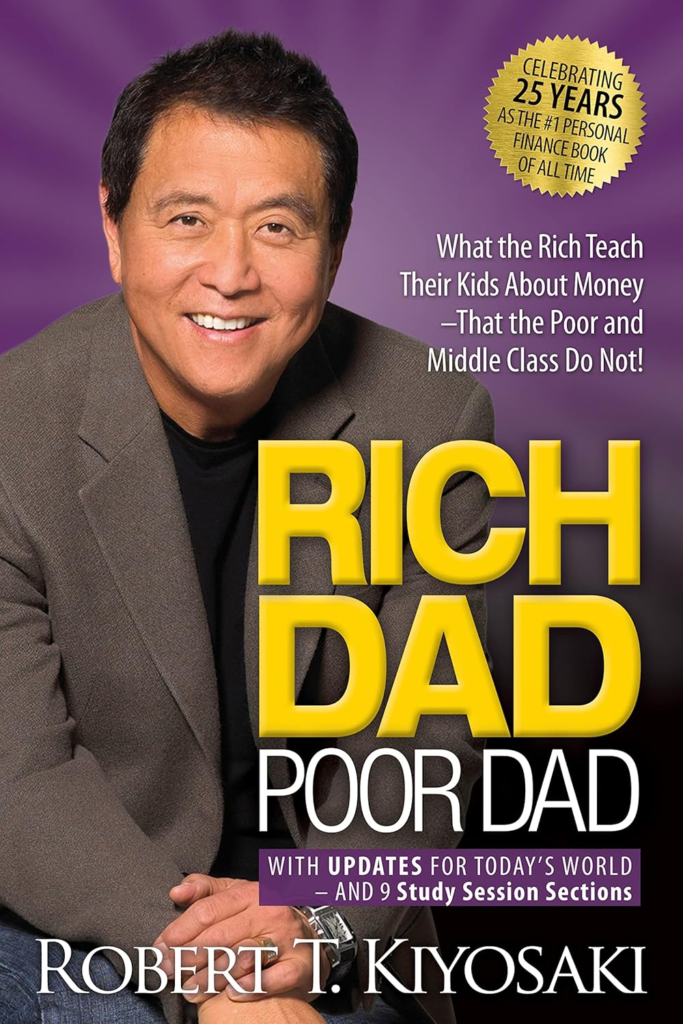
Rich Dad Poor Dad: What the Rich Teach Their Kids About Money That the Poor and Middle Class Do Not! is a personal-finance book by Robert T. Kiyosaki, written with Sharon L. Lechter. First published in 1997, the book presents a series of financial lessons through the contrasting perspectives of two father figures in Kiyosaki’s story: his biological father, described as the “Poor Dad,” and the father of his childhood friend, described as the “Rich Dad.”
At the heart of the book is a simple but influential question:
Why do some people work for money all their lives, while others learn how to make money work for them?
Kiyosaki uses this contrast to introduce readers to ideas such as financial literacy, assets and liabilities, cash flow, entrepreneurship, investing, financial independence, taxation, leverage, and the importance of acquiring financial knowledge.
The book challenges the conventional assumption that a high salary automatically leads to wealth. Instead, Kiyosaki argues that financial outcomes depend heavily on what people do with their income, what they own, how they understand money, and whether they develop income-producing assets.
Written partly as a memoir and partly as a financial parable, Rich Dad Poor Dad became a major commercial success and eventually developed into the foundation of the wider Rich Dad publishing and financial-education brand.
As of the 25th-anniversary period, publisher and bookselling sources reported that the book had sold more than 40 million copies worldwide and had been translated into dozens of languages.
Book information
| Field | Details |
|---|---|
| Title | Rich Dad Poor Dad |
| Full title | Rich Dad Poor Dad: What the Rich Teach Their Kids About Money That the Poor and Middle Class Do Not! |
| Author | Robert T. Kiyosaki |
| Co-author | Sharon L. Lechter |
| First published | 1997 |
| Genre | Personal finance, business, investing, financial education |
| Original language | English |
| Country of origin | United States |
| Major subjects | Financial literacy, investing, entrepreneurship, wealth building |
| Major concepts | Assets, liabilities, cash flow, financial intelligence, financial independence, Rat Race |
| Later edition | 25th Anniversary Edition |
| Publisher/imprint of later editions | Plata Publishing |
| Series | Rich Dad series |
The original work was self-published in 1997 before its subsequent commercial success. Publishers Weekly reported in 2022 that the book had originally been self-published through Kiyosaki’s Cashflow Technologies.
Overview
Rich Dad Poor Dad is built around a narrative contrast.
Kiyosaki describes growing up with two important father figures who held very different attitudes toward money.
His biological father, referred to throughout the book as his “Poor Dad,” was highly educated and followed a conventional professional path.
The other father figure was the father of Kiyosaki’s childhood friend Mike. Kiyosaki calls him his “Rich Dad” and presents him as an entrepreneur who developed businesses, invested, and thought about money differently.
The two figures represent two contrasting financial philosophies.
                 TWO APPROACHES TO MONEY

          "POOR DAD"                 "RICH DAD"
               │                         │
        Job security              Financial education
               │                         │
        Earn a salary             Build businesses
               │                         │
       Work for money             Make money work
               │                         │
       Seek qualifications        Develop financial IQ
               │                         │
       Increase income            Acquire assets
               │                         │
               └──────────┬──────────────┘
                          │
                    FINANCIAL CHOICE
The book does not simply argue that one person is intelligent and the other is not.
Its central purpose is to show how different beliefs about money can lead to different financial behaviors.
The central idea
The simplest expression of the book’s philosophy is:
Income alone does not determine wealth.
A person can earn a large salary and still remain financially fragile if expenses, debt, and lifestyle commitments consume most of that income.
Conversely, someone with a more modest income may gradually build financial security by saving, investing, acquiring productive assets, controlling expenses, and developing additional income streams.
Kiyosaki therefore directs the reader’s attention away from the size of the paycheck and toward the cash-flow pattern behind the paycheck.
              EARNED INCOME
                    │
          ┌─────────┴─────────┐
          │                   │
       EXPENSES            ASSETS
          │                   │
          ▼                   ▼
      Money OUT           Money IN
                              │
                              ▼
                       MORE CASH FLOW
                              │
                              ▼
                     MORE ASSET BUILDING
This idea is the foundation for much of the book.
The “two dads” framework
The title itself is a metaphorical framework for the entire book.
Poor Dad
The “Poor Dad” is presented as representing a conventional view of success:
- obtain a good education
- find secure employment
- work hard
- earn a salary
- seek promotions
- save money
- depend primarily on employment income
Kiyosaki presents this approach as respectable but financially limited.
Rich Dad
The “Rich Dad” represents a different philosophy:
- learn how money works
- understand financial statements
- build or acquire businesses
- invest
- acquire income-producing assets
- understand taxes and corporations
- use financial leverage carefully
- develop financial intelligence
- seek financial independence
The contrast is deliberately dramatic because the book is designed to challenge the reader’s existing assumptions.
The six major lessons
The book is organized around six major financial lessons.
- The Rich Don’t Work for Money
- Why Teach Financial Literacy?
- Mind Your Own Business
- The History of Taxes and the Power of Corporations
- The Rich Invent Money
- Work to Learn—Don’t Work for Money
These lessons are followed by sections dealing with overcoming obstacles, getting started, and continuing the learning process. The table of contents of later editions preserves this structure.
Lesson 1: The Rich Don’t Work for Money
The first lesson introduces the book’s central distinction between working for money and building systems that generate money.
Kiyosaki does not literally mean that wealthy people never work.
Rather, he argues that people who remain dependent entirely on wages can become trapped in a cycle:
WORK
 ↓
PAYCHECK
 ↓
EXPENSES
 ↓
NEED ANOTHER PAYCHECK
 ↓
WORK AGAIN
 ↓
PAYCHECK
 ↓
EXPENSES
This cycle is later described using the book’s famous expression:
The Rat Race
The Rat Race is the condition in which a person’s financial commitments require continued employment, even when the person wants greater freedom.
A simplified version is:
Higher income
      ↓
Higher spending
      ↓
Higher financial obligations
      ↓
Need for higher income
      ↓
More work
      ↓
Higher income
      ↓
Higher spending
      ↺
The book argues that simply earning more does not necessarily break the cycle.
The critical question becomes:
What happens to the additional money?
Fear and desire
Kiyosaki also examines the emotional forces that influence financial decisions.
Two important emotions are:
- fear
- desire
Fear can encourage people to remain in jobs they dislike because they are afraid of losing income.
Desire can encourage people to spend more as soon as their income rises.
This can create a psychological loop:
FEAR
 ↓
"I need my paycheck."
 ↓
WORK
 ↓
INCOME
 ↓
DESIRE
 ↓
"Now I can afford more."
 ↓
SPENDING
 ↓
MORE FINANCIAL PRESSURE
 ↓
MORE FEAR
The book’s proposed alternative is greater financial literacy and a gradual shift toward income-producing assets.
Lesson 2: Why Teach Financial Literacy?
This is arguably the conceptual center of the book.
Kiyosaki argues that people should understand basic financial statements even if they are not accountants.
The book repeatedly emphasizes three ideas:
- Income
- Expenses
- Assets
- Liabilities
The relationship can be visualized as:
             INCOME
               │
        ┌──────┴──────┐
        │             │
     EXPENSES       ASSETS
        │             │
     MONEY OUT      MONEY IN
                      │
                      ▼
                  CASH FLOW
Assets and liabilities
One of the most famous — and most debated — ideas in Rich Dad Poor Dad is Kiyosaki’s distinction between assets and liabilities.
He uses a practical cash-flow definition:
An asset puts money into your pocket.
A liability takes money out of your pocket.
This is a deliberately simplified definition designed to teach financial behavior rather than formal accounting.
Kiyosaki’s practical framework
| Category | Cash-flow effect |
|---|---|
| Income-producing rental property | Potential money in |
| Business producing profit | Potential money in |
| Royalties | Potential money in |
| Dividends | Potential money in |
| Interest-producing investments | Potential money in |
| Consumer debt | Money out |
| Car with continuing costs | Money out |
| Expensive lifestyle commitments | Money out |
It is important to note that this is Kiyosaki’s educational framework, not the formal accounting definition of an asset or liability.
Under standard accounting, for example, a personal residence can be recorded as an asset while a mortgage is recorded separately as a liability.
The distinction matters because readers may otherwise confuse Kiyosaki’s simplified cash-flow terminology with professional accounting terminology.
The cash-flow pattern
The book encourages readers to look beyond labels and examine what money is actually doing.
                    CASH FLOW

                 ┌───────────────┐
                 │    INCOME     │
                 └───────┬───────┘
                         │
              ┌──────────┴──────────┐
              │                     │
              ▼                     ▼
          EXPENSES               ASSETS
              │                     │
              ▼                     ▼
           MONEY OUT             MONEY IN
                                    │
                                    ▼
                             MORE INVESTABLE
                                 CASH FLOW
The objective is to gradually increase the proportion of cash flow generated by assets.
Why financial statements matter
Kiyosaki argues that financially literate people should be able to understand:
- income statements
- balance sheets
- cash flow
- debt
- assets
- liabilities
- taxes
- investment returns
The broader message is that financial decisions become easier to evaluate when a person can see the numbers rather than merely react to financial marketing or social pressure.
Lesson 3: Mind Your Own Business
The third lesson encourages readers to distinguish between:
the job that pays the bills
and
the financial foundation they are building.
Kiyosaki does not necessarily tell readers to quit their jobs immediately.
Instead, he encourages them to think about what they own outside their employment.
A person may work as:
- a teacher
- engineer
- doctor
- manager
- accountant
- designer
while simultaneously building an investment or business portfolio.
The idea is:
JOB
 │
 ├── Pays current expenses
 │
 └── Provides capital
          │
          ▼
      BUY / BUILD
        ASSETS
          │
          ▼
    ADDITIONAL CASH FLOW
This distinction is central to the book’s philosophy.
The “asset column”
Kiyosaki encourages readers to build an asset column.
Potential categories include:
- businesses
- stocks
- bonds
- income-producing real estate
- intellectual property
- royalties
- other investments
The book’s emphasis is not merely on owning something valuable.
It is on owning things that can contribute to cash flow or wealth creation.
Lesson 4: The History of Taxes and the Power of Corporations
The fourth lesson discusses taxation and corporate structures.
Kiyosaki argues that financially sophisticated people learn how taxation works and structure their affairs accordingly.
The book presents corporations and other legal structures as tools that can affect:
- taxation
- business expenses
- liability
- investment structures
- financial organization
However, tax laws vary considerably between countries and change over time.
Therefore, the examples and strategies in the book should not be interpreted as universal tax advice.
A legal structure that is useful in the United States may have a completely different treatment in:
- India
- the United Kingdom
- Canada
- Australia
- Singapore
- the European Union
This is one area where readers should distinguish between financial education and professional tax advice.
Lesson 5: The Rich Invent Money
The fifth lesson focuses on financial intelligence and opportunity recognition.
Kiyosaki argues that opportunities are not always obvious.
Financially knowledgeable people may recognize possibilities that others overlook because they understand:
- numbers
- markets
- financing
- risk
- business structures
- negotiation
- investment
The concept can be summarized as:
KNOWLEDGE
    +
EXPERIENCE
    +
CONFIDENCE
    +
CREATIVITY
    ↓
RECOGNIZE OPPORTUNITY
    ↓
EVALUATE RISK
    ↓
TAKE ACTION
The emphasis is on developing the ability to recognize and evaluate opportunities rather than waiting for a guaranteed opportunity to appear.
Financial intelligence
Financial intelligence is one of the book’s recurring ideas.
It includes understanding:
- accounting
- investing
- markets
- law
- taxes
- business
- risk
- cash flow
The book treats these areas as interconnected rather than isolated subjects.
For Kiyosaki, financial education is not simply knowing how much money one has.
It is understanding how money moves.
Lesson 6: Work to Learn—Don’t Work for Money
The sixth lesson challenges readers to think about employment as an educational opportunity.
Kiyosaki suggests that a job can provide valuable skills even when the salary is not the primary attraction.
He particularly emphasizes transferable skills such as:
- sales
- communication
- negotiation
- accounting
- leadership
- management
- marketing
- business development
The philosophy can be expressed as:
JOB
 ↓
SKILLS
 ↓
EXPERIENCE
 ↓
FINANCIAL KNOWLEDGE
 ↓
GREATER CAPABILITY
 ↓
MORE OPTIONS
This is one of the book’s less controversial and more broadly applicable ideas.
A person’s career can be viewed not only as an income source but also as a skill-building platform.
The Rat Race
The Rat Race is perhaps the book’s most memorable metaphor.
It represents a cycle in which people continuously earn and spend without substantially improving their financial position.
      JOB
       ↓
    PAYCHECK
       ↓
    BILLS
       ↓
    SPENDING
       ↓
  FINANCIAL PRESSURE
       ↓
   NEED TO WORK
       ↓
      JOB
       ↺
Kiyosaki argues that increasing income without changing the underlying financial structure may simply make the Rat Race more expensive.
The proposed alternative is to build assets and income streams that gradually reduce dependence on employment income.
The path out of the Rat Race
The book’s philosophy can be summarized as:
FINANCIAL EDUCATION
        ↓
UNDERSTAND CASH FLOW
        ↓
CONTROL EXPENSES
        ↓
ACQUIRE / BUILD ASSETS
        ↓
INCREASE NON-SALARY CASH FLOW
        ↓
REDUCE DEPENDENCE ON PAYCHECK
        ↓
GREATER FINANCIAL FREEDOM
This should be understood as a conceptual model rather than a guaranteed financial formula.
Overcoming obstacles
The book identifies several psychological obstacles that can interfere with financial progress.
Among them are:
- fear
- cynicism
- laziness
- bad habits
- arrogance
Kiyosaki argues that financial knowledge alone is insufficient if emotional and behavioral barriers prevent people from acting.
This introduces an important theme:
Financial behavior is partly psychological.
Someone may understand that saving and investing matter but still spend impulsively.
Someone may understand risk but avoid every investment opportunity.
Someone may earn more but automatically increase lifestyle expenses.
The problem is therefore not always a lack of information.
Sometimes it is the inability to convert information into behavior.
Getting started
The book’s practical section encourages readers to begin developing financial capability rather than waiting until they have a large amount of money.
The underlying progression is:
LEARN
 ↓
OBSERVE
 ↓
PRACTICE
 ↓
MAKE SMALL DECISIONS
 ↓
LEARN FROM RESULTS
 ↓
IMPROVE
 ↓
REPEAT
This is consistent with the book’s larger argument that financial intelligence develops through education and experience.
The importance of financial education
One of the strongest themes running through the book is the argument that traditional education and financial education are not necessarily the same thing.
A person may be highly educated academically while having little knowledge of:
- taxes
- investing
- debt
- cash flow
- retirement planning
- business ownership
- financial statements
Kiyosaki argues that formal schooling often emphasizes preparation for employment, whereas financial education should also teach people how to understand and manage money.
This claim is central to the book’s philosophy and has helped make financial literacy a major part of its legacy.
The financial statement as a “scorecard”
A useful concept derived from the book is to think of a personal financial statement as a scorecard.
             PERSONAL FINANCIAL PICTURE

                 INCOME
                   │
          ┌────────┴────────┐
          │                 │
       EXPENSES          INVESTMENTS
          │                 │
          ▼                 ▼
       CASH OUT          CASH FLOW
                            │
                            ▼
                         NET WORTH
The framework encourages readers to ask:
- Where does my money come from?
- Where does it go?
- What do I own?
- What do I owe?
- Which assets generate income?
- Which expenses are consuming future income?
These questions are more important than simply asking:
“How much do I earn?”
Wealth versus income
The book makes a fundamental distinction between income and wealth.
A high-income individual is not automatically wealthy.
For example:
Person A
Income:        $10,000/month
Expenses:       $9,500/month
Surplus:         $500/month
Person B
Income:         $6,000/month
Expenses:       $3,500/month
Surplus:        $2,500/month
These are hypothetical examples, not evidence that one person is necessarily wealthier.
The point is that cash-flow structure matters.
Income tells us how much money comes in.
It does not, by itself, tell us:
- how much is retained
- how much is invested
- how much debt exists
- how much wealth has accumulated
- how dependent the person is on employment
Assets, liabilities and cash flow: the book’s central diagram
             TRADITIONAL THINKING

       "I earn more → I am richer."

                    VS.

             RICH DAD THINKING

       "What happens to my money?"

                    ↓

             ┌──────────────┐
             │   INCOME     │
             └──────┬───────┘
                    ↓
        ┌───────────┴───────────┐
        ↓                       ↓
    EXPENSES                 ASSETS
        ↓                       ↓
     MONEY OUT               MONEY IN
                                ↓
                         MORE INVESTABLE
                            CASH FLOW
This is perhaps the single most important conceptual diagram in the book.
The house-as-an-asset debate
One of Kiyosaki’s most controversial claims is that a house you live in is not necessarily an asset in the way people commonly think about assets.
His reasoning is based on cash flow.
If a home requires:
- mortgage payments
- taxes
- insurance
- maintenance
- utilities
and does not produce income, Kiyosaki’s framework classifies it as a liability because it takes money out of the owner’s pocket.
However, standard accounting treats a house owned by an individual as an asset and records the associated mortgage separately as a liability.
Therefore, readers should understand the distinction:
Accounting language
House = asset
Mortgage = liability
Kiyosaki’s cash-flow teaching model
Income-producing property = asset
Property requiring ongoing outflow without income = liability
The difference is largely about the definition being used, rather than a disagreement over whether a house physically has value.
Entrepreneurship and employment
The book does not claim that employment is inherently bad.
Its deeper argument is that people should understand the difference between:
earning income
and
building ownership.
A salaried employee can simultaneously be an investor.
An entrepreneur can fail.
A business owner can lose money.
An investor can experience losses.
Therefore, the book’s framework is not a guarantee of financial success. It is a particular philosophy about how people can approach wealth creation.
Risk and financial education
Kiyosaki’s approach places considerable emphasis on taking calculated risks.
The important word is calculated.
A financially educated person should ideally understand:
- what could go wrong
- how much could be lost
- what assumptions the investment depends upon
- how much debt is involved
- how liquid the investment is
- what happens if income falls
- whether diversification is adequate
The book itself is more philosophical than technical on these questions.
Consequently, readers seeking detailed investment methodology need additional sources.
The book’s style
Rich Dad Poor Dad differs from many conventional financial books because it is written as a story-driven financial lesson.
Instead of presenting a textbook-style sequence of formulas, Kiyosaki repeatedly returns to:
- conversations
- anecdotes
- childhood experiences
- lessons from the two fathers
- financial parables
- memorable contrasts
This storytelling approach makes abstract financial concepts easier to remember.
It also means that the book should not be read as a conventional academic finance textbook.
Memoir, parable and financial philosophy
The book occupies an unusual space between several genres.
             RICH DAD POOR DAD

                  ┌──────────┐
                  │ MEMOIR   │
                  └────┬─────┘
                       │
              ┌────────┴────────┐
              │                 │
          PARABLE          SELF-HELP
              │                 │
              └────────┬────────┘
                       │
                PERSONAL FINANCE
                       │
                       ▼
             FINANCIAL PHILOSOPHY
This hybrid format is one reason the book is accessible to readers who might otherwise find financial literature intimidating.
The role of the “Rich Dad” character
The “Rich Dad” is central to the book’s narrative.
Kiyosaki has described the character as based on the father of his childhood friend Mike and has said that this figure taught him lessons about business and money.
The identity and historical details surrounding the “Rich Dad” story have attracted scrutiny over the years. Some accounts have identified the model as Hawaiian businessman Richard Kimi, while questions about how literally the character and episodes should be interpreted have also appeared in public commentary.
For an encyclopedia-style treatment, it is useful to distinguish between:
the narrative function of “Rich Dad”
and
the independently verifiable historical record behind every episode in the story.
The book is best understood primarily as a vehicle for presenting Kiyosaki’s financial philosophy.
Sharon L. Lechter
Although the book is widely identified with Robert Kiyosaki, Sharon L. Lechter is credited as co-author.
Lechter is an American accountant, author, entrepreneur, and financial-literacy advocate. She co-authored Rich Dad Poor Dad and subsequently worked with Kiyosaki on numerous books in the Rich Dad series.
Penguin Random House describes her as an author and CPA who co-authored Rich Dad Poor Dad and numerous other Rich Dad books.
Her accounting background is particularly relevant to the book’s emphasis on financial statements and financial literacy.
About Robert T. Kiyosaki
Robert Toru Kiyosaki was born on April 8, 1947, in Hilo, Hawaii.
He is an American entrepreneur, author, investor, and financial educator best known for the Rich Dad series.
His educational background includes the U.S. Merchant Marine Academy at Kings Point, where he earned a bachelor’s degree and received a commission. He later served in the United States Marine Corps as a helicopter pilot during the Vietnam War.
After military service, Kiyosaki worked for Xerox, where he developed sales experience.
He later became involved in entrepreneurship and investing before establishing the financial-education enterprise associated with the Rich Dad brand.
His official biography describes his interests as including entrepreneurship, investing, real estate, mining, and financial education.
Kiyosaki’s entrepreneurial background
Kiyosaki’s career did not consist solely of successful ventures.
His official biography describes early entrepreneurial experiments, including a business involving nylon-and-Velcro wallets, and financial difficulties associated with some of his ventures.
These experiences became part of the broader narrative behind his philosophy:
EMPLOYMENT
    ↓
SKILLS
    ↓
ENTREPRENEURSHIP
    ↓
FAILURES + EXPERIENCE
    ↓
FINANCIAL EDUCATION
    ↓
INVESTING
The book’s philosophy is therefore presented as something Kiyosaki claims to have developed through a combination of education, mentors, business experience, failures, and investing.
The Rich Dad Company
Following the success of the book, Kiyosaki and his wife Kim Kiyosaki developed the broader Rich Dad enterprise.
The company expanded beyond books into:
- financial education
- seminars
- games
- digital courses
- coaching
- educational materials
- podcasts and other media
The company’s own history describes the board game CASHFLOW as an important part of its early educational approach. It says that material created to explain the game eventually developed into the manuscript that became Rich Dad Poor Dad.
CASHFLOW and the book’s educational philosophy
The CASHFLOW concept reflects a central principle of the book:
Financial literacy can be learned through practice and simulation.
The game is designed around concepts such as:
- income
- expenses
- assets
- liabilities
- cash flow
- financial decisions
The larger educational philosophy is that people can improve financial decision-making by becoming familiar with financial concepts before applying them to real-world situations.
Publication history
Rich Dad Poor Dad was first published in 1997.
According to Publishers Weekly, it was initially self-published through Kiyosaki’s Cashflow Technologies before becoming a commercial publishing success.
The book subsequently became a major international bestseller.
Later editions were updated and republished, including the 20th Anniversary Edition and 25th Anniversary Edition.
The 25th-anniversary edition was published in 2022 and included updated material intended to place the book’s financial lessons in a contemporary context.
Global reception and sales
The book became a major international commercial success.
Publisher and bookselling sources have reported sales exceeding 40 million copies worldwide and translations into numerous languages. Penguin Random House India reported more than 40 million copies sold and translations into 38 languages in its 25th-anniversary presentation.
Other publisher materials have reported different totals depending on whether they refer specifically to the individual book or the broader Rich Dad series and on the date of measurement. For that reason, sales figures should be treated as publisher-reported figures rather than a single independently audited number.
Why the book became influential
Several features helped Rich Dad Poor Dad reach a very large international audience.
1. It made financial vocabulary accessible
Terms such as:
- assets
- liabilities
- cash flow
- financial intelligence
- Rat Race
became memorable concepts for readers who had little previous exposure to financial education.
2. It challenged conventional assumptions
The book questions ideas such as:
“A good job automatically produces financial security.”
and
“A high income automatically means wealth.”
3. It uses storytelling
Readers encounter financial concepts through a narrative rather than through a conventional textbook.
4. It emphasizes ownership
The book repeatedly directs attention toward what a person owns rather than merely what a person earns.
5. It encourages financial curiosity
Perhaps the book’s most lasting educational contribution is its invitation to ask questions about money instead of treating personal finance as a subject reserved for accountants, bankers, or investment professionals.
Major concepts in the book
| Concept | Meaning in the book |
|---|---|
| Financial literacy | Understanding how money, financial statements, investments, taxes and business work |
| Financial intelligence | The ability to interpret financial information and make financial decisions |
| Asset | In Kiyosaki’s cash-flow framework, something that puts money into one’s pocket |
| Liability | In Kiyosaki’s framework, something that takes money out of one’s pocket |
| Cash flow | The movement of money into and out of a person’s financial life |
| Rat Race | A cycle of earning and spending that maintains dependence on employment |
| Financial freedom | Greater independence from the need to work solely for earned income |
| Mind your own business | Build an asset base rather than relying only on one’s job |
| Work to learn | Use employment to develop transferable skills |
| Financial IQ | A broader understanding of financial information and decision-making |
The Rich Dad financial model
The book’s philosophy can be condensed into one diagram:
                    EDUCATION
                        ↓
                FINANCIAL IQ
                        ↓
                BETTER DECISIONS
                        ↓
             ┌──────────┴──────────┐
             ↓                     ↓
         CONTROL                 BUILD
         EXPENSES               ASSETS
             │                     │
             └──────────┬──────────┘
                        ↓
                  CASH FLOW
                        ↓
                REINVESTMENT
                        ↓
               MORE ASSETS
                        ↓
              GREATER OPTIONS
The model is deliberately simplified.
Real-world wealth building also involves:
- taxes
- inflation
- market risk
- interest rates
- diversification
- liquidity
- insurance
- regulation
- sequence of returns
- personal circumstances
Those subjects require additional financial education.
The book’s view of salary
Kiyosaki does not treat salary as inherently bad.
Instead, he argues that salary should be understood as one type of income rather than as the final measure of financial success.
A salary can provide:
- stability
- capital
- professional skills
- networking
- experience
- benefits
The book’s question is what happens after the salary arrives.
SALARY
  ↓
┌───────────────┐
│               │
EXPENSES       SURPLUS
│               │
↓               ↓
CONSUMPTION    SAVING /
               INVESTMENT
                   ↓
                 ASSETS
                   ↓
              CASH FLOW
This makes the book more nuanced than the title alone might suggest.
Financial freedom
The book uses financial freedom as a major objective.
Conceptually:
FINANCIAL FREEDOM

Income from assets
        ≥
Necessary living expenses
This is a simplified conceptual equation, not a universal definition.
The underlying idea is that a person becomes less financially dependent on employment when investment or business income can cover an increasing proportion of living expenses.
The “rich” mindset
Kiyosaki frequently contrasts what he describes as the mindset of financially successful people with conventional thinking.
The contrast can be summarized as:
| Conventional question | Rich Dad-style question |
|---|---|
| How much is the salary? | What does the cash flow look like? |
| Can I afford the payment? | What will this purchase do to my finances? |
| What job pays more? | What skills will I learn? |
| What should I buy? | What can I acquire that produces income? |
| How can I save more? | How can I increase financial capability? |
| Is this expensive? | What is the long-term financial effect? |
These contrasts represent Kiyosaki’s philosophy rather than universal financial rules.
Criticism and limitations
Because Rich Dad Poor Dad has had such a large influence, its limitations are important to understand.
1. It is not an investment textbook
The book provides a philosophy and framework rather than a detailed investment curriculum.
It does not provide comprehensive treatment of:
- portfolio construction
- diversification
- valuation
- modern portfolio theory
- asset allocation
- risk-adjusted returns
- retirement planning
- insurance
- emergency funds
Readers should not mistake an introduction to financial thinking for a complete investment strategy.
2. The asset/liability definitions are unconventional
Professional accounting uses more precise definitions than the book’s cash-flow-based framework.
This does not make Kiyosaki’s educational distinction useless.
It means readers should understand what he is doing:
He is teaching a cash-flow perspective, not rewriting accounting standards.
3. The book can make wealth building sound simpler than it is
Building wealth through:
- businesses
- real estate
- investing
- intellectual property
can involve substantial risk.
Returns are not guaranteed.
Businesses fail.
Properties can lose value.
Debt can magnify losses as well as gains.
Investments can decline.
A reader should therefore separate the book’s mindset lessons from the assumption that any particular wealth-building strategy will work for everyone.
4. Leverage requires careful risk management
Kiyosaki has frequently discussed the use of debt and leverage as tools for investing.
Leverage can increase returns when an investment performs well.
It can also increase losses when it performs poorly.
             LEVERAGE

       Investment rises
              ↓
       Potentially larger gain

              BUT

       Investment falls
              ↓
       Potentially larger loss
The book’s philosophy should therefore be supplemented with detailed education about debt risk, interest rates, liquidity, and downside scenarios.
5. The book relies heavily on anecdotal storytelling
Anecdotes are powerful teaching tools, but they do not establish that a financial strategy will work universally.
A story about one successful entrepreneur does not constitute statistical evidence that the same strategy will produce the same result for every reader.
6. Tax and legal advice is jurisdiction-specific
The book discusses corporations, taxes, and financial structures primarily from its own context.
Readers outside the United States should be particularly cautious about transferring those examples directly to their own countries.
Tax and corporate law vary significantly by jurisdiction.
What the book does particularly well
Without treating the book as a complete financial manual, several educational contributions are clear.
It asks readers to look at cash flow.
Instead of focusing exclusively on income, the book asks what happens to income after it is received.
It makes financial statements less intimidating.
The book encourages ordinary readers to become comfortable with financial language.
It challenges lifestyle inflation.
Earning more does not necessarily require spending more.
It emphasizes ownership.
The distinction between earning income and owning productive assets is central to the book.
It encourages lifelong financial education.
This may be the broadest lesson in the entire book.
A balanced reading of Rich Dad Poor Dad
The book is best understood neither as a complete financial blueprint nor as merely a collection of motivational slogans.
A balanced reading might look like this:
          TAKE FROM THE BOOK

          ✓ Financial literacy
          ✓ Cash-flow awareness
          ✓ Asset-building mindset
          ✓ Long-term thinking
          ✓ Entrepreneurship awareness
          ✓ Skill development
          ✓ Financial curiosity

          SUPPLEMENT WITH

          + Accounting principles
          + Investment research
          + Diversification
          + Risk management
          + Tax advice
          + Legal advice
          + Retirement planning
          + Evidence-based financial planning
This approach allows the reader to appreciate the book’s educational contribution without treating every proposition as a universal financial rule.
Rich Dad Poor Dad and financial literacy
The book’s greatest cultural impact may be its role in making financial literacy a mainstream subject.
Before encountering the book, many readers may never have thought deeply about:
- cash flow
- financial statements
- asset allocation
- income sources
- business ownership
- taxes
- financial independence
After reading it, they may at least begin asking those questions.
That shift—from not asking financial questions to asking better ones—is arguably one of the book’s most important contributions.
A financial literacy roadmap inspired by the book
The ideas can be organized into a learning sequence:
STEP 1
Understand income and expenses
          ↓
STEP 2
Learn basic accounting
          ↓
STEP 3
Understand assets and liabilities
          ↓
STEP 4
Track personal cash flow
          ↓
STEP 5
Build an emergency reserve
          ↓
STEP 6
Learn investment fundamentals
          ↓
STEP 7
Understand taxes and risk
          ↓
STEP 8
Develop additional skills/income
          ↓
STEP 9
Acquire productive assets
          ↓
STEP 10
Review and improve continuously
This is an editorial synthesis inspired by the book, not a verbatim ten-step system from Kiyosaki.
Rich Dad Poor Dad in the digital age
The financial environment of the 1990s was very different from today’s environment.
Readers now encounter:
- online banking
- digital brokerages
- cryptocurrencies
- algorithmic trading
- financial apps
- online businesses
- creator economies
- remote work
- artificial intelligence
- global digital marketplaces
These developments have created new opportunities but also new forms of financial risk.
The book’s emphasis on financial literacy can therefore be interpreted in a contemporary way:
The more complicated the financial environment becomes, the more important it is to understand the underlying numbers.
The specific investment products may change.
The need to understand cash flow, risk, incentives, debt, and financial decisions does not.
Rich Dad Poor Dad: key ideas in one infographic
╔════════════════════════════════════════════╗
║             RICH DAD POOR DAD              ║
╠════════════════════════════════════════════╣
║                                            ║
║  1. LEARN HOW MONEY WORKS                  ║
║             ↓                              ║
║  2. UNDERSTAND CASH FLOW                   ║
║             ↓                              ║
║  3. KNOW ASSETS & LIABILITIES              ║
║             ↓                              ║
║  4. BUILD FINANCIAL INTELLIGENCE           ║
║             ↓                              ║
║  5. DEVELOP VALUABLE SKILLS                ║
║             ↓                              ║
║  6. BUILD / ACQUIRE PRODUCTIVE ASSETS      ║
║             ↓                              ║
║  7. INCREASE NON-SALARY CASH FLOW          ║
║             ↓                              ║
║  8. REDUCE DEPENDENCE ON PAYCHECKS         ║
║             ↓                              ║
║  9. KEEP LEARNING                          ║
║                                            ║
╚════════════════════════════════════════════╝
Six lessons at a glance
┌─────────────────────────────────────────────┐
│  LESSON 1  │ Don't remain dependent on     │
│             │ working only for money.      │
├─────────────────────────────────────────────┤
│  LESSON 2  │ Learn financial literacy.     │
├─────────────────────────────────────────────┤
│  LESSON 3  │ Build your asset column.      │
├─────────────────────────────────────────────┤
│  LESSON 4  │ Understand taxes and legal    │
│             │ structures.                  │
├─────────────────────────────────────────────┤
│  LESSON 5  │ Develop financial intelligence │
│             │ and recognize opportunities. │
├─────────────────────────────────────────────┤
│  LESSON 6  │ Work to develop skills, not   │
│             │ only to collect a paycheck.  │
└─────────────────────────────────────────────┘
Frequently asked questions
What is Rich Dad Poor Dad about?
It is a personal-finance book that uses the contrasting philosophies of two father figures to teach concepts including financial literacy, assets, liabilities, cash flow, investing, entrepreneurship, and financial independence.
Who wrote Rich Dad Poor Dad?
The book is credited to Robert T. Kiyosaki, with Sharon L. Lechter as co-author.
When was Rich Dad Poor Dad first published?
It was first published in 1997.
What are the six lessons in the book?
They are:
- The Rich Don’t Work for Money
- Why Teach Financial Literacy?
- Mind Your Own Business
- The History of Taxes and the Power of Corporations
- The Rich Invent Money
- Work to Learn—Don’t Work for Money
What is the Rat Race?
The Rat Race is Kiyosaki’s metaphor for a financial cycle in which people depend on employment income, increase spending as income rises, and remain dependent on continued work.
What does Kiyosaki mean by an asset?
In the book’s cash-flow framework, an asset is something that puts money into a person’s pocket.
This differs from the formal accounting definition of an asset.
Why does Kiyosaki say a house is not an asset?
Kiyosaki focuses on whether the property generates cash flow or consumes cash through mortgage payments, taxes, maintenance, and other expenses. This is a teaching framework rather than the standard accounting treatment of a residence.
Does the book say that jobs are bad?
No. Its argument is that employment should not necessarily be a person’s only financial strategy. Kiyosaki encourages readers to use employment to earn income and develop skills while also building an asset base.
What is financial intelligence?
In the context of the book, financial intelligence means understanding financial information well enough to make better decisions concerning income, expenses, assets, liabilities, investing, taxes, and business.
Is Rich Dad Poor Dad an investment guide?
It is better described as an introductory personal-finance and financial-philosophy book than as a comprehensive investment manual.
Is everything in Rich Dad Poor Dad financially accepted?
No. Some of Kiyosaki’s definitions and recommendations are debated, and several of his ideas differ from conventional accounting or mainstream personal-finance approaches.
Can the book’s advice be applied outside the United States?
Its broad concepts can be considered internationally, but readers should not automatically apply its tax, corporate, legal, or investment examples to another country’s financial system.
Is the book autobiographical?
It is presented through an autobiographical-style narrative involving Kiyosaki’s childhood and two father figures. The book combines personal storytelling with financial lessons and parables.
Legacy
Rich Dad Poor Dad has had an unusually large influence on popular financial education.
Its vocabulary has become familiar far beyond traditional investment circles:
assets
liabilities
cash flow
financial intelligence
Rat Race
financial freedom
work to learn
The book also helped establish a broader commercial ecosystem of financial-education books, seminars, games, courses, and media under the Rich Dad brand.
Its influence is not solely the result of technical financial instruction. Much of its power comes from the way it changes the questions readers ask.
Instead of:
“How much money do I earn?”
the book encourages:
“What happens to the money I earn?”
Instead of:
“Can I afford this?”
it encourages:
“What will this purchase do to my cash flow?”
Instead of:
“What job should I get?”
it asks:
“What skills should I develop?”
Instead of:
“How can I make more money?”
it asks:
“How can I build things that generate income?”
These questions are the intellectual engine of the book.
Final perspective
The enduring appeal of Rich Dad Poor Dad lies less in any single investment recommendation than in its attempt to change the reader’s mental model of money.
Kiyosaki asks readers to stop viewing personal finance purely through the lens of salary and consumption and instead examine cash flow, ownership, skills, financial education, and productive assets.
Some of the book’s terminology is deliberately simplified. Some of its investment philosophy is controversial. Some of its examples are anecdotal rather than empirical. And its ideas should not replace professional accounting, tax, legal, or investment advice.
Yet its central educational challenge remains straightforward:
Learn how money works before making important decisions with it.
That idea helps explain why a book first published in 1997 continues to attract readers decades later.
Money changes.
Markets change.
Technology changes.
But the need to understand what comes into your financial life, what leaves it, and what you are building in between remains remarkably constant.
See also
- Robert T. Kiyosaki
- Sharon L. Lechter
- Financial literacy
- Personal finance
- Financial independence
- Investing
- Entrepreneurship
- Cash flow
- Asset allocation
- Wealth management
- Financial planning
- Rich Dad’s CASHFLOW Quadrant
- Rich Dad’s Guide to Investing
- The Intelligent Investor
- Think and Grow Rich
Read more
Books by Robert T. Kiyosaki
- Rich Dad’s CASHFLOW Quadrant
- Rich Dad’s Guide to Investing
- Rich Dad’s Rich Kid Smart Kid
- Rich Dad’s Retire Young Retire Rich
- Rich Dad’s Before You Quit Your Job
Related areas of study
Readers wanting to go beyond Kiyosaki’s introductory framework may wish to study:
- accounting fundamentals
- personal budgeting
- investment diversification
- index investing
- real-estate finance
- business finance
- taxation
- retirement planning
- behavioral finance
- risk management
- entrepreneurship
References
- Kiyosaki, Robert T., with Sharon L. Lechter. Rich Dad Poor Dad: What the Rich Teach Their Kids About Money That the Poor and Middle Class Do Not! Originally published in 1997.
- Kiyosaki, Robert T. Rich Dad Poor Dad, 25th Anniversary Edition. Plata Publishing, 2022.
- Simon & Schuster. Robert T. Kiyosaki — Official Author Page.
- Penguin Random House India. Rich Dad Poor Dad — 25th Anniversary information and publication details.
- Penguin Random House. Sharon Lechter — Author biography.
- FranklinCovey and related financial-education literature concerning personal effectiveness and financial literacy.
- Open library and university-library bibliographic records for publication and contents information.
- Publishers Weekly, “Rich Dad, Poor Dad: 25 Years of Financial Advice Books,” 2022.
About the authors
Robert T. Kiyosaki
Robert T. Kiyosaki is an American entrepreneur, investor, author, and financial educator. He is best known for Rich Dad Poor Dad and the broader Rich Dad series.
His career has included military service, sales, entrepreneurship, real estate, investing, and financial education.
His work is centered on the proposition that financial education should be accessible to ordinary people and should include subjects traditionally associated with accounting, investing, business, and taxation.
Sharon L. Lechter
Sharon L. Lechter is an American CPA, author, entrepreneur, publisher, and financial-literacy advocate.
She co-authored Rich Dad Poor Dad and numerous subsequent Rich Dad books. Her accounting background contributed to the financial-literacy orientation of the series.
She has also worked on financial-literacy initiatives beyond the Rich Dad brand, including service on the President’s Advisory Council on Financial Literacy.
One-sentence summary
Rich Dad Poor Dad is Robert T. Kiyosaki and Sharon L. Lechter’s influential personal-finance book that uses two contrasting approaches to money to encourage financial literacy, cash-flow awareness, skill development, entrepreneurship, and the long-term accumulation of productive assets.