
Introduction
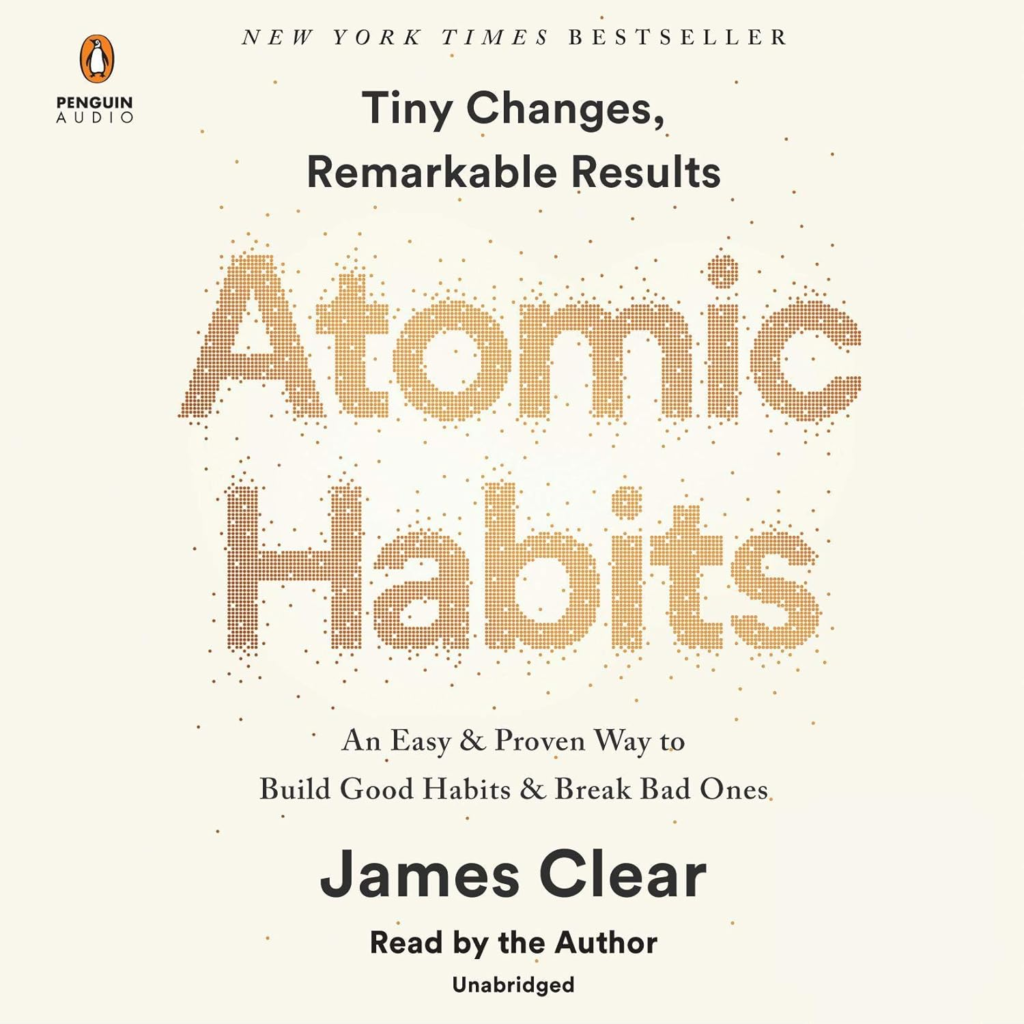
Atomic Habits: An Easy & Proven Way to Build Good Habits & Break Bad Ones is a 2018 self-help and personal-development book by American author James Clear. The book examines how small, repeated behaviors can accumulate over time and presents a practical framework for developing desirable habits and reducing undesirable ones.
Clear organizes his approach around four stages of habit formation—cue, craving, response, and reward—and translates them into four principles known as the Four Laws of Behavior Change: make it obvious, make it attractive, make it easy, and make it satisfying. The inverse of these principles is used to weaken unwanted habits.
The book also emphasizes identity-based habits, arguing that lasting behavioral change is easier when people focus not only on what they want to accomplish, but on the kind of person they want to become.
Since its publication, Atomic Habits has become one of the most widely read books on habits and behavior change. Penguin Random House lists the book as a New York Times bestseller and reports sales of more than 25 million copies worldwide and translations into more than 60 languages.
Book information
| Detail | Information |
|---|---|
| Title | Atomic Habits: An Easy & Proven Way to Build Good Habits & Break Bad Ones |
| Author | James Clear |
| Genre | Self-help, personal development, behavioral psychology |
| Publisher | Avery |
| Publication date | October 16, 2018 |
| Length | 320 pages |
| ISBN | 9780735211292 |
| Original language | English |
| Subject | Habit formation, behavior change, continuous improvement |
| Related work | The Atomic Habits Workbook |
The publisher’s bibliographic information identifies Avery as the publisher, gives the original publication date as October 16, 2018, and lists the book at 320 pages.
Overview
At first glance, Atomic Habits is about habits. At a deeper level, however, the book is about behavioral systems.
Clear’s central argument is that meaningful improvement does not necessarily require dramatic changes. Instead, relatively small behaviors, repeated consistently, can accumulate into substantial differences over time.
The word “atomic” is used in two related senses: something extremely small and something with substantial power. Clear applies this idea to everyday behavior. A single action may appear insignificant, but repeated actions can influence skills, health, productivity, relationships, finances, and other areas of life.
One of the book’s most recognizable ideas is the 1% improvement principle. Clear illustrates that improving by 1% each day would produce a mathematical multiplier of approximately 37 over a year:
1.01³⁶⁵ ≈ 37.8
Likewise:
0.99³⁶⁵ ≈ 0.026
These calculations are best understood as an illustration of compound growth, not as a scientific prediction that human performance literally increases or decreases by exactly 1% every day.
The broader point is simpler: small differences repeated over long periods can become large differences.
The central philosophy
The book can be understood through several interconnected ideas:
- Small habits compound.
- Systems are often more important than goals.
- Environment influences behavior.
- Habits become easier when they are repeated in stable contexts.
- Identity can reinforce behavior.
- Good habits should be designed to require less friction.
- Bad habits can be made more difficult to perform.
- Consistency matters more than occasional bursts of motivation.
- Progress is often difficult to see during its early stages.
- Long-term behavior change is usually a process rather than a single decision.
Clear’s own description of the book emphasizes the distinction between goals and systems: goals describe desired results, whereas systems describe the processes used to produce those results.
What is an atomic habit?
An atomic habit is a small behavior that is relatively easy to perform but can contribute to larger outcomes when repeated consistently.
Examples include:
- reading two pages of a book;
- writing one paragraph;
- putting running shoes beside the bed;
- drinking a glass of water after waking;
- saving a small amount of money regularly;
- preparing tomorrow’s work before going to sleep;
- doing a few minutes of exercise;
- placing a phone outside the bedroom at night.
The important feature is not that the behavior is impressive.
In fact, the opposite is often true.
An atomic habit is deliberately small enough that resistance to starting it is reduced.
This is one of the book’s practical strengths: it moves the discussion of self-improvement away from dramatic declarations such as “I am going to completely change my life” and toward smaller questions such as “What is the next behavior I can repeat?”
The compounding effect of habits
Clear argues that habits function somewhat like compound interest. A single repetition rarely produces a visible transformation, but repeated actions accumulate.
The concept can be expressed simply:
Small action → repeated action → accumulated effect → changed results
However, real human behavior is not as mathematically predictable as financial compounding.
The 1% illustration therefore works best as a mental model rather than a literal law of human performance.
Illustrative mathematical model
The chart demonstrates why Clear’s metaphor is memorable: even a tiny repeated percentage difference produces a very large mathematical gap over time.
Goals versus systems
One of the book’s recurring themes is the distinction between goals and systems.
A goal describes the destination.
A system describes what happens repeatedly along the way.
For example:
| Goal | System |
|---|---|
| Write a book | Write 300 words every morning |
| Become fit | Exercise at a fixed time |
| Read more | Read 10 pages before bed |
| Save money | Automate a monthly transfer |
| Learn a language | Practice for 15 minutes each day |
| Reduce phone use | Keep the phone outside the bedroom |
Clear does not argue that goals are useless. Rather, he places greater emphasis on the recurring processes that produce results.
This distinction is particularly important because achieving a goal can be temporary. A system, by contrast, can continue operating after a particular milestone has been reached.
Identity-based habits
Perhaps the most important conceptual idea in Atomic Habits is the distinction between outcome-based, process-based, and identity-based change.
Clear describes behavioral change as occurring at three levels:
1. Outcomes
What a person wants to achieve.
Examples:
- lose weight;
- publish a book;
- pass an examination;
- save money.
2. Processes
What a person does repeatedly.
Examples:
- exercise;
- write;
- study;
- budget.
3. Identity
What a person believes about who they are.
Examples:
- “I am a reader.”
- “I am a writer.”
- “I am someone who exercises.”
- “I am careful with money.”
Clear argues that durable change can be strengthened when repeated actions become evidence for a desired identity. His formulation is essentially:
Identity → behavior → repeated evidence → stronger identity
The idea is not that simply declaring a new identity magically changes behavior. Rather, repeated actions provide evidence that can gradually reinforce the way a person sees themselves.
Infographic: Three layers of behavior change
OUTCOME
What do I want to achieve?
↓
PROCESS
What do I repeatedly do?
↓
IDENTITY
Who do I want to become?
Clear places particular emphasis on moving from the question “What do I want?” toward “Who do I want to become?”
The habit loop
The book describes a habit as a four-stage loop:
Cue → Craving → Response → Reward
Cue
Something signals the possibility of a behavior.
Examples:
- seeing a phone;
- receiving a notification;
- entering the kitchen;
- feeling tired;
- sitting at a desk.
Craving
The cue creates a desire for a particular change in state.
For example, a notification may create curiosity about what happened.
Response
The person performs an action.
The response may be physical or mental.
Reward
The action produces some satisfying result, which reinforces the likelihood of repeating the behavior.
Over time, repeated cue-response associations can become increasingly automatic.
This broad concept is consistent with established habit research, which describes habits as behaviors increasingly triggered by learned associations between contexts and responses.
The Four Laws of Behavior Change
Clear turns the four stages of the habit loop into a practical framework.
| Stage | Law | Question |
|---|---|---|
| Cue | Make it obvious | How can I make the habit visible? |
| Craving | Make it attractive | How can I make it appealing? |
| Response | Make it easy | How can I reduce the effort? |
| Reward | Make it satisfying | How can I make the result rewarding? |
For breaking a bad habit, Clear reverses each law:
| Good habit | Bad habit |
|---|---|
| Make it obvious | Make it invisible |
| Make it attractive | Make it unattractive |
| Make it easy | Make it difficult |
| Make it satisfying | Make it unsatisfying |
This four-law framework is the organizing mechanism behind much of the book.
First Law: Make it obvious
The first law concerns visibility and cues.
If a desired behavior is easy to notice, remembering it becomes easier.
Clear recommends making the intended behavior explicit rather than relying entirely on memory or motivation.
Habit scorecard
One approach is to examine existing routines and identify whether each behavior is helpful, neutral, or harmful.
The purpose is not to judge oneself harshly. It is to make automatic behavior visible.
For example:
Wake up → check phone → brush teeth → breakfast → commute
A person trying to change morning behavior can identify exactly where the unwanted behavior enters the sequence.
Implementation intentions
Another strategy is to specify:
I will [behavior] at [time] in [location].
For example:
I will read for 10 minutes at 9:30 p.m. in my bedroom.
This removes some ambiguity from the decision.
Habit stacking
Habit stacking connects a new behavior to an existing routine.
The structure is:
After I [current habit], I will [new habit].
For example:
After I make my morning tea, I will read two pages.
The existing routine becomes the cue for the new behavior.
Research on habit formation similarly emphasizes the importance of stable contextual cues and repeated behavior.
Second Law: Make it attractive
The second law focuses on motivation and anticipation.
A behavior becomes easier to repeat when it is associated with something desirable.
One strategy discussed by Clear is temptation bundling: combining an activity one wants to do with an activity one needs or ought to do.
For example:
Only listen to a favorite podcast while walking.
The desired entertainment becomes associated with the behavior that needs strengthening.
Clear also discusses the influence of family, friends, and social groups. People often imitate the habits of those around them, particularly when those behaviors appear normal within the group.
Third Law: Make it easy
The third law addresses friction.
A behavior requiring ten steps is generally harder to repeat than one requiring two.
Clear therefore recommends reducing the number of steps between intention and action.
For example:
Difficult:
Get home → find exercise clothes → search for shoes → decide what exercise to do → begin.
Easier:
Prepare clothes and shoes in advance → follow a predetermined routine.
The principle can also be used in reverse.
If a person wants to reduce an unwanted behavior, increasing the number of steps required can make that behavior less convenient.
The Two-Minute Rule
One of the best-known practical techniques in Atomic Habits is the Two-Minute Rule.
The idea is to scale a new habit down until it can be started in approximately two minutes.
Examples:
| Large intention | Two-minute version |
|---|---|
| Read every night | Read one page |
| Run every morning | Put on running shoes |
| Study daily | Open the textbook |
| Write a book | Write one sentence |
| Practice guitar | Pick up the guitar |
The purpose is not to limit the eventual behavior to two minutes.
The purpose is to make starting easy.
The technique reflects a broader principle in behavior change: reducing effort and friction can make repetition more feasible.
The Fourth Law: Make it satisfying
The fourth law concerns reinforcement.
People are more likely to repeat behaviors that produce satisfying consequences.
Clear therefore recommends creating immediate evidence of progress, especially when the larger benefit is delayed.
Habit tracking
A habit tracker provides a visible record of completed behaviors.
For example:
Monday ✓
Tuesday ✓
Wednesday ✓
Thursday ✓
Friday ✓
The visual chain can itself become motivating.
However, tracking should remain a tool rather than becoming the objective. Missing one day does not erase the value of previous repetitions.
Never miss twice
Another memorable principle in the book is the idea of recovering quickly after a lapse.
Missing one workout is not the same as abandoning exercise.
Skipping one study session is not the same as abandoning a course.
The practical rule is:
A mistake is an event; repetition of the mistake can become a pattern.
The emphasis is therefore on returning to the behavior rather than demanding perfection.
The role of environment
One of the book’s recurring observations is that behavior is influenced by surroundings.
A person who wants to eat healthier can change what is visible in the kitchen.
Someone who wants to read can leave a book on the desk.
Someone who wants to reduce social-media use can remove distracting applications from the home screen.
The underlying principle is:
Design the environment so that the desired behavior requires less effort and the undesired behavior requires more effort.
This is compatible with established habit research, which emphasizes the role of stable contexts and environmental cues in triggering learned responses.
The role of repetition
Habits are not created merely by understanding an idea.
They develop through repeated behavior, particularly when behavior occurs in a consistent context.
Research on habit formation supports this general principle, although the speed of habit formation varies considerably between behaviors and individuals.
This point is important because popular discussions sometimes reduce habit formation to a fixed number of days.
There is no universal number of repetitions or days after which every behavior becomes automatic.
The research literature indicates substantial variation depending on the behavior, context, repetition pattern, and individual circumstances.
The Goldilocks Rule
Clear argues that people tend to remain engaged with a task when it is neither overwhelmingly difficult nor completely trivial.
He calls this the Goldilocks Rule: motivation tends to be strongest when a task is close enough to a person’s current ability to be challenging but still achievable.
This idea leads to a practical progression:
Too easy → boredom
Too difficult → discouragement
Appropriately challenging → engagement
The implication for habit building is that once a behavior becomes easy, it can gradually be made more challenging.
Habits and mastery
The later part of Atomic Habits moves beyond simply creating habits.
Clear asks what happens after a behavior becomes routine.
A habit can become so automatic that it no longer provides much challenge.
For long-term improvement, he therefore discusses the need for deliberate refinement and increasing difficulty.
This creates a distinction between:
Building a habit
and
Using a habit to develop mastery.
The first establishes consistency.
The second introduces progressive challenge.
Habits, talent and individuality
Clear also discusses the influence of genetics, environment, personality, and natural strengths.
His argument is not that everyone can achieve identical outcomes through identical habits.
Instead, people may find it easier to maintain certain behaviors when those behaviors fit their interests, abilities, circumstances, and environment.
This is an important qualification to simplistic interpretations of the book.
Habits can improve behavior, but they do not eliminate differences in opportunity, resources, health, environment, talent, or social circumstances.
What the book gets right—and what requires qualification
Atomic Habits presents many ideas that fit comfortably with established research on habit formation, particularly the importance of repetition, contextual cues, automaticity, environmental design, and reducing friction.
At the same time, the book is a popular self-help work, not a systematic academic review.
Its four-law framework is a practical synthesis created by Clear. It should not be mistaken for a complete scientific theory of all human behavior.
Clear himself acknowledges this limitation, writing that it would be irresponsible to claim that the four laws constitute an exhaustive framework for changing every human behavior.
This distinction matters.
Human behavior is affected by many factors, including:
- biology;
- mental processes;
- social relationships;
- economic circumstances;
- environment;
- culture;
- stress;
- illness;
- incentives;
- past learning;
- personality;
- opportunity and access.
A habit strategy can be useful without being sufficient for every behavioral problem.
Scientific background
Although Atomic Habits is written for a general audience, its subject overlaps with several established areas of behavioral science.
Automaticity
Research commonly defines habits in terms of automatic responses to contextual cues developed through repetition.
A review in health psychology describes habits as learned context-behavior associations that can eventually activate behavior with reduced conscious deliberation.
Context
Stable contexts can help strengthen habit associations.
For example, repeatedly performing a behavior after the same daily event can provide a consistent cue.
A recent systematic review and meta-analysis of physical-activity studies found positive associations between context consistency and both physical-activity behavior and habit strength, although the observed effects were relatively small.
Repetition
Repeated performance is a fundamental component of habit formation.
However, repetition does not produce identical results for every individual or every behavior. Research reviews emphasize substantial variation in how quickly automaticity develops.
Goal-directed behavior
Habitual and deliberate behavior are not mutually exclusive.
Psychological research describes habits as interacting with deliberate goal pursuit rather than simply replacing conscious decision-making.
Influence and reception
Atomic Habits became an international bestseller and has accumulated a large readership.
Penguin Random House currently describes it as a New York Times bestseller and reports more than 25 million copies sold worldwide and translations into more than 60 languages.
Reader reception has also been substantial. Goodreads currently lists the book at approximately 4.31/5 from more than 1.4 million ratings, although reader ratings are user-generated and should not be treated as a scientific assessment of the book’s claims.
The book’s popularity can partly be explained by its accessibility. Rather than presenting habit research primarily through academic terminology, Clear converts many concepts into short rules, examples, checklists, and behavioral experiments.
The result is a book that sits between popular psychology and practical self-help.
Major ideas at a glance
The Atomic Habits framework
1. Tiny changes matter
Small behaviors can accumulate when repeated.
2. Systems matter
Long-term results depend partly on recurring processes rather than goals alone.
3. Identity matters
Repeated behavior can reinforce a person’s conception of who they are.
4. Make good habits obvious
Use visible cues and clear plans.
5. Make good habits attractive
Connect behaviors with desirable experiences and social environments.
6. Make good habits easy
Reduce friction and simplify the first step.
7. Make good habits satisfying
Provide immediate feedback or evidence of progress.
8. Reverse the laws for bad habits
Hide cues, reduce attractiveness, increase difficulty, and reduce rewards.
Practical example
Suppose someone wants to develop a reading habit.
Goal
Read 24 books this year.
Identity
Become a person who reads regularly.
System
Read every night before sleeping.
Make it obvious
Keep the book on the pillow.
Make it attractive
Choose subjects the reader genuinely enjoys.
Make it easy
Begin with five or ten pages.
Make it satisfying
Track completed reading sessions.
Recover from lapses
If one night is missed, return the following night.
This example captures the architecture of Atomic Habits without requiring a dramatic lifestyle transformation.
Strengths of the book
Several features help explain the book’s continuing popularity.
Accessibility
Clear writes for ordinary readers rather than an academic audience.
Practicality
Many concepts can be converted directly into everyday actions.
Strong organizational framework
The Four Laws provide a memorable structure for the book.
Emphasis on environment
The book moves beyond the idea that successful behavior change depends entirely on willpower.
Identity-based approach
The distinction between changing outcomes and changing identity gives readers another way to think about long-term behavior.
Useful examples
Clear frequently translates abstract ideas into familiar situations involving exercise, reading, work, food, and productivity.
Limitations and criticisms
The book also has limitations.
First, its simplicity can sometimes make complex behavioral science appear more straightforward than it actually is.
Second, the 1% better every day concept is a mathematical illustration rather than a realistic expectation that human performance will compound at a fixed rate.
Third, individual circumstances can strongly influence whether a habit strategy works. Someone dealing with severe stress, poverty, illness, addiction, disability, or an unstable environment may face barriers that cannot be solved simply by redesigning cues or reducing friction.
Fourth, the Four Laws are best understood as a practical framework rather than a complete scientific model of human behavior.
Finally, the book’s popularity should not itself be interpreted as evidence that every recommendation has been independently established by rigorous experimental research.
These qualifications do not invalidate the framework. They place it in the appropriate category: a popular, practical synthesis of behavioral ideas rather than a comprehensive academic theory of behavior.
Legacy
Atomic Habits helped popularize a vocabulary of behavior change centered on small improvements, systems, identity, environmental design, habit stacking, the Two-Minute Rule, and the Four Laws of Behavior Change.
Its influence can be seen particularly in the way habit formation is discussed online, in productivity communities, workplace coaching, fitness programs, educational settings, and personal-development literature.
The book’s enduring idea is relatively modest:
Change does not always begin with a dramatic transformation.
Sometimes it begins with a behavior so small that it is almost impossible to argue that it matters.
The significance comes from what happens when that behavior is repeated.
Related work
The Atomic Habits Workbook
In 2025, James Clear and Avery published The Atomic Habits Workbook, an official companion to the original book. It provides exercises, prompts, habit-tracking activities, and other practical tools intended to help readers apply the framework.
The workbook should be distinguished from the original Atomic Habits: it is a later companion work rather than a revised edition of the 2018 book.
About James Clear
James Clear is an American writer and speaker whose work focuses on habits, decision-making, and continuous improvement.
Before publishing Atomic Habits, Clear had already been writing about habits and behavioral improvement on his website.
The book represented his first full-length book project and was developed after several years of research and writing. Clear announced the forthcoming book in 2018, describing it as a practical guide drawing on ideas from biology, psychology, and neuroscience.
His work has subsequently expanded into articles, newsletters, speaking, and companion material related to habits and continuous improvement.
Key terminology
| Term | Meaning in the context of the book |
|---|---|
| Atomic habit | A small behavior that can contribute to larger results through repetition |
| Identity-based habit | A habit connected to the type of person one wants to become |
| Habit loop | Cue → craving → response → reward |
| Four Laws | Make it obvious, attractive, easy, and satisfying |
| Habit stacking | Linking a new behavior to an existing habit |
| Two-Minute Rule | Scaling a habit down so its starting point takes about two minutes |
| Environment design | Structuring surroundings to influence behavior |
| Habit tracking | Recording repetitions of a behavior |
| Systems | Repeated processes used to produce desired results |
| Goldilocks Rule | Maintaining an appropriate level of challenge |
Frequently asked questions
What is Atomic Habits about?
It is a practical guide to developing beneficial habits and reducing undesirable ones through small behavioral changes, environmental design, repetition, and identity-based thinking.
What are the Four Laws of Behavior Change?
They are:
- Make it obvious.
- Make it attractive.
- Make it easy.
- Make it satisfying.
The inverse laws are used to weaken unwanted habits.
What does “atomic” mean in Atomic Habits?
It refers to something extremely small while also suggesting that small components can have considerable power when accumulated.
Does the book say that habits take 21 days to form?
No. The popular “21-day” claim should not be treated as a universal scientific rule. Research shows that habit formation varies substantially according to the behavior, context, repetition, and individual.
Is Atomic Habits a scientific book?
It is a popular self-help book informed by behavioral science. It is not an academic textbook or systematic scientific review.
What is the most important idea in the book?
The book has several major ideas, but its overall framework can be summarized as follows:
Design small behaviors → repeat them consistently → make the environment support them → allow the accumulated behavior to produce larger change.
References
- Clear, James. Atomic Habits: An Easy & Proven Way to Build Good Habits & Break Bad Ones. Avery, 2018. ISBN 9780735211292.
- Clear, James. “Atomic Habits Summary.” JamesClear.com.
- Clear, James. “Atomic Habits.” JamesClear.com.
- Clear, James. “Identity-Based Habits: How to Actually Stick to Your Goals This Year.” JamesClear.com.
- Clear, James. “How To Start New Habits That Actually Stick.” JamesClear.com.
- Wood, Wendy, and Dennis Rünger. “Psychology of Habit.” Annual Review of Psychology, 2016.
- Gardner, Benjamin, et al. “A Review and Analysis of the Use of ‘Habit’ in Understanding, Predicting and Influencing Health-Related Behaviour.”
- Lally, Phillippa and colleagues. Research on habit formation and automaticity, discussed in subsequent systematic reviews of health-behavior habit formation.
- Recent systematic review and meta-analysis of context consistency, physical activity, and habit strength.
Read more
Official resources
- James Clear — Atomic Habits
- James Clear — Atomic Habits Summary
- James Clear — Habits Guide
- James Clear — Books
Related behavioral science
- Psychology of Habit — PubMed
- Review of Habit and Health-Related Behaviour — PMC
- Habit Formation Systematic Review and Meta-analysis — PMC
Related books
- The Power of Habit — Charles Duhigg
- Tiny Habits — B. J. Fogg
- The 7 Habits of Highly Effective People — Stephen R. Covey
- Thinking, Fast and Slow — Daniel Kahneman
See also
- Habit formation
- Behavioral psychology
- Behavior change
- Self-improvement
- Personal development
- Goal setting
- Motivation
- Decision-making
- Continuous improvement
- Productivity
- The Power of Habit
- Tiny Habits
Editorial note
This article is intended as an encyclopedia-style reference entry, not as a substitute for reading Atomic Habits itself. The book’s arguments and frameworks are attributed to James Clear, while claims about habit science are presented separately and supported by research literature where appropriate.
That distinction is important for a book encyclopedia: what the author says, what readers think, and what independent research establishes are three different kinds of information.