


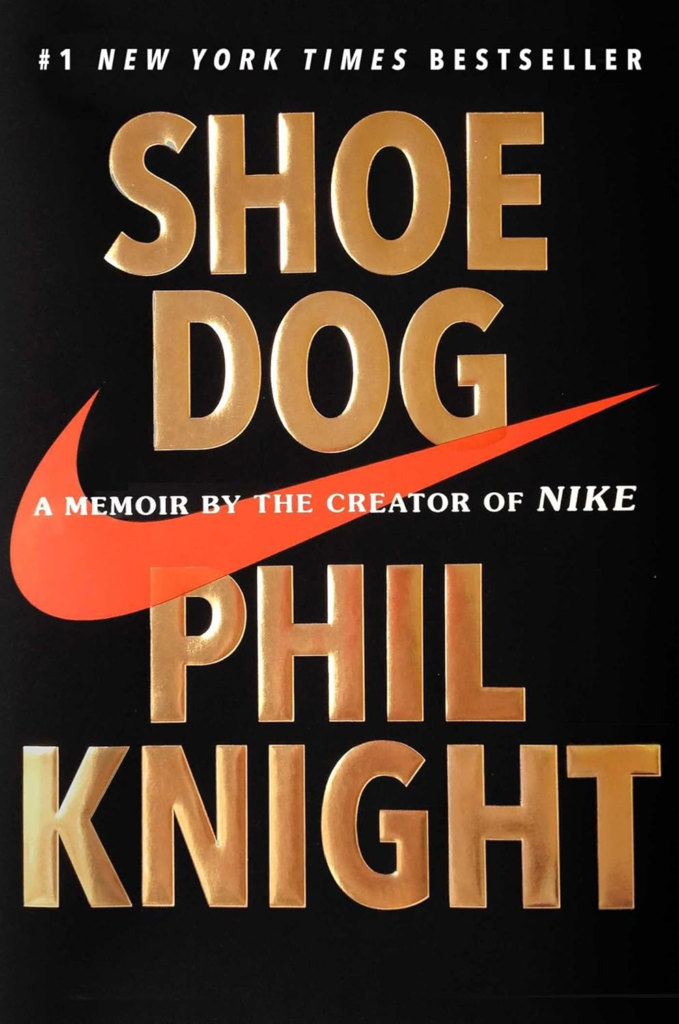
Shoe Dog: A Memoir by the Creator of Nike is an autobiographical business memoir by American entrepreneur Phil Knight, co-founder of Nike, Inc. The book recounts the formation and early development of the company that eventually became one of the world’s best-known sportswear businesses.
First published in 2016, Shoe Dog focuses primarily on the period between Knight’s early ambitions as a young runner and entrepreneur and Nike’s emergence as a major international company. Rather than presenting Nike as an inevitable success story, Knight describes a business characterized by uncertainty, cash shortages, difficult negotiations, competitive pressure, personal losses, legal problems and repeated near-failures.
The memoir begins with Knight’s decision, after completing his education and traveling abroad, to pursue what he describes as a seemingly unconventional business idea: importing high-quality, inexpensive running shoes from Japan. He initially sold shoes from the trunk of his car and gradually built a company first known as Blue Ribbon Sports, working closely with his former University of Oregon track coach Bill Bowerman and a small group of employees and associates.
The company eventually became Nike, and the book follows the transformation from a small shoe importer into a major athletic brand.
Simon & Schuster describes Shoe Dog as the story of Nike’s early startup years and its evolution into a global brand. The publisher notes that Knight began the venture with $50 borrowed from his father and that his first-year sales amounted to $8,000.
Unlike many conventional business memoirs, Shoe Dog spends considerable time on failure. Knight openly discusses mistakes, financial pressure, difficult personalities, strained relationships and moments when the company’s survival was uncertain.
The result is both a history of Nike’s origins and a personal account of the emotional experience of building a business before success was guaranteed.
Book information
| Field | Details |
|---|---|
| Title | Shoe Dog: A Memoir by the Creator of Nike |
| Author | Phil Knight |
| Country | United States |
| Language | English |
| Genre | Memoir; business; entrepreneurship |
| Subject | Phil Knight and the origins of Nike |
| Publisher | Scribner |
| First published | 2016 |
| Original form | Hardcover |
| Hardcover ISBN-13 | 9781501135910 |
| Trade paperback ISBN-13 | 9781501135927 |
| Indian paperback ISBN-13 | 9781471146725 |
| Length | Approximately 400 pages in the standard adult editions |
| Author | Phil Knight |
| Principal subject | Creation and growth of Nike |
| Related company | Blue Ribbon Sports / Nike |
| Young readers edition | Published in 2017 |
The standard adult editions published by Scribner are listed at approximately 400 pages. Different international editions have different ISBNs and publication dates.
Overview
At its heart, Shoe Dog is the story of a business that did not begin with a giant factory, enormous investment fund or established corporate infrastructure.
It began with an idea.
Phil Knight believed that high-quality running shoes manufactured in Japan could compete with established European and American brands. He imagined importing those shoes into the United States and selling them to runners.
The idea eventually became Blue Ribbon Sports.
Blue Ribbon Sports eventually became Nike.
But the distance between those two points is what makes the memoir compelling.
IDEA
  │
  ▼
$50 BORROWED FROM FATHER
  │
  ▼
JAPANESE RUNNING SHOES
  │
  ▼
BLUE RIBBON SPORTS
  │
  ▼
SMALL TEAM
  │
  ▼
FINANCIAL PRESSURE
  │
  ▼
GROWING SALES
  │
  ▼
BANKING & SUPPLIER PROBLEMS
  │
  ▼
OWN BRAND
  │
  ▼
NIKE
  │
  ▼
GLOBAL SPORTS BRAND
The important point is that Knight’s story is not presented as a straight line.
It is a story of repeated uncertainty.
The origin of the idea
The roots of Knight’s business idea can be traced to a paper he wrote while studying at Stanford Graduate School of Business.
Knight considered the possibility that Japanese manufacturers could produce high-quality running shoes at lower cost than established German manufacturers.
The concept was unusual at the time.
Instead of manufacturing shoes himself, Knight proposed acting as an intermediary between Japanese production and the American running market.
The idea combined several emerging trends:
- international trade
- increasing interest in running
- changing American consumer culture
- Japanese manufacturing
- entrepreneurial distribution
- the growth of competitive athletics
Knight’s idea was initially more theoretical than practical.
Turning it into a company would prove considerably harder.
Phil Knight’s early life
Phil Knight was born in Portland, Oregon, in 1938.
He attended the University of Oregon, where he became involved in track and field under coach Bill Bowerman.
Running was therefore not merely a business category for Knight.
It was part of his personal identity.
That connection became fundamental to Nike’s later culture.
After graduating from the University of Oregon, Knight continued his education at Stanford Graduate School of Business, where his ideas about entrepreneurship and international trade began taking a more concrete form.
Nike’s own corporate biography identifies Knight as a University of Oregon graduate and Stanford MBA, and records his later leadership roles at the company.
Bill Bowerman
One of the most important people in Shoe Dog is Bill Bowerman, Knight’s former track coach.
Bowerman was not simply an investor or business partner.
He was deeply interested in improving athletic performance through better footwear.
His experimentation with shoe construction eventually became an important source of product innovation.
The Knight–Bowerman relationship combined two different forms of knowledge:
PHIL KNIGHT
     │
     ├── Business
     ├── Finance
     ├── Marketing
     ├── International trade
     └── Brand building

          +

BILL BOWERMAN
     │
     ├── Coaching
     ├── Running
     ├── Athlete performance
     ├── Experimentation
     └── Shoe design

          ↓

      NIKE
The partnership was one of the foundational relationships in the company’s history.
The “Crazy Idea”
Knight’s early business concept is presented as an almost absurdly ambitious idea when viewed from the perspective of his circumstances.
He was young.
He had limited capital.
He did not own a shoe factory.
He did not have a famous brand.
He did not possess a large sales organization.
Yet he believed there was an opportunity.
The memoir repeatedly returns to this psychological state:
The entrepreneur begins with conviction long before the market provides proof.
That distinction is essential to understanding Shoe Dog.
Japan and the Onitsuka connection
Knight traveled to Japan and established a relationship with Onitsuka Co., the Japanese company that manufactured Tiger running shoes.
He proposed distributing the shoes in the United States.
The arrangement gave Knight access to footwear without requiring him to establish his own manufacturing infrastructure.
This dramatically lowered the initial barrier to entry.
The basic business model was:
JAPANESE MANUFACTURER
          │
          │ Shoes
          ▼
   BLUE RIBBON SPORTS
          │
          │ Distribution
          ▼
     U.S. RUNNERS
The model looked straightforward.
Making it work at scale was not.
Blue Ribbon Sports
Blue Ribbon Sports was founded by Knight and Bill Bowerman.
The company became the foundation from which Nike eventually emerged.
Knight initially sold shoes directly to athletes, often operating with extremely limited infrastructure.
The image of Knight selling running shoes from his car became one of the most recognizable elements of the memoir.
The contrast is striking:
EARLY BLUE RIBBON SPORTS

Car trunk
   +
Shoes
   +
Phone calls
   +
Track meets
   +
Small office
   +
Personal relationships
   =
Growing business
There was no global marketing machine.
There was no massive retail empire.
There was simply a founder trying to make the next sale.
The first sales
Knight’s early sales efforts were intensely personal.
He traveled to track meets and approached athletes and coaches.
The shoes were not initially sold through the vast retail infrastructure associated with modern Nike.
Knight and his colleagues built the market one customer at a time.
According to Simon & Schuster, Knight’s first-year sales reached $8,000 after he began selling shoes from the trunk of his Plymouth.
That figure is significant because it illustrates the enormous distance between Nike’s later scale and its beginnings.
The importance of running
Running played a unique role in the company’s early development.
Knight understood the sport because he had participated in it.
Bowerman understood athletes because he coached them.
This created a feedback loop:
ATHLETE
   ↓
PROBLEM WITH SHOE
   ↓
COACH / RUNNER
   ↓
EXPERIMENT
   ↓
NEW SHOE DESIGN
   ↓
ATHLETE FEEDBACK
   ↓
IMPROVEMENT
The company’s early products therefore emerged from the culture of sport itself.
Bowerman’s experimentation
Bowerman was constantly interested in making shoes lighter, more comfortable and more effective.
One of the most famous episodes involved experimentation with the waffle-patterned sole.
The story has become part of Nike’s founding mythology because it illustrates the company’s early culture of experimentation.
Rather than approaching footwear solely as a commodity, Bowerman approached it as an engineering problem.
This helped create a product-development philosophy that later became central to Nike.
From distributor to manufacturer
The relationship with Onitsuka eventually became increasingly difficult.
Blue Ribbon Sports depended heavily on its Japanese supplier, creating a structural vulnerability.
The company faced a classic entrepreneurial dilemma:
DEPEND ON SUPPLIER
       │
       ▼
LOWER MANUFACTURING RISK
       │
       ▼
BUT
       │
       ▼
LESS CONTROL
       │
       ▼
SUPPLIER CONFLICT
       │
       ▼
NEED FOR INDEPENDENCE
The conflict ultimately encouraged Knight and his team to develop their own footwear brand.
That brand was Nike.
The birth of Nike
The name Nike was proposed as the company moved toward developing its own identity.
Nike is named after the ancient Greek goddess of victory.
The name proved remarkably appropriate for a sports brand.
But the company needed more than a name.
It needed a visual identity.
The Swoosh
The Nike Swoosh was designed by graphic-design student Carolyn Davidson.
The logo eventually became one of the world’s most recognizable corporate symbols.
Knight’s initial reaction to the design was famously understated.
The contrast between the modest origins of the logo and its later global importance became one of the most memorable elements of Nike’s origin story.
The evolution of the brand
SMALL RUNNING COMPANY
        │
        ▼
     NIKE NAME
        │
        ▼
      SWOOSH
        │
        ▼
ATHLETIC IDENTITY
        │
        ▼
GLOBAL BRAND
The Swoosh eventually became more than a trademark.
It became a cultural symbol associated with sport, movement and performance.
The name Nike
The choice of Nike was significant because it linked the company to the Greek concept of victory.
The brand therefore carried a meaning larger than footwear.
It suggested:
- competition
- achievement
- movement
- athletic excellence
- victory
This connection between product and cultural symbolism became a defining feature of Nike’s marketing.
Financial pressure
One of the strongest themes in Shoe Dog is the financial fragility of the company.
Modern readers know Nike as a global corporation.
Knight’s memoir asks the reader to temporarily forget that outcome.
In the early years, the company repeatedly struggled with:
- working capital
- bank financing
- inventory
- supplier relationships
- cash flow
- rapid expansion
- debt
- payment timing
The paradox was simple:
The company could be growing rapidly and still be short of cash.
Growth versus cash
One of the most important business concepts illustrated by the memoir is the difference between profitability and cash flow.
A company can sell more products and still experience severe financial pressure if it must pay suppliers before receiving money from customers.
Simplified cash-flow cycle
ORDER SHOES
    │
    ▼
PAY / FINANCE INVENTORY
    │
    ▼
RECEIVE SHOES
    │
    ▼
SELL SHOES
    │
    ▼
WAIT FOR PAYMENT
    │
    ▼
RECEIVE CASH
    │
    └───────────────┐
                    ▼
             BUY MORE SHOES
Rapid growth can therefore create a financing problem.
Shoe Dog illustrates this issue repeatedly.
Banks and financing
Knight’s relationship with banks becomes one of the recurring sources of tension in the memoir.
From the perspective of a conventional banker, rapidly expanding inventory and borrowing could look dangerous.
From Knight’s perspective, insufficient financing could prevent a growing company from fulfilling demand.
This created a fundamental conflict:
BANK
"Control your risk."

          VS.

ENTREPRENEUR
"Give me enough capital to grow."
The tension between these positions appears throughout the early history of Nike.
The Nike team
One of the most memorable elements of Shoe Dog is Knight’s description of the people around him.
The company was not built by Knight alone.
The memoir introduces a group of employees and associates who became central to the company’s identity.
Among the important early figures were:
- Bill Bowerman
- Jeff Johnson
- Bob Woodell
- Jon McClain
- Geoff Hollister
- Delbert Hayes
- Jerry Fleming
- Rob Strasser
- John Baugh
- other early employees, managers and advisers
Knight portrays these people not simply as employees but as members of a highly unusual entrepreneurial community.
The “Buttface” culture
One of the recurring ideas in Shoe Dog is the sense that Nike’s early employees were outsiders.
They were not necessarily conventional corporate executives.
Many were runners, athletes, enthusiasts and unconventional personalities.
Knight’s affectionate descriptions of his early colleagues help explain why the company developed such a strong internal culture.
The company’s identity grew partly from the feeling that its members were participating in something unusual together.
The importance of friendship
The memoir repeatedly demonstrates that entrepreneurial ventures are built through relationships.
Knight’s relationships with Bowerman and his early employees provided:
- expertise
- emotional support
- trust
- loyalty
- creativity
- resilience
The business therefore becomes more than an economic organization.
It becomes a community.
VISION
  +
TRUST
  +
FRIENDSHIP
  +
SHARED MISSION
  +
HARD WORK
       ↓
TEAM
       ↓
COMPANY
Entrepreneurship as an adventure
One of the reasons Shoe Dog reads differently from many business books is its narrative style.
Knight often writes like someone remembering an adventure rather than explaining a management theory.
There are:
- road trips
- airport meetings
- athletic competitions
- tense negotiations
- financial crises
- personal arguments
- unexpected breakthroughs
- moments of exhaustion
- celebrations
- losses
This gives the memoir a distinctive rhythm.
The business story becomes almost an adventure narrative.
The psychology of the entrepreneur
Knight does not present himself as completely confident.
Instead, the memoir frequently reveals uncertainty.
He worries about:
- whether the company will survive
- whether banks will continue financing it
- whether suppliers will cooperate
- whether competitors will defeat it
- whether his decisions are correct
- whether he can keep growing
This is important because many entrepreneurship books are written retrospectively from the perspective of success.
Knight attempts to recreate the uncertainty of the journey.
Failure as a recurring theme
Failure is not a side topic in Shoe Dog.
It is one of the central subjects.
The company repeatedly faces situations in which success appears uncertain.
IDEA
 ↓
SETBACK
 ↓
RECOVERY
 ↓
GROWTH
 ↓
NEW SETBACK
 ↓
ADAPTATION
 ↓
NEW GROWTH
 ↓
LARGER SETBACK
 ↓
PERSISTENCE
The cycle continues throughout the narrative.
This is why the book is more accurately described as a memoir of persistence than simply a memoir of success.
Knight’s relationship with risk
Knight repeatedly took risks that would appear significant in retrospect.
However, the memoir shows that risk was not always a single dramatic decision.
It accumulated gradually.
One order led to another.
One loan led to another.
One employee led to another.
One market led to another.
The business became increasingly committed to a future that did not yet exist.
The accumulation of risk
Small Risk
   +
Small Risk
   +
Small Risk
   +
Small Risk
   +
Small Risk
      ↓
Growing Commitment
      ↓
Large Enterprise
This is one of the most realistic aspects of the memoir.
The role of competition
Nike’s rise took place in a highly competitive athletic-footwear market.
The company had to compete with established brands while simultaneously developing its own identity.
Competition forced Nike to improve:
- product design
- athlete relationships
- distribution
- marketing
- manufacturing
- branding
The result was an organization increasingly built around performance and innovation.
Marketing and athletes
Nike eventually became famous for associating its products with elite athletes.
But this strategy developed from the company’s early relationship with runners.
Athletes provided credibility.
They also provided feedback.
This created a powerful cycle:
ATHLETE
  ↓
USES PRODUCT
  ↓
PERFORMANCE
  ↓
PUBLIC ATTENTION
  ↓
BRAND CREDIBILITY
  ↓
MORE CUSTOMERS
  ↓
MORE ATHLETES
The athlete-brand relationship eventually became one of Nike’s defining business strategies.
Nike and the idea of identity
One of the most important insights in Shoe Dog is that Nike eventually sold more than shoes.
It sold an identity.
The consumer was not merely purchasing footwear.
The brand suggested:
- movement
- ambition
- athleticism
- competition
- freedom
- self-improvement
This transformation from product to identity was critical to Nike’s global growth.
The role of storytelling
Knight’s own memoir demonstrates the importance of storytelling.
Nike’s history contains memorable characters and symbols:
- the young founder
- the coach
- the runners
- the Japanese shoes
- the car trunk
- the Swoosh
- the financial crises
- the athletes
- the eventual global brand
The company therefore acquired a story long before it acquired global scale.
Infographic: The Nike origin story
                 PHIL KNIGHT
                      │
                      ▼
             "Crazy Idea"
                      │
                      ▼
               JAPAN TRIP
                      │
                      ▼
              ONITSUKA SHOES
                      │
                      ▼
            BLUE RIBBON SPORTS
                      │
          ┌───────────┴───────────┐
          ▼                       ▼
    BILL BOWERMAN             EARLY TEAM
          │                       │
          └───────────┬───────────┘
                      ▼
              PRODUCT INNOVATION
                      │
                      ▼
                 NIKE NAME
                      │
                      ▼
                  SWOOSH
                      │
                      ▼
              ATHLETE CULTURE
                      │
                      ▼
               GLOBAL BRAND
Major people in Shoe Dog
Phil Knight
Founder and central narrator of the memoir.
Knight provides both the business story and the personal perspective from which it is told.
Bill Bowerman
Knight’s former track coach and an essential early partner.
Bowerman’s interest in running and footwear innovation contributed significantly to Nike’s early product development.
Jeff Johnson
One of Nike’s earliest employees.
Johnson became an important figure in the company’s sales and operational development.
Carolyn Davidson
The graphic designer who created the Nike Swoosh.
Her contribution became one of the most recognizable pieces of Nike’s visual identity.
Steve Prefontaine
The celebrated American distance runner became associated with Nike during its early development.
His relationship with the company illustrates the importance of athletes in Nike’s emerging brand culture.
Rob Strasser
An important executive and strategist during Nike’s development.
Strasser played a major role in the company’s marketing and business development.
The title “Shoe Dog”
The title refers to the culture of people who become deeply obsessed with footwear.
A “shoe dog” is not simply someone who sells shoes.
It suggests someone who becomes fascinated by:
- footwear
- athletes
- materials
- performance
- design
- running
- competition
The title is deliberately informal.
It reflects the unconventional culture Knight describes.
Themes
1. Persistence
The memoir’s most obvious theme is persistence.
Knight repeatedly continues despite circumstances that might have encouraged him to stop.
2. Risk
The book explores the emotional and financial risks associated with entrepreneurship.
3. Friendship
Many of Nike’s achievements emerge from relationships rather than isolated individual brilliance.
4. Competition
Competition is present at almost every level of the story.
Nike competes against other brands, while Knight also competes against uncertainty itself.
5. Passion
The company’s early employees were deeply interested in running and sport.
That passion became part of the organization’s identity.
6. Innovation
Nike’s early growth depended partly on experimentation with footwear design.
7. Financial survival
Cash flow, borrowing and financing are recurring realities.
8. Identity
The company gradually evolves from a shoe distributor into a cultural brand.
9. Failure
The memoir deliberately refuses to remove failure from the success story.
10. Mortality and legacy
Although the book focuses on business, Knight’s reflections also reveal his awareness that a person’s work eventually becomes part of a larger history.
The business model of early Nike
The early company can be understood through a relatively simple sequence:
IMPORT
  ↓
DISTRIBUTE
  ↓
SELL
  ↓
REINVEST
  ↓
GROW
  ↓
BORROW
  ↓
IMPORT MORE
  ↓
GROW FASTER
But this model created a dangerous dependence on external financing.
The company’s growth therefore generated its own financial demands.
That paradox is one of the book’s most valuable business lessons.
Growth creates new problems
The memoir demonstrates an important entrepreneurial principle:
Success can create problems that failure never would.
A tiny company may have difficulty obtaining customers.
A rapidly growing company may instead have difficulty:
- producing enough inventory
- financing inventory
- hiring enough people
- managing suppliers
- maintaining quality
- controlling cash flow
- meeting demand
SMALL COMPANY
      │
      ▼
"How do we find customers?"
      │
      ▼
GROWTH
      │
      ▼
"How do we fulfill demand?"
      │
      ▼
MORE GROWTH
      │
      ▼
"How do we finance expansion?"
This is one of the most realistic business lessons in Shoe Dog.
The entrepreneurial team
Knight’s account challenges the myth of the lone entrepreneur.
Nike’s story is instead presented as a collective effort.
                   NIKE
                     │
        ┌────────────┼────────────┐
        ▼            ▼            ▼
     FOUNDER       COACH         TEAM
     Knight      Bowerman       Employees
        │            │            │
        └────────────┼────────────┘
                     ▼
                SHARED MISSION
                     │
                     ▼
                  BRAND
The company becomes successful because different forms of expertise complement one another.
From shoe company to cultural institution
Nike’s transformation can be understood in four stages.
Stage 1 — Product
Nike sells athletic shoes.
Stage 2 — Performance
Nike associates the shoes with athletes and competition.
Stage 3 — Brand
Nike develops a recognizable visual and emotional identity.
Stage 4 — Culture
Nike becomes associated with broader ideas of sport, ambition and personal achievement.
PRODUCT
   ↓
PERFORMANCE
   ↓
BRAND
   ↓
CULTURE
This transformation is central to understanding Nike’s eventual global influence.
Phil Knight’s leadership style
Knight’s leadership differs from the stereotypical image of the charismatic corporate chief executive.
He is often portrayed in the memoir as:
- introspective
- competitive
- anxious about the company
- loyal to colleagues
- highly persistent
- deeply attached to sport
- willing to take significant risks
- sometimes uncertain
- strongly motivated by independence
The memoir’s tone is particularly interesting because Knight does not portray himself as an infallible strategist.
He often presents himself as someone trying to understand what to do next.
The emotional side of entrepreneurship
One of the book’s distinguishing features is its attention to emotion.
The reader encounters:
- excitement
- fear
- frustration
- grief
- exhaustion
- loyalty
- anger
- relief
- pride
Business decisions are therefore shown as human decisions.
The company exists not in a spreadsheet but in the lives of the people who depend upon it.
The memoir’s narrative structure
The book generally follows a chronological path but is written with the pacing of a personal story.
Knight moves between:
- early memories
- business crises
- personal relationships
- product development
- travel
- athletic culture
- financial negotiations
- reflections on the past
This makes the book accessible to readers who may have little interest in conventional corporate history.
Why Shoe Dog does not read like a conventional business book
A typical management book might present:
Principle → Explanation → Example → Lesson
Knight instead often presents:
Problem → Panic → Decision → Consequence → Another Problem
That structure makes the memoir feel more authentic.
The reader experiences uncertainty rather than simply receiving advice about it.
The “messy” nature of success
The publisher quotes Bill Gates describing Shoe Dog as a reminder that business success is “messy, perilous, and chaotic,” emphasizing mistakes, struggles and sacrifice.
This description captures the book’s central narrative approach.
Nike’s success did not emerge from a perfectly executed five-year plan.
It emerged from improvisation.
Infographic: The real shape of entrepreneurship
                         SUCCESS
                           ▲
                           │
                     ┌─────┴─────┐
                     │           │
                  Growth      Setback
                     │           │
                     ▼           ▼
                  Problem → Decision
                     │           │
                     └─────┬─────┘
                           │
                        Adapt
                           │
                           ▼
                         Grow
                           │
                           ▼
                      NEW PROBLEM
                           │
                           ▼
                       REPEAT
The process is circular rather than linear.
Nike’s cultural philosophy
The company’s relationship with athletes was fundamental to its identity.
Nike did not initially emerge from conventional fashion.
It emerged from sport.
That distinction influenced the company’s culture.
Performance came first.
Brand culture developed around it.
Sport as a source of meaning
For Knight, sport represented more than physical competition.
It represented:
- discipline
- effort
- aspiration
- uncertainty
- failure
- improvement
- courage
- competition
These values became embedded in Nike’s later identity.
The importance of the Oregon environment
The Oregon setting is important to the story.
The University of Oregon’s track culture and the state’s connection with outdoor activity helped shape Knight and Bowerman.
Nike’s origins therefore cannot be completely separated from the regional culture in which its founders developed their ideas.
International business
The early Nike story was international from the beginning.
Knight’s model depended on Japanese manufacturing.
That meant the company was dealing with:
- international trade
- currency
- transportation
- manufacturing
- supplier relationships
- cultural differences
- import arrangements
Nike therefore became globally connected long before it became a global brand.
The transition to Nike
The move from Blue Ribbon Sports to Nike represents a fundamental change.
The company moves from being primarily a distributor to developing its own identity and products.
BLUE RIBBON SPORTS
       │
       │ Distribution
       ▼
Japanese footwear
       │
       ▼
Market knowledge
       │
       ▼
Product expertise
       │
       ▼
Independent identity
       │
       ▼
NIKE
This transition is one of the book’s central business developments.
The Nike brand strategy
Nike’s later brand strategy can be summarized as:
PRODUCT
   +
ATHLETE
   +
PERFORMANCE
   +
STORY
   +
SYMBOL
   +
EMOTION
   =
BRAND
The Swoosh became the visual shorthand for this combination.
Shoe Dog as a memoir
The book is fundamentally a memoir rather than an independent biography.
That distinction matters.
Knight is describing his own memories and interpretations.
Consequently, the narrative inevitably reflects his perspective.
It provides extraordinary access to Knight’s thinking, but readers should also recognize that autobiographical writing cannot provide the same perspective as a biography written independently by an outside researcher.
Strengths of the memoir
The book’s major strengths include:
- first-person access to Knight’s thinking
- detailed recollections of Nike’s early years
- candid descriptions of financial difficulties
- memorable characterization of early employees
- insight into entrepreneurial uncertainty
- vivid storytelling
- detailed account of the company’s origins
The publisher emphasizes the book’s candid and personal character and describes it as a revealing account of Nike’s early startup years.
Limitations
A memoir also has limitations.
Knight is the narrator.
Therefore:
- events are filtered through his memory
- other people may interpret events differently
- some organizational history receives more attention than other parts
- later success can influence how earlier decisions are remembered
The book is consequently best read alongside independent histories of Nike and the sportswear industry.
Reception
Shoe Dog became a major commercial success and a New York Times bestseller. Simon & Schuster’s publisher page identifies it as such and records praise from figures including Bill Gates and Warren Buffett.
Bill Gates praised the book for its candid account of the difficulties behind business success, while Warren Buffett described Knight as a gifted storyteller.
The book has also been praised for moving away from the conventional corporate memoir format and emphasizing the personalities and relationships that shaped Nike’s early years.
Its reception has extended beyond business readers. It is frequently recommended to entrepreneurs, athletes, students and readers interested in the history of major consumer brands.
Why readers connect with Shoe Dog
The appeal of the book lies partly in the enormous contrast between its beginning and its ending.
At the beginning:
$50
+
CAR TRUNK
+
RUNNING SHOES
+
ONE YOUNG ENTREPRENEUR
At the end:
GLOBAL BRAND
+
ATHLETES
+
INTERNATIONAL MARKETS
+
ICONIC LOGO
+
NIKE
Knowing the destination makes the uncertainty of the journey even more interesting.
Major lessons from Shoe Dog
Lesson 1: Start before everything is perfect
Knight did not begin with a complete infrastructure.
He began with an idea and acted on it.
Lesson 2: Know the customer
Knight understood runners because he had been one.
Lesson 3: Build relationships
The company was built through relationships with athletes, suppliers, employees, bankers and partners.
Lesson 4: Growth creates financial pressure
Sales growth does not automatically solve cash-flow problems.
Lesson 5: A team can become a competitive advantage
Nike’s early culture was strongly shaped by the people who joined it.
Lesson 6: Product quality matters
Bowerman’s experimentation demonstrated the importance of improving the product itself.
Lesson 7: Brand meaning matters
Nike eventually became much more than a footwear distributor.
Lesson 8: Persistence is not the same as certainty
Knight often continued despite uncertainty.
He did not always know whether the next decision would work.
Infographic: The Shoe Dog formula
             VISION
                │
                ▼
            ACTION
                │
                ▼
             RISK
                │
                ▼
           SETBACKS
                │
                ▼
           PERSISTENCE
                │
                ▼
             TEAM
                │
                ▼
          INNOVATION
                │
                ▼
             BRAND
                │
                ▼
             SCALE
This is not presented by Knight as a mathematical formula.
It is a useful way of visualizing the recurring pattern of the memoir.
The role of luck
Another important feature of Shoe Dog is Knight’s recognition that luck plays a role in entrepreneurship.
Not everything can be explained by planning.
The right person appears.
A supplier becomes available.
A customer places an order.
A product works.
A competitor makes a mistake.
A financing problem is solved.
A chance encounter creates an opportunity.
The memoir therefore complicates the popular idea that business success is always the direct result of individual genius.
Luck and preparation
The book suggests a more nuanced model:
OPPORTUNITY
     +
PREPARATION
     +
ACTION
     +
PERSISTENCE
     +
LUCK
     ↓
OUTCOME
The presence of luck does not eliminate the importance of effort.
It simply acknowledges that entrepreneurs cannot control every variable.
The human side of Nike’s origin
Perhaps the most memorable feature of Shoe Dog is that Nike does not initially look like Nike.
There is no polished global corporation.
There are people improvising.
There are people making mistakes.
There are people arguing.
There are people borrowing money.
There are people driving around with shoes in their cars.
There are people trying to convince athletes to try an unfamiliar brand.
The future global corporation is almost invisible.
And that is precisely what makes the origin story compelling.
Author: Phil Knight
Philip Hampson Knight, commonly known as Phil Knight, is an American businessman and philanthropist and one of the co-founders of Nike, Inc.
Born in Portland, Oregon, in 1938, Knight attended the University of Oregon, where he was a track athlete under coach Bill Bowerman. He later earned an MBA from Stanford Graduate School of Business.
Before devoting himself fully to Nike, Knight worked as a certified public accountant and later taught business administration at Portland State University. Nike’s official biography records his educational background and early professional experience.
Knight and Bowerman established the business that became Nike from the earlier Blue Ribbon Sports operation.
According to Nike, Knight led the company through much of its transformation from a small partnership into a global footwear, apparel and equipment company. He served as Nike’s president from 1968 to 1990 and again from 2000 to 2004, with a break during 1983–1984. He later served as chairman and is now Chairman Emeritus.
Phil Knight’s role at Nike
Knight’s career at Nike can be broadly divided into several stages:
ATHLETE
   │
   ▼
STUDENT
   │
   ▼
ENTREPRENEUR
   │
   ▼
BLUE RIBBON SPORTS
   │
   ▼
NIKE CO-FOUNDER
   │
   ▼
CEO / PRESIDENT
   │
   ▼
CHAIRMAN
   │
   ▼
CHAIRMAN EMERITUS
Nike’s official biography confirms Knight’s long leadership history with the company.
Phil Knight as a writer
Shoe Dog is Knight’s best-known major memoir.
His writing style differs from the polished language frequently found in corporate histories.
He often writes conversationally and personally.
The reader sees events from inside Knight’s own uncertainty.
That gives the memoir a quality that resembles a long conversation with an entrepreneur looking back at the most difficult years of his career.
The significance of Bill Bowerman
It would be difficult to understand Shoe Dog without understanding Bowerman.
Bowerman provided:
- coaching knowledge
- athlete credibility
- product experimentation
- technical insight
- leadership
- a connection to the running community
Knight provided:
- business vision
- financial organization
- international trade
- sales
- entrepreneurship
- strategic direction
Together they represented complementary forms of expertise.
The Knight–Bowerman partnership
                NIKE ORIGIN
                    │
          ┌─────────┴─────────┐
          │                   │
          ▼                   ▼
      PHIL KNIGHT        BILL BOWERMAN
          │                   │
       Business             Sport
       Finance              Coaching
       Sales                Design
       Strategy             Innovation
          │                   │
          └─────────┬─────────┘
                    ▼
             BLUE RIBBON SPORTS
                    │
                    ▼
                  NIKE
The partnership is one of the clearest examples in the memoir of complementary talent producing a larger result.
The Nike story in numbers
The following simplified timeline illustrates the enormous change described in the memoir:
| Stage | Approximate situation |
|---|---|
| Early 1960s | Knight develops the business idea |
| 1962 | Knight begins pursuing the Japanese-shoe concept |
| 1963 | First-year sales reach about $8,000 |
| 1960s | Blue Ribbon Sports expands |
| Early 1970s | Company moves toward its own brand |
| 1971 | Nike name and Swoosh emerge |
| 1970s | Nike develops into a major athletic brand |
| Later decades | International expansion accelerates |
| 2000s | Nike becomes a global sportswear leader |
| 2016 | Shoe Dog published |
The publisher specifically identifies 1963 as the year of Knight’s first-year $8,000 sales.
Publication history
The adult edition of Shoe Dog was published in 2016 by Scribner.
The original hardcover is listed with ISBN-13 9781501135910. A 400-page trade paperback edition carries ISBN-13 9781501135927.
International editions were subsequently published in various formats and markets.
For example, Simon & Schuster India’s paperback edition carries ISBN-13 9781471146725 and is listed at 400 pages.
Young readers edition
An abridged Young Readers Edition was published in 2017.
The edition retains the central story of Knight’s entrepreneurial journey while adding material intended for younger readers.
Simon & Schuster describes it as an abridged version of the adult memoir with additional front matter and back matter, including a letter from Knight to younger readers.
Audiobook
An unabridged audiobook edition of Shoe Dog was also published.
The availability of audiobook and compact-disc editions is documented by Simon & Schuster.
Adaptations and cultural influence
The story of Nike’s early years has been referenced extensively in business education, entrepreneurship discussions and popular media.
The memoir itself became an important part of Nike’s public origin story because it provided Knight’s first-person account of the company’s development.
It also helped humanize a company that had previously been better known for its products, athletes and advertising than for the people who built it.
Shoe Dog as an entrepreneurship book
Although technically a memoir, Shoe Dog is frequently read as an entrepreneurship book.
Its value in this context comes less from explicit instructions and more from lived experience.
Knight does not simply tell readers:
“Entrepreneurship is difficult.”
He shows what difficulty looks like.
It looks like:
- waiting for money
- arguing with banks
- losing suppliers
- making payroll
- worrying about inventory
- traveling constantly
- dealing with competitors
- hiring unusual people
- losing friends
- making decisions without enough information
That is one reason the memoir has remained popular among entrepreneurs.
A different kind of success story
Many business biographies begin with the successful company and work backward.
Shoe Dog does something different.
It asks the reader to spend much of the book inside the uncertainty that existed before Nike became Nike.
This changes the emotional experience.
The reader knows the company survives.
Knight does not.
That difference creates much of the book’s tension.
Central message
The book’s central message can be summarized as follows:
You do not need certainty to begin.

You need:
    an idea
      +
    enough courage to act
      +
    people willing to join you
      +
    the ability to survive setbacks
      +
    persistence over time.
But the memoir also contains a less comfortable message:
Persistence does not guarantee success.
Knight was fortunate as well as persistent.
The outcome depended upon people, circumstances, timing, markets and opportunities that he could not completely control.
Critical interpretation
Shoe Dog is most powerful when read neither as a perfect entrepreneurial blueprint nor as a simple celebration of Nike.
It is better understood as a personal reconstruction of what it felt like to build a company before its success was obvious.
Its greatest contribution is psychological.
The book reminds readers that successful companies usually look much more uncertain while they are being built than they do in retrospect.
RETROSPECT
──────────────►
"Of course Nike succeeded."

THE REAL EXPERIENCE
──────────────►
"Will this work?"
"Can we finance it?"
"Can we survive?"
"What's next?"
"Can we keep going?"
That difference between retrospective certainty and lived uncertainty is perhaps the most important idea in the memoir.
Conclusion
Shoe Dog: A Memoir by the Creator of Nike is the personal account of how Phil Knight and a small group of colleagues built the company that became Nike.
But the book is not really about shoes alone.
It is about uncertainty, ambition, friendship, risk, competition, persistence and the gradual construction of a dream.
The most striking aspect of Knight’s story is the contrast between the company readers know today and the fragile enterprise he describes in its early years.
Nike began without the resources associated with a global corporation.
It began with a young entrepreneur, a borrowed $50, Japanese running shoes, a former coach, a handful of unconventional colleagues and a belief that something different might be possible.
The company did not become Nike overnight.
It evolved through years of experimentation, financial pressure, personal sacrifice, competitive battles and repeated uncertainty.
That is why Shoe Dog has resonated far beyond the world of footwear.
Its most enduring subject is not Nike.
It is the experience of building something before the world knows whether it will work.
References
- Knight, Phil. Shoe Dog: A Memoir by the Creator of Nike. Scribner, 2016. Official publisher information and bibliographic details.
- Simon & Schuster. Shoe Dog — official publisher page, including synopsis, publication information and author biography.
- Simon & Schuster India. Shoe Dog — international paperback edition, ISBN 9781471146725.
- Nike, Inc. “Philip H. Knight, Chairman Emeritus.” Official Nike corporate biography.
- Simon & Schuster. Shoe Dog — trade paperback edition and reader/reviewer information.
- Simon & Schuster. Shoe Dog: Young Readers Edition. Publication information and description of the abridged edition.
Further reading
Readers interested in the subjects explored in Shoe Dog may also investigate:
Nike and its history
- History of Nike, Inc.
- Blue Ribbon Sports
- Nike product development
- Nike’s relationship with elite athletes
- Nike advertising and branding
- History of athletic footwear
Entrepreneurship
- Startup financing
- Working capital management
- Founder-led companies
- Entrepreneurial risk
- Brand building
- Product innovation
- Sports marketing
Sport and business
- History of running in the United States
- Evolution of athletic footwear
- Athlete endorsements
- Sports sponsorship
- The commercial development of professional sport
Read more
Related people
- Phil Knight
- Bill Bowerman
- Carolyn Davidson
- Steve Prefontaine
- Jeff Johnson
- Rob Strasser
Related organizations
- Nike, Inc.
- Blue Ribbon Sports
- University of Oregon
- Stanford Graduate School of Business
Related subjects
- Entrepreneurship
- Business memoir
- Sportswear
- Athletic footwear
- Branding
- Marketing
- Product design
- International trade
- Sports marketing
External links
- Simon & Schuster — Shoe Dog by Phil Knight
- Simon & Schuster India — Shoe Dog
- Nike — Phil Knight, Chairman Emeritus
- Shoe Dog — Trade Paperback edition
- Shoe Dog — Young Readers Edition
Bibliographic note
Because Shoe Dog has been published in multiple countries and formats, pagination, ISBN and publication dates can differ between editions. The standard adult Scribner hardcover is listed as 400 pages with ISBN-13 9781501135910, while the trade paperback carries ISBN-13 9781501135927. The Indian paperback edition has ISBN-13 9781471146725.
One-line encyclopedia summary
Shoe Dog is Phil Knight’s candid memoir of the uncertain, financially precarious and deeply personal journey from a young entrepreneur importing Japanese running shoes to the creation of Nike, one of the world’s most recognizable sports brands.