


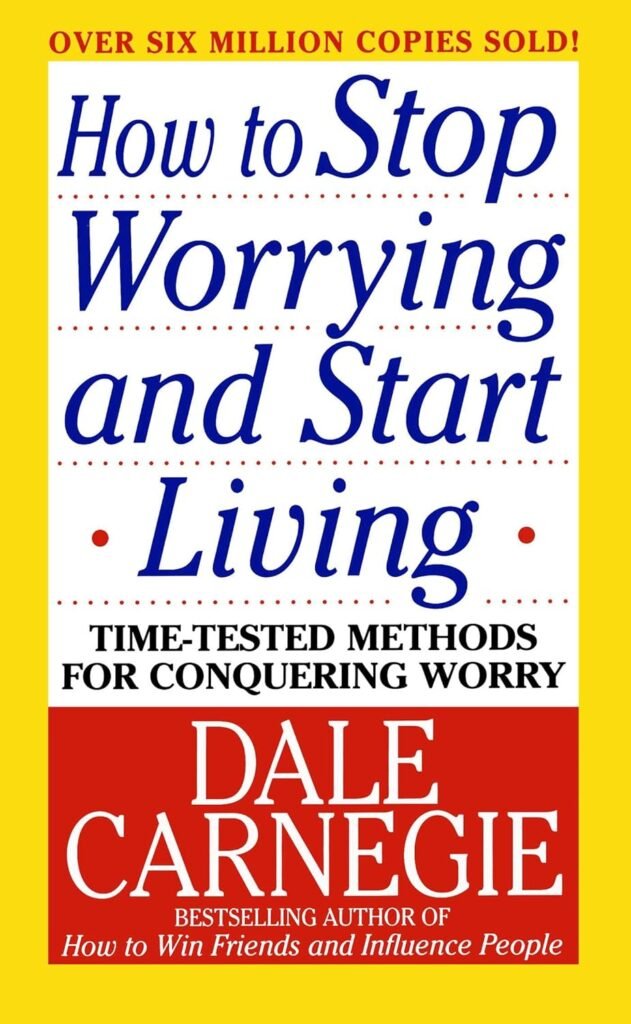
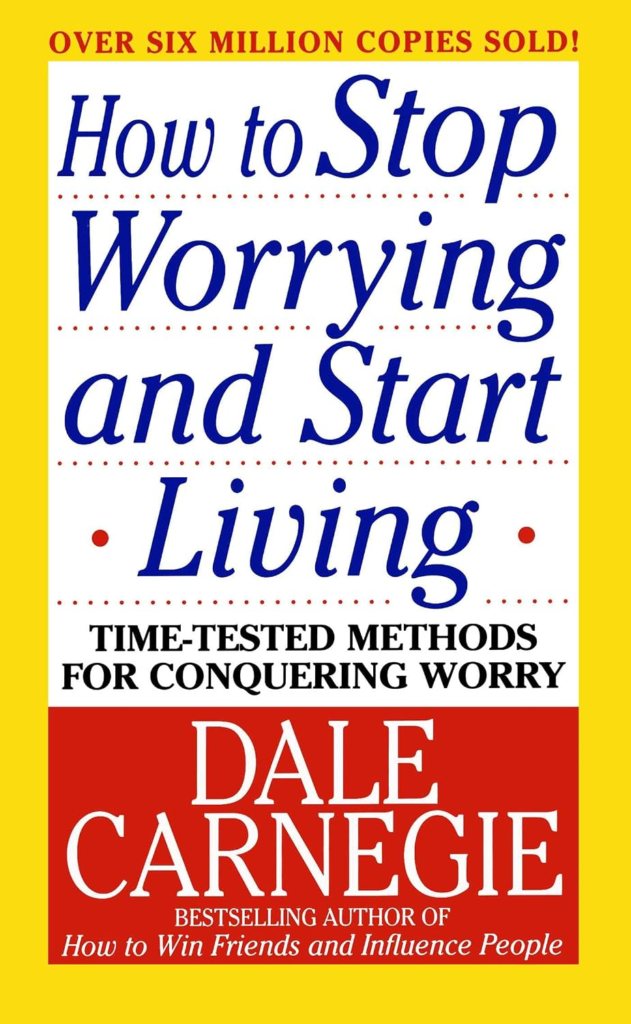
How to Stop Worrying and Start Living is a self-help book by American writer and lecturer Dale Carnegie. First published in 1948 by Simon & Schuster, the book presents practical methods for dealing with worry, anxiety, criticism, fatigue, financial concerns, difficult circumstances, and dissatisfaction with everyday life. Rather than approaching worry as an abstract psychological problem, Carnegie examines it through ordinary situations involving work, money, relationships, health, criticism, uncertainty, and personal failure.
The book is one of Carnegie’s two best-known works, alongside How to Win Friends and Influence People. Its central idea is deceptively simple: people cannot control everything that happens to them, but they can often change how they respond to circumstances. Carnegie therefore emphasizes living in the present, analysing problems objectively, accepting unavoidable realities, taking constructive action, and developing habits that make worry less dominant in everyday life.
Unlike a modern clinical psychology textbook, How to Stop Worrying and Start Living is primarily a work of practical self-help. Carnegie illustrates his principles through anecdotes, historical examples, personal experiences, and stories about people who faced difficult circumstances. The result is a book that reads less like a scientific treatise and more like a long conversation with an experienced lecturer trying to persuade the reader to stop spending emotional energy on problems that cannot be changed.
Book information
| Field | Details |
|---|---|
| Title | How to Stop Worrying and Start Living |
| Author | Dale Carnegie |
| Original publication | 1948 |
| Original publisher | Simon & Schuster |
| Language | English |
| Genre | Self-help, personal development |
| Subject | Worry, stress, personal effectiveness, happiness |
| Original edition length | Approximately 306 pages |
| Dewey classification | 158.1 in later library cataloguing |
| Major related work | How to Win Friends and Influence People |
| Later editions | Numerous revised and international editions |
Library and publishing records confirm the 1948 Simon & Schuster publication, while later editions differ considerably in pagination and presentation. For example, Open Library records a 1948 edition at 306 pages and later revised editions with substantially different pagination.
Edition note: Readers may encounter different chapter numbers, page counts, and even slightly different structural divisions depending on the edition. The core work, however, remains Carnegie’s practical system for dealing with worry.
Overview
At first glance, How to Stop Worrying and Start Living appears to promise something almost impossible: a life without worry.
Carnegie’s actual argument is more practical.
He does not suggest that a person can eliminate every difficult thought or prevent every unfortunate event. Instead, he repeatedly returns to a more manageable question:
What can I do about this situation now?
That shift—from endlessly imagining possibilities to dealing with the facts of the present—is at the heart of the book.
Carnegie’s method can be broadly represented as:
Worry → Facts → Analysis → Action → Acceptance → Forward Movement
When a problem can be solved, Carnegie encourages the reader to solve it.
When a problem cannot be solved immediately, he encourages the reader to accept the present circumstances rather than mentally fighting reality.
When something belongs entirely to the past, he argues that continuing to relive it is an unnecessary expenditure of emotional energy.
This practical orientation explains why the book has remained popular long after its original publication. Dale Carnegie’s official organization continues to describe the work in terms of managing stress and reducing its negative effects on health, relationships, and mental attitude.
Why Dale Carnegie Wrote the Book
Carnegie’s motivation for writing the book was personal.
In the preface, he describes himself as having been an extremely unhappy young man in New York and explains that worry had affected his physical and emotional well-being. His own struggle with dissatisfaction became one of the reasons he became interested in discovering practical methods for dealing with worry.
This personal starting point matters.
Carnegie was not writing about worry from the perspective of a laboratory researcher. He approached it as a teacher who had watched ordinary people struggle with fear, insecurity, failure, criticism, money, work, and uncertainty.
That explains the distinctive style of the book.
Instead of presenting pages of psychological terminology, Carnegie tells stories.
A businessman worries about losing his job.
A person becomes consumed by criticism.
Someone spends years regretting a decision that cannot be reversed.
Another person becomes exhausted because worry follows them into work and sleep.
The stories are different, but Carnegie keeps returning to the same fundamental problem: the mind can continue fighting a battle long after there is anything useful left to do.
Central Idea of the Book
The central proposition of How to Stop Worrying and Start Living can be expressed in one sentence:
Deal with the facts of the present situation, take whatever constructive action is possible, and stop mentally paying for problems that cannot be changed.
This philosophy produces several recurring themes:
- Live in the present rather than constantly projecting yourself into an uncertain future.
- Define the actual problem.
- Separate facts from assumptions.
- Identify possible courses of action.
- Make a decision.
- Act on that decision.
- Accept what cannot be changed.
- Avoid repeatedly revisiting old failures.
- Develop a constructive mental attitude.
- Protect physical energy and avoid unnecessary fatigue.
- Reduce the importance given to criticism.
- Deal realistically with financial problems.
- Find meaningful work and productive activity.
- Learn from other people’s experiences.
The Structure of the Book
The exact organization varies between editions. The original work and later editions have been presented with somewhat different pagination and structural details.
The major themes traditionally associated with the book include the following sections:
Part One — Fundamental Facts You Should Know About Worry
This opening section establishes Carnegie’s basic philosophy. It introduces the importance of living in the present, understanding what worry does to a person, and approaching problems through facts rather than imagination.
Part Two — Basic Techniques in Analysing Worry
Carnegie moves from philosophy to procedure.
The reader is encouraged to identify the problem, examine the facts, consider possible solutions, and make a decision.
Part Three — How to Break the Worry Habit Before It Breaks You
Here Carnegie explores techniques for interrupting repetitive worry. He discusses acceptance, distraction through constructive activity, dealing with unavoidable circumstances, and refusing to repeatedly revisit the past.
Part Four — Seven Ways to Cultivate a Mental Attitude That Will Bring You Peace and Happiness
This section shifts from problem-solving to mental attitude. Gratitude, perspective, self-acceptance, forgiveness, and the ability to transform difficult circumstances become important themes.
Part Five — The Perfect Way to Conquer Worry
Carnegie turns toward a broader philosophical and spiritual approach to uncertainty and worry.
Part Six — How to Keep from Worrying About Criticism
Criticism is examined as one of the major sources of unnecessary emotional distress. Carnegie argues that the desire for universal approval can itself become a source of worry.
Part Seven — Six Ways to Prevent Fatigue and Worry and Keep Your Energy and Spirits High
Carnegie connects fatigue, boredom, work habits, sleep, and worry. The section reflects his belief that emotional problems cannot always be separated from the way a person uses physical and mental energy.
Part Eight — Finding Work in Which You May Be Happy and Successful
Work and career become central concerns. Carnegie argues that dissatisfaction with one’s occupation can become an important source of worry.
Financial worries
Later editions and versions also devote specific attention to financial anxiety and the ways people can reduce worry related to money. Some later contents lists divide these subjects into additional parts, which is one reason different editions can appear structurally different.
Infographic: Carnegie’s Basic Worry Cycle
                 A PROBLEM APPEARS
                        │
                        ▼
                ┌───────────────┐
                │   WORRY       │
                │ "What if...?" │
                └───────┬───────┘
                        │
                        ▼
                ┌───────────────┐
                │ EXAMINE FACTS │
                └───────┬───────┘
                        │
                        ▼
              ┌───────────────────┐
              │ CAN I DO SOMETHING│
              │ ABOUT IT?         │
              └───────┬─────┬─────┘
                      │     │
                    YES      NO
                      │     │
                      ▼     ▼
                  ACTION   ACCEPT
                      │     │
                      └──┬──┘
                         ▼
                  MOVE FORWARD
This diagram is a modern representation of Carnegie’s recurring problem-solving philosophy, not a chart reproduced from the book.
Part One: Living in “Day-Tight Compartments”
One of Carnegie’s most memorable ideas is the concept of “day-tight compartments.”
The metaphor compares life to a ship whose compartments can be sealed off from one another.
Instead of mentally carrying yesterday into today and tomorrow into today, Carnegie encourages the reader to concentrate on the period currently being lived.
The underlying principle is:
Yesterday has already happened. Tomorrow has not happened yet. Today is where action is possible.
This does not mean ignoring the future.
Planning is useful.
Preparation is useful.
Learning from the past is useful.
But endless mental rehearsal of future disasters is different from preparation.
That distinction remains one of the most useful ideas in the book.
Part Two: A Method for Analysing Worry
Carnegie’s approach to worry is surprisingly procedural.
Instead of simply telling the reader to “think positively,” he encourages an analytical approach.
A person can ask:
1. What exactly is the problem?
A vague problem produces vague anxiety.
For example:
“My future is ruined.”
is psychologically very different from:
“I may lose my job within three months, and I currently have enough savings for four months.”
The second statement is uncomfortable, but it is measurable.
2. What are the facts?
Carnegie repeatedly emphasizes the importance of facts.
Worry often grows in the space between what is known and what is imagined.
3. What are the possible solutions?
List them.
Even an imperfect list can transform an emotional problem into a practical one.
4. What is the best course of action?
A decision reduces uncertainty.
5. What can I do now?
Action converts mental energy into useful energy.
Infographic: Carnegie’s Problem-Solving Formula
        IDENTIFY
           ↓
         FACTS
           ↓
        OPTIONS
           ↓
        DECISION
           ↓
         ACTION
           ↓
       ACCEPT RESULT
           ↓
       MOVE FORWARD
The important point is that worry is not treated as action.
Thinking about a problem can be productive.
Thinking about the same problem repeatedly without moving toward a decision is something else.
The Difference Between Preparation and Worry
One of the most important distinctions that emerges from the book is the difference between preparation and worry.
| Preparation | Worry |
|---|---|
| Looks at facts | Replays possibilities |
| Identifies risks | Magnifies risks |
| Creates options | Creates mental loops |
| Produces action | Often produces paralysis |
| Has a stopping point | Can continue indefinitely |
| Asks “What can I do?” | Asks “What if everything goes wrong?” |
Carnegie’s method is essentially an attempt to move a person from the second column toward the first.
What Worry May Do to a Person
Carnegie devotes considerable attention to the consequences of chronic worry.
He connects worry with:
- fatigue
- loss of concentration
- irritability
- reduced enjoyment of life
- disturbed sleep
- strained relationships
- reduced effectiveness at work
- physical exhaustion
The historical discussion should, however, be understood in context.
The book was written in the 1940s, and its explanations of stress, fatigue, and health do not constitute a modern clinical account of anxiety disorders or other mental-health conditions.
Carnegie’s work is best understood as practical self-help, not as a substitute for professional diagnosis or treatment.
Breaking the Worry Habit
Carnegie treats worry partly as a habit.
The implication is important.
If worry becomes habitual, the solution may not be one dramatic insight. Instead, it may require repeated changes in how a person responds to everyday situations.
Several of his methods can be grouped into five broad strategies:
1. Interrupt the thought cycle
Move attention toward a constructive activity.
2. Face the facts
Replace vague fears with specific information.
3. Accept unavoidable circumstances
Some realities cannot be negotiated away.
4. Stop reopening old wounds
A past mistake cannot be physically changed by repeatedly regretting it.
5. Replace mental energy with useful action
Do something concrete.
“Don’t Try to Saw Sawdust”
One of Carnegie’s most memorable metaphors is the idea that trying to “saw sawdust” is pointless.
The image is simple.
Once wood has already been cut into sawdust, a person cannot undo the cutting by continuing to work on it.
Carnegie applies the same logic to the past.
A mistake can be examined.
A lesson can be extracted.
An apology can sometimes be made.
A corrective action can sometimes be taken.
But after those possibilities have been exhausted, repeated regret does not alter the event.
This idea gives the book one of its most practical distinctions:
Learn from the past; do not repeatedly relive it.
Accepting the Inevitable
Another recurring principle is Carnegie’s call to “co-operate with the inevitable.”
The phrase does not mean surrendering to every problem.
It means distinguishing between:
- things that can be changed,
- things that can be influenced,
- and things that cannot be changed at all.
That distinction can dramatically alter how a person uses mental energy.
For example, if a decision can still be changed, action may be appropriate.
If a decision has already been made by someone else and cannot be reversed, endlessly replaying the situation may accomplish very little.
Acceptance, in Carnegie’s framework, is therefore not necessarily passivity.
It can be a way of stopping an unwinnable internal argument.
The “Stop-Loss” Principle
Carnegie borrows the idea of a stop-loss order from financial thinking and applies it to emotional life.
The basic idea is:
Decide how much emotional energy a problem deserves—and stop paying beyond that point.
This is particularly relevant to:
- arguments
- criticism
- failed relationships
- business mistakes
- missed opportunities
- embarrassment
- financial losses
The principle is not that every problem should be forgotten immediately.
Rather, it asks:
How long am I going to continue paying emotionally for something that has already happened?
Seven Mental Attitudes for Peace and Happiness
One of the major sections of the book focuses less on solving individual problems and more on cultivating a durable mental attitude.
The themes include:
Gratitude
Carnegie repeatedly encourages readers to notice what they already possess instead of constantly comparing themselves with what they lack.
Forgiveness
Resentment can keep a past conflict psychologically alive.
Self-acceptance
The reader is encouraged to stop trying to become an imaginary version of another person.
Perspective
A problem can appear enormous when viewed alone and much smaller when placed in the context of an entire life.
Constructive reinterpretation
Carnegie’s famous “lemonade” metaphor suggests that an unpleasant circumstance can sometimes become the raw material for something useful.
Purposeful activity
An occupied mind is less likely to spend every available moment rehearsing worries.
Living rather than merely existing
The title itself captures this distinction.
The goal is not simply to survive problems.
It is to continue living while problems exist.
“If You Have a Lemon, Make a Lemonade”
The “lemonade” principle is one of Carnegie’s most recognizable ideas.
Its underlying message is:
A difficult situation may contain an opportunity for learning, adaptation, creativity, or personal growth.
This is not the same as pretending that unpleasant circumstances are pleasant.
A financial loss is still a financial loss.
A rejection is still a rejection.
A failure is still a failure.
Carnegie’s argument is that the event does not have to be the final meaning of the experience.
A setback can become information.
A limitation can stimulate creativity.
A mistake can become education.
A disappointment can redirect a person’s life.
Worry About Criticism
Carnegie devotes a separate section to criticism because social judgment is one of the most persistent sources of anxiety.
People may worry about:
- what colleagues think,
- what relatives think,
- what friends think,
- what strangers think,
- how they appear,
- whether they have embarrassed themselves,
- whether others approve of their decisions.
Carnegie argues that attempting to satisfy everyone is an impossible project.
His solution is not to become indifferent to all feedback.
Instead, the reader is encouraged to distinguish between:
useful criticism and destructive criticism.
Useful criticism can reveal a genuine weakness.
Destructive criticism may simply reflect another person’s opinion, insecurity, hostility, misunderstanding, or preference.
The practical question becomes:
“Is there something useful here that I can learn?”
If yes, learn it.
If not, let the criticism go.
Why “No One Ever Kicks a Dead Dog” Matters
The provocative title of one chapter uses the metaphor that people do not bother attacking what they consider insignificant.
Carnegie uses criticism as a way of discussing visibility, achievement, and social judgment.
The broader lesson is not that criticism is proof of success.
Rather, it is that criticism is unavoidable whenever a person becomes visible, takes risks, makes decisions, or does something different.
Therefore, a person who waits for universal approval may never act.
Fatigue, Work and Worry
The book’s discussion of fatigue is particularly interesting because Carnegie does not treat worry as something completely separate from daily routines.
He examines:
- working habits,
- rest,
- boredom,
- sleep,
- repetitive work,
- mental tension,
- and the organization of one’s day.
The message is straightforward:
An exhausted mind often has less capacity to deal rationally with problems.
Carnegie therefore treats energy management as part of worry management.
This aspect of the book also explains why later editions continue to present the work as relevant to stress and everyday effectiveness.
Infographic: The Carnegie Energy-Worry Connection
       POOR WORK HABITS
              │
              ▼
           FATIGUE
              │
              ▼
       LOWER RESILIENCE
              │
              ▼
       MORE IRRITABILITY
              │
              ▼
            WORRY
              │
              ▼
        POOR SLEEP / REST
              │
              └───────────────┐
                              ▼
                           FATIGUE
This is a conceptual interpretation of Carnegie’s discussion rather than a scientific causal model.
Financial Worry
Money is one of the oldest and most persistent sources of anxiety, and Carnegie gives it considerable attention.
Financial worry often involves several different questions simultaneously:
- How much money do I have?
- How much do I owe?
- What happens if my income falls?
- Can my family manage?
- What if I lose my job?
- What if an unexpected expense appears?
- Am I spending too much?
- Am I saving enough?
Carnegie’s general strategy is to replace undefined fear with concrete information.
A person can therefore begin by calculating:
Income → Essential expenses → Debt → Savings → Risk → Available options
The psychological benefit is obvious.
A number can be managed.
A vague fear is much harder to manage.
Finding Meaningful Work
Another major theme is the relationship between occupation and happiness.
Carnegie recognizes that people spend a substantial portion of their lives working. Consequently, dissatisfaction with one’s occupation can become a continuing source of worry.
The book asks readers to think seriously about the kind of work in which they may find satisfaction and success.
This does not mean that every person can immediately abandon an unsatisfying job and pursue a dream career.
Carnegie’s broader point is that work should be considered not merely as a source of income but also as a major component of daily life.
The Role of Stories in the Book
One of the defining characteristics of How to Stop Worrying and Start Living is its extensive use of anecdotes.
Carnegie does not simply state:
“Accept circumstances you cannot change.”
He tells stories of people who had to confront difficult circumstances.
He does not merely argue that criticism should not control a person’s life.
He tells stories about people who learned to live with criticism.
The book therefore operates through example → principle → application.
This storytelling method was central to Carnegie’s teaching philosophy.
His broader career began with communication classes, and the Dale Carnegie organization traces the origins of the famous Carnegie Course to his work teaching adults in New York in 1912.
Author: Dale Carnegie
Dale Carnegie
Dale Carnegie (1888–1955) was an American writer, lecturer, teacher, and pioneer of popular self-improvement education.
He was born in Missouri in 1888. According to the Dale Carnegie organization’s historical account, he later became a salesman and aspiring actor before moving to New York, where he began teaching communication classes to adults at the YMCA.
His teaching eventually developed into the Dale Carnegie Course, which emphasized public speaking, confidence, interpersonal communication, and practical self-improvement. The course began in 1912 and later expanded internationally.
Carnegie became internationally famous following the publication of:
How to Win Friends and Influence People — 1936
The book became one of the best-known works in the self-help tradition. The Library of Congress describes it as an influential American self-help book and records Carnegie as the author.
He subsequently wrote or contributed to several other works, including:
- How to Win Friends and Influence People
- How to Stop Worrying and Start Living
- Lincoln the Unknown
- The Art of Public Speaking
Carnegie died in 1955.
The Library of Congress maintains catalogued material identifying Dale Carnegie as a figure born in 1888 and deceased in 1955, including photographic and bibliographic records.
Dale Carnegie’s Philosophy
Carnegie’s books share a recognizable philosophy.
He generally avoids abstract intellectual arguments and instead asks:
“What can an ordinary person actually do?”
His writing emphasizes:
- practical behaviour,
- communication,
- confidence,
- interpersonal relationships,
- decision-making,
- emotional discipline,
- constructive habits,
- and personal responsibility.
This explains the relationship between How to Win Friends and Influence People and How to Stop Worrying and Start Living.
The first focuses heavily on other people.
The second focuses more heavily on the individual’s relationship with problems and circumstances.
Together, they form a broad picture of Carnegie’s approach to self-improvement.
Relationship With How to Win Friends and Influence People
| How to Win Friends and Influence People | How to Stop Worrying and Start Living |
|---|---|
| Focuses on people | Focuses on worry and circumstances |
| Relationships | Emotional resilience |
| Communication | Problem-solving |
| Influence | Acceptance |
| Social confidence | Personal peace |
| Understanding others | Managing one’s own reactions |
The two books overlap in one important respect:
Both attempt to turn abstract advice into practical behaviour.
Major Principles at a Glance
| Principle | Core Question |
|---|---|
| Live in day-tight compartments | What can I deal with today? |
| Analyse the problem | What exactly is wrong? |
| Examine the facts | What do I actually know? |
| Consider alternatives | What can I do? |
| Make a decision | What course will I take? |
| Take action | What can I do now? |
| Accept the inevitable | What cannot be changed? |
| Stop-loss thinking | How much more energy should I spend? |
| Don’t saw sawdust | Can the past still be changed? |
| Make lemonade | What can I learn or create from this? |
| Ignore destructive criticism | Is this criticism useful? |
| Protect energy | Am I making myself unnecessarily exhausted? |
| Manage money concretely | What are the actual numbers? |
| Find meaningful work | Is my work compatible with the life I want? |
The Book’s Practical Framework
A modern reader can compress Carnegie’s approach into a simple framework:
F.A.C.T.S.
F — Face the problem
Do not disguise it.
A — Analyse the facts
Separate evidence from imagination.
C — Choose a course
Identify what can actually be done.
T — Take action
Move from thought to behaviour.
S — Stop revisiting what cannot be changed
Learn, accept, and continue.
The acronym above is a modern interpretive framework created for this encyclopedia article; it is not Carnegie’s original acronym.
A One-Page Visual Summary
╔══════════════════════════════════════════════╗
║       HOW TO STOP WORRYING & START LIVING   ║
║                DALE CARNEGIE                 ║
╠══════════════════════════════════════════════╣
║                                              ║
║  1. LIVE IN THE PRESENT                      ║
║             ↓                                ║
║  2. DEFINE THE PROBLEM                       ║
║             ↓                                ║
║  3. COLLECT THE FACTS                        ║
║             ↓                                ║
║  4. IDENTIFY POSSIBLE SOLUTIONS              ║
║             ↓                                ║
║  5. MAKE A DECISION                          ║
║             ↓                                ║
║  6. TAKE ACTION                              ║
║             ↓                                ║
║  7. ACCEPT WHAT CANNOT BE CHANGED            ║
║             ↓                                ║
║  8. STOP PAYING FOR THE PAST                 ║
║             ↓                                ║
║  9. PROTECT YOUR ENERGY                      ║
║             ↓                                ║
║ 10. KEEP LIVING                              ║
║                                              ║
╚══════════════════════════════════════════════╝
What Makes the Book Different From a Modern Psychology Book?
It is important not to confuse Carnegie’s work with contemporary clinical psychology.
The book:
- was written in the 1940s;
- is primarily practical and anecdotal;
- uses stories extensively;
- predates much of modern research on anxiety and stress;
- does not provide a clinical diagnostic framework;
- does not replace psychotherapy or medical treatment.
Its value lies principally in its practical philosophy of dealing with everyday worry.
Modern readers should therefore distinguish between:
Carnegie’s practical wisdom
and
scientifically established clinical treatment for anxiety disorders.
Those are not the same thing.
A person experiencing severe, persistent, disabling, or clinically significant anxiety should seek appropriate professional help rather than relying solely on a self-help book.
Criticism and Limitations
The book’s longevity does not mean every recommendation should be accepted uncritically.
1. Historical context
Some examples reflect the social attitudes and working conditions of the mid-20th century.
2. Anecdotal evidence
Carnegie frequently relies on personal stories and individual experiences. Anecdotes can be memorable, but they do not establish scientific causation.
3. Simplification
Human worry can arise from biological, psychological, social, financial, and environmental factors. A simple change in attitude cannot solve every problem.
4. Mental-health limitations
The book should not be treated as a clinical treatment manual for anxiety disorders, depression, insomnia, or other mental-health conditions.
5. Structural problems
Some problems are not primarily caused by individual thinking. Poverty, discrimination, unsafe working conditions, illness, family circumstances, and economic instability can create genuine external pressures.
This is an important modern qualification to Carnegie’s strongly individual-oriented approach.
Why the Book Remains Relevant
More than seven decades after its original publication, the central question of the book remains familiar.
People still worry about:
- careers,
- money,
- relationships,
- health,
- social approval,
- failure,
- uncertainty,
- aging,
- missed opportunities,
- and the future.
The technology has changed dramatically since Carnegie’s era.
The basic human experience of imagining something going wrong—and then mentally experiencing the event again and again before it has even happened—has not disappeared.
That is why the book continues to attract new editions and translations. The publisher’s current description reports more than six million copies sold and notes that the work has been updated in later editions.
The continued publication of the book does not prove that every Carnegie recommendation is universally effective. It does, however, demonstrate the enduring commercial and cultural interest in his approach to worry and everyday stress.
Modern Interpretation
A modern reader can reinterpret Carnegie’s philosophy without accepting every historical assumption.
For example:
Carnegie’s question:
“What can I do about this?”
Modern interpretation:
Focus attention on controllable variables.
Carnegie’s advice to examine facts:
Modern interpretation:
Separate evidence from catastrophic prediction.
Carnegie’s advice to accept the inevitable:
Modern interpretation:
Recognize the difference between controllable and uncontrollable circumstances.
Carnegie’s advice to live in the present:
Modern interpretation:
Avoid spending excessive cognitive resources on hypothetical futures while neglecting current action.
Carnegie’s advice to stop “sawing sawdust”:
Modern interpretation:
Learn from past events without repeatedly engaging in unproductive rumination.
A Reader’s Practical Exercise
The following exercise captures much of the book’s approach in a single page.
The Worry Worksheet
1. What exactly am I worried about?
Write one sentence.
2. What are the facts?
Write only information that you can reasonably verify.
3. What am I imagining?
Separate predictions from facts.
4. What can I control?
List only things within your influence.
5. What are my options?
Write at least three possible actions.
6. What is the next action?
Choose one.
7. What cannot be changed?
Name it clearly.
8. What will I do about that reality?
Accept it, adapt to it, or seek help.
9. When will I review the situation?
Give the problem a specific time rather than allowing it to occupy the entire day.
10. What should I do now?
Return to the present.
Key Ideas in One Sentence Each
- Live today: Do not allow an imaginary tomorrow to consume the present.
- Face facts: Worry becomes easier to handle when a vague fear becomes a defined problem.
- Decide: Indefinite uncertainty can keep the mind trapped in a loop.
- Act: Action converts mental energy into practical energy.
- Accept: Reality does not become easier to live with by repeatedly denying it.
- Learn: A mistake can become valuable if it produces knowledge.
- Let go: The past cannot be physically rewritten.
- Ignore needless criticism: Universal approval is unattainable.
- Protect energy: Fatigue can make ordinary problems feel much larger.
- Keep living: The presence of problems does not require the suspension of life.
Influence and Legacy
Dale Carnegie became one of the most influential figures in the development of modern popular self-improvement literature.
His influence extends beyond books into professional training, public speaking, communication, leadership education, and corporate development.
The Dale Carnegie organization continues to teach programs inspired by his original approach and identifies 1912 as the beginning of the Dale Carnegie Course.
His work also belongs to an important period in the development of mass-market self-help publishing. Carnegie helped popularize the idea that ordinary people could deliberately improve their communication, confidence, relationships, and everyday habits.
Publication History
The book was first published in 1948 by Simon & Schuster. Library records identify the original work as a New York publication from that year, with a pagination of approximately 306 pages.
It has subsequently appeared in numerous editions, including revised editions and translations.
Different editions may contain:
- different pagination,
- updated introductory material,
- editorial notes,
- revised presentation,
- additional material,
- and different structural divisions.
For this reason, citations to individual page numbers should always identify the edition being used.
Reception and Continuing Popularity
How to Stop Worrying and Start Living has remained one of Carnegie’s most widely circulated books.
The publisher describes the work as having sold more than six million copies and continues to market it as a practical guide to reducing worry and improving everyday life.
Its continuing popularity can partly be explained by its accessibility.
Carnegie does not ask the reader to master a complicated theoretical system.
He repeatedly brings the reader back to ordinary questions:
What is the problem?
What are the facts?
What can I do?
What cannot I change?
What am I going to do next?
That simplicity is probably one of the book’s greatest strengths—and, at the same time, one of the reasons modern readers should supplement it with contemporary psychological knowledge when dealing with serious mental-health problems.
Conclusion
How to Stop Worrying and Start Living is ultimately a book about where human attention goes.
A person can spend an enormous amount of mental energy imagining what might happen, replaying what has already happened, worrying about what other people think, or fighting circumstances that cannot be changed.
Carnegie’s alternative is deliberately practical:
Look at the facts.
Decide what you can do.
Do it.
Accept what you cannot change.
Then return to living.
That message explains the enduring appeal of a book first published in 1948.
Carnegie did not discover a magical formula that makes difficult life events disappear. What he offered was something more modest and, in many circumstances, more useful: a framework for refusing to give every problem unlimited access to one’s attention.
The book’s deepest lesson may therefore be found not in the promise to stop worrying completely, but in the second half of its title:
Start living.
Key Takeaways
If the entire book had to be reduced to ten principles, they would be:
- Live one day at a time.
- Define the actual problem.
- Collect the facts.
- Consider possible solutions.
- Make a decision.
- Take constructive action.
- Accept unavoidable circumstances.
- Do not repeatedly relive the past.
- Do not allow criticism to control your life.
- Preserve your energy for living rather than endlessly worrying.
Frequently Asked Questions
What is How to Stop Worrying and Start Living about?
It is a self-help book by Dale Carnegie about managing everyday worry through practical problem-solving, acceptance, constructive action, changes in mental attitude, better working habits, and reduced concern about criticism.
When was How to Stop Worrying and Start Living published?
The book was first published in 1948 by Simon & Schuster.
Who wrote How to Stop Worrying and Start Living?
The author is Dale Carnegie, the American writer, lecturer, and teacher best known for How to Win Friends and Influence People.
What is the main message of the book?
Its central message is to deal with problems through facts and constructive action, accept circumstances that cannot be changed, and avoid wasting mental energy on hypothetical futures or irreversible past events.
Is the book about anxiety disorders?
Not primarily. It is a practical self-help book written in the 1940s. It should not be considered a modern clinical treatment guide for anxiety disorders or other mental-health conditions.
What does “day-tight compartments” mean?
It refers to the idea of concentrating on the present day instead of allowing regrets about the past or fears about the future to dominate current life.
What does “Don’t Try to Saw Sawdust” mean?
It is Carnegie’s metaphor for the futility of repeatedly trying to change something that has already happened. The practical lesson is to learn from the past without continually reliving it.
What does “If You Have a Lemon, Make a Lemonade” mean?
It means attempting to find a constructive use, lesson, opportunity, or new direction within an unpleasant circumstance.
Is How to Stop Worrying and Start Living still relevant?
Many of its practical themes—decision-making, dealing with uncertainty, criticism, fatigue, work dissatisfaction, and financial worry—remain recognizable to modern readers. However, its advice should be read in its historical context and supplemented with contemporary evidence-based mental-health guidance when appropriate.
Is this book the same as How to Win Friends and Influence People?
No. Both were written by Dale Carnegie, but they address different subjects. How to Win Friends and Influence People focuses primarily on interpersonal relationships and communication, while How to Stop Worrying and Start Living focuses primarily on worry, stress, personal problems, and mental attitude.
Read More
By Dale Carnegie
- How to Win Friends and Influence People
- Lincoln the Unknown
- The Art of Public Speaking
Related subjects
- Self-help literature
- Personal development
- Stress management
- Decision-making
- Emotional resilience
- Positive psychology
- Public speaking
- Interpersonal communication
- Work and career satisfaction
- Financial stress
References
- Carnegie, Dale. How to Stop Worrying and Start Living. Simon & Schuster, 1948. Library records identify the original New York edition and approximately 306 pages.
- Google Books. How to Stop Worrying and Start Living, Dale Carnegie. Bibliographic and contents information.
- Open Library. Bibliographic records for How to Stop Worrying and Start Living, including original and revised editions.
- Simon & Schuster. How to Stop Worrying and Start Living: Time-Tested Methods for Conquering Worry. Official publisher information.
- Dale Carnegie Training. Dale Carnegie heritage and historical biography.
- Library of Congress. Records concerning Dale Carnegie and his published works.
- Google Books. Contents and edition information for later editions of How to Stop Worrying and Start Living.
External Links
- Dale Carnegie official organization — information about Carnegie’s legacy and programs.
- Simon & Schuster — official publisher information for the book.
- Google Books — bibliographic and preview information for various editions.
- Open Library — library records for different editions.
- Library of Congress — historical and bibliographic records concerning Dale Carnegie.
Encyclopedia Editorial Note
This article summarizes and interprets the ideas of How to Stop Worrying and Start Living. It does not reproduce the book’s text. Chapter organization and pagination can differ among editions; bibliographic details should therefore be checked against the specific edition being referenced. The infographic-style diagrams in this article are original explanatory representations created for educational purposes and are not reproductions from Carnegie’s book.