
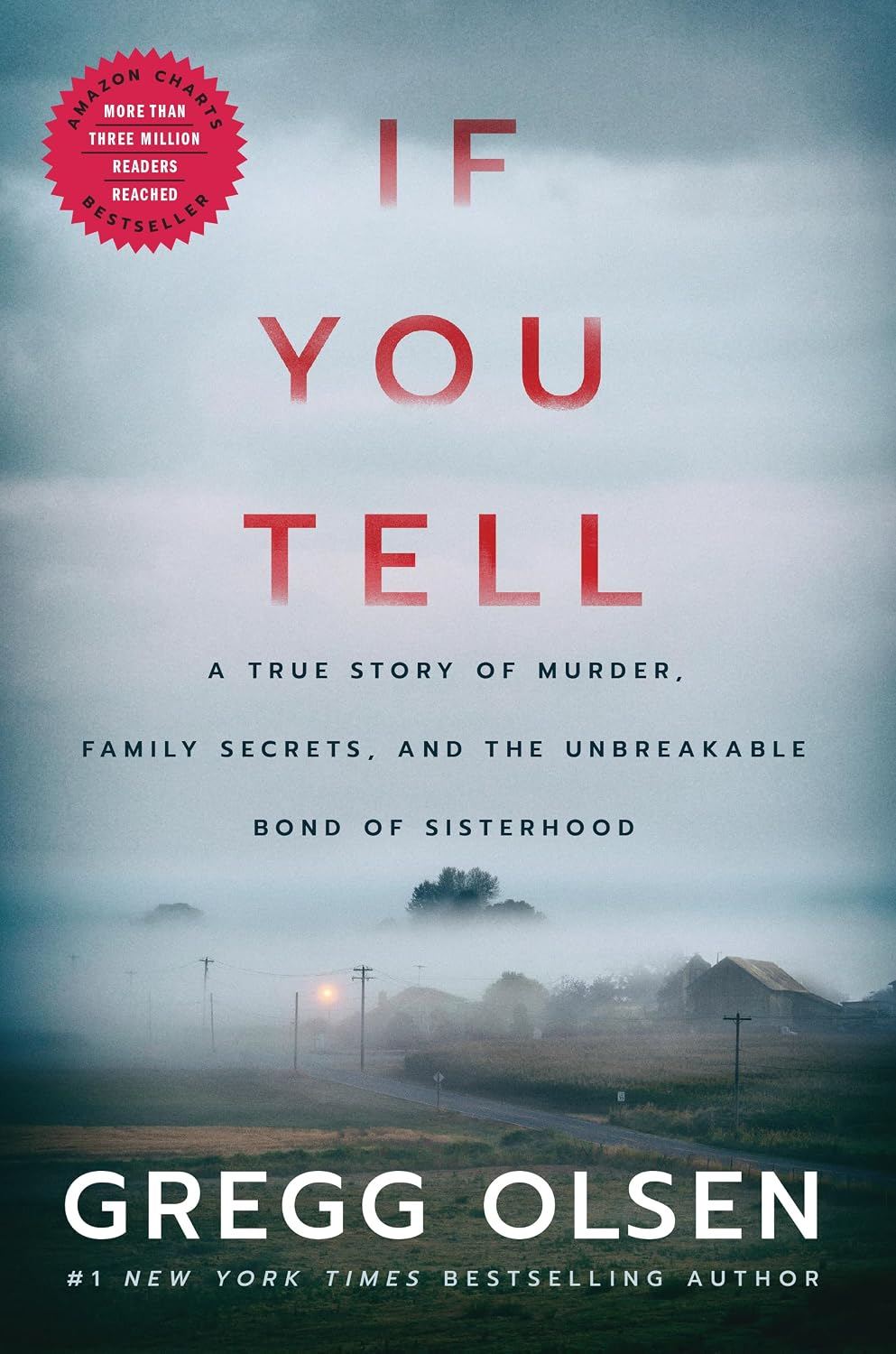
If You Tell: A True Story of Murder, Family Secrets, and the Unbreakable Bond of Sisterhood is a 2019 true-crime book by American author Gregg Olsen. Published by Thomas & Mercer, the book chronicles the lives of sisters Nikki, Sami, and Tori Knotek and the years of abuse they experienced within their family home in Raymond, Washington. The narrative also examines the deaths of people who became associated with the Knotek household and the eventual investigation that resulted in the imprisonment of their parents, Shelly and David Knotek. (Kirkus Reviews)
The book combines investigative nonfiction with a chronological account of the sisters’ childhood experiences. At its center is the relationship among the three sisters, whose cooperation eventually helped expose what had happened inside their home. Olsen describes If You Tell as a story of survival and the sisters’ eventual movement from being victims of their circumstances toward rebuilding their lives. (Gregg Olsen)
Bibliographic information
| Field | Details |
|---|---|
| Title | If You Tell: A True Story of Murder, Family Secrets, and the Unbreakable Bond of Sisterhood |
| Author | Gregg Olsen |
| Genre | True crime; investigative nonfiction |
| Publisher | Thomas & Mercer |
| Publication date | December 1, 2019 |
| Language | English |
| ISBN | 978-1-5420-0522-7 |
| Paperback ISBN | 978-1-5420-0523-4 |
| Length | Approximately 400–460 pages, depending on edition |
| Setting | Raymond, Washington, United States |
| Subject | Family abuse, murder, survival, sisterhood, criminal investigation |
Bibliographic records list the 2019 Thomas & Mercer edition at 405 pages, while the Publishers Weekly listing records a 460-page edition and the paperback at 429 pages, illustrating differences among editions and formats. (PublishersWeekly.com)
Background
The events described in If You Tell center on the Knotek family of Raymond, Washington, a small community in the Pacific Northwest.
At the heart of the story is Shelly Knotek, portrayed by Olsen as a highly controlling and abusive mother. Her daughters—Nikki, Sami, and Tori—grew up in an environment characterized by psychological manipulation, physical abuse, fear, and secrecy.
The family’s circumstances became particularly disturbing because other people were also brought into the household. According to accounts summarized by Olsen and contemporary reviews, these included people who became victims of Shelly’s abuse and, in several cases, were later found to have died. (Kirkus Reviews)
The book therefore operates on two interconnected levels:
- A family-survival story, centered on three sisters.
- A true-crime investigation, concerning abuse, disappearances, deaths, and the eventual criminal prosecution of the parents.
This dual structure is one reason the book has attracted both true-crime readers and readers interested in family dynamics and survival.
The Knotek family
Shelly Knotek
Shelly Knotek is the central perpetrator described in If You Tell. Olsen’s account portrays her as a controlling figure who exercised extensive psychological and physical control over members of her household.
The book describes a pattern in which fear and secrecy prevented family members from openly challenging her behavior. The daughters were subjected to abuse while simultaneously being placed in situations where they became witnesses to, or were forced to participate in, the abuse of others. (Kirkus Reviews)
The resulting environment made the family home fundamentally different from the ordinary concept of a safe domestic space. The house became, in the book’s narrative, a closed system governed by Shelly’s rules.
David Knotek
David Knotek, Shelly’s husband, is also an important figure in the story.
According to the published accounts, David participated in some aspects of the abusive environment or failed to intervene effectively. Kirkus describes him as assisting or standing by while Shelly abused members of the household. (Kirkus Reviews)
The distinction between active participation and passive compliance is an important element in understanding the family dynamics presented by Olsen.
The three sisters
The emotional center of If You Tell is the relationship among Nikki, Sami, and Tori Knotek.
Olsen presents the sisters not merely as witnesses to their family’s history but as people who developed their own system of emotional support within an abusive environment.
Nikki
Nikki, the eldest sister, is portrayed as an important early source of resistance within the family.
As she grew older, Nikki eventually managed to distance herself from the household and establish a life outside it. Her increasing independence became significant in the later unraveling of the family’s secrets. (Kirkus Reviews)
Sami
Sami, the middle sister, occupies a particularly complicated position in the narrative.
She attempted to negotiate with her mother while also trying to protect herself and her sisters. Publishers Weekly describes Sami as reaching an understanding with Shelly concerning her education while maintaining silence about the family’s secrets. (PublishersWeekly.com)
Her experience illustrates one of the book’s recurring themes: under extreme coercion, survival can involve choices that appear contradictory from the outside.
Tori
Tori, the youngest sister, remained in the household longer than her older sisters.
Her eventual realization that she had become a direct target of her mother’s abuse became a crucial turning point. According to the published accounts, her sisters responded by joining together to protect her and bring the situation to the attention of law enforcement. (PublishersWeekly.com)
The sisters’ eventual cooperation forms the narrative’s central arc.
Abuse and control
One of the most disturbing aspects of If You Tell is the variety of abusive methods described in the narrative.
Published reviews refer to physical assaults, starvation, verbal degradation, bleach-related abuse and other forms of cruelty. Kirkus specifically describes the abuse of one victim as involving drugging, beating, starvation and a form of waterboarding. (Kirkus Reviews)
The abuse described in the book was not presented as a series of isolated incidents. Instead, Olsen depicts an extended pattern of:
- psychological intimidation;
- physical violence;
- humiliation;
- manipulation;
- isolation;
- threats;
- secrecy;
- coercive control; and
- punishment for disobedience.
This distinction is important because the book’s central question is not simply what happened, but how an abusive system could continue for years without being stopped.
The deaths and disappearances
The true-crime element of If You Tell involves several people who became connected with the Knotek household.
Kirkus identifies Kathy Loreno and two other victims among the people whose deaths became part of the case. Publishers Weekly also discusses the deaths of people who had entered the family’s orbit. (Kirkus Reviews)
The circumstances surrounding these deaths form one of the darkest portions of the book.
Rather than treating the deaths as isolated criminal events, Olsen places them within the broader history of the Knotek household. The narrative therefore asks readers to consider how prolonged domestic abuse, manipulation and secrecy can create conditions in which serious crimes remain hidden.
How the sisters broke the silence
The book’s title, If You Tell, refers to one of the fundamental mechanisms of control in the story: silence.
For years, the sisters had powerful reasons to remain silent. They feared their mother, feared the consequences of disclosure and had been conditioned to keep family matters private.
The situation eventually changed when the sisters began communicating with one another more openly.
The decisive moment came when Tori’s situation prompted Nikki and Sami to take action. The sisters eventually approached authorities, leading to an investigation and the eventual arrest of Shelly and David Knotek. (PublishersWeekly.com)
The book consequently moves from secrecy toward disclosure:
Fear → Silence → Recognition → Sisterhood → Disclosure → Investigation → Justice
That progression provides the basic narrative architecture of the book.
Investigation and criminal proceedings
The Knotek case eventually resulted in the imprisonment of both parents.
Kirkus reports that Shelly and David Knotek were arrested in 2003 following the sisters’ disclosures and were subsequently sent to prison for their roles in the deaths of victims. (Kirkus Reviews)
The criminal case is therefore substantially different from a conventional murder mystery. Readers already know from the historical record that the family secrets eventually came to light.
The dramatic question becomes how the sisters survived, how the truth remained hidden, and how the family finally escaped the cycle of control.
Timeline of the case
Infographic: The road from secrecy to disclosure
┌──────────────────────────────┐
│   LIFE INSIDE THE HOUSE      │
│ Abuse • Fear • Secrecy       │
└──────────────┬───────────────┘
               │
               ▼
┌──────────────────────────────┐
│  OTHER PEOPLE ENTER FAMILY   │
│  CIRCLE                       │
│  Abuse extends beyond girls  │
└──────────────┬───────────────┘
               │
               ▼
┌──────────────────────────────┐
│     SISTERS GROW OLDER        │
│ Independence begins to grow  │
└──────────────┬───────────────┘
               │
               ▼
┌──────────────────────────────┐
│      TORI BECOMES TARGET      │
│      OF SERIOUS ABUSE         │
└──────────────┬───────────────┘
               │
               ▼
┌──────────────────────────────┐
│     SISTERS UNITE             │
│ Nikki + Sami + Tori           │
└──────────────┬───────────────┘
               │
               ▼
┌──────────────────────────────┐
│       POLICE INVOLVEMENT      │
│       Investigation           │
└──────────────┬───────────────┘
               │
               ▼
┌──────────────────────────────┐
│   2003: ARRESTS & PRISON      │
│ Shelly and David Knotek       │
└──────────────────────────────┘
The exact chronology contains more events than this simplified visualization; it is intended as an overview rather than a substitute for the detailed narrative in Olsen’s book.
Central themes
Sisterhood
The most important theme of If You Tell is arguably the relationship among the three sisters.
The title emphasizes disclosure, but the book’s emotional foundation is sisterhood. The sisters’ ability to communicate with and protect one another ultimately becomes more powerful than their mother’s efforts to isolate them.
Olsen’s official description explicitly frames the book as a survivor’s story in which the sisters move from being victims toward rebuilding their lives. (Gregg Olsen)
Silence and secrecy
Silence functions almost like another character in the story.
The family’s secrets remain protected because those inside the household are afraid to speak. The book demonstrates how secrecy can become self-reinforcing:
Fear
  ↓
Silence
  ↓
Isolation
  ↓
More control
  ↓
Greater fear
  ↓
Deeper silence
Breaking this cycle becomes essential to the sisters’ eventual escape.
Coercive control
The story also illustrates the concept of coercive control—a pattern in which an individual uses intimidation, manipulation, isolation and threats to dominate another person.
Although If You Tell is primarily a true-crime narrative rather than an academic study of coercive control, the family dynamics described by Olsen provide an example of how such control can operate inside an intimate relationship.
Childhood trauma
The sisters’ experiences demonstrate another important theme: the long-term consequences of childhood trauma.
The narrative does not end when the sisters leave the household. Olsen’s account is also concerned with the process of rebuilding identities and relationships after years of abuse.
In this respect, the book moves beyond the question of criminal responsibility and becomes a story about survival.
The problem of bystanders
Another important question raised by the case is how severe abuse can remain hidden.
Kirkus specifically questioned how the crimes could go undetected for so long in a small community where people were generally familiar with one another. (Kirkus Reviews)
This question gives the book a broader social dimension.
The case raises issues concerning:
- recognition of domestic abuse;
- children’s vulnerability;
- social isolation;
- fear of authority;
- manipulation of outsiders;
- community awareness; and
- the difficulty of identifying abuse when victims are prevented from speaking.
Narrative style
Olsen structures If You Tell as a fast-moving true-crime narrative rather than as a conventional academic case study.
Kirkus notes that the book consists of 85 relatively short chapters, while Booklist, as reported by Book Marks, characterized Olsen’s approach as chronological and straightforward. (Kirkus Reviews)
The short chapters allow the narrative to move rapidly between episodes and stages of the family’s history.
This structure is particularly effective for a story containing a large number of people and events because it prevents the reader from becoming trapped in long blocks of exposition.
The role of survivor testimony
One of the distinctive aspects of the book is its reliance on access to members of the Knotek family.
Kirkus notes that Olsen had access to the sisters, David Knotek and a grandmother. (Kirkus Reviews)
The result is a narrative that gives considerable space to the sisters’ recollections and perspectives.
That approach also creates an important nonfiction question: memories of traumatic childhood events are inherently personal, and a narrative based partly on survivor recollection is different from a court transcript or contemporaneous investigative record.
For that reason, readers interested in the case should distinguish between:
documented legal facts → reported testimony → reconstructed narrative → author’s interpretation.
That distinction is particularly important when reading any dramatized true-crime account.
Reception
If You Tell received substantial attention from reviewers and became a commercial success.
Publishers Weekly gave the book a starred review and described its account of the sisters’ experiences as compelling, while Booklist praised Olsen’s chronological and straightforward presentation. (PublishersWeekly.com)
The book also received a more mixed assessment from Kirkus Reviews. Kirkus acknowledged the sisters’ courage and the seriousness of the story but criticized what it considered an overly dramatic and repetitive writing style and questioned how the crimes could have remained undetected for so long. (Kirkus Reviews)
This difference in reception is useful in understanding the book’s place within contemporary true crime:
| Aspect | Critical response |
|---|---|
| Subject matter | Widely recognized as disturbing and compelling |
| Sisters’ story | Generally viewed as the emotional core |
| Chronological structure | Praised by some reviewers |
| Accessibility | Generally considered readable and fast-moving |
| Writing style | Some reviewers found it dramatic or repetitive |
| Investigative questions | Some reviewers wanted deeper explanation |
Book Marks aggregates several published reviews and records positive assessments from Publishers Weekly and Booklist alongside Kirkus’s mixed review. (Book Marks)
Commercial reception
The book’s publisher and author have identified If You Tell as a bestseller across several lists and platforms.
Gregg Olsen’s official website describes the book as a Wall Street Journal, Washington Post, USA Today and Amazon Charts bestseller. (Gregg Olsen)
Google Books likewise identifies it as a bestseller associated with several major lists. (Google Books)
These claims concern commercial placement and should not be confused with critical awards or literary rankings.
Author
Gregg Olsen
Gregg Olsen is an American author whose work spans true crime, crime fiction, thrillers and young-adult fiction.
Olsen was born in Seattle, Washington, in 1959. His bibliography includes numerous nonfiction books and more than twenty novels, according to his official biography. (Gregg Olsen)
His nonfiction writing frequently focuses on extraordinary criminal cases and historical events.
Among his nonfiction books are:
- The Deep Dark
- Starvation Heights
- Bitter Almonds
- A Twisted Faith
- If You Tell
His fiction includes several crime and thriller titles.
Olsen’s official biography states that his books have appeared on the New York Times, USA Today, Wall Street Journal, Washington Post and Amazon Charts bestseller lists. He has also appeared on numerous television programs, including Dateline NBC, 48 Hours, Good Morning America, Anderson Cooper 360 and programs associated with Investigation Discovery and A&E. (Gregg Olsen)
His work has therefore developed at the intersection of investigative nonfiction, popular true crime and crime fiction.
Gregg Olsen’s approach to true crime
Olsen’s nonfiction generally focuses on cases in which apparently ordinary environments conceal extraordinary violence.
That approach is particularly visible in If You Tell.
Rather than beginning with the criminal investigation and working backward, the book spends considerable time inside the family environment. Readers first encounter the relationships, tensions and patterns of control before reaching the eventual criminal consequences.
This approach creates a different kind of true-crime narrative:
Family life → hidden abuse → escalating danger → deaths → disclosure → investigation → aftermath
The emphasis is consequently not only on who committed the crimes, but also on the social and psychological environment in which they occurred.
Major characters
                         KNOTEK FAMILY
                              │
                 ┌────────────┴────────────┐
                 │                         │
           Shelly Knotek               David Knotek
                 │                         │
                 └────────────┬────────────┘
                              │
             ┌────────────────┼────────────────┐
             │                │                │
           Nikki            Sami             Tori
           Eldest          Middle            Youngest
             │                │                │
             └────────────────┼────────────────┘
                              │
                       SISTERHOOD
                              │
                              ▼
                    BREAKING THE SILENCE
This diagram simplifies the complicated family and victim relationships described in the book.
Narrative arc
A useful way to understand If You Tell is through five stages.
1. The closed household
The family home becomes a controlled environment in which Shelly determines what others can say, do and reveal.
2. Escalation
The abuse becomes increasingly severe and extends beyond the immediate family.
3. Recognition
The sisters gradually become old enough to understand that what is happening is fundamentally wrong.
4. Solidarity
Their individual experiences begin to form a shared understanding. The sisters realize that their best chance of escaping the situation lies in supporting one another.
5. Disclosure
The family secrets are finally communicated to authorities, leading to an investigation and criminal proceedings.
A conceptual map of the book
Infographic: What drives the story?
             ┌────────────────────┐
             │      ABUSE         │
             └─────────┬──────────┘
                       │
                       ▼
             ┌────────────────────┐
             │       FEAR         │
             └─────────┬──────────┘
                       │
                       ▼
             ┌────────────────────┐
             │      SECRECY       │
             └─────────┬──────────┘
                       │
                       ▼
             ┌────────────────────┐
             │     ISOLATION      │
             └─────────┬──────────┘
                       │
                       ▼
             ┌────────────────────┐
             │    SISTERHOOD      │
             └─────────┬──────────┘
                       │
                       ▼
             ┌────────────────────┐
             │    DISCLOSURE      │
             └─────────┬──────────┘
                       │
                       ▼
             ┌────────────────────┐
             │   INVESTIGATION    │
             └─────────┬──────────┘
                       │
                       ▼
             ┌────────────────────┐
             │    AFTERMATH       │
             └────────────────────┘
Why the title matters
The title If You Tell captures the threat that lies beneath much of the story.
In abusive environments, disclosure can be presented to victims as something dangerous: if you tell someone, something worse will happen.
The book reverses that idea.
For the sisters, telling eventually becomes the route toward freedom.
The title therefore functions on two levels:
- literal: the threat associated with revealing family secrets;
- symbolic: the transformative power of breaking silence.
This is why the word Tell is as important as Sisterhood in understanding the book.
True crime and human interest
Although the book contains murder and criminal investigation, its lasting interest is not solely the crimes themselves.
The more unusual element is the relationship among the sisters.
Many true-crime books are structured around the offender, the investigation or the police work. If You Tell instead places substantial narrative emphasis on the victims and survivors.
That makes the book partly a survival narrative.
The murders provide the criminal framework, but the sisters’ experiences provide the emotional framework.
Ethical questions raised by the book
The case also raises questions relevant to the ethics of true-crime writing.
The victim’s perspective
When crimes involve severe abuse, there is a risk that the suffering of victims can become entertainment. A responsible reader should therefore distinguish between understanding the case and consuming its most disturbing details for shock value.
Survivor agency
The sisters’ experiences are not merely evidence in a criminal story. They are also their own lives.
Olsen’s narrative emphasizes their movement from victimization toward independence, which gives the story a different emphasis from a conventional murder investigation.
Reconstruction of memory
True-crime authors frequently reconstruct conversations and events that occurred years earlier. Such reconstruction should be understood as narrative nonfiction rather than treated automatically as equivalent to a verbatim historical transcript.
Cultural significance
If You Tell belongs to a broader wave of popular true-crime literature examining crimes that occurred within families or seemingly ordinary communities.
Its central subject—the hidden nature of domestic abuse—has relevance beyond the particular case.
The book illustrates several uncomfortable realities:
- violence can occur behind apparently ordinary doors;
- victims may remain silent because disclosure itself feels dangerous;
- children may not have the resources to escape abusive homes;
- outsiders may misunderstand what they see;
- victims can develop strong bonds with one another as a survival mechanism; and
- leaving an abusive environment does not automatically erase its psychological consequences.
These themes help explain why the book has attracted readers beyond traditional murder-mystery audiences.
Critical perspective
The reception of If You Tell demonstrates that the book can be approached in two different ways.
One approach emphasizes its subject matter and survivor perspective. Publishers Weekly praised the account’s ability to document the sisters’ experiences and the mechanisms of family control. (PublishersWeekly.com)
Another approach focuses on the craft of true-crime storytelling. Kirkus argued that the narrative sometimes became overly dramatic and repetitive, while also questioning whether the book sufficiently explained how the abuse remained undetected. (Kirkus Reviews)
Both observations are useful because they separate the historical significance of the case from an assessment of Olsen’s literary technique.
The case itself is disturbing regardless of one’s assessment of the author’s prose.
Legacy
The enduring element of If You Tell is not simply the criminal case.
It is the transformation of three sisters from people trapped within a secretive and abusive household into survivors capable of speaking publicly about what happened.
The book’s final emphasis is therefore less on the perpetrator than on the survivors.
Olsen’s official description explicitly characterizes the sisters as having moved beyond victimhood and rebuilt their lives. (Gregg Olsen)
That framing is important because it changes the reader’s perspective.
The story begins with a family defined by fear.
It ends with the sisters defined by connection.
At a glance
| Category | Information |
|---|---|
| Book | If You Tell |
| Full title | If You Tell: A True Story of Murder, Family Secrets, and the Unbreakable Bond of Sisterhood |
| Author | Gregg Olsen |
| First published | 2019 |
| Publisher | Thomas & Mercer |
| Country | United States |
| Genre | True crime / investigative nonfiction |
| Primary setting | Raymond, Washington |
| Central figures | Nikki, Sami and Tori Knotek |
| Principal perpetrators discussed | Shelly and David Knotek |
| Core subjects | Abuse, secrecy, murder, survival and sisterhood |
| Narrative focus | The sisters’ experiences and eventual disclosure |
| Reception | Generally positive but with some critical disagreement about style |
Related topics
Readers interested in If You Tell may also wish to explore:
- True crime
- Domestic violence
- Child abuse
- Coercive control
- Criminal investigation
- Survivor narratives
- Family systems
- Trauma and recovery
- Pacific Northwest true crime
- Gregg Olsen’s nonfiction
Read more
- Gregg Olsen — author of If You Tell and numerous other true-crime and crime-fiction books.
- Thomas & Mercer — publisher of the 2019 edition.
- True crime — the nonfiction genre dealing with real criminal cases.
- Domestic violence — patterns of violence and coercive behavior within intimate or family relationships.
- Child abuse — abuse or neglect involving children.
- Coercive control — patterns of behavior used to dominate and restrict another person.
References
- Olsen, Gregg. If You Tell: A True Story of Murder, Family Secrets, and the Unbreakable Bond of Sisterhood. Thomas & Mercer, 2019. Bibliographic information is recorded by Google Books. (Google Books)
- Publishers Weekly. “If You Tell: A True Story of Murder, Family Secrets, and the Unbreakable Bond of Sisterhood.” Review, October 8, 2019. (PublishersWeekly.com)
- Kirkus Reviews. “If You Tell.” Review, September 23, 2019. (Kirkus Reviews)
- Book Marks. “All Book Marks reviews for If You Tell.” Review aggregation. (Book Marks)
- Gregg Olsen. Official author biography. (Gregg Olsen)
- Gregg Olsen. Official book page for If You Tell. (Gregg Olsen)
- Booklist and other published reviews are summarized through Book Marks’ review aggregation. (Book Marks)
External links
- Gregg Olsen — Official Website
- Gregg Olsen — Official *If You Tell* page
- Google Books — *If You Tell*
- Publishers Weekly review
- Kirkus Reviews — *If You Tell*
Suggested visual elements for a book-encyclopedia page
For your books-encyclopedia website, I would present the article with four visual components rather than simply inserting decorative images:
1. Book information box
┌────────────────────────────────────┐
│            IF YOU TELL             │
│                                    │
│        Gregg Olsen • 2019          │
├────────────────────────────────────┤
│ Genre: True Crime                  │
│ Publisher: Thomas & Mercer         │
│ Setting: Raymond, Washington       │
│ Subjects: Abuse • Murder           │
│           Survival • Sisterhood    │
└────────────────────────────────────┘
2. Case timeline
Family life → escalating abuse → sisters’ separation → Tori’s crisis → sisters reunite → disclosure → investigation → 2003 arrests
3. Theme wheel
                  SISTERHOOD
                      │
         ┌────────────┼────────────┐
         │            │            │
      SURVIVAL      SECRECY      TRAUMA
         │            │            │
         └────────────┼────────────┘
                      │
                 DISCLOSURE
                      │
                    JUSTICE
4. “Book at a glance” data visualization
A horizontal thematic graphic could show:
Family abuse ████████████████████
Psychological control ██████████████████
Sisterhood ████████████████████
Criminal investigation ███████████████
Survival/recovery ███████████████████
These bars should be presented as thematic emphasis rather than numerical measurements; assigning numerical percentages would imply a precision that the book itself does not provide.
Overall, If You Tell is best understood as a true-crime narrative in which the murders and criminal investigation provide the framework, but the sisters’ survival and eventual breaking of the family’s silence provide the central human story. Its combination of documented criminal events, survivor testimony and accessible narrative storytelling has made it one of Gregg Olsen’s more prominent nonfiction works. (Gregg Olsen)