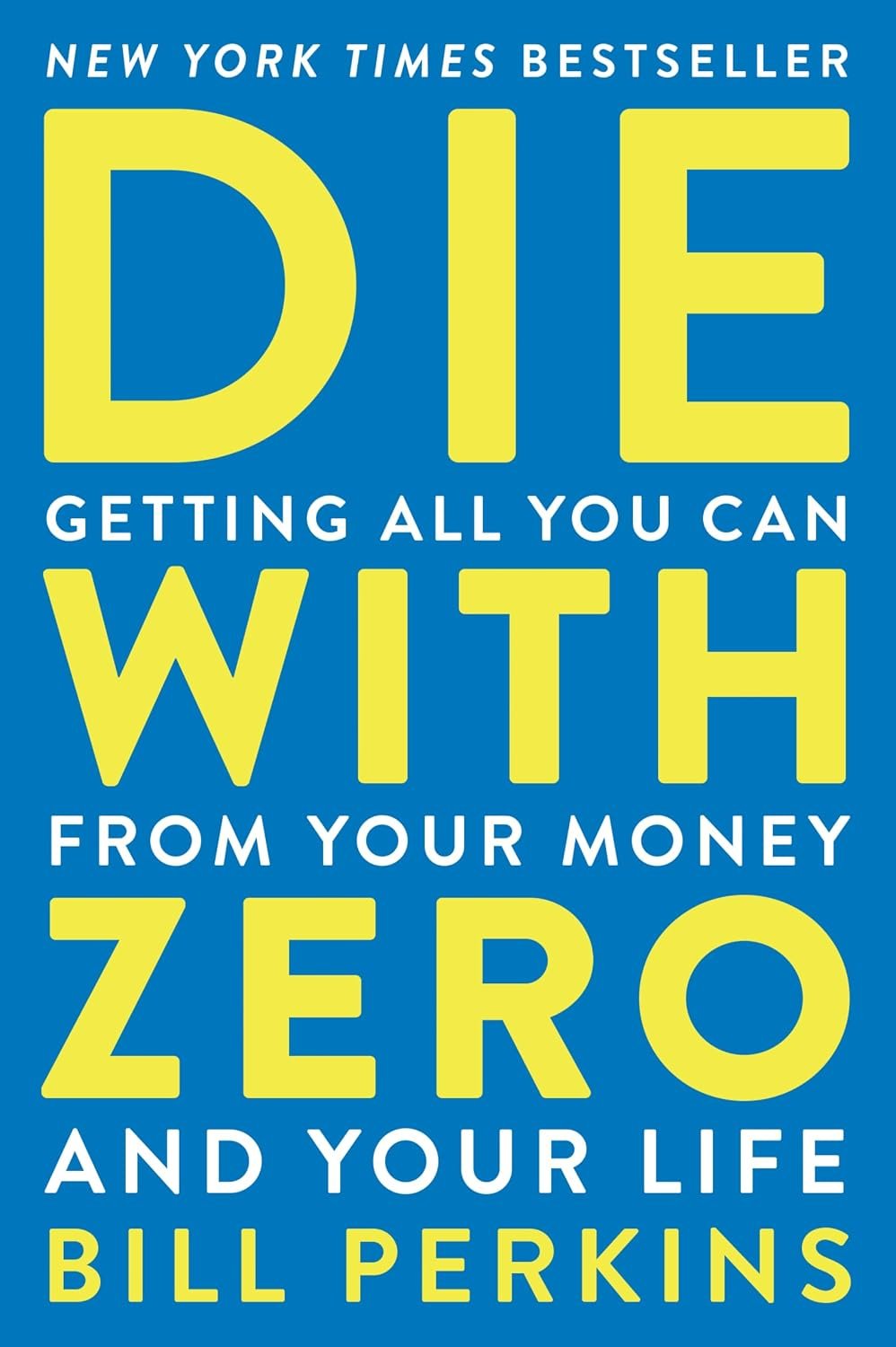
Die with Zero
Getting All You Can from Your Money and Your Life — by Bill Perkins
Perkins encourages readers to balance saving with spending on meaningful experiences, consider how age affects the experiences they can enjoy, and think carefully about when money can create the greatest value. The title is intentionally provocative: the goal is not reckless spending, but avoiding a life in which money is preserved at the expense of time and opportunities that cannot be recovered.
Overview
Conventional personal-finance advice often emphasizes saving, investing, minimizing expenses and accumulating enough assets to support retirement. These are important goals, but Perkins asks a different question: what happens if people become so focused on financial security that they postpone meaningful parts of life indefinitely?
The book challenges the assumption that a larger net worth is always better. Money has value because it can provide security, choices, goods, services and experiences. Yet money that remains unspent until the end of life may represent opportunities that were never used.
Perkins therefore proposes a form of life optimization in which money, health, time and personal interests are considered together. A trip, a family activity, a challenging adventure or time with loved ones may have a different value at different stages of life.
Background and publication
Die with Zero was published in 2020 by Houghton Mifflin Harcourt. The book draws on Perkins’s experience in energy trading, investing and entrepreneurship, along with examples and arguments about time, consumption, saving, experiences and the psychology of money.
The book’s subtitle, Getting All You Can from Your Money and Your Life, expresses its dual focus. It is a book about money, but its ultimate subject is how people allocate the limited time available to them.
Bill Perkins

Author and energy trader
Bill Perkins is an American energy trader, investor, entrepreneur and author. He became known in finance and business circles through energy trading and later developed interests in other ventures, including film production and poker.
His professional experience informs the book’s emphasis on capital allocation, risk, opportunity cost and the difference between possessing money and using it to achieve a desired outcome.
The central thesis: optimize life, not only net worth
The book’s core argument is that financial decisions should be evaluated against the life they enable. Saving money is useful when it supports security, future needs and worthwhile goals. Saving becomes less useful when it is pursued without a clear purpose or when it permanently displaces valuable experiences.
Perkins distinguishes between maximizing wealth and maximizing the value that wealth creates. A person can have a large portfolio and still regret not spending enough time with family, traveling when physically able, pursuing a passion or taking opportunities that later became impractical.
This sequence is a conceptual summary of the book, not a mathematical guarantee that spending on any particular experience will make someone happier.
Invest in experiences
Perkins argues that experiences deserve deliberate financial investment because they can contribute to enjoyment, relationships, identity and lasting memories. Unlike many material purchases, an experience may continue to matter long after the immediate event has ended.
This does not mean that material goods are inherently bad. It means that a purchase should be assessed by the role it plays in a person’s life. A useful tool, comfortable home or reliable vehicle may create lasting value; an expensive status purchase may provide only brief satisfaction.
Relationships
Shared meals, family trips, celebrations and time with friends can strengthen social bonds.
New experiences
Travel, learning, creative work and unfamiliar activities can expand a person’s perspective.
Physical adventures
Some experiences depend on energy, mobility, health or physical ability that may change with age.
Experiences versus possessions
| Dimension | Experience | Material possession |
|---|---|---|
| Immediate value | Participation, enjoyment, discovery | Utility, comfort, convenience or status |
| Long-term value | Memories, stories and shared meaning | Continued use, resale or practical utility |
| Time sensitivity | May depend on age, health or other people | Often can be bought later, subject to availability |
| Risk | May disappoint or fail to meet expectations | May be underused, depreciate or require upkeep |
| Best question | Will this be meaningful to me? | Will this improve my life enough to justify its cost? |
Memory dividends
One of the book’s most memorable concepts is the idea of memory dividends. A worthwhile experience can provide value more than once: first when it happens and later when it is recalled, discussed, photographed, written about or shared with other people.
For example, a family holiday may create enjoyment during the trip. Years later, the family may still share stories, look at photographs and remember the experience. The initial expenditure has generated a stream of remembered value.
Memory dividends are a metaphor rather than a measurable financial return. Not every experience creates lasting happiness, and people differ in what they remember or value.
What does “die with zero” mean?
The title is deliberately provocative. It is not a recommendation to spend every rupee immediately, ignore emergencies or leave dependants without support. Rather, it asks readers to examine whether their savings are serving a clear purpose and whether they are postponing life indefinitely.
The underlying question is whether a person can make a more thoughtful plan for spending, giving, saving and investing across their lifetime instead of treating the accumulation of money as an unlimited objective.
What the idea encourages
- Spend intentionally on meaningful experiences.
- Recognize that time and health are limited.
- Plan for future needs rather than saving aimlessly.
- Consider giving while recipients can benefit.
- Balance security with enjoyment.
What it does not require
- Spending all savings while young.
- Ignoring emergencies or insurance.
- Assuming a specific lifespan.
- Taking unaffordable debt for experiences.
- Abandoning responsible retirement planning.
How to spend without running out of money
The practical challenge is not simply learning to spend more. It is finding a balance between present enjoyment and future financial resilience.
A sensible interpretation of Perkins’s argument begins with essential expenses, emergency reserves, insurance, debt obligations and long-term needs. Only after these are considered should a person determine how much can reasonably be directed toward experiences and discretionary goals.
| Financial layer | Purpose | Question to ask |
|---|---|---|
| Essential spending | Housing, food, healthcare and basic living costs | Are essential needs covered? |
| Emergency protection | Manage unexpected expenses and income disruptions | Can I withstand a financial shock? |
| Future obligations | Retirement, dependants, debt and other commitments | What must I fund before discretionary spending? |
| Experience budget | Trips, learning, family time and personal goals | Which experiences are worth prioritizing? |
| Giving and legacy | Support family, causes or people who matter | Would earlier support create greater value? |
Children, inheritance and giving
Perkins challenges the assumption that the best way to help children is always to leave them the largest possible inheritance after death. He asks readers to consider whether money given earlier could be more useful, particularly when recipients are building their lives, raising children, buying a first home or establishing a business.
This is not a universal rule. The appropriate timing and amount of support depend on family circumstances, the recipient’s maturity, tax implications, the giver’s financial security and the possibility of future care needs.
Giving later
- May preserve the giver’s financial independence.
- May provide a larger inheritance.
- Recipients may receive it when their need is lower.
Giving earlier
- May help with major life milestones.
- Allows the giver to witness the benefit.
- May support experiences shared across generations.
The broader lesson is to treat giving as an intentional decision about timing and impact, not merely as a final calculation of what remains.
Balance your life
The book emphasizes that money is only one of several resources required for a satisfying life. Time, health, energy and relationships are also limited, and their value changes as a person ages.
Money
Provides choices, security and access to experiences.
Time
Determines how many opportunities can still be pursued.
Health
Affects which activities remain comfortable or possible.
The point is not that health always declines in a predictable way or that everyone shares the same priorities. It is that financial decisions should recognize non-financial constraints that cannot necessarily be solved by spending more money later.
Time-bucketing: plan experiences by age and opportunity
A conventional bucket list records what someone wants to do. Time-bucketing adds a deadline or life stage: when would this experience be most valuable, practical or possible?
A person might want to travel with young children, learn a physically demanding sport, spend extended time with ageing parents or pursue a demanding educational goal. These activities may have very different ideal windows.
| Time bucket | Possible priority | Why timing matters |
|---|---|---|
| Near term | Reconnect with friends or take a planned trip | The opportunity may already be available. |
| Next 3–5 years | Learn a skill or complete a personal project | Requires time and deliberate preparation. |
| Next 5–10 years | Plan a major family or travel experience | Needs budgeting and coordination. |
| Later life | Choose comfortable travel, creative projects or legacy goals | Preferences, mobility and responsibilities may change. |
Know your peak
Different experiences have different windows of maximum value. A physically demanding adventure, a holiday with small children, a long conversation with a parent and a creative project may each be most meaningful at a different time.
The book encourages readers to consider not just whether they can afford an experience, but whether waiting will change the experience itself.
| Experience | Possible constraint | Planning implication |
|---|---|---|
| Adventure travel | Fitness, mobility, time away from work | Plan when health and circumstances support it. |
| Time with children | Children’s changing interests and independence | Do not assume the same shared experience can be postponed indefinitely. |
| Time with older relatives | Health, distance and family availability | Prioritize meaningful contact while possible. |
| Education or creative work | Energy, responsibilities and available time | Identify a realistic window and begin. |
Be bold, not foolish
The book encourages readers to take meaningful opportunities rather than allowing fear to dictate every decision. But boldness should not be confused with financial recklessness.
An experience can be valuable and still be too expensive for a person’s current circumstances. A good decision considers both the opportunity being pursued and the consequences of the money being spent.
Constructive boldness
- Make a plan for a meaningful goal.
- Understand the costs and trade-offs.
- Take manageable risks deliberately.
- Act before a genuine opportunity disappears.
Recklessness
- Ignore debt and essential obligations.
- Assume future income is guaranteed.
- Spend to impress other people.
- Confuse urgency with importance.
The Die with Zero framework
The book’s concepts can be brought together into a practical sequence for making life and money decisions.
Net worth versus life fulfillment
The following diagram is a conceptual illustration, not a measured dataset. It contrasts the goal of accumulating wealth indefinitely with the idea of using resources to support experiences over time.
Illustrative example: planning a meaningful experience
Imagine a person considering a major family trip. The trip is affordable, but postponing it would allow the person to save somewhat more. The person must decide whether the extra savings are worth delaying the experience.
| Question | Example consideration |
|---|---|
| What is the experience? | A planned family holiday. |
| What will it cost? | Estimate travel, accommodation, food and contingency costs. |
| What would postponing achieve? | Additional savings or a larger future budget. |
| What could change? | Family schedules, health, interests or travel circumstances. |
| What must remain protected? | Emergency savings, essential bills and future obligations. |
| What is the next action? | Compare a realistic budget with the value of doing it now. |
Chapter-by-chapter guide
The following overview follows the nine main numbered chapters listed in the book’s bibliographic contents. It summarizes their broad themes rather than reproducing the original text.
| Chapter | Title | Main theme |
|---|---|---|
| 1 | Optimize Your Life | Make life quality, not wealth accumulation alone, the objective. |
| 2 | Invest in Experiences | Consider experiences as a meaningful use of resources. |
| 3 | Why Die With Zero? | Examine the trade-off between unused wealth and lived experience. |
| 4 | How to Spend Your Money Without Actually Hitting Zero Before You Die | Think about spending while preserving adequate financial security. |
| 5 | What About the Kids? | Consider inheritance, family support and the timing of gifts. |
| 6 | Balance Your Life | Consider the interaction of time, money, health and experiences. |
| 7 | Start to TimeBucket Your Life | Assign experiences to realistic time windows. |
| 8 | Know Your Peak | Recognize that some experiences are time-sensitive. |
| 9 | Be Bold Not Foolish | Take thoughtful action without ignoring financial risk. |
Chapter titles and page counts can vary across editions. See the book’s bibliographic record for the edition being referenced.
Criticism and limitations
The book presents a compelling challenge to excessive accumulation, but its recommendations are not equally suitable for every person. Its ideas need to be interpreted in light of differences in income, wealth, family obligations, health, longevity and access to social protection.
1. Uncertainty about lifespan
No one knows exactly how long they will live. Spending plans based on an optimistic lifespan assumption can create a risk of running out of money while still alive.
2. Unexpected costs
Medical needs, care responsibilities, inflation, job loss and other shocks can change a financial plan. Reserves and flexible spending plans remain important.
3. Unequal financial circumstances
A person with substantial assets has different options from someone living paycheck to paycheck. The freedom to spend on experiences depends partly on resources that may not be available to everyone.
4. Experiences are subjective
Not every expensive experience becomes a cherished memory. Meaningful experiences can also be inexpensive or free, such as spending time with loved ones, learning a skill or exploring a nearby place.
5. Family and inheritance obligations
Earlier giving may be useful in some families, but others need to retain resources for dependants, long-term care, housing or other obligations. The right approach depends on individual circumstances.
6. The framework is not a retirement calculator
The book’s philosophical ideas do not replace a financial plan that accounts for assets, spending, inflation, taxes, investment risk, pensions, insurance and expected longevity.
Key takeaways
Money is a tool
Its value comes from the security, choices and experiences it enables.
Time matters
Some opportunities become less practical or less meaningful when postponed.
Experiences can last
A good experience may continue to provide value through memory and shared stories.
Use time buckets
Put meaningful goals into realistic time windows instead of leaving everything for “someday.”
Think about giving
Consider when financial help can create the most value for the people you care about.
Protect the future
Spend intentionally without ignoring emergencies, retirement and dependants.
The book in one minute
Bill Perkins argues that money should be used deliberately to create a life worth living. Meaningful experiences can have lasting value, but some opportunities are tied to particular stages of life, health and relationships.
The book encourages readers to plan experiences, consider the timing of spending and giving, and avoid saving without a clear purpose. Its message is not to abandon financial responsibility, but to balance future security with the opportunities available in the present.
Related books
References
-
Perkins, Bill.
Die with Zero: Getting All You Can from Your Money and Your Life.
Houghton Mifflin Harcourt, 2020.
Google Books bibliographic record -
Google Books, alternate edition and publication information.
View edition details and table of contents -
Official website for the book.
Die with Zero — official website -
Library of Congress bibliographic information, as reproduced in
the book’s publication record.
Library of Congress record