


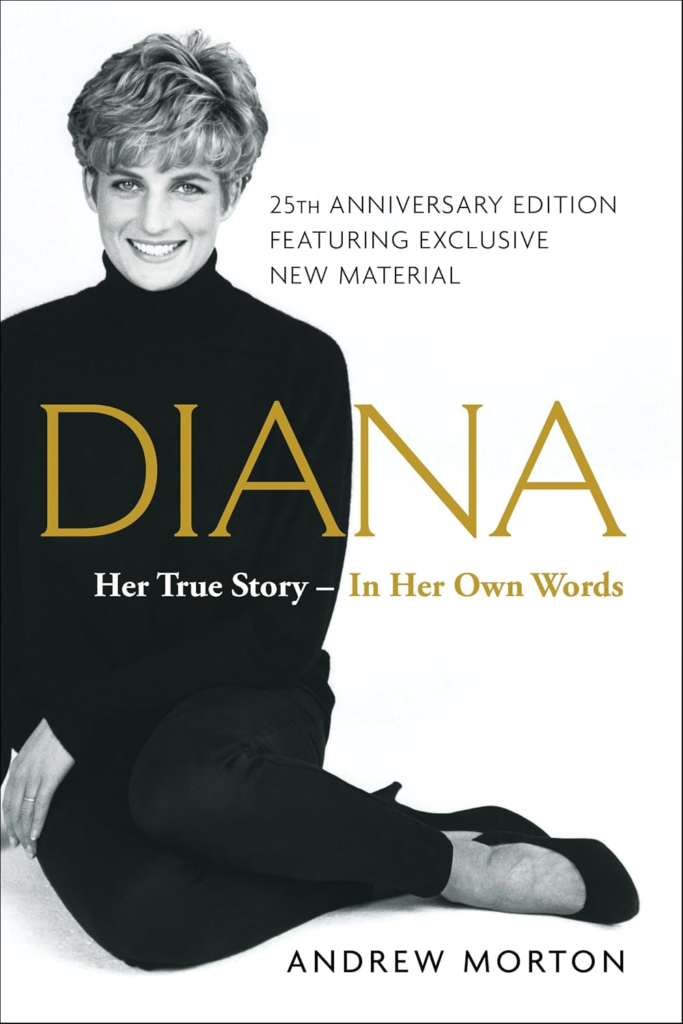
Diana: Her True Story—in Her Own Words is a biographical work by British journalist and writer Andrew Morton about Diana, Princess of Wales. The book was first published in the United Kingdom in June 1992 under the title Diana: Her True Story. It became one of the most consequential books ever published about the British royal family because it presented an unusually intimate account of Diana’s marriage to Charles, Prince of Wales, her experiences within the royal establishment, her emotional struggles, and her relationship with the public.
The book’s importance extends beyond its subject matter. When it was first published, Diana’s direct involvement was not publicly acknowledged. It was later revealed that she had cooperated extensively with Morton through recorded interviews conducted by her friend James Colthurst, who acted as an intermediary between the princess and the author. The revelation fundamentally changed the way the book was understood. Later editions were retitled Diana: Her True Story—in Her Own Words and incorporated material explaining the book’s origins and Diana’s role in providing its testimony.
The book was initially met with disbelief and controversy, but it subsequently became a major bestseller and an important document in the history of the modern British monarchy. Simon & Schuster describes it as a #1 New York Times bestselling biography that changed public perceptions of the monarchy when it appeared in 1992.
Book Information
| Detail | Information |
|---|---|
| Title | Diana: Her True Story |
| Later title | Diana: Her True Story—in Her Own Words |
| Author | Andrew Morton |
| Subject | Diana, Princess of Wales |
| Genre | Biography, Royal biography |
| Language | English |
| Original publisher | Michael O’Mara Books |
| Original publication date | 16 June 1992 |
| Original ISBN | 9781854791917 |
| Original format | Hardcover |
| Later editions | Revised editions, paperback, e-book and audiobook |
| Country of origin | United Kingdom |
Bibliographic records vary in page count between editions; the original UK edition is commonly catalogued at approximately 224 pages, while other editions have different pagination.
Overview
Diana: Her True Story occupies an unusual place between biography, royal history, personal testimony and investigative journalism.
Morton’s stated task was to tell the story of Diana’s life, but the book eventually became something much more intimate. It provided an account of royal life from the perspective of a woman who had entered the British royal family as a young bride and subsequently found herself living under extraordinary public scrutiny.
The narrative addresses:
- Diana’s childhood and aristocratic background
- her relationship with her family
- her romance with Charles
- the 1981 royal wedding
- her adjustment to royal life
- motherhood
- the pressures of royal protocol
- her relationship with the Queen and other members of the royal household
- difficulties within her marriage
- depression and emotional distress
- eating disorders
- her relationships outside the marriage
- media attention and paparazzi
- her charitable work
- the growing distance between Diana and the royal establishment
The book’s most significant feature, however, is its source material: much of Diana’s account was derived from conversations she deliberately provided through James Colthurst.
This makes the work difficult to classify simply as a conventional biography.
The Extraordinary Story Behind the Book
The history of Diana: Her True Story is almost as remarkable as the book itself.
Andrew Morton was already an experienced royal journalist when he began working on the biography. Because directly interviewing Diana would have created obvious difficulties, the communication took place indirectly.
Diana’s friend James Colthurst became the crucial intermediary.
Colthurst interviewed Diana privately, using questions supplied by Morton. Diana’s answers were recorded and passed to Morton.
According to accounts of the book’s creation, the recordings became a central source for the biography. Diana was therefore not merely the passive subject of a journalist’s investigation. She actively supplied the material from which her story was constructed.
How the book was created
                 ANDREW MORTON
                      │
              Questions for Diana
                      │
                      ▼
             JAMES COLTHURST
                (intermediary)
                      │
               Recorded answers
                      │
                      ▼
              DIANA, PRINCESS
                 OF WALES
                      │
                      ▼
             Morton's biography
                      │
                      ▼
             Published in 1992
This structure was highly unusual for a royal biography.
The Secret Collaboration
When the book appeared in 1992, Buckingham Palace denied that Diana had cooperated with Morton.
The public understanding was therefore that Morton had constructed the biography through interviews with friends, associates and other sources.
The later revelation that Diana herself had been the principal source dramatically altered the interpretation of the book.
The 1997 edition explicitly presented the work as being based substantially on Diana’s own words and included additional material concerning the secret collaboration. Google Books’ description of the revised edition states that the book was “almost entirely based on her own words”, supplemented by interviews with friends.
This revelation transformed the book from an apparently external biography into something closer to a mediated autobiography.
Diana Before the Royal Marriage
Morton’s account begins with Diana’s background before she became internationally famous.
Born Diana Frances Spencer in 1961, she belonged to an aristocratic family with longstanding connections to the British royal family.
Her childhood unfolded within the world of the English aristocracy, but her later public identity would be radically different from that of a conventional aristocratic daughter.
She became globally recognizable after her relationship with Charles developed.
The transformation was extraordinarily rapid.
Diana’s transformation
Private aristocratic childhood
            │
            ▼
Young woman in London
            │
            ▼
Relationship with Prince Charles
            │
            ▼
Engagement
            │
            ▼
Royal wedding
            │
            ▼
Princess of Wales
            │
            ▼
Global celebrity
            │
            ▼
Independent international figure
The book is particularly interested in the gap between the public image of “Princess Diana” and the private individual behind it.
The Royal Wedding
Diana married Charles on 29 July 1981 at St Paul’s Cathedral in London.
The wedding was watched by a global television audience and became one of the defining spectacles of the twentieth-century British monarchy.
For the public, the event represented romance, tradition and continuity.
Morton’s account presents a considerably more complicated private reality.
The young bride entered an institution with centuries of traditions, strict expectations and deeply established hierarchies.
The contrast between the fairy-tale image of the wedding and the difficulties that followed became one of the central tensions of the book.
Life Inside the House of Windsor
One of the book’s major subjects is Diana’s adjustment to the royal environment.
The British monarchy was not simply a family. It was also an institution.
Diana therefore had to learn:
- royal protocol
- public duties
- formal appearances
- relations with courtiers
- expectations surrounding marriage
- the traditions of the monarchy
- the intense relationship between royal privacy and public responsibility
The book portrays this adjustment as particularly difficult for a young woman who was suddenly expected to perform a highly visible institutional role.
Marriage to Charles
The marriage between Diana and Charles is the emotional centre of the book.
Morton’s narrative describes a relationship that began with extraordinary public expectations but increasingly became troubled.
The book discusses emotional distance, incompatibility, tensions involving other relationships and Diana’s growing sense of isolation.
It is important to distinguish the book’s perspective from a complete historical account of every aspect of the marriage.
Morton’s book is fundamentally constructed around Diana’s testimony and the accounts of people close to her. It therefore provides an unusually detailed account of Diana’s experience of the marriage, rather than a neutral transcript of every participant’s perspective.
That distinction is essential when reading the book historically.
Diana’s Emotional Struggles
Perhaps the most controversial aspect of the book in 1992 was its description of Diana’s emotional distress.
The biography discussed:
- depression
- feelings of isolation
- despair
- eating disorders
- difficulties associated with royal life
- suicidal thoughts and behaviour
These subjects were particularly striking because they contradicted the polished public image normally associated with members of the royal family.
The book therefore helped introduce a very different type of royal narrative into mainstream publishing: one in which a member of the monarchy openly discussed vulnerability.
Bulimia and Mental Health
Diana’s discussion of bulimia was especially significant.
At the time, public understanding of eating disorders was considerably less developed than it is today.
Her willingness to discuss her experiences helped bring the subject into international public conversation.
The book consequently became important not only as royal biography but also as a cultural document concerning celebrity, mental health and eating disorders.
However, modern readers should remember that the book reflects the language, medical understanding and media culture of the early 1990s.
The Image of the “People’s Princess”
One of the most enduring themes associated with Diana is the contrast between royal formality and personal accessibility.
Diana developed a public style that emphasized:
- physical contact
- emotional warmth
- humanitarian causes
- children
- hospitals
- people affected by illness
- people marginalized by society
Her public behaviour increasingly differed from the stereotypical image of a distant royal figure.
The book helps explain how her private experiences and public identity developed alongside each other.
Motherhood
Diana’s role as the mother of Prince William and Prince Harry occupies an important place in the story.
Motherhood provided her with a role that was emotionally distinct from her position as Princess of Wales.
The book describes Diana’s attachment to her children and her desire to provide them with experiences that were more ordinary than the highly controlled environment surrounding the royal family.
This aspect of her life later became central to the public understanding of Diana.
Diana and the Media
The relationship between Diana and the press was one of the great paradoxes of her life.
The media helped create her extraordinary fame.
At the same time, relentless media attention contributed to the pressure under which she lived.
The book illustrates this tension:
        Diana's popularity
               │
               ▼
        Greater media interest
               │
               ▼
       More public exposure
               │
               ▼
       Greater celebrity
               │
               ▼
       Less private life
               │
               ▼
        Greater pressure
Diana was both a participant in and a victim of the celebrity culture surrounding her.
That contradiction would become even more significant after her death in 1997.
The Royal Family
The book also examines Diana’s relationships with other members of the royal family.
Particular attention is given to:
- Queen Elizabeth II
- Charles, Prince of Wales
- Prince William
- Prince Harry
- other members of the Windsor family
- royal courtiers and staff
The portrayal is largely shaped by Diana’s experiences and perceptions.
Consequently, the book should not be treated as an impartial institutional history of the House of Windsor.
Its value lies partly in precisely the opposite quality: it documents what royal life looked like from the inside, through one participant’s perspective.
Diana and Camilla Parker Bowles
The relationship between Charles, Diana and Camilla Parker Bowles became one of the most sensitive subjects associated with the biography.
Morton’s account presents Diana’s distress over Charles’s continuing relationship with Camilla and its consequences for the marriage.
The subject became particularly controversial because it challenged the conventional public narrative surrounding the royal marriage.
It also demonstrated the power of royal biography to expose tensions that had previously remained largely behind palace walls.
“There Were Three People in This Marriage”
One of the most famous ideas associated with Diana’s account of her marriage was her description of the presence of another relationship within the marriage.
The phrase became emblematic of the wider story of Charles, Diana and Camilla.
Its significance was not merely romantic.
It represented Diana’s perception that the marriage was no longer an exclusive partnership and that forces outside the couple had become central to its breakdown.
The Book and the British Monarchy
The publication of Diana: Her True Story occurred during a difficult period for the British monarchy.
The early 1990s brought increasing public discussion of royal finances, marital difficulties and the relevance of monarchy in contemporary Britain.
Against this background, Morton’s book became much more than a celebrity biography.
It became part of a broader public conversation about:
- monarchy
- marriage
- privacy
- tradition
- gender
- celebrity
- institutional power
- emotional vulnerability
Simon & Schuster states that the book changed public perceptions of the British monarchy when it was published in 1992.
Why the Book Caused a Sensation
The book’s impact came from the collision of three things:
1. The subject
Diana was one of the world’s most famous women.
2. The revelations
The biography discussed deeply personal subjects that were rarely associated with senior members of the British royal family.
3. The hidden source
The later revelation that Diana herself had supplied much of the material made the book even more extraordinary.
The impact formula
Diana's global fame
        +
Royal secrecy
        +
Personal revelations
        +
Diana's own testimony
        =
International controversy
The Book’s Most Important Historical Twist
Perhaps the single most important fact about the book is that its title was initially misleading in a very specific historical sense.
The 1992 book was presented as a biography written by Morton.
But the later evidence showed that Diana had been directly involved in supplying the material.
This led to the later title:
Diana: Her True Story—in Her Own Words
The revised title emphasizes that the book is not simply Morton’s interpretation of Diana’s life.
It is also a record of Diana’s own attempt to control the narrative surrounding her life.
From Biography to Mediated Autobiography
The book can therefore be understood through three overlapping forms:
             BIOGRAPHY
                 │
        Andrew Morton's
        journalistic work
                 │
                 ▼
       DIANA'S TESTIMONY
                 │
                 ▼
       MEDIATED AUTOBIOGRAPHY
                 │
                 ▼
      HISTORICAL DOCUMENT
This hybrid character is what makes the book unusual.
Morton remained the named author, but Diana’s testimony is fundamental to the narrative.
Publication History
The original edition was published in Britain on 16 June 1992 by Michael O’Mara Books.
The book subsequently appeared in numerous editions and formats.
Later versions incorporated additional information about Diana’s involvement.
Following Diana’s death in 1997, Morton published a substantially revised version that openly acknowledged her role and incorporated material from the recorded interviews. The later edition was titled Diana: Her True Story—in Her Own Words.
A major revised edition was also published in connection with the twentieth anniversary of Diana’s death. Simon & Schuster describes this edition as containing previously unrevealed material concerning the secret recordings and Diana’s involvement.
The 1997 Revision
The 1997 edition is particularly important because Diana had died only weeks before its publication.
Morton’s decision to reveal the extent of her involvement changed the historical understanding of the original work.
The new edition was no longer simply a biography about Diana.
It became evidence of Diana’s own attempt to tell her story.
The revelation also raised ethical questions concerning:
- confidentiality
- journalistic responsibility
- privacy
- the publication of private recordings
- the relationship between journalist and source
- the responsibilities of biographers after a subject’s death
These questions remain part of the book’s legacy.
Critical Reception
The book generated strong reactions because it challenged established conventions surrounding royal biography.
Some readers and commentators viewed it as an unprecedented opportunity to hear Diana’s perspective.
Others regarded the work as too closely aligned with Diana’s point of view.
That criticism is important.
A biography based heavily on one participant’s testimony can provide extraordinary access while simultaneously creating limitations.
Historical strength and limitation
| Strength | Limitation |
|---|---|
| Direct testimony from Diana | Strongly shaped by her perspective |
| Access to private experiences | Other perspectives receive less weight |
| Contemporary documentation | Reflects the knowledge of the period |
| Reveals royal private life | Some claims are difficult to independently verify |
| Important historical source | Not a neutral institutional history |
The book is therefore most useful when read as a major primary-source-influenced biography, rather than as an unquestionable final account of every event it describes.
A Changing Historical Perspective
The meaning of Diana: Her True Story has changed over time.
1992
It was primarily understood as a sensational royal biography.
1997
Diana’s death transformed public interest in the book.
1997 revised edition
Her direct involvement became publicly acknowledged.
2000s
The book increasingly became part of the historical record of the late twentieth-century monarchy.
2010s–2020s
The emergence of additional documentaries, biographies, interviews and archival material allowed readers to place Morton’s account within a much broader historical context.
This distinction matters.
A book can be historically important without every interpretation within it remaining uncontested.
Diana’s Voice
One of the most striking features of the work is its emphasis on Diana’s emotional vocabulary.
She is not presented simply as:
Princess of Wales
but as:
- a daughter
- a wife
- a mother
- a woman under pressure
- a public figure
- a person struggling with identity
- a celebrity attempting to regain control over her own story
This is one reason the book has continued to attract readers decades after its original publication.
The Central Conflict
At its deepest level, the book can be understood as a conflict between public identity and private identity.
                 DIANA
                   │
        ┌──────────┴──────────┐
        │                     │
        ▼                     ▼
 PUBLIC DIANA            PRIVATE DIANA
 Princess               Woman
 Celebrity              Mother
 Royal figure            Wife
 Humanitarian            Vulnerable individual
 Global icon             Person seeking control
The tension between these two identities runs throughout the narrative.
Major Themes
1. Royalty versus individuality
Diana entered an institution with powerful traditions and expectations.
The book examines what happened when an individual personality collided with those institutional demands.
2. Public image versus private reality
The fairy-tale princess and the troubled private woman existed simultaneously.
The book attempts to reveal the second behind the first.
3. Love and marriage
The story examines the gap between romantic expectations and the realities of a highly structured royal marriage.
4. Fame and isolation
Diana was surrounded by millions of admirers yet frequently experienced loneliness.
That contradiction is central to her story.
5. Control of one’s own narrative
Diana’s cooperation with Morton can be interpreted as an attempt to reclaim control over how her life was represented.
6. Motherhood
Her relationship with William and Harry became one of the strongest sources of meaning in her life.
7. Mental health
The biography helped bring private emotional suffering into a public conversation.
8. The changing monarchy
The book appeared at a time when traditional royal secrecy was becoming increasingly difficult to maintain.
Diana’s Public Transformation
The book also helps explain the transformation of Diana’s public identity.
1981
Young royal bride
      │
      ▼
1980s
Princess and young mother
      │
      ▼
Late 1980s
Increasingly independent public figure
      │
      ▼
Early 1990s
Separated and publicly outspoken
      │
      ▼
Mid-1990s
International humanitarian celebrity
This transformation was not instantaneous.
It developed gradually as Diana acquired confidence, public experience and an increasingly distinct identity.
Human Dimension of the Book
Behind the royal titles and international headlines, the book is ultimately a story about a person attempting to understand her own life.
That is perhaps why the biography has survived as more than a piece of 1990s celebrity journalism.
Readers encounter a young woman entering a world much larger than herself, discovering that fame does not necessarily produce happiness, and gradually trying to establish an identity independent of the institution into which she married.
The most human element of the story is not the palace drama.
It is the question underneath it:
What happens to an individual when the world insists on seeing an image instead of a person?
Andrew Morton
Author Profile
Andrew Morton is a British journalist and biographer particularly known for books about members of the British royal family and internationally famous public figures.
He studied history at the University of Sussex, with an academic interest in aristocracy and twentieth-century British history.
His career in journalism developed into a specialization in celebrity and royal biography.
Morton’s subjects have included:
- Diana, Princess of Wales
- Sarah, Duchess of York
- Tom Cruise
- Angelina Jolie
- Madonna
- Meghan Markle
Google Books’ author information identifies Morton as a biographer whose work has included books on the British royal family and major international celebrities.
His best-known work remains Diana: Her True Story.
Andrew Morton’s Writing Method
Morton’s approach combines:
- journalistic investigation
- interviews
- personal testimony
- background research
- anecdotal evidence
- contemporary reporting
- narrative biography
His work is generally more journalistic than academic.
This distinction helps explain the readability of Diana: Her True Story.
Rather than constructing a detached historical study, Morton builds a narrative around people, relationships, conversations and personal experiences.
The Role of James Colthurst
James Colthurst deserves particular attention in any serious discussion of the book.
He was not merely a minor participant.
He provided the bridge between Diana and Morton.
Andrew Morton
     │
     │ Questions
     ▼
James Colthurst
     │
     │ Interviews
     ▼
Diana
     │
     │ Recorded answers
     ▼
James Colthurst
     │
     ▼
Andrew Morton
Without this intermediary arrangement, the book would probably have been very different.
Why Diana Wanted Her Story Told
The book emerged during a period when Diana increasingly felt that her public identity was being shaped by other people.
The press created stories about her.
The palace communicated through official channels.
Royal protocol limited what could be said publicly.
Her own perspective was therefore difficult to express directly.
Working indirectly with Morton gave her a mechanism through which she could tell her side of the story.
This is one of the most important ways to understand the book.
It was not simply a book about Diana.
It was also an attempt by Diana to participate in the construction of her own historical record.
The Book as a Historical Source
For historians, Diana: Her True Story has two simultaneous values.
Documentary value
It records Diana’s own recollections and perceptions during a crucial period of her life.
Interpretive limitation
Those recollections represent one person’s perspective and should be compared with other evidence.
Therefore:
Diana's testimony
       +
Morton's reporting
       +
Contemporary journalism
       +
Other biographies
       +
Archival evidence
       =
More complete historical picture
This is a useful way to approach any major royal biography.
Influence on Royal Biography
The success of Diana: Her True Story helped change expectations surrounding royal biographies.
The public became increasingly interested not merely in:
What did the royal family do?
but also:
What did individual members of the royal family actually feel?
That shift had lasting consequences for royal journalism and celebrity culture.
Personal testimony became increasingly important.
The boundaries between royal biography, journalism and celebrity storytelling became less rigid.
Cultural Legacy
The book remains significant because Diana became more than a member of the British royal family.
She became a global cultural figure.
Her story has been revisited through:
- biographies
- documentaries
- television dramas
- interviews
- archival projects
- newspapers
- podcasts
- films
- historical studies
Morton’s book occupies an important early position in this much larger body of material.
Reception in the Digital Era
Modern readers encounter Diana: Her True Story differently from readers in 1992.
A contemporary reader has access to:
- decades of subsequent reporting
- documentaries
- interviews
- additional biographies
- digital archives
- transcripts
- historical analyses
- competing accounts
As a result, the book is now best understood both as a biography and as a historical artifact of the early 1990s.
Reader reception remains mixed in emphasis. Some readers value the intimacy of Diana’s testimony, while others find the narrative heavily shaped by her perspective. Contemporary reader-review aggregations also show that the book continues to attract substantial interest decades after publication.
Why the Book Still Matters
There are several reasons the book remains relevant.
1. It changed royal journalism
It demonstrated that a senior member of the British royal family could become the subject of an intensely personal public narrative.
2. It revealed the power of first-person testimony
Diana’s participation gave the biography an unusual immediacy.
3. It documented changing attitudes toward mental health
The book brought subjects such as depression and eating disorders into a highly public setting.
4. It illustrates the economics of celebrity
The book demonstrates how royal fame, journalism and public fascination can reinforce one another.
5. It records a turning point in monarchy
The early 1990s marked an important period in the modernization—and destabilization—of the public image of the British monarchy.
Timeline
| Year | Event |
|---|---|
| 1961 | Diana Frances Spencer is born |
| 1981 | Diana marries Charles, Prince of Wales |
| 1982 | Prince William is born |
| 1984 | Prince Harry is born |
| 1980s | Diana becomes one of the world’s most recognizable public figures |
| 1991 | Secret recorded interviews with Diana contribute to Morton’s research |
| 1992 | Diana: Her True Story is published |
| 1992 | The book becomes a major international publishing event |
| 1993 | A television adaptation is produced |
| 1996 | Diana and Charles’s divorce is finalized |
| 1997 | Diana dies in Paris |
| 1997 | Revised edition reveals her extensive involvement |
| 2017 | A major anniversary edition revisits the original tapes and collaboration |
| Present | The book remains a major source for discussions of Diana and modern royal history |
The existence of revised editions is important because readers should distinguish the original 1992 publication from later versions that contain additional material.
Infographic: Diana’s Story in the Book
                 DIANA
                   │
        ┌──────────┼──────────┐
        │          │          │
        ▼          ▼          ▼
      FAMILY     MARRIAGE    ROYAL LIFE
        │          │          │
        ▼          ▼          ▼
    Childhood    Charles     Protocol
        │          │          │
        ▼          ▼          ▼
     Romance     Crisis      Pressure
        │          │          │
        └──────────┼──────────┘
                   ▼
             PUBLIC FAME
                   │
                   ▼
             PRIVATE PAIN
                   │
                   ▼
           FINDING HER VOICE
                   │
                   ▼
              HER STORY
Infographic: The Book’s Three Layers
┌──────────────────────────────────────────┐
│  LAYER 1 — MORTON'S JOURNALISM           │
│  Interviews, research and narrative      │
├──────────────────────────────────────────┤
│  LAYER 2 — DIANA'S TESTIMONY             │
│  Recorded answers and personal accounts  │
├──────────────────────────────────────────┤
│  LAYER 3 — HISTORICAL CONTEXT            │
│  Royal family, media and public reaction │
└──────────────────────────────────────────┘
                    │
                    ▼
        DIANA: HER TRUE STORY
A Simple Theme Map
                    DIANA
                      │
       ┌──────────────┼──────────────┐
       │              │              │
    Marriage        Identity        Fame
       │              │              │
       ▼              ▼              ▼
   Conflict       Independence     Media
       │              │              │
       └──────────────┼──────────────┘
                      │
                      ▼
                Vulnerability
                      │
                      ▼
                Self-expression
                      │
                      ▼
                 Legacy
Major Ideas at a Glance
| Theme | What the book explores |
|---|---|
| Marriage | The breakdown of Diana’s relationship with Charles |
| Royal life | The restrictions and expectations surrounding monarchy |
| Identity | Diana’s struggle to distinguish herself from her royal role |
| Mental health | Depression, distress and eating disorders |
| Motherhood | Her relationship with William and Harry |
| Media | The rewards and costs of extraordinary fame |
| Celebrity | The construction of Diana as a global icon |
| Control | Her attempt to tell her own story |
| Institution | The tension between individual freedom and royal tradition |
| Legacy | The continuing historical significance of her life |
Critical Reading of the Book
A modern reader should approach the book with two ideas in mind.
First, Diana’s voice is its greatest strength.
The reader gains access to an unusually personal account from someone who normally lived behind institutional barriers.
Second, Diana’s perspective is also its central limitation.
Her experiences and interpretations are crucial, but they do not automatically establish every disputed event as objective fact.
This does not diminish the book’s importance.
Rather, it explains how the book should be used.
It is simultaneously:
a biography, a journalistic investigation, a personal testimony and a historical source.
Is Diana: Her True Story an Autobiography?
Strictly speaking, no.
Andrew Morton is the named author, and the work was published as a biography.
However, its unusual production history makes it resemble a mediated autobiography.
Diana did not sit down and write the book herself.
Instead, she supplied recorded answers to Morton’s questions through James Colthurst, and Morton transformed that material into a coherent biographical narrative.
The later title Diana: Her True Story—in Her Own Words reflects this distinctive relationship between author and subject.
Difference Between the Original and Later Editions
| Original 1992 edition | Later editions |
|---|---|
| Published as Diana: Her True Story | Published as Diana: Her True Story—in Her Own Words |
| Diana’s participation was not publicly acknowledged | Her role was explicitly acknowledged |
| Contemporary royal controversy | Additional historical perspective |
| Primarily the original narrative | Additional material and explanations |
| Published during Diana’s lifetime | Later editions reflect events after her death |
The differences are significant enough that readers researching the book historically should identify which edition they are using.
Legacy
The legacy of Diana: Her True Story is inseparable from Diana herself.
The book helped change the public understanding of a woman who had previously been presented largely through photographs, royal appearances and media narratives.
Its greatest historical significance may not lie in any individual revelation.
Instead, it lies in the fact that it gave the public an unusually direct window into the private experience of a senior member of the British royal family.
It also demonstrated something fundamental about modern celebrity:
the person who controls the story can influence how the world remembers the person.
Diana’s collaboration with Morton was an attempt to gain that control.
The Enduring Paradox of Diana
Diana spent much of her life surrounded by cameras.
Yet she repeatedly sought privacy.
She became famous because people wanted to see her.
Yet that fame contributed to her loss of privacy.
She became a symbol of compassion.
Yet her private life was often discussed without compassion.
She was a member of one of the world’s most powerful institutions.
Yet she increasingly sought an independent identity.
This paradox is one of the reasons her story remains compelling.
Why Readers Continue to Read the Book
For modern readers, Diana: Her True Story can be approached in several ways.
As royal history
It documents a pivotal period in the modern British monarchy.
As biography
It offers an intimate account of Diana’s life.
As journalism
It demonstrates how investigative reporting can uncover stories hidden behind institutional structures.
As cultural history
It captures the emergence of modern celebrity culture.
As a study of identity
It explores what happens when a private individual becomes a public symbol.
As a primary-source document
Diana’s own testimony gives the book historical value beyond ordinary celebrity biography.
About the Author: Andrew Morton
Andrew Morton is an English journalist and biographer whose career has focused extensively on royalty and high-profile public figures.
His work on Diana established him internationally as a prominent royal biographer.
His later subjects have included:
- Sarah, Duchess of York
- Tom Cruise
- Madonna
- Angelina Jolie
- Meghan Markle
Morton’s books typically combine conventional biographical research with interviews and access to people close to his subjects.
His career demonstrates the distinctive role of the modern celebrity biographer: part historian, part journalist and part investigator.
Bibliographic Information
Morton, Andrew. Diana: Her True Story. London: Michael O’Mara Books, 1992.
Original publication date: 16 June 1992.
Original ISBN: 9781854791917.
The book subsequently appeared under the expanded title Diana: Her True Story—in Her Own Words. Bibliographic databases record numerous editions with different publishers, pagination and ISBNs.
References
- Morton, Andrew. Diana: Her True Story. Michael O’Mara Books, 1992.
- Morton, Andrew. Diana: Her True Story—in Her Own Words. Revised editions.
- Simon & Schuster. Diana: Her True Story—in Her Own Words. Official publisher information.
- Google Books. Diana: Her True Story, Andrew Morton, O’Mara, 1992.
- Google Books. Diana: Her True Story—in Her Own Words, revised edition.
- Open Library. Bibliographic records for Diana: Her True Story—in Her Own Words.
Further Reading
For readers interested in Diana’s life and the history of the British monarchy, useful areas of further reading include:
- biographies of Diana, Princess of Wales
- biographies of Charles III
- histories of the House of Windsor
- studies of the British monarchy during the twentieth century
- books about royal journalism and the British press
- studies of celebrity culture
- accounts of Diana’s humanitarian work
- documentaries concerning Diana’s public and private life
Read More
Related subjects
- Diana, Princess of Wales
- Charles III
- British royal family
- House of Windsor
- British monarchy
- Royal journalism
- Royal biography
- Celebrity culture
- Diana’s humanitarian work
- History of the British monarchy
Related books
Readers interested in royal biography may also explore biographies of:
- Diana, Princess of Wales
- Charles III
- Queen Elizabeth II
- Queen Elizabeth the Queen Mother
- Sarah, Duchess of York
- Meghan, Duchess of Sussex
External Links
Official publisher page: Simon & Schuster — Diana: Her True Story—in Her Own Words
Google Books: Google Books — Diana: Her True Story by Andrew Morton
Google Books — revised edition: Diana: Her True Story—in Her Own Words
Open Library: Open Library — Diana: Her True Story
Encyclopedia Summary
Diana: Her True Story is a 1992 biography of Diana, Princess of Wales, written by Andrew Morton. Initially published as a conventional royal biography, the book later became famous for the revelation that Diana herself had secretly provided much of its source material through recorded interviews conducted with the assistance of James Colthurst. The book describes Diana’s childhood, marriage to Charles, experiences within the British royal family, motherhood, emotional difficulties, relationship with the media and emergence as an international humanitarian figure. Its later editions, published as Diana: Her True Story—in Her Own Words, openly acknowledged Diana’s role in its creation. The work remains an important document in the history of Diana, modern celebrity culture and the changing public image of the British monarchy.
In one sentence: Diana: Her True Story—in Her Own Words is not merely a biography of Princess Diana; it is a remarkable record of a globally famous woman attempting to reclaim the story of her own life.