
What Is This Article About?
Starting a service-based business can be one of the most practical ways to become an entrepreneur without investing heavily in inventory, manufacturing facilities, or expensive equipment.
Whether you want to offer digital marketing, graphic design, consulting, bookkeeping, cleaning, tutoring, website development, or another professional service, you can begin with skills, experience, and a clearly defined customer problem.
However, having a skill alone does not guarantee business success. You also need to identify customers who are willing to pay, develop an attractive service offer, establish competitive pricing, and build trust in the marketplace. Most importantly, you must learn how to find your first paying clients.
This guide explains the process through 10 practical steps, from selecting a profitable service and validating market demand to promoting your business, approaching potential customers, and delivering excellent results.
By following these steps, you can build a service-based business systematically, starting small and expanding as your client base grows.
The 10-Step Guide to Starting a Service-Based Business
Identify Your Skills and Choose a Service

The first step in starting a service-based business is identifying what you can offer to customers in exchange for money. Unlike product-based businesses, service businesses primarily sell expertise, time, professional knowledge, convenience, or specialized skills. You do not necessarily need years of entrepreneurial experience to get started. You may already possess useful skills through your education, employment, hobbies, or previous work. The key is to identify skills that can solve practical problems for individuals or businesses. Start with services you can deliver competently, rather than choosing an industry simply because it appears profitable.
- List your existing skills: Write down your professional qualifications, technical abilities, communication skills, creative talents, and practical experience. Include skills developed through employment, independent projects, or personal interests.
- Identify problems you can solve: Think about the difficulties individuals and businesses experience that your knowledge could help address. Examples include managing accounts, creating websites, improving online visibility, teaching students, or maintaining business records.
- Explore different service categories: Consider opportunities in consulting, education, digital services, home maintenance, administrative support, healthcare support, professional services, and creative industries.
- Evaluate your ability to deliver: Assess whether you can provide the service independently or need additional training, certifications, software, equipment, or qualified professionals.
- Select two or three promising services: Shortlist services that match your capabilities, customer demand, available time, and financial resources. Compare them before selecting your initial business direction.
Choose a Profitable Niche and Target Audience

After selecting a potential service, narrow your focus by choosing a specific market niche and target audience. Trying to serve everyone can make it difficult to communicate your value and differentiate your business. A clearly defined niche allows you to understand customer requirements, customize your services, and develop specialized expertise. For example, instead of offering general digital marketing services, you could focus on helping local restaurants attract customers through online marketing. Similarly, a bookkeeping service could specialize in supporting small retailers or independent professionals. A focused business is generally easier to position and promote when you are starting out.
- Identify a specific customer group: Decide whether you want to serve individuals, families, professionals, startups, small businesses, retailers, educational institutions, or larger organizations.
- Understand their specific requirements: Investigate the problems, priorities, purchasing habits, and expectations of your chosen customer segment. Understand what they need most and why.
- Explore specialized niches: Look for opportunities to serve a particular industry, profession, location, customer category, or business size. Specialization can make your service more relevant.
- Evaluate the customers’ ability to pay: Determine whether your target customers have sufficient budgets and are willing to spend money to solve the problems you address.
- Define your ideal customer profile: Prepare a simple description of your ideal client, including their characteristics, business requirements, location, purchasing capacity, and common challenges.
Research Market Demand and Validate Your Service Idea

A service idea becomes a business opportunity only when potential customers have a genuine need for it and are willing to pay for the solution. Before investing substantial money in your business, investigate whether sufficient demand exists in your selected market. Study existing service providers, customer reviews, industry trends, pricing structures, and purchasing behaviour. Most importantly, speak directly with potential customers. Their feedback can reveal whether your proposed service addresses an actual problem or is based mainly on your personal assumptions. Market validation helps you make better decisions before committing significant time and resources.
- Study existing service providers: Identify businesses already offering similar services. Examine their websites, service descriptions, target customers, locations, and business positioning.
- Analyse competitor pricing: Compare the fees charged by different service providers. Understand what customers receive at different price points and whether additional services are included.
- Read customer reviews and complaints: Examine online reviews, discussion forums, and social media comments to discover recurring customer frustrations and unmet service expectations.
- Interview potential customers: Speak with at least 10 prospective customers. Ask about their current challenges, existing solutions, spending habits, and interest in your proposed service.
- Test your service on a small scale: Offer a limited pilot service or demonstration to a few suitable prospects. Observe their response, willingness to pay, and feedback before expanding.
Develop a Clear and Valuable Service Offer

Once you understand your target market, develop a clearly defined service offer that explains what customers will receive and why it is valuable. Customers are generally more interested in the results of a service than in the number of hours you spend working. For example, instead of simply offering website development, you could offer a complete small-business website package that includes website design, essential pages, mobile responsiveness, and contact functionality. A well-structured offer makes your service easier to understand, compare, purchase, and deliver. It also reduces confusion about responsibilities, pricing, and expected outcomes.
- Define the exact service deliverables: Specify what is included in your service, such as consultations, reports, designs, installations, training sessions, maintenance, or completed projects.
- Focus on customer outcomes: Explain how your service can save time, reduce operational difficulties, improve efficiency, increase convenience, or address a specific customer problem.
- Create different service packages: Consider developing basic, standard, and premium packages with clearly differentiated features and levels of support.
- Set clear service boundaries: Explain what is included, what is excluded, how many revisions or consultations are available, and what additional work may cost.
- Establish a delivery timeline: Specify how long the service will take, what information customers must provide, and when they can expect completion.
Set Your Service Pricing and Revenue Model

Pricing is one of the most important decisions when starting a service-based business. Your fees should reflect the value delivered to customers while covering your operating expenses and generating a reasonable profit. Charging too little may make it difficult to sustain the business, whereas unrealistic pricing can discourage potential clients. Service businesses can generate revenue through hourly charges, fixed project fees, monthly retainers, subscriptions, consultation fees, or performance-based arrangements where appropriate. Choose a pricing structure that matches your service, customer expectations, and delivery requirements.
- Calculate your service delivery costs: Include labour, software, equipment, transportation, communication, outsourced work, taxes, and other expenses associated with delivering the service.
- Research market pricing: Compare what similar service providers charge. Consider their experience, service quality, specialization, and customer segment when evaluating prices.
- Select an appropriate pricing model: Choose hourly pricing for time-based work, fixed pricing for clearly defined projects, or monthly retainers for recurring services.
- Calculate your desired profit margin: Determine how much revenue must remain after service delivery costs and operating expenses. Avoid confusing total revenue with actual business profit.
- Establish payment terms: Decide whether you will collect an advance, milestone-based payments, payment on completion, or recurring monthly fees. Clearly communicate payment deadlines and applicable terms.
Build Your Portfolio and Establish Credibility
Customers want confidence that you can deliver the service you promise. This can become a challenge when you are starting a new business without an established client base or previous customer testimonials. A professional portfolio helps overcome this difficulty by demonstrating your knowledge, capabilities, work quality, and approach. You do not necessarily need dozens of completed projects to establish credibility. A few carefully prepared sample projects, demonstrations, case studies, or relevant qualifications can help prospective clients evaluate your capabilities. Your objective is to provide convincing evidence that you understand their problems and can deliver a dependable solution.
- Create sample projects: Prepare realistic demonstrations of your work that show the quality and type of service customers can expect. Clearly identify demonstration projects as samples.
- Document your professional experience: Highlight relevant qualifications, training, industry experience, specialized knowledge, and previous work that supports your ability to deliver the service.
- Develop case studies: Explain the problem addressed, your approach, the work completed, and measurable outcomes wherever genuine results are available.
- Collect genuine testimonials: Request honest feedback from previous clients or pilot customers after completing work. Obtain permission before publishing their comments or identifying details.
- Prepare a professional portfolio: Organize your samples, qualifications, service descriptions, case studies, and contact information in a simple website or shareable digital presentation.
Set Up Your Business and Essential Operations

A service-based business does not always require a physical office, large staff, or expensive infrastructure. Many service providers begin from home, operate remotely, or work directly at customer locations. However, you still need an organized business setup to manage enquiries, proposals, payments, appointments, project delivery, and customer communication. Depending on your business activity and location, you may also need appropriate registrations, professional permissions, insurance, tax compliance, and written agreements. Establishing these essential systems early helps you operate professionally and reduces the risk of misunderstandings as your business grows.
- Choose your operating model: Decide whether you will work from home, use a shared office, operate from a commercial location, visit customers, or deliver services entirely online.
- Complete applicable legal formalities: Check relevant business registration, professional licensing, local permissions, GST applicability, tax obligations, and other regulatory requirements for your particular service.
- Set up essential business tools: Arrange a professional email address, phone number, invoicing system, payment methods, scheduling tools, document storage, and project management software.
- Prepare standard business documents: Develop quotation formats, proposals, invoices, service agreements, payment terms, and customer information forms.
- Establish a delivery workflow: Create a simple process covering customer enquiries, requirement collection, proposals, advance payments, service execution, quality checks, and final delivery.
Create Your Online Presence and Generate Leads

Once your service is ready, potential customers need a way to discover your business and understand what you offer. A professional online presence makes it easier to communicate your expertise, display your portfolio, answer common questions, and generate enquiries. You do not need to spend heavily on advertising when starting out. A simple website, relevant social media profiles, useful educational content, local business listings where appropriate, and professional networking can help you reach prospective clients. Focus on channels where your target audience already searches for solutions rather than trying to maintain a presence on every available platform.
- Create a professional website: Include your services, target customers, benefits, portfolio, frequently asked questions, pricing information where suitable, and clear business contact details.
- Optimize your business profiles: Develop appropriate profiles on relevant platforms such as LinkedIn, Instagram, Facebook, or Google Business Profile, depending on your business model and eligibility.
- Publish useful educational content: Share articles, short videos, practical tips, demonstrations, and industry insights that address the problems your potential customers experience.
- Use local and professional networks: Participate in relevant business communities, industry groups, professional associations, and local networking opportunities to increase visibility.
- Develop a lead collection system: Create a simple way to record enquiries, customer details, requirements, follow-up dates, and sales progress. Track which channels generate genuine prospective clients.
Approach Potential Customers and Win Your First Clients

Finding your first paying clients is often the most challenging stage of starting a service-based business. You may have the necessary skills, a professional portfolio, and an attractive service offer, but customers will not automatically approach you. You must actively identify potential clients, communicate the value of your service, understand their requirements, and follow up professionally. Your initial customers may come from personal networks, professional contacts, local businesses, referrals, online communities, or carefully targeted outreach. Instead of approaching everyone with generic promotional messages, focus on prospects who have a genuine need for your particular service.
- Prepare a list of potential clients: Identify at least 50 individuals or businesses that match your ideal customer profile. Use professional networks, local directories, industry communities, and legitimate online sources to identify suitable prospects.
- Start with your existing network: Inform former colleagues, professional contacts, acquaintances, and relevant business connections about the service you provide. Ask for introductions to people who may genuinely need your service.
- Send personalized outreach messages: Contact suitable prospects through appropriate professional channels. Mention a relevant problem you can help solve and explain your service briefly without sending generic mass advertisements.
- Offer a consultation or demonstration: Where appropriate, offer a short discovery conversation, sample demonstration, or initial assessment. Use the interaction to understand customer requirements and explain how your service can help.
- Follow up and convert enquiries into sales: Send a clear proposal with deliverables, pricing, timelines, and payment terms. Follow up respectfully, answer questions, address objections, and ask for a clear decision.
Deliver Excellent Service and Build Long-Term Relationships

Acquiring your first clients is an important milestone, but building a sustainable service-based business requires consistently satisfying customers and maintaining strong professional relationships. A satisfied customer may return for additional services, purchase a recurring package, recommend your business to others, or provide a valuable testimonial. Reliable delivery, transparent communication, timely completion, and professional customer support can differentiate your business from competitors. As your customer base increases, develop systems that maintain service quality without making your operations unnecessarily complicated. Long-term client relationships can reduce the cost of acquiring new customers and create more predictable business revenue.
- Understand and confirm customer expectations: Before beginning work, confirm the customer’s requirements, deliverables, deadlines, responsibilities, and agreed service conditions.
- Maintain regular communication: Keep clients informed about progress, important decisions, possible delays, and completed milestones. Respond professionally to their questions and concerns.
- Deliver work on time and maintain quality: Follow your agreed process, review completed work, correct genuine mistakes, and ensure that the final deliverables meet the agreed requirements.
- Request feedback and referrals: After successful completion, ask customers about their experience. Request permission to use genuine testimonials and invite suitable referrals without pressuring them.
- Develop recurring service opportunities: Identify whether customers need ongoing maintenance, monthly support, regular consultations, subscriptions, or additional services. Build suitable long-term arrangements based on actual customer requirements.
Practical Tips for Starting a Service-Based Business
- Start with your existing skills: Choose a service you can deliver competently instead of investing heavily in learning an entirely unfamiliar field without validating demand.
- Start small and control expenses: Avoid unnecessary office rentals, expensive equipment, large teams, and complicated infrastructure during the initial stages.
- Focus on a specific customer niche: A specialized service can make it easier to communicate your value and attract relevant customers.
- Sell solutions, not just working hours: Explain the practical results and benefits customers receive from your service.
- Do not compete only on price: Build your positioning around expertise, reliability, specialization, convenience, and quality.
- Prioritize customer acquisition: Spend sufficient time identifying prospects, having conversations, sending proposals, and following up.
- Build credibility through evidence: Use demonstrations, genuine case studies, relevant qualifications, and customer testimonials.
- Keep track of business finances: Monitor revenue, operating expenses, outstanding payments, cash flow, and actual profit separately.
- Develop repeatable processes: Standardize quotations, customer onboarding, service delivery, quality checks, and follow-ups.
- Measure customer acquisition: Track how many prospects you contact, enquiries received, proposals submitted, clients acquired, and revenue generated.
- Do not hire prematurely: Build a consistent client base and understand your workload before adding permanent employees.
- Improve through customer feedback: Use real customer experiences to refine your service, pricing, communication, and delivery process.
Conclusion
Starting a service-based business does not necessarily require substantial capital, a large workforce, or a sophisticated office setup. It begins with identifying a valuable skill, finding customers who need it, and developing a service that solves their problems effectively.
The 10 steps in this guide provide a practical framework for turning your skills and knowledge into a business. Begin by selecting the right service and identifying a specific target market. Validate demand, create a compelling service offer, establish appropriate pricing, and build credibility through a professional portfolio. Then set up your operations, establish an online presence, and actively approach prospective customers.
Remember that your first few clients are more important than building an impressive business infrastructure. They provide an opportunity to test your service, understand customer expectations, improve your delivery, and develop genuine business relationships.
The most important principle is to focus on solving a real customer problem and acquiring your first paying clients before attempting to scale. Start with a manageable service, deliver excellent results, collect customer feedback, and build your business step by step. With consistent effort and a customer-focused approach, a small service operation can gradually develop into a profitable and sustainable business.
10 Frequently Asked Questions About Starting a Service-Based Business
What is a service-based business?
A service-based business is a business that sells skills, expertise, knowledge, or professional services rather than physical products. Examples include digital marketing, web design, consulting, tutoring, accounting, cleaning, and graphic design.
How do I start a service-based business with no experience?
Start by identifying skills you already possess or are willing to learn. Choose a specific service, study your target customers' needs, practise your skills, create sample work, and offer your service to a small group of potential clients.
What are the most profitable service-based businesses to start?
Some potentially profitable service businesses include digital marketing, web development, business consulting, bookkeeping, graphic design, online tutoring, SEO services, content writing, and virtual assistance. Profitability depends on demand, expertise, pricing, and operating costs.
How much money do I need to start a service-based business?
Many service-based businesses can be started with a relatively small investment. You may initially need a computer, internet connection, essential software, a website, and basic marketing expenses. Some businesses can begin with less than ₹10,000, depending on the service offered.
How do I find my first clients for a service-based business?
Start with your existing network, personal contacts, local businesses, professional communities, and social media. Create a portfolio, demonstrate your expertise, ask for referrals, and contact potential customers with a clear explanation of how your service can solve their problems.
Do I need a website to start a service-based business?
A website is not essential at the beginning, but it can improve your professional credibility. You can initially use LinkedIn, social media profiles, online portfolios, and business directories to showcase your services and attract customers.
How should I price my services?
Consider your time, expertise, operating expenses, market rates, and the value you deliver to customers. You can charge hourly rates, fixed project fees, monthly retainers, or service packages. Choose a pricing model that is profitable and easy for customers to understand.
How can I promote my service-based business without spending much money?
Use organic social media marketing, valuable educational content, networking, referrals, local business communities, and direct outreach. Publishing useful information related to your service can also help establish credibility and attract potential customers.
How many clients do I need to make a service-based business profitable?
There is no fixed number. It depends on your pricing, expenses, service delivery capacity, and profit margin. For example, if your monthly target revenue is ₹60,000 and you charge ₹10,000 per client, you need six clients to achieve that revenue.
How can I grow my service-based business after getting my first clients?
Focus on delivering excellent service, collecting genuine customer feedback, generating referrals, improving your processes, and building long-term client relationships. Gradually introduce service packages, recurring plans, additional services, or a team to increase revenue and business capacity.
More Guides from Clickerrr Guides
How to Find a Profitable Business Niche
Learn how to identify a profitable niche, evaluate market demand, and choose the right business opportunity.
Read the Full Guide →
How to Increase Small Business Revenue
Discover practical strategies to attract customers, increase sales, and improve your business revenue.
Read the Full Guide →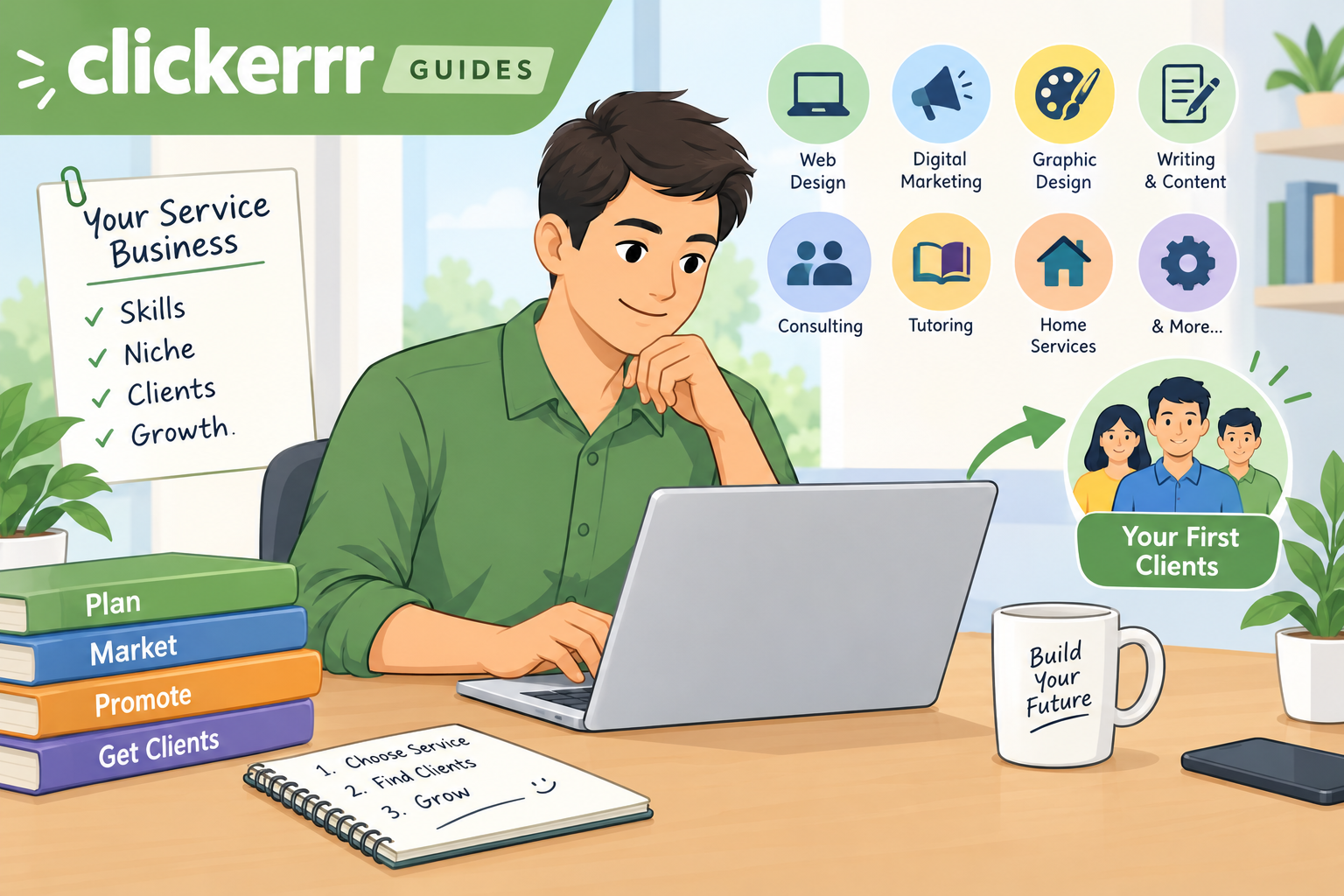
How to Start a Service-Based Business
Follow practical steps to select a service, find your first clients, and build a sustainable business.
Read the Full Guide →
How to Write a Business Plan
Understand how to prepare a business plan, define your goals, and create a practical roadmap for your business.
Read the Full Guide →