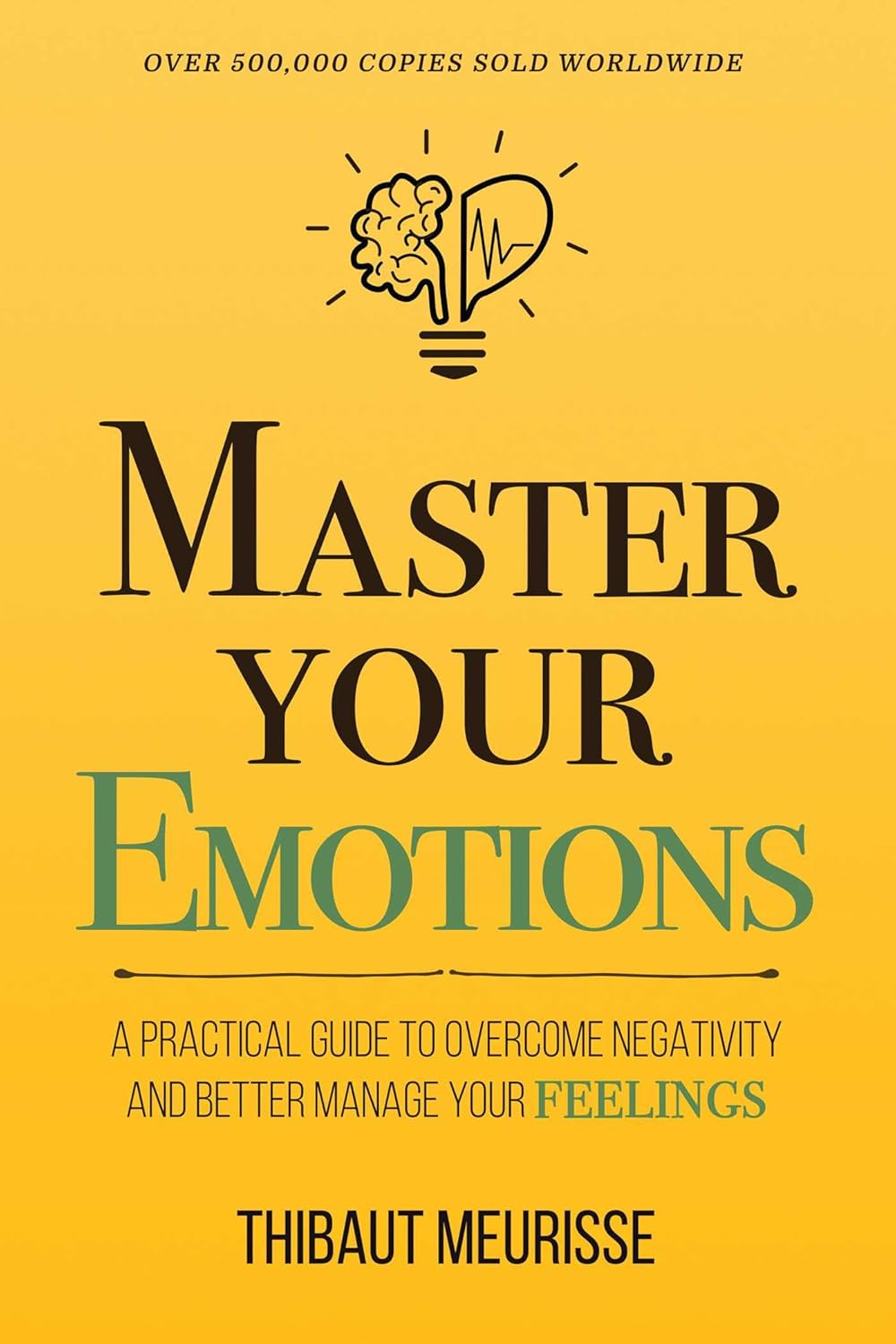
Master Your Emotions: A Practical Guide to Overcome Negativity and Better Manage Your Feelings is a self-help and personal-development book by French author Thibaut Meurisse. The book examines the relationship between thoughts, emotions, habits, physical states, attention, and personal interpretation, and presents practical techniques intended to help readers respond more effectively to difficult emotional states.
First published independently in 2018, the book became one of Meurisse’s best-known works and subsequently appeared in multiple editions and formats. A substantially revised and expanded edition was published by Authors Equity in June 2026 and distributed by Simon & Schuster. The 2026 edition is 256 pages and carries ISBN 9798893312010. The publisher describes it as a revised and expanded version and states that more than 500,000 people have trusted the book.
The book belongs to Meurisse’s broader Mastery Series and is aimed primarily at general readers interested in emotional self-management, personal growth, negative thinking, self-awareness, and psychological well-being.
Rather than presenting emotions as enemies that must simply be eliminated, the book’s central approach is to understand what produces emotional reactions and then change the factors that can reasonably be changed.
At its heart is a deceptively simple question:
If you cannot always choose what you feel, can you learn to influence what happens next?
Bibliographic information
| Field | Details |
|---|---|
| Title | Master Your Emotions |
| Full title | Master Your Emotions: A Practical Guide to Overcome Negativity and Better Manage Your Feelings |
| Author | Thibaut Meurisse |
| Series | Mastery Series |
| Genre | Self-help, personal development, popular psychology |
| Subject | Emotions, negative thinking, self-awareness, emotional regulation |
| Original publication | 2018 |
| Original publisher | Independently Published |
| Original ISBN | 9781981089154 |
| Original edition length | 254 pages |
| Revised edition | 2026 |
| Revised publisher | Authors Equity |
| Distributor | Simon & Schuster |
| 2026 ISBN | 9798893312010 |
| 2026 edition length | 256 pages |
| Language | English |
The 2018 edition is listed by Google Books as an independently published 254-page work with ISBN 9781981089154. The 2026 revised edition has different publishing information and should therefore be distinguished from the original edition rather than treating all bibliographic records as describing exactly the same physical book.
Author
Thibaut Meurisse
Thibaut Meurisse is a personal-development author whose work focuses on emotions, motivation, productivity, mindset, and related aspects of self-improvement.
According to his official biography, Meurisse became interested in personal development more than a decade ago, started a blog in 2014, and published his first book in 2015. He describes his writing philosophy as emphasizing books that are easy to read, practical, inspirational, and relatable, and notes that many of his books include action guides.
Meurisse states that his books have been translated into more than 30 languages and that Master Your Emotions has sold more than 500,000 copies. These figures are author/publisher claims rather than independently audited sales statistics.
His work is notable for translating broad personal-development concepts into short exercises and behavioral suggestions rather than presenting them as academic theory.
Publication history
Original edition
Master Your Emotions was first published in 2018. Google Books identifies the original edition as independently published on May 16, 2018, with 254 pages and ISBN 9781981089154.
The original edition promoted several practical components, including:
- 31 coping strategies;
- techniques for changing one’s relationship with emotions;
- exercises for dealing with negative feelings;
- a framework for changing habitual thought patterns; and
- a downloadable workbook.
The original book was marketed primarily as a practical guide rather than an academic examination of emotion science.
Revised and expanded edition
In June 2026, Authors Equity released a revised and expanded edition distributed by Simon & Schuster.
The publisher describes the new edition as an updated version of a guide that had already reached more than 500,000 readers. It identifies eight key factors that affect emotions, an approach for improving mood and changing mental patterns, and 27 strategies for managing emotions.
The difference in the number of strategies between editions illustrates why readers should identify which edition they are using when discussing the book.
Premise
The fundamental premise of Master Your Emotions is that emotional experience is influenced by more than external events.
A simplified version of the book’s model is:
                 EVENT
                   │
                   ▼
              INTERPRETATION
                   │
                   ▼
                 THOUGHT
                   │
                   ▼
                EMOTION
                   │
                   ▼
                 ACTION
                   │
                   ▼
                RESULT
The model does not mean that people can simply “think themselves” out of every difficult emotional experience.
Rather, it suggests that interpretation, attention, physical state, habits, and behavioral responses can sometimes influence emotional experience.
This is one of the book’s defining characteristics: it moves the reader’s attention from the question
“Why do I feel this way?”
toward the additional question
“What factors are influencing the way I feel, and which of them can I change?”
Understanding emotions
Meurisse treats emotions as meaningful experiences rather than random disturbances.
Emotions can influence:
- attention;
- decision-making;
- behavior;
- relationships;
- motivation;
- memory;
- perception;
- communication; and
- physical state.
The book’s practical orientation encourages readers to become observers of their own emotional patterns.
Instead of immediately reacting to an emotion, the reader is encouraged to examine it.
The emotional observation process
       FEELING
          │
          ▼
   "What am I feeling?"
          │
          ▼
   "What triggered it?"
          │
          ▼
 "What am I telling myself?"
          │
          ▼
 "What can I influence?"
          │
          ▼
   CHOOSE RESPONSE
This distinction between emotion and response is central to the book.
The survival mechanism
One of the themes discussed in the book is the role of the brain’s survival-oriented tendencies.
Humans evolved to detect threats, uncertainty, social rejection, and potential danger.
Consequently, attention can become disproportionately focused on negative information.
The practical model presented by the book can be represented as:
POTENTIAL THREAT
       │
       ▼
HEIGHTENED ATTENTION
       │
       ▼
NEGATIVE INTERPRETATION
       │
       ▼
NEGATIVE EMOTION
       │
       ▼
MORE THREAT MONITORING
       │
       └───────────────┐
                       ▼
                  NEGATIVITY LOOP
The important insight is not that the survival system is “bad.”
It exists for a reason.
The problem arises when mechanisms designed to protect an individual from danger remain activated in situations that do not require the same level of threat response.
The ego
Another major concept in Master Your Emotions is the ego.
Meurisse uses the term largely in a popular self-development sense: the part of psychological functioning concerned with identity, self-image, comparison, validation, control, and protection from perceived threats.
The book connects ego-related thinking with experiences such as:
- insecurity;
- resentment;
- comparison;
- defensiveness;
- fear of judgment;
- the need for approval;
- attachment to past events; and
- excessive concern about status.
The book’s practical recommendation is not necessarily to “destroy” the ego.
Instead, the reader is encouraged to notice when self-image has become the hidden driver of an emotional reaction.
The nature of emotions
The book attempts to make emotions more understandable by examining their origins and consequences.
A useful conceptual distinction is:
| Experience | Possible question |
|---|---|
| Anger | What boundary or expectation feels violated? |
| Fear | What threat am I anticipating? |
| Jealousy | What comparison or perceived loss is involved? |
| Sadness | What loss, disappointment, or unmet need is present? |
| Guilt | What action conflicts with my values? |
| Shame | What does this experience seem to say about my identity? |
| Anxiety | What uncertain future outcome am I mentally rehearsing? |
These interpretations should not be regarded as universal diagnostic definitions. The same emotion can arise from very different circumstances.
The value of the framework is that it encourages curiosity instead of immediate reaction.
Eight factors affecting emotions
The revised edition explicitly identifies eight key factors that impact emotions.
Across the book’s framework, these factors can be understood broadly as involving:
- thoughts and interpretations;
- physical state;
- sleep;
- environment;
- habits;
- attention;
- language and self-talk; and
- behavioral responses.
These factors interact rather than operating independently.
Emotional system
                    EMOTIONAL STATE
                          │
        ┌─────────────────┼─────────────────┐
        │                 │                 │
        ▼                 ▼                 ▼
     THOUGHTS           BODY             ENVIRONMENT
        │                 │                 │
        ▼                 ▼                 ▼
    SELF-TALK           SLEEP             PEOPLE
        │                 │                 │
        └─────────────────┼─────────────────┘
                          ▼
                       RESPONSE
This is one of the book’s most practical ideas: emotional management is not necessarily one giant psychological problem. It can be approached through several smaller levers.
Sleep and emotional well-being
Sleep receives particular attention because physical condition can affect mood, concentration, impulse control, and emotional reactivity.
The basic relationship can be visualized as:
POOR SLEEP
    │
    ├──► Reduced concentration
    │
    ├──► Increased irritability
    │
    ├──► Reduced emotional resilience
    │
    └──► Greater difficulty regulating reactions
Conversely, adequate sleep can provide a more stable physiological foundation from which to handle emotional challenges.
This is an important feature of the book because it prevents emotional well-being from being treated as purely a matter of positive thinking.
Using the body to influence emotions
Meurisse also emphasizes physical behavior.
Mood can be affected by factors such as:
- physical activity;
- posture;
- breathing;
- sleep;
- food;
- exposure to one’s surroundings; and
- general physical state.
The principle can be summarized as:
BODY
 │
 ▼
PHYSIOLOGICAL STATE
 │
 ▼
ATTENTION + AROUSAL
 │
 ▼
EMOTIONAL EXPERIENCE
The relationship is bidirectional.
Emotions affect the body, but bodily states can also influence emotional experience.
Thoughts and emotional interpretation
One of the book’s most important themes is the relationship between thoughts and emotions.
An event does not always produce an identical emotional response in every person.
Consider the statement:
“My colleague did not reply to my message.”
One person may think:
“They must be angry with me.”
Another may think:
“They are probably busy.”
The external event is identical.
The interpretation is different.
Consequently, the emotional response may also be different.
Interpretation model
SAME EVENT
     │
     ├──────────────┐
     ▼              ▼
INTERPRETATION A   INTERPRETATION B
     │              │
     ▼              ▼
ANGER / ANXIETY    NEUTRALITY
This idea is closely related to established psychological approaches emphasizing cognitive appraisal and the interpretation of events.
Negative thought patterns
The book encourages readers to identify recurring patterns of negative thinking.
Examples include:
- catastrophizing;
- excessive comparison;
- overgeneralization;
- dwelling on the past;
- anticipating rejection;
- mind-reading;
- self-criticism;
- all-or-nothing thinking; and
- repeatedly imagining negative outcomes.
The objective is not to replace every negative thought with an artificially positive thought.
Instead, the reader is encouraged to examine whether the thought is:
accurate, useful, controllable, and proportionate to the situation.
The negativity loop
The book’s ideas can be represented through a common cycle:
NEGATIVE EVENT
      ↓
NEGATIVE INTERPRETATION
      ↓
NEGATIVE EMOTION
      ↓
NEGATIVE BEHAVIOR
      ↓
NEGATIVE CONSEQUENCE
      ↓
"SEE, I WAS RIGHT"
      ↓
STRONGER NEGATIVE BELIEF
      ↓
REPEAT
Breaking the cycle at any point can potentially change the trajectory.
For example:
EVENT
 ↓
PAUSE
 ↓
QUESTION INTERPRETATION
 ↓
CHOOSE RESPONSE
 ↓
DIFFERENT BEHAVIOR
 ↓
DIFFERENT OUTCOME
Using words to influence emotions
Language is another tool discussed by Meurisse.
The way people describe their experiences can reinforce particular emotional states.
Compare:
“Everything is going wrong.”
with:
“Several things have gone wrong this week, and I need to decide what I can address first.”
The second statement does not deny the difficulty.
It makes the problem more specific.
Specific problems are generally easier to act upon than global conclusions.
Emotional responsibility
A recurring implication of the book is that emotional responsibility differs from emotional blame.
Emotional responsibility means asking:
“What can I do with this emotion?”
It does not necessarily mean:
“I caused this emotion.”
This distinction matters because people encounter circumstances over which they have little or no control.
The book’s approach is primarily concerned with the portion of the emotional process that remains open to influence.
Control versus acceptance
One of the most important ideas in the book is the distinction between things a person can control and things they cannot.
              MY LIFE
                 │
       ┌─────────┴─────────┐
       ▼                   ▼
   CAN INFLUENCE       CANNOT CONTROL
       │                   │
       ▼                   ▼
 My actions             Other people
 My habits              The past
 My attention           Random events
 My words               Others' opinions
 My response            External outcomes
       │                   │
       └─────────┬─────────┘
                 ▼
          ACCEPT REALITY
          ACT WHERE POSSIBLE
Trying to control uncontrollable events can become a major source of emotional exhaustion.
Acceptance does not necessarily mean approval.
It means recognizing reality as it currently exists before deciding what to do next.
Emotional control versus emotional suppression
The word “master” in the title can easily be misunderstood.
Emotional mastery does not necessarily mean eliminating unpleasant feelings.
Suppressing an emotion is different from understanding it.
SUPPRESSION
Emotion
   ↓
"Don't feel this."
   ↓
Avoidance
   ↓
Emotion remains unresolved


REGULATION
Emotion
   ↓
Notice
   ↓
Understand
   ↓
Accept
   ↓
Choose response
This distinction is particularly important when discussing mental health.
A difficult emotion is not automatically a malfunction.
Sadness, anger, fear, grief, and frustration can all provide information.
The challenge is learning when an emotion is useful information and when a habitual response is making the situation worse.
Emotional habits
Meurisse treats emotional patterns partly as habits.
A person can become accustomed to:
- worrying;
- complaining;
- comparing;
- replaying past arguments;
- anticipating failure;
- seeking reassurance;
- criticizing themselves; or
- reacting immediately.
Repeated emotional responses can become increasingly familiar.
The proposed alternative is to create different patterns through repetition.
Emotional habit transformation
OLD TRIGGER
    ↓
OLD THOUGHT
    ↓
OLD EMOTION
    ↓
OLD RESPONSE
    ↓
OLD RESULT


NEW RESPONSE
    ↓
REPEATED
    ↓
PRACTICED
    ↓
MORE FAMILIAR
The book therefore treats emotional improvement as a process rather than a single breakthrough.
Visualization
Visualization is presented as another method for influencing one’s emotional state.
The underlying idea is that mental imagery can influence anticipation, attention, and emotional preparation.
A simplified process is:
MENTAL IMAGE
     ↓
EMOTIONAL EXPECTATION
     ↓
ATTENTION
     ↓
BEHAVIOR
     ↓
EXPERIENCE
Visualization should not be confused with a guarantee that imagining an outcome will cause it to occur.
Its practical value lies more plausibly in helping people rehearse desired responses and direct attention toward particular possibilities.
Journaling and self-reflection
The book’s practical orientation includes exercises and reflective prompts.
Journaling can help convert an emotional experience from something vague into something observable.
A simple journal framework might ask:
- What happened?
- What did I feel?
- What did I think?
- What did I assume?
- What was actually under my control?
- What was not under my control?
- What response did I choose?
- What would I do differently next time?
This turns an emotional experience into information.
Emotional intelligence
Although Master Your Emotions is not an academic textbook on emotional intelligence, many of its themes overlap with the broader concept.
Emotional intelligence commonly involves abilities related to:
- recognizing emotions;
- understanding emotional information;
- regulating responses;
- communicating effectively; and
- navigating interpersonal situations.
Meurisse approaches these issues from a self-help perspective.
Emotional intelligence cycle
NOTICE
  ↓
NAME
  ↓
UNDERSTAND
  ↓
REGULATE
  ↓
RESPOND
  ↓
LEARN
This cycle encourages people to become participants in their emotional lives rather than passive observers.
Negative emotions as information
One of the book’s more constructive ideas is that negative emotions can be used as information.
For example:
| Emotion | Possible information |
|---|---|
| Anger | A perceived boundary violation |
| Fear | A perceived threat |
| Jealousy | A comparison or insecurity |
| Sadness | Loss or disappointment |
| Frustration | An obstacle or unmet expectation |
| Guilt | Conflict with personal values |
| Anxiety | Perceived uncertainty or lack of control |
These are possible interpretations, not diagnostic rules.
The same emotion can have multiple causes.
The useful question is:
“What might this emotion be telling me?”
rather than:
“How do I get rid of this emotion immediately?”
The emotional feedback loop
The book can be understood through a larger feedback model:
                    ┌──────────────┐
                    │   EVENT      │
                    └──────┬───────┘
                           ↓
                    ┌──────────────┐
                    │ INTERPRETATION│
                    └──────┬───────┘
                           ↓
                    ┌──────────────┐
                    │   EMOTION    │
                    └──────┬───────┘
                           ↓
                    ┌──────────────┐
                    │   BEHAVIOR   │
                    └──────┬───────┘
                           ↓
                    ┌──────────────┐
                    │ CONSEQUENCE  │
                    └──────┬───────┘
                           │
                           └──────► reinforces future interpretation
This explains why emotional habits can become self-reinforcing.
Practical framework
The ideas in Master Your Emotions can be condensed into a seven-stage process.
1. Notice
Become aware that an emotional reaction is occurring.
2. Name
Give the feeling a reasonably precise name.
3. Identify the trigger
Determine what happened immediately before the emotional response.
4. Examine the interpretation
Ask what story the mind created around the event.
5. Separate control from non-control
Identify which aspects can actually be influenced.
6. Choose a response
Act deliberately rather than automatically.
7. Repeat
Practice the new response until it becomes increasingly familiar.
The seven-step model
NOTICE
  ↓
NAME
  ↓
TRIGGER
  ↓
INTERPRET
  ↓
CONTROL
  ↓
RESPOND
  ↓
REPEAT
This is perhaps the clearest way to understand the practical philosophy of the book.
Example: criticism
Suppose someone receives harsh criticism at work.
Automatic response
Criticism
   ↓
"I am incompetent."
   ↓
Shame
   ↓
Defensiveness
   ↓
Argument
   ↓
Relationship deteriorates
Reflective response
Criticism
   ↓
Pause
   ↓
"What exactly was criticized?"
   ↓
Separate useful information from insult
   ↓
Identify what can be improved
   ↓
Respond calmly
   ↓
Learn
The second response does not require pretending that criticism feels good.
It simply introduces a space between emotion and action.
Example: resentment
Resentment often involves repeatedly replaying an event after it has already occurred.
The cycle may look like:
PAST EVENT
    ↓
MENTAL REPLAY
    ↓
ANGER
    ↓
MORE REPLAY
    ↓
MORE ANGER
    ↓
EMOTIONAL EXHAUSTION
The book’s philosophy suggests asking:
- Can the event be changed?
- Can the relationship be repaired?
- Is a boundary necessary?
- Is an apology required?
- Is action possible?
- If nothing can be changed, what would acceptance look like?
This reframes resentment from an emotion that must simply be “removed” into a situation that may require understanding, action, boundaries, or acceptance.
Example: anxiety
Anxiety frequently involves mentally rehearsing possible future problems.
A useful conceptual distinction is:
POSSIBLE FUTURE
      ↓
"Something might go wrong."
      ↓
MENTAL SIMULATION
      ↓
ANXIETY
The practical response is not always positive thinking.
It can be:
What exactly am I afraid of?
             ↓
Can I prevent it?
      ┌──────┴──────┐
     YES            NO
      │              │
      ▼              ▼
Make a plan       Accept uncertainty
      │              │
      └──────┬───────┘
             ▼
          ACT / ACCEPT
This is one of the most transferable ideas in the book.
What the book means by “mastery”
The title does not need to be interpreted as a promise of permanent emotional control.
Human beings continue to experience:
- anger;
- grief;
- fear;
- disappointment;
- loneliness;
- jealousy;
- frustration;
- uncertainty; and
- sadness.
Emotional mastery is therefore better understood as improved awareness and response.
A mature emotional response might be:
“I am angry, and I can decide what I do with that anger.”
rather than:
“I must never feel angry.”
This distinction gives the book a more useful interpretation.
Scientific perspective
Master Your Emotions should primarily be classified as popular self-help and personal development, rather than an academic psychology text.
Many of its themes overlap with established psychological concepts, including:
- cognitive appraisal;
- behavioral conditioning;
- self-regulation;
- attention;
- stress;
- sleep and mood;
- habit formation;
- cognitive distortions;
- mindfulness; and
- emotional intelligence.
However, readers should distinguish between an idea appearing in psychological literature and the particular simplified formulation presented in a self-help book.
Human emotion is highly complex.
There is no universal technique capable of eliminating negative emotions, and emotional difficulties can sometimes arise from trauma, psychiatric conditions, neurological factors, medical conditions, interpersonal circumstances, or severe environmental stress.
For persistent or severe psychological symptoms, professional assessment may be more appropriate than relying on a self-help framework alone.
Reception
Master Your Emotions has developed a substantial international readership.
Goodreads currently lists the book at approximately 4.12/5 from more than 19,000 ratings and more than 1,200 reviews, although ratings naturally change over time.
Reader reactions are mixed in detail.
Positive reviews frequently emphasize:
- practical exercises;
- accessibility;
- simplicity;
- usefulness for readers beginning personal-development work;
- journaling prompts; and
- the book’s focus on actionable strategies.
Some critical reviews argue that the book simplifies psychological concepts, repeats familiar self-help ideas, or does not provide enough scientific depth or references. Such criticism is particularly relevant when the book is evaluated as psychology rather than as introductory personal-development literature.
This distinction is important.
A book can be useful as a practical introduction without being a comprehensive account of the scientific literature.
Strengths
Accessibility
Meurisse writes for ordinary readers rather than specialists.
Practicality
The book emphasizes exercises and behavioral applications.
Broad coverage
It connects thoughts, body, sleep, environment, habits, language, and emotional responses.
Action orientation
The book consistently encourages readers to move from intellectual understanding toward behavioral experimentation.
Self-observation
Its emphasis on identifying emotional patterns can encourage greater self-awareness.
Limitations
Simplification
Complex psychological processes are sometimes presented through relatively simple models.
Scientific depth
The book is not designed to function as a systematic academic review.
Risk of over-responsibility
Readers could misunderstand emotional-management advice as suggesting that people are entirely responsible for how they feel, despite the influence of circumstances and biology.
“Mastery” can be misunderstood
No realistic emotional framework eliminates difficult emotions completely.
Individual differences
A strategy that helps one person may not help another.
Mental-health boundaries
Self-help techniques should not automatically be treated as substitutes for professional care when significant psychological symptoms are present.
The book’s practical philosophy
The philosophy of Master Your Emotions can be summarized in one sentence:
You may not control every emotion that appears, but you can become more skillful at understanding its source, questioning the thoughts surrounding it, and choosing what to do next.
That distinction changes the entire meaning of emotional mastery.
Consider two statements:
“I cannot control my emotions.”
and
“I cannot always control what I initially feel, but I can influence how I understand and respond to it.”
The second statement captures the practical direction of the book.
Infographic: The emotional transformation cycle
              ┌───────────────────┐
              │      TRIGGER      │
              └─────────┬─────────┘
                        ↓
              ┌───────────────────┐
              │    INTERPRETATION │
              └─────────┬─────────┘
                        ↓
              ┌───────────────────┐
              │      EMOTION      │
              └─────────┬─────────┘
                        ↓
              ┌───────────────────┐
              │      PAUSE        │
              └─────────┬─────────┘
                        ↓
              ┌───────────────────┐
              │     REFRAME       │
              └─────────┬─────────┘
                        ↓
              ┌───────────────────┐
              │     RESPONSE      │
              └─────────┬─────────┘
                        ↓
              ┌───────────────────┐
              │     OUTCOME       │
              └─────────┬─────────┘
                        │
                        └────► LEARNING
Infographic: Eight emotional levers
                    EMOTIONAL STATE
                           │
       ┌───────────────────┼───────────────────┐
       │                   │                   │
       ▼                   ▼                   ▼
    THOUGHTS              BODY             SLEEP
       │                   │                   │
       ▼                   ▼                   ▼
  SELF-TALK            MOVEMENT          RECOVERY
       │                   │                   │
       └───────────────────┼───────────────────┘
                           │
             ┌─────────────┴─────────────┐
             ▼                           ▼
        ENVIRONMENT                  HABITS
             │                           │
             └─────────────┬─────────────┘
                           ▼
                       RESPONSE
                           │
                           ▼
                     EMOTIONAL
                      PATTERN
The exact categorization of factors varies between formulations of the book, particularly between the original and revised editions.
Infographic: What can I control?
             ┌───────────────────────┐
             │       SITUATION       │
             └───────────┬───────────┘
                         │
             ┌───────────┴───────────┐
             ▼                       ▼
       WITHIN INFLUENCE         OUTSIDE CONTROL
             │                       │
             ▼                       ▼
          ACTION                   ACCEPT
             │                       │
             ▼                       │
          CHOICE                    │
             │                       │
             └───────────┬───────────┘
                         ▼
                   BETTER RESPONSE
This framework is particularly useful when an individual is spending large amounts of mental energy attempting to change something fundamentally outside their control.
Infographic: From emotional reaction to emotional intelligence
REACTION
   │
   ▼
AWARENESS
   │
   ▼
UNDERSTANDING
   │
   ▼
SELF-REGULATION
   │
   ▼
DELIBERATE RESPONSE
   │
   ▼
BETTER OUTCOME
   │
   ▼
LEARNING
   │
   └──────────────► GREATER AWARENESS
The process is cyclical rather than linear.
Key ideas at a glance
| Concept | Main idea |
|---|---|
| Emotions | Emotional experiences contain information and influence behavior |
| Thoughts | Interpretation can influence emotional response |
| Survival mechanism | Threat detection can contribute to negativity and reactivity |
| Ego | Self-image and perceived threats can influence emotional patterns |
| Sleep | Physical recovery can affect mood and emotional resilience |
| Body | Physical states can influence emotional experience |
| Self-talk | Language can reinforce or modify interpretations |
| Habits | Repeated responses can become familiar emotional patterns |
| Environment | External surroundings can affect emotional states |
| Acceptance | Not everything can be controlled or changed |
| Visualization | Mental imagery can influence attention and anticipation |
| Journaling | Reflection can make emotional patterns more observable |
| Reframing | Alternative interpretations can sometimes produce different responses |
| Emotional mastery | Greater awareness and deliberate response rather than total emotional control |
Relationship to other self-help literature
Master Your Emotions sits within a large body of modern self-development literature dealing with emotional regulation, habits, mindfulness, productivity, and mindset.
Its closest conceptual neighbors include works dealing with:
- emotional intelligence;
- cognitive behavioral approaches;
- mindfulness;
- habit formation;
- positive psychology;
- self-regulation;
- resilience;
- motivation; and
- personal effectiveness.
Unlike academic books in these fields, however, Meurisse’s work is deliberately written for a general audience and focuses heavily on practical application.
See also
- Emotional intelligence
- Emotion regulation
- Self-regulation
- Cognitive appraisal
- Cognitive behavioral therapy
- Cognitive distortion
- Mindfulness
- Meditation
- Stress management
- Resilience
- Habit formation
- Self-help
- Positive psychology
- Personal development
- The Power of Now
- Atomic Habits
- Mindset
- The 7 Habits of Highly Effective People
References
- Meurisse, Thibaut. Master Your Emotions: A Practical Guide to Overcome Negativity and Better Manage Your Feelings. Independently Published, 2018. ISBN 9781981089154.
- Meurisse, Thibaut. Master Your Emotions: A Practical Guide to Overcome Negativity and Better Manage Your Feelings (Mastery Series). Authors Equity, 2026. ISBN 9798893312010.
- Simon & Schuster. Master Your Emotions — official publisher page for the 2026 revised and expanded edition.
- Google Books. Master Your Emotions — bibliographic record for the 2018 edition.
- Goodreads. Master Your Emotions — reader ratings, reviews, and edition information.
- Meurisse, Thibaut. “About Me.” Official author website.
- Damasio, Antonio. Descartes’ Error: Emotion, Reason, and the Human Brain. Putnam, 1994.
- Gross, James J. Research on emotion regulation and psychological processes involved in regulating emotional responses.
- Lazarus, Richard S. Emotion and Adaptation. Oxford University Press, 1991.
- Kahneman, Daniel. Thinking, Fast and Slow. Farrar, Straus and Giroux, 2011.
- Beck, Aaron T. Cognitive Therapy and the Emotional Disorders. International Universities Press, 1976.
Further reading
Readers interested in the subjects explored in Master Your Emotions may wish to investigate the following areas:
Emotion regulation
Research into how people influence the intensity, duration, expression, and interpretation of emotional responses.
Cognitive appraisal
Research examining how interpretation of an event contributes to emotional experience.
Cognitive behavioral therapy
A structured psychological approach examining relationships between thoughts, emotions, and behavior.
Mindfulness
Research concerning attention, awareness, acceptance, and the observation of internal experiences.
Habit formation
Research into how repeated behaviors become associated with particular cues and contexts.
Sleep and mood
Research examining the relationship between sleep, cognition, emotional regulation, and psychological well-being.
Emotional intelligence
Literature concerning the recognition, understanding, regulation, and use of emotional information.
External links
- Official author website: Thibaut Meurisse
- Official publisher page: Master Your Emotions, Authors Equity / Simon & Schuster
- Google Books: Master Your Emotions
- Goodreads: Master Your Emotions
- Library and ISBN catalogues: edition-specific bibliographic information
Conclusion
Master Your Emotions is ultimately a book about creating space between what happens and what we do about it.
Something happens.
A thought appears.
An emotion follows.
The instinct is to react.
Meurisse asks the reader to insert one additional step:
pause.
That pause is where the book places much of its practical philosophy.
The objective is not to become a person who never feels anger, fear, sadness, jealousy, frustration, or anxiety. Such a person would not be human.
The more realistic objective is to become better at recognizing emotional patterns, understanding their possible causes, separating controllable factors from uncontrollable ones, and choosing responses deliberately.
In that sense, the title Master Your Emotions is best understood not as a promise of absolute control but as an invitation to develop emotional skill.
The book’s most enduring idea can therefore be expressed as a simple sequence:
FEEL
  ↓
NOTICE
  ↓
UNDERSTAND
  ↓
CHOOSE
  ↓
ACT
  ↓
LEARN
  ↓
REPEAT
Emotional maturity is not the absence of difficult feelings.
It is the growing ability to meet those feelings without automatically becoming their prisoner.